Bedroom

12 Best Footboard of 2026: The Solid Wood Boards That Quietly Transform Your Home Office

Which footboards offer lasting calf relief without sliding, splintering, or snapping—perfect for standing-desk workers and home rehab.

Too many footboards fail the most basic furniture test: they can't sit in a room for a month without creaking, peeling, or collapsing under daily use. A board that promises plantar fasciitis relief but snaps its hinge after two weeks of squats isn't a tool—it's a liability. The core issue is that nearly every cheap wooden model uses soft wood and short screws that pull free as soon as body weight shifts dynamically.

When you buy a footboard, you're effectively adding a permanent piece of furniture to your home office or living room. The good ones feel as stable as a well-built footstool, stay planted on hardwood floors, and look intentional rather than like a forgotten gym prop. They pair five distinct inclines with sealed hardwood that resists warping, so the board becomes a quiet part of your morning routine instead of an eyesore you hide when company comes over.

#1

Best Overall

StrongTek 16" Slant Board

StrongTek 16" Slant Board

9.5/10 Exceptional
  • Surface Grip: Anti-slip grip tape
  • Material & Build Quality: Lauan hardwood plywood
  • Portability & Foldability: Side handles, 8.97 lbs, non-folding
  • Weight Capacity & Stability: 450 lbs (user verified)
Check Price on Amazon

Pros

  • Sturdy lauan hardwood build supports up to 450 lbs with zero flex or wobble. — 502 mentions, 99% positive
  • Five precise incline positions effectively target calves, Achilles, and ankles. — 204 mentions, 100% positive
  • Wide platform stays rock-steady during two-footed squats and mobility work. — 130 mentions, 96% positive

Cons

No notable drawbacks to flag.

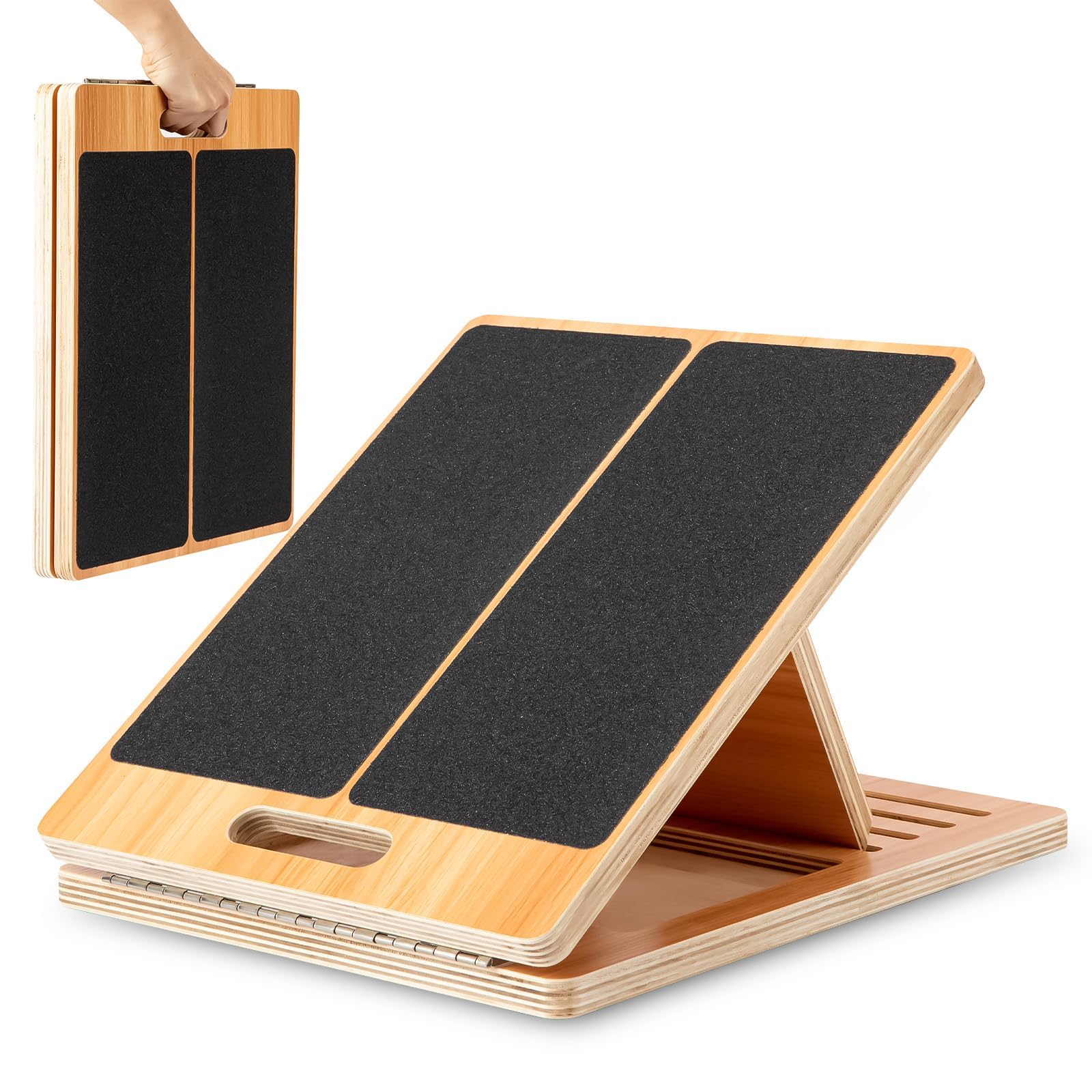
The StrongTek slant board’s 16-inch lauan hardwood platform stays rock-steady under full-body weight, handling up to 450 pounds without flex or wobble. Five clearly detented incline positions—from 15° for gentle stretches to 35° for demanding calf work—let users progress steadily. The wide surface accommodates both feet side by side during squats, and the anti-slip tread locks shoes in place, even during dynamic ankle mobility drills. This board functions as a durable anchor for daily rehab and strength work, not a flimsy accessory that shifts on hard floors.

Home gym owners and those managing plantar fasciitis or Achilles tightness will value its tank-like build and smooth adjustability over years of use. The side handles make it easy to tuck against a wall, but it’s not a grab-and-go travel board; at nearly 9 pounds, it’s meant to stay where you train. Over extended heavy sessions, the grip tape surface may begin to peel or wear—a tradeoff for a board that otherwise outlasts cheaper alternatives. If you prioritize longevity under demanding daily use and can overlook that single maintenance point, this is the board for your therapy corner.

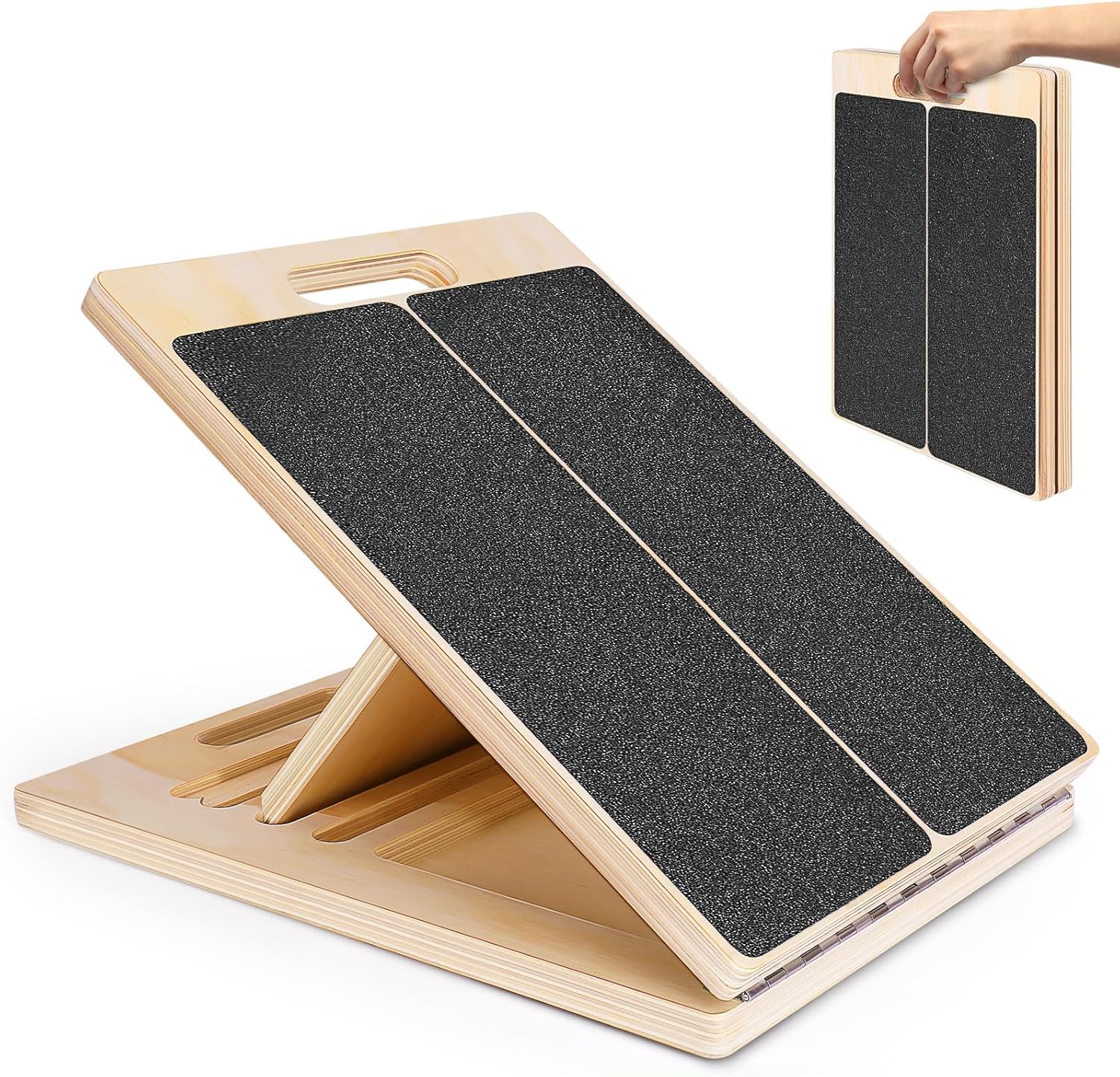
Bottom Line: For a heavy-duty, long-term stretching tool that won’t shift or crack, the StrongTek is the reference standard in this price tier—just plan on replacing the grip surface down the road.
#2

Best Value Wooden Board

MUCITAGF Slant Board

MUCITAGF Slant Board

9.4/10 Outstanding
  • Surface Grip: Non-slip grip tape
  • Material & Build Quality: Natural hardwood
  • Portability & Foldability: Assembled, 8.5 lbs, non-folding
  • Weight Capacity & Stability: 300+ lbs (user reported)
Check Price on Amazon

Pros

  • Sturdy hardwood construction that stays stable under heavy weight — 126 mentions, 99% positive
  • Effortless, precise five-angle adjustment for progressive stretching — 68 mentions, 100% positive
  • Costs less than comparable wood boards with the same adjustability — 38 mentions, 97% positive

Cons

  • Platform width can feel snug during wide two-footed squats — A few users note slight narrowness.
  • Does not fold, so it needs a dedicated spot on the floor

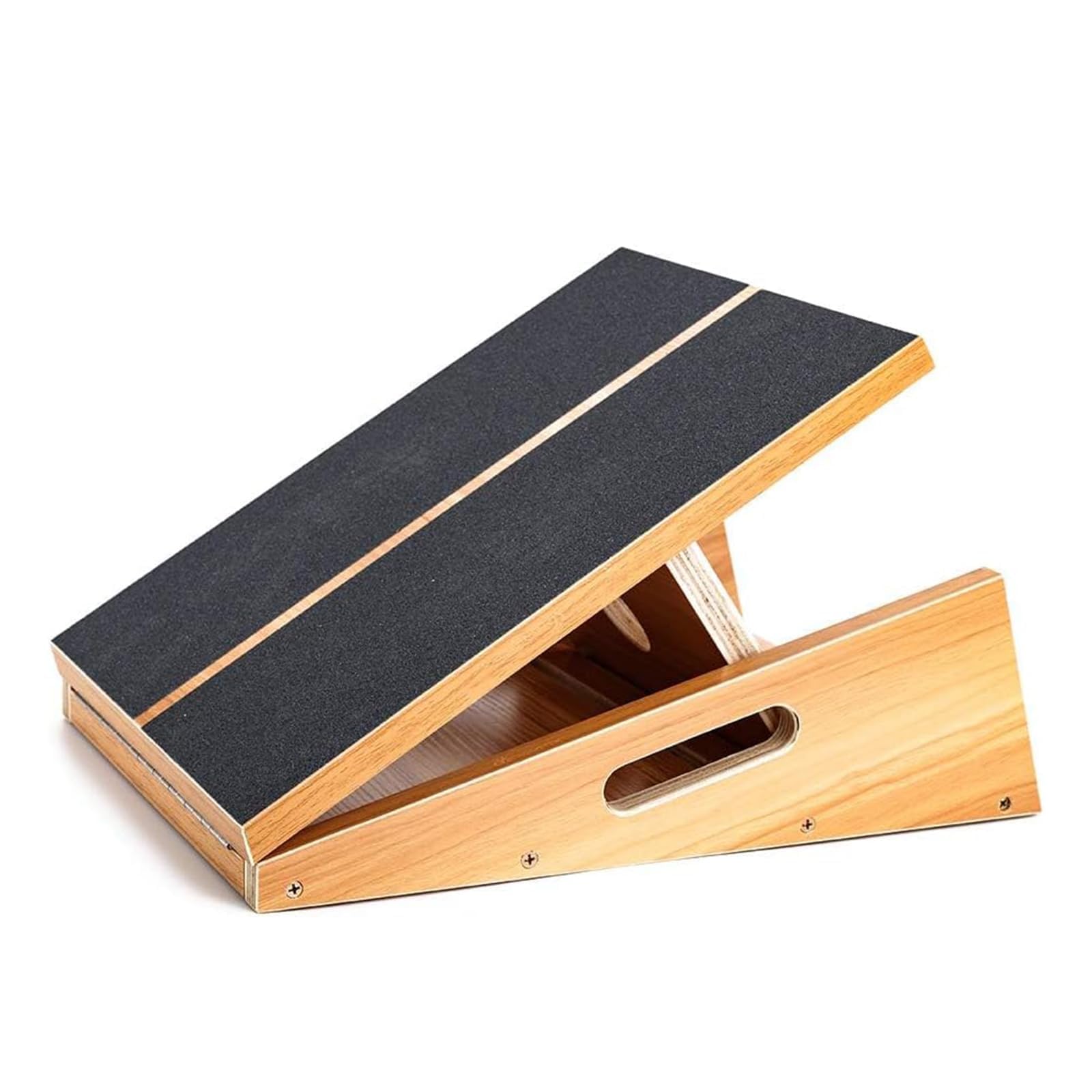
The MUCITAGF Slant Board mirrors the premium hardwood slant board's full 15°–35° range and solid construction without the higher price tag. Its five-position mechanism locks securely, and the board stays planted during dynamic calf and hamstring work — no sliding or flexing under heavy users.

It's a strong match for anyone rehabbing plantar fasciitis or Achilles tightness who wants a ready-to-use board that functions like permanent furniture. Quick angle changes make it easy to share between family members with different flexibility levels, and the natural wood finish blends into a living space without looking like gym clutter.

Bottom Line: If the top pick's price stretches your budget and you can work with a standard-width board that stays assembled, the MUCITAGF delivers the same stretching range and build quality for less.
#3

Best Portable Stretcher

NORBASE Slant Board

NORBASE Slant Board

9.0/10 Outstanding
  • Surface Grip: Anti-slip surface
  • Material & Build Quality: Wood
  • Portability & Foldability: Folds flat, 4.5 lbs, built-in handle
  • Weight Capacity & Stability: 150+ lbs (user reported)
Check Price on Amazon

Pros

  • Solid wood build resists flex during deep calf raises — 426 mentions, 95% positive
  • Stays planted on hard floors without sliding — 268 mentions, 93% positive
  • Four-incline adjustability supports varied stretches and squats — 190 mentions, 99% positive

Cons

No notable drawbacks to flag.

This NORBASE slant board folds flat, weighs just 4.5 lbs, and needs no assembly — you can grab it for squats, calf stretches, or standing desk relief right out of the box. Unlike some foldable boards that compromise hinge durability, the solid wood construction holds up to daily use without wobble. It's built for fitness enthusiasts who want immediate mobility throughout the day, not for rehab beginners who need a gentle starting incline. The lowest angle of 30° can strain very tight calves, so those recovering from injury should look for a board that starts at 15°.

Bottom Line: If your routine demands a board that disappears into a bag between meetings or sets, this foldable slant board earns its keep — just make sure your calves are already comfortable hitting 30° or above.
#4

Best Rocker Board for Balance & Core

Fitterfirst Professional Rocker Board – 20”

Fitterfirst Professional Rocker Board – 20”

9.4/10 Outstanding
  • Surface Grip: Non-slip coating
  • Material & Build Quality: Baltic birch plywood
  • Portability & Foldability: 7.5 lbs, not foldable
  • Weight Capacity & Stability: 350 lbs
Check Price on Amazon

Pros

  • Adjustable sphere placement lets you set tilt to 10°, 12°, or 15° for progressive instability — 44 mentions, 93% positive
  • Baltic birch plywood construction withstands heavy daily use without creaking — 129 mentions, 97% positive
  • Demands constant ankle, knee, and core engagement that slant boards do not — 134 mentions, 100% positive

Cons

No notable drawbacks to flag.

A 20-inch Baltic birch platform and adjustable spheres let you fine-tune instability from a gentle 10° tilt to a more demanding 15°. Unlike static slant boards that end at calf stretch, this rocker demands constant micro-adjustments from ankles, knees, and core — turning every stand into active balance training.

The steep learning curve makes this a better fit for athletes, physical therapy clinics, and seniors committed to progressive stability work than for casual calf stretchers. Complete beginners may find the 10° starting tilt still too challenging and abandon the board. Budget-conscious buyers will get more value from a fixed-angle slant board.

💡 💡 Tip: Start with the shallowest tilt setting on a carpeted surface and hold onto a wall until your ankles adapt.

Bottom Line: A worthwhile upgrade for anyone committed to daily balance work who finds fixed-angle boards too static — but overkill if all you need is a simple calf stretch.
#5

Best for Runners & Foot Strength

Mobo Board

Mobo Board

9.3/10 Outstanding
  • Surface Grip: Textured bamboo surface
  • Material & Build Quality: Bamboo
  • Portability & Foldability: 3.4 lbs, not foldable
  • Weight Capacity & Stability: 300 lbs
Check Price on Amazon

Pros

  • Significantly improves foot and ankle strength and balance — 44 mentions, 95% positive
  • Excellent bamboo build quality and innovative toe box design — 21 mentions, 95% positive

Cons

  • Rocker pieces can slide on slick floors unless used on a mat — 16 mentions, 31% negative — the board may shift unexpectedly on hardwood or tile

While the top pick delivers multiple incline angles for static calf stretching, the MOBO Board shifts focus to dynamic foot strengthening. Its bamboo platform and toe box technology force the arches and ankles to engage, building the small muscles that support better balance and stride efficiency.

Runners, athletes, and those in foot rehab will appreciate the targeted arch and ankle work this unique design demands. Budget-conscious buyers and anyone seeking a simple calf stretch should look elsewhere. The rocker pieces can shift on hardwood or tile, so pairing the board with a mat is essential for stable use.

💡 💡 Tip: Use on a yoga mat or carpet to prevent the rocker pieces from sliding during exercises.

Bottom Line: For runners and athletes who want intrinsic foot strength over static stretches, this premium board delivers a focused, science-backed workout — just plan to use it on carpet or a mat.
#6

Best Foam Wedge Set

NOONCRAZY Foam Wedges

NOONCRAZY Foam Wedges

9.0/10 Outstanding
  • Surface Grip: Smooth EPP foam
  • Material & Build Quality: EPP foam
  • Portability & Foldability: 1 lb, detachable, carry bag
  • Weight Capacity & Stability: 480 lbs
Check Price on Amazon

Pros

  • Effectively stretches calves when used with shoes — 100 mentions, 99% positive
  • Sturdy foam construction that holds its shape over time — 84 mentions, 96% positive
  • Stable on the floor during exercise despite the light build — 57 mentions, 95% positive

Cons

  • Foam surface can feel slick barefoot; shoes provide needed traction — 40 mentions, 43% negative — reports of lack of grip and recommendation to wear shoes

Unlike basic foam wedge sets, this one stacks to create five distinct angles, including a rehab-friendly 8.5° that’s far gentler than the fixed inclines on many budget boards. At just one pound, it’s easy to toss into a gym bag or suitcase.

Travelers, rehab beginners, and budget-conscious stretchers will appreciate the flexibility, but the foam surface can feel slick barefoot. Wearing shoes solves this entirely, though anyone who insists on barefoot grip or the heavy planted feel of a wooden board should look elsewhere.

💡 💡 Tip: Wear athletic shoes to eliminate slickness — the foam stays stable once your feet are locked in.

Bottom Line: When portability and a gentle starting incline matter more than the planted feel of wood, this foam set delivers surprisingly effective stretching for the price.
#7

Light Occasional Use

TEMI Slant Board

TEMI Slant Board

9.2/10 Outstanding
  • Surface Grip: Non-slip surface
  • Material & Build Quality: High-density wooden board
  • Portability & Foldability: 5 lbs, folds flat, handle
  • Weight Capacity & Stability: 500 lbs
Check Price on Amazon

Pros

  • Stable wood platform stays put during exercises — 84 mentions, 93% positive
  • Effective for calf stretching and ankle mobility routines — 70 mentions, 99% positive

Cons

  • Hinge screws can separate from the wood under repeated stress, shortening lifespan — 22 mentions, 41% negative

The TEMI Slant Board packs five angles and a 500-lb capacity into a fold-flat wood frame at a budget-friendly price. It feels stable for calf stretching and squats, and the 20° starting angle suits gentle rehab. The hinge screws can pull out of the wood with repeated flexing, making this a better fit for occasional use than daily heavy workouts.

Bottom Line: For casual stretching and light rehab work where the board won't be folded repeatedly, the TEMI delivers impressive adjustability and stability at a low price.
#8

Narrow Portable Rehab

StrongTek 13-inch Slant Board

StrongTek 13-inch Slant Board

9.2/10 Outstanding
  • Surface Grip: Non-slip surface
  • Material & Build Quality: High-density plywood
  • Portability & Foldability: 5.3 lbs, folds flat, handle
  • Weight Capacity & Stability: 350 lbs
Check Price on Amazon

Pros

  • High-density plywood construction resists creaks and flex during daily stretching. — 30 mentions, 100% positive
  • Stable, non-slip surface keeps the board planted firmly on hard floors. — 26 mentions, 96% positive

Cons

  • The 13-inch width gets tight for larger feet or wider stances; the full-size platform gives more room for squats.

Same 15°–35° range as the top pick in a fold-flat, 5.3-lb board. The 13-inch width suits travel and smaller feet, but it’s narrower than the flagship for two-footed work. Reasonably sturdy, it lacks the same long-term usage history as the top pick, so the full-size model remains the safer choice for heavy daily use.

Bottom Line: If portability and a smaller footprint matter more than maximal squat stability, this fold-flat board is a sensible pick for travel or rehab with a gentle 15° start.
#9

Standing Desk Balance

HAPOO Wobble Board

HAPOO Wobble Board

9.0/10 Outstanding
  • Surface Grip: Anti-slip pads
  • Material & Build Quality: Wood with anti-slip pads
  • Portability & Foldability: 3.9 lbs, no assembly
  • Weight Capacity & Stability: 350 lbs
Check Price on Amazon

Pros

  • Sturdy wood construction holds up to daily standing desk use. — 59 mentions, 97% positive
  • Gentle wobble engages core and improves balance for beginners. — 48 mentions, 96% positive

Cons

  • Fixed curvature offers a narrow movement plane that may feel too easy for experienced balance trainees. — 21 mentions, 19% negative — some find the board too easy and return it

The HAPOO wobble board's solid wood construction and non-slip surface make it a dependable desk companion for light balance work and ankle mobility drills. The fixed curvature does limit the challenge — advanced users looking for progressive balance training or a deep calf stretch will find it too tame.

Bottom Line: A sensible option for office workers or physical therapy patients seeking a low-intensity balance stimulus under a standing desk, but those needing a calf stretch or advanced challenge should look elsewhere.
#10

Ultra-Budget Squats

Grope Foam Wedges

Grope Foam Wedges

8.8/10 Excellent
  • Surface Grip: Smooth EPP foam
  • Material & Build Quality: EPP foam
  • Portability & Foldability: 1 lb, carry bag
  • Weight Capacity & Stability: 480 lbs
Check Price on Amazon

Pros

  • Effective for calf stretching and squat depth work — 30 mentions, 100% positive
  • Sturdy EPP foam handles bodyweight without compressing noticeably — 19 mentions, 89% positive

Cons

  • Foam surface can slide on hard floors when barefoot; wearing shoes resolves it — 12 mentions, 25% negative

This featherweight EPP foam set stacks into five angles, making calf stretches and squat work affordable and portable. The foam surface can slide on hard floors without shoes, so wearing trainers keeps things steady, but for anyone on a strict budget, it delivers the basics.

Bottom Line: For budget-focused gym-goers who wear shoes and accept the foam feel, this is the cheapest usable wedge set on the market.
#11

Multi-Mode Light Use

ODCPN 3-in-1 Board

ODCPN 3-in-1 Board

8.9/10 Excellent
  • Surface Grip: Anti-slip surface
  • Material & Build Quality: 11-ply poplar core
  • Portability & Foldability: 4.5 lbs, folds flat
  • Weight Capacity & Stability: 300 lbs
Check Price on Amazon

Pros

  • Easy to switch between slant, rocker, and 360° balance modes — 24 mentions, 88% positive
  • Effective for calf stretching and balance exercises — 46 mentions, 98% positive

Cons

  • Durability can be a gamble; some units may break apart during use — 14 mentions, 57% negative

The 3-in-1 design swaps between slant, rocker, and full rotation, making it easy to explore calf stretches, ankle mobility, and balance drills in one compact tool. The magnetic panels simplify mode changes for light daily use. However, parts can break off with regular stress, so it's better suited for careful, low-intensity sessions.

Bottom Line: For space-conscious users who want to experiment with multiple exercise modes at gentle intensity, this board offers a budget-friendly way to try everything — but it isn't built for heavy, repetitive loading.
#12

Budget Steep Stretch

XCMVCN Slant Board

XCMVCN Slant Board

9.1/10 Outstanding
  • Surface Grip: Non-slip surface
  • Material & Build Quality: Wood
  • Portability & Foldability: 4.6 lbs, folds flat
  • Weight Capacity & Stability: 300 lbs
Check Price on Amazon

Pros

  • Improves calf flexibility and aids post-workout recovery — 31 mentions, 94% positive
  • Solid wood construction resists wobble and supports up to 300 lbs — 27 mentions, 93% positive

Cons

  • The 23° starting angle can feel aggressive for very tight calves or early rehab — 13 mentions, 31% negative

The XCMVCN Slant Board folds flat, adjusts to five angles up to 45°, and handles 300 lbs — a portable pick for calf stretching. Its sturdy wood build stays stable. The 23° minimum lacks the gentler 15°–20° range found on pricier boards, so it fits best if you’re comfortable with a moderate stretch — not for tight calves or rehab.

Bottom Line: A portable choice for active users who want a quick 23°–45° stretch — skip it if you need a rehab-grade incline below 20°.

How to Choose

Incline Range and Starting Angle

The deepest stretch doesn't always come from the steepest angle. A 15° start lets tight calves adapt gradually, while a 35° setting intensifies work for advanced mobility. Boards that begin at 30° or higher can overstress the Achilles tendon for users with limited flexibility, turning a recovery tool into a source of strain.

Look for at least 4-5 distinct positions if multiple people in your household will use the board, so each can find a pain-free starting point. A rocker board with adjustable tilt adds dynamic challenge but won't provide the same static stretch as a slant board.

Material and Build Quality

Solid hardwood or Baltic birch plywood resists warping and hinge pull-out better than low-density poplar or composite. The difference shows up after months of body weight compression: cheap boards often crack along screw holes because they use short screws into soft wood, while a heavy-duty board with full-grain hardwood and reinforced hinges stays silent and stable.

If the board will live in a visible part of your home, a sealed, sanded finish also prevents splinters and looks intentional, not like unfinished lumber that snags socks.

Weight Capacity and Stability

A board's listed capacity means little if the hinge design can't handle dynamic weight shifts. During squats or rapid calf raises, pressure concentrates at the hinge point. Choose a board with a capacity at least 50% above your body weight and look for reviews that mention no wobble during two-footed exercises—those indicate well-tested joint construction. Boards that flex audibly under load will likely fail well before their rating suggests.

Surface Grip

Grip tape works best for barefoot use and holds up under sweat, but cheap tape can peel after months of friction. Smooth foam boards demand shoes because even textured EPP foam can slide on polished hardwood or tile, making a routine stretch feel unsteady.

If you plan to use the board directly on hard floors, a rubber-backed or silicone-grip base prevents the entire unit from migrating mid-exercise—a critical detail that keeps the board from skidding into furniture.

Portability and Foldability

A fold-flat design adds convenience, but the hinge becomes the most stressed part of the whole board. A solid one-piece rocker or slant board may be heavier and less storable, yet it eliminates the very failure point that plagues foldable budget models. Decide first whether you'll move the board daily or stash it behind a door; that answer tells you whether portability is worth the hinge risk.

Frequently Asked Questions