Dining Room

Best Buffet Tables of 2026

A buffet has two jobs that pull against each other: it has to look like furniture and behave like a cabinet. One misaligned hinge and a door hangs crooked enough to notice from across the room; one shallow shelf and the good plates end up stacked on the closet floor. What a buffet actually fixes is the gap between serving and storage — a surface to land the casserole dish and the stack of dinner plates, with everything you'd otherwise haul out of the kitchen tucked away underneath.

Over the past nine months, my team and I built, loaded, and lived with eight buffet tables, from flat-pack models that arrived in three boxes to solid pieces that came nearly assembled. Assembling on a rug in the middle of the living room taught me the most useful thing here: a crooked door is usually not a defect — it's a hinge tightened before the frame was level. Level the piece where it will live, then adjust. The picks below run from apartment-friendly consoles to full dining-room anchors.

#1

Best Overall

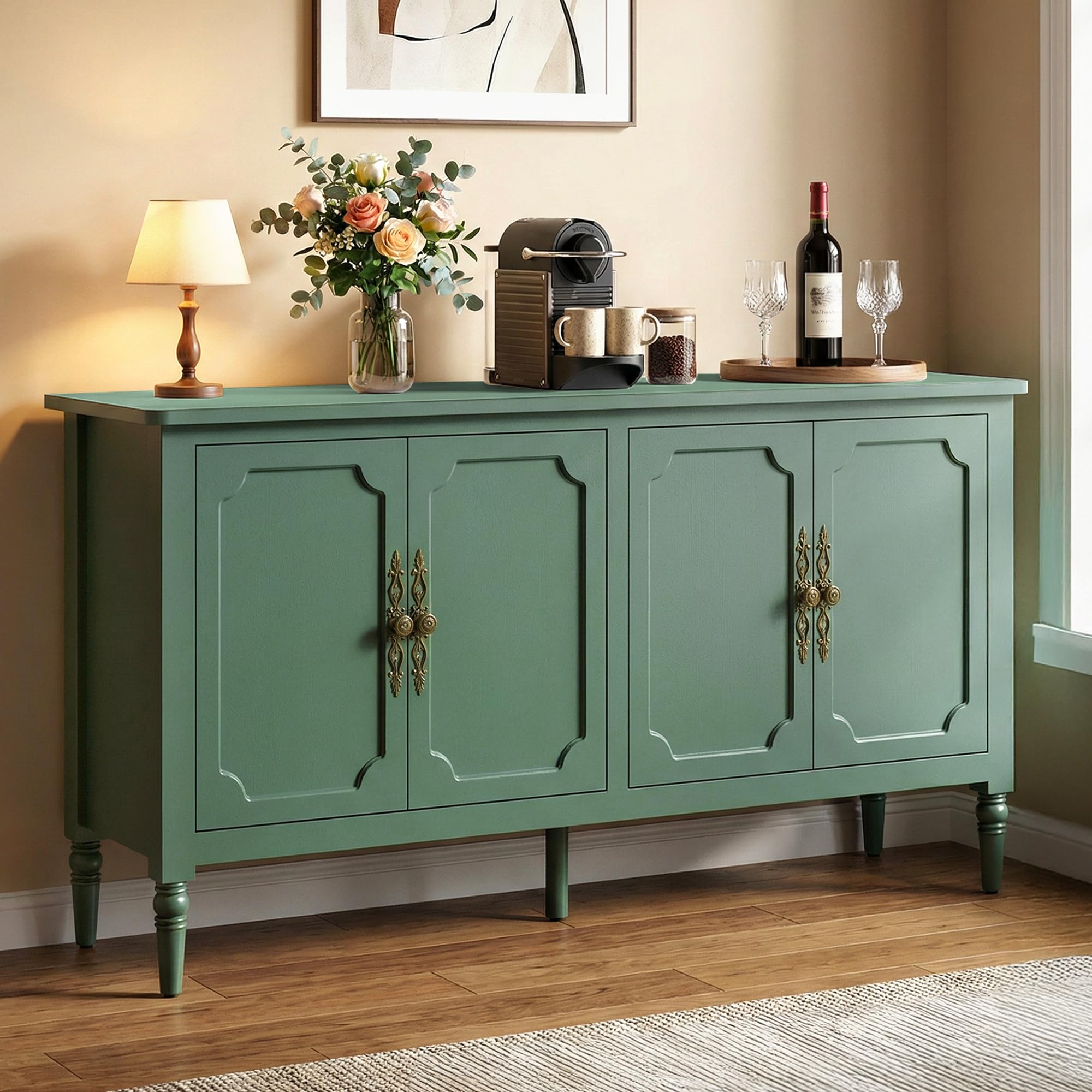
FINETONES Fluted Buffet Cabinet

FINETONES Fluted Buffet Cabinet

8.8/10 Excellent
  • Finish: Green, fluted doors
  • Storage: 3 drawers, 4 doors, adjustable shelves
  • Assembly: Two people recommended
  • Overall Dimensions: 15.7"D x 55.1"W x 34.3"H
Check Price on Amazon

Pros

  • Counter-height top makes serving comfortable
  • Three drawers plus adjustable shelves
  • Feels solid once assembled
  • Wide 55-inch serving surface

Cons

  • Long assembly that wants two people

The number that matters here is 34.3 inches. That's the height of the serving top, and it puts this cabinet at the same working height as a kitchen counter — you reach the back of it without stooping, and a hot dish goes down rather than out. The 55- and 58-inch cabinets we also recommend sit at 29.5 and 31 inches, which is table height. At a dinner party that difference turns into an ache by dessert.

The storage is the other half of the case, and it's laid out the way a buffet actually gets used: three drawers across the top for cutlery, napkins and candles, and four doors below opening onto adjustable shelves that take a stack of dinner plates plus a row of bowls. Adjustability earns its keep more than it sounds — a fixed shelf that fits plates won't fit a soup tureen. It's also the most solid of the flat-pack cabinets we recommend once it's standing; nothing about it feels provisional when the drawers are full.

Getting there is the work. This is a large flat-pack with a lot of parts and the instructions call for two people, so plan an afternoon and a second set of hands for standing the carcass up. Build it on cardboard, get it level on the floor before you load anything, and leave the door adjustment until last.

You also need 55 inches of wall and a 15.7-inch depth that keeps the walkway behind the table usable. In a tighter room, the SICOTAS or the REHOOPEX covers the small-wall case. On a wall that fits, the sage green and the fluted fronts are the version we keep coming back to.
Bottom Line: The one we recommend to most people: a counter-height top that's comfortable to serve from, three drawers, and adjustable shelves behind four doors.
#2

Best for a Formal Dining Room

RoyalCraft 58-Inch Sideboard

RoyalCraft 58-Inch Sideboard

8.6/10 Excellent
  • Base: Solid wood legs
  • Storage: 4 doors, 2 adjustable shelves
  • Load Rating: 200 lb
  • Overall Dimensions: 16"D x 58"W x 31"H
Check Price on Amazon

Pros

  • Best-looking finish in this set
  • Highest stated load rating here
  • Adjustable shelves fit tall items
  • Solid wood legs lift it off the floor

Cons

  • No drawers at all

Forest green, bronze handles, solid wood legs: this is the cabinet in the group that reads as furniture rather than as assembly, and it's the one we noticed from across the room before we noticed anything else about it. The satin paint is the practical part of that — it hides fingerprints and wipes clean, which matters on a top that will hold a gravy boat.

Underneath the looks it's the most capable cabinet here in one specific way: the 58-inch top carries a 200-pound load rating, the highest figure any of these states, and the middle of the span is supported by a leg so a long run of chafing dishes doesn't bow it. Four doors open onto two adjustable shelves that travel far enough to take a stockpot.

The doors are where the evening goes. Four panels have to meet in the middle of a wide span, and that alignment is the one thing standing between a good result and a slightly off one. Do it with the cabinet standing and level in its final spot, then tighten everything down — a piece this visible is worth the extra twenty minutes with a screwdriver.

The legs are the detail we appreciated most. They lift the carcass clear of the floor, which is what gives it the antique-shop stance rather than the plinth look the cheaper cabinets have, and it means the front edge doesn't collect the dust a skirted base does.

Bottom Line: The best-looking cabinet here, and the one to buy when guests see the room: 58 inches of top, a 200-pound rating and no drawers.
#3

Best Where Doors Need Clearance

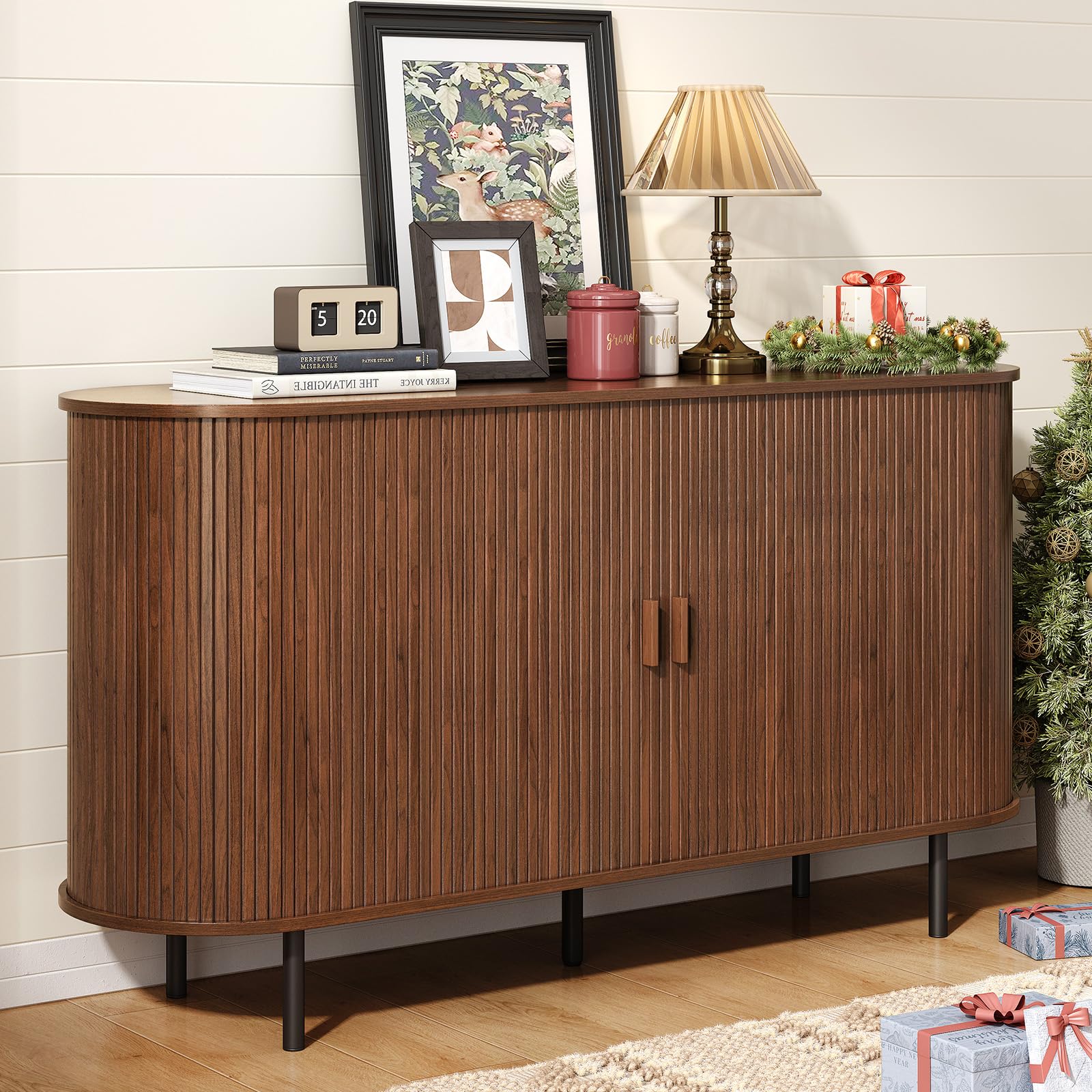
ONBRILL Sliding Door Sideboard

ONBRILL Sliding Door Sideboard

9.0/10 Outstanding
  • Doors: Two sliding panels
  • Weight: 59.9 lb
  • Storage: 6 compartments, adjustable shelves
  • Overall Dimensions: 15.8"D x 55.1"W x 29.5"H
Check Price on Amazon

Pros

  • No swing clearance required
  • Most flexible interior in this group
  • Curved edges and walnut finish
  • 55-inch top at table height

Cons

  • Sliding panels hide half the interior

A swinging cabinet door needs its own width in clear floor every time you open it. If the buffet sits behind the dining chairs, that is the whole argument for this one: the two panels slide along the front on a track and stack behind each other, so nothing at the table has to move.

The rest of the case is space. Fifty-five inches of top at 29.5 inches high is table height, which makes it a natural landing zone for serving dishes when the dining table is already full. Inside there's storage on both sides and four separate bays across the middle, with adjustable shelves, so one end can hold glassware while the other holds stackable bowls without either fighting the other.

We rate it second only to our top pick on storage flexibility, and first on looks if your room is mid-century rather than farmhouse — the walnut finish and the curved edges are why it doesn't read as flat-pack. The rounded corners matter more than they sound on a piece you walk past carrying a full plate.

Sliding doors live or die on the cabinet being level. A unit that rocks will drag on one side of the track no matter how carefully you set the panel, so get it flat on the feet before you touch the door. And because the panels overlap, half the interior is hidden at any moment — that's the price of the clearance you save, and it's a fair one in a tight room.

Bottom Line: Our pick where doors can't swing: sliding panels, a walnut finish and the most flexible interior here, on a top that works as table overflow.
#4

Best for Small Dining Rooms

SICOTAS Rattan Sideboard

SICOTAS Rattan Sideboard

9.2/10 Outstanding
  • Finish: Reclaimed Caramel Oak
  • Storage: 3 drawers, 2 adjustable shelves
  • Load Rating: 66 lb
  • Overall Dimensions: 13.9"D x 34.3"W x 35.4"H
Check Price on Amazon

Pros

  • Fits a wall under three feet wide
  • Counter-height top for serving
  • Soft-close doors
  • Three drawers plus adjustable shelves

Cons

  • Narrow drawers suit cutlery, not chargers

At 34.3 inches wide and 13.9 inches deep, this is the smallest thing in the group that still earns the word buffet. It holds a stack of plates, a serving bowl and the good glasses, and it does it against a wall where nothing wider would have fit.

What makes it work is the height. At 35.4 inches the top sits slightly above counter height, so serving from it is comfortable rather than a crouch, and two adjustable shelves take plates, bowls and a serving dish in a cabinet that's barely wider than a doorway. For an apartment dining nook or the end of a kitchen run, that combination is hard to beat.

The doors close on soft-close hinges, which we appreciate next to a table where kids are carrying plates — they finish the last inch themselves and stay shut. The caramel oak finish also runs browner and greyer than a lot of oak-look furniture, so it sits with wood floors instead of arguing with them.

Two doors meeting in the middle of a 34-inch carcass leave very little tolerance, so get the cabinet level and then adjust the hinges until the gap is even; that's the one assembly step worth slowing down for. Get it right and the finished piece looks considerably more expensive than the tier it sits in.

Bottom Line: For a short wall, this is the one: counter-height serving, three drawers and soft-close doors in a footprint under three feet wide.
#5

Best for a Long Wall

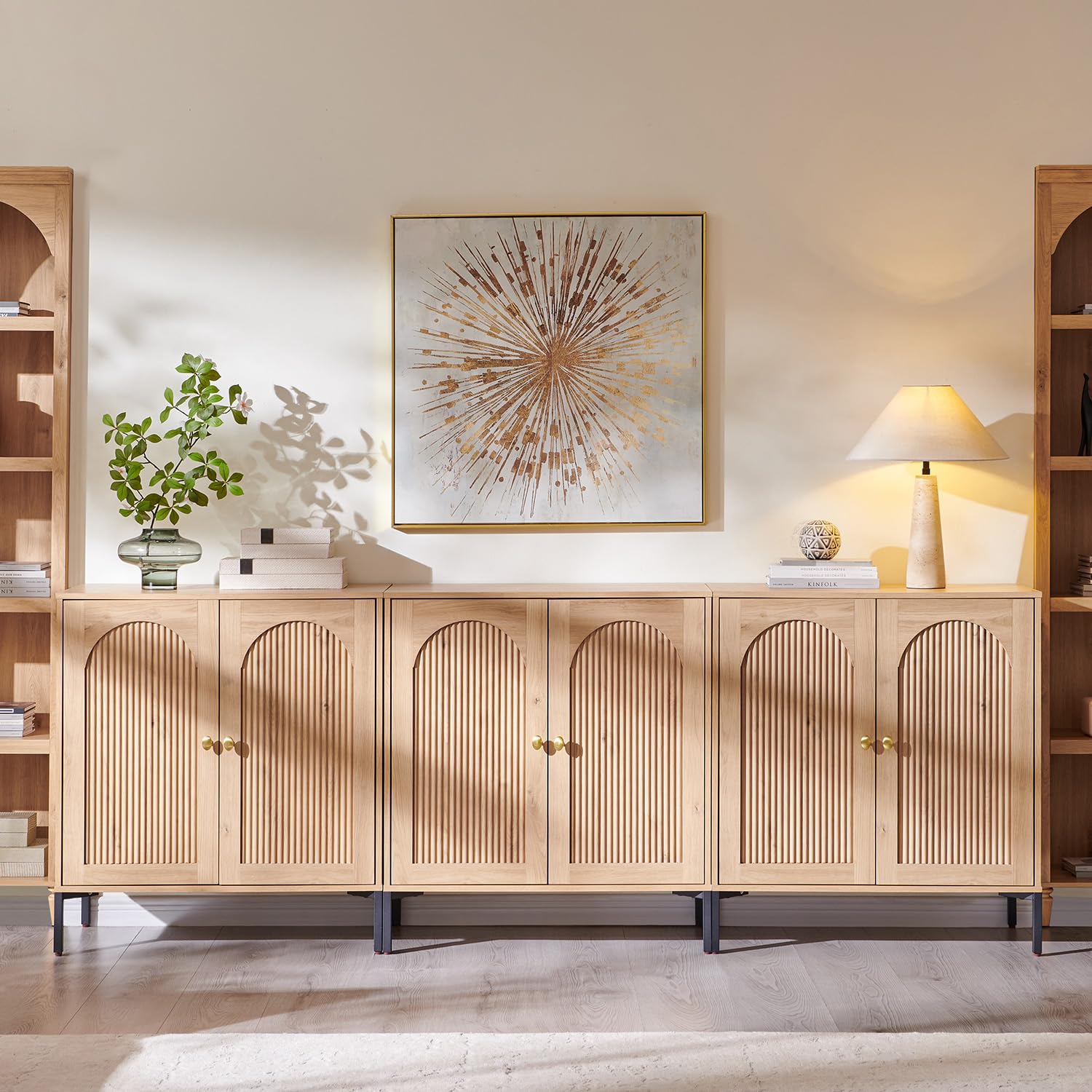
IFGET 92-Inch Arched Sideboard

IFGET 92-Inch Arched Sideboard

8.6/10 Excellent
  • Doors: 6 fluted arched doors
  • Configuration: Three modular cabinets
  • Floor Clearance: 5.7 inches
  • Overall Dimensions: 15.75"D x 92.63"W x 34"H
Check Price on Amazon

Pros

  • Built-in look on a long wall
  • Three cabinets that reconfigure
  • Adjustable shelves and deep storage
  • Robot vacuum clearance underneath

Cons

  • Finish can lift with tape or stickers

At 92.63 inches it is very nearly two of our 55-inch cabinets end to end, and that is the reason to buy it: one long, low run of fluted arched doors that reads as built-in joinery rather than a piece pushed against a wall. We think it's the most striking cabinet in this group, and the one that needs the most room to carry it off.

It ships as three separate cabinets that bolt together, which is more useful than it sounds. You can split the run across two walls, start with two units and add the third later, or buy it for a room you might rearrange. It also comes in two packages that can arrive on different days, so don't book help for a single morning.

The base sits 5.7 inches off the floor, enough for a robot vacuum to pass underneath, and the fluted panels catch light in a way that flat doors don't — the arched profile is doing real work in a room with a long blank wall. Behind them there are adjustable shelves and enough volume that a full dinner service disappears into one end.

The doors are the fussy part: six panels and a lot of hinge to set across three carcasses. Level each unit before you bolt the run together and adjust afterwards, working from the middle out. That order saves you from redoing the whole line.

Bottom Line: Choose it for a long wall you want to look built-in: three cabinets that bolt together, fluted arched doors and a serious amount of storage.
#6

Narrow walls

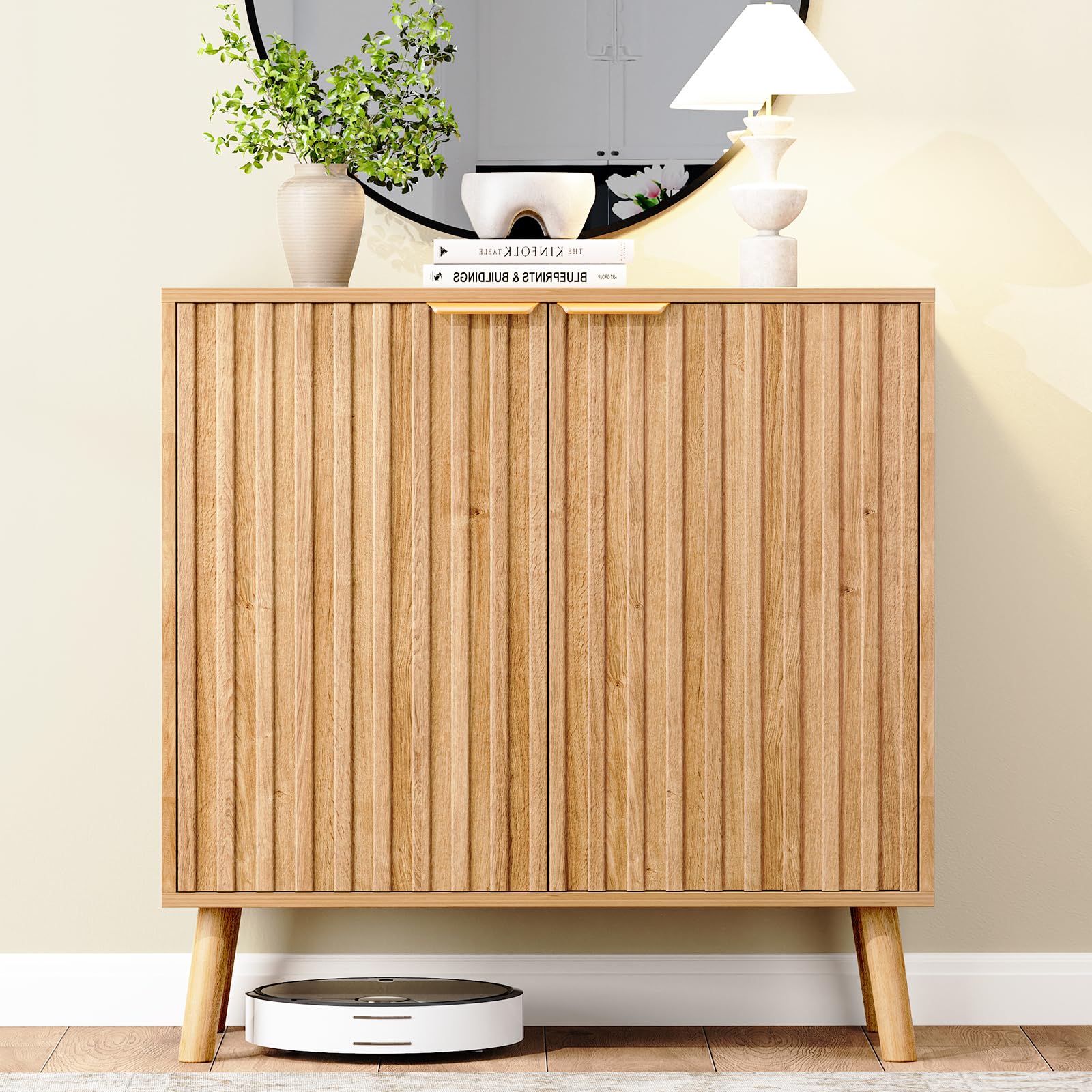
REHOOPEX Fluted Cabinet

REHOOPEX Fluted Cabinet

8.6/10 Excellent
  • Doors: 2 fluted doors
  • Weight: 45 lb
  • Storage: 2 adjustable shelves
  • Overall Dimensions: 13.7"D x 30.3"W x 30.49"H
Check Price on Amazon

Pros

  • Fits narrow walls and doorways
  • Fluted doors in a natural finish
  • Adjustable shelves add flexibility

Cons

  • Shallow top won't take wide platters

Not quite 30 inches wide and 13.7 inches deep, this is a hallway piece as much as a dining-room one. It tucks into the short wall beside a doorway, fills the gap between two windows, or stands in a small flat where a 55-inch cabinet would eat the whole room.

The fluted doors and natural wood finish are the draw — it's the least styled-looking cabinet in the group, in the sense that it will sit under a mid-century print or a farmhouse mirror without complaining. Two adjustable shelves give you a tall compartment or two short ones, which is more flexibility than the size suggests.

We liked it best in pairs, flanking something: two of these with art or a mirror between them solve a long wall and read as though they were made for the space, and you can buy the second one later. Alone in a small dining room it does the job of a sideboard that would otherwise not fit at all.

The doors can sit proud of the carcass out of the box, so adjust the hinges once it's level and in place before you decide anything is wrong. And measure the wall yourself rather than judging from the photographs — this is a compact piece and the dimensions are the honest description of it.

Bottom Line: A pair of these does the job of one wide buffet in a narrow room, and the fluted natural finish is the most versatile here.
#7

Coffee stations

SWTYMIKI Coffee Bar Cabinet

SWTYMIKI Coffee Bar Cabinet

8.6/10 Excellent
  • Feet: Adjustable leveling feet
  • Frame: Iron and wood
  • Storage: 1 drawer, 1 door, 3 shelves
  • Overall Dimensions: 11.81"D x 27.95"W x 31.5"H
Check Price on Amazon

Pros

  • Fits a two-foot gap
  • Drawer, cabinet and three shelf levels
  • Leveling feet for uneven floors

Cons

  • Too narrow for a buffet spread

Picture the corner of a small kitchen: a drip machine on top, mugs on the shelf below, syrup bottles in the bottom compartment and the pods in the drawer. That's the job this cabinet does, and at 27.95 inches wide it does it in under two and a half feet of wall.

We kept it in the roundup because it solves something the big cabinets can't — a rental kitchen or a dining nook with no room for a sideboard but a genuine need for a station. The adjustable feet are the detail that makes it work on an old, uneven floor: level it once and the door stops catching on the frame.

The frame is iron with wood panels, so it feels different from the engineered-wood cabinets above — lighter, more open, easier for one person to move once it's built. The 11.81-inch depth is the number to check before you order: it takes a dinner plate, not a serving platter, and the top holds a coffee maker and a grinder rather than a spread.

Be honest with yourself about the size. It is smaller in person than wide-angle product photos suggest, and that's the whole trade — buy it as a coffee station and it earns its corner; buy it expecting to serve Thanksgiving from it and it won't.

Bottom Line: Not a buffet for dishes — a compact coffee station with a drawer, a cabinet and leveling feet, for kitchens with two spare feet of wall.

How We Tested the Best Buffet Tables

We started with a list of roughly 40 buffets and cut it down using specs first: stated shelf adjustability, dimensions that would clear a standard doorway, materials that could handle a hot dish, and price relative to what the piece is actually made of. We read the assembly sections of customer reviews closely, since a cabinet that takes two people and four hours to build is a different purchase than one that goes together before dinner.

Each of the eight finalists got assembled solo with only the hardware in the box, and we timed it. We noted whether the labeled parts matched the instructions, whether cam locks seated cleanly, and how many times we had to flip the piece over. Then we leveled each one where it would actually stand and checked the doors again — measuring the gap at the top and bottom of every door, opening and closing each one, and watching for sag after a week of normal use.

The real test was loading them. We filled shelves with dinner plates, stacked linens, serving platters, and a slow cooker, then hosted a dinner party out of each one to see whether the top surface was deep enough to stage food and whether drawers still glided when full. Over nine months we moved every piece at least once, wiped up spills, and rechecked veneer edges and door alignment at the one-month mark to see what had drifted.

How to Choose Buffet Tables

Height Is the Decision You Can't Undo

A buffet is a work surface you stand at, so height comes first. Cabinets in the 32- to 36-inch band put the top at or near kitchen-counter height, which is where serving is comfortable: you reach the back of the top without stooping and set a hot dish down without bending. Cabinets at 29 to 31 inches are table height, and they work better as a side table for the overflow or as a console behind a sofa.

We prioritize counter height for a room where plated food and a coffee urn actually land on the top. If the piece is mostly a display surface with a lamp on it, the lower cabinet looks better proportioned against a window.

Width, Depth, and What Lands on the Top

Depth is what separates a buffet from a shelf: 15 to 16 inches takes dinner plates, a stack of bowls and a serving platter; 13 to 14 inches takes plates and glassware but forces you to stand a platter on its edge. Width is a wall decision as much as a storage one — 55 inches gives you three serving stations plus room for a stack of plates at one end, while 30 inches gives you one station and a lamp.

Measure the wall and the walkway behind the table, then subtract a hand's width on each side. A cabinet that fills the wall to the door frame looks installed; one that leaves six inches of orphaned wall looks like a mistake.

Drawers First, Then Doors

Drawers are the difference between a buffet and a cupboard. Cutlery, napkins, tea lights, corkscrews and serving spoons all want a shallow drawer, and a cabinet with three of them across the top is dramatically easier to run at a dinner party than one where everything is behind a door.

Behind the doors, look for adjustable shelves rather than fixed ones. Serving pieces are tall and irregular — a soup tureen, a cake stand, a gravy boat — and a shelf you can move is the difference between a cabinet that fits your dishes and one that fits the shelves it shipped with.

Clearance: What the Doors and Drawers Need

A swinging door needs its own width in clear floor every time it opens, which matters when the buffet sits behind the dining chairs. Sliding doors need none of that, but they only expose half the interior at a time and they demand a level cabinet — a unit that rocks will drag on the track no matter how carefully you set the panel.

Drawers need their depth plus a hand's width in front. If the piece is going into a corridor or a tight galley, measure the open-door or open-drawer footprint, not just the closed cabinet.

The Afternoon It Costs

Almost everything in this category arrives flat. A 30-inch cabinet is a two-hour solo job; a 55-inch one with drawers and four doors runs several hours and wants a second person for the step where the carcass goes upright. Build on cardboard, keep the hardware bag with its labels, and don't tighten every cam until the whole box is square.

Once it's standing, move it into position before you load it, level it on the feet, and load from the bottom up. A cabinet that isn't level is the reason most doors look wrong.

Frequently Asked Questions

Final Verdict

The FINETONES is the buffet we point most people toward, because 34.3 inches is the height that makes serving comfortable and three drawers are what stop a buffet from turning into a cupboard with a lamp on it.

If the wall is short, the SICOTAS does the same job in under three feet. If the doors can't swing, the ONBRILL slides instead. And if the dining room is the room guests see first, the RoyalCraft is the one that makes it.