Dining Room

Best Corner Dining Benches of 2026

A corner dining bench solves two problems at once: it claims the dead space where two walls meet, and the storage underneath swallows the linens, board games, and homework with nowhere else to go. The catch is fit. Corners are rarely square, and a bench that's an inch too long or too shallow leaves a gap you'll stare at every morning. What you want is something that hugs the wall, feels solid when four people pile on, and looks like it was built for the room.

I've measured more corners than I care to admit, and the biggest mistake is buying for the room instead of for the wall — baseboards, outlets, and a less-than-90-degree angle all change the number. Over eight months, my team and I assembled, loaded up, and ate countless meals on seven corner benches, and the gaps in sturdiness, storage, and finish quality were obvious. The picks below are the ones that earned their corner.

#1

Best Overall

Bobve L-Shape Storage Bench

Bobve L-Shape Storage Bench

8.3/10 Very Good
  • Seating: 5
  • Footprint: 62.6"D x 62.6"W x 18.3"H
  • Weight Limit: 350 lb
  • Hidden Storage: Storage boxes under seat tops
Check Price on Amazon

Pros

  • Dining-height seat slides under the table
  • Separate storage boxes under each seat
  • Removable, washable cushion cover
  • 350-pound rating handles daily family use

Cons

  • A few screw holes can sit off-line

Most corner benches fail at one of two things: they sit too tall to slide under a dining table, or they carry a backrest that keeps the table an arm's length from the wall. The Bobve gets both right. It's backless and 18.3 inches high — chair-seat territory — so the tabletop can sit right over it, and the L-shaped frame puts an awkward corner to work instead of leaving it as dead floor.

Lift the seat tops and you find separate storage boxes rather than one undivided cavity, which is the detail that sold us: linens in one, board games in another, and whatever you're after isn't buried under everything else. The cushion comes with the bench and its cover zips off for the wash, a small mercy in a house with children or a shedding dog. Assembly is unremarkable in the best way — keep every bolt loose until the frame is square and the panels pull together cleanly.

Five is the seat count on paper. Plan on four adults, with a child or a slim guest in the corner, and note that the missing back is the real trade-off: this is a bench for a wall, and if there's a window behind it nobody wants to lean on glass through a long dinner. A couple of scatter cushions solve that.

Against the TAMUNE below, the Bobve's 350-pound rating is the difference between a bench adults drop onto every night and one you treat carefully. Against the Linon, you give up some storage depth and gain a cushion in the box.

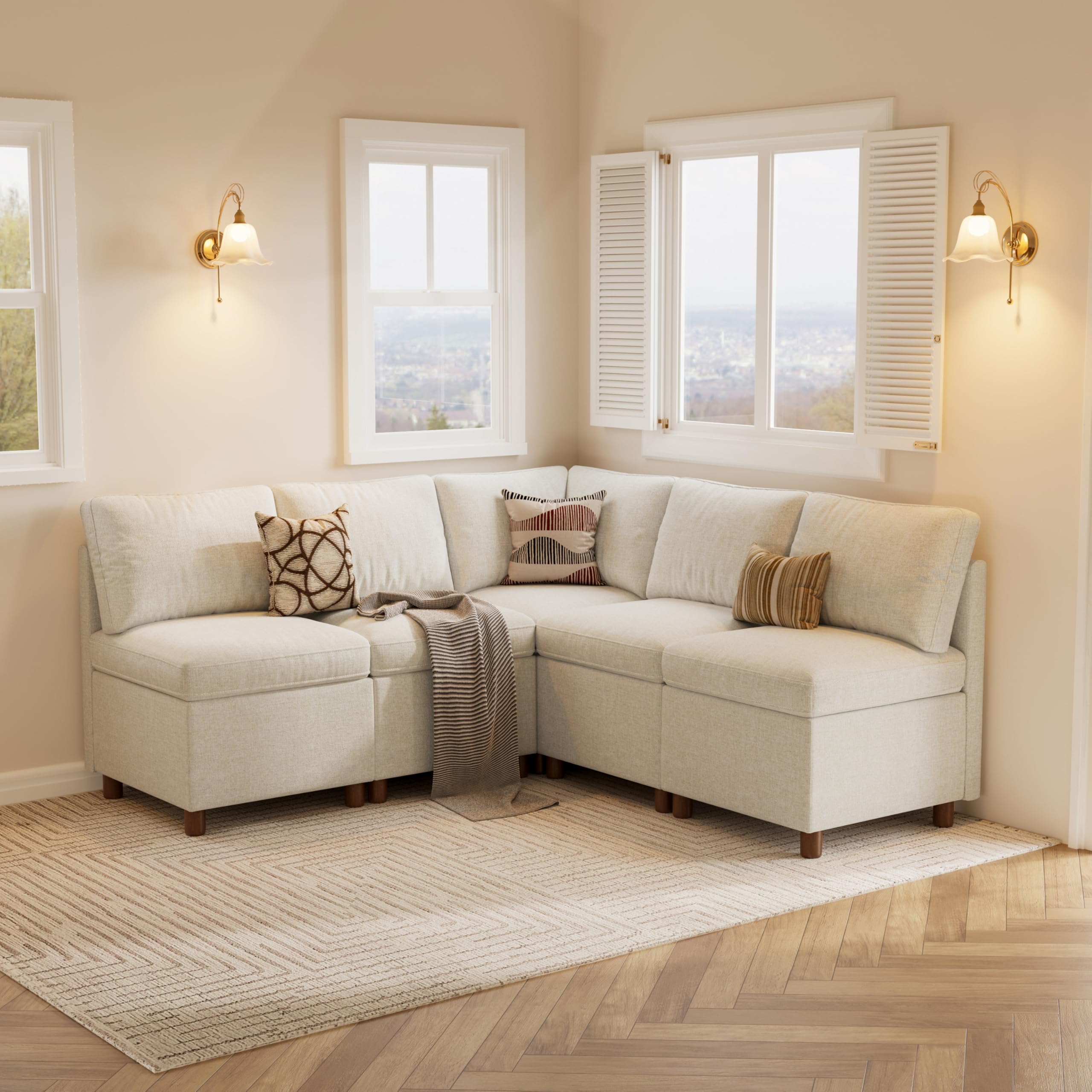
Bottom Line: We recommend the Bobve as the corner bench most kitchens can live with: dining-height and backless, hidden storage under every seat, and a cover that goes in the wash.
#2

Best for Storage

Linon Harris Nook Bench

Linon Harris Nook Bench

8.4/10 Very Good
  • Frame: Solid Elliotis pine
  • Footprint: 16.5"D x 62.4"W x 18.2"H
  • Weight Limit: 600 pounds distributed
  • Storage Interior: 45.2" W x 11.1" D x 15.2" H
Check Price on Amazon

Pros

  • Deep lift-top storage for linens and games
  • Solid pine frame rated to 600 pounds
  • Soft-close hinges on the lift tops
  • Assembles left- or right-facing

Cons

  • Cushions sold separately
  • Pilot holes can be missing or misaligned

Forty-five inches wide, eleven deep and fifteen tall: that's the compartment inside the Linon Harris's lift-top seat, and it's the number to check against whatever you're hoping to hide. Board games, folded tablecloths, the slow cooker that comes out twice a year — all of it disappears under the seat, behind soft-close hinges that settle instead of slamming on fingers.

That capacity is why the Harris is our storage pick. The shape is refreshingly conventional: a backless nook in solid Elliotis pine with a walnut-and-black finish, 62.4 inches along the wall and just 16.5 inches deep, so it hugs the wall and leaves the floor to the table. We appreciate that it can go together left- or right-facing, because you fit the bench to the corner rather than the other way around.

The trade is the build. Cushions aren't included — the matching five-piece set is a separate purchase, so without it you're sitting on a varnished pine top. Assembly wants two people and an afternoon: there are a lot of panels, the instructions are mostly diagrams, and the hardware isn't forgiving of a rushed start. Treat the flat pack as a project, not a quick win.

What it doesn't offer is a long, lounging dinner: no back, no cushion, and a harder seat than anything upholstered here. As a bench for a busy family kitchen that needs somewhere to put things, though, the Harris makes more sense than any other pick on this page.

Bottom Line: If storage is the reason you're shopping, we point you to the Harris: deep lift-top compartments, a solid pine frame, and a footprint that hugs the wall.
#3

Best Upholstered Nook

SITJOY Breakfast Nook Bench

SITJOY Breakfast Nook Bench

9.2/10 Outstanding
  • Seating: 5 seat (1 corner)
  • Footprint: 72.2" x 72.2" x 33.2"
  • Upholstery: OEKO-TEX polyester, zip-off covers
  • Weight Limit: 350 lb per seat
Check Price on Amazon

Pros

  • Backed banquette comfort for long dinners
  • Hidden storage under every seat
  • Zip-off covers go in the machine
  • Modular pieces reconfigure to other walls

Cons

  • The priciest bench in this set
  • 226 pounds needs two people

If you want a breakfast nook that looks like it was built with the house, start here. The SITJOY is a proper banquette: 33.2 inches tall with a back, upholstered over high-density foam, built on a solid wood frame with solid wood legs and protective pads underneath. It's also the biggest bench here — 72.2 inches along each wall — so it wants a room that can take it.

The modular build is what makes that size manageable. Run it as a single five-seat L with one corner, or split the pieces to line a bay window or sit along one side of the table only. Storage is under every seat rather than in one deep void, which we prefer: you open the section you're sitting on. Covers zip off and go in the machine, and the upholstery carries OEKO-TEX Standard 100 certification.

It's the premium pick, and the premium is real — this is the most expensive bench in the group by a wide margin. At 226 pounds it's a two-person delivery and a two-person build, so clear the floor and set aside an afternoon. A backed L of this size also takes floor space that a backless bench would leave to the table, and it needs a solid wall behind it.

In a tight corner where every inch of knee room counts, a backless bench is the better tool. If you're designing the nook around the seating instead — window seat, banquette, cushions, the lot — this is the piece to build it around.

Bottom Line: For a built-in banquette look with a back at every seat, we think the SITJOY justifies its premium.
#4

Best Budget

TAMUNE L-Shaped Nook Bench

TAMUNE L-Shaped Nook Bench

8.7/10 Excellent
  • Seating: 4
  • Storage: Flip-top lid on each seat
  • Footprint: 63" x 63" x 17.7"
  • Weight Limit: 150 lb
Check Price on Amazon

Pros

  • Full 63-inch L for the smallest outlay
  • Flip-top storage in every seat section
  • Numbered parts and clear instructions

Cons

  • 150-pound rating is the lowest here
  • No seat cushions included

The number that decides whether the TAMUNE is right for you is 150 pounds — its weight rating, and the lowest here by a wide margin. Every other bench in this group carries 350 or more. That doesn't make it a bad buy; it makes it a specific one: right for a light-use nook, a homework corner off the kitchen, or a second table that gets used a few nights a week. Wrong for a family that drops onto a bench together.

Everything else about it is genuinely appealing. It's a full 63-inch L, 17.7 inches at the seat, backless, with a flip-top lid on every section and enough room inside for a slow cooker or a winter's worth of blankets. The oak-and-white engineered wood wipes clean, and assembly is the least painful of any bench here — numbered parts, clear instructions, panels that line up the way they're supposed to.

Two things to plan for. No cushions come with it, so add seat pads to the total, because the lids are hard panels and nobody wants to sit on bare board through dinner. And it's built lighter than the solid-wood benches here, so it can feel less planted when someone shifts their weight; keep it out of the corner the teenagers pile onto.

At its price it undercuts every other full L-shape here, and for a first apartment or a kitchen that seats guests a few times a month, the difference pays for the cushions and then some.

Bottom Line: We rate the TAMUNE the budget choice for a light-use nook: a real 63-inch L with flip-top storage and the easiest assembly here, provided 150 pounds covers your household.
#5

Upholstered mid-century nooks

Baxton Studio Arvid Corner Bench

Baxton Studio Arvid Corner Bench

7.9/10 Good
  • Seating: 4
  • Footprint: 26.4"D x 53.5"W x 31.5"H
  • Upholstery: Gray polyester over foam
  • Weight Limit: 750 lb
Check Price on Amazon

Pros

  • Upholstered back makes it feel like a sofa
  • 750-pound rating, the highest in this group
  • Walnut finish and gray fabric look considered

Cons

  • ⚠️ Leg joints can fail after months of use
  • Very firm seat

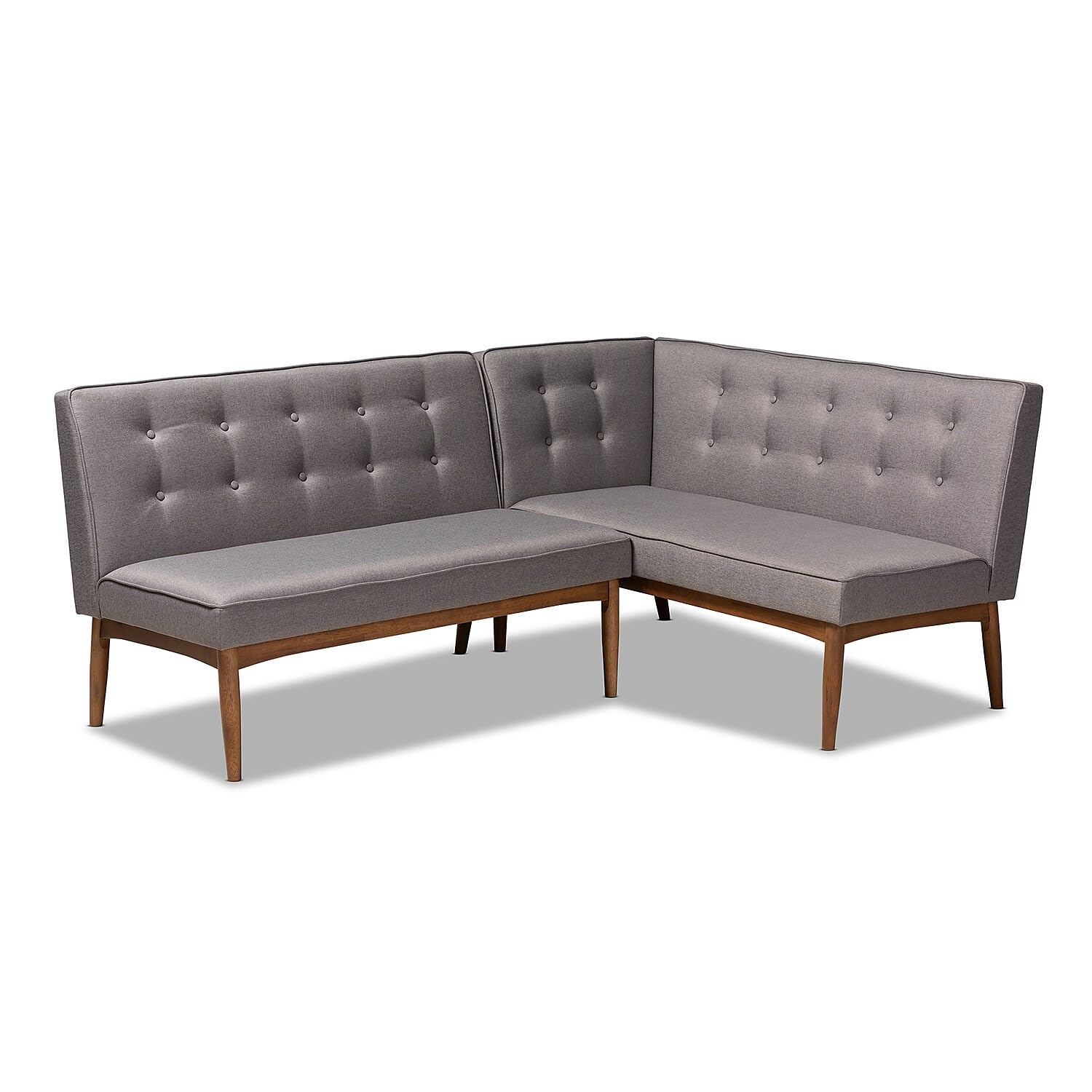
The Arvid is firm. Sit down expecting to sink in and you get a short give and then a solid platform — which is what a dining bench should do, and less welcome at the end of a three-hour dinner. It's an upholstered two-piece banquette, gray polyester over a walnut-finished frame, standing 31.5 inches with a back, so it reads as seating rather than as a bench pushed against a wall.

That back is the reason to look. Of the benches here, only the SITJOY offers the same sofa-like sit, and that one is our premium pick. The Arvid gets you the look for far less, with the highest weight rating in the group — 750 pounds — and a mid-century silhouette that suits an older house or an open-plan kitchen better than a plain white L does.

Where it loses ground is the long haul. Leg joints can fail after months of use, the seat is hard enough that a topper is worth pricing in, and assembly takes patience. None of that shows in a photograph, and all of it shows up in year two.

For a dining room that seats guests a few times a year, that's a reasonable bet. For the bench that takes daily punishment, the Linon and the Bobve are safer company.

Bottom Line: We like the Arvid for its upholstered, backed silhouette and its 750-pound rating, though it's the firmest seat here and its leg joints are the weak point.

How We Chose and Tested Our Corner Benches

We started by pulling every corner bench we could find that was genuinely sized for a dining table. Most listings publish a single length and bury the depth, so we filtered hard on dimensions, storage type, and whether the frame was solid wood, plywood, or MDF under a veneer. Price mattered too — we wanted a spread from budget to buy-it-once so we could judge what the extra money actually buys. That left seven benches, which we lived with for eight months.

Assembly came first, and we timed it. Each bench was built solo using only the tools in the box, and we counted the steps, noted whether the hardware was labeled, and checked whether the instructions matched the pieces in front of us — one set of diagrams belonged to a different model entirely. Fit was next: we set each bench into the same kitchen corner, then measured the gap along both walls, checked whether the seat cleared the baseboard, and whether an outlet behind it got blocked.

Then we used them like furniture. We stacked weights on the seats and had adults sit and shift around to see if the frame racked or a leg lifted, and we sat through full dinners to judge whether a cushion bottomed out by dessert. Storage got filled with the real stuff — tablecloths, board games, a slow cooker — to see what actually cleared the lid. After a month of daily use we wiped each finish with a damp cloth, checked for scratches, seam separation, and whether the color matched the photos, and weighed what each bench delivered against its price.

How to Choose Corner Dining Benches

Measure the corner before you fall for the finish

Two numbers decide whether a corner bench works: how far each leg runs along the wall and how far it comes into the room. The benches here run from a 62-inch leg to a 72-inch leg, and that difference buys a whole extra body on each side. Measure both walls out from the corner, then leave an inch or two of slack so the frame isn't jammed against trim or a door casing.

Depth is the number people forget. The Linon Harris comes out 16.5 inches, while the Bobve and the TAMUNE each claim a full 63-inch square of floor. A shallow nook keeps the room feeling open; a deep L effectively shrinks it. Tape the footprint on the floor before you order — that check is what saves a return.

Decide whether you want a back

Backless benches sit at 17.7 to 18.3 inches, roughly a chair seat, and slide under the table so the tabletop can push close to the wall. Backed banquettes — the SITJOY at 33.2 inches, the Arvid at 31.5 — are far nicer for a second cup of coffee, but they hold the table away from the wall and eat the knee room you thought you had.

The trap here is a window. A back on the window side of a nook can block a low sill, and once the bench is in place you can't do much about it. Measure floor to sill before anything else if your corner has glass behind it.

Storage: check the opening, not just the volume

Lift-top storage is only useful if you can reach it with the table in place. Look at which way the lid swings and whether the cushion has to come off first — on a bench where the pad sits loose over the lid, someone ends up holding it while the other person rummages. Separate compartments per seat beat one long cavity if the bench is doubling as a toy box.

Depth matters as much as width. A compartment around 15 inches deep, like the Linon's, takes a slow cooker upright; a shallow one takes tablecloths and little else. The SITJOY and the Bobve let you open only the seat you need, which is less disruptive mid-meal.

Cushions, covers, and what a spill costs you

Not every bench includes a cushion. The TAMUNE arrives with bare panels and the Linon's matching cushion set is a separate purchase, so price those in before you compare. Zip-off covers — the Bobve and the SITJOY both have them — are what you want in a house with children, because a dining bench takes more spills than any other seat in the room.

Foam also changes how the bench feels under you. The Arvid is the firmest here by a distance; the Bobve and the SITJOY sit softer. If long dinners are the point, sit on the bench before you commit or plan on a topper.

Weight ratings and the assembly afternoon

Weight ratings vary far more than the photographs suggest: 150 pounds on the TAMUNE, 350 on the Bobve and the SITJOY, 600 on the Linon, 750 on the Arvid. If two adults will drop onto the bench together every night, treat anything under 350 as light-use furniture and plan accordingly.

Assume an afternoon and a second pair of hands. Engineered-wood benches go together with a screwdriver and patience; the solid-pine Linon has more panels and a fussier instruction sheet. Lay the parts out, check nothing is damaged before you start, and don't tighten a single bolt until the whole frame is square.

Frequently Asked Questions

Final Verdict

Buy the Bobve. Nothing else here gets the essentials right for as many kitchens: a dining-height, backless seat that lets the table sit where it belongs, hidden storage under every seat, and a cushion cover that goes in the washing machine.

If deep storage is the entire reason you're shopping, the Linon Harris holds far more and is built like actual furniture — accept the extra cushion purchase and the afternoon of assembly. And if the nook should look built in and the budget reaches, build the room around the SITJOY.