Dining Room

Best Dining Room Tables of 2026

There's a moment at almost every dinner party when the table quietly tells you what it's made of. Someone leans on an elbow, a chair gets dragged back, a hot dish lands without a trivet — and by dessert you're either still talking about the food or making a mental list of wobbles and scratches. A good table disappears under the meal: it seats the people you actually have, holds still, and looks like itself after years of holiday dinners.

The catch is that the price covers the top and legs only — chairs are almost always sold separately, and six decent ones can run as much as the table. Over the past ten months, my team and I assembled, ate at, and scratched eight dining tables, and the ones that held up had less to do with the label than with what's under the finish: solid wood at the joints, hardware that stays tight, instructions one person can follow. The picks below are the ones we'd buy again.

#1

Best Overall

Mxtxmy Extendable Round Oval Table

Mxtxmy Extendable Round Oval Table

8.6/10 Excellent
  • Diameter: 43.3 inches
  • Extended Length: 59 inches
  • Seating Capacity: 4 to 8
  • Tabletop Thickness: 1.18 inches
Check Price on Amazon

Pros

  • Extends from four seats to eight
  • Storage shelf in the base
  • Cross base with a thick 1.18-inch top
  • Smooth, quiet extension rail

Cons

  • MDF veneer can chip at the edges

The extension is the whole idea, so it's where we started: the top opens, a leaf drops into the middle, and a 43.3-inch circle becomes a 59-inch oval. Close it back up and you have a round table again, which is the difference between a table that only works on holidays and one you eat at on a Tuesday.

That trick is why we recommend it for most households. Four seats with the leaf out, eight with it in, and a cross-shaped base that leaves enough legroom underneath for chairs to tuck away properly instead of sitting out in the walkway. The top is 1.18 inches of MDF in a walnut finish, and the shelf in the base is 20.55 inches wide, which is room for a stack of dinner plates and the serving bowl that never has a home.

Sturdiness is where an extending table usually gives itself away, because there's a joint in the one place you don't want one. This one weighs 103.6 pounds and sits on a cross base rather than four spindly legs, and in use the extension felt solid under a hand pressed to the middle rather than springy.

Plan the build for two people and an afternoon: the box is heavy, and the base, shelf, and rail all have to line up before the top goes on. After that it's a table you stop thinking about, which is the highest compliment a dining table can get.
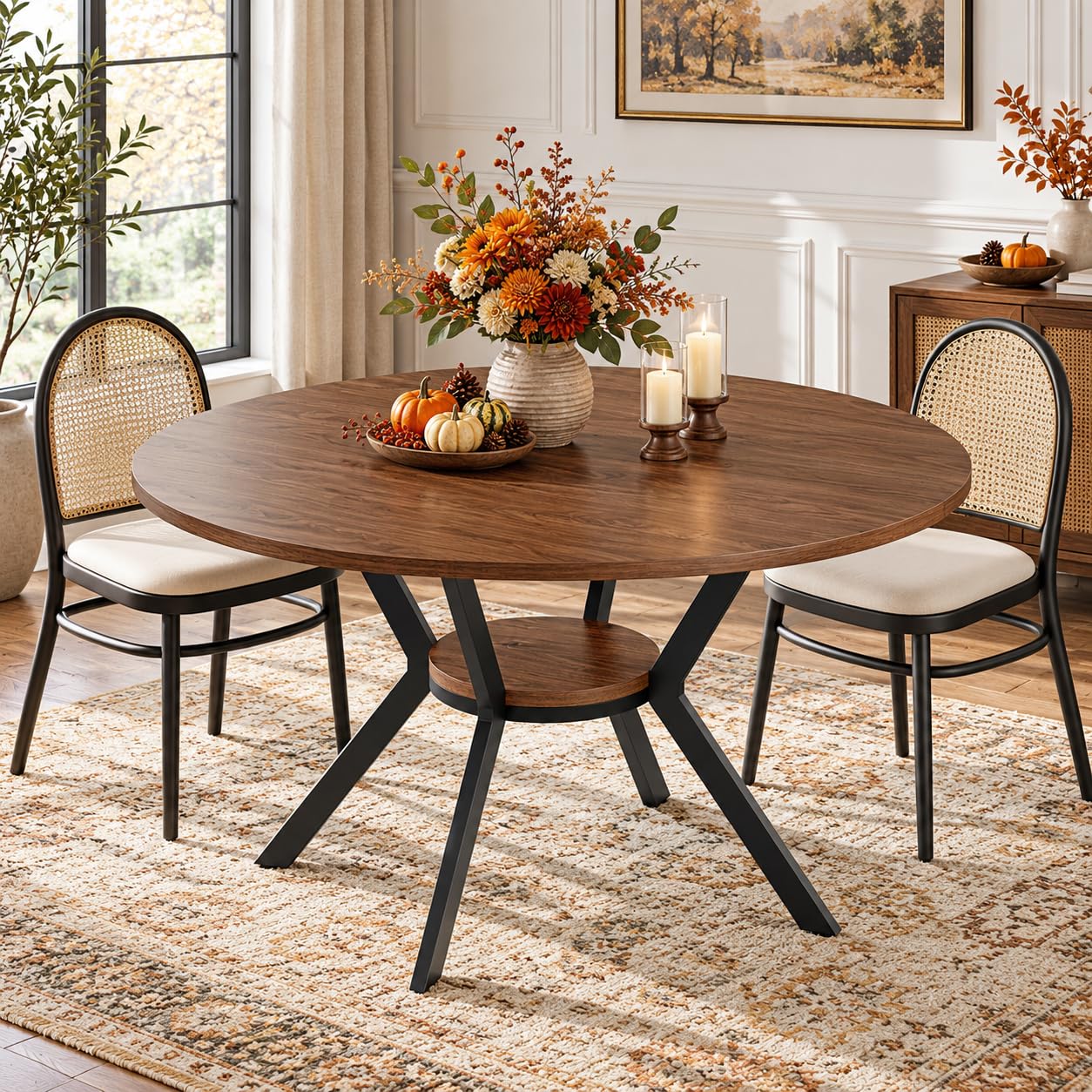
Bottom Line: This is the one we recommend for most households: a 43.3-inch circle for four that opens into a 59-inch oval for eight.
#2

Best for Four

MECHYIN 42-Inch Round Table

MECHYIN 42-Inch Round Table

9.0/10 Outstanding
  • Height: 30 inches
  • Diameter: 42 inches
  • Item Weight: 38.6 lb
  • Seating Capacity: 4
Check Price on Amazon

Pros

  • Steel cross base with adjustable feet
  • Flat, stable two-panel top
  • Storage shelf under the top
  • Light 38.6-pound frame

Cons

  • The join across the top is visible up close

The top arrives as two panels joined over a metal connector, and that seam is the first thing we checked once it was together. Ours sits flush, with no ridge under a plate and no rock when you press the middle, and that small piece of engineering is why this is the four-person table we recommend over the cheaper rounds here.

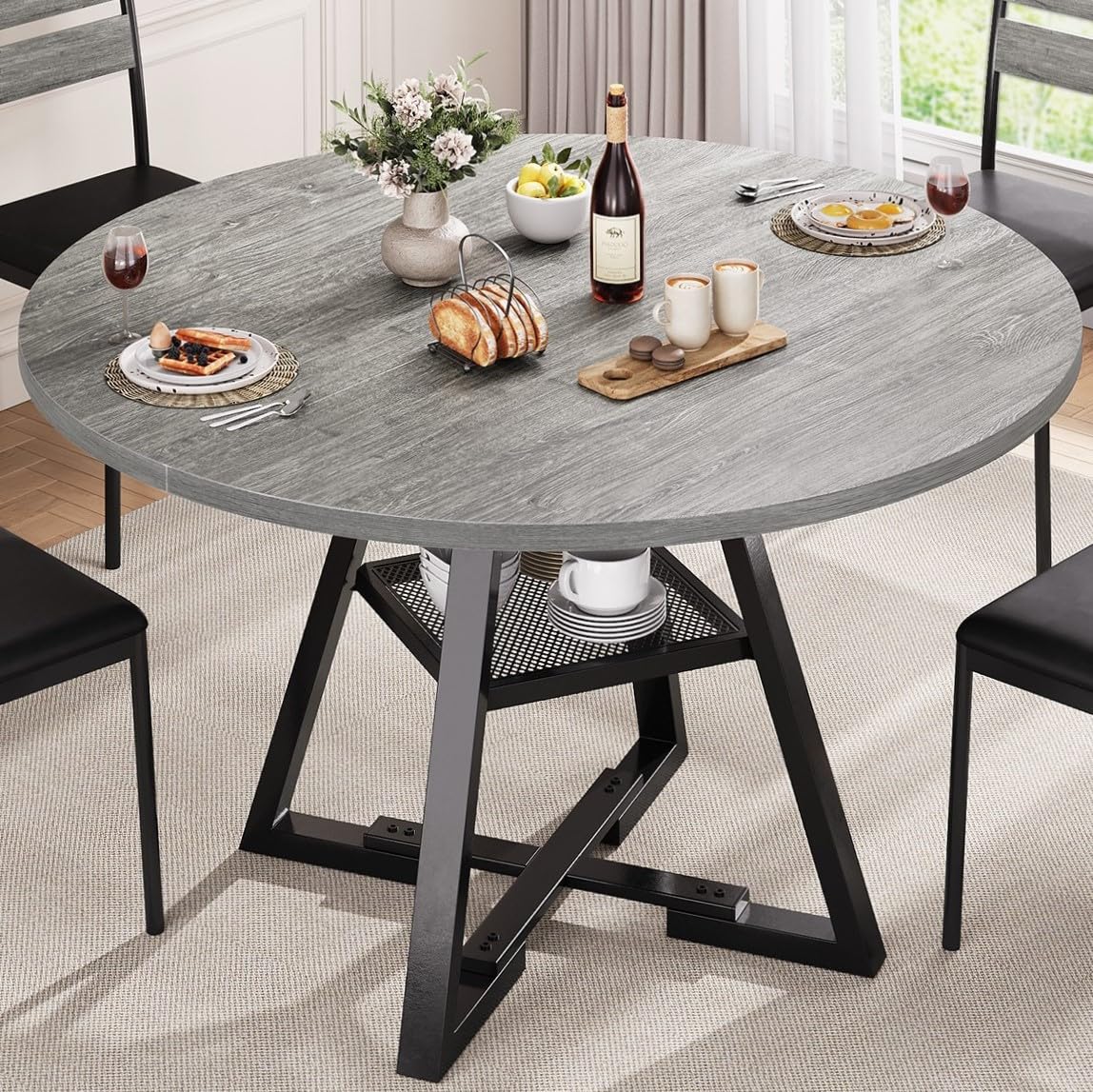
Forty-two inches across is the honest size for four: everyone gets an edge, the middle is reachable without standing up, and the whole table weighs 38.6 pounds, light enough for two people to shift out of the way. The base is a cross of 50×25mm steel legs with adjustable feet, so a floor with a slope to it is a twist away from level rather than a folded card under a corner.

The shelf underneath sounds like a gimmick until you're setting four places and don't want to walk back to the cupboard for the plates. Be clear about capacity, though: 42 inches seats four at dinner and no more, and a fifth chair means someone eating off the edge.

Bottom Line: We point households of four here: 42 inches, a steel cross base, and a two-panel top that sits flat under a cloth.
#3

Best for Eight

Hlivelood 78-Inch Dining Table

Hlivelood 78-Inch Dining Table

8.8/10 Excellent
  • Width: 39.4 inches
  • Length: 78.7 inches
  • Weight Capacity: 350 lb
  • Seating Capacity: 8
Check Price on Amazon

Pros

  • Seats eight around one table
  • 350-pound weight rating
  • Adjustable feet and anti-rock crossbars
  • Numbered parts and an hour of assembly

Cons

  • Needs 78.7 inches of dedicated wall
  • MDF panels rather than solid wood

Seventy-eight inches is the number that decides whether this table is right for you. At 78.7 by 39.4 inches it puts eight people around one top without the elbow negotiations, and it needs the long wall to match. Give it a dedicated dining room and it's the best table here for a full house.

The surface is a two-tone marble-texture panel over MDF, with V-shaped legs in wood and rust-proof metal and anti-deformation crossbars underneath. It's rated to 350 pounds, and at 81 pounds it plants itself rather than sliding when someone leans on the end of it.

Assembly takes about an hour with numbered parts and an illustrated manual, and the adjustable feet are what save it on an old, out-of-level floor. The thing to measure is chairs rather than the room: eight seats means three along each long side, so check the outside width of your chairs against that 78.7-inch run before you order.

Bottom Line: Our pick when eight people sit down regularly: 78.7 inches of tabletop and a rated 350-pound capacity.
#4

Best for Six Every Night

GIANTEX 63-Inch Kitchen Table

GIANTEX 63-Inch Kitchen Table

8.4/10 Very Good
  • Width: 31.5 inches
  • Length: 63 inches
  • Item Weight: 64.5 lb
  • Seating Capacity: 6
Check Price on Amazon

Pros

  • 63 inches seats six comfortably
  • Thick legs with reinforced screws
  • Coded parts make assembly quick
  • Stays put at 64.5 pounds

Cons

  • 31.5-inch depth crowds serving dishes
  • Engineered wood under a laminate, not solid

Sixty-three by 31.5 inches is the shape of a six-seater that still fits a normal dining room: two chairs on each long side, one at each end, and enough space between settings that nobody's glass sits at the edge of the table.

For a family that eats together every night, this is the rectangle we point to. The legs are thick, the screw structure is reinforced, and 64.5 pounds of table stays where you put it when a chair gets pushed back. Assembly is quick because every screw and pin carries its own code in the instructions, so the guesswork comes out of it.

The compromise is depth. At 31.5 inches wide it's a table for plates, cutlery, and a jug rather than a row of serving dishes down the middle, so put the extras on a sideboard and it's a comfortable six. The black surface is a laminate over engineered wood, which wipes clean in one pass and is the reason it stays in this price tier.

Bottom Line: The six-seater we reach for first: 63 inches of black rectangle with legs thick enough to stop the shimmy.
#5

Best for Tight Budgets

VASAGLE 55-Inch Dining Table

VASAGLE 55-Inch Dining Table

8.3/10 Very Good
  • Width: 29.5 inches
  • Length: 55.1 inches
  • Weight Capacity: 220 lb
  • Seating Capacity: 4 to 6
Check Price on Amazon

Pros

  • Least expensive table in this group
  • Top takes dishes up to 140°C
  • Swivel leveling feet for uneven floors
  • 40 pounds, easy for one person to move

Cons

  • Veneer scratches under daily use

Ignore the 55.1-inch length for a moment and look at the depth: 29.5 inches. That's a four-person table with room to spare, and six only if everyone agrees to be friendly. Bought as a four-seater, it's a good one.

The top is 0.6-inch veneered particleboard rated to take heat up to 140°C, so a dish straight out of the oven doesn't have to wait for a trivet. Splayed steel legs with swivel leveling feet handle a kitchen floor with a slope to it, and the whole table weighs 40 pounds, light enough that one person can move it to sweep underneath.

As the least expensive table here, it earns its place on the practical things: it wipes clean, it levels, and 220 pounds of capacity covers a dinner service and a centrepiece without drama. It's the one we point at for a first apartment or a kitchen that doubles as an office, where a bigger table is simply in the way.

Bottom Line: Our budget pick for four: the least expensive table here, with a heat-resistant top and feet that level out an old floor.
#6

Best Budget Round

Jocoevol 42-Inch Round Table

Jocoevol 42-Inch Round Table

8.7/10 Excellent
  • Diameter: 42 inches
  • Item Weight: 37.4 lb
  • Seating Capacity: 6
  • Tabletop Thickness: 25 millimeters
Check Price on Amazon

Pros

  • Storage shelf at plate height
  • Carbon steel frame with 25mm legs
  • One-person assembly
  • Light at 37.4 pounds

Cons

  • Finish scratches with everyday use

The cheapest table in this group is also one of the better thought-out ones: a 42-inch round on a cross base, with a shelf built into the frame at the height you actually want a stack of plates.

It's light at 37.4 pounds, and the frame is carbon steel with 25mm-thick metal legs, so it sits steady on a kitchen floor instead of shivering every time someone leans on the rim. The top is engineered wood in the grey finish the listing leads with, and it seats four comfortably, six if the extra two are children or people who like each other.

Assembly is the nicest surprise. The instructions are simple, the parts are labelled, and one person can have it standing in an evening, with a second pair of hands only making it quicker. That's why we recommend it when the budget is real but the room still has to look like somewhere you want to eat.

Bottom Line: We recommend it as the cheapest way into a round table with real storage underneath.
#7

Small dining rooms

LITTLE TREE 47-Inch Round Table

LITTLE TREE 47-Inch Round Table

8.6/10 Excellent
  • Height: 29.53 inches
  • Diameter: 47.24 inches
  • Item Weight: 58.4 lb
  • Seating Capacity: 6
Check Price on Amazon

Pros

  • Pedestal frees legroom on every side
  • 47 inches seats four to six
  • Rustic brown finish matches the photos
  • No corner legs to catch toes

Cons

  • Top seam can sit unevenly
  • Can rock slightly on one side

A pedestal base is the quiet luxury of a small dining room: no corner legs to stub a toe on, no post where a knee should go, and chairs that pull in from any point on the circle. At 47.24 inches across, this one gives you the whole rim to work with.

It stands 29.53 inches high and weighs 58.4 pounds, and the rustic brown finish is close to the product photos rather than glossier or redder in person. The pedestal is wood with metal components inside, and the top is engineered wood laid out in four panels.

Those panels are what you check first: they join across the middle, and the seam can sit unevenly, with a slight wobble on one side that a turn of a foot or a felt pad may settle. Nothing about that stops the table doing its job, but it's a table to look over on arrival rather than assume.

For a small dining room where shape and look matter more than timber, we think it's worth it, because the legroom changes how the room feels around the table. If you want a top that reads as one piece of solid wood, this isn't that table.

Bottom Line: Our pick for a small dining room that wants a pedestal: 47.24 inches across, four to six seats, and the whole rim free.
#8

Cottage dining rooms

Ashley Realyn Extension Table

Ashley Realyn Extension Table

8.4/10 Very Good
  • Leaf: 24-inch drop-in
  • Extended Length: 72 inches
  • Collapsed Length: 47.88 inches
  • Seating Capacity: 6
Check Price on Amazon

Pros

  • Extends from 48 to 72 inches
  • Distinctive chipped-white cottage finish
  • Seats six with the leaf in

Cons

  • Finish chips with daily use
  • Legs can need forcing into their cutouts

The chipped-white paint over an oak-toned top is the entire argument for this table: nothing else here does French country, and it does it well enough to anchor a cottage dining room rather than just decorate one.

The mechanics are useful too. The ends pull apart, a 24-inch leaf drops in, and a 48.25-inch table becomes 72 inches, taking you from four for supper to six when the family arrives. The legs are tapered and the whole thing weighs 101 pounds, so it stays where it's put.

It's veneers, wood, and engineered wood, and it wants two people and a clear floor to assemble. Dry-fit each leg into its cutout before you tighten anything, because the fit is tight and a rubber mallet is a better answer than a stripped bolt.

We think it earns its place in a formal dining room or a cottage that already has the whitewashed sideboard, and it will look wrong in a loft, which is fine, because it isn't for that room.

Bottom Line: We recommend it for the look, chipped white with an oak-toned top and a drop-in leaf, knowing the finish won't shrug off daily life.

How We Tested Eight Dining Tables Over Ten Months

We started with a shortlist of roughly 30 tables and cut it down by material (solid wood, veneer over MDF, metal, and glass), seating capacity from four to eight, and the fine print — whether chairs were included, which almost none were, so we priced six chairs alongside every table, and whether the top was solid or veneered, since the two age very differently.

Each of the eight then lived in a tester's dining room through Sunday dinners, homework sessions, birthday cake, and at least one board game with a careless winner. We built every one ourselves, solo, using only the tools and instructions in the box, timing the job and noting where a diagram was unclear or a step quietly needed two people. Then we shoved each corner, leaned our full weight on the edge, and re-checked the bolts a month later to see what had worked loose. Before delivery we taped the footprint on the floor and measured knee clearance with real people seated, because a table that seats eight on paper often seats six comfortably.

Durability meant drag tests: plates, keys, a cast-iron skillet, and a child's metal toy pulled across the finish, plus red wine left to sit for ten minutes. We judged wood quality where nobody looks — end grain, undersides, the joinery at the apron — and appearance over months rather than in a showroom, in morning light and under a pendant at night. Value came down to cost per usable seat, chairs included.

How to Choose Dining Room Tables

Start with the number of people, not the number in the title

A useful rule of thumb is 24 inches of table edge per person, which puts four around a 42-inch round, four to six around 47 inches, six around a 63-inch rectangle, and eight around 78 inches. Retail listings are optimistic: a 55-inch rectangle is sold as a six-seater, but 29.5 inches of depth makes four the comfortable number, with the ends best left to children.

If the count changes with the calendar, buy the extension instead of the bigger table. A 43-inch round that opens to 59 covers four on a normal night and eight twice a year, which is what most households actually need and the reason our top pick is shaped the way it is.

Shape decides how the room walks

A round table has no corners to clip on the way past the sideboard, and a pedestal or cross base leaves the whole rim free so chairs pull in from any side. A rectangle gives you more usable edge per foot of wall and accepts a bench along one side. An oval splits the difference, and it's the shape that extends most gracefully.

Then check clearance, which is where small rooms get caught. You want roughly 36 inches behind each chair to push back and stand, so a 47-inch round wants a space around 10 feet across before it feels generous rather than tight.

Read the material line twice

Engineered wood, MDF, veneer, and laminate are what most tables at this level are made of, and none of that is a scandal: they're stable, they don't move with the seasons like solid timber, and they wipe clean. What you give up is the edges, where veneer chips if a chair back catches it.

Where a listing says wood, look for the words solid or veneer, and expect multi-panel tops to arrive as pieces joined over a connector. A seam is normal; a step you can feel under a plate is not.

Stability and assembly are one decision

A table that rocks is usually a foot or an uneven floor, so swivel leveling feet and adjustable legs earn their keep in old houses. Beyond that, look at the base: a cross or pedestal puts the weight in the middle, splayed steel legs spread it outward, and four corner legs leave a post exactly where knees want to be.

Then weigh the box before you commit. A 100-pound table needs two people to flip and a floor big enough to lay it on, and the best instruction sheet in the world won't help if you're building it alone in a narrow room.

Frequently Asked Questions

Final Verdict

Buy the Mxtxmy as your default. It's the one table here that covers the whole range most households live in: 43.3 inches of circle for four on a weeknight, 59 inches of oval for eight when the family lands, and a shelf in the base that keeps the second-best plates where you need them.

If four is the permanent number and stability matters more than flexibility, the MECHYIN's steel cross base and flush two-panel top make it the better four-person table. And if eight sit down every week, measure your long wall for the Hlivelood's 78.7 inches.