Dining Room

Best Glass Display Cabinets of 2026

There's a particular satisfaction in seeing your collection behind glass—until you notice the dust settling on the top shelf, the door that never quite latches, or the whole unit wobbling when you walk past. A good glass display cabinet should protect and showcase what you put in it, not add another chore to your weekend. Over the past nine months, I've assembled, loaded, and lived with 10 different cabinets, from compact curio styles to full-height towers, to figure out which ones get the basics right.

The first thing I learned: glass thickness and shelf support matter more than the marketing photos suggest, and assembly instructions are often an afterthought—some cabinets took two people and an afternoon, while others went together in under an hour. Lighting can make or break the display, but placement matters as much as brightness. The picks below are the ones that felt sturdy, looked good, and were worth the money.

#1

Best Overall

BROTTAR 4-Tier Display Cabinet

BROTTAR 4-Tier Display Cabinet

8.7/10 Excellent
  • Doors: Pop-up glass, no handles
  • Shelves: 4 tiers
  • Lighting: 3-color LED, motion sensor
  • Dimensions: 14"D x 31.5"W x 65"H
Check Price on Amazon

Pros

  • Four 31.5-inch-wide tiers of display room
  • Three-color dimmable LED with motion sensor
  • Wall anchor included for stability
  • Labelled flat-pack parts and clear instructions

Cons

  • Shallow 14-inch depth limits bulky pieces
  • Side and back panels are acrylic, not glass

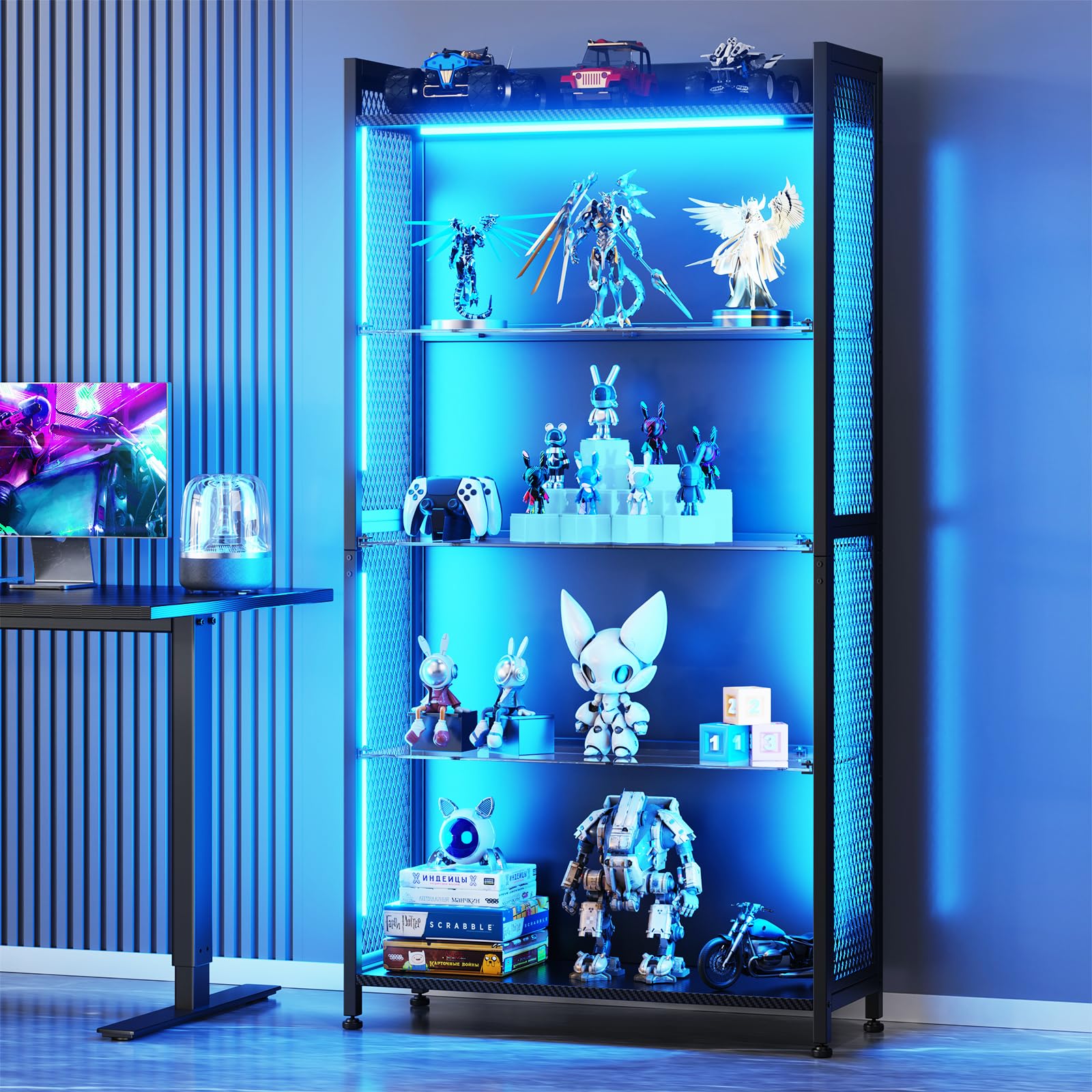
A 14-inch depth is the number that decides this cabinet. Most of us don't have two feet of floor to hand over to a display piece, and this BROTTAR stands against a wall at 31.5 inches wide, 65 tall and 14 deep — closer to a bookcase footprint than to dining-room furniture. The payoff is shelf width: four tiers, each wide enough for a row of figures, a run of books or a mixed display, with glass doors across the whole front so no frame blocks the view.

The lighting is the part we appreciated most. A 36W LED strip runs down the front, dimmable, with white, warm and blue settings, and a motion sensor picks you up as you walk past. That sounds like a gimmick until the cabinet is in a dim hallway and the second shelf is visible without hunting for a switch. Assembly is flat-pack and well labelled, and the supplied wall bracket is worth using — a 65-inch cabinet on four legs shifts when you pull the doors open.

Two details to weigh. The glass is on the doors, shelves and top; the sides and back are acrylic and wood-look board, so this reads as glass-fronted rather than see-through, and it won't work as a divider between two rooms. The shallow depth that makes it fit also rules out bulky pieces: a big die-cast statue or a wide vase crowds the door rather than sitting comfortably behind it.

Put the sensor on warm light and leave it there. The blue setting is fun for an evening and then it's just blue.

Bottom Line: We point most people to this one: four wide glass tiers, a dimmable LED strip with a motion sensor, and a depth that fits a hallway wall.
#2

Best for Corners

BROTTAR Corner Cabinet

BROTTAR Corner Cabinet

9.2/10 Outstanding
  • Shelves: 4 tiers
  • Lighting: 3-color LED, motion sensor
  • Dimensions: 23.6"D x 33.5"W x 65"H
  • Glass Coverage: Four sides
Check Price on Amazon

Pros

  • Glass on four sides, not just the front
  • Motion-sensor LED in three colors
  • 160-pound total shelf capacity

Cons

  • Instructions get confusing in places

The same money buys a very different shape here. Where the straight cabinet asks for a flat wall, this one asks for a 90-degree corner and wraps around it: 33.5 inches across, 65 tall, 23.6 inches deep, with the widest part of the display angled out into the room instead of flat against plaster.

Glass on four sides is what makes the shape pay off. The cabinet reads as a display case from either approach, the magnetic pop-up doors keep the front unbroken by handles, and 160 pounds of total shelf capacity takes stoneware and die-cast pieces without flinching. Steadiness is the strongest of anything in this set — this is the one we trust with the heaviest shelf.

The sensor reaches two to three meters, which is generous for a corner unit: the light is already on by the time you're close enough to look, and it drops out after you leave. Three colors, dimmable, with a brightness range that goes low enough to sit in a hallway without glaring.

Measure the corner before you order. It needs a genuine right angle with clear space on both returns; wedged against a door frame, you lose the advantage that made it worth choosing.

Bottom Line: If your room has a real corner going spare, this is the one we put there — glass on four sides, 160 pounds of shelf capacity and the steadiest build in this set.
#3

Best Lockable

PEUKC 71-Inch Metal Cabinet

PEUKC 71-Inch Metal Cabinet

8.3/10 Very Good
  • Lock: Three-point key lock
  • Frame: Welded steel
  • Shelves: 4 adjustable
  • Dimensions: 15.7"D x 31.5"W x 71"H
Check Price on Amazon

Pros

  • Three-point key lock on tempered glass doors
  • Four adjustable shelves rated to 120 pounds
  • Leveling feet keep it flat on uneven floors

Cons

  • Thin steel dents and scratches easily

A lock on a display cabinet sounds like overkill until you share a house with teenagers, roommates or a cleaner who dusts. This is the only steel-bodied cabinet here with a three-point key lock, and that's the reason to choose it: two tempered glass doors, four adjustable shelves, a 120-pound capacity and a 71-inch frame that puts the top tier at eye level.

Adjustability is what makes the height useful. The shelves move, so a tall trophy, a model or a stack of files gets the room it needs instead of being wedged under a fixed tier, and the leveling feet take out the rock on an old floor. The steel wipes clean with a damp cloth, which matters more than it sounds in a kitchen or a utility room.

The doors are the catch. The magnetic strip isn't strong enough to hold them shut by itself, so they sit a few millimeters proud unless you turn the key — which makes the lock the everyday closure rather than something you use when guests arrive. Worth knowing before you buy, because a closed cabinet that doesn't quite close is missing part of the point.

For an office, a shared flat or a collection with real value in it, that's a fair trade: 71 inches of display, a key, and a body you can wipe down. Put it where the key lives, though — a cabinet you have to unlock every time stops being a display and starts being a cupboard.

Bottom Line: We recommend this one when the collection shouldn't be handled: a steel body, tempered glass doors and a three-point lock on a tall 71-inch frame.
#4

Best for Humid Rooms

UNICOLY 4-Tier Glass Cabinet

UNICOLY 4-Tier Glass Cabinet

8.7/10 Excellent
  • Frame: Powder-coated steel
  • Glass: Tempered
  • Shelves: 4
  • Dimensions: 14"D x 27.5"W x 66.1"H
Check Price on Amazon

Pros

  • Steel body that suits humid rooms
  • Tempered glass doors on a powder-coated frame
  • Adjustable feet and a supplied anti-tip bracket

Cons

  • No built-in lighting in this version

Steel and tempered glass is the combination we look for in anything that lives in a kitchen, a bathroom or a sunroom, and this UNICOLY is the plainest, most sensible version of it here: 27.5 inches wide, 66.1 tall, 14 deep, two tempered glass doors, four shelves, and a powder-coated body that won't swell, warp or smell of chipboard in damp air.

It also works as a plant cabinet better than anything else in this set. Steel panels and a closed front hold humidity, and the coating shrugs off spray and condensation — the kind of use a wood-look cabinet with an open back can't take. For figures and ceramics it's just as happy: the shelves are adjustable, and the anti-tip bracket plus four leveling feet do the unglamorous work of keeping it flat and upright.

There's no lighting in this version, and that's the trade. On a bright wall you won't miss it; in a hallway or a north-facing room you will, and adding a strip later means a cable. Buy this one for the material and the simplicity, not for a lit display.

Bottom Line: Our pick for a humid room or a shelf of plants: steel and tempered glass that wipe clean and don't swell, at the cost of built-in lighting.
#5

Figure displays

AODK Glass Shelf Display Case

AODK Glass Shelf Display Case

8.8/10 Excellent
  • Doors: None, open shelf
  • Shelves: 5
  • Lighting: RGB strips, app control
  • Dimensions: 11.0"D x 27.6"W x 63.0"H
Check Price on Amazon

Pros

  • App-controlled RGB lighting in 6,000 colors
  • Three tempered glass shelves on a steel frame
  • The lowest price in this roundup

Cons

  • Open shelves let in dust and hands

No doors. That's the first thing to understand about the AODK, and depending on what you're showing off it's either a deal-breaker or exactly the point. It's an open tower — 27.6 inches wide, 63 tall, 11 deep, with five levels made from three tempered glass shelves and two mesh panels — so you can see every shelf from the side, not just head-on.

The lighting is the fun part: five LED strips, 6,000 colors through an app, and a music mode that pulses with sound. We think that's aimed squarely at a game room or a teenager's bedroom, and it does the job — a row of figures on an open shelf with RGB behind them looks better than the same figures behind glass under one white strip.

What it isn't for is dust, or anything you'd mind a visitor picking up. There's nothing between the collection and a cat, a toddler or a sunny window, and no lock. For Lego you rebuild, cheap vinyl figures or a bright plastic collection, it's the most fun per dollar here; for china, carded collectibles or anything with resale value, put the money into a closed cabinet.

Bottom Line: The budget choice for figures you want visible rather than pristine: an open steel-and-glass tower with app-controlled RGB lighting.
#6

Narrow gaps

LFT HUIMEI2Y Glass Cabinet

LFT HUIMEI2Y Glass Cabinet

8.6/10 Excellent
  • Door: Single locking door
  • Shelves: 4
  • Dimensions: 14.4"D x 16.7"W x 64.7"H
  • Shelf Rating: 22 lb each
Check Price on Amazon

Pros

  • Fits gaps only 17 inches wide
  • 5mm tempered glass with a locking door
  • Each shelf rated to 22 pounds

Cons

  • Glass panels can arrive scratched
  • Instructions are thin for the build

Sixteen-point-seven inches is narrow for a display cabinet, and that is the entire argument for this one. It slots into a gap between a door frame and a wardrobe, or a hallway where nothing wider fits: 64.7 inches tall, 14.4 deep, frameless, so the glass runs edge to edge and the tower reads as a transparent column rather than furniture.

The glass is tempered, 5mm thick, rather than the acrylic used on cheaper boxes, and the single door locks — a real advantage in a rented flat or a shared house, and unusual at this width. Each shelf is rated to 22 pounds, which is generous for figures, model cars and minerals, and thin for a shelf of hardbacks or a row of wine bottles.

Buy it knowing you'll need to check the glass on arrival. Panels can turn up with fine scratches or a hairline crack at the edge, so unpack in daylight, look at every sheet before you peel the film, and hang on to the packaging until the door is on and closing cleanly.

Bottom Line: For a 17-inch gap that needs a lockable glass tower, this tempered-glass cabinet earns its place; inspect the panels before you build.

How We Tested 10 Glass Display Cabinets Over Nine Months

We started by researching the market—reading specs, filtering by price, size, and frame material, and skipping cabinets with vague dimensions or no weight capacity listed. That left us with 10 units, which we assembled and placed in living rooms, dining rooms, and a home office over nine months.

Assembly was the first test: we timed how long each cabinet took one person, noted when a second set of hands was required, and followed the instructions step by step to see where they got confusing. Once built, we loaded shelves with glassware, figurines, and books—up to the stated weight limit—then checked for wobble, shelf sag, and how the doors closed. We opened and closed each door dozens of times a day, noting if they stuck, slammed, or drifted out of alignment.

Over the months, we dusted weekly and moved items in and out, watching for scratches on glass and frame finishes, loose hardware, and any change in sturdiness. We tested lighting with the collection in place, noting glare, shadows, and whether the bulbs ran hot. At the end, we compared what each cabinet cost against how it held up and how good it looked in a real room.

How to Choose Glass Display Cabinets

Measure depth before you look at anything else

The cabinets here run from 11 to 23.6 inches deep, and that gap decides which room each one suits. A 14-inch cabinet sits against a hallway wall without narrowing the walkway; a corner cabinet takes 23.6 inches on the diagonal but uses floor you weren't walking on in the first place. Height is rarely the constraint — an eight-foot ceiling leaves roughly two feet above a 71-inch cabinet.

Then check the doors. Pop-up glass fronts need a few inches of clearance in front of them, and a hinged pair needs half the cabinet's width to swing. If the cabinet lands beside a doorway, the swing matters more than the footprint.

Know where the glass ends

Glass-fronted is not the same as all-glass. Several of these cabinets put glass in the doors and shelves and use acrylic or wood-look board for the sides and back — lighter, cheaper and impossible to see through from an angle. If the cabinet will float in the middle of a room or divide a space, pay for glass on the sides.

Tempered glass is worth choosing where it's offered, and it matters most on shelves, which take a knock every time you rearrange a display. A thin untempered shelf under a row of stoneware is the wrong place to save.

Shelves: count, movement and load

Four tiers suits most collections. What matters more than the count is whether the shelves move, because a fixed grid is what forces tall figures to lie on their side. Adjustability turns a display cabinet into something you can re-plan when the collection changes, which it will.

Per-shelf ratings across this set run from 22 to 120 pounds, and that number is the one to check against what you own. Figures and models are light; hardbacks, stoneware and bottles are not. A 22-pound shelf is generous for plastic and thin for a row of books.

Lighting and locks change the price

An integrated LED strip with a motion sensor is the feature most worth paying for: it makes a dark cabinet usable in a dim room, and the sensor means you actually switch it on. Three-color strips let you warm the light to match a lamp instead of fighting it.

Check that the strip can be replaced, because thin LED tape is the most fragile part of any cabinet here. A key lock matters in a shared house or an office, and on a closed display it has a second job: it holds the doors shut.

Doors, catches and assembly

Magnetic catches are the weak link across these cabinets. The doors close, but a weak strip lets them sit a few millimeters proud, and one cabinet here only holds its doors shut once it's locked. Test the latch in the first week; a stronger magnetic catch is a five-minute fix.

Assembly is flat-pack throughout, and anything over 60 inches wants a second pair of hands for the glass panels. Fit the anti-tip bracket even if the cabinet feels steady — an unloaded cabinet and a loaded one behave differently.

Frequently Asked Questions

Final Verdict

Start with the BROTTAR 4-tier cabinet if you have a wall to spare. It gives you the most display width for the least depth, its lighting is genuinely useful rather than decorative, and it sits in the middle of the group on price.

If the wall doesn't exist but a dead corner does, the corner BROTTAR is the better buy: more glass, a sturdier frame, the same money. And if the collection is one guests shouldn't handle, take the PEUKC and accept the thin steel.