Dining Room

Best Sideboards of 2026

A sideboard is the piece that makes a dining room or hallway feel finished—until the doors stop lining up, the shelves bow under a stack of plates, or it wobbles when you open a drawer. I've made that mistake myself: a bargain console that looked sharp online and turned into a two-person assembly project with a door that never sat flush. What a good sideboard actually fixes is simple: it gives you hidden storage that looks intentional, holds the weight you put on it, and stays square after the novelty wears off.

Over the past nine months, my team and I have lived with eight sideboards—loading them with dishes, linens, records, and hallway clutter—to see which earned their footprint. We looked at how they looked in a real room, how much they actually swallowed, whether the doors stayed aligned after daily use, and whether the price felt fair once assembly was done. The best ones share one trait: you stop noticing them as furniture and start using them as storage. Below are the sideboards that held up.

#1

Best Overall

ONBRILL 55" Walnut Sideboard

ONBRILL 55" Walnut Sideboard

9.0/10 Outstanding
  • Storage: 6 compartments, 2 sliding doors
  • Dimensions: 15.8"D x 55.1"W x 29.5"H
  • Cabinet Weight: 59.9 lb
Check Price on Amazon

Pros

  • Sliding doors need no clearance in front
  • Six compartments with adjustable shelving
  • Numbered parts make solo assembly realistic
  • Walnut finish looks pricier than the tier

Cons

  • Sliding panels drag if the track is not square
  • 29.5-inch height sits below counter level

Fifty-five inches is the awkward middle that turns out to be the sweet spot: wide enough for a dinner service and a lamp, short enough to leave a doorway or a window clear. The ONBRILL takes that width and does the two things we care about most — it hides a lot behind two sliding doors, and it looks more expensive than it is. It is our pick for most dining rooms.

The sliding doors are the practical part. Where a hinged door needs a clear arc in front of the cabinet, these panels travel sideways on a rail, so you can push a chair right up against the front and still get in. Inside, six compartments split across adjustable shelves, and the middle bays take a wine rack or a stack of serving bowls without complaint. At 15.8 inches deep it is a standard body rather than a shallow hallway piece.

Assembly is one of the better experiences in this group: numbered panels, labeled hardware, and instructions that hold up well enough for two people to work through without much head-scratching.

The catch is the door track. Sliding panels only glide when the rail is seated square, and a cabinet standing on an uneven floor will let one panel drag or fail to meet the middle. Fit the rails before you tighten everything down. It is also a low cabinet at 29.5 inches, so the top lands below a window sill rather than at counter height.

Bottom Line: Our pick for most dining rooms: 55 inches of walnut storage, sliding doors that save floor clearance, and a finish that punches above its price tier.
#2

Best Solid Wood

Bme Georgina 61" Sideboard

Bme Georgina 61" Sideboard

9.3/10 Outstanding
  • Setup: 90% pre-assembled
  • Storage: 3 drawers, 2 doors
  • Material: Solid acacia wood
  • Dimensions: 15.75"D x 61"W x 29.21"H
Check Price on Amazon

Pros

  • Arrives assembled apart from four legs
  • Solid acacia top, frame and doors
  • Soft-close hinges and magnetic latches
  • Three drawers plus an adjustable shelf

Cons

  • Premium price tier for a 61-inch cabinet

Ten minutes with a screwdriver is all the Georgina asks for. The case, doors and drawers arrive assembled, and you bolt on four legs — no cam locks, no bag of two hundred screws, no cardboard tide across the living room. We have built enough flat-pack furniture to know how unusual that is.

What you are paying for is the material. The top, frame and door fronts are solid acacia, the doors carry a carved geometric pattern, and the hinges are soft-close with magnetic latches. It is the only solid-wood cabinet here, and the finish has a warmth that painted MDF cannot fake.

The caveat lives in the wood itself. Acacia moves with humidity, and this one can crack or lose a drawer from its panel, so open the boxes promptly, check the joints, and do it while returns are still easy. That is the price of real timber, and for most people it is a fair one — the doors close with a weight and quietness no engineered-wood cabinet in this group matches.

Bottom Line: For buyers who want real wood and a ten-minute setup, this is the one — a 61-inch acacia sideboard with soft-close doors and a premium price to match.
#3

Best for Smaller Rooms

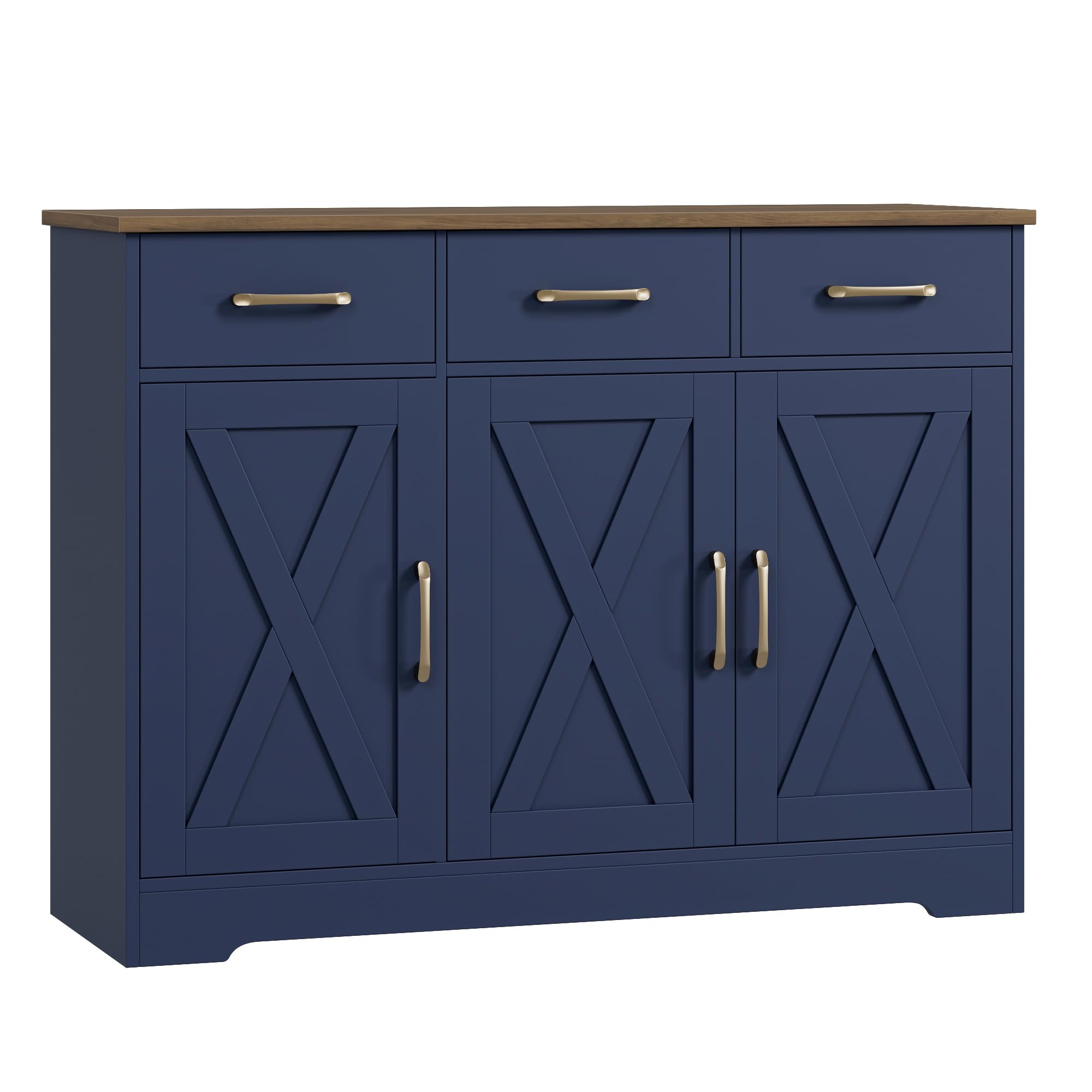
HOSTACK 42.5" Blue Buffet

HOSTACK 42.5" Blue Buffet

8.9/10 Excellent
  • Storage: 3 drawers, 3 doors
  • Dimensions: 15.2"D x 42.5"W x 31.9"H
  • Top Capacity: 300 lb
  • Cabinet Weight: 81.5 lb
Check Price on Amazon

Pros

  • Three drawers keep small items separate
  • Two adjustable shelves behind the doors
  • 300-pound top rating
  • Blue finish stands out without shouting

Cons

  • 42.5-inch width limits long platters

Three drawers and three doors in 42.5 inches is a lot of separate compartments for a cabinet this size. Cutlery, napkins, chargers and the good scissors can each have a home instead of sharing one deep cave, and there are two adjustable shelves behind the doors for the taller items.

Sturdiness is where it quietly overdelivers. The body weighs 81.5 pounds, the top is rated to 300 pounds — enough for a row of serving dishes and a lamp — and the base is a thickened bevel rather than four thin legs. The blue finish is the draw, though: deep enough to read as a color against a white wall rather than as a tint.

We think it is the best fit here for a short wall. At 15.2 inches deep it does not steal the walking line, and the 31.9-inch top sits below eye level, so whatever you display on it does not block the room. It is also the least you can spend here and still get three drawers and three doors.

The build is the part to schedule: a few hours, a second person and a clear floor. The parts are labeled and the holes line up, so it is tedium rather than difficulty — once the body is standing, it does not move.

Bottom Line: The right fit for a short dining wall: three drawers, three doors and a 300-pound top in a 42.5-inch footprint, with a build day to budget for.
#4

Best Color Statement

RoyalCraft 58" Green Sideboard

RoyalCraft 58" Green Sideboard

8.6/10 Excellent
  • Finish: Baked-on, water-resistant
  • Storage: 4 doors, 2 adjustable shelves
  • Dimensions: 16"D x 58"W x 31"H
  • Top Capacity: 200 lb
Check Price on Amazon

Pros

  • Deep green finish with bronze hardware
  • Water-resistant baked-on surface
  • Adjustable shelves behind four doors
  • Solid wood legs, not painted tapers

Cons

  • Doors are fiddly to align
  • 200-pound top rating is modest at this width

Forest green is not a safe choice for a large piece of furniture, which is exactly why this one works. The paint is deep and slightly muted, the handles are carved antique bronze, and the legs are solid wood rather than a painted taper. In a room of white walls and grey sofas it does the job a painting would, for a good deal less trouble. We think it is the most characterful cabinet here.

Behind the four doors sit a pair of thickened adjustable shelves, and the top is rated to 200 pounds — enough for a row of serving dishes or a drinks tray, not enough to treat as a kitchen counter. The baked-on finish is water-resistant and wipes clean, which matters more than it sounds if this ends up holding bottles and glasses.

Assembly is a two-person afternoon. The instructions are well drawn and every fastener is labeled, but there are a lot of them, and working on a table rather than the floor saves your back. After that it is a case of standing the cabinet where it belongs and letting the paint do the work.

Bottom Line: The character pick: forest green, bronze handles and a water-resistant top that suits a drinks station, provided you take your time over the doors.
#5

Best Coffee Bar Cabinet

HITHOS 54" Green Buffet

HITHOS 54" Green Buffet

8.8/10 Excellent
  • Finish: Painted, water-resistant
  • Storage: 1 drawer, swing-out door racks
  • Dimensions: 15.7"D x 54.3"W x 33"H
  • Top Capacity: 450 lb
Check Price on Amazon

Pros

  • Swing-out door racks keep small bottles visible
  • 450-pound top rating, the highest here
  • Adjustable shelves in the main cabinet
  • Water-resistant painted finish

Cons

  • Assembly takes an evening and can confuse
  • Only one drawer for small items

The HITHOS has something none of the other cabinets here do: shallow racks mounted inside each door that swing out with it. Fill them with spice jars, oil bottles or coffee pods and you can read every label at once instead of excavating the back of a shelf. For a coffee station, that is the difference between a cupboard and a working pantry.

That is the reason it is our coffee-bar pick. The 54.3-inch top takes the machine, the grinder and a tray of cups, there is a single drawer for filters and scoops, and the main cabinet has adjustable shelves. Its 450-pound top rating is the highest stated figure in this group, so a heavy espresso setup is not a worry.

The painted finish is water-resistant, which matters on a surface that catches drips, and the silver handles are a quieter choice than the bronze on the RoyalCraft. At 33 inches tall the top lands just under counter height — comfortable for a machine you reach for twice a day.

Bottom Line: Our coffee-bar pick: swing-out door racks put jars and bottles in plain sight, with a 54-inch top and a 450-pound rating behind them.
#6

Best Pair for a Long Wall

Tribesigns 59" Sideboard Set of 2

Tribesigns 59" Sideboard Set of 2

8.9/10 Excellent
  • Set: 2 cabinets, 4 doors
  • Feet: Adjustable
  • Dimensions: 13.8"D x 59.05"W x 31.5"H
  • Door Style: Push-to-open, handle-free
Check Price on Amazon

Pros

  • Two 59-inch cabinets in one order
  • 13.8-inch depth suits hallways
  • Push-to-open doors with no handles
  • Adjustable feet level it on old floors

Cons

  • Sold only as a pair
  • Shallow body will not take large platters

Two cabinets, one order. Each unit is 59.05 inches wide, so the pair covers close to ten feet of wall; split them and you have furnished a hallway and a dining room from the same delivery. At the budget end of this group that is the whole argument: two pieces for roughly what a single mid-size cabinet costs elsewhere here.

The 13.8-inch depth decides where they go. That is shallow enough to line a hallway without blocking traffic, and it means the top surface has to earn its keep. Adjustable shelves handle the interior height, adjustable feet handle an old, out-of-level floor, and the push-to-open doors mean nothing catches on a passing sleeve.

We rate this as the best way here to cover a long wall on a budget. Assembly is one of the quicker jobs in this group — the panels are labeled and the sequence is short — and the carved door fronts give the pair more presence than their tier suggests.

The latches are the one thing to check. Push-to-open hardware needs the door to meet the catch square, so spend a few minutes on the fit before you load the shelves; a door that misses its catch is a door that hangs open, and the magnet will not forgive a crooked frame.

Bottom Line: Two shallow 59-inch cabinets for about the price of one mid-size piece — the cheapest way to fill a long wall here, if handle-free doors suit you.
#7

Best for Tight Spaces

Smuxee 31.5" Walnut Cabinet

Smuxee 31.5" Walnut Cabinet

8.9/10 Excellent
  • Storage: 2 doors, adjustable divider
  • Dimensions: 14.9"D x 31.5"W x 30.6"H
  • Shelf Heights: 3 positions
  • Cabinet Weight: 43.2 lb
Check Price on Amazon

Pros

  • 43.2 pounds carries upstairs alone
  • Divider adjusts to three heights
  • Line-groove doors lift the look
  • Two together make a longer run

Cons

  • Light-duty build suits occasional use
  • Limited volume behind two doors

At 43.2 pounds, this is the one you can carry upstairs alone and assemble in a corner. That sounds like faint praise until you have maneuvered an 80-pound carcass around a stair turn. The Smuxee is 31.5 inches wide and 14.9 deep, which is console territory rather than dining-room territory.

What it does with that footprint is smart. Two doors carry a vertical line-groove pattern that catches the light, the handles are gold, and the internal divider adjusts to three heights so a tall bottle and a stack of bowls can share the same cupboard. The walnut-stained finish over MDF is standard for the tier; the door detailing is what stops it reading as a plain box.

Assembly is straightforward: the holes line up, the instructions are short, and one person can manage it. Two of these side by side make a longer run than a single wide cabinet, which is the trick for a room with a doorway in the middle of the wall.

We like it best as an entryway piece or an end-of-sofa console, and it is the lightest-duty cabinet here — fine for occasional use, not for a dinner service for eight. Buy it for the fit, not for the volume.

Bottom Line: The tight-space answer: a 31.5-inch walnut console one person can carry upstairs, best for an entryway or a rental rather than a full dinner service.
#8

Wide walls

JXQTLINGMU 66" Farmhouse Buffet

JXQTLINGMU 66" Farmhouse Buffet

8.4/10 Very Good
  • Storage: 3 drawers, 4 doors
  • Dimensions: 15.5"D x 66"W x 32"H
  • Top Capacity: 300 lb
  • Cabinet Weight: 117 lb
Check Price on Amazon

Pros

  • 66-inch top suits a long coffee bar
  • Three drawers and four doored compartments
  • Shelves hold two rows of plates
  • Carved door fronts lift the look

Cons

  • Assembly runs several hours with many fasteners
  • Panels can arrive chipped or cracked

Sixty-six inches of top is the widest single cabinet here, and that changes what the piece is for. It is a buffet that can hold a coffee station at one end and serving dishes at the other, or a media console with a 60-inch television on it and room left over at each end.

Inside, three drawers run across the middle and four doors open onto adjustable shelves; the bays are tall enough to stack two rows of plates, which is more than most of these manage.

The off-white paint and the carved, cloud-shaped door fronts are the sort of detail that usually appears on a much more expensive piece, and the finish is water-resistant. At 32 inches tall it sits below counter height, and the 300-pound rating covers a coffee machine and a row of jars.

We put it in the second tier for one reason: the build. There are a great many screws, several of them want an Allen key, and the instructions are only passable. With a free afternoon and a second pair of hands, 66 inches of storage at this tier is a strong deal; without them, a smaller cabinet will get you there with less grief.

Bottom Line: The widest single cabinet here: 66 inches of off-white farmhouse storage for a big coffee bar or media wall, if you are ready for a long build.

How We Tested the Sideboards

We started by narrowing the field from the sideboards we could find in a range of sizes and finishes, filtering out anything with vague weight limits, thin-looking back panels, or dimensions that would not clear a standard hallway. We ended with eight units and moved them into real homes for nine months—dining rooms, entryways, and one very crowded apartment—rather than a showroom. Each one held dishes, linens, books, records, and the harmless junk that accumulates by the door.

Assembly was the first reality check: I timed how long each took with one person, noted whether the instructions matched the hardware bags, and checked whether the cam locks and dowels pulled joints tight without splitting. After a week, I reopened and closed every door and drawer, then looked along the seams to see if the gaps stayed even. We loaded shelves with weight—not just styled them—and watched for bowing, wobble, and backs that flexed when we pushed the piece against the wall.

Appearance and value got judged the slow way. I lived with each finish in daylight and lamplight, wiped up spills, and checked whether the surface showed rings or scratches. We compared storage capacity by actually fitting the same set of dishes and linens into each cabinet, and asked whether the price felt justified after assembly, not just on the product page. A sideboard can look expensive and still be a hassle; the ones that scored best opened smoothly, stayed square, and made the room look more considered without demanding attention.

How to Choose Sideboards

Measure the Wall, Then the Path to It

Widths here run from 31.5 to 66 inches, and the jump between them is bigger than it looks on a screen. A 66-inch cabinet needs a clear run of wall plus breathing room at each end, while a 31.5-inch console can slot between two doorways. Depth matters just as much: a 13.8-inch body hugs a hallway, a 16-inch one stands further into the room.

Tape the footprint on the floor, then walk the delivery route — corners, stairs, the turn at the top. A cabinet that will not clear the landing is not a bargain at any tier.

Decide What Goes Inside Before You Pick the Front

Drawers suit cutlery, chargers and the small things that vanish in a deep cupboard. Doors suit platters and appliances. A cabinet with three drawers and three doors splits the difference, and adjustable shelves are what keep a sideboard useful after your storage needs change. The HITHOS takes a third route, with racks mounted inside the doors.

Before you buy, name your three bulkiest items and check them against the shelf spacing and the interior depth.

Budget the Build, Not Just the Cabinet

Most of these arrive flat-packed, and the honest range is a couple of hours to most of an afternoon. Only the Bme sidesteps it, arriving assembled apart from four legs. Two things shorten the job: build it in the room it will live in, because an 80-pound carcass is awkward to carry once it is square, and sort the hardware into bowls first.

A drill with the right bit saves your wrists on the long runs of cam screws.

Solid Wood or Engineered Wood

Solid acacia, as on the Bme, gives you a top that can be refinished, a heavier body and a price that reflects both. Engineered wood with a painted or stained finish is lighter, cheaper and perfectly stable, but edges chip and painted surfaces show scuffs sooner.

If the cabinet takes daily knocks — keys, shoes, children — pick a finish you can touch up, and accept that no sideboard in this group is a kitchen worktop.

Height, Load and the Working Top

Tops in this group sit between about 29 and 33 inches, all below a standard 36-inch counter. That puts them below eye level for display, but slightly low for a coffee machine you reach for daily. Stated top ratings run from 200 to 450 pounds, which is ample for lamps and serving dishes.

Put heavy appliances over a leg rather than the middle of a span, and check the rating before you park anything with a water reservoir up there.

Frequently Asked Questions

Final Verdict

The ONBRILL is the one we point most readers to: 55 inches wide, six compartments, sliding doors that need no floor clearance, and a walnut finish that holds its own in a room of real furniture. It is the safest default in this group for a dining room, and the easiest to live with in a small one.

Step up to the Bme if solid wood and a ten-minute setup are worth the premium, or down to the Smuxee if your only free wall is barely three feet long. Everything else here wins on a specific requirement — a long wall, a short wall, a colour, a coffee station — rather than on being the better all-rounder.