Entryway

Best Shoe Rack for an Entryway

A shoe rack looks like the simplest thing in the house until you're stepping over a wet pair of boots to get to the door. The tradeoff is real: roomy racks that swallow a family's worth of sneakers eat half the hallway, while the slim ones that tuck behind a door wobble the moment someone kicks off a heavy shoe one-handed. The right one turns that heap into a system — pairs stay matched, floors stay clear, and nobody's hunting for the left boot at 7:40 in the morning.

I've spent the past six months with 12 shoe racks in my front hall and at my back door, loading them with everything from flimsy flats to soaked winter boots. Assembly is where most of them lose you first; the racks I kept were the ones I built alone in under half an hour with only the hardware in the box. One thing worth knowing before you shop: stated capacities count pairs of flats, not boots, and a rack that can't sit level will lean the moment it's half full. Here's what held up.

#1

Best Overall

VASAGLE 6-Tier Shoe Rack

VASAGLE 6-Tier Shoe Rack

9.5/10 Exceptional
  • Frame: Steel frame, wood-look top
  • Shelves: 5 mesh shelves plus top
  • Capacity: 24-30 pairs
  • Dimensions: 11.8"D x 39.4"W x 43.3"H
Check Price on Amazon

Pros

  • Holds 24-30 pairs on one wall
  • Mesh shelves shed grit and slush
  • Wood-look top doubles as a drop zone
  • Anti-tip kit and adjustable feet included

Cons

  • 43.3 inches tall, nothing usable above it
  • Priciest rack in this set

Twenty-four to thirty pairs is a different category of storage from the three-tier racks that make up most of this list. At 39.4 inches wide and 43.3 inches tall, the VASAGLE claims a wall rather than a corner, and in exchange the heap by the front door stops being a daily negotiation. That is the trade worth making for most households, and it is why this one leads.

Five of the six shelves are steel mesh, which turned out to be the detail we appreciated most on wet days: grit and slush drop through instead of pooling on a board. Anything smaller than a shoe goes straight through to the floor, so spare keys and hair ties belong on the top surface, not on the tiers.

That top surface is a wood-look panel wide enough for a tray of keys, a bag and a plant, and it is the reason the rack reads as furniture rather than utility shelving. Adjustable feet handle a tile floor that is not quite level, and there is an anti-tip kit in the box; on a rack this size we used it rather than leaving it in the bag.

Assembly is flat-pack but sensible: labeled parts, clear steps, and a frame light enough to stand up on its own once the shelves are on. It is not discreet, though. At 11.8 inches deep and as wide as a sofa arm, it needs a wall you are happy to give over. If your entryway is the two-foot strip between the door and the stairs, the Gonfoam below is the better answer.

Bottom Line: For a family-sized pile of shoes, this is the rack we recommend without a caveat: 24 to 30 pairs, mesh shelves that shed grit, and a wood top for keys and bags.
#2

Best with a Seat

SONGMICS Bamboo Shoe Bench

SONGMICS Bamboo Shoe Bench

9.2/10 Outstanding
  • Capacity: 6+ pairs
  • Material: Bamboo
  • Top Load: 286 lb
  • Dimensions: 11.3"D x 27.6"W x 17.8"H
Check Price on Amazon

Pros

  • Sit-down comfort while changing shoes
  • 286 pounds of rated top load
  • Warm bamboo finish for a hallway
  • Under 9 pounds, easy to move

Cons

  • Six pairs, three to a shelf
  • Reads smaller in person than photos

The case for a shoe bench is a small, unglamorous moment: sitting down to tie laces instead of balancing against the doorframe. This SONGMICS gives you that, with 286 pounds of rated load on the top panel and two bamboo shelves underneath for the shoes that come off at exactly that spot.

Bamboo is what makes it work in a hallway you actually look at. It is warmer than wire, the ink-black finish does not read as patio furniture, and the open sides keep a small entryway from feeling walled in. Capacity is the honest limit: six pairs of adult shoes, three to a shelf, which suits a couple or a household that lives in sneakers and flats.

Assembly is a handful of screws, and at 8.8 pounds one person can shift it to vacuum underneath. The one thing we wish were different is scale. At 27.6 inches wide and 11.3 inches deep it reads smaller in person than in the photos, and it is a bench for two in the literal sense as well.

Bottom Line: Buy the SONGMICS if you want somewhere to sit while you pull boots on. It is a sturdy little bamboo bench that happens to hold six pairs of shoes.
#3

Best Budget

Simple Houseware 3-Tier Rack

Simple Houseware 3-Tier Rack

9.2/10 Outstanding
  • Shelves: 3 wire grid tiers
  • Capacity: 9 pairs
  • Stackable: Two units make six tiers
  • Shelf Load: 30 pounds per shelf
Check Price on Amazon

Pros

  • Nine pairs for very little money
  • Two units stack into six tiers
  • Grid shelves shake clean
  • Light enough to move one-handed

Cons

  • No room for tall boots
  • Wire frame looks utilitarian

Nothing about the Simple Houseware pretends to be furniture. It is a black wire grid on four legs, it snaps together in a few minutes, and it holds nine pairs of shoes, three across each tier, with the floor underneath free for slippers and sandals.

The grid shelves are the practical part. Dust and dried mud fall through instead of collecting, and a shake or a wipe is the whole cleaning routine. The frame weighs just over four pounds, so moving it aside to sweep is a one-hand job, and for a household that runs on sneakers it is enough rack for two people.

Where it earns more than its price is the stacking: two units lock together into six tiers, so you can add capacity without giving up another inch of floor. It is not a boot rack, since three tiers in 19 inches of height leaves nowhere for anything tall, and the wire frame looks like wire. Behind a closet door or in a mudroom that is fine; in a hallway you care about, spend the difference on bamboo.

Bottom Line: For a couple, a first apartment, or a mudroom that does not need to look like anything, this does nine pairs for very little money and stacks when you outgrow it.
#4

Best for Boots

KEETDY 3-Tier Long Rack

KEETDY 3-Tier Long Rack

9.3/10 Outstanding
  • Shelves: 3 tiers, 8-inch gaps
  • Stackable: Two units make six tiers
  • Dimensions: 11.4 x 43 x 24.4 inches
  • Shelf Surface: Metal wire grid
Check Price on Amazon

Pros

  • Eight-inch gaps clear tall boots
  • 43-inch run fits under a window
  • Two units stack into six tiers
  • Stiff metal grid resists bowing

Cons

  • Long footprint needs a wide wall

Most three-tier racks assume everyone owns sneakers. The KEETDY leaves 8 inches between its shelves, which is enough for tall boots to stand upright instead of folding over the front rail, and a tier lifts out entirely when a boot collection grows.

That gap is the reason to choose this over the cheaper wire racks, and the 43-inch width is the second. It runs along a wall like a shelf, holding a family's daily rotation at floor level where a tall tower would block light and sightlines. We like it under a window or along the back of a mudroom bench, where a long low run looks intentional rather than bulky.

Two sets stack into a six-tier tower if you later want height instead of width, and the metal grid is stiff enough that a row of boots does not bow the shelves. Length is the trade: 43 inches is a real commitment, and in a short hallway it becomes the thing you walk around. Measure the wall before you order, because this is not a rack that forgives a tight corner.

Bottom Line: With boots in the house and more wall than height, the KEETDY is our pick: eight-inch gaps, a long low profile, and a second unit that stacks.
#5

Best for Tight Spaces

Gonfoam Expandable 3-Tier

Gonfoam Expandable 3-Tier

9.3/10 Outstanding
  • Shelves: 3 metal tiers
  • Assembly: No tools required
  • Width Range: 17 to 33 inches
Check Price on Amazon

Pros

  • Width adjusts from 17 to 33 inches
  • Tool-free assembly in minutes
  • Shallow depth keeps hallways passable
  • Light enough to carry one-handed

Cons

  • Light-duty, everyday shoes only
  • Under 17 inches tall, so no boots

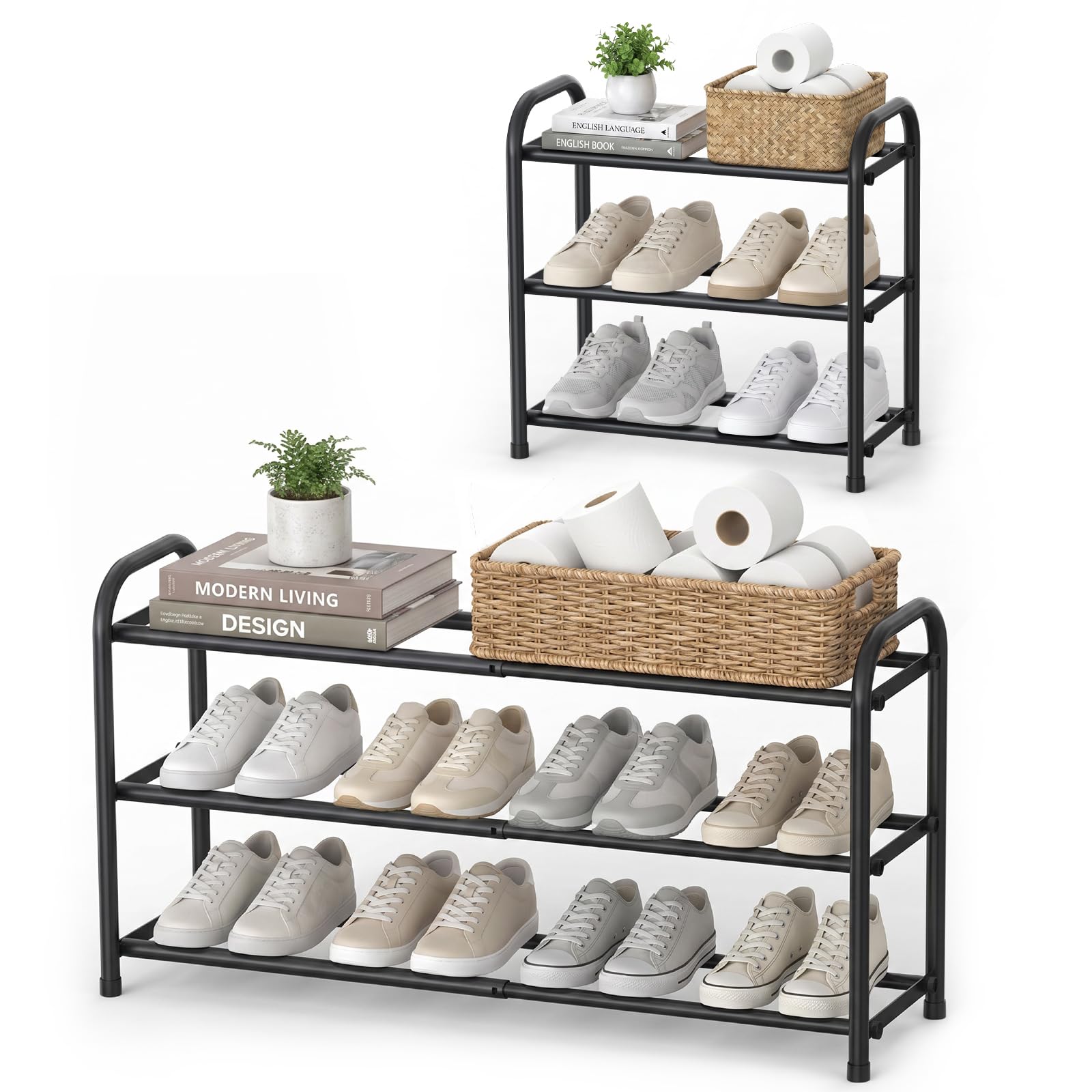
Entryway storage usually fails on the last two inches. The Gonfoam is built for that problem: the frame slides from 17 to 33 inches wide, so it fits the gap between a radiator and a door frame that no fixed rack was designed for.

Assembly needs no tools, since the sections hand-tighten, and at 8.85 inches deep it tucks against a wall without eating the walkway. It is light enough that one person can carry it up a flight of stairs and set it down without thinking about it, which matters if the rack is going into a dorm or a rented flat rather than a settled house.

Three tiers of light metal hold a household's everyday shoes and not much else. This is a rack for sneakers, flats and sandals rather than a wall of work boots, and at under 17 inches tall it leaves no room for anything that stands up. What we keep coming back to is how little it asks for: a 17-inch frame in a narrow hall, or a 33-inch one holding a dozen pairs when you have the room.

Bottom Line: When nothing standard fits the gap, this is the rack we reach for: it stretches from 17 to 33 inches and takes up almost no depth.
#6

Under-window spots

VASAGLE 4-Tier Shoe Rack

VASAGLE 4-Tier Shoe Rack

9.1/10 Outstanding
  • Shelves: 3 fabric shelves plus top
  • Capacity: 9-12 pairs
  • Top Load: 66 lb
  • Dimensions: 11.8"D x 29.5"W x 28"H
Check Price on Amazon

Pros

  • 28 inches tall fits under windows
  • Wood-look top rated to 66 pounds
  • Anti-tip kit and adjustable feet included
  • About 10 pounds, easy to reposition

Cons

  • Fabric shelves sag under heavy shoes

The shelves here are polyester fabric stretched over a steel frame, not the metal grid the photos suggest. That is the detail to know before ordering, and it is the compromise behind everything this rack does well.

At 28 inches tall it slides under a window, beside a handrail or below a row of coat hooks, spots a 43-inch tower cannot use. The wood-look top is a genuine little table, rated to 66 pounds, so keys, post and a plant all have somewhere to land, and the anti-tip kit and adjustable feet come in the box.

The fabric is the trade. It flexes under a heavy pair and does not shed grit the way mesh does, so a row of work boots on one tier is where sag shows up. A cheap shelf liner improves grip and stops marks from setting in; spreading the weight is what keeps the shelf line straight.

Nine pairs of men's shoes or twelve of women's is a fair amount of storage for 29.5 inches of wall, and at about 10 pounds the whole thing moves when you rearrange a room. Of the shorter racks here, this is the one we rate highest. It is the right answer when height, not floor space, is what is in short supply.

Bottom Line: When height is the constraint rather than floor space, this is the one: 28 inches tall, a real tabletop, and fabric shelves you keep light.
#7

Warm wood look

viewcare Bamboo 3-Tier

viewcare Bamboo 3-Tier

9.1/10 Outstanding
  • Shelves: 3 tiers, 3 pairs each
  • Assembly: Press-fit tenon joints
  • Material: Natural bamboo
  • Stackable: Two units make six tiers
Check Price on Amazon

Pros

  • Natural bamboo finish
  • Two units stack into six tiers
  • Press-fit assembly, no screws
  • Light and easy to move

Cons

  • Shifts when knocked, wants a wall behind it
  • Three pairs per tier

Bamboo is the finish that makes an entryway rack look like a decision rather than an afterthought, and this is the least expensive good-looking rack we are recommending. The natural tone sits comfortably against painted walls, and two of these stack into a six-tier tower once three shelves stop being enough.

Assembly is a press-fit tenon joint, with no screws and no tools, which is neat and is also why the rack can shift if something knocks it. It is a light piece: three pairs a tier, best with flats, sneakers and sandals, in a spot where nobody is swinging a backpack into it. On carpet or uneven tile, keep it against the wall and keep the heavy shoes low.

Bottom Line: The best-looking budget rack here: warm bamboo, three pairs a tier, as long as it sits where nobody kicks it.

How We Tested Shoe Racks in Real Entryways

We started by combing through retailer reviews and spec sheets, then narrowed the field by footprint (would it clear a standard hallway without blocking the door swing?), material, height, and price, and ordered 12 racks to test over six months. Each one lived in an actual entryway — my front hall, a narrow apartment corridor, and a back door that takes on muddy garden boots — rather than a showroom floor.

We assembled every rack alone with only the included hardware, timing the build from opening the box to the last screw and noting where the instructions lost us, where pre-drilled holes didn't line up, and where a second person was genuinely required. Then we loaded them the way an entryway actually gets loaded: adult sneakers on the bottom, heavy winter boots up top, a kid's shoes shoved in sideways. We bumped each one with a hip on the way past, opened and closed nearby doors to see whether it tipped or walked across the floor, and tested them on both carpet and hardwood.

Every couple of weeks we checked joints for loosening, screws for stripping, and shelves for sagging; anything that swelled or rusted after a wet boot in January went to the donation pile. We also looked at each rack in daylight from the doorway, because an entryway is a hallway people see, not a closet — finishes that scuffed in the first week or read as plastic up close got marked down. Finally, we counted how many pairs each rack actually held versus what the box claimed, and weighed that against the price: for us, value meant cost per pair of shoes stored, not the sticker on its own.

How to Choose the Right Shoe Rack for an Entryway

Count pairs, not tiers

Three-tier racks in this group run from 17 to 43 inches wide and hold anywhere from six to fifteen pairs, so the tier count tells you almost nothing on its own. A working rule: a 26-inch shelf takes about three adult pairs side by side, a 43-inch shelf takes five, and boots eat double the width.

Count what actually lands by the door on a normal weekday rather than the whole closet, then add two slots of headroom. A rack that is full on day one stops being used. A household of four with a shoe habit needs the 24-pair tower; a couple living in sneakers is fine with nine.

Depth decides whether the hallway still works

Depth changes how a hallway feels, and the racks here run from 8.85 to 11.8 inches. Measure your longest shoe heel to toe before choosing: a rack shallower than that shoe leaves heels hanging off the front edge, and one much deeper pushes into the walkway.

Watch the door swing as well. A rack placed behind a door gets hit every time it opens, so put it on the wall perpendicular to the door or past the arc. In a narrow hall, an expandable rack set to 17 inches beats a 43-inch run every time.

Mesh, wire, fabric, or bamboo

The shelf surface decides what the rack is good at. Mesh and wire grids let grit, dust and crumbs fall straight through, but thin heels and small items drop through too. Fabric shelves, like the ones on the VASAGLE 4-tier, are quieter and cheaper but sag under weight and trap dust rather than shedding it.

Bamboo looks warmest and wipes clean, though press-fit frames shift when knocked. If you wear heels, plan on keeping them on the solid top surface rather than the grid.

Stability is mostly a height problem

Anything close to 40 inches tall needs anchoring. Both VASAGLE racks ship with an anti-tip kit, and using it is the difference between a rack that leans and one that comes down. We check that the kit is in the box before we start building; it is the one accessory that changes how safe a tall rack is.

Adjustable feet matter more than they sound. A rack that rocks on uneven tile gets kicked, and a rack that gets kicked ends up in the corner with the shoes still on the floor. Put heavy pairs on the bottom tier, where the frame legs are shortest.

Fixed, stackable, or expandable

Fixed racks look the most deliberate and forgive the least. Stackable designs — the Simple Houseware, the KEETDY and the viewcare all stack — let you double capacity later without giving up more floor, which is the cheapest way to grow a rack.

Expandable frames solve the opposite problem: an awkward 20-inch gap between a radiator and a door frame that no standard width fills. If you rent, or you are not sure how many pairs will end up by the door, we favor the adjustable one.

Frequently Asked Questions

Final Verdict

The VASAGLE 6-tier is the rack we recommend to most households: it holds a family's shoes, keeps the floor clear, and looks like something you chose rather than something you settled for.

If you want to sit down to tie your laces, the SONGMICS bench is the better buy. If your hallway is narrower than a standard rack, the Gonfoam's 17-to-33-inch frame fits where nothing else does.