Home Office

Best Bookshelves of 2026

A bookshelf should hold your books, not your attention. The wrong one wobbles when you pull a novel off the top shelf, sags in the middle, or turns a Saturday afternoon into a hex-key puzzle with vague instructions; the right one makes a room feel finished, swallows hardcovers and board games, and stays put. It gives you storage you don't have to think about—and furniture that looks intentional rather than temporary. We've spent six months with a dozen bookshelves, from compact cubes to full-height cases, and the differences in assembly, sturdiness, and usable shelf space were obvious.

I've learned that shelf depth matters as much as height—a deep shelf swallows art books but wastes floor space in a narrow room—and that a back panel can do more for rigidity than thick side boards. We assembled each one, loaded it with real books, and paid attention to how it looked and held up, not just how it photographed. The picks below are the ones that earned their footprint.

#1

Best Overall

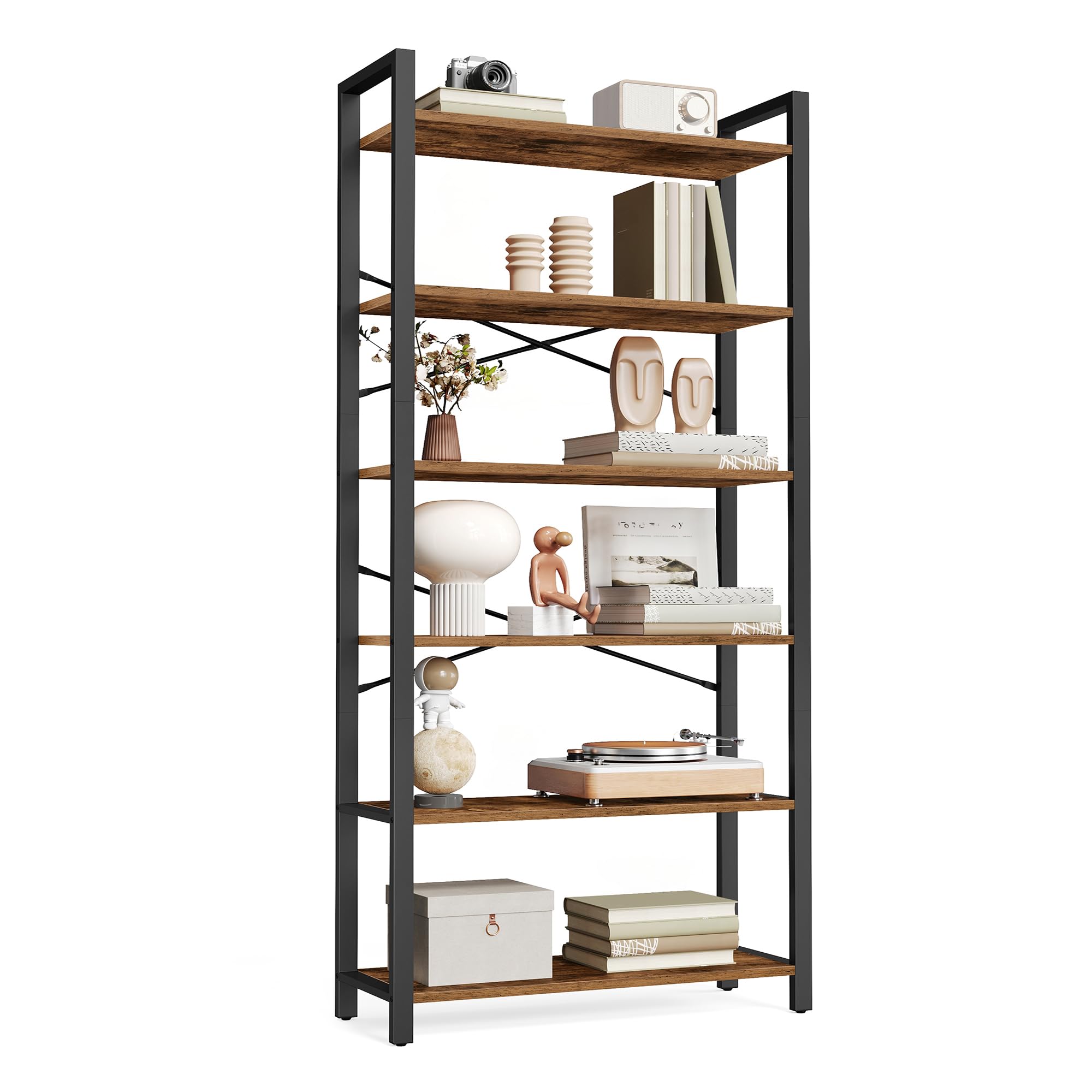
VASAGLE 6-Tier Bookshelf

VASAGLE 6-Tier Bookshelf

9.3/10 Outstanding
  • Shelves: 6 tiers
  • Stability: Anti-tip kit, adjustable feet
  • Dimensions: 11.8"D x 26"W x 73.2"H
  • Weight Capacity: 132 pounds total
Check Price on Amazon

Pros

  • Six tiers in a 26-inch-wide footprint
  • Anti-tip kit and adjustable feet included
  • Lowest price among the tall open units here
  • One-person assembly with labeled parts

Cons

  • Screw holes can arrive out of line, stalling a build
  • 11.8-inch depth leaves oversize art books overhanging

Twenty-six inches wide, just under twelve deep, and a shade over six feet tall — the VASAGLE is the shape most small rooms actually want from a bookcase. Six tiers of storage fit in a strip of floor narrower than a doorway, and it does that for less money than any other tall open unit here. That is why it is our default for a spare bedroom, a study, or the wall beside a desk.

The frame is steel and the shelves are half-inch particleboard, which is the usual arrangement at this end of the market and works because the steel carries the load. What the listing doesn't spell out is that the 132-pound capacity is for the whole unit, not one shelf. Spread across six tiers, a shelf of hardcovers sits close to the limit, so we kept the heavy books on the bottom two tiers and paperbacks up top, and the boards stayed flat.

Two details make it easier to live with than the price suggests: adjustable feet that level it on a floor that isn't true, and an anti-tip kit in the box rather than sold separately. At 73 inches, anchoring it isn't optional in a house with kids or a big dog. Assembly is the usual labeled-parts job, and one person can manage it without help.

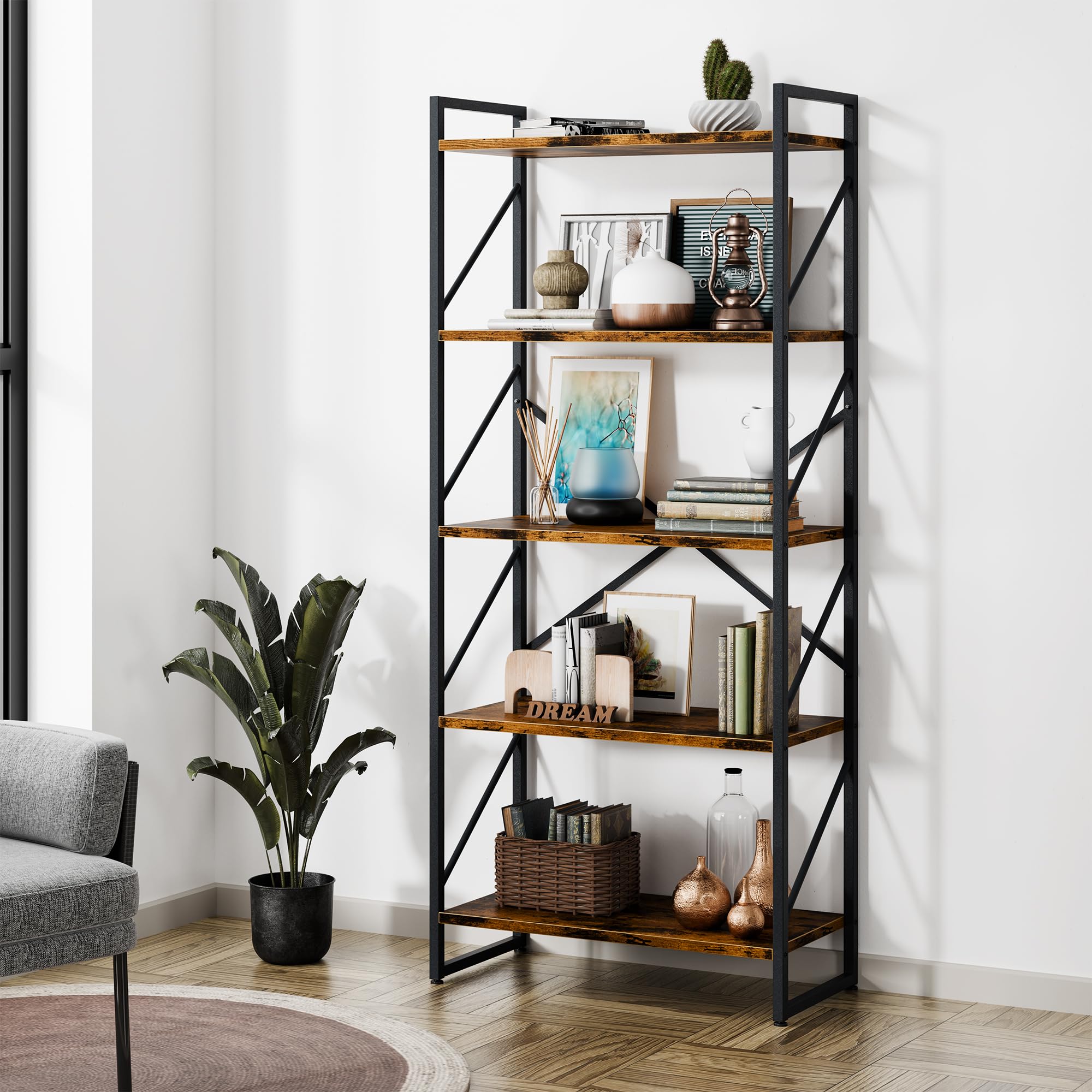
Bottom Line: The best default here for a small room: six tiers of books in a 26-inch-wide strip of floor, with the anti-tip kit and leveling feet already in the box.
#2

Best Build Quality

Sauder Trestle 5-Shelf Bookcase

Sauder Trestle 5-Shelf Bookcase

9.3/10 Outstanding
  • Finish: Vintage Oak, all four sides
  • Shelves: 5 open shelves
  • Dimensions: 16.63"D x 23.5"W x 71.13"H
  • Unit Weight: 60 lb
Check Price on Amazon

Pros

  • 16.63-inch shelves take oversize volumes
  • Finished on all sides, so it can float
  • 60-pound frame reads as furniture
  • Five-year parts coverage

Cons

  • Heaviest carton here; plan on two people
  • Highest price in this group for engineered wood

The Trestle is finished on all four sides, which sounds like a small thing until you want a bookcase that doesn't have to stand against a wall. Put it in the middle of a room as a divider, or at the end of a run of shelving, and the back is as presentable as the front. Almost nothing else here can do that.

Depth is the bigger story. At 16.63 inches these are the deepest shelves in the group by a wide margin, and that is what lets art books, binders, and oversized hardcovers sit fully inside the frame instead of hanging over the front edge. The unit itself weighs 60 pounds, and it feels like it. This is the bookcase we reach for when someone tells us the shelves have to hold a real collection rather than a few paperbacks and a plant.

It is engineered wood rather than solid timber, and the vintage oak finish is a good print rather than an heirloom. Expect to need two people for the carton, not because the build is complicated — the instructions are clear and the hardware is generous — but because 60 pounds of flat-pack is awkward to wrestle upright alone. Sauder covers the parts for five years, longer than the one-year cover on the least expensive units here.

Bottom Line: Buy this if the shelves will hold real books and be seen from the back: it is the deepest, heaviest, best-finished bookcase in this group.
#3

Best for Heavy Books

Shintenchi 5-Tier Bookshelf

Shintenchi 5-Tier Bookshelf

9.2/10 Outstanding
  • Shelves: 5 tiers
  • Dimensions: 11.8"D x 23.6"W x 62.2"H
  • Back Bracing: X-shaped rod
  • Weight Capacity: 40 pounds per shelf
Check Price on Amazon

Pros

  • 40 pounds per shelf, the strongest stated rating here
  • X-shaped back rod keeps the frame square
  • Five tiers on a 23.6-inch width

Cons

  • Paint can chip at edges and corners

Almost the same money and nearly the same footprint as our top pick, the Shintenchi makes one argument the VASAGLE can't: 40 pounds per shelf, quoted shelf by shelf. On the VASAGLE, the 132-pound figure is the whole unit. If your shelves carry hardcovers, photo albums, or binders rather than paperbacks, that difference is the whole decision.

It is five tiers rather than six and 62 inches tall rather than 73, so it reads as a bookcase rather than a wall of shelving — better in a bedroom, worse if you are trying to store a lot in very little floor. The powder-coated frame is braced with an X-shaped rod across the back, and loaded up it stands without the sideways shimmy tall flat-pack units sometimes develop. Of the mid-priced open units here, this is the one we trust with weight.

Just under twelve inches of depth takes a standard hardcover and not much more, so an oversized book has to lie flat or go somewhere else. That is the honest boundary of what this shelf is for. Where it will show wear is the finish: the frame is the part to look over when it arrives.

Bottom Line: If the shelves hold hardcovers, binders, or photo albums rather than paperbacks, this is the better of the two mid-priced towers — 40 pounds a shelf, stated plainly.
#4

Best for Wide, Low Walls

SUPERJARE Triple 4-Tier Bookshelf

SUPERJARE Triple 4-Tier Bookshelf

9.3/10 Outstanding
  • Feet: 8 adjustable feet
  • Shelves: 11, adjustable
  • Dimensions: 9.5"D x 59.5"W x 54.9"H
  • Weight Capacity: 22 pounds per shelf
Check Price on Amazon

Pros

  • Wide, low profile fits under a window
  • Adjustable shelf heights across 11 bays
  • Eight adjustable feet for uneven floors

Cons

  • 9.5-inch depth leaves oversize books overhanging
  • Steel frame feels light for its width

Fifty-nine and a half inches wide and under five feet tall, the SUPERJARE runs along a wall rather than up it. That is the shape you want under a window, along a hallway, or in a room where a 73-inch tower would block the light and make the ceiling feel low. It is a stepped ladder profile, so the bays shorten toward one end.

Eleven open shelves, and the heights adjust — that is the part we were struck by. You can set two tall bays for art books and a run of short ones for paperbacks on the same unit, which is the most shelf flexibility in this group. Eight adjustable feet underneath handle a floor that isn't level, and at 22 pounds per shelf it is rated for books rather than a record collection.

Nine and a half inches of depth means anything bigger than a standard hardcover overhangs, and the steel frame reads lighter in the hand than the VASAGLE's does. Neither matters much if the shelf is mostly paperbacks, plants, and board games — which, at this height, is exactly what it is for.

Bottom Line: The best answer for a long, low wall: eleven adjustable bays let art books and paperbacks share one unit without a tower blocking the window.
#5

Best for Tight Corners

SUNMORY Tree Bookshelf

SUNMORY Tree Bookshelf

8.9/10 Excellent
  • Shelves: 6 tiers
  • Storage: 2 drawers
  • Capacity: 5 to 10 books per shelf
  • Dimensions: 7.87"D x 14.57"W x 47.4"H
Check Price on Amazon

Pros

  • 14.57-inch width fits gaps a bookcase can't
  • Two drawers take the clutter
  • Angled tiers suit paperbacks and DVDs

Cons

  • Five to ten books a tier caps the collection
  • Many parts make the build slow going

The tree shape isn't decoration bolted onto a box — the branches are the shelves, angled and staggered up a central trunk, with two drawers sitting at the base. At 14.57 inches wide and under four feet tall, it slides into gaps no rectangular bookcase will take: beside a door, between a desk and a wall, in the corner of a small bedroom.

Each tier holds somewhere between five and ten books depending on thickness, so the honest reading is a small collection rather than a library. The angled branches take paperbacks, DVDs, and children's books well; a heavy art book wants the bottom tier or one of the drawers. Assembly is the trade-off — there are a lot of parts, and the instructions lean on a QR-code video.

Where it earns its place is in a room where the shelf is also the thing you look at. Of everything here, this is what we choose when the bookcase has to be furniture rather than storage: the drawers absorb the clutter that would otherwise eat a shelf, and the silhouette gives a small room something to look at instead of a flat wall of spines.

Bottom Line: For a small room where the shelf will be seen, this is the pick: two drawers, six angled tiers, and a footprint narrower than a nightstand.
#6

Smallest footprint

SEI Metal Spine Book Tower

SEI Metal Spine Book Tower

9.0/10 Outstanding
  • Shelves: 12
  • Dimensions: 15.75"W x 16"D x 65.25"H
  • Shelf Gaps: 5.25 and 5.5 inches
  • Weight Capacity: 99 lb
Check Price on Amazon

Pros

  • Twelve shelves on a 15.75-inch width
  • Books read as floating rows
  • Fast, tool-light assembly

Cons

  • Shelves can bow under a heavy row of hardcovers

Twelve shelves in a 16-inch square sounds like a magic trick until you read the gaps: 5.25 to 5.5 inches between shelves on alternating levels. That is paperback height. Trade hardcovers fit on some levels and not others, and an art book doesn't fit at all — so go in knowing this is a tower for a paperback habit rather than a reference library.

What it does within that limit is clever. The black metal frame holds each shelf out on its own, so books sit forward and read as floating rows rather than a solid wall of spines, and the whole thing stands 65 inches tall without looking heavy. Assembly is the least painful on this list; the frame goes together with the included hardware and stays square. The stated capacity is 99 pounds for the tower.

In an apartment, the 15.75-by-16-inch footprint is the entire point: it turns a strip of wall the width of a chair into twelve shelves. We keep coming back to it for narrow rooms where an ordinary bookcase would eat the walking space.

Bottom Line: For a paperback-heavy collection in a small apartment, this tower holds twelve shelves of books in a footprint the width of a chair.
#7

Family rooms

VASAGLE 13-Compartment Bookcase

VASAGLE 13-Compartment Bookcase

9.1/10 Outstanding
  • Back: Closed back with side panels
  • Dimensions: 9.8"D x 33.9"W x 55.1"H
  • Compartments: 13
  • Weight Capacity: 176 pounds total
Check Price on Amazon

Pros

  • Thirteen mixed-size cubbies in one frame
  • Closed back and side panels hold things in
  • Rounded corners and anti-tip kit included

Cons

  • Reads smaller in the room than in photos
  • Pictogram-only instructions slow the build

Side panels, a closed back, and rounded corners: this VASAGLE is built like a cubby unit rather than an open shelf, and that changes what it is good at. Nothing slides off the back, nothing drops through to the wall, and the compartments are sized for paperbacks, magazines, CDs, and the odds and ends that never find a home on a normal shelf.

Thirteen compartments in a tree arrangement sit on a 33.9-inch-wide frame that stands 55 inches tall, and the layout is the appeal — tall cubbies for magazines, short ones for paperbacks, a couple sized for a plant or a basket. Stated capacity is 176 pounds across the unit, the highest total on this list.

Two things to know before ordering. It reads bigger in the photos than it does in a room, so measure the wall rather than the picture. And the instructions are pictograms only, which is survivable but slows the build while you work out which panel faces where.

Where it earns a place is a family room or a child's bedroom. The closed back, the side panels, and the rounded corners are exactly what you want in a room where small hands pull books out, and the anti-tip kit a 55-inch unit needs is already in the box.

Bottom Line: For a child's room or a family room, the closed back and rounded corners matter more than shelf count, and this is the pick for that job.
#8

First apartments

Furinno Pasir 3-Tier Bookshelf

Furinno Pasir 3-Tier Bookshelf

8.8/10 Excellent
  • Shelves: 3 tiers
  • Material: FSC-certified composite wood
  • Dimensions: 9.7"D x 23.7"W x 31.5"H
  • Weight Capacity: 40 pounds per shelf
Check Price on Amazon

Pros

  • Least expensive bookcase here
  • Closed back panel keeps books in place
  • 40 pounds per shelf on a 19.4-pound unit

Cons

  • Laminate chips at the edges and corners

This is the least expensive shelf in the group, and it doesn't pretend otherwise: three tiers, 31.5 inches tall, particleboard with a printed walnut grain and a closed back panel. Set beside a tall tower it looks like what it is — a small, light, inexpensive bookcase.

In the right spot it is hard to argue with. Under a window, at the end of a desk, in a dorm or a first apartment, 31.5 inches is exactly the height that fits without dominating a room, and the closed back means books can't slide out the rear. Each shelf is rated to 40 pounds, generous for a unit this light.

The material is the catch. The boards are thin, the laminate chips at edges and corners, and screw heads can show on the outside of the panels. Ours has held paperbacks and a fern without complaint for as long as we have had it, which is the load it was built for.

Buy it for a rental, a kid's room, or a first apartment where the shelf will hold paperbacks and a plant, and it is genuinely good value. We steer people away from it when the plan is a hardcover collection or a piece that has to survive two moves.

Bottom Line: The cheapest way to get books off the floor, and for paperbacks in a small room that is enough — just don't hand it a hardcover collection.

How We Tested a Dozen Bookshelves in Real Rooms

We started by scanning specs, dimensions, and reviews for bookshelves across the price spectrum—compact cubes, leaning ladders, and full-height cases—then narrowed the field to 12 models that represented the most common sizes and construction styles. Because every shelf arrived flat-packed, assembly came first: we timed how long one person needed to unpack and build each one, noted whether the instructions were clear, and checked whether the hardware was labeled and the parts fit without forcing.

Each finished shelf then went into a real room—a living room corner, a bedroom wall, a home office, and a small apartment hallway—and stayed there for six months. We loaded them with hardcovers, paperbacks, board games, and the occasional plant, then paid attention to what happened next: whether the frame wobbled when we pulled a book off the top shelf, whether the middle shelf sagged, and whether adjustable shelves stayed where we set them. We also measured footprint and shelf depth to see what actually fit, from oversized art books to storage bins.

At the end, we looked at the finish, visible hardware, and whether the shelf still looked intentional in the room rather than like a temporary fix. We weighed what each one demanded in assembly time and daily fuss against what it delivered in sturdiness, capacity, and looks over six months. The shelves that rose to the top went together without a fight, held a full load without complaining, and looked good enough to leave partly bare.

How to Choose Bookshelves

Depth decides what actually fits

Most of the bookcases here run between nine and twelve inches deep, which is fine for a standard hardcover and not much else. Oversize art books, ring binders, and boxed sets want closer to sixteen, and only the Sauder Trestle in this group gets there. Measure the tallest and widest book you actually own, add an inch, and use that as your minimum.

A shallow shelf does not fail. It just leaves books hanging over the front edge, which looks worse every year and makes the whole unit read as shelving rather than furniture.

Read the weight number the way the maker wrote it

Some listings quote a per-shelf figure and some quote a total for the whole unit, and the two are not interchangeable. The Shintenchi's 40 pounds per shelf is a different promise from the VASAGLE's 132 pounds spread across six tiers. When the number is a total, divide it by the shelf count before you decide anything.

Then load accordingly: hardcovers and photo albums low, paperbacks and plants up top. A shelf rated at 22 pounds is a paperback shelf, whatever the styling photo suggests.

Match the shape to the wall, not the room

Tall and narrow works in a hallway, beside a desk, or in the corner of a small bedroom. Wide and low suits a run under a window or along a wall where a tower would block daylight. Both store the same books; only one of them lets the room keep its light.

Walk the space with a tape measure and check what a listing can't tell you: where the outlets sit, how much wall is clear of a radiator, and whether the top of the unit lands above or below eye level when you stand in the doorway.

Budget for the build, not just the shelf

Flat-pack bookcases live or die on their hardware. Labeled panels and bagged screws turn an evening into an hour; pictogram-only instructions and pre-drilled holes that don't quite line up turn it into a return. Sort the hardware by number before you start.

Dry-fit the side panels and leave every screw loose until the frame is square, then tighten from the middle outward. A 60-pound carton and a 73-inch frame are easier with two people, but everything else on this list is a solo build.

Open back, closed back, or cubby

A backless shelf lets books sit flush and shows the wall through the tiers, which looks deliberate in a study and unfinished in a living room. A closed back stops books sliding out the rear and hides the wall, at the cost of a thin panel that tears more easily than the boards.

Cubbies split the difference: fixed compartments, more dusting, and the best choice in a room with small children. Think about who else uses the room before you decide.

Frequently Asked Questions

Final Verdict

The VASAGLE 6-tier is the bookcase most people should buy: six tiers, a steel frame, anti-tip hardware and leveling feet included, in a footprint that fits a bedroom wall without eating the room. It is not the strongest shelf here, but for paperbacks and standard hardcovers it is the best balance of money, floor space, and how little fuss it causes.

Spend more for a reason. If the shelves will hold art books and the back of the unit will be visible, the Sauder Trestle's 16.63-inch depth and 60-pound frame are worth the premium. If hardcovers are the whole point, the Shintenchi's per-shelf rating decides it.