Home Office

Best Cube Storage Organizers of 2026

A cube organizer looks like the simplest piece of furniture in the catalog: a grid of squares, a few shelves, done. Then you get it home, load the bottom row with hardbacks and the top row with fabric bins, and watch the whole thing lean away from the wall like it just heard bad news. The grid was never the hard part. The hard part is finding one that stays square after a year of board games, toy bins, and a kid who treats the lower cubes as a ladder.

I've kept one in a hallway for years, and the lesson I keep relearning is that sturdiness lives in the back panel and the joinery, not in how many cubes the box promises. My team and I built 11 of these over the past six months and loaded each with the same mix of books, bins, and clutter. Here's a thing almost no first-time buyer checks: the advertised cube size is approximate, so measure the actual opening before you buy bins to go inside it. The picks below are the ones that stayed square, sat flush, and looked like furniture instead of shelving.

#1

Best Overall

C&AHOME 12-Cube Wire Organizer

C&AHOME 12-Cube Wire Organizer

8.9/10 Excellent
  • Cubes: 12
  • Cube Opening: 11.8 x 11.8 x 11.8 in
  • Assembled Size: 36.6 x 12.4 x 48.4 in
  • Per-cube Weight Limit: 22 lb
Check Price on Amazon

Pros

  • Twelve 11.8-inch cubes fit standard bins
  • 22-pound per-cube limit is the highest here
  • Modular panels assemble without tools
  • Good capacity for the price

Cons

  • Connectors can pop when the unit is moved

Twelve cubes for about the price of the six-cube wire and bookshelf picks here is why this C&AHOME set is our top pick. Each cube is 11.8 inches square, so standard 11-inch fabric bins drop in, and the 22-pound per-cube limit is the highest in this group. That makes it the one we reach for when a closet has to hold shoes, folded clothes, and a few heavy bins without turning into a dedicated storage room.

The modular wire panels are light enough to carry before assembly and go together without tools, though the connectors are the weak point. Once the unit is square, it feels reasonably solid; if you move it loaded, panels can pop out at the corners. We treat it as a build-in-place organizer, not furniture to slide around. The open wire also means you see what is inside, which is helpful in a closet and less so in a living room.

What we appreciate most is the 12-cube footprint: 36.6 inches wide and 48.4 inches tall, with a 12.4-inch depth. That is narrow enough for a closet wall but tall enough to use vertical space. If you need a finished back and a furniture look, the ClosetMaid is the better choice; the C&AHOME is the storage-first pick. The depth is the number to check against hanging clothes: 12.4 inches leaves room for an 11-inch bin without swallowing the rail space.

Bottom Line: Our top pick for most buyers: 12 standard cubes and a 22-pound per-cube limit make it the storage-first choice here.
#2

Best Furniture-Style

ClosetMaid Cubeicals 6-Cube

ClosetMaid Cubeicals 6-Cube

8.6/10 Excellent
  • Cubes: 6
  • Item Weight: 30.4 lb
  • Orientation: Vertical or horizontal
  • Assembled Size: 24.2 x 11.7 x 35.9 in
Check Price on Amazon

Pros

  • Closed back looks like furniture
  • Six cube openings fit standard bins
  • Stands vertically or horizontally

Cons

  • Engineered wood can chip or arrive damaged

This is the cube organizer we point to when the unit will sit in a living room rather than a closet. The closed back and white laminate give it a finished look, and because it can stand vertically or horizontally, it can work as a low console under a window or a tall bookcase. Six cubes is fewer than the 12-cube C&AHOME, but each opening is sized for standard bins and the whole thing feels more like a piece of furniture.

That furniture feel comes with weight: 30.4 pounds, most of it in the engineered-wood panels. Assembly is straightforward, though the back panel and nails take patience. The bigger caveat is the material. Particle board can chip at the edges and arrive with damaged corners, so inspect it before assembly and keep it away from damp floors. We also anchor it to the wall; a tall, heavy shelf with bins in it is not something to leave freestanding in a kid's room.

Where it earns its place is the closed back. In a bedroom or living area, it hides the wall behind the cubes and makes the shelf look intentional rather than temporary. The 24.2-inch width and 35.9-inch height are modest, so it fits where a 12-cube unit is too much for the room. If you want maximum storage per dollar, go with the C&AHOME; if you want the organizer to disappear into the room, this is the one.

Bottom Line: For living spaces, we choose the ClosetMaid: its closed back and furniture finish justify the extra weight and smaller cube count.
#3

Best Mid-Size Closet Organizer

HOMIDEC 9-Cube Organizer

HOMIDEC 9-Cube Organizer

8.7/10 Excellent
  • Cubes: 9
  • Material: Metal frame and resin panels
  • Item Weight: 11.7 lb
  • Cube Opening: 11.8 x 11.8 x 11.8 in
Check Price on Amazon

Pros

  • Nine 11.8-inch cubes fit standard bins
  • Light 11.7-pound frame
  • Mid-size layout fits closet walls
  • Easy snap-together assembly

Cons

  • Connectors can work loose if not fully seated
  • Not for heavy books or tools

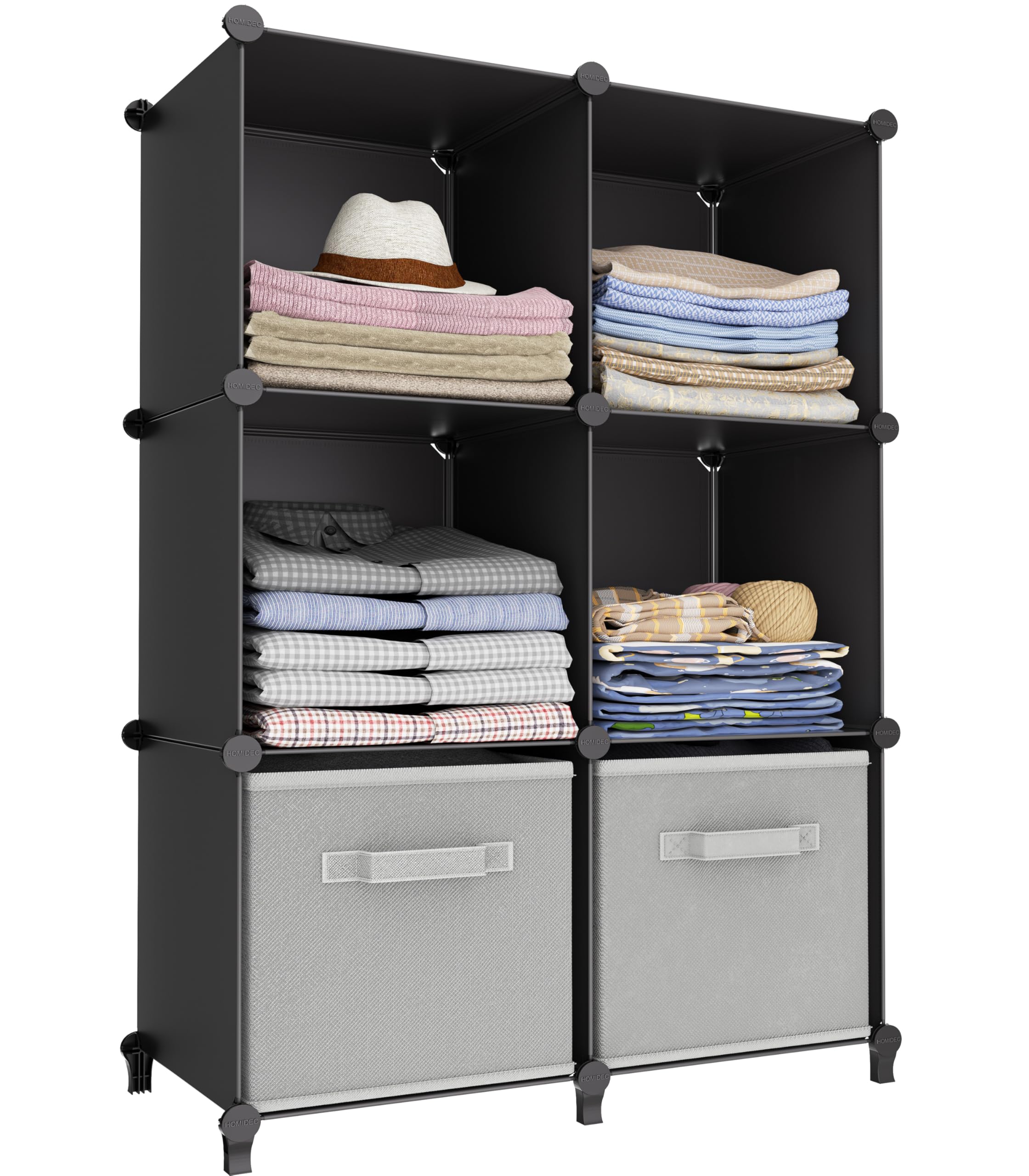
Nine cubes is the size that makes sense in a walk-in closet: enough for folded clothes, shoes, and a few bins, but not so much that the unit takes over the room. The HOMIDEC set uses 11.8-inch cubes, so the same 11-inch fabric bins that fit our top pick work here, and the 11.7-pound frame is light enough to move before you load it.

We like the 9-cube layout for a closet wall because it gives you more storage without the 48-inch height of the 12-cube unit. Assembly is a snap-together job, and most of the work is making sure every connector is fully seated. That last part matters. If a panel is only half-locked, the unit will wobble and the connectors can work loose when you slide a bin in or out. We check each joint with a firm press before adding weight.

The trade-off is strength. This is not the organizer for a shelf of hardbacks or heavy tools; it is best for clothes, shoes, bags, and light bins. The black finish is neutral enough for a closet, and the open front keeps everything visible. If you need a furniture piece for a bedroom, the ClosetMaid is the better look; if you need more cubes in a closet, the 12-cube C&AHOME is the better value. The HOMIDEC sits in the middle, and that is exactly where many closets need it.

Bottom Line: We recommend the HOMIDEC 9-cube for walk-in closets and light household storage, where nine 11.8-inch openings hit the sweet spot.
#4

Best Budget Six-Cube

C&AHOME 6-Cube Organizer

C&AHOME 6-Cube Organizer

8.9/10 Excellent
  • Cubes: 6
  • Cube Opening: 11.8 x 11.8 x 11.8 in
  • Assembled Size: 36.6 x 12.4 x 36.6 in
  • Per-cube Weight Limit: 11 lb
Check Price on Amazon

Pros

  • Budget-friendly six-cube set
  • Standard 11.8-inch cubes
  • Tool-free assembly goes quickly

Cons

  • 11-pound per-cube limit rules out heavy books
  • Can feel flexible when loaded

The C&AHOME six-cube is the budget option in this group, and it does not ask you to give up the standard 11.8-inch opening. Six cubes, a 36.6-inch width, and a 36.6-inch height make it a compact wall of storage for a closet, laundry room, or kids' room. The white finish is clean and neutral, and the panels are light enough to carry up a flight of stairs before assembly.

What we like best is how little fuss the assembly takes. The panels and connectors go together without tools, and the resulting unit is light enough to reposition before you fill it. It is not a heavy-duty shelf. The per-cube limit is 11 pounds, so it is fine for clothes, toys, and shoes, but not for a row of hardback books. Once loaded, it can feel a little flexible; we keep it against a wall and avoid dragging it across the floor.

The six-cube size is the right call for a narrow closet or a child's room where a 12-cube unit is too much. It also leaves room in the budget for bins, which is the hidden cost of any cube organizer. If you want a black finish, the HOMIDEC six-cube is the closest alternative; if you want more cubes, the 12-cube C&AHOME is the better upgrade.

Bottom Line: Our budget pick is the C&AHOME six-cube: standard openings and tool-free assembly, provided you keep the load light.
#5

Utility and garage

Amazon Basics 6-Cube Wire

Amazon Basics 6-Cube Wire

8.8/10 Excellent
  • Cubes: 6
  • Cube Size: 14 x 14 x 14 in
  • Total Weight Limit: 60 lb
  • Per-cube Weight Limit: 10 lb
Check Price on Amazon

Pros

  • 14-inch cubes hold bulky items
  • 60-pound total capacity for light goods
  • Open wire keeps contents visible

Cons

  • Panels can pop out at the connectors
  • Standard 11-inch bins fit loosely

The Amazon Basics wire cubes are the odd size in this group: 14 inches square instead of the usual 11.8. That makes them roomier for bulky items like shoes, towels, or pantry goods, but it also means standard 11-inch fabric bins will rattle around inside. The set uses powder-coated steel wire and plastic corner connectors, with a 10-pound limit per cube and 60 pounds total.

Assembly does not require tools, but it does require patience. The connectors need to be fully seated, and the panels can pop out when the unit is moved or when a loaded cube is dragged. The open wire design is a benefit in a garage or utility room because you can see what is inside and air can circulate; in a living space, it looks like utility shelving. Count the connectors before you start; a set short by a few pieces can stop the build.

We choose it for a garage, basement, or pantry where visibility matters more than a furniture finish. The 60-pound total capacity is fine for light household goods, not for a wall of books or tools. If you want standard bin fit and a cleaner look, the C&AHOME six-cube or the ClosetMaid is the better choice. The Amazon Basics is the open-wire workhorse, not the display piece.

Bottom Line: We keep the Amazon Basics on our utility shortlist for garage or pantry storage, where 14-inch cubes and open visibility matter more than furniture looks.
#6

Cheap black cubbies

HOMIDEC 6-Cube Organizer

HOMIDEC 6-Cube Organizer

8.8/10 Excellent
  • Cubes: 6
  • Item Weight: 6 lb
  • Cube Opening: 11.8 x 11.8 x 11.8 in
  • Per-cube Weight Limit: 15 lb
Check Price on Amazon

Pros

  • Low-cost six-cube set
  • 15-pound per-cube limit for light gear
  • Only 6 pounds empty

Cons

  • Thin panels and connectors can pop
  • Not for heavy books or tools

The HOMIDEC six-cube is a low-cost six-cube set in this group, and it still gives you the standard 11.8-inch opening. Each cube is rated for 15 pounds, which is higher than the C&AHOME six-cube's 11-pound limit, and the whole unit weighs just 6 pounds before loading. That makes it easy to carry home and easy to move into place.

The catch is the snap-together build. The panels are thin, and the connectors need to be fully locked or the unit will not stay square. Once it is together, it is fine for clothes, shoes, and toys, but it is not a shelf for heavy books or a loaded toolbox. The open front and black finish are neutral, and the low weight means you can lift the empty unit onto a closet shelf or into a corner without help.

We see it as a starter organizer: cheap enough to try in a dorm, rental, or kids' room, and good enough for light storage. The C&AHOME six-cube is the cheaper of the two and feels a bit more settled in use; the HOMIDEC is the one to pick when you want a black finish or a 15-pound per-cube rating. Just build it where it will live, because moving it loaded is asking for popped connectors.

Bottom Line: For a dorm or rental, this HOMIDEC six-cube earns our nod when you want a black finish and a 15-pound per-cube rating, provided the load stays light.
#7

Small-space books

Furinno LUDER 5-Cube

Furinno LUDER 5-Cube

8.4/10 Very Good
  • Cubes: 5
  • Assembled Size: 9.4 x 19.5 x 31.5 in
  • Total Weight Limit: 100 lb
  • Per-cube Weight Limit: 20 lb
Check Price on Amazon

Pros

  • Narrow 19.5-inch footprint saves floor space
  • 20-pound per-cube limit for small shelves
  • Closed back looks finished

Cons

  • 9-inch cubes do not fit standard bins
  • Thin panels and nailed back

The Furinno LUDER is a five-cube bookshelf, not a standard cube organizer, and the difference shows up in the openings. The unit is only 9.4 inches deep and 19.5 inches wide, with five compartments of two different sizes; the cubes are around 9 inches, so standard 11-inch fabric bins do not fit. What it does fit is a small stack of books, kids' paperbacks, and decorative bins sized for a bookshelf.

At 9 pounds, it is easy for one person to move, and assembly is a straightforward one-person job. The engineered-wood panels are thin, and the back panel is nailed on, so it is not furniture to move from apartment to apartment. We keep it in a bedroom, hallway, or child's room where it can sit against a wall and stay put. The 20-pound per-cube limit is respectable for a small shelf, but the overall footprint is narrow, so heavy books should be distributed across the bottom row.

The closed back gives it a more finished look than the open wire units, and the white finish is easy to match. The trade-off is capacity: five small cubes do not replace a 12-cube closet organizer, and the price is not the bargain it looks like once you realize standard bins will not fit. It is a good small-space bookshelf, not a full closet system.

If you need a narrow shelf for a child's room or a hallway, the Furinno earns its place. If you are organizing clothes, shoes, or craft supplies in standard cube bins, choose one of the 11.8-inch organizers instead; the Furinno will frustrate you.

Bottom Line: Our recommendation for the Furinno is narrow: small spaces and books only, because its 9-inch openings do not fit standard cube bins.

How We Tested Cube Storage Organizers

We started with the specs people actually shop by: cube count, footprint, shelf thickness, finish options, and price. Anything with shelves thinner than half an inch, no back panel, or hardware that couldn't be retightened after assembly got cut before testing. That left 11 organizers, from compact 2x2 units to full 4x4 grids, which we built and lived with for six months.

Assembly came first, and we did every build solo with only the included tools, timing each one and noting where we stalled. We paid attention to whether the cam locks and dowels lined up without force, whether the parts were labeled clearly enough that we stopped second-guessing, and whether the diagram assumed a second person. We counted leftover hardware at the end and checked each unit for wobble before anything went on the shelves.

Then we loaded them the way people actually do: hardbacks and board games in some cubes, fabric bins and toy bins in others, in an entryway, a kid's room, and a living room corner. We measured the real interior opening of every cube and tried standard 11-, 12-, and 13-inch bins in each, since a half inch decides whether a basket drops in or jams. We checked the diagonals after loading to see which units had racked out of square, then anchored each to the wall and re-checked.

Over the following months we watched for sagging shelves, scuffed finishes, and cubes that loosened at the joints, and we disassembled and rebuilt two units to see whether the hardware survived a move. We also weighed whether the price bought thicker shelves and a real back panel or just a nicer-looking finish.

How to Choose Cube Storage Organizers

Start With Cube Size, Not Cube Count

A standard fabric storage bin is about 11 inches wide, so it needs an opening close to 11.8 inches to slide in and out without scraping. That is the number we check first. A 14-inch wire cube like the Amazon Basics needs larger bins, while the Furinno LUDER's roughly 9-inch openings are for books and small baskets, not standard cube bins. Measure the outside of your bin, then compare it with the opening, not the overall shelf width. We prefer six cubes that fit over twelve that do not.

Match the Footprint to the Wall

Cube organizers range from a narrow six-cube bookcase to a 12-cube wall that is 48 inches tall. Check height against the wall you have, but check depth against the room: a 12.4-inch-deep unit can crowd a narrow closet, and a 9.4-inch bookshelf leaves more floor space. If the unit can stand vertically or horizontally, as the ClosetMaid can, you get two footprints from one piece. Tape the dimensions on the floor before assembly, and leave room for the door to open and for bins to pull out.

Decide How Much Weight Each Cube Must Hold

Per-cube limits in this group run from 10 pounds to 22 pounds, and that range matters more than the total capacity. A cube holding hardback books, tools, or records needs the higher end; clothes, shoes, and toys are fine at the lower end. Snap-together panels also flex more than a fixed wood shelf, so put heavy items in the bottom row and avoid moving a loaded unit. We treat the per-cube number as a ceiling, not a target, and we keep the heaviest bins low.

Choose Open, Closed, Modular, or Fixed

Open wire cubes are easy to see into and let air circulate, which suits garages, pantries, and craft rooms; they look utilitarian in a bedroom. A closed back like the ClosetMaid's hides the wall and gives a furniture finish. Modular panels let you rebuild the unit for a new space, but fixed shelves are usually sturdier. We choose closed and fixed for living areas, and open and modular for closets and utility rooms. If you plan to move the unit often, build it where it will live and keep the load light.

Frequently Asked Questions

Final Verdict

The C&AHOME 12-cube is the organizer we recommend first because it gives you the most usable cube storage for the money here: standard 11.8-inch openings, 12 cubes, and a 22-pound per-cube limit that handles more than clothes.

If the unit will sit in a living room and you want a closed back and a furniture finish, choose the ClosetMaid Cubeicals instead; it holds fewer cubes and weighs more, but it looks like a piece of furniture. For a narrow closet or a first apartment, the six-cube C&AHOME is the budget compromise.