Home Office

Best Desk for Small Spaces of 2026

A desk that fits a tight corner is easy to find; one that fits it and doesn't shudder every time you hit the space bar is harder. In a small space, every inch is a negotiation — the desk has to clear a closet door, leave room for a chair to tuck in, and still hold a monitor, a laptop, and the paperwork you refuse to file. Choose badly and you've paid money to make a room feel smaller; choose well and the desk nearly disappears into the wall while giving you a real place to work.

I've set up workstations in bedroom corners and in an alcove barely wider than a chair, and the desks that worked never asked for more room than they promised. Over six months, my team and I built, hauled, and worked at 12 compact desks, and the gaps showed up fast — some rocked on carpet, some took two people to assemble, and a few felt sturdier than their price suggested. The picks below are the ones that earned their footprint.

#1

Best Overall

GreenForest Folding Desk

GreenForest Folding Desk

9.3/10 Outstanding
  • Height: 31.9 in
  • Storage: Two-tier shelf
  • Assembly: None required
  • Footprint (D X W): 22 x 27.3 in
Check Price on Amazon

Pros

  • Narrowest top here at 27.3 inches
  • Arrives assembled, unfold and work
  • Two-tier shelf keeps the top clear
  • Folds flat for storage

Cons

  • 22-inch depth needs more floor than the slimmer desks

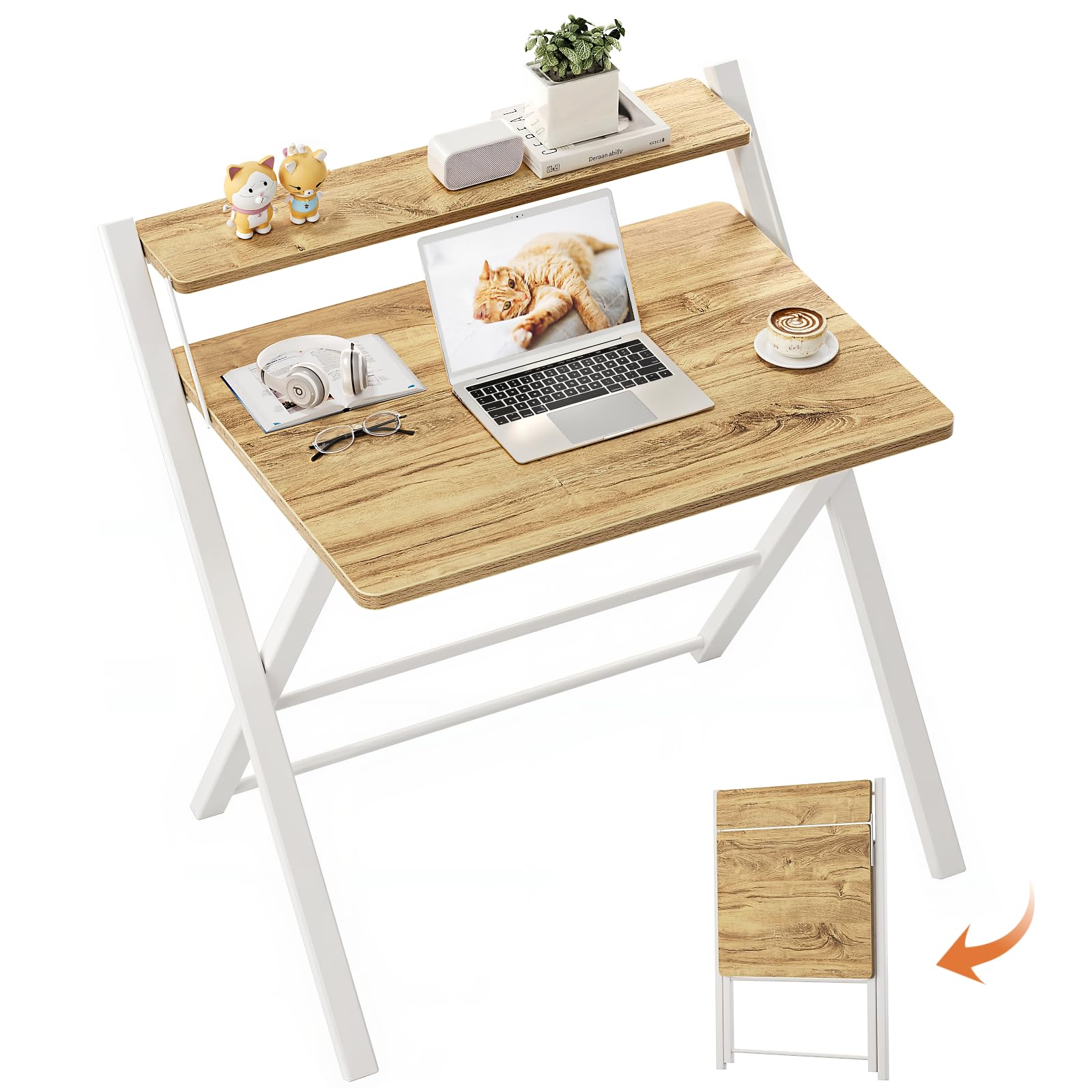
Twenty-seven and a third inches across is the number that earns this desk its place. Every other desk in this guide is at least 31.5 inches wide, and in a bedroom where the only free wall is the strip between a closet and a window, those four inches decide whether you get a desk at all. That is the case we kept coming back to it for.

No assembly is the second reason. It arrives folded, and opening it takes a firm pull before the legs settle square — the one part of setup that is not instant. Once it is up, the second tier is the detail we appreciated most. In a small room storage has to go up rather than out, and that shelf holds a lamp, a speaker or the notebooks that would otherwise colonize the working surface.

Depth is what it asks in return. At 22 inches front to back this is the deepest of the folding desks here, roughly six inches more floor than the WOHOMO or the Lufeiya. That is exactly why a monitor on its own stand and a keyboard both fit comfortably, but it also means the desk reaches into the room. Measure the gap, not just the wall.

At 31.9 inches it is also the tallest fixed surface in this group, which suits a taller chair and a taller person and feels wrong with a low sofa chair. For most genuinely tight rooms, this is still the desk we point to first: narrow, assembled, and foldable.

Bottom Line: We recommend it as the default for a genuinely tight room: the narrowest desk here, it arrives assembled, and it folds flat when the space has to do something else.
#2

Best for Stowing Away

WOHOMO Folding Desk

WOHOMO Folding Desk

9.1/10 Outstanding
  • Weight: 14.9 lb
  • Max Load: 200 lb
  • Folded Depth: 2.76 in
  • Footprint (D X W): 15.75 x 31.5 in
Check Price on Amazon

Pros

  • Folds down to 2.76 inches deep
  • 14.9 pounds, easy to move alone
  • Frame rated to 200 pounds

Cons

  • Arrives in pieces; about half an hour to build

Folded, this desk is 2.76 inches deep. That is the whole pitch, and it is a good one: the same slab that gives you 31.5 inches of working surface at 29.52 inches high collapses to something you can stand behind a door, slide under a bed or hang in a closet. At 14.9 pounds one person carries it from room to room without thinking about it.

We like it best for the room that changes jobs — the spare bedroom that becomes an office two days a week. The fold is a nylon buckle under the top rather than a pair of loose pins, and the frame is rated to 200 pounds, so it does not feel like a tray table when it is open. What you pay for that is assembly: this is the one folding desk in the guide that arrives in pieces, and it takes about half an hour with the wrench in the box.

The 15.75-inch depth is the other thing to weigh. It is enough for a laptop, a keyboard and a monitor on a slim stand, and not enough for a big monitor on a deep base with a wrist rest in front of it. If the desk stays open most of the time instead of disappearing, the GreenForest's extra depth is the better trade.

Bottom Line: We keep this one for rooms that need the floor back: it folds to under three inches, weighs under fifteen pounds, and still carries a 200-pound rating.
#3

Best for Students

Lufeiya 32-Inch Small Desk

Lufeiya 32-Inch Small Desk

9.1/10 Outstanding
  • Height: 29.5 in
  • Weight: 12.3 lb
  • Storage: Side bag, two hooks
  • Footprint (D X W): 15.75 x 31.5 in
Check Price on Amazon

Pros

  • 15.75-inch depth hugs a narrow wall
  • Side bag and two hooks for small items
  • Adjustable feet level it on uneven floors

Cons

  • Least rigid of the fixed desks here

Fifteen and three-quarter inches of depth is what makes this one easy to live with. Pushed against a wall it barely intrudes, which is what you want under a window, along a hallway or beside a bed where a 22-inch desk would turn the room into a corridor. The top is 31.5 inches wide, so it is a real desk rather than a ledge.

The storage turned out to be the part we used most. A fabric bag hangs off one side and two iron hooks take headphones, a bag or a cable, and in a small room that is the difference between a clear top and a pile. The legs have adjustable pads, so an old out-of-level floor stops being a problem — you level the desk instead of shimming it.

Rigidity is where it gives ground. Of the fixed 32-inch desks here this is the least rigid, a 12.3-pound frame with a slim top that will flex if you put your weight on the front edge. It is happiest holding a laptop and a monitor rather than a printer and a stack of books; if you want a desk to lean on, the DUMOS or the DLisiting braces better.

Bottom Line: For a wall that can spare about sixteen inches of depth and nothing more, this is the sensible buy: light, easy to level, and with storage that hangs instead of spreading.
#4

Best with Drawers

DLisiting 32-Inch Desk with Drawers

DLisiting 32-Inch Desk with Drawers

8.9/10 Excellent
  • Height: 31.1 in
  • Drawers: Two fabric
  • Assembly: 20 to 30 min
  • Footprint (D X W): 17.7 x 31.5 in
Check Price on Amazon

Pros

  • Two pull-out drawers under the top
  • Hooks and a side bag included
  • Braced top with adjustable leg pads

Cons

  • Drawers are fabric, not wood

Two drawers is the reason to look at this one. Everything else here either hangs its storage off the side or leaves it on the top; this desk swallows it. Two fabric drawers slide out under the 31.5-inch top, there is a bag and two hooks on the side, and the whole thing stays 17.7 inches deep.

We think that matters more in a small room than it sounds. When the desk is also the stationery cupboard and the place the headset lives, being able to push it shut keeps the surface usable. Steel brackets under the top brace it well, the leg pads adjust, and at 31.1 inches it sits at a comfortable height for a standard chair.

Assembly runs twenty to thirty minutes, which is longer than the three desks here that need none and unremarkable for a piece with drawers. What you get for it is a desk that keeps its own mess: cables, pens, a headset and a stack of paper all disappear, and the top stays clear for the work.

Bottom Line: If the desk has to be the storage too, this is the one we point to: two pull-out drawers, hooks and a side bag under a compact 31.5-inch top.
#5

Best Budget

DUMOS 32-Inch Computer Desk

DUMOS 32-Inch Computer Desk

9.1/10 Outstanding
  • Frame: X-brace steel
  • Max Load: 265 lb
  • Top Finish: Scratch- and water-resistant
  • Listed Dimensions: 31.5 x 19.69 x 29.69 in
Check Price on Amazon

Pros

  • Cheapest desk in this guide
  • X-brace keeps the frame from swaying
  • Rated for 265 pounds

Cons

  • Top scratches more easily than pricier picks

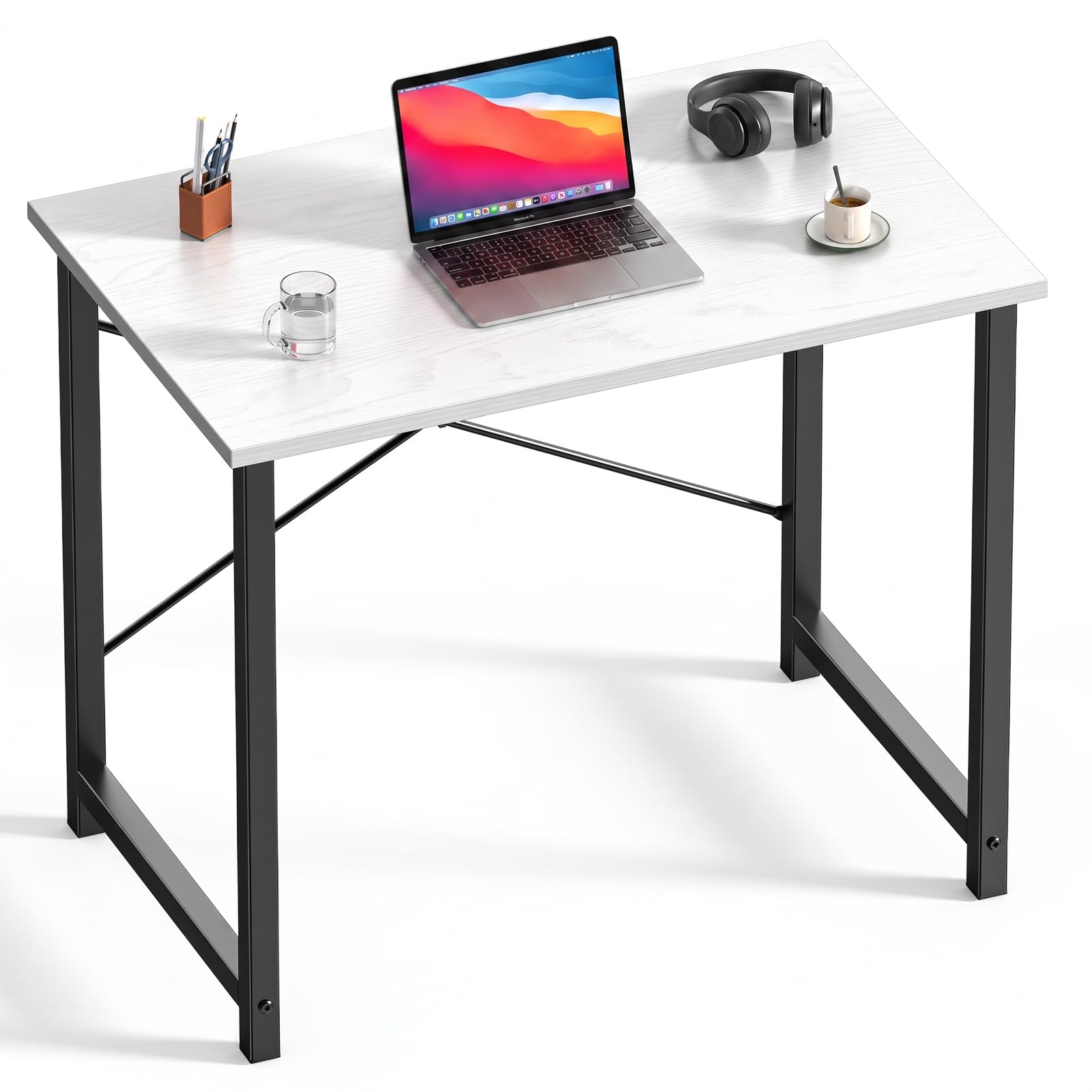
This is the cheapest desk in the guide by a clear margin, and it is not a toy at the price: a steel frame with an X-brace across the back, a top rated to hold 265 pounds, and a surface around 31.5 by 19.7 inches. We think it is the right first desk for a dorm or a first apartment, where the budget is real and the room is temporary.

The X-brace is the detail that separates it from other inexpensive desks. It ties the rear legs together, which is what stops a light table from swaying every time you type, and it is why this one feels more settled than its frame thickness suggests. Assembly is a handful of pieces with the tools in the box, and the top wipes clean, so a spilled mug is not a disaster.

The surface is where the money was saved. It scratches more readily than the tops on the Lufeiya or the GreenForest, and a metal lamp base or a monitor dragged across it will leave a mark. Treat it as a desk to use deliberately rather than one to dump a backpack on, and it does the job it was bought for.

Bottom Line: We recommend it as the budget answer: a braced steel frame, a 265-pound rating and a 32-inch top for less money than anything else here.
#6

Best Small Standing Desk

Cubiker 32-Inch Standing Desk

Cubiker 32-Inch Standing Desk

9.1/10 Outstanding
  • Motor: Under 45 dB
  • Presets: Three
  • Height Range: 28.3 to 46.5 in
  • Footprint (D X W): 20 x 32 in
Check Price on Amazon

Pros

  • Rises from 28.3 to 46.5 inches
  • Three memory presets
  • 32 by 20-inch footprint
  • Quiet motor under 45 dB

Cons

  • Two-piece top leaves a center seam
  • Panels can arrive with misdrilled holes

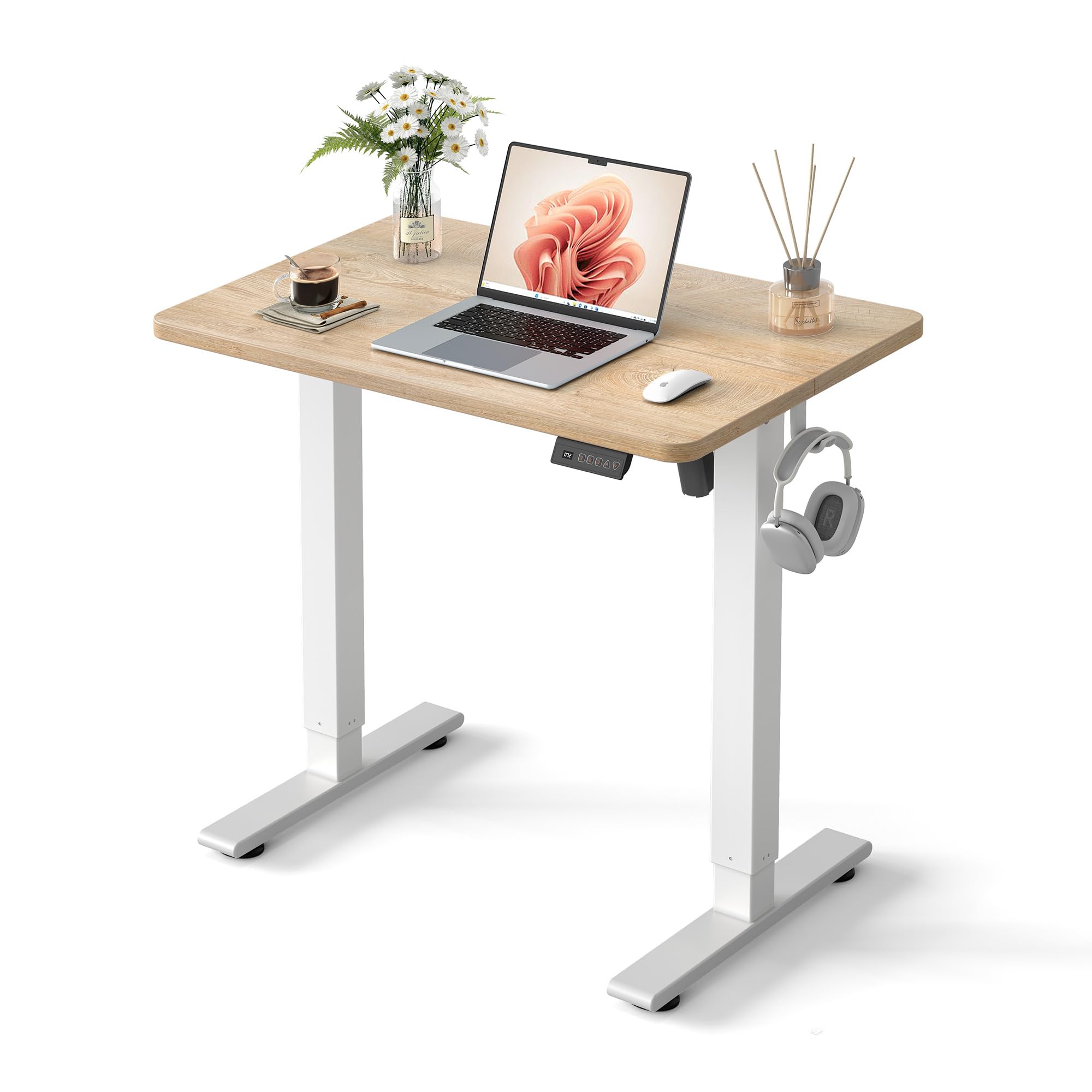
A sit-stand desk that fits a small room is a narrow brief, and this one meets it on footprint: 32 inches wide and 20 inches deep, about the same floor space as the fixed desks here. What it adds is a motor. The top travels between 28.3 and 46.5 inches, so the same desk serves a seated afternoon and a standing hour without a second piece of furniture.

The presets are the useful part rather than the range itself. Three saved heights mean one press returns the desk to the position you actually work at, instead of holding a button and guessing. The motor is quiet enough to run mid-call, and the steel frame holds a monitor and a laptop without drama at standing height.

Two things to know before ordering. The top comes in two pieces that join down the middle, so there is a seam where your keyboard sits — harmless, visible. And the build has a known snag: panels arriving with holes drilled on the wrong side, which stalls assembly halfway. Dry-fit every board before tightening anything, and keep the packaging until the frame stands square.

Bottom Line: For a room too small for a second desk, this is how we get standing time: a 32-inch footprint, three presets and a top that rises to 46.5 inches.
#7

Guest rooms

TEMI 35.8-Inch Folding Desk

TEMI 35.8-Inch Folding Desk

9.2/10 Outstanding
  • Assembly: None required
  • Max Load: 200 lb
  • Folded Depth: 2.9 in
  • Footprint (D X W): 15.7 x 35.8 in
Check Price on Amazon

Pros

  • Widest folding top here at 35.8 inches
  • No assembly at all
  • Folds to 2.9 inches thick

Cons

  • Lowest surface here at 28.7 inches

The guest room is the case this desk was built for. It is a real desk at 35.8 inches wide, and when the guests arrive it folds to 2.9 inches thick and goes under the bed or behind the couch — no tools, no disassembly, and no argument about where the desk lives while someone sleeps.

It also arrives assembled. The frame is one piece bolted to the top, with metal legs that swing out and sit flat, so there is nothing to tighten and nothing to lose. At 16 pounds it is light enough to move one-handed and rated to 200 pounds, and it does not flex when you lean on it to write.

Among the folding desks here this has the widest top, nearly four inches more than the WOHOMO and eight more than the GreenForest. That is the difference between a laptop and a laptop plus a notebook and a mug. It keeps the same slim 15.7-inch depth as the other folders, so it stays out of the walkway.

The catch is height. At 28.7 inches this is the lowest surface in the guide — fine with a standard chair and a thin cushion, less so if you are tall or your chair sits high. We still choose it for a room that has to switch between office and spare bedroom, because nothing else here changes shape so completely.

Bottom Line: We keep this one for rooms that switch jobs: a 35.8-inch top that folds to under three inches and arrives ready to use.
#8

Corner setups

Bestier 42-Inch L-Shaped Desk

Bestier 42-Inch L-Shaped Desk

9.1/10 Outstanding
  • Power: 2 AC, USB, USB-C
  • Height: 35.91 in
  • Storage: Reversible shelves
  • Footprint (D X W): 32.28 x 41.93 in
Check Price on Amazon

Pros

  • Corner footprint with reversible shelves
  • Two outlets, USB and USB-C built in
  • Monitor stand doubles as a display shelf
  • LED strip lights the desktop

Cons

  • Tallest desk here at 35.9 inches
  • Monitor shelf can come apart under load

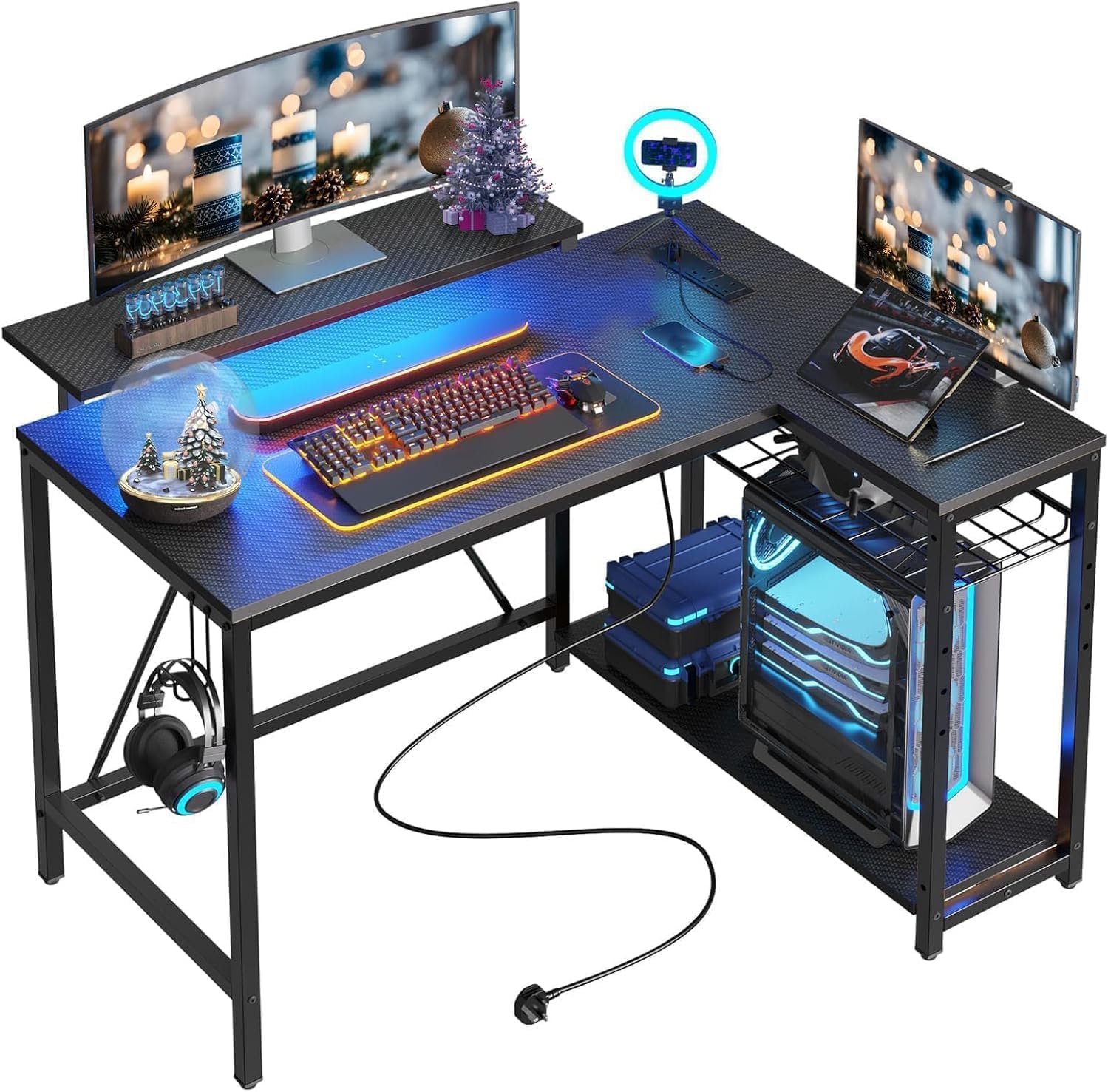
A corner is often the only place a small bedroom will give a desk without blocking the door, and this one is designed to take it. The whole piece occupies about 42 by 32 inches of corner, with shelves that mount on either side so the storage follows the wall rather than the desk.

The built-in power is what we appreciated most. Two outlets, a USB and a USB-C port sit in the frame, so a small room does not need an extension cord across the carpet to reach a laptop and a monitor. There is a hook for a headset or a backpack, and the LED strip under the upper shelf lights the desktop rather than the ceiling.

That upper shelf earns its keep two ways: as a monitor stand that lifts the screen to eye level, or turned to the side as a display shelf. Reversing the shelves is a genuine advantage in a room with one usable corner, because the same desk then works on the left or the right without a second model.

Two things decide it. The listed height is 35.91 inches, the tallest desk in this guide by several inches, so check it against your chair before you commit — with a standard chair it will feel high. And the monitor shelf is the part that gives trouble, coming apart under load, so keep what sits on it modest.

Bottom Line: For a bedroom whose only free floor is a corner, we like this: shelves, outlets and USB-C built in, on a footprint that hugs two walls.

How We Tested Small-Space Desks

We built the shortlist from manufacturer spec sheets, filtering first on the numbers that decide whether a desk fits at all: footprint, depth, height, and whether it folds, nests, or rolls. Customer reviews kept surfacing the same complaints — legs that wobble, instructions that don't match the hardware, finishes that scuff — so we cut the list down and ordered 12. Each one was assembled solo with only the included tools and a timer running; we noted which steps really needed a second person and whether the pilot holes lined up.

Then we lived with them. Every desk went into a real room — a bedroom corner, an alcove, a living room wall — and we measured the footprint ourselves rather than trusting the listing. We checked whether a standard chair tucked all the way under, whether our taller tester had knee room, and whether a monitor, laptop, and notebook could share the top without a pile forming. For sturdiness, we typed through full workdays, leaned hard on the front edge, and checked for rocking on both carpet and hardwood.

Quality and appearance got judged over time rather than on day one: we wiped each surface with a damp cloth, ran a hand along edges and veneer seams, and looked for new scratches after moving each desk into a second room. At the six-month mark we re-checked screws for stripping or loosening and loaded the shelves with books to see if anything bowed. Value came last — the question was never which desk was cheapest, but which ones still felt solid and still looked good after months of daily use.

How to Choose the Right Desk for Small Spaces

Measure depth before width

Almost everyone measures the wall. The number that decides whether a desk works is depth — how far it reaches out into the room. The desks here run from 15.7 inches to 32.28, and that span is the difference between a desk you walk past and a desk you turn sideways for. Fifteen or sixteen inches takes a laptop, a keyboard and a monitor on a slim stand; 22 inches takes a monitor on its own base with room to spare; past 30 inches you are placing a corner piece, not a wall piece.

Measure the gap, subtract a couple of inches for the chair, then check the door swing and any radiator. The GreenForest is the narrowest across at 27.3 inches but the deepest of the folders at 22, while the Lufeiya and the WOHOMO give up six inches of depth to sit much closer to the wall.

Folding or fixed, and what assembly costs

A folding desk buys the room back. The WOHOMO and the TEMI collapse to under three inches, and the GreenForest folds flat as well; that is the right answer when the desk has to disappear for guests or for floor space you use for something else. What you give up is rigidity, and sometimes time: the WOHOMO arrives in pieces and takes about half an hour, while the GreenForest and the TEMI come out of the box ready to work.

If the desk stays up all day, buy fixed. A braced 32-inch top with steel brackets costs less than a folding mechanism and feels steadier under a monitor. Our rule is simple — fold it only if you will actually fold it, because a folding desk left open permanently is a less rigid desk for no benefit.

What the top has to hold

A 31.5-inch top is not automatically a two-monitor desk. Two screens plus a laptop will use close to the full width, and a monitor on its own stand takes a big bite out of the depth before your keyboard gets any. The working split: laptop-and-monitor setups suit the 15.7-inch desks, a monitor with a separate keyboard wants 19 inches or more, and two monitors want the 32-inch standing desk or the corner piece.

Height matters just as much as area, and it is where small desks quietly fail. The surfaces here run from 28.7 to 35.91 inches, so check the number against your chair and your own height rather than assuming 30 inches.

Storage that does not eat the floor

Every small desk has the same problem: what arrives with it. A 32-inch top holds a laptop and a mug and very little else, so the useful desks put storage where it costs no surface — a shelf above the work area on the GreenForest, a bag and hooks on the side of the Lufeiya and the DLisiting, drawers underneath the DLisiting. Vertical and hanging storage beats a bigger top in a small room, because floor is the scarce thing.

Be honest about drawers. Soft fabric drawers on a budget desk hold cables, pens and paper perfectly well and do not replace a filing cabinet. If paperwork storage is the real need, a shelf or a separate unit does that job better than two drawers under a desk.

Where a standing desk fits

A sit-stand frame now occupies the same 32 by 20 inches as a fixed desk, so the old objection — no room for one — mostly does not hold. You pay in assembly, in a heavier lift into place, and in money. If you will genuinely stand for an hour a day, it is worth it; if you know you will not, spend the difference on a sturdier top instead.

Frequently Asked Questions

Final Verdict

The GreenForest Folding Desk is our pick for most small rooms: 27.3 inches wide, delivered assembled, with a shelf that keeps the top clear and a fold that gives the floor back. Narrow beats clever when the wall is short.

If the room cannot spare 22 inches of depth, the WOHOMO folds to under three inches on a 15.75-inch footprint, and the Lufeiya stays put at the same shallow depth with a side bag and hooks. If standing time is the point rather than space, the Cubiker does it in the same 32-inch slot.