Home Office

Best File Cabinet of 2026

A file cabinet is one of those purchases you notice only when something goes wrong — a drawer that shudders instead of gliding, a folder that won't slide under the hang rails, a top that sags under the weight of a printer. Papers accumulate faster than anyone plans for, and the shoebox in the closet stops being a system around the second tax year. A good cabinet does one unglamorous job well: it keeps what you need findable, keeps the rest out of sight, and doesn't wobble, stick, or eat an entire Saturday in assembly.

I've been through three in ten years, including a wood two-drawer that looked handsome and jammed every humid July. Over the past six months my team has assembled and loaded 12 cabinets, from flat-pack wood to welded steel, and the gap between a good one and a frustrating one comes down to details you can check before you buy — starting with drawer depth, measured inside rather than across the front, since that's what decides whether hanging folders sit front to back or wedge in sideways. The picks below run from full-suspension steel workhorses to furniture-grade wood and compact corner-savers.

#1

Best Overall

Laura Davidson Stockpile Curve

Laura Davidson Stockpile Curve

9.4/10 Outstanding
  • Drawers: 3, letter or legal
  • Locking: One key, all 3 drawers
  • Assembly: Fully assembled
  • Dimensions: 20"D x 15.75"W x 24"H
Check Price on Amazon

Pros

  • Takes letter and legal folders with no adapters
  • Arrives fully assembled with feet and casters
  • Ball-bearing glides and a furniture-grade finish
  • One key locks all three drawers

Cons

  • Interlock opens only one drawer at a time
  • 60 pounds is a two-person move

Rounded corners and a matte powder coat do a lot of work here. This is the one cabinet in the group that looks deliberate in a room rather than merely tolerated, and the details hold up close: inset handles sitting flush, drawer fronts that line up, seams tight enough that we stopped looking for gaps.

We think the money is better spent here than on any other cabinet in this guide, because the build backs up the finish. Cold-rolled steel, ball-bearing glides, three drawers that take letter or legal hanging folders with no extra accessory rack, and one key that secures all three. It arrives fully assembled, with stationary feet already fitted and a set of casters in the box if you want it mobile instead.

Two quirks to know before you buy. An interlock releases one drawer at a time, which is reassuring when the top drawer is heavy and mildly irritating when you are filing a stack. And at 60 pounds it is a place-it-and-leave-it cabinet; the casters make it movable, not portable.

The small things are what kept winning us over: a pencil tray and a drawer divider in the box, two uniquely keyed locks so two people can hold a key, and a folding key fob that lies flat in a pocket instead of digging into your leg. If you are spending office money once, this is where it goes furthest.

Bottom Line: Our top pick: a lockable three-drawer that takes letter and legal files, arrives assembled, and looks like furniture rather than office surplus.
#2

Best Value Mobile

Letaya 3-Drawer Mobile

Letaya 3-Drawer Mobile

8.8/10 Excellent
  • Drawers: 3, letter/legal/A4
  • Locking: One key, all 3 drawers
  • Dimensions: 17.32"D x 14.57"W x 24.4"H
  • Weight Capacity: 120 lb
Check Price on Amazon

Pros

  • Only the casters need fitting
  • One key secures all three drawers
  • Fits under a desk at 24.4 inches tall
  • Locking front casters hold it in place

Cons

  • Bottom drawer can hang up when heavily loaded

Five casters, and that is the whole job. Everything else on this cabinet arrives put together, which is why it earns a place here at a price that undercuts most of the steel in this guide. Unbox it, bolt on the wheels, roll it under a desk.

The panels are 0.8 mm steel, one key locks all three drawers, and the cabinet stands 24.4 inches tall — low enough to slide under a desk with a keyboard tray and narrow enough at 14.57 inches to sit beside one instead. Letter, legal and A4 hanging folders all ride the rails.

Where it gives ground to our top pick is the drawer action. The pulls want a firm, square push over the last couple of inches, and a heavy bottom drawer can hang up if the cabinet is not sitting level on its wheels. Load it evenly and it behaves; jam folders in until the drawer bulges and it complains.

Two of the front casters lock, so it stays where you put it when you yank a drawer open, and the powder coat does not announce itself as budget steel from across the room. For a first home office, that combination is hard to argue with.

Bottom Line: Our pick for most home offices on a budget: three lockable drawers, five casters, and setup that is nothing but the wheels.
#3

Best for Heavy Files

DEVAISE 2-Drawer Mobile

DEVAISE 2-Drawer Mobile

8.7/10 Excellent
  • Drawers: 2, full extension
  • Dimensions: 17"D x 15"W x 27"H
  • File Sizes: Letter, legal, A4
  • Weight Capacity: 200 lb
Check Price on Amazon

Pros

  • Drawers extend fully, so nothing gets lost at the back
  • Takes letter, legal and A4 folders
  • Highest stated capacity of the two-drawer picks
  • Five casters with a centre anti-tip wheel

Cons

  • ⚠️ Can tip forward with a full drawer extended
  • Top drawer needs a firm push to latch

Full extension is the phrase that matters on this one. Both drawers come out to the stops, so the folder at the back is as easy to grab as the one at the front — a small thing that stops being small once you file every day.

Cold-rolled steel, removable hanging bars that take letter, legal and A4 folders, and a lock that secures both drawers at once. Five casters, including a front centre one that acts as a third leg when a drawer is out. It ships assembled except for the wheels, which is a ten-minute job.

For a home office with one active letter file and one legal archive, this two-drawer is the shape we reach for. At 27 inches tall and 15 inches wide it tucks beside a desk, and the second drawer stays genuinely useful instead of becoming a lid you open twice a year. The stated capacity is the highest of the two-drawer cabinets here.

The caveat is stability. Fully loaded and pulled all the way out, a drawer can tip this cabinet forward, anti-tip caster or not, so the heaviest files belong in the bottom drawer and the brakes belong on. The top drawer also needs a firm push to latch, which you will notice for a week and then stop noticing.

Bottom Line: We rate it the best two-drawer here for full-extension access and legal-size files, as long as the heavy folders go in the bottom drawer.
#4

Best for Tight Floor Space

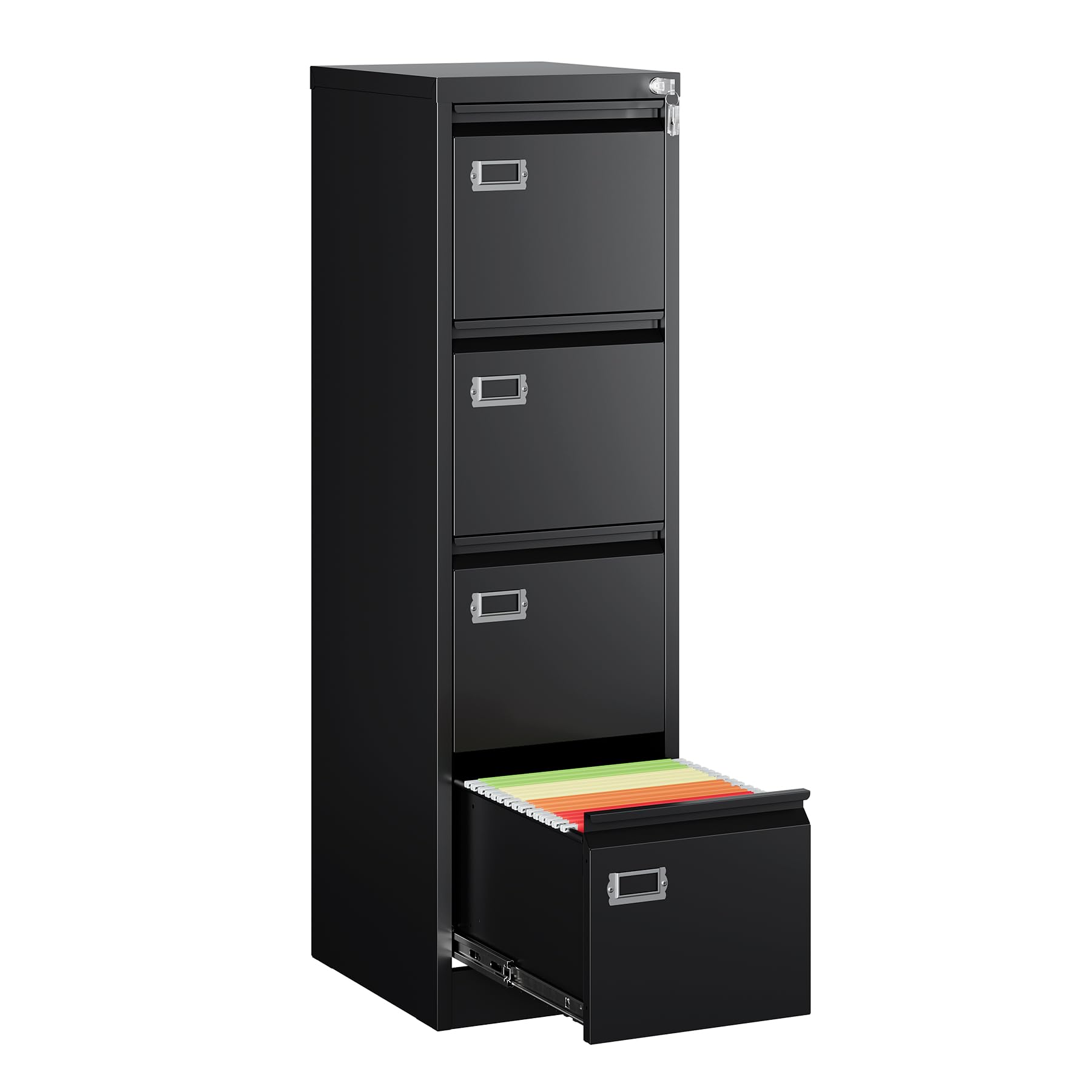
MIIIKO 4-Drawer Vertical

MIIIKO 4-Drawer Vertical

8.2/10 Very Good
  • Drawers: 4, letter/legal/A4
  • Locking: One key, all 4 drawers
  • Dimensions: 17.71"D x 15"W x 50.11"H
  • Weight Capacity: 220 lb
Check Price on Amazon

Pros

  • Four file drawers in a 15-inch footprint
  • One lock secures all four drawers
  • Highest stated capacity in this set
  • Takes letter, legal and A4 folders

Cons

  • Flat-pack assembly with fiddly drawer alignment
  • Top drawers sit above a seated reach

Fifteen inches wide and a shade over four feet tall. This cabinet puts four full file drawers into the floor space of a bedside table, and if your office is a corner of another room, that trade is the entire point.

We think it is the best answer in this guide when capacity matters more than looks. All-steel construction, a top lock that secures all four drawers through an interlock, rails that take letter, legal and A4 folders, and a stated capacity of 220 pounds — higher than anything else here that publishes one.

You will assemble it. The parts are labelled and the tools come in the box, but hanging four drawer fronts on sliding rails is fiddly work, and the shell wants a second pair of hands while you hold a panel square. Set aside a proper session rather than a coffee break, and seat each drawer on its rails before you tighten anything.

One consequence of the height that nobody mentions: the top drawer sits well above chest level for a seated adult, so you file standing up. We did not mind it, because the alternative is giving up the floor. It is also why a 50-inch vertical is not a universal answer to a storage problem.

Bottom Line: The pick when floor space is the constraint: four locking drawers, letter through legal, in a footprint fifteen inches wide.
#5

Budget four-drawer

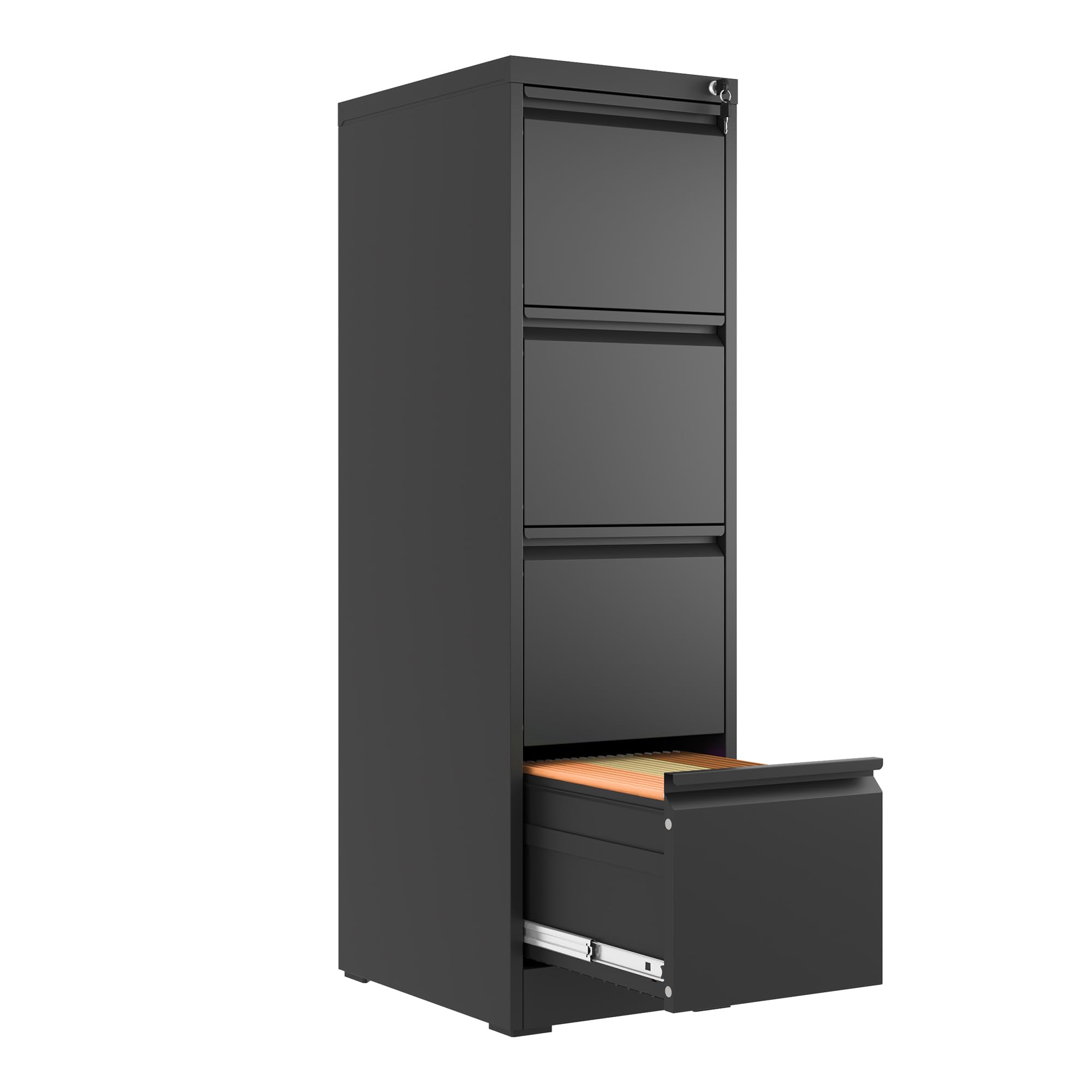
FLIXELIO 4-Drawer Vertical

FLIXELIO 4-Drawer Vertical

8.2/10 Very Good
  • Drawers: 4, letter/legal/A4/F4
  • Locking: One key, all 4 drawers
  • Assembly: Flat-pack
  • Dimensions: 17.72"D x 14.96"W x 52.4"H
Check Price on Amazon

Pros

  • Four drawers for the price of a two-drawer
  • One key locks all four drawers
  • Takes letter, legal, A4 and F4 folders

Cons

  • Long flat-pack assembly; rails need careful seating

Four drawers, folded steel, and a box that arrives with a screwdriver and a pair of cloth gloves inside. The gloves tell you what the panel edges are like before you have touched one, and the screwdriver is the manufacturer being realistic about what you are about to do.

The numbers are appealing: 52.4 inches tall, 14.96 wide, letter, legal, A4 and F4 hanging files, and one key locking all four drawers through an anti-tip interlock that releases them one at a time. Tuck it beside a door and it disappears.

We think it is the value pick in the group. You give up finish and a pleasant afternoon, and you get four lockable drawers for roughly what the two-drawer cabinets here cost. That is a fair exchange for a spare room or a back office, less so for the first thing a visitor sees.

The evening is the catch. Every part is coded and there is a video, but a flat-pack steel shell this tall is a lot of screws, and the rails are where alignment goes wrong. A drawer that drags on one corner in the first week is a rail that was not seated squarely, so check all four before you fill them and you will not fight the cabinet for the next five years.

Bottom Line: The value play for four lockable drawers: budget steel, one long evening of assembly, and everything from letter to F4.
#6

Letter-only corner

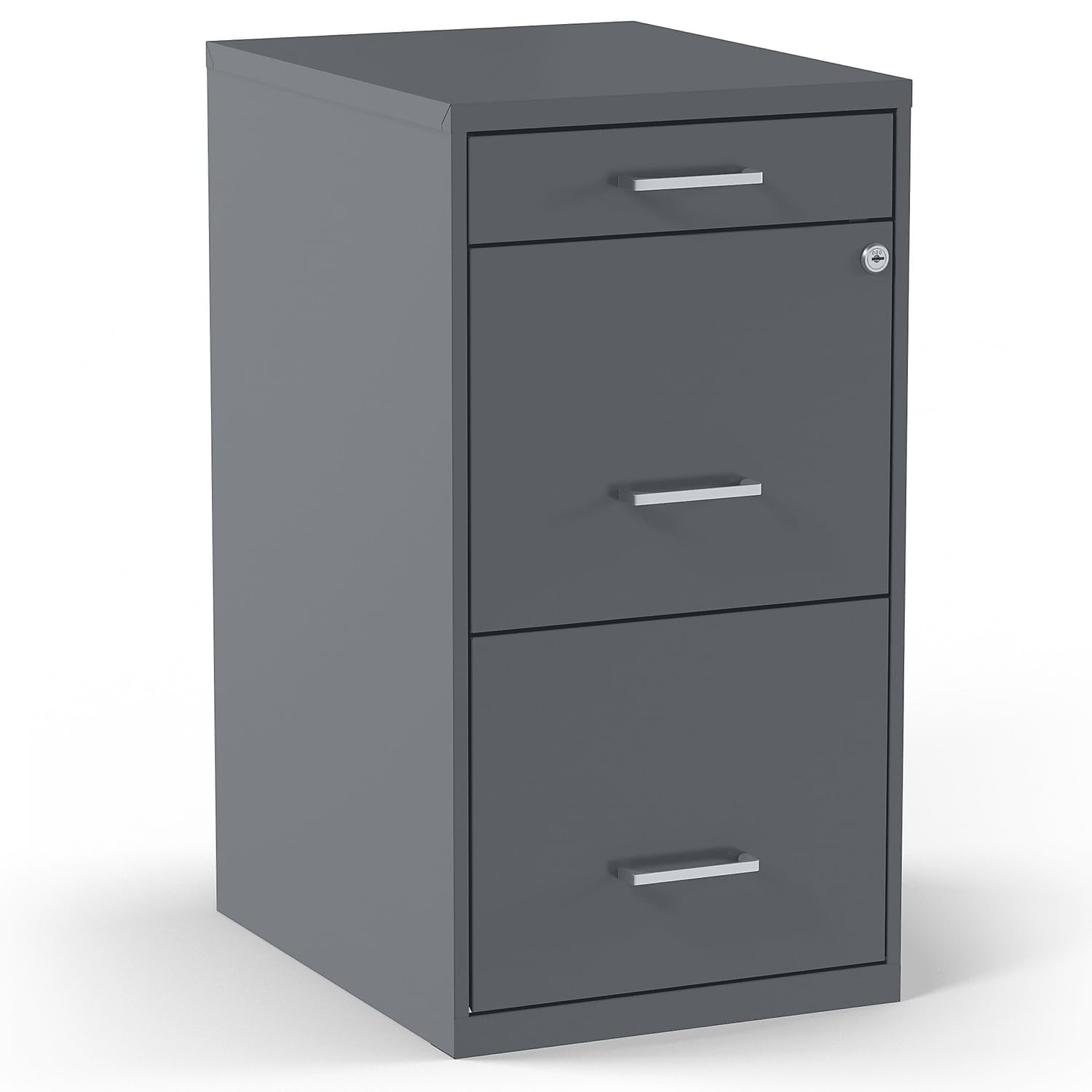
Staples 3-Drawer Vertical

Staples 3-Drawer Vertical

8.6/10 Excellent
  • Drawers: 3, two file and one supply
  • Locking: Top two drawers
  • Dimensions: 18.9"D x 14.3"W x 26.8"H
  • File Sizes: Letter only
Check Price on Amazon

Pros

  • Smoothest glides at this size
  • Compact letter-size footprint
  • Useful small supply drawer on top

Cons

  • Only the top two drawers lock
  • File drawers do not pull out all the way

Only the top two drawers lock. The bottom one opens for anyone who pulls the handle, so decide before delivery whether that is where the printer paper goes or where the archive goes.

What is left is a compact letter-size vertical: 18.9 inches deep, 14.3 wide, 26.8 tall, with ball-bearing glides that are noticeably smoother than the plain slides on most cabinets at this size. There is a small top drawer for pens, chargers and the stapler, which does more for a desk than a fourth file drawer would.

Two drawbacks worth naming. The steel is lighter than the powder coat suggests, so it is happiest holding paper rather than a printer on top. And the file drawers do not travel all the way out, which quietly wastes the back couple of inches of every folder — you end up reaching rather than lifting.

Where it earns its place is a letter-only corner. It is narrow enough to flank a desk, the charcoal finish blends into a room, and the supply drawer keeps the desktop clear. We would not keep a will in it, but we would happily keep a year of invoices in it.

Bottom Line: A tidy letter-size cabinet with genuinely smooth glides; we like it where the unlocked bottom drawer holds supplies, not documents.
#7

Light-duty spare room

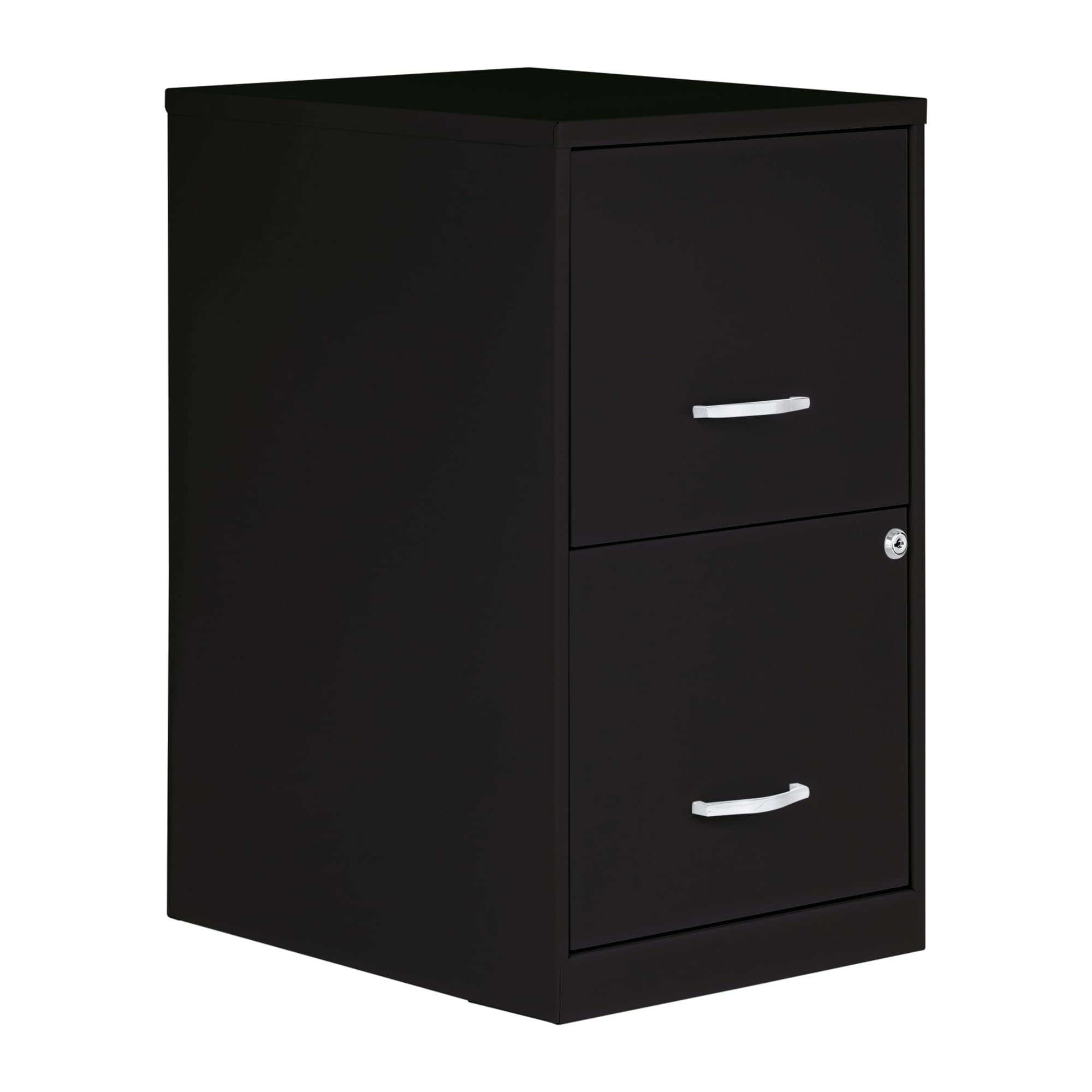
NuSparc 2-Drawer Locking

NuSparc 2-Drawer Locking

8.6/10 Excellent
  • Weight: 22 lb
  • Drawers: 2, letter
  • Locking: One key, both drawers
  • Dimensions: 18"D x 14.2"W x 24.5"H
Check Price on Amazon

Pros

  • 22 pounds, easy for one person to move
  • Handles are the only assembly
  • Both drawers lock with one key

Cons

  • Thin steel that can arrive dented
  • Letter-size folders only

Twenty-two pounds, carried up the stairs in one hand. That is the case for this cabinet: it goes wherever you need it, including the gap under a desk you otherwise leave empty, and it does not need a second person or a furniture dolly to get there.

It arrives assembled apart from the handles, takes letter-size hanging folders on three-quarter extension, and locks both drawers with one key. At 24.5 inches tall and 14.2 wide, it slides under most desks with room to spare.

The steel is thin, and that shows up in two ways: a cabinet can arrive dented, and the drawers can bind if it is not sitting perfectly level. Open the box and check the panels before the packaging goes out, then set it on a hard, flat floor rather than deep carpet.

What it does better than anything else here is disappear. Under a desk, inside a closet, on a shelf in a spare room, it holds a year or two of letter files and asks nothing of the room around it. That is a genuinely useful thing for a filing cabinet to be good at.

Bottom Line: We keep it on the list as the light-duty budget pick: letter files only, 22 pounds, and it slides under a desk without help.

How We Tested File Cabinets

We built the shortlist from spec sheets and customer reviews, then filtered hard: interior drawer depth, stated load rating, whether hang rails came included, finish options, and price. Anything that couldn't hold a full drawer of letter folders front to back was cut before we placed an order.

The 12 cabinets that made it were tested over six months. One person assembled each one with only the tools in the box, and we timed it — a 40-minute build with a cryptic diagram got noted as such. Then we loaded them with real paper: hanging folders, three-ring binders, and a ream of copy paper dropped in the top drawer, because weight is what exposes thin steel and undersized glides. Every drawer was opened and closed 20 times empty, then 20 times full, and we paid attention to what we heard — a rumble meant nylon rollers on a cheap track, a quiet pull meant ball-bearing slides — and whether the drawer racked or dragged after a week of use.

We rolled each cabinet across carpet and hardwood to see how the casters and feet behaved, and pulled a loaded top drawer all the way open to check whether the whole thing tipped. A humidity-heavy home office served as the long-term home, where we watched for swelling, sticking, and finish wear. Appearance got the same scrutiny as function: scratches and fingerprints on gloss fronts, seams that didn't line up after assembly, and how the cabinet held up with a printer sitting on top of it.

How to Choose the Right File Cabinet

Start from the folders, not the drawer count

A letter-size hanging folder is shorter than a legal one, and a cabinet built for letter files is usually shallower front to back because it does not have to swallow the extra length. That depth is the number to check first — it decides whether the cabinet slides under a desk, sits flush against a wall, or sticks into the room by three inches you did not budget.

Four drawers of the wrong size are worse than two of the right one. If you keep a legal archive alongside active letter files, look for a cabinet that states both sizes on adjustable rails rather than assuming an accessory rack will fix it later.

Steel holds files; wood holds a room together

Powder-coated steel is the safer choice for documents: drawers do not sag under the weight of a full run of folders, it wipes clean, and it shrugs off a damp basement. The steel cabinets in this guide list capacities between 120 and 220 pounds, which is a real ceiling once you have a drawer of binders.

Engineered wood buys you a warmer finish that can pass as living-room furniture, and it costs you load margin — particleboard rates lower, swells if it gets wet, and depends much more on how carefully it was assembled. We would put steel in a working office and wood in a room where the cabinet is also decor.

Height and depth decide where it lives

Measure the gap between the floor and the underside of the desk, including any keyboard tray or drawer that hangs below it, then add an inch so the cabinet does not scrape going in. Casters add height; a 24-inch cabinet on wheels is a different proposition from the same cabinet on feet.

Anything around four feet tall is a freestanding piece, not an under-desk one, and that is a deliberate trade: the tall verticals here hold four drawers in a footprint barely wider than a nightstand. Decide which resource you are short of, floor or wall, before you fall for a drawer count.

Ask which drawers the key actually locks

One key that secures every drawer through an interlock is the norm on steel cabinets, and it comes with a quirk: the interlock usually releases only one drawer at a time, which keeps a loaded cabinet from tipping but slows down batch filing.

Not every cabinet covers everything. Some lock the top two drawers and leave the bottom one open to anyone who pulls the handle, which is fine for a supplies drawer and not fine for a client file. Check the coverage before you decide what goes where, not after.

Wheels, brakes and the anti-tip caster

Five casters, with an extra one at the front centre, is the configuration that keeps a mobile cabinet planted when a drawer is out; four wheels on a carpet let a full drawer walk the cabinet away from you. Front brakes are worth having and worth remembering to set.

None of that makes a light cabinet immune to tipping. Load the heaviest folders low, keep one drawer open at a time, and treat the top drawer as the light one. If the cabinet lives somewhere a child or a dog can pull at it, put it against a wall rather than in the middle of the floor.

Frequently Asked Questions

Final Verdict

The Laura Davidson Stockpile Curve is the cabinet we point most people to. It takes letter and legal folders without adapters, locks all three drawers, arrives assembled, and looks like something you chose rather than something you inherited. Its one-drawer interlock and its 60 pounds are the price of that build, and we consider it fair.

If you want three lockable drawers on casters for roughly a third of the outlay, the Letaya is the one; if floor space is the real constraint, the MIIIKO goes tall instead of wide.