Home Office

Best Lateral File Cabinets of 2026

The breaking point for me was a two-drawer cabinet that wobbled every time I pulled it open, while a stack of tax returns sat on the floor because I couldn’t trust the glides. A lateral file cabinet should solve that—wide drawers that swallow letter and legal folders, a top sturdy enough to double as a shelf, and a footprint that fits under a window or beside a desk. But the wrong one can be a wobbly eyesore that makes you dread filing. Over the past eight months, my team and I have tested eight lateral file cabinets, from steel workhorses to wood-grained models, and the differences in assembly, drawer glide, and storage capacity are not subtle.

Tip: lateral cabinets are sized by drawer width, not overall footprint, so check the interior rails and depth before you buy. You’ll also want to know whether the drawers open one at a time, whether the finish matches your office, and whether the instructions are a single diagram or a 20-step puzzle. The picks below weigh assembly, daily use, and value for money.

#1

Best Overall

Bush Salinas Lateral File

Bush Salinas Lateral File

9.0/10 Outstanding
  • Footprint: 32"W x 20"D x 30"H
  • File Sizes: Letter, legal and A4
  • Drawer Slides: Full-extension ball bearing
  • Weight Capacity: 50 lb
Check Price on Amazon

Pros

  • Full-extension drawers reach the back
  • Holds letter, legal and A4 files
  • Sits at desk height for extra surface
  • Looks like furniture, not office kit

Cons

  • Long flat-pack build with many parts
  • One-year manufacturer warranty

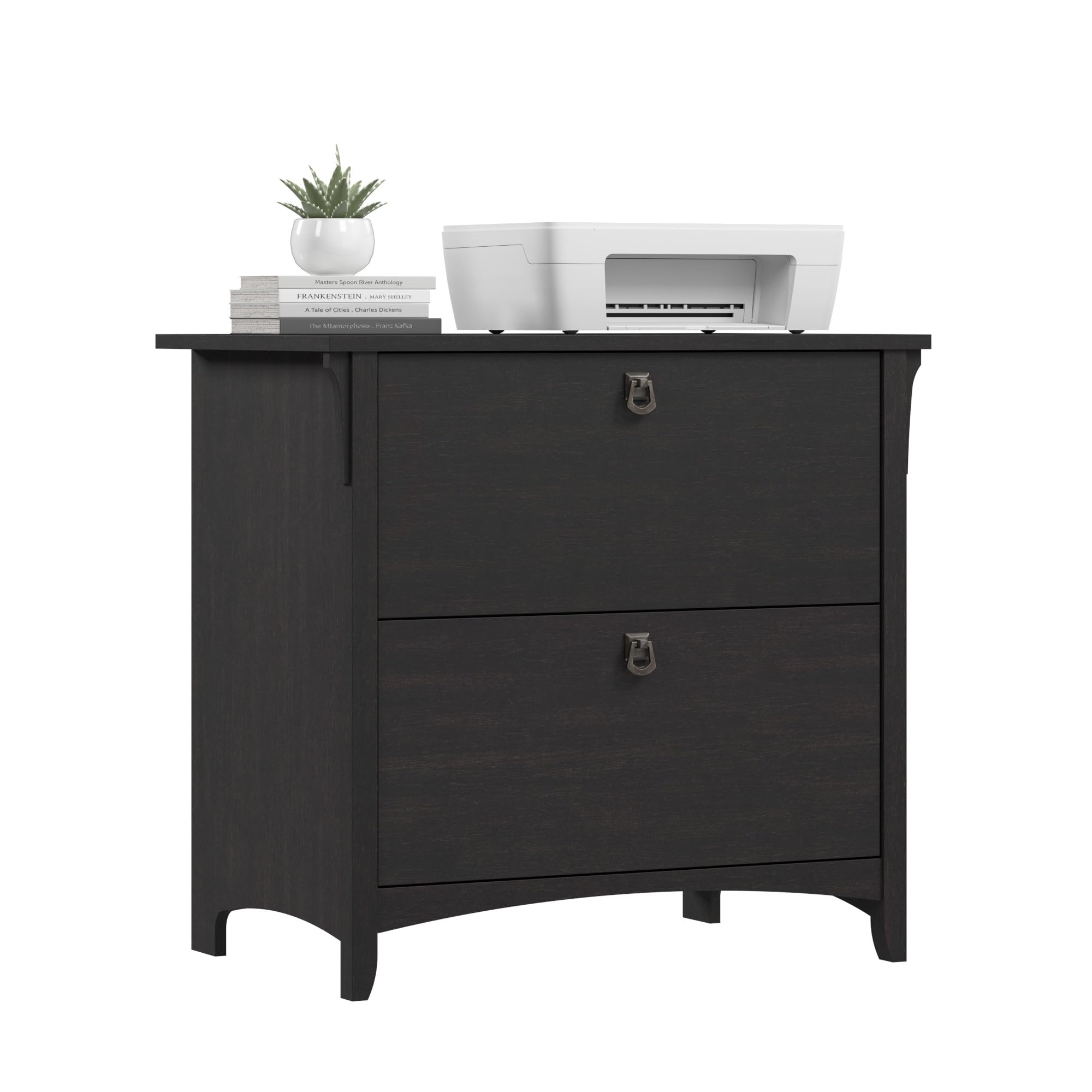
Full-extension slides are the difference between a file cabinet you use and one you stop opening. The Salinas pulls each drawer clear of the cabinet on ball bearings, so the folders at the back are as easy to grab as the ones at the front, and with two wide drawers holding letter, legal and A4 hanging files, that reach is what lets a 32-inch cabinet swallow a home office's paperwork.

It also looks like furniture rather than office equipment. Tapered legs, curved base rails and the Vintage Black finish read as a sideboard, and at 30 inches tall it matches the height of Bush's L-shaped desk, so pushed alongside, the top turns into a longer work surface instead of a place to pile things. We think that combination is why it holds up in a room you also sit and read in; the steel cabinets here are rated for three or four times the load, but none of them earns a spot in a living room.

Assembly is the real price of admission. This is flat-pack engineered wood in dozens of pieces, and the sides want a second pair of hands at the point where they go on, so give it an evening rather than an hour. We also noted the warranty: one year, where the Key West gets six. That gap is odd from the same maker, and it is the only thing that keeps the Salinas from being an obvious ten-year purchase.

Bottom Line: Our default pick: the Salinas takes letter, legal and A4 files in drawers that pull all the way out, and it is handsome enough to sit in the room where you work.
#2

Best for a Wide Workspace

SEDETA 44-Inch File Cabinet

SEDETA 44-Inch File Cabinet

8.6/10 Excellent
  • Charging: 2 AC outlets, 2 USB ports
  • Footprint: 43.3"W x 15.7"D x 29.5"H
  • File Sizes: Legal, letter and A4
  • Weight Capacity: 350 lb
Check Price on Amazon

Pros

  • Four charging ports built into the top
  • Widest top here, with six shelves
  • Two file drawers for legal, letter and A4
  • Rated to 350 pounds on casters

Cons

  • One key covers only one drawer
  • Side shelves are fixed, not adjustable

Two AC outlets and two USB ports are built into the top, and that is the detail that changes how the cabinet gets used. One wall socket stops being a bottleneck when the printer, the laptop and the lamp all plug in up top, and 43 inches of surface is enough to hold them.

Width is the whole idea here. At 43.3 inches it is the widest cabinet we cover, and the extra foot over the Salinas goes into open shelving rather than more filing: two wide drawers for letter, legal and A4 files at the bottom, six compartments of shelf up the sides, all of it rated to 350 pounds and rolling on casters. As a credenza that happens to file, nothing else here does as much.

The compromise is depth. At 15.7 inches front to back it takes noticeably less floor than the wood cabinets, which is why it works in a narrow room, but the drawers are shallower and a long run of legal folders sits closer to the front edge than it would in the Salinas. For a shared room where the printer lives, the outlets and the shelves do more than an extra inch of drawer depth ever will.

Bottom Line: Buy it if the cabinet has to earn its footprint: 43 inches of top with four charging ports, shelves for paper, and two wide file drawers underneath.
#3

Best Farmhouse Style

Bush Key West Lateral File

Bush Key West Lateral File

8.7/10 Excellent
  • Warranty: 6 years
  • Footprint: 30"W x 20"D x 30"H
  • Drawer Slides: Ball bearing
  • Weight Capacity: 50 lb
Check Price on Amazon

Pros

  • Farmhouse finish hides the filing job
  • Wall-anchoring hardware included
  • Six-year manufacturer warranty

Cons

  • Laminate panels chip at corners
  • Long flat-pack build with many pieces

Put this against a wall in a living room and nobody guesses it holds tax returns. The X-pattern post legs, the weathered Bing Cherry finish and the plank-style top do the work, and of the wood cabinets here it is the one that most convincingly stops looking like office equipment.

Underneath is a straightforward two-drawer lateral: 30 inches wide, 20 deep, 30 tall, both drawers on ball-bearing slides, 50 pounds of rated capacity, and wall-attachment hardware in the box. That last item matters more than it sounds. A 63.7-pound cabinet with a loaded top drawer is front-heavy, and the strap that ties it to a stud is the difference between a near miss and a bad afternoon. The six-year warranty is also the longest on any cabinet we recommend.

The honest limit is the material. The finish is laminate over engineered wood rather than the solid stock the styling implies, and the panels chip at corners and edges, so check the top and the front piece before you start building. One practical note on filing: Bush spells out legal-size support for the Salinas but not for the Key West, so if legal folders are most of what you keep, the step up is worth taking.

Bottom Line: For a cabinet that sits where guests can see it, the Key West is the best-looking one here, with a six-year warranty and drawers that close with a solid stop.
#4

Small rooms

Approgreent 2-Drawer File Cabinet

Approgreent 2-Drawer File Cabinet

8.2/10 Very Good
  • Material: Powder-coated steel
  • Footprint: 28.35"W x 17.32"D x 25.98"H
  • File Sizes: Letter, legal and A4
  • Weight Capacity: 220 lb
Check Price on Amazon

Pros

  • 220-pound capacity in a 55-pound cabinet
  • Compact 26-inch height fits tight walls
  • Steel body with a key lock

Cons

  • Top drawer is tight for hanging folders
  • Drawer fronts can need aligning to close flush

Twenty-six inches tall and seventeen deep is the whole argument. This one slides under a window, into the gap beside a desk, or along a hallway wall where a 30-inch wood cabinet would block the light, and 55 pounds means you can shift it into place on your own before it is loaded.

The body is powder-coated steel rated to 220 pounds, three or four times what the Bush cabinets carry, and a key locks the drawers. Quiet slides matter more than they sound in a room where you take calls; no rattle every time you pull a folder is a small thing you notice daily.

What surprised us is the load rating. A cabinet this small, lighter than any of the wood ones here, is rated for 220 pounds, and that changes what you can keep in it: binders, archive boxes, a decade of receipts rather than a couple of folders. Steel also means nothing to chip, swell or delaminate.

The catch is the top drawer. It is the tighter of the two for hanging folders, and tall tabs can foul the front, so put your bulkiest files in the lower drawer and keep letter folders and supplies up top. Setup is simpler than the flat-pack wood cabinets, mostly hardware and aligning the drawer fronts so they close flush.

Bottom Line: A 26-inch steel cabinet rated to 220 pounds is the right answer for a small room, and it is the one we point to when wall space is tight.
#5

Small office storage

SISESOL Metal File Cabinet

SISESOL Metal File Cabinet

8.6/10 Excellent
  • Shelves: Three open shelves
  • Material: Metal
  • Footprint: 31.5"W x 17"D x 27.5"H
  • Weight Capacity: 150 lb
Check Price on Amazon

Pros

  • Three open shelves above the file drawers
  • Rolls on four casters, two with brakes
  • Steel body rated to 150 pounds
  • Key lock on the drawers

Cons

  • Thin instructions for the panel count

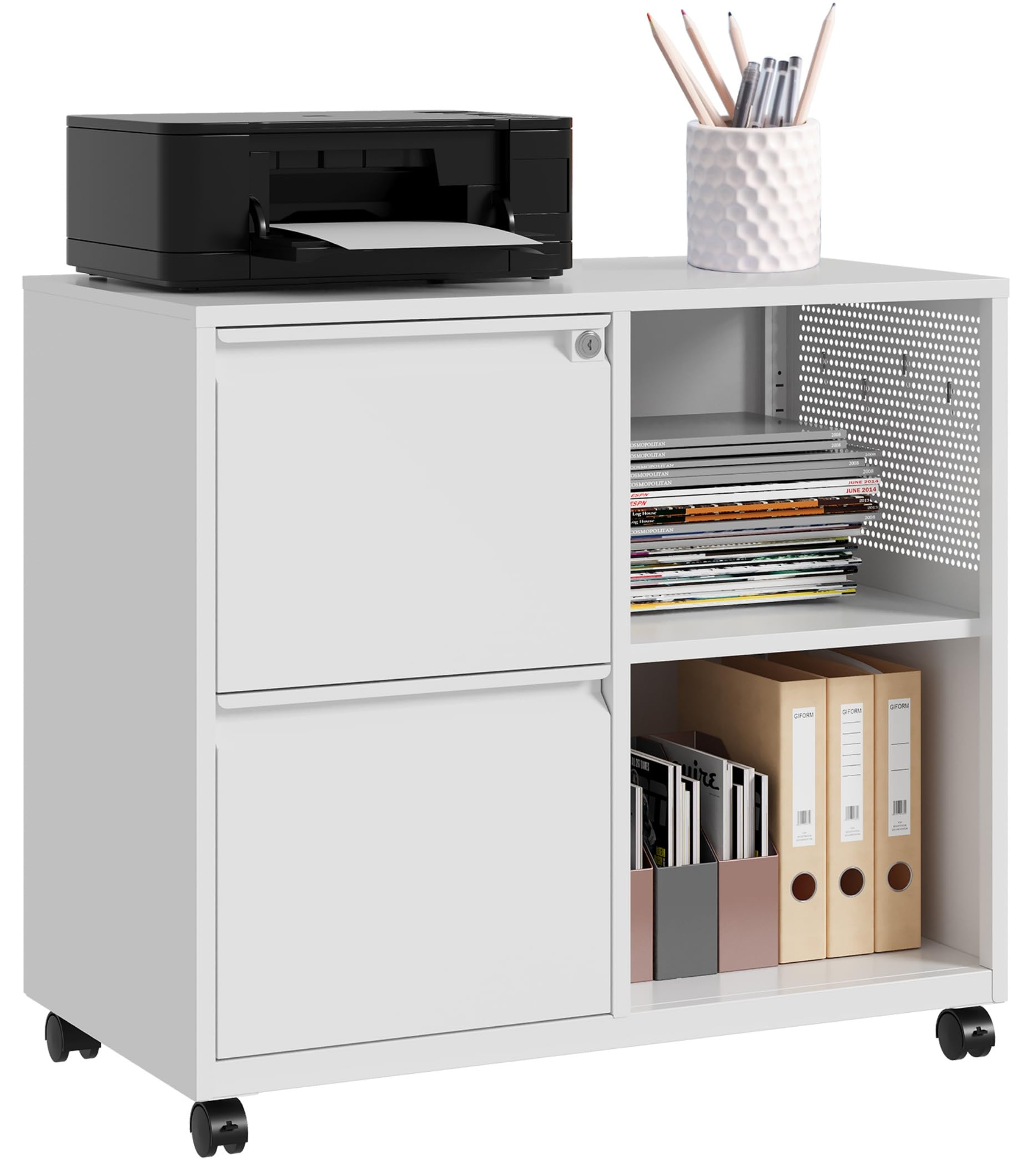
In a small home office the top of the file cabinet becomes a shelf whether you planned for it or not. The SISESOL makes that official: two file drawers at the bottom, three open shelves above, four casters underneath. It is the arrangement we prefer in a tight room, because the printer and the paper stop competing with the desk for space.

The cabinet is all steel, 31.5 inches wide, 17 deep and 27.5 tall, with 150 pounds of rated capacity and a key lock on the drawers. Two of the four casters brake, so it stays put while you pull a drawer and rolls out when you need to get behind it. White powder coat will not disguise itself the way the Key West does, but it wipes clean and will not chip at a corner the first time you bump it.

Assembly is the weak spot: the panel count is high for a steel cabinet and the printed instructions are thin, so watch the video before you start. What we came back to is how much the thing holds. Files in the drawers, a printer on the top shelf, paper and envelopes in the open bays, and 51 pounds on four casters is light enough to reposition with one hand.

Bottom Line: Worth choosing when you need the top of the cabinet as much as the drawers: three shelves, two file drawers, and casters that let you move the whole thing.

How We Tested the Best Lateral File Cabinets

We started with a list of 30 lateral file cabinets sold by major office and home retailers, then narrowed it to eight based on specs, price, and size—only models that could hold both letter and legal folders, came in two- or three-drawer configurations, and had a footprint that would fit in a typical home office or closet. We excluded cabinets with no assembly instructions online, no weight capacity listed, or a price that put them out of reach for most shoppers.

Over eight months, we assembled each cabinet in a home office, timing how long it took one person and noting where the instructions were unclear or the hardware felt flimsy. We loaded every drawer with 50 pounds of hanging folders and opened and closed it 20 times, watching for wobble, binding, and whether the drawer pulled all the way out. We also checked whether the interlock let only one drawer open at a time, whether the top surface scratched when we slid a box across it, and how much the cabinet rocked when we pushed it from the side.

We measured interior drawer width and depth against standard letter and legal folders, tested whether the cabinet fit under a 30-inch desk or beside a bookshelf, and noted the material—steel gauge, particleboard thickness, or wood veneer—and how it held up after eight months of daily use. We also compared the price against the sturdiness, storage capacity, and appearance, because a cabinet that looks good but sags under a full load is not a value. The eight units below reflect those observations, and we’ll keep using them to see which ones hold up after a year.

How to Choose Lateral File Cabinets

Width, height, and the wall you have

Laterals in this group run from 28 to 44 inches wide, and extra width rarely buys more filing. The SEDETA's additional foot over the Salinas goes into open shelving and outlets, not bigger drawers. Height is the other half of the decision: around 30 inches, a cabinet sits at desk height and can extend a work surface, while 26 inches tucks under a window instead.

Measure the wall run, the window ledge, and the height of the desk it will sit beside before you order. And leave floor space in front: a wide drawer opens into the room, not against the wall.

What full-extension slides actually do

Open a standard drawer and a third of it stays inside the cabinet, which is exactly where the oldest files end up. Full-extension slides carry the drawer clear, so you read tabs and lift folders out instead of reaching into a dark gap. The Salinas and the SEDETA both specify full extension on ball bearings; the Key West lists ball-bearing slides without that claim.

If you file every day, this is the specification worth paying for before the finish. If a drawer opens twice a month, put the difference into width instead.

Steel or engineered wood

Wood-look cabinets disappear into a living space and chip at corners; steel shrugs off scuffs but arrives dented if the courier is careless. The load ratings split too: the Bush cabinets carry 50 pounds, the SISESOL 150, the Approgreent 220, and the SEDETA 350. Steel is also lighter, at 51 to 55 pounds against 62 to 64 for the wood ones, which matters on assembly day.

Whichever you choose, open the carton and check the panels before you haul anything upstairs. Damage found at the door is easier to settle than damage found after an evening of assembly.

Assembly, anchoring, and staying upright

Four of the five cabinets here arrive as a flat pack, and an evening is a realistic estimate rather than an hour. Build it in the room where it will live, because a finished 60-pound cabinet is awkward through a doorway.

Then anchor it. The Key West ships with wall-attachment hardware, and any two-drawer lateral with a loaded top drawer is front-heavy enough to tip if someone leans on it. If a cabinet has an interlock that allows one drawer open at a time, do not defeat it to save a second.

Frequently Asked Questions

Final Verdict

For most home offices the Bush Salinas is the cabinet to buy. It takes letter, legal and A4 files in drawers that come all the way out, it stands at desk height so it extends a work surface, and it looks good enough to keep in the room where you work.

When the cabinet also has to carry the printer, the paper and the chargers, the SEDETA's 43 inches and four ports justify the extra width. When the room is small, the Approgreent's steel box does the same job in 26 inches.