Kids & Nursery

Best Baby Dressers of 2026

A baby dresser has a job description no other piece of nursery furniture can claim. It holds the clothes, it holds the wipes, and at 3 a.m. it holds the baby while you fumble one-handed for a fresh onesie. It also gets leaned on, yanked open, and climbed in ways no adult dresser ever is, so the flimsy ones announce themselves fast: a top that flexes under the changing pad, a drawer that sticks halfway, a wobble you feel every morning. The right one fixes all of that at once, staying steady under a hand, roomy enough for a week of laundry, and good-looking enough to sit in the middle of the room.

I've built enough flat-pack nursery furniture to be suspicious of anything that arrives in a thin box, and over the past eight months my team and I have assembled, loaded, and lived with 10 dressers. Here's what nobody tells a first-time buyer: the drawer glides matter more than the wood species, and the footprint on the page rarely matches the one in your room. The picks below survived all of it.

#1

Best Overall

Storkcraft Avalon 6-Drawer

Storkcraft Avalon 6-Drawer

8.7/10 Excellent
  • Drawers: 6
  • Dimensions: 17.5" D x 50" W x 40.5" H
  • Certification: GREENGUARD Gold; ASTM F2057 tested
  • Drawer Safety: Interlocking, one opens at a time
Check Price on Amazon

Pros

  • Interlocking drawers plus anti-tip hardware
  • GREENGUARD Gold and ASTM F2057 tested
  • Wide top takes a changing pad and supplies
  • Solid wood framing, not fabric bins

Cons

  • Heavy at 114 pounds; a two-person move
  • Long, hardware-heavy flat-pack assembly

Interlocking drawers are the first thing we check on a nursery dresser, and the Avalon is the only one here that has them: one drawer opens at a time, so a baby pulling up on an open drawer cannot bring a second one out on top of themselves. Add the tip-over restraint in the box and GREENGUARD Gold certification for low emissions, and this is the piece in the group built for a nursery first and a bedroom second.

The size is the other argument. At 50 inches wide and 40.5 inches tall, the top takes a changing pad with room left for wipes and a stack of diapers beside it, and the six drawers below swallow a full first year of clothes plus bedding without a second chest. Solid wood framing puts it in a different class from the fabric towers here, and the white finish is the kind that takes being wiped down twice a day.

What we do not love is the build itself. It is a flat-pack job with a lot of pieces, the hardware wants patience, and at 114 pounds assembled it is not a one-person move once it is standing. It is also the most expensive dresser in this guide, and the gap in money is real.

Do one thing first: unpack and check every panel before assembly starts. Panels can arrive scratched, chipped or cracked, and a damaged piece is a small problem in the carton and a miserable one once the chest is built. Check it in the first day or two, while a return is still simple, and the rest of the ownership experience is uneventful.

Bottom Line: The one we recommend for a nursery that will be used for years: interlocking drawers, GREENGUARD Gold air, and a wide top that takes a changing pad.
#2

Best Changing-Table Dresser

BOLUO Changing Table Dresser

BOLUO Changing Table Dresser

9.1/10 Outstanding
  • Drawers: 6 fabric
  • Dimensions: 16.9" D x 32.7" W x 37.2" H
  • Drawer Size: 12" W x 16.9" D x 9" H
  • Changing Top: Removable
Check Price on Amazon

Pros

  • Pad-width top at a back-friendly 37.2 inches
  • Six deep drawers sized for diapers and clothes
  • Removable top converts it to a plain dresser
  • Light, quick assembly with tools included

Cons

  • Changing pad sold separately
  • Fabric bins, so it is a nursery-years piece

A changing pad takes up most of the top on any dresser, and the BOLUO is the one here designed around that: 32.7 inches across the top at 37.2 inches high, which is tall enough that you are not stooping and narrow enough to sit in a corner. The changing station and the dresser are the same piece of furniture, so a small nursery does not have to hold both.

We like it best as a first-year dresser. Six fabric drawers, each about 12 inches wide and 9 inches deep, take sleepers, towels and socks, and the depth means a box of diapers stands upright in one instead of sprawling across two. The top lifts off when the changing days are over, which turns it into a plain six-drawer chest for a kid's room rather than a piece you have to sell.

Assembly is one of the shortest jobs in this guide — light panels, tools in the box, about 40 pounds finished — and four adjustable feet settle it on a floor that is not quite level. The limit is the material. Non-woven bins on a metal frame are nursery furniture, not heirloom furniture, and a heavy-handed four-year-old will find the edges of that.

Bottom Line: Buy this when the changing station is the whole point: a pad-width top at a comfortable height, six deep bins, and a top that lifts off later.
#3

Best Furniture-Grade Pick

Xixini Fluted 6-Drawer

Xixini Fluted 6-Drawer

8.7/10 Excellent
  • Weight: 90.4 lb
  • Drawers: 6
  • Dimensions: 15.55" D x 47.2" W x 30.5" H
  • Drawer Glide: Center-mounted slides
Check Price on Amazon

Pros

  • Fluted oak finish that looks like real furniture
  • Drawer boxes on slides with anti-tip bracket
  • Six deep drawers for clothes and bedding

Cons

  • No tools included; assembly runs long
  • Drawer depth suits kid clothes, not adult stacks

Ninety pounds of flat-pack is a statement. The Xixini arrives as panels and hardware and turns into something that feels like furniture: a fluted front, a grained oak top, and drawer boxes on center-mounted slides rather than fabric bins that fold when you push too hard. At 47.2 inches wide and 30.5 inches tall it reads as a proper bedroom dresser that happens to live in a nursery.

That is what makes it worth the money here if the nursery is a room adults sit in. The drawers take folded baby clothes without sagging, the anti-tip bracket is there for the climbing stage, and the finish shrugs off a wipe. What it is not is a changing station: 30.5 inches is low for an adult to change a baby on, so plan on a pad with a non-slip base or a separate station.

Set aside an evening and a drill. Assembly is the long pole — panels are numbered but there are a lot of them, no tools come in the box, and the holes want a power driver to line up cleanly. Check panels for shipping damage before you start, because a chipped corner on a piece this size is a fight you do not want after the fact.

Bottom Line: For the nursery that doubles as a grown-up room: a solid, fluted chest with real drawer slides and a low top you will not change a baby on.
#4

Best Storage in a Tight Space

WLIVE 9-Drawer Fabric Dresser

WLIVE 9-Drawer Fabric Dresser

8.8/10 Excellent
  • Frame: Steel with wood top
  • Weight: 29 lb
  • Drawers: 9 fabric
  • Dimensions: 39.6" L x 11.8" W x 39.5" H
Check Price on Amazon

Pros

  • Nine drawers in an 11.8-inch depth
  • Wood top holds a lamp and a monitor
  • Light enough for one person to shift

Cons

  • Fabric bins rather than solid drawers
  • Shallow top limits what sits on it

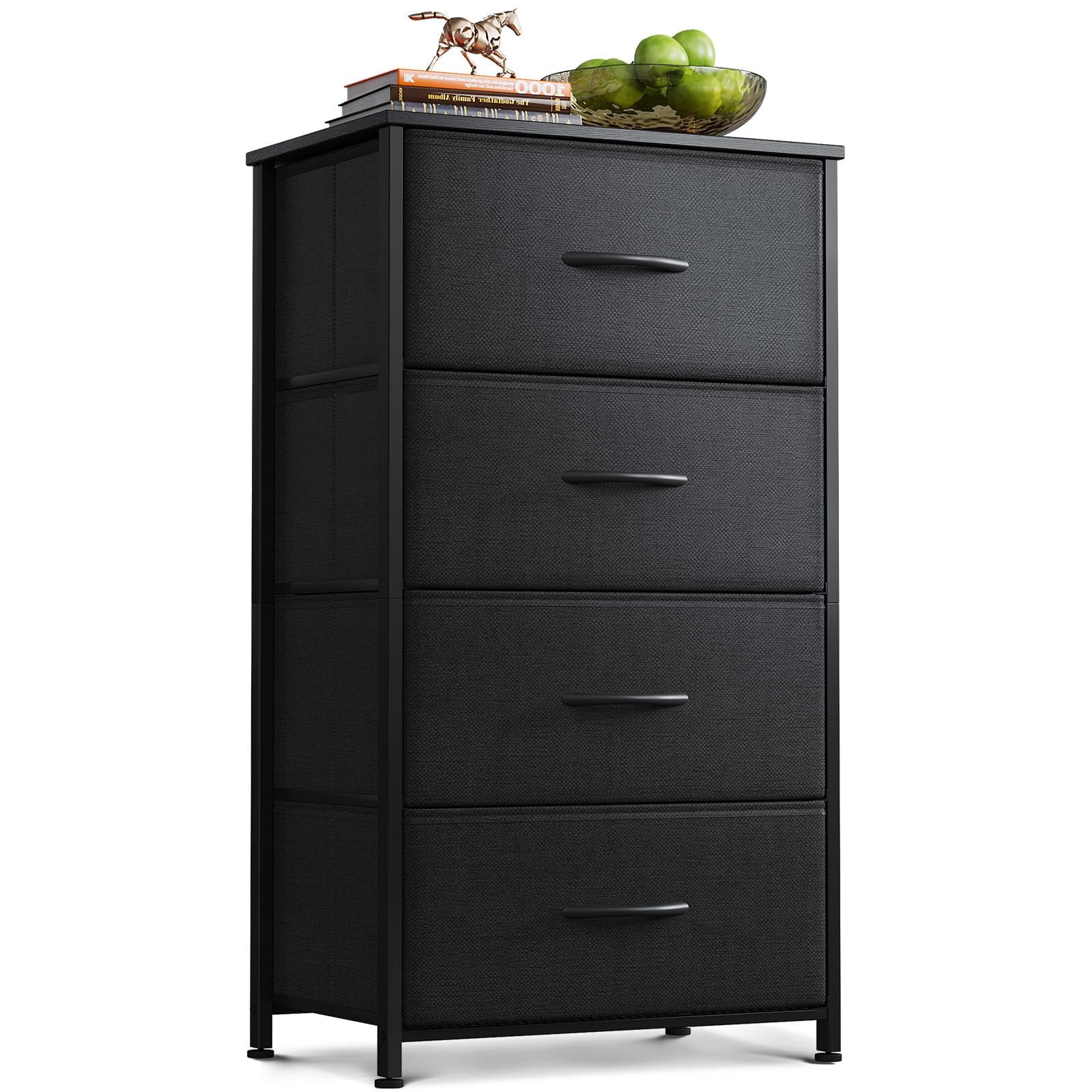
Nine drawers in a footprint 11.8 inches deep. If the only free wall in your nursery is the one behind the door, that number decides more than any finish does: the WLIVE is 39.6 inches wide, 39.5 tall, and barely a foot out from the wall, so it holds a whole baby wardrobe without eating the floor you need for a crib and a chair.

The drawers are fabric bins on a steel frame, and that is the trade. A deep bin takes a stack of sleepers and a blanket without complaint, and the wood top gives you somewhere to land a lamp and a monitor. What the bins do not do is glide like a drawer box, and the tower flexes a little when it is loaded and pushed.

For a wall with nothing else to give, that trade is the right one. Anchor it to the wall rather than trusting it freestanding — at 29 pounds this is a light tower, and adjustable feet only do so much on carpet. Put the heavy things in the lower drawers, keep the top two for socks and muslins, and assembly is a one-person job with the instructions open in front of you.

Bottom Line: The storage-per-inch pick: nine deep bins on a foot-deep footprint, made for a nursery wall that has nothing else to give.
#5

Best for a Toddler's Room

Sorbus 7-Drawer Dresser

Sorbus 7-Drawer Dresser

8.9/10 Excellent
  • Color: Pastel pink
  • Drawers: 7 fabric, fold flat
  • Material: Steel frame, MDF top
  • Dimensions: 11.87" D x 25" W x 28.75" H
Check Price on Amazon

Pros

  • 28.75-inch height toddlers can reach
  • Colored drawers help kids sort their own clothes
  • Bins fold flat for storing or moving

Cons

  • Small: 25 inches wide and 28.75 tall
  • Fabric bins on a light steel frame

Twenty-eight and three-quarter inches is the number that makes this one useful. That is below adult waist height and right at a two-year-old's eye level, which is why the Sorbus works as a dresser a child grows into rather than one they grow out of before they can reach the second drawer.

Seven drawers in a 25-inch width, with colored fronts that do real work: a child who cannot read yet can still learn that the pink bin is pajamas and the blue one is socks. The pulls are quiet enough for a room where someone is sleeping, and the bins fold flat, which makes the whole thing easier to move between rooms or store between kids.

It is small, and that is the honest catch. The listing photos make it look like a chest of drawers when it is closer to a bedside tower — 25 inches wide, 11.87 deep, 28.75 tall. Measure the wall before you order, because this one fits gaps a full dresser cannot and disappoints anyone expecting a full dresser's volume.

It is the dresser a two-year-old can call their own, and in the toddler years that is worth more than capacity. Set it up on a flat floor and check the frame is square before you tighten everything down; a frame that goes together twisted is what makes drawers bind when they slide.

Bottom Line: The dresser a toddler can actually use: seven colored bins at 28.75 inches, in the narrow corner nobody else wanted.
#6

Best for a Nursery With No Closet

EnHomee Dresser with Hanging Rack

EnHomee Dresser with Hanging Rack

8.8/10 Excellent
  • Weight: 37.2 lb
  • Drawers: 6 fabric
  • Dimensions: 15.8" D x 49.2" W x 47.2" H
  • Hanging Rack: With grid panel and 4 hooks
Check Price on Amazon

Pros

  • Hanging rail and four hooks above six drawers
  • Deep bins that take baby clothes and supplies
  • Charging point and LED strip built in
  • 37.2 pounds, so it repositions easily

Cons

  • Fabric drawers on a metal frame
  • 49.2 inches wide needs a long wall

If the nursery has no closet, this is the piece that solves the room. The EnHomee pairs six deep fabric drawers with a hanging rack — a rail, a grid panel and four hooks — so outfits that would crease in a drawer can hang, and everything else goes below. One 49.2-inch-wide unit at 47.2 inches tall does a wardrobe's job here.

The extras earn their place more than the listing suggests. The charging point on the side keeps a monitor or sound machine plugged in without hunting for an outlet behind the crib, and the LED strip gives you enough light for a night change without turning the overhead on. In a small flat, that is the difference between a nursery and a room with a crib in it.

It is light at 37.2 pounds, which cuts both ways. Two people can walk it into position and move it alone later, but the frame is metal and the drawers are fabric, and the material is exactly what it looks like — a storage system dressed up, not a wood dresser. Assembly is straightforward, and the left or right version means the rack sits on whichever side suits the room.

The width is the real constraint. Measure the wall: 49.2 inches is as wide as a double dresser and it wants a long, unbroken stretch, not the gap between a door and a crib.

Bottom Line: For a nursery with no closet, the hanging rail and six deep bins replace a wardrobe and a dresser in one footprint.
#7

Crib-side storage

AODK 4-Drawer Dresser

AODK 4-Drawer Dresser

8.5/10 Excellent
  • Weight: 11 lb
  • Drawers: 4 fabric
  • Stability: Anti-tip design, adjustable feet
  • Dimensions: 11.73" D x 15.74" W x 31.77" H
Check Price on Amazon

Pros

  • Fits a 16-inch gap beside a crib
  • Anti-tip design and adjustable feet
  • Eleven pounds, easy to carry upstairs
  • Deep bins for wipes, sheets and sleepers

Cons

  • Four small drawers only; not a full wardrobe
  • Light fabric build needs the wall strap

AODK's own listing says it plainly: this is a small dresser. Fifteen and three-quarter inches wide, 31.8 tall, four drawers. If you are picturing the chest that holds a baby's whole wardrobe, this is not it, and the disappointment in that mismatch is entirely avoidable — the dimensions are on the page.

What it is, is the most useful small thing here. Eleven pounds with an anti-tip design and adjustable feet, and four fabric bins deep enough for a stack of sleepers, a pack of wipes and the spare sheets. It goes where a dresser cannot: the gap beside the crib, the closet corner, the landing where you actually change a baby at four in the morning.

We rate it as a second storage point and not a primary dresser, and it is good at exactly that. Pair it with a real chest for the wardrobe and let this hold what you need within arm's reach of the crib. Assembly is quick, the top is a stable little shelf, and nothing about it pretends to be more than a well-made small box with drawers.

Bottom Line: Buy it as the crib-side second storage point rather than the main dresser: 11 pounds, four deep bins, and a footprint that fits anywhere.

How We Tested 10 Baby Dressers Over Eight Months

We started with more than 40 dressers sold for nursery use and cut the list on paper first: models that didn't publish full exterior dimensions, that shipped without a wall-anchoring kit, or that used stapled rather than joined drawer boxes never got ordered. Ten made the cut, and we've spent the last eight months building, loading, and living with them in real nurseries instead of a showroom.

Each one was assembled by a single person using only the hardware and tools in the box, with a timer running. The spread was wide, from a forty-minute straight shot to an afternoon of mislabeled panels and a hardware-store run. Once built, we measured the actual footprint against a typical nursery wall and set a standard changing pad on top to see whether it sat flat or overhung the edges. For sturdiness, we pulled a loaded top drawer open one-handed while holding a 15-pound weight in the other arm, then leaned our body weight into the front edge and watched for flex, tipping, or creep.

Spaciousness got judged with real baby clothes: we filled each drawer with a newborn-to-12-month wardrobe and noted which ones swallowed a full week of sleepers and which needed refolding to close. Over the eight months we wiped finishes with baby wipes, set down damp cups, and dragged a few across the floor during a room redo to see which edges dinged and whether the particleboard swelled at the seams. Value came down to what held up — a dresser that needed its screws re-tightened by month three didn't earn its price, however good it looked on delivery day.

How to Choose Baby Dressers

Measure the Wall Before You Compare Drawers

Depth is the number buyers skip and then regret. The dressers here run from 11.4 to 17.5 inches deep, and a shallow fabric tower buys back nearly a foot of floor in a small nursery — often the difference between a glider fitting and not. Then check the two clearances that ruin layouts: the door swing and the gap to the crib.

A 49- or 50-inch double dresser is a commitment to a long, unbroken wall; a 25-inch chest slips into the corner beside a window. Tape the footprint on the floor before you order and the room will tell you which one it can take.

Fabric Bins or Real Drawer Boxes

Two constructions dominate this category, and the choice is really about how long you want the furniture. Non-woven bins on a steel frame are light, inexpensive, and hold an astonishing amount of baby clothes. They also flex, do not glide, and will not survive a determined four-year-old. Drawer boxes on slides cost more and weigh more, and they feel like furniture a decade later.

For a first baby in a rental, bins make sense. If the dresser will follow you into a child's room and beyond, pay for the drawer boxes now — it is the one upgrade you cannot add later.

Safety Hardware Is the Reason to Pay More

Every dresser in a nursery gets anchored to the wall, including the light ones: a 29-pound tower with a drawer hanging open is a tipping hazard the moment a baby pulls up on it. The better pieces add hardware you cannot retrofit — an interlocking system that allows only one drawer open at a time, and certification to the ASTM F2057 clothing storage unit standard.

In a room where a baby sleeps, GREENGUARD Gold certification for low emissions is worth looking for too. Those specifications are what separate a nursery dresser from a bedroom dresser that got reassigned.

The Top: Changing Pad and the Right Height

A changing pad needs a flat top at least as wide as the pad, and a surface around 37 to 40 inches high saves your back through the ten changes a day you will be doing. Anything near 30 inches turns changing into a squat, which is fine for a chest and wrong for a changing station.

Decide early whether the dresser is where you change the baby. A removable top converts back to a plain dresser later; a low, wide chest needs a separate pad and a lot of bending. Either way, buy a pad with a non-slip base and keep a hand on the baby.

Assembly, Odor, and Timing

Flat-pack dressers take an evening, not twenty minutes, and the ones with real drawer boxes take longest — a power driver and a second pair of hands make the difference. Build it before the baby arrives rather than the week they come home, then let the panels air in a garage or spare room for a few days. Engineered wood and paint can smell sharp at first, and a nursery is the worst room in the house to discover that.

Unpack and check every panel before assembly starts, while a return is still simple. A chipped corner is a small problem in the carton and a large one once the chest is built.

Frequently Asked Questions

Final Verdict

The Storkcraft Avalon is the one we would put in a nursery and leave there. Interlocking drawers, GREENGUARD Gold air, a tip-over restraint in the box and a 50-inch top that takes a changing pad are the reasons it beats everything else here for a family that wants one dresser to do the whole job.

If the built-in changing station is the deciding feature, the BOLUO does that job in a fraction of the footprint and money. The Xixini is the pick when the nursery doubles as a grown-up room and you want the dresser to look the part.