Kids & Nursery

Best Changing Table Dressers of 2026

A changing table dresser has to be two pieces of furniture at once: a safe, waist-high spot for a 3 a.m. diaper change and a real dresser that still looks right in a nursery two years later. The worry is that it does neither job well — a top too small for a standard pad, drawers that jam when you're reaching over with one hand, a frame that shimmies when a toddler kicks. What it fixes is straightforward: everything you need stays within arm's reach, and you get the storage you were going to buy anyway in one footprint instead of two.

Over the past six months, my team and I built, loaded, wiped down, and lived with eight of these dressers, and the ones that pulled ahead did it on things you can't see in a product photo — how the drawer bottoms are attached, whether the glides can be adjusted, how the finish takes a wipe-down twice a day. Here's the piece of advice I'd give any first-time buyer: the changing top is the part you outgrow first, so shop the dresser for what it becomes. These picks earned their place as both.

#1

Best Overall

Delta Children Perry 3-Drawer

Delta Children Perry 3-Drawer

8.9/10 Excellent
  • Item Weight: 108 lb
  • Drawer Safety: Interlocking, one drawer at a time
  • Drawer Interiors: 29.5"W x 13.5"D x 5.75"H
  • Overall Dimensions: 36.75"W x 20.25"D x 38.25"H
Check Price on Amazon

Pros

  • Interlocking drawers that open one at a time
  • Real drawer boxes on ball-bearing slides
  • Removable topper leaves a plain three-drawer dresser
  • Solid 108-pound build

Cons

  • Changing pad sold separately; needs a 32 by 16 inch
  • Heavy; plan on a helper and the wall strap

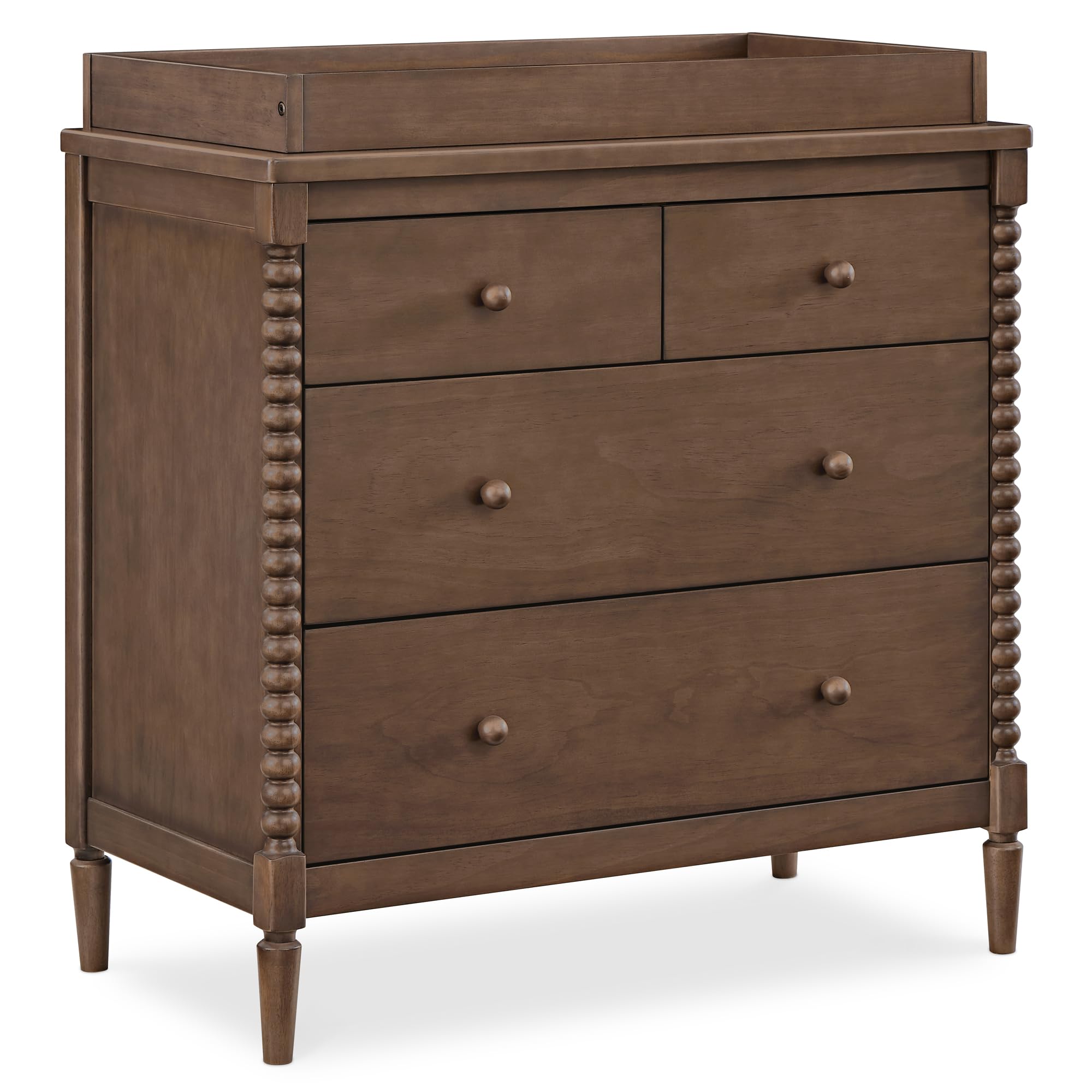
Only one drawer opens at a time, and that single restriction is why this sits at the top of our list. The interlock is tested to the mandatory ASTM F2057 clothing-storage standard, and Delta builds it into a dresser that looks like furniture rather than baby equipment: picture-frame molding on every drawer front, ball-bearing slides, sustainable pine and engineered wood, 108 pounds of it.

The dimensions are the honest trade. At 36.75 inches wide and 20.25 inches deep the Perry wants a real wall rather than a corner, but the drawer interiors run 29.5 inches across and 5.75 inches deep — enough for a shelf of folded sleepers with no bin in sight. The changing top lifts off, which is the part we care about most: you're buying the dresser your child keeps, not a station you retire at eighteen months.

Expect a firm, deliberate pull on the drawers, and expect to fetch one thing at a time. We'll take that bargain in a nursery, where a toddler using an open drawer as a ladder is the risk worth designing out.

Cross-shopping the Storkcraft Horizon? That one is about three inches shallower and twenty pounds lighter, which matters if the wall is tight. Where there's room, the Perry's deeper drawer boxes and quieter slides win the comparison for us.

Bottom Line: Our pick for most nurseries: the Perry is a real dresser first, with interlocking drawers that resist climbing and a topper that lifts off when diapering ends.
#2

Best Value

BOLUO 6-Drawer Changing Dresser

BOLUO 6-Drawer Changing Dresser

9.1/10 Outstanding
  • Storage: 6 fabric drawers
  • Drawer Size: 12"W x 16.9"D x 9"H
  • Changing Top: Removable; pad not included
  • Overall Dimensions: 32.7"W x 19.7"D x 37.2"H
Check Price on Amazon

Pros

  • Six deep fabric drawers in a small footprint
  • Tool-free assembly without a second pair of hands
  • Removable top converts it to a plain chest
  • Working height matches the wood dressers

Cons

  • Fabric drawers, not wood
  • Not built to survive a move

There are two ways to spend less on a changing dresser, and only one of them is worth doing. BOLUO takes the sensible route: a metal frame and engineered-wood body carrying six fabric drawers, a removable top, and a price that makes it the budget answer in this group without asking you to change a baby on something flimsy.

What surprised us is assembly. It goes together without extra tools and without the two-person afternoon the wood dressers here demand — the adjustable feet even sort out a floor that isn't level. In a nursery that's also the room you're still unpacking, that counts for more than it sounds.

What you give up is furniture-grade construction. Those drawers are fabric boxes — 12 inches wide, 16.9 deep, 9 tall — on a 40-pound frame, deep enough for a bulk box of diapers and then some, and never going to survive a move the way a plywood drawer box will. At 32.7 inches wide it tucks into a small room, and the 37.2-inch top is the same working height as the wood dressers here. The top comes off afterward, leaving a plain six-drawer chest that's fine in a guest room and not much more.

Bottom Line: If the total is what decides it, buy this one: six deep fabric drawers, a removable top, and a build that doesn't eat a weekend.
#3

Best for Small Spaces

Storkcraft Horizon 3-Drawer

Storkcraft Horizon 3-Drawer

0.0/10 Fair
  • Drawers: 3
  • Item Weight: 86.7 lb
  • Certification: GREENGUARD Gold
  • Overall Dimensions: 34.09"W x 16.93"D x 38.62"H
Check Price on Amazon

Pros

  • Shallow 16.9-inch depth fits tight walls
  • GREENGUARD Gold certified for indoor air
  • Removable topper leaves a plain chest
  • Interlocking drawers for toddler safety

Cons

  • Drawers rattle on every open and close
  • Long flat-pack build with many panels

Depth is what decides this one. At 16.93 inches front to back, the Horizon is the shallowest full-height dresser in this group — about three inches less than the Perry — and that's the difference between a dresser that fits beside a door and one that fouls its swing.

We think that's worth paying for in a small nursery, and Storkcraft doesn't make you accept a worse piece to get it. The build is GREENGUARD Gold certified for low emissions, 86.7 pounds of engineered wood, with a topper that lifts off to leave a plain three-drawer chest and the same one-drawer-at-a-time interlock as our top pick.

The money went into the box, not the hardware. These drawers rattle on every open and close — the one detail that would keep us from putting this against a shared wall — and they stop short of full extension, so you reach into the back rather than sliding the drawer clear. Neither is much of a problem when the drawer holds sleepers you can see at a glance.

Bottom Line: For a narrow wall this is the one we choose: the shallowest dresser here, GREENGUARD Gold certified, with a topper that lifts off and drawers that make noise.
#4

Best Mobile Station

YeTom 9-Box Changing Table

YeTom 9-Box Changing Table

8.9/10 Excellent
  • Storage: 9 fabric boxes
  • Mobility: 4 removable locking casters
  • Item Weight: 28 lb
  • Changing Pad: Waterproof PVC, included
Check Price on Amazon

Pros

  • Rolls between rooms on locking casters
  • Nine fabric boxes hold bulk supplies
  • Waterproof pad included in the box
  • Narrow 16.7-inch depth for a wide top

Cons

  • Light 28-pound build won't be handed down
  • Fabric boxes instead of drawers

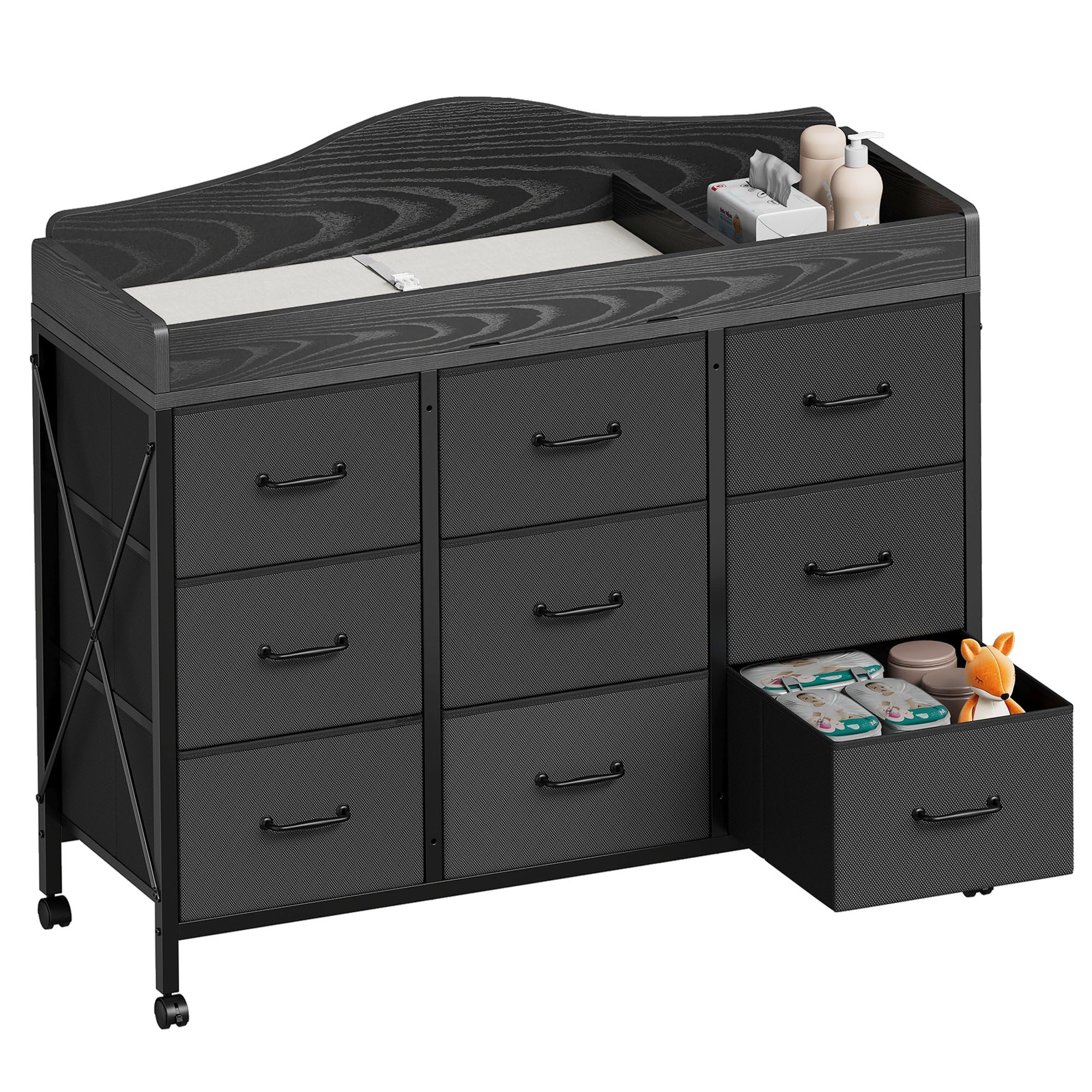
Four locking casters change how a changing station gets used. This is the only pick here that rolls, so it can live against the wall and come to the bedside at 2 a.m., and the wheels lift out if you want it parked for good.

Nine fabric boxes do the storage, spread across a 43-inch frame that's only 16.7 inches deep — a lot of bin space for very little floor. A waterproof PVC pad comes in the box, which our top pick makes you buy separately, and the top is ringed with safety baffles on all four sides, with a strap to match.

That 16.7-inch depth is the part we appreciated as much as the wheels: the thing disappears against a wall instead of jutting into the room. It's why this works in a shared space, where the station has to pack down at night and stop looking like a nursery.

The honest limit is 28 pounds. That's what makes it easy to move alone, and it's also what it feels like: engineered wood and non-woven fabric, not a dresser you hand down. For the two years a changing station actually gets used, the trade is fair, and the black finish is forgiving of the marks this job produces.

Bottom Line: For a room where the station has to travel, this one rolls: nine fabric boxes, a waterproof pad in the box, and casters that lock.
#5

Maximum storage

Bigbiglife 4-Drawer Dresser

Bigbiglife 4-Drawer Dresser

8.9/10 Excellent
  • Storage: 4 drawers, 1 cabinet, 3 open shelves
  • Dimensions: 15.8"D x 47.2"W x 37.2"H (4 Drawers)
  • Changing Pad: Included, sized to top
  • Drawer Slides: European slide
Check Price on Amazon

Pros

  • Changing pad included and matched to the top
  • Four drawers, a cabinet and three shelves
  • 15.8-inch depth keeps the footprint shallow

Cons

  • Engineered wood on ordinary drawer slides
  • 47.2 inches wide needs a long wall

The pad comes in the box, cut to the top. That sounds minor until you've ordered a dresser, discovered the topper wants a pad you don't own, and made a second trip with a newborn in the car.

Four drawers on European slides, a closed cabinet for bulk diapers and creams, and three open shelves, all inside 15.8 inches of depth — the storage of a much larger dresser on the wall space of a small one. At 47.2 inches wide it's a wall piece, not a corner piece, so measure before you fall for the layout.

For a nursery where everything happens at one station, we think the arrangement is the best in this group: diapers behind a door, clothes in drawers, and the things you grab mid-change on open shelves within reach of a free hand.

What we can't promise is the years after. It's engineered wood on ordinary slides, without the pine or the air-quality certification the Delta and Storkcraft pieces carry. Buy it because the arrangement suits how you actually change a baby, and treat the dresser it becomes as a bonus.

Bottom Line: Buy it for the layout: four drawers, a cabinet and three open shelves on a shallow footprint, with the changing pad already in the box.
#6

Wide dresser walls

St.Mandyu 5-Drawer Dresser

St.Mandyu 5-Drawer Dresser

7.7/10 Good
  • Drawers: 5
  • Shelving: Adjustable shelves
  • Dimensions: 19.3"D x 47.2"W x 37"H
  • Item Weight: 103 lb
Check Price on Amazon

Pros

  • Five drawers plus adjustable shelving
  • Gold-tone handles and curved wrapping detail
  • Widest dresser here at 47.2 inches

Cons

  • Long, fiddly flat-pack assembly

Set aside an evening and a second pair of hands, and know going in that the build is the price of the widest, best-dressed storage in this group. The panels are many and the instructions are the weak link; squaring the drawer fronts early is what decides whether they still run cleanly a year from now.

Get past that and there's a lot here. At 47.2 inches wide it's the widest dresser on this page, with five drawers, adjustable shelving and two open compartments, finished with gold-tone metal handles and a curved wrapping profile that reads as furniture rather than nursery kit. The 37-inch top puts the changing surface at the same working height as our top pick.

Weight is the other thing to plan for at 103 pounds, and the wall anchor isn't optional at that size. The reward is a dresser with somewhere to put everything — which is the whole argument for buying one combined piece instead of a cheap changing table plus a bookcase.

Bottom Line: Worth the wall if you want the look: five drawers, adjustable shelves and gold-tone handles, provided you're ready for a long build.
#7

Grown-up nursery

Delta Children Saint 4-Drawer

Delta Children Saint 4-Drawer

8.3/10 Very Good
  • Drawers: 4
  • Item Weight: 112.5 lb
  • Overall Dimensions: 36.75"W x 19.5"D x 38.25"H
  • Large Drawer Interior: 31.25"W x 13.5"D x 5.75"H
Check Price on Amazon

Pros

  • Turned-post design that outlives the nursery
  • Four drawers, two of them wide
  • Interlocking drawers and wall-mount build
  • New Zealand pine and engineered wood

Cons

  • Painted pine reads plain for the price
  • One drawer at a time gets tedious

Turned posts and a teak-brown finish put this in a different category from everything else here. The Saint is the piece that moves to the guest room when the nursery is done, and it's priced like it — the most expensive dresser on this page.

Four drawers, two of them wide enough for blankets, run on ball-bearing slides, and the one-drawer-at-a-time interlock from the Perry is here too. Construction is New Zealand pine and engineered wood, it's built to be wall-mounted, and 112.5 pounds is what a dresser of this size should weigh.

Two things temper it. Painted pine reads plainer in person than in the photographs, and at this price that's a genuine disappointment; the interlock also gets tiring when you're packing for a trip and want two drawers open at once.

We think it's worth the premium for one buyer: someone furnishing a nursery that has to pass as a grown-up room in five years, who doesn't mind an evening with an Allen key. If the dresser only needs to last until kindergarten, the Perry does the same job for far less.

Bottom Line: This is the dresser to buy if the nursery has to grow into a guest room: pine, turned posts and interlocking drawers, at a price that shows.
#8

Small rooms

Cidaziya 4-Drawer Changing Table

Cidaziya 4-Drawer Changing Table

8.1/10 Very Good
  • Frame: Reinforced steel
  • Storage: 4 drawers, mesh pockets, 5 hooks
  • Dimensions: 32.6 x 15.6 x 35 inches
  • Item Weight: 18.8 lb
Check Price on Amazon

Pros

  • Light enough to carry and reposition alone
  • Mesh pockets and hooks hold supplies
  • Compact footprint for small rooms

Cons

  • Less steady as your baby gains weight
  • Bins and a steel frame, not a dresser

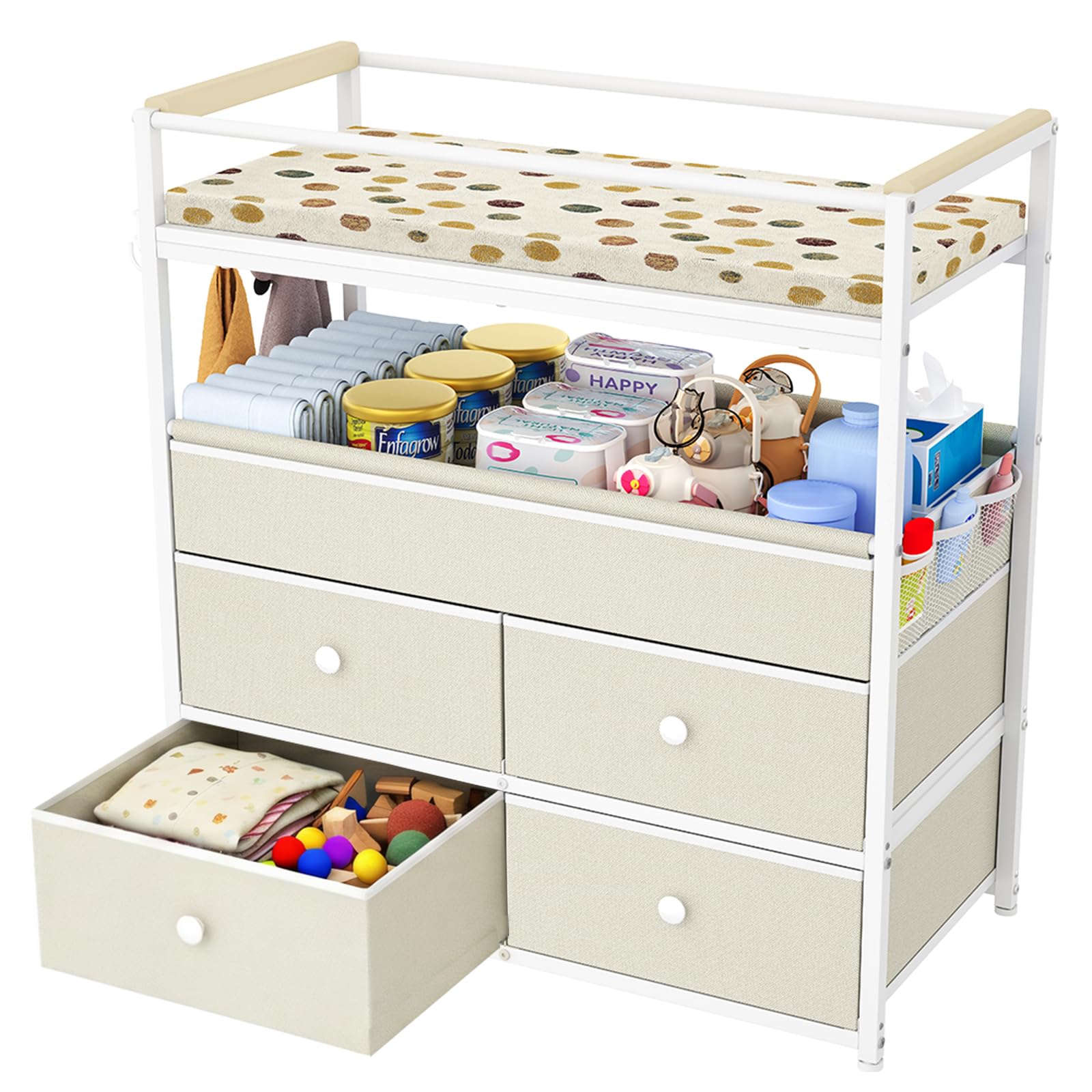
This isn't a dresser that changes diapers; it's a changing station with storage, and knowing which of those you're buying is most of the decision. A reinforced steel frame carries four fabric drawers, with mesh pockets on the sides and five hooks for bags, burp cloths and the things that otherwise live on the floor.

At 18.8 pounds it's the lightest full-size option here, which makes it the one you can carry upstairs alone and nudge into place with a knee. The 32.6-inch width and 15.6-inch depth tuck into a corner a wood dresser can't use, and the 35-inch top is friendly if you're shorter than average; taller parents will feel the extra bend at every change.

Sturdiness is the trade. The frame is fine for a newborn and less convincing once your baby is pushing against the sides and gaining weight, and this isn't the piece for a climbing two-year-old.

For a first year in a room where a wood dresser won't fit, we think it earns its place. It's the piece you buy for the job rather than for the furniture, and it does the job.

Bottom Line: A steel frame, four fabric bins and a low price make this the sensible first-year buy for a small room and a baby who isn't walking yet.

How We Tested These Changing Table Dressers

We started with a shortlist of roughly 40 dressers sold as changing tables and narrowed it by specs: whether the top could hold a standard contoured pad with a hand's width to spare, interior drawer depth, materials and finishes, and how the piece is meant to be anchored to a wall. Price factored in too — we wanted a spread of options where the money clearly went into the build rather than the label.

Each of the eight arrived flat-packed, so assembly became the first test. We timed the build from the first box to the last screw, working alone with only the included tools, and noted every step that genuinely needed a second person or a drill. Once built, we loaded the drawers and pushed hard on the top corner to watch for rocking, then tightened and rechecked every joint.

For storage, we packed each dresser with a real week's worth of diapers, wipes, spare clothes, and bedding, then opened and closed the drawers one-handed while cradling a 15-pound sandbag to see whether they glided or fought back. We also measured the usable changing surface and checked whether wipes and cream stayed within easy reach without leaving the pad.

To judge appearance and durability, we wiped each finish with a damp cloth and smeared on diaper cream to check for staining, then checked again after months of daily use for lifting edges, loose hardware, sagging drawer bottoms, and frames that had drifted out of square. The dressers that held their shape and their looks are the ones that made the list.

How to Choose Changing Table Dressers

Wood drawer boxes or fabric bins

This fork decides everything else. Fabric bins on a metal or engineered-wood frame cost less, weigh less, and hold a surprising amount — one bin will swallow a bulk box of diapers — but they aren't drawers and they won't survive a move or a second child. Real drawer boxes on ball-bearing or European slides need a heavier frame and cost more, and they're the difference between a piece that becomes your child's dresser and one that leaves the house.

If the nursery is small, rented, or temporary, buy the bins and spend the difference on a good pad. If you're furnishing a room your child will keep, buy the drawers — the Perry is the clearest example here of what that money buys.

Measure the wall, then the height

Widths in this group run from about 32 to 47 inches, and depth from 15.6 to 20.25. Depth is the number people forget: a 20-inch dresser fouls a door swing that a 16.9-inch one clears. Mark the footprint in painter's tape and stand inside it before you order, and remember that a 47-inch dresser needs walking room on both sides, not just a long wall.

Height decides how the next two years feel. Everything here lands between 35 and 38.6 inches; we favor the upper end of that range, because you'll be leaning over this surface several times a day and every inch of height is an inch less bend.

The topper: keep it or lose it

Most of these are dressers with a removable changing top rather than dedicated changing tables, and that's the better buy. The topper adds a rim and a strap; lift it off in a year and you have a plain dresser in the same footprint. Check two things before ordering: that the top genuinely lifts off, and that the surface underneath is finished, because a bare panel edge will be on show for the next decade.

Interlocks, straps, and what safety costs in daily use

The dressers here that carry an interlock let one drawer open at a time, which is exactly what stops a toddler pulling all three out and climbing. It is also mildly annoying when you're unpacking a shower haul. Take the trade — a drawer that opens fully and often is not worth a tip-over risk.

Whichever you buy, anchor it. Every wood dresser here includes or specifies a wall strap, and at 100-plus pounds you don't want to test the physics; the fabric-frame units under 40 pounds still deserve one.

Assembly, weight, and getting it upstairs

Fabric-and-frame units go together in 15 to 20 minutes without extra tools and weigh between 18.8 and 40.3 pounds, so one person can build and place them. The wood dressers are a different evening: 86 to 112.5 pounds, dozens of panels, and a second pair of hands that makes the difference between a square dresser and a wobbly one. If the nursery is upstairs, decide where it goes before you build it, because that is where it will live.

Frequently Asked Questions

Final Verdict

If we were furnishing one nursery tomorrow and could buy only one piece, it would be the Delta Children Perry. It's a dresser first — ball-bearing drawer boxes, a solid 108-pound frame, an interlock that stops a toddler using the drawers as a ladder — and the changing top is the part that comes off, not the part you're stuck with.

Buy the BOLUO instead if the budget decides and the piece only has to last the diapering years. Buy the Storkcraft Horizon if the wall is shallow enough that three inches of depth settles the room.