Kids & Nursery

Best House Beds of 2026

A house bed looks like a little cottage dropped into a kid's room — a low platform with a pitched roofline, usually close to the floor. That shape is the point: it makes the move out of a crib feel less like exile and more like a fort, and it gives a small sleeper a frame they can climb into without a step stool. What it does not guarantee is a solid frame, sensible dimensions, or an assembly afternoon that ends before dinner.

I've assembled plenty of flat-pack furniture, but a house bed is a different test: it has to survive a child using the roof rail as a jungle gym and still look tidy from the doorway. Over eight months, my team and I tested 10 house beds in real bedrooms, paying attention to how the pieces line up, how steady the frame feels when a kid flops onto it, whether the footprint makes sense for the room, and whether the finished bed earns its keep. The picks below are the ones I would happily assemble again.

#1

Best Overall

Timy Twin House Bed

Timy Twin House Bed

9.1/10 Outstanding
  • Storage: Side and footboard pouches
  • Mattress Size: Twin
  • Assembled Size: 78.35 x 39.61 x 59.53 in
  • Frame Material: Powder-coated metal
Check Price on Amazon

Pros

  • Lowest roof of the metal frames here
  • Pouches on the side and foot rails
  • About 40 lb and a one-person build
  • Twin platform, no box spring needed

Cons

  • Low roof leaves little room for a canopy

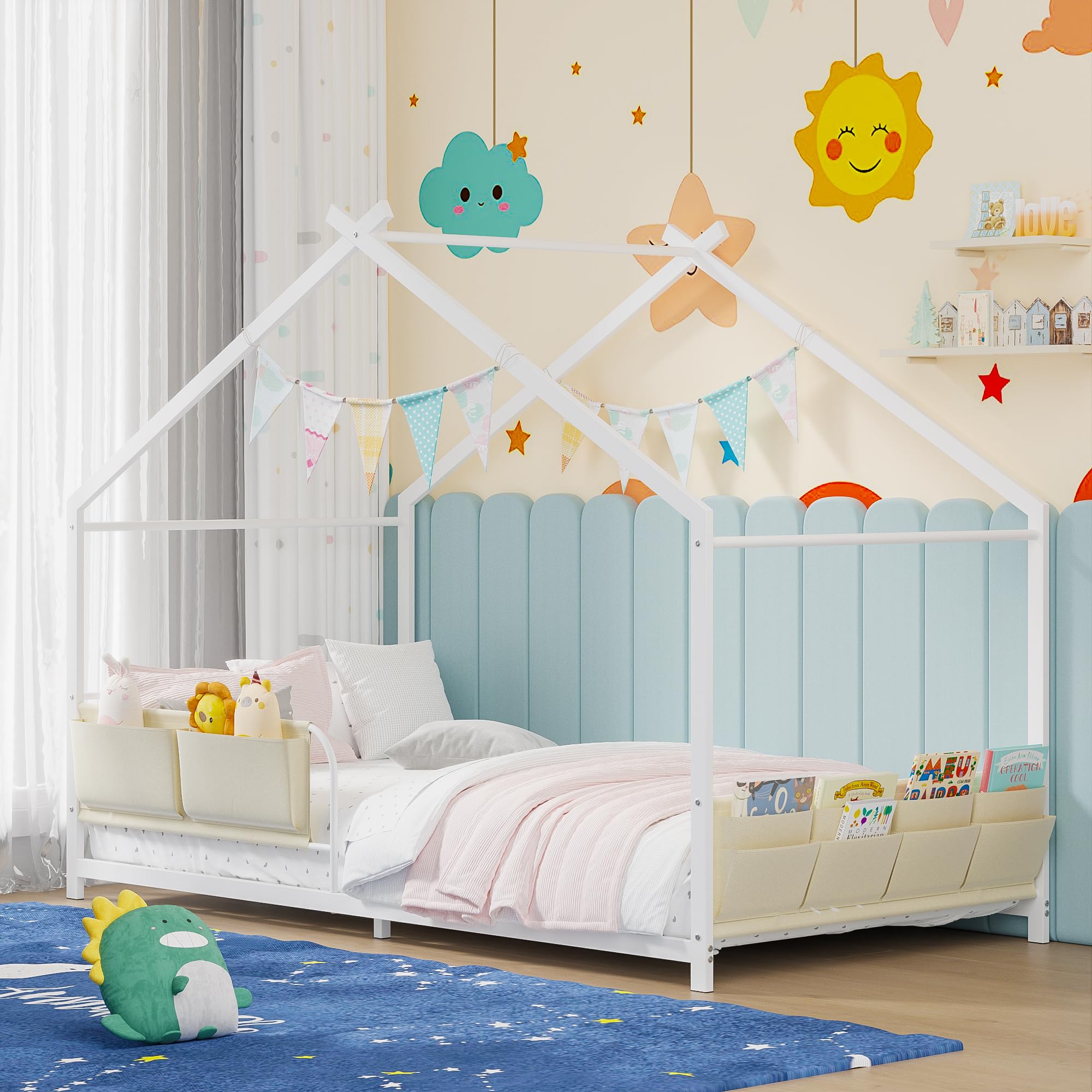
At 59.5 inches to the peak, the Timy has the lowest roof of any metal house bed here — the LIKIMIO and ADORNEVE frames stand a foot taller. That's most of why it's our pick. The house silhouette does the same job here that it does on a six-foot frame, giving a child a corner that feels like theirs, without demanding the headroom: it sits happily under a window, beside a sloped ceiling, or in the small bedroom most children actually get. The mattress deck is close to the floor, so a two-year-old climbs in without help and a half-asleep four-year-old gets out.

The pouches hanging off the side and foot rails are the detail we kept coming back to. Books, a water bottle, the small plastic things that otherwise end up under the mattress — everything has a home within reach of the pillow. It's a cheap addition that makes the frame feel designed around a child rather than around a photograph.

Roughly 40 pounds of metal slides across a carpet without a second pair of hands, and assembly is a one-person job with numbered parts and the tools in the box. White powder-coated metal reads young, though, and it'll be the first thing that feels babyish in a room that's growing up — worth knowing if this bed has to last past the second grade.

Bottom Line: We pick the Timy as the default house bed: the lowest roof of the metal frames here, a deck a toddler can climb onto alone, and a build one adult can finish.
#2

Best Value

LIKIMIO Twin Floor Bed with Roof

LIKIMIO Twin Floor Bed with Roof

8.9/10 Excellent
  • Guardrails: Full length, both sides
  • Mattress Size: Twin
  • Assembled Size: 76.8 x 40.8 x 71.7 in
  • Frame Material: Metal
Check Price on Amazon

Pros

  • Full-length guardrails on both sides
  • Anti-tip strap included for wall fixing
  • Roof reaches 71.7 in for canopies

Cons

  • Mattress sits near the floor with little airflow

The least expensive metal house bed here is also one of the better thought-out ones. Full-length guardrails run down both sides rather than stopping halfway along the frame, and an anti-tip strap comes in the box so the whole thing can be fixed to a stud. Those are the two things we check first on any frame a child is going to climb.

Where it differs from our top pick is upstairs. At 71.7 inches the roof is one of the tallest here, which is what you want if the plan involves draping a canopy or hanging a string of lights and leaving the sides open for air. The footprint is a tidy 76.8 by 40.8 inches, shorter than most twins in this group, so it slots into a corner without swallowing the floor. Open sides mean no rail to climb over at bedtime.

Assembly is the other reason it's easy to recommend: a bolt-together metal frame with a single folded instruction sheet, and parts light enough to hold one-handed while you line up the roof. Two adults finish faster; one adult still gets there. For a first bed in a rented apartment, where the frame may move twice before it's outgrown, that lightness matters as much as the price does.

Bottom Line: The metal house bed we recommend on a budget: full-length rails down both sides, a wall strap in the box, and more roof height than our top pick.
#3

Best Wood Frame

GIANTEX Solid Wood House Bed

GIANTEX Solid Wood House Bed

8.9/10 Excellent
  • Slats: 8 wooden slats
  • Weight Limit: 350 lb
  • Mattress Size: Twin
  • Frame Material: Pine wood and plywood
Check Price on Amazon

Pros

  • 350 lb limit, highest stated on a twin here
  • Eight pine slats support the mattress evenly
  • Natural pine with no box spring needed

Cons

  • Longest twin footprint here at 82 in

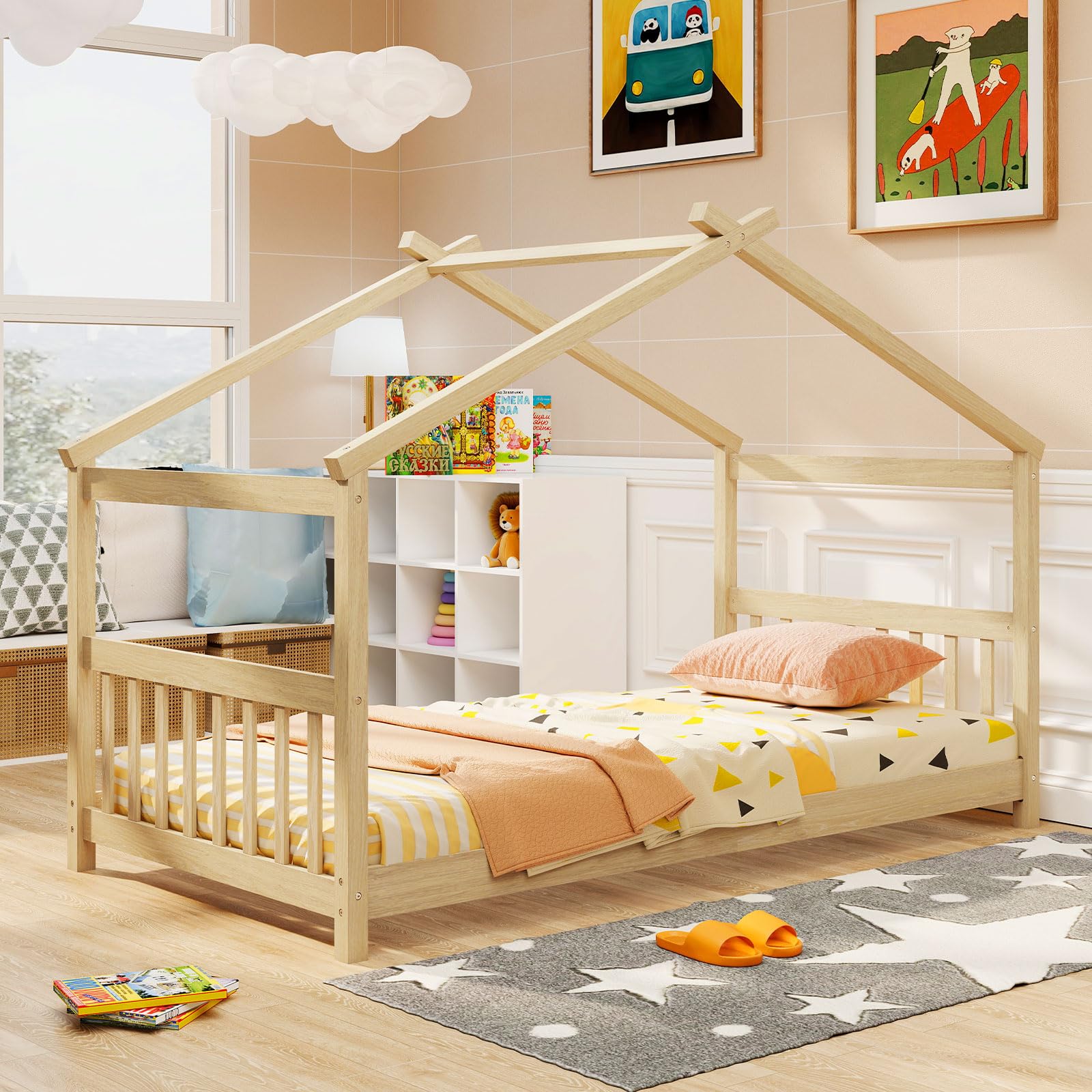
Eight pine slats and a 350-pound weight limit are the numbers that make this the wood frame we reach for. That limit is the highest stated on any twin here, and it's why the bed survives being a stage, a fort and a trampoline in the same afternoon. The slat deck also lets air move under the mattress, which keeps a foam mattress from going stale against a solid base.

The roof peaks at 56.5 inches, the lowest of the wood frames here and level with the full-size GORELAX, and that's deliberate rather than stingy. The silhouette still reads as a house; the peak just stays below a ceiling fan and doesn't loom over a small sleeper. Natural pine, no box spring, and a mattress that sits down inside the rails instead of on top of them — the whole thing looks calmer than the price suggests.

Building it is the part to plan. The parts are heavy enough that two people make short work of the roof, and the bolt holes want patience: start every bolt loose, line the roof up, then tighten, because a cross-threaded bolt at the first step makes the rest of the build a chore. Once it's up, it's the frame that stays put when the bed gets used as a gym.

Bottom Line: For a child who climbs, bounces and hangs, this is the frame we choose: solid pine, eight slats, and the highest weight limit stated on any twin here.
#4

Best for Storage

ADORNEVE House Bed with 6 Drawers

ADORNEVE House Bed with 6 Drawers

8.7/10 Excellent
  • Storage: 6 drawers (2 large, 4 small)
  • Mattress Size: Twin
  • Assembled Size: 76.8 x 40.6 x 72.4 in
  • Frame Material: Steel
Check Price on Amazon

Pros

  • Six drawers under the frame for toys
  • Full-length enclosed guardrail on the open side
  • Ships in one box with numbered parts

Cons

  • Arrives as a single 75 lb carton

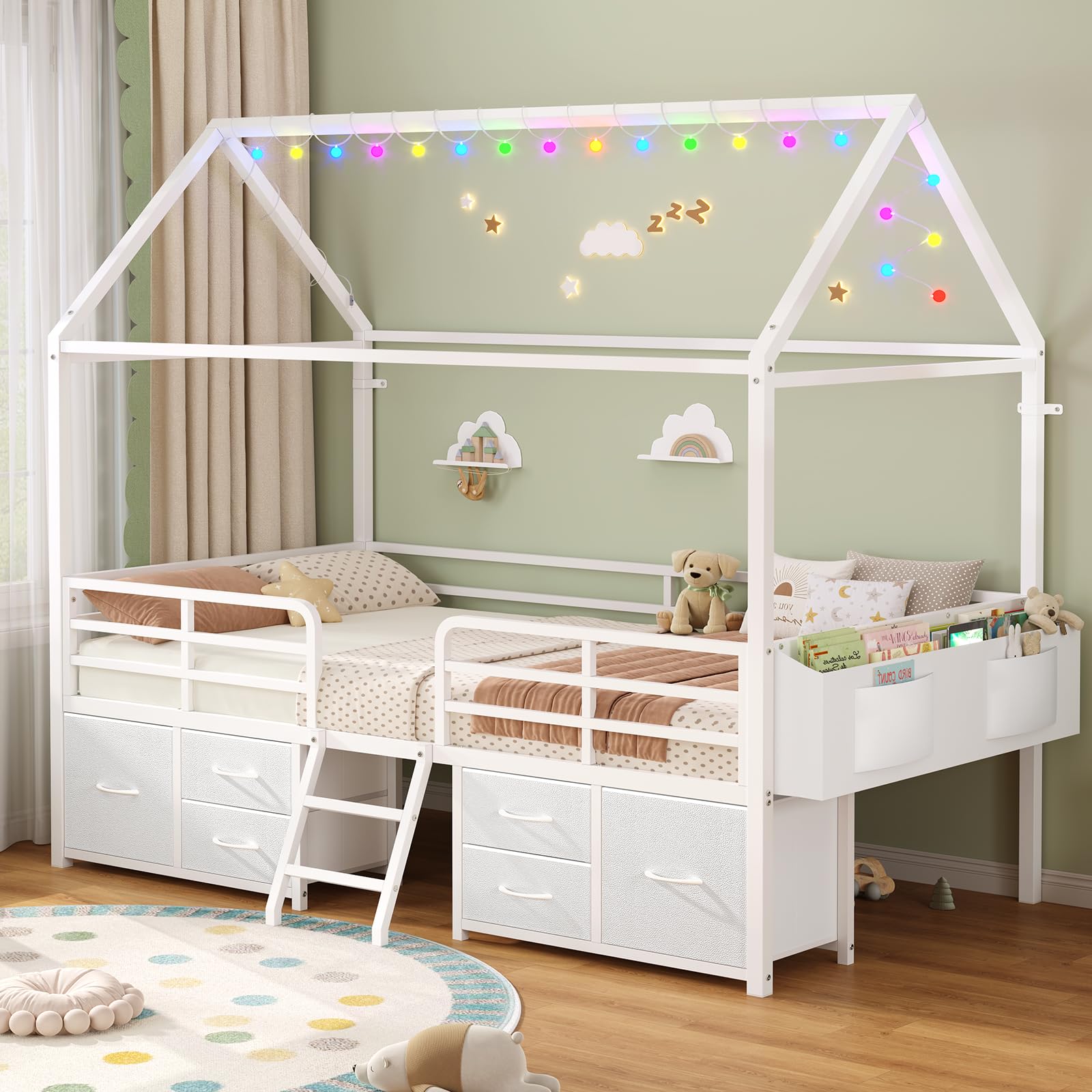
This is the house bed for the bedroom where the toys have already won. Six drawers sit under the frame — two wide ones and four small ones — so the floor stays visible, the books stop living in a pile by the door, and the small plastic collection has somewhere to go that isn't the mattress. In a room with no closet, that matters more than the roof does.

The frame is steel tube with a full-length enclosed guardrail along the open side and anti-tip straps for the wall, and it ships in one box with the parts numbered. One detail we noticed at the edges: they're curved rather than cut square, which is a small thing at noon and a good thing at two in the morning when a child is climbing in half asleep.

The build is the part to plan: the roof section wants two people, one holding it square while the other drives the bolts, and there are more steps than on a plain frame. What you get back is a small room that functions like a bigger one — floor space for playing, books off the floor, and no dresser needed beside the bed.

Bottom Line: If the room is small and the closet is smaller, this is the one we point to: six drawers under the frame and a guardrail that runs the full length.
#5

Best for Bigger Kids

GORELAX Full Size House Bed

GORELAX Full Size House Bed

8.9/10 Excellent
  • Slats: 8 slats
  • Weight Limit: 350 lb
  • Mattress Size: Full
  • Frame Material: Pine wood and plywood
Check Price on Amazon

Pros

  • Full-size frame that lasts into the teens
  • Eight slats and a 350 lb limit
  • No box spring required

Cons

  • No storage of any kind

This is the only full-size frame in the group, and that single fact decides who it's for. Twin house beds cover the years between a crib and a proper bed; a full-size one skips the intermediate stage and buys a bed a child can keep into their teens, with room for a parent reading beside them without balancing on the edge.

The build is plain in the way we like. Solid pine, eight slats, no box spring, and a 350-pound limit that matches the best of the twins here. The roof tops out at 56.5 inches, low enough to stay clear of a ceiling fan and low enough that the play happens at the sides rather than up in a tower. A four-year-old rolling out lands a few inches from the floor; a twelve-year-old still has a bed that doesn't look like a hand-me-down.

The mattress is the cost to budget for, since a full costs more than a twin and none of these frames includes one. That's the trade for buying late and once instead of twice — and it's why this is the pick for a child already past the playhouse years rather than one about to start them.

Bottom Line: Choose this when the bed has to carry a child into their teens: full-size, solid pine, eight slats, and no box spring to buy.
#6

Playful toddlers

Bellemave High Fence House Bed

Bellemave High Fence House Bed

8.1/10 Very Good
  • Design: High fence with door
  • Weight Limit: 300 lb
  • Mattress Size: Twin
  • Frame Material: Pine wood
Check Price on Amazon

Pros

  • Cheapest house bed in this group
  • High fence and door enclose the mattress
  • Twin pine frame with a 300 lb limit

Cons

  • Painted finish chips near floor level

The word to notice in this bed's name is without slats. There's no deck under the mattress — it lies inside the fence, on the floor. That's the purist Montessori arrangement, and it's also part of why this is the least expensive frame here. If you already own a twin mattress and want the lowest possible sleep for a toddler, it's a straightforward buy.

What the money does buy is the most enclosed shape in this group: a high pine fence with a door, so the bed reads as a playhouse from every angle and a rolling toddler stays inside it. The frame is certified to the children's product standard, which is the paperwork we want to see on a fence a child will lean over, and the sides are tall enough to feel like walls rather than rails.

The practical consequence of a floor-level mattress is airflow: it needs lifting and airing every few weeks, and the floor beneath needs to be dry, so a concrete slab or a damp carpet is the wrong home for this frame. In a carpeted, heated bedroom it's simply a different way of using a bed.

Bottom Line: The least expensive house bed here, and the most enclosed: a fenced pine frame with a door, as long as a floor-level mattress suits the room.
#7

Play and sleep

GIANTEX Grey House Bed

GIANTEX Grey House Bed

8.7/10 Excellent
  • Mattress Size: Twin
  • Assembled Size: 79.5 x 45 x 72.5 in
  • Frame Material: Solid wood and plywood
  • Mattress Thickness: 6 in
Check Price on Amazon

Pros

  • Tallest wood roof here at 72.5 in
  • Grey finish stands out from white and pine
  • 45 in wide, the roomiest twin footprint

Cons

  • 250 lb limit, lowest of the wood frames

The first evening with this frame, a flat sheet went over the roof and it stopped being a bed. That's the point of the tallest wood roof in the group — 72.5 inches — and it's why this is the one to pick if the bed is also going to be the shop, the den and the spaceship. The sides are open enough that a child can see out from underneath.

The rest is sensible. Solid wood and plywood, wood slat support, no box spring, and a footprint of 79.5 by 45 inches — the widest twin here, which is what gives it the roomy, walk-in feel. It's built around a 6-inch twin mattress, so a deep pillow-top sits above the rails rather than down inside them.

Assembly is straightforward and the finished frame lands around 54 pounds, light enough to shift once it's built. Grey is the only finish in this group that isn't white, natural or black, and it sits well against pale walls without looking like a nursery leftover.

What you're really paying for is height and a colour that isn't white, and for a kid who wants a roof over their head that feels like one, that's a fair trade. It's the frame we reach for when the furniture budget has to buy a toy as well as a bed.

Bottom Line: Our pick when the bed doubles as a playhouse: the tallest wood roof here, in a grey that suits a room that's already painted.
#8

Older children

LIKIMIO House Bed with Drawers

LIKIMIO House Bed with Drawers

8.5/10 Excellent
  • Storage: 2 drawers and shelf
  • Weight Limit: 800 lb
  • Mattress Size: Twin
  • Frame Material: Engineered wood and metal
Check Price on Amazon

Pros

  • Two-way shelf faces in or out
  • Two drawers and a bookshelf in one frame
  • 800 lb limit, highest stated here

Cons

  • Heaviest frame here at 91.5 lb

Somewhere around eight, a child wants a room that doesn't look like it was chosen for them. This frame answers that: black, with a curved headboard and a house silhouette that reads closer to architecture than to a nursery. It's also the house bed here that a teenager wouldn't argue with.

The bookshelf is the detail we kept pointing at. It mounts two ways — facing in over the mattress for a book at bedtime, or facing out as a display ledge — and it's the sort of thing that gets used every night rather than decorated once and forgotten. Two drawers underneath add the storage a small room needs.

Underneath the finish it's engineered wood on a metal frame with an 800-pound limit, the highest stated here, on a footprint of 77.1 by 40.7 inches. That limit is mostly about the metal; the panels are the parts to treat kindly when the bed changes rooms, and the drawers add assembly steps the plain frames don't have.

None of that changes who it's for. If the child is past the playhouse stage, wants somewhere to put their own books, and the room has to work as a bedroom and a study corner at once, this is the one that looks right and stays useful. Buy it for the years after the canopy.

Bottom Line: For an older child's room, this is the house bed we choose: black, unfussy and useful, with two drawers and a shelf that earns its keep.

How We Chose and Tested House Beds

We started by pulling together house beds sold in twin and full sizes, then narrowed the list by comparing dimensions against typical bedroom footprints, roof height, mattress support, and whether the frame was solid wood, plywood, or engineered wood. Anything with vague specs or a footprint that would swallow a small room was cut. Ten beds made the final list, and we lived with them for eight months.

Each bed was assembled by one adult using the tools in the box, timed from opening the carton to tightening the last bolt. We noted whether the instructions matched the hardware bags, whether pre-drilled holes lined up, and how often we had to flip a rail because a label was unclear. After assembly, the beds went into daily use: toddlers climbing in at nap time, a parent sitting on the edge for bedtime stories, mattresses swapped, sheets washed, and the floor underneath vacuumed.

Frames that felt solid on day one sometimes developed a rock after a month. We checked corner joints, slats, and roof rails for wobble and loosening, ran a hand along edges for splinters and rough patches, and looked for gaps where a small foot could catch. Appearance was judged from the doorway as well as up close — whether the roofline looked intentional, the finish was even, and the bed still looked neat after stickers, storybooks, and fort blankets.

Size and value came last: we measured the sleeping platform against standard mattress sizes, checked how much floor space the frame really took up, and asked whether the materials, hardware, and finish justified the cost compared with the rest of the group.

How to Choose House Beds

Start with the roof, not the photograph

Roof heights in this group run from 56.5 inches to 72.5 inches, and the difference isn't cosmetic. A 56-inch peak clears a window sill, a sloped ceiling and most ceiling fans, and it keeps a small room feeling open. A 70-inch peak gives you somewhere to hang a canopy or a string of lights and makes the bed read as a proper house — but it needs clear wall above it and enough room to change the sheets without ducking.

Measure from the floor to the window sill, to the fan blades, and to any shelf on that wall. If two of those come in under 60 inches, buy the short roof and decorate the sides instead.

Slats, platforms, and the floor-level trap

The tempting assumption is that every house bed holds a mattress the same way. It doesn't. Most frames here use a slat deck or a metal platform that lets air move under the mattress; a few Montessori-style frames ship without slats and expect the mattress to lie on the floor inside the fence. That isn't a fault, but it changes what you buy: a floor mattress needs lifting and airing, and a damp room is the wrong place for one.

Check the mattress thickness as well. At least one frame here is built around a 6-inch twin, and a deep hybrid will sit proud of the rails and defeat the point of having them.

Rails, fences, and getting out of bed

The real safety feature on a house bed is the height of the mattress, not the height of the rail. A deck a few inches off the floor means a roll-out is a short drop, which is why these frames suit toddlers where a tall-sided bed doesn't. Beyond that, look for a guardrail that runs the full length of the open side rather than a stubby one at the head, and a high fence with a door if the bed also has to work as a playpen.

If the frame comes with an anti-tip strap, use it, and fix it to a stud. A tall house frame that a child swings on will move.

Metal or wood

Metal frames here weigh around 40 pounds, cost less, and go up in an evening with one adult and a set of hex keys. They also look industrial up close, and the rails are thin. Wood frames weigh 50 to 97 pounds, feel warmer, take paint and canopies better, and want their bolts checked after the first month — a wood house bed that wobbles is nearly always a loose bolt rather than a broken part.

Buy metal for a first bed, a rented apartment, or a room that gets rearranged. Buy wood if this bed is furniture for the next decade.

Storage, footprint, and the space you actually have

A twin mattress is 75 by 38 inches; the frames here run 76.8 to 82 inches long and up to 45 inches wide, so the bed adds two to seven inches in each direction. Tape that rectangle on the floor before ordering, then check that you can still open the closet and change the sheets without moving furniture.

Storage is the other half of a small room. Drawers add weight, assembly steps and a second pair of hands; pouches and a single shelf add almost nothing. In a room with no closet at all, the drawers are worth the effort.

Frequently Asked Questions

Final Verdict

If we're choosing for you, it's the Timy. It has the lowest roof of the metal frames here, which sounds like a small thing until you're standing in a small bedroom with a window exactly where the roof wants to go. Low deck, light frame, one-person build — and a child can reach their own books without getting out of bed.

Two alternatives earn their place. The ADORNEVE when the room has no closet and the floor is already lost to toys, and the full-size GORELAX when this is meant to be the last bed you buy that child.