Kids & Nursery

Best Kids Dressers of 2026

Kids dressers are deceptively tricky furniture. A small-scale dresser needs to fit a child's room, hold a surprising amount of clothes, and still feel solid when a drawer is yanked open for the tenth time before school. I've assembled enough flat-pack furniture to know that a pretty finish means little if the drawers stick or the frame wobbles. What you're really after is a dresser that earns its place: straightforward to put together, sturdy enough for daily use, and sized so it doesn't crowd the room or swallow the floor space.

For the past eight months, my team and I have lived with 10 kids dressers, loading them with folded clothes, stacking books on top, and letting our kids treat the drawers like they were auditioning for a demolition derby. We paid attention to how each one looked after months of use—scuffed corners, loose handles, sagging drawer bottoms—and whether the material and construction justified what it cost. The shortlist below is the result: the dressers that held up, fit real bedrooms, and felt worth the money.

#1

Best Overall

Sorbus 7-Drawer Kids Dresser

Sorbus 7-Drawer Kids Dresser

8.9/10 Excellent
  • Drawers: 7 fabric bins
  • Assembly: No tools needed
  • Drawer Depth: About 8 inches
  • Overall Depth: 11.87 inches
Check Price on Amazon

Pros

  • A top a small child can see into
  • Bins lift out and carry to the bed
  • Tool-free assembly in about twenty minutes

Cons

  • Compact; smaller in person than the photos suggest
  • Bins are fabric, so folded clothes only

The Sorbus is the one dresser here built and sold as nursery furniture rather than an adult chest with a smaller price tag, and that difference is why it leads this list. The top sits low enough that a child looks down into the top drawer instead of hauling clothes out blind, and it comes in blue, pink or purple rather than a wood grain a grown-up chose.

Seven drawers, each about eight inches deep, on a steel frame under a wood top. The bins lift out completely and have carry handles at the front, which is the feature we rate highest: a whole drawer of clothes comes out to the bed for folding and goes back in one move, and a child can do it alone. Assembly needs no tools and runs about twenty minutes.

Where it asks for patience is the drawer frames. Some units arrive with bins that bind or sit crooked until you loosen the frame bolts, square the whole thing up and tighten them again, which is ten minutes of work rather than a return. Do that before you fill it.

What we keep coming back to is how little help it needs. A small child can open a bin, choose, and put clothes away without a step stool or an adult standing over them, and that is the whole reason to buy a kids dresser instead of repurposing an old one.
Bottom Line: We recommend the Sorbus first because a child can run it without help: a low top, seven lift-out bins, and a color they will actually want in their room.
#2

Best for Two Kids Sharing

WLIVE Wide 8-Drawer Dresser

WLIVE Wide 8-Drawer Dresser

8.7/10 Excellent
  • Top: FSC-certified wood
  • Width: 39.4 inches
  • Height: 30.4 inches
  • Drawers: 8 deep fabric bins
Check Price on Amazon

Pros

  • 39.4 inches of drawers at kid height
  • FSC-certified wood top wipes clean
  • Adjustable feet level it on old floors

Cons

  • Handles and bin fronts wear under heavy loads

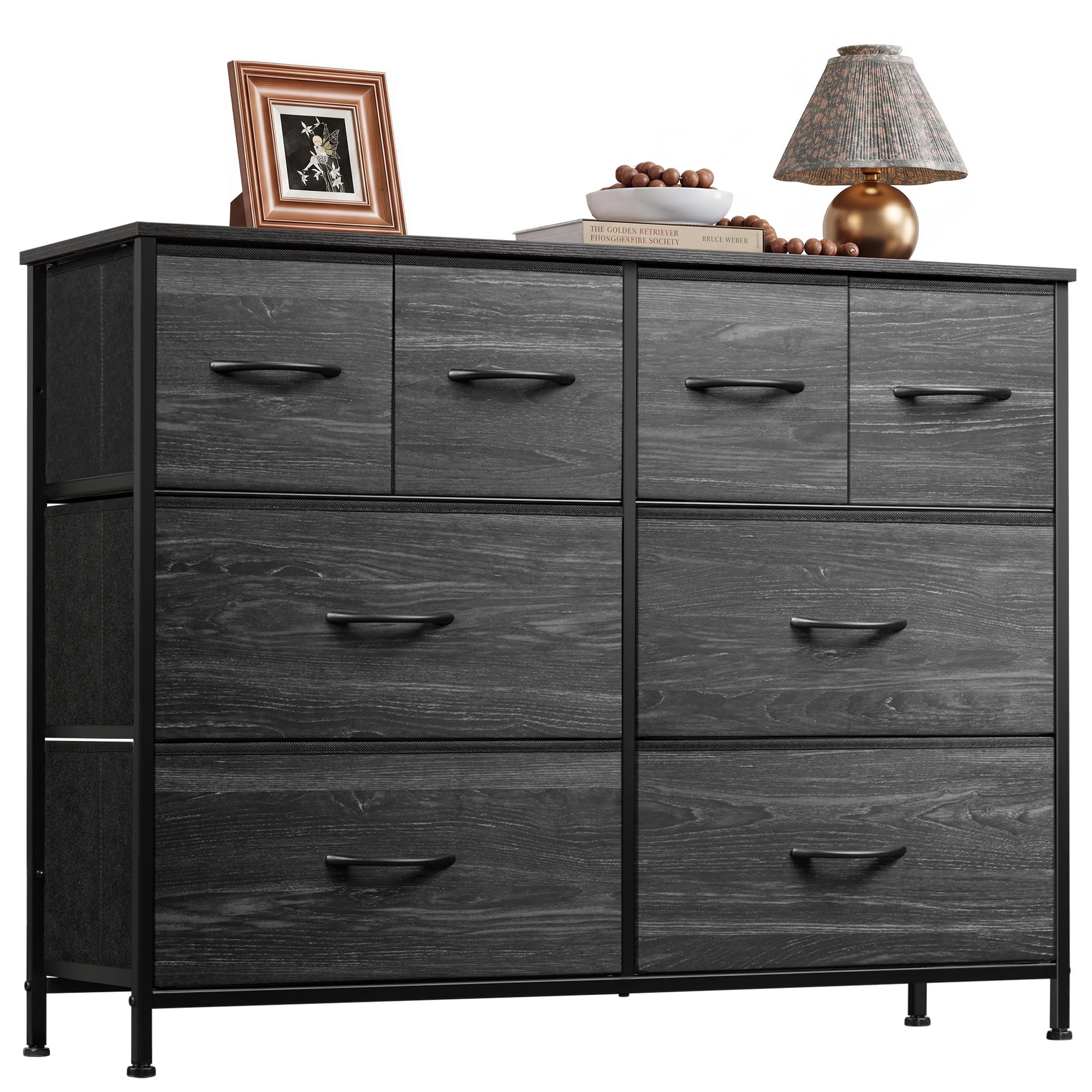
Where the Sorbus is the child-sized choice, this WLIVE is the family-sized one: 39.4 inches of drawer frontage, eight deep bins, and a top that still stops at 30.4 inches, high enough to feel like furniture and low enough that a seven-year-old can see over it.

Two children sharing a room is the case we make for it. Eight drawers split cleanly down the middle, a wood top that takes glue, glitter and a spilled drink, and adjustable feet that keep the drawers running true on an old, out-of-level floor. That top is FSC-certified wood rather than a printed wrap, which is why it wipes clean instead of flaking. Underneath, the center support stops short of the floor, so a heavily loaded top has a little give in the middle.

The parts that wear are the handles and the front panels of the bins. A drawer crammed past full pulls its front away from the frame, so give jeans and hoodies their own drawers and do not shut a bin on a bulging load. Do that and it stays square, which is most of what you can ask of a fabric dresser.

Bottom Line: For two kids in one room, we take the wide WLIVE: eight drawers at a height both can reach, and a real wood top that survives being used as a desk.
#3

Best for Small Rooms

AODK 4-Drawer Small Dresser

AODK 4-Drawer Small Dresser

8.5/10 Excellent
  • Width: 15.74 inches
  • Height: 31.77 inches
  • Weight: 11 lb
  • Drawers: 4 fabric bins
Check Price on Amazon

Pros

  • Fits a 16-inch gap beside a bed
  • Light enough to carry upstairs alone
  • Anti-tip design and adjustable feet

Cons

  • Only four drawers
  • Smaller in person than the photos suggest

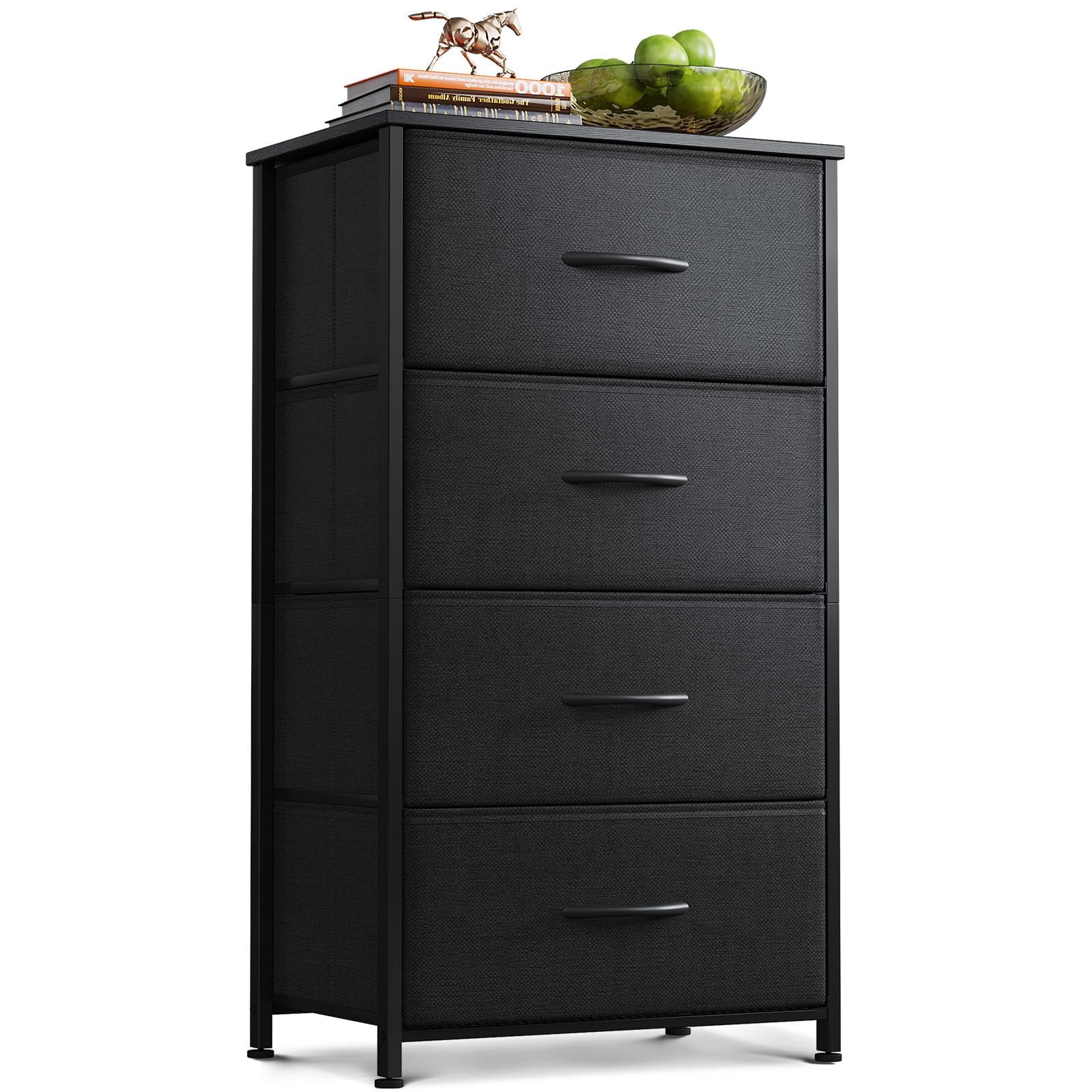
Fifteen and three-quarter inches of wall is all this needs, and it stands 31.8 inches tall: the same skinny footprint as the tall WLIVE tower, without the height that puts the top drawers past a small child's reach. In a room where the dresser has to live between a bed and a door frame, this is the one we send people to.

Four drawers is the honest limit. Two of them hold most of a young child's folded clothes; four hold a small wardrobe, not a growing one. It weighs eleven pounds, which cuts both ways: you can carry it upstairs under one arm, and a determined four-year-old can shift it, so anchor it with the anti-tip fitting and keep the heavy drawer at the bottom.

Nothing here pretends to be an heirloom: a light steel frame, a wood top, adjustable feet. As a first-bedroom dresser it does its job without eating the room, and by the time four drawers stop being enough, it will have paid for itself.

Bottom Line: The AODK earns its place in the smallest room: sixteen inches of wall, four bins a small child can reach, and no wasted floor.
#4

Best Mid-Size

Sweetcrispy 8-Drawer Dresser

Sweetcrispy 8-Drawer Dresser

8.5/10 Excellent
  • Width: 30.9 inches
  • Height: 36.42 inches
  • Drawers: 8 fabric bins
  • Load Rating: 66 lb
Check Price on Amazon

Pros

  • Eight drawers in 31 inches of wall
  • 66-pound load rating for the unit
  • Anti-tip kit included

Cons

  • Top row sits high for a small child

The handles on this dresser screw directly into the fabric of the drawer front, with no metal plate behind them. It is the sort of corner that gets cut on an inexpensive dresser, and it tells you what to expect: a light, clever, budget piece that asks you not to yank.

Eight bins on a steel frame under a water-resistant MDF top, rated to 66 pounds as a unit. That is enough for clothes, a lamp and the clutter that accumulates on a kid's dresser; it is not a licence to stack it with books. At 30.9 inches wide it fills the ground between the sixteen-inch AODK and the 39-inch WLIVE, which is where most kids' rooms actually sit.

The annoyance is the drawer stops. Pull a bin past its stop and the retaining rod slips out of its seat; push it back and carry on, and expect it to happen again the next time someone forgets the drawer is meant to stop. It is a quick fix, but it is why this is not the one to hand a four-year-old and walk away from.

Where it wins is the balance: eight drawers in 31 inches, an anti-tip kit in the box rather than a note telling you to buy one, and a top that takes real weight. If your wall is neither tiny nor generous, this is the dresser to start with, because it fits the room most children actually have.

Bottom Line: A standard bedroom wall, eight drawers, and an anti-tip kit in the box: we recommend the Sweetcrispy for the room that is not unusually small or large.
#5

Closets and teens

WLIVE Tall 5-Drawer Dresser

WLIVE Tall 5-Drawer Dresser

8.7/10 Excellent
  • Frame: X-frame back
  • Width: 15.7 inches
  • Height: 47.5 inches
  • Drawers: 5 fabric bins
Check Price on Amazon

Pros

  • Five drawers on a 15.7-inch footprint
  • X-frame back keeps the tower from twisting
  • Adjustable feet steady it on carpet

Cons

  • Printed wrap finish can peel at the corners

Forty-seven and a half inches is tall for a kids dresser, tall enough that the top two drawers sit above a small child's line of sight and tall enough that it needs fixing to the wall before anyone uses it. We are recommending it anyway, for one specific job.

That job is a closet, a dorm room or a teenager's bedroom, where 15.7 inches of width buys five drawers out of floor space you were not using. The X-frame across the back does real work here: this is a narrow tower that does not twist. Adjustable feet keep it from rocking on a carpet edge.

The parts list in the box is the dresser, a guide and a tool, with no wall strap, so buy one before it goes into a child's room, because a 47-inch tower is exactly the shape that goes over. Otherwise it is a plain, narrow, steady tower that does one thing well and asks for no more floor than a laundry basket.

Bottom Line: We keep this one for closets and teenagers: five drawers on fifteen inches of floor, with a wall strap you will need to add yourself.
#6

Cheapest eight-drawer

SageNest 8-Drawer Dresser

SageNest 8-Drawer Dresser

8.3/10 Very Good
  • Height: 36.3 inches
  • Drawers: 8 fabric bins
  • Anti-tip: Kit included
  • Drawer Capacity: 12 adult T-shirts or 7 pairs of jeans
Check Price on Amazon

Pros

  • Anti-tip kit in the box
  • 12 T-shirts or 7 jeans per drawer
  • Cheapest dresser here

Cons

  • Rails and drawer fronts can arrive damaged

It is the cheapest dresser here, and it ships with an anti-tip kit in the box: a bracket and hardware, not a line in the manual telling you to go buy one.

The capacity claim is 12 adult T-shirts or seven pairs of jeans per drawer. Scale that down for a child and one bin swallows most of a week's school clothes, which makes eight of them more storage than a single kid needs and roughly enough for two children to share.

What gives us pause is the box, not the dresser. Rails and drawer fronts are the fragile parts, and a delivery that has been dropped shows up as cracked runners and bins that will not sit flat, so open everything, dry-fit each rail, and check the fronts before you tighten a single bolt. Do that and you have an eight-drawer dresser with anchoring hardware for less than any other eight-drawer here.

Bottom Line: Buy the SageNest if you want the most drawers for the least money and will inspect every rail before you build.
#7

Older kids

DUMOS 9-Drawer Dresser

DUMOS 9-Drawer Dresser

8.3/10 Very Good
  • Frame: Steel with cross support
  • Width: 39.4 inches
  • Height: 39.4 inches
  • Drawers: 9 fabric bins, two sizes
Check Price on Amazon

Pros

  • Nine drawers in two sizes
  • Steel frame with a cross support bar
  • Adjustable feet for uneven floors

Cons

  • Fabric drawer bottoms rip when overloaded

Nine drawers, and they come in two sizes: the deep ones take jeans and hoodies, the shallow ones take socks, underwear and the small things that otherwise end up on the floor. That split is what makes a nine-drawer unit more useful than a wider eight.

It is 39.4 inches wide and stands 39.4 inches tall, the tallest of the wide dressers here, with a steel frame, a cross support bar across the back and adjustable feet. Height is the number that decides it: a ten-year-old reaches the top row without thinking, a four-year-old does not, and no amount of folding changes that.

That puts it in a narrow lane: the biggest drawer count here for a child who has outgrown the small stuff, at a height that suits them. The drawer bottoms are fabric, and that is what goes when a bin is packed too full, so pack it like a wardrobe and keep the toy overflow somewhere else.

Bottom Line: Most drawers of any pick here: we recommend the DUMOS for a ten-year-old with a full wardrobe, not for a four-year-old.

How We Tested the Best Kids Dressers

We started by narrowing the field through research, comparing listed dimensions, materials, price, and assembly requirements, then filtering out anything that seemed too bulky for a typical child's room or too flimsy for daily use. From that group, we brought in 10 dressers across a range of sizes and finishes. Over eight months, we assembled each one in a child's bedroom using only the included tools and timed how long it took, noting whether the instructions were clear, whether the drawers lined up without force, and how many extra hands we needed.

Once a dresser was built, we filled it with the same load: folded shirts, pants, pajamas, socks, and a few small toy bins. We checked storage capacity by seeing how much fit without stuffing drawers past flush, and we noted whether the footprint left enough room to open a closet door or walk past the bed. Sturdiness got a real-life test—drawers pulled open at kid height, a parent leaning on the top while folding laundry, books stacked on the surface—and we watched for wobble, sticking, or drawers that drifted open on their own.

After weeks of use, we inspected corners, drawer fronts, and handles for chips, scratches, and loosening, and compared how each finish looked against how it looked on assembly day. We also weighed material and construction against cost, because a kids dresser only feels like a good value if it still looks and works right after eight months of daily use.

How to Choose Kids Dressers

Height decides whether they use it

If a child cannot see into the top drawer, that drawer becomes yours: it fills with out-of-season clothes and the dresser stops being something they can run alone. Most of the units here put the top surface 28 to 32 inches off the floor, which is the range that works from about age four to age ten. Above 36 inches the top row belongs to an adult, and at 47 inches you are buying a closet tower.

Before you order, have your child stand against the wall and reach up. Wherever their fingertips land is the highest drawer worth counting.

Fabric bins are not a compromise at this price

Almost everything here is a steel frame carrying non-woven fabric bins, and that is why these dressers weigh 11 to 29 pounds and cost what they do. Fabric is quiet, there is no metal runner to pinch fingers, and the bins lift out for folding on the bed. The trade-off is shape: a bin holds its form when it is reasonably full and sags at the seams when it is crammed.

Use them for clothes rather than toys and books, and the bins keep their shape far longer. Wood-front drawers exist, but they add weight and money.

Width, depth, and the wall you are measuring

Depth barely varies across this set: nearly every one is about 11.8 inches front to back, shallow enough to sit in a hallway without blocking it. Width is where the decision lives, from a 15.7-inch tower up to a 39.4-inch double dresser. Measure the wall span, then add a few inches, because drawers need room to open past a door frame and a bed pushed against one end makes the last drawer useless.

If you are unsure, mark the footprint on the floor with tape and live with it for an evening.

Anchor it before you fill it

Every dresser here can go over. They are light, the drawers pull out, and children climb. Several ship with an anti-tip kit: SageNest and Sweetcrispy both list one, AODK builds the anchoring design in, and DUMOS is sold as an anti-tip unit. The tall WLIVE lists only a dresser, a guide and a tool, so a strap is on you.

Fix the strap to a stud rather than drywall, put the heaviest drawer at the bottom, and never leave a loaded bin hanging open where a toddler can reach it.

Assembly takes an evening, not ten minutes

The small units go together in about twenty minutes with the included tool. The 39-inch ones take an hour or more on your own, and the difference between a dresser that runs smoothly and one that binds is whether the frame went up square. Build it in the room it will live in, on the flattened carton, and leave every bolt finger-tight until all four corners are on.

Then square it, tighten, and slide each drawer in before you put a single piece of clothing away.

Frequently Asked Questions

Final Verdict

Start with the Sorbus. It is the one dresser here a child can genuinely run alone, with a low top, seven lift-out bins and a color they choose, and it costs about the same as the wide WLIVE.

If the wall is sixteen inches, take the AODK. If it is around thirty-one, take the Sweetcrispy. If two children share the room, the wide WLIVE holds both wardrobes. Whichever you buy, put the wall strap in before the clothes.