Kids & Nursery

Best Nursery Rocking Chairs of 2026

At 3 a.m., a chair that squeaks, rocks too far, or leaves your back aching makes every night feed harder than it needs to be. Over seven months, my team and I tested eight nursery rocking chairs—swivel gliders, classic rockers, recliners—in real nurseries and living rooms. The right one gives you a quiet, comfortable place to feed, rock, and read bedtime stories without waking the baby or your partner.

The small stuff matters: a slight recline saves your lower back during cluster feeds, a swivel base earns its keep in a tight corner, and a seat that's too firm or too soft will wear you down by month three. A good-looking chair that's miserable to sit in is a bad buy; so is a comfortable one that takes an afternoon to assemble. We checked fabric and frame quality, because a nursery chair gets spilled on, rocked hard, and used for years—value isn't the price tag, it's how well it holds up through toddlerhood. The picks below suit small spaces, tall parents, and grandparents who need an easy lift.

#1

Best Overall

Harkawon Swivel Rocker Recliner

Harkawon Swivel Rocker Recliner

8.8/10 Excellent
  • Motions: 360° swivel, rock, 3-position manual recline
  • Footprint: 39.37"D x 32.67"W x 40.55"H
  • Wall Clearance: Wall hugger
  • Weight Capacity: 350 lb
Check Price on Amazon

Pros

  • Swivels, rocks, and reclines in one chair
  • 30-inch backrest suits tall parents
  • Wall-hugger frame needs little clearance
  • 350-pound weight capacity

Cons

  • Rocker arc is shorter than a true glider stroke

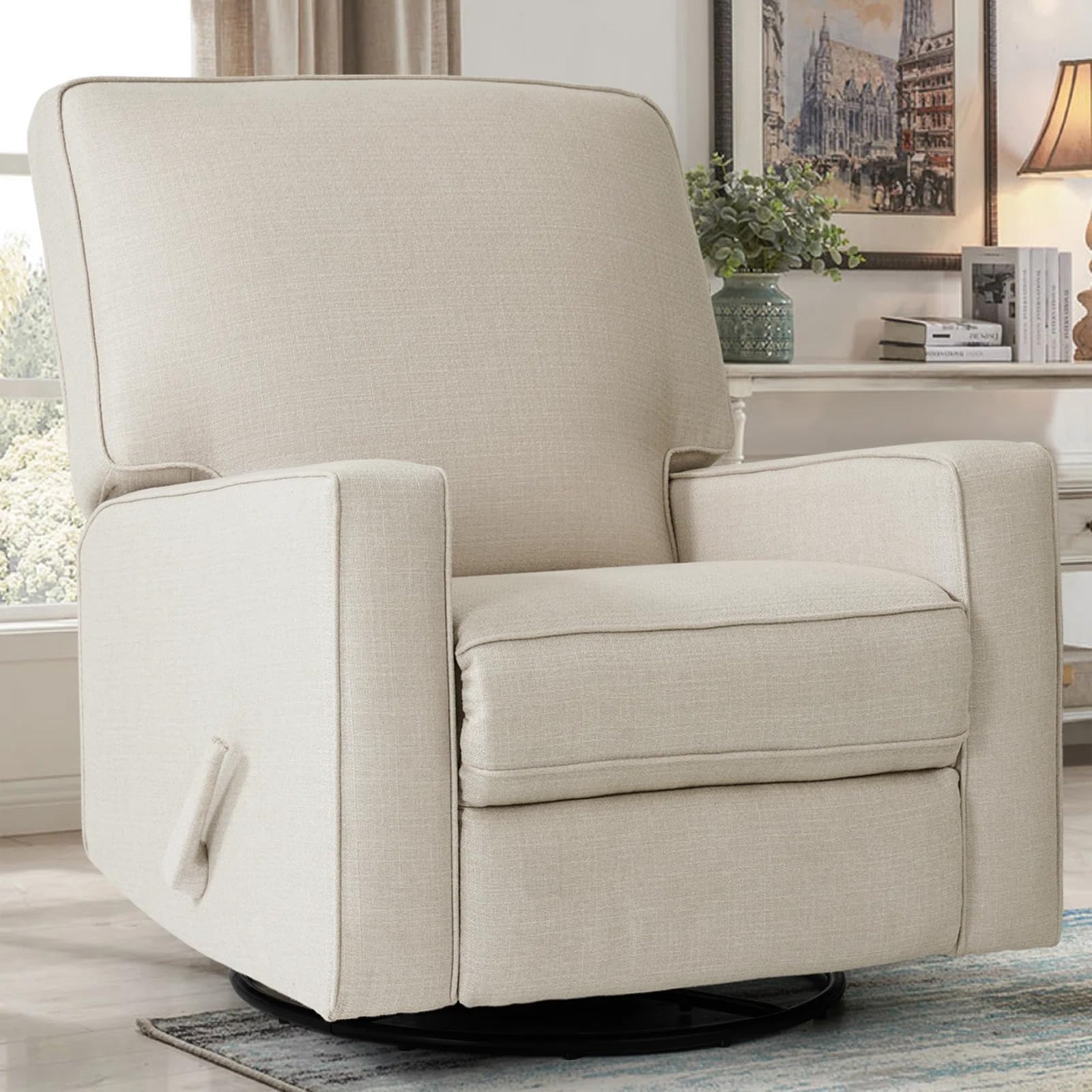
Three motions, a backrest over 30 inches tall, and a 350-pound rating: the Harkawon covers more nursery ground than anything else in this group without asking you to pick a priority. It swivels a full 360 degrees, rocks, and drops into three recline positions from a lever set into the side, and the footrest folds back under the seat when you sit up.

That combination is why it gets our top recommendation. Most nursery chairs make you choose — rockers that don't recline, recliners that fight you, tall-backed chairs priced like heirlooms. Here a six-foot parent gets head support, the frame carries 350 pounds, and the chair measures 32.7 inches across, which is narrow enough for a small second bedroom.

The wall-hugger claim is the detail we appreciated most. A recliner usually needs a foot or more of clearance behind it to lean into, and in a nursery that space is a dresser or a door swing. We set this one close to the wall and still got the full recline out of it. Setup is a snap-together job one person can handle, and the upholstery is spot-clean, so milk and spit-up come off with a damp cloth rather than a whole cleaning kit.

One thing to test before you commit: the backrest has some give at full recline, so a lighter sitter can feel it push them forward while a heavier partner won't notice. In a chair two adults share, that's worth a minute of trying. Everything else is the unglamorous stuff done well — a wide padded arm to rest a bottle hand on, and a lever set where your hand naturally falls.

Bottom Line: We recommend the Harkawon to most families: it swivels, rocks, reclines, fits tall parents, and hugs the wall, and it does it for less than the premium chairs here.
#2

Best for Long Feeds

Carter's by DaVinci Arlo Recliner

Carter's by DaVinci Arlo Recliner

9.0/10 Outstanding
  • Motions: 360° swivel, glide, 3-position recline
  • Dimensions: 38"D x 29"W x 41.5"H
  • Certifications: GREENGUARD Gold, FSC, CertiPUR-US
  • Weight Capacity: 250 lb
Check Price on Amazon

Pros

  • Deep, plush seat you can nap in
  • GREENGUARD Gold and CertiPUR-US certified
  • Stain-resistant performance fabric
  • Hidden recline keeps a clean profile

Cons

  • Leg rest needs a firm push to close
  • Heavy at 106 pounds to move

The Arlo is the chair we kept going back to when a feed ran long. The seat is deep, the wing back gives you somewhere to put your head, and the recline is buried in the frame so the chair reads as an armchair rather than baby equipment. It is, by some distance, the easiest chair in this group to fall asleep in — which is either the highest praise or a warning, depending on how your nights are going.

What you're paying for is the upholstery and the paperwork. GREENGUARD Gold, FSC-certified wood, and CertiPUR-US foam are the certifications that matter in a room where a baby sleeps, and the performance fabric is water- and stain-resistant, so a 2 a.m. spit-up is a wipe rather than a project. The 360-degree swivel and glide are smooth enough to settle a fussy baby without a jolt at the end of the stroke.

The leg rest is the friction point. It takes a firm push to seat it again, and that's an awkward motion with a sleeping baby on your chest — this is a chair to recline in before you settle, not after. It also weighs 106 pounds, which is fine for a nursery that stays put and less fine if the chair has to go up a staircase.

Bottom Line: If your budget stretches to the premium end, the Arlo is the most comfortable chair we sat in, with indoor-air certifications and a fabric that shrugs off spills.
#3

Best for Tight Spaces

Delta Children Blair Slim Glider

Delta Children Blair Slim Glider

8.5/10 Excellent
  • Motions: Swivel and glide
  • Dimensions: 26.5"W x 31.5"D x 36"H
  • Seat Cushion: 5.5 inches thick
  • Weight Capacity: 225 lb
Check Price on Amazon

Pros

  • Fits corners at 26.5 inches wide
  • Removable cushion for washing
  • Low 17-inch seat suits shorter parents
  • Light enough to move alone

Cons

  • Swivel and glide only, no recline
  • Lowest weight rating here at 225 pounds

At 26.5 inches wide, the Blair Slim is the narrowest chair here that still feels like a chair rather than a stool. That figure is the whole point: it slips between a crib and a door frame, and it's the one we point to when the nursery is really a corner of a bedroom.

What you get instead is a swivel and a glide on steel mechanisms, thickly padded arms, and a 5.5-inch seat cushion that lifts out for washing — a small thing that matters more than it sounds once a stomach bug goes through the house. The seat sits at 17.25 inches, so shorter parents get their feet flat on the floor without buying an ottoman, and at 68 pounds it's light enough to slide out and vacuum under.

We prefer this to a plain rocker in a tight corner, because swiveling out of the chair is easier than sliding it backwards with a baby in your arms. The glide can start to complain after a few months of nightly use, which is the honest cost of a slim steel mechanism at this position in the group.

Bottom Line: Buy the Blair Slim when the room is tight: at 26.5 inches it's the narrowest chair here, and the washable cushion and low seat suit small spaces and shorter parents.
#4

Best Lightweight Rocker

HCHAIRH Boucle Nursery Rocker

HCHAIRH Boucle Nursery Rocker

8.9/10 Excellent
  • Frame: Wood
  • Upholstery: Boucle
  • Item Weight: 39.7 lb
  • Weight Capacity: 300 lb
Check Price on Amazon

Pros

  • Light enough to carry between rooms
  • Boucle cover suits a calm nursery
  • Assembles without tools
  • 300-pound weight capacity

Cons

  • Rocks only, with no glide or recline
  • Seat depth is a snug 17.3 inches

At 39.7 pounds, this is the one chair in the group you can pick up and carry into the next room when the nursery has to become a guest room. That portability isn't a small thing in a house where furniture does two jobs.

We like it for what it doesn't pretend to be. There's no motor, no lever, no recline — just a wooden frame on curved runners with drop-proof legs, a boucle cover that looks calm against a pale wall, and a seat rated for 300 pounds. Assembly is a screwdriver-free job that one person finishes before the baby wakes up, and the side pocket means the pacifier isn't on the floor.

For storytime and short night feeds it's plenty of chair; for two-hour cluster feeds, a recliner earns its keep. The number to check against your own frame is the seat depth, which is snug if you're tall.

Bottom Line: For a small nursery or a chair that has to move from room to room, the HCHAIRH is our pick: light, simple, and good-looking enough to keep out of the corner.
#5

Best Powered Recliner for Nursing

Mamazing Lullapod Power Recliner

Mamazing Lullapod Power Recliner

8.8/10 Excellent
  • Motions: 270° swivel, rock, triple-motor power recline
  • Charging: USB and USB-C ports
  • Dimensions: 37.4"D x 38.9"W x 42"H
  • Weight Capacity: 300 lb
Check Price on Amazon

Pros

  • Powered armrests ease shoulder strain
  • Three motors move back, legs, and arms
  • Leather surface wipes clean
  • USB and USB-C charging built in

Cons

  • Armrests can drift out of position
  • Neck support is thin for tall sitters

The Lullapod's party trick is a pair of powered armrests that rise, fall, and rotate to bring your elbows up to feeding height, and after a long nursing session that is not a gimmick. It's the most thoughtfully designed chair here for the person doing the feeding, and the first one that made us rethink what a nursery chair is for.

Three motors handle the backrest, footrest, and arms across eight positions, with a 105 to 135 degree power recline, a 270-degree swivel, and a 30-degree rock. The leather wipes clean in seconds, and USB and USB-C ports plus two cup holders keep the pump and the phone charged and off the floor.

It is also 140 pounds and 38.9 inches wide, which rules out a small nursery, and it sits at the top of this group on price by some margin. What that buys is a chair that keeps working once feeding is over — it reads as a recliner in a living room rather than baby kit you'll want gone by eighteen months.

Bottom Line: If nursing is the job and money is secondary, the Lullapod is the chair we point to: powered armrests, three motors, and a wipe-clean surface that survives a baby.
#6

Best Dual-Purpose Recliner

CANMOV Swivel Rocker Recliner

CANMOV Swivel Rocker Recliner

8.6/10 Excellent
  • Motions: Swivel, rock, manual recline
  • Dimensions: 37"D x 30"W x 40"H
  • Recline Range: 90-150°
  • Weight Capacity: 300 lb
Check Price on Amazon

Pros

  • Swivels, rocks, and reclines to 150 degrees
  • Firm seat is easy to get out of
  • Assembles in about ten minutes
  • 300-pound weight capacity

Cons

  • Firm cushion won't suit soft-seat fans

The footrest on the CANMOV takes a real shove to close, and that was the first thing we noticed. It's worth saying plainly, because it's the one motion you'll repeat at every feed — and everything else about this chair is better than the rest of the package suggests.

What you get is a 360-degree swivel, a rock, and a manual recline that runs from upright to 150 degrees, in a chair 30 inches wide and 37 inches deep with a 300-pound rating. The button-back padding is plush on top and firm underneath, and assembly is the work of ten minutes with the hardware that ships in the box.

Firm is the word we keep coming back to. The seat doesn't sink under you, which is exactly what you want in the weeks after a C-section, and the 40-inch back gives head support without a separate pillow. The fabric wipes clean, and the whole thing reads as a living-room recliner rather than nursery kit — which is either the point or a problem, depending on the room.

Where it lands: a full swivel recliner with a supportive seat at the lower end of the midrange. The swivel is what makes it, honestly — you turn toward the bassinet instead of standing up out of the chair with a baby in your arms.

Bottom Line: We recommend the CANMOV for its supportive seat and full swivel, a midrange recliner that's easy to get out of in the weeks after birth.
#7

Small bedrooms

Korser Swivel Rocking Recliner

Korser Swivel Rocking Recliner

8.4/10 Very Good
  • Motions: 360° swivel, rock, recline to 165°
  • Upholstery: Chenille
  • Item Weight: 66.1 lb
  • Weight Capacity: 299.8 lb
Check Price on Amazon

Pros

  • Fits a small bedroom
  • Swivels and rocks smoothly
  • Chenille cover feels soft
  • Cheapest route here to all three motions

Cons

  • Seat runs narrow for broad sitters
  • Recline lever takes a firm push

A nursery that is really a corner of a bedroom needs a chair that turns in place, and the Korser is built for exactly that: a 360-degree swivel, a rock, and a manual backrest that tilts to 165 degrees, all in a compact frame that leaves the closet door working.

The chenille cover is the nicest surprise — soft and matte rather than shiny, and it reads as living-room furniture. Assembly is short and tool-light, and the seat is deep enough that a tall parent doesn't feel perched on the edge of it.

It's the least expensive route in this group to swivel, rock, and recline in one chair, and for a small bedroom where the chair also does duty as reading space, that's most of what you need: something that turns toward the crib and leans back far enough to settle. It isn't the chair for a two-hour contact nap — the cushioning is honest rather than plush.

Bottom Line: For a small bedroom where the chair has to swivel, rock, and lean back, we recommend the Korser as the least expensive way here to get all three motions.
#8

Short feeds

NIOIIKIT Teddy Rocking Chair

NIOIIKIT Teddy Rocking Chair

8.4/10 Very Good
  • Footrest: Adjustable
  • Dimensions: 28.74"D x 24.8"W x 40.9"H
  • Upholstery: Teddy
  • Weight Capacity: 350 lb
Check Price on Amazon

Pros

  • High teddy-covered back
  • Footrest included
  • 350-pound weight capacity
  • Quick to assemble

Cons

  • Footrest is flimsy and doesn't extend smoothly
  • Can develop a wobble with use

The NIOIIKIT has a forward tilt in the seat that suits reading and works against you when you want to sink back with a drowsy baby. It isn't a fault so much as a posture — this chair holds you upright, and if you like to lean into the corner of a chair, you'll notice it immediately.

What it gets right is the back: 25.9 inches of interior height under a soft teddy cover, on a frame rated for 350 pounds. The seat is generously padded and the foam hasn't gone flat in the chairs we've sat in, which is more than you can say for most rockers at the bottom of a group like this.

At 41 pounds it slides across a rug without a second person, and it's narrow enough to sit beside a crib rather than at the foot of it. Assembly is quick, the tools come in the box, and the side pocket takes a phone or a burp cloth.

Where it earns a place is the barrier to entry: a high-backed, soft-covered rocker with a footrest and a 350-pound rating is rare down here. It's the chair for a nursery that needs something now and doesn't need that something to last a decade.

Bottom Line: For short feeds and storytime in a small nursery, the NIOIIKIT is good value; for the parent on night duty, step up to a recliner.

How We Tested (and Lived With) Eight Nursery Rocking Chairs

We started with more than 40 nursery rocking chairs from brands we trust, then narrowed by size, recline and swivel options, upholstery choices, and price. We dropped any chair with vague assembly instructions, a suspiciously low weight limit, or reviews that repeatedly mentioned squeaking within the first month. That left eight chairs, which we assembled and used for seven months.

Each chair was assembled solo, with a stopwatch running. We noted how long it took, whether the hardware was labeled, and if the chair felt solid once together. In the nursery, we measured the footprint against a standard crib and dresser to see if it blocked walking paths. We also checked fabric seams, wood joints, and how the finish held up after daily use. To gauge value, we weighed the price against features that mattered—washable fabric, a quiet swivel, a recline that locks.

Comfort testing looked like real life: we rocked for 30-minute stretches during the day, then used each chair for night feeds and bedtime stories. We paid attention to seat firmness—too soft and you sink, too hard and your tailbone aches—and whether back support held up after an hour. We tested recline and adjustability while holding a 15-pound weight (a stand-in for a sleeping baby), and swiveled on carpet and hardwood to see if the base caught or drifted. Noise was key: we listened for squeaks, clicks, and glider hums in quiet rooms, especially at 2 a.m.

By the end, we knew which chairs felt built to last and which might loosen up in a year. The best ones shared smooth, quiet motion, a seat that supported without swallowing you, and assembly that didn't require a second person or a video tutorial. We'll keep using them through toddlerhood and update if anything changes.

How to Choose Nursery Rocking Chairs

Decide Which Motions You Actually Need

Rocking and gliding are different things wearing the same word. A rocker rides curved wooden runners and travels a short arc; a glider runs on a fixed metal mechanism and stays put under you. Swivel is the motion that gets you out of the chair without sliding it backwards, and recline is what turns a feeding chair into somewhere to sleep.

Our ranking puts swivel and glide first for most nurseries, with recline worth paying for only if you'll genuinely doze in the chair or need your feet up after a C-section. A rocker like the HCHAIRH suits a small room and light use; a recliner like the Harkawon does more but claims more floor.

Measure the Room, Then the Chair

Widths in this group run from 26.5 inches to 38.9 inches, which is the difference between a chair that fits a corner and one that owns the room. Add clearance to swivel — a chair wants roughly a hand's width on each side to turn without knocking the crib — and check what's behind it.

A conventional recliner needs several inches of rear clearance to lean into; a wall-hugger like the Harkawon does not. The trap is measuring the wall you had in mind and forgetting the door swing, the radiator, or the closet the chair will block.

Match the Seat to the Parent Who Sits Longest

Seat height decides whether your feet reach the floor. The chairs here sit between about 17 and 21 inches off the ground, and a shorter parent wants the low end so they can push themselves up without an ottoman. Back height decides head support: the Harkawon's backrest runs over 30 inches, while compact rockers stop well below the shoulders.

When two adults share the chair, the taller one's head support is what gets sacrificed. Sit in it, lean back fully, and notice where the top of the back meets your neck before you decide.

Work the Recline Before You Buy

The mechanism you'll resent is the footrest. It's the one control you operate with a baby in your arms, and a stiff one is a real problem in the weeks after a C-section. Look for a lever or button you can reach without shifting your weight, and a footrest that folds away without a shove.

Squeaks are the other long-term complaint. Chairs with steel or metal glide mechanisms tend to stay quieter than wooden rockers on runners, and any chair can start to talk after a few months of nightly use — which is why quiet motion is worth checking in the room rather than on the listing.

Choose the Fabric for Spit-Up, Not for the Swatch

Water-resistant performance fabric and removable covers are worth seeking out. Leather wipes clean fastest, teddy and boucle hide stains but hold crumbs, and a lift-out seat cushion is the difference between a ten-minute clean and an afternoon with a sponge.

Also look for GREENGUARD Gold certification. It means the foam and fabric have been screened for volatile compounds — a reasonable thing to want in the room where a baby sleeps, and one of the few labels in this category that means anything.

Frequently Asked Questions

Final Verdict

We recommend the Harkawon for most nurseries. It swivels, rocks, and reclines, the back is tall enough for a six-foot parent, and the wall-hugging frame solves the clearance problem that makes most recliners awkward beside a crib — all for less than the premium chairs that don't do more.

If comfort is the priority and the budget is open, the Arlo is the chair you'll fall asleep in. If the room simply won't take a full-size chair, measure the Delta Blair Slim against your wall: at 26.5 inches it fits where nothing else here will.