Kids & Nursery

Best Toy Storage Cabinets of 2026

A toy storage cabinet sounds simple until you’re staring down a box of cam-lock screws and wondering whether it will wobble the moment a toddler leans on it. I’ve built my share of pint-size furniture, and the difference between a cabinet that becomes a dumping ground and one that keeps the floor visible comes down to solid shelves, bins that slide without a fight, and instructions that don’t assume a degree in engineering. The right one gives toys a home without turning your Saturday into an assembly project.

We tested 12 cabinets over eight months, loading each with picture books, blocks, dress-up clothes, and the tiny plastic bits that multiply overnight. The keepers had shelves that didn’t sag, finishes that survived sticky hands, and enough usable capacity to actually close the lid. A few looked great online but felt hollow once built—or came with instructions that skipped a step. The picks below are the ones that held up to daily play and felt worth the money, not just the product photos.

#1

Best Overall

Humble Crew 16-Bin Organizer

Humble Crew 16-Bin Organizer

9.4/10 Outstanding
  • Bins: 16 (12 standard, 4 large)
  • Frame: Engineered wood, steel dowels
  • Assembled Size: 42"W x 16"D x 31"H
  • Per-tier Limit: 20 lb
Check Price on Amazon

Pros

  • Sixteen bins in two genuinely useful sizes
  • Open front keeps toys visible and reachable
  • Steel dowels and a 20-pound per-tier rating
  • Anti-tip wall anchor included in the box

Cons

  • Deeper 16-inch footprint than most here

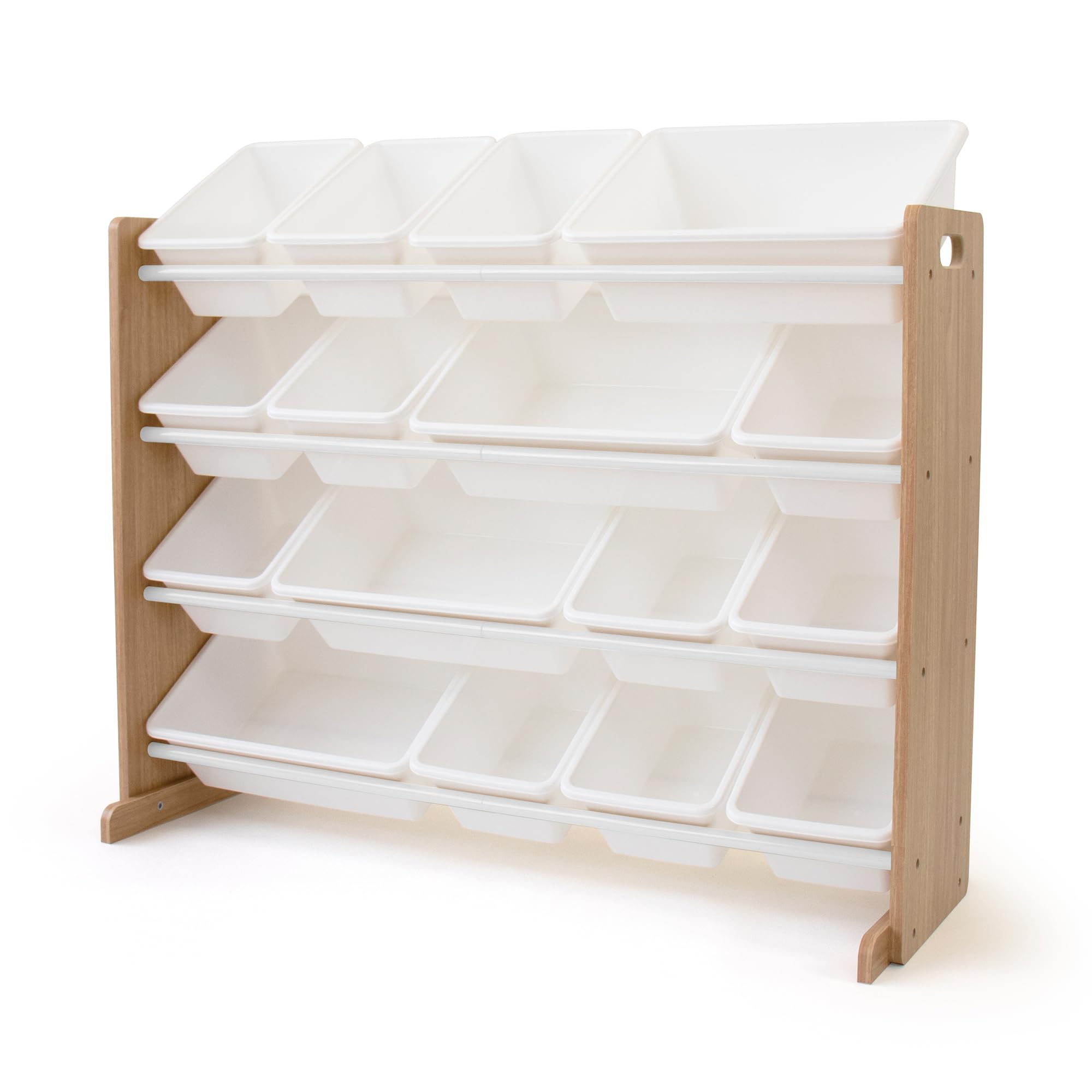
Twelve standard bins and four wide ones is the mix that sold us. The small bins take the things that cause the most trouble, the loose figures and the forty-piece sets and the marbles, while the four large ones swallow the bulky stuff that clogs every other organizer. That mix, more than anything about the frame, is why this is the first unit we point people to for a playroom.

The frame is engineered wood braced with steel dowels and rated for 20 pounds per tier, which is honest about what this is: sturdy furniture rather than heirloom furniture. At 42 inches wide, 16 deep and 31 high, it sits under a window or along a bedroom wall without eating the room, and 31 inches is a height a four-year-old can work from the bottom row to the top.

Nothing is behind a door, and that mattered more than we expected. Toys in sight get played with, and cleanup becomes a sorting job rather than an excavation. Assembly is straightforward rather than instant, and the anti-tip kit in the box is worth the extra minutes, because a 31-inch cabinet full of bins is exactly what a climbing preschooler will test.

The one caveat worth naming is the material: a printed wood grain over engineered board. If solid pine matters to you, the EXPERLAM is the pick to look at instead. Everything else here, the bin count, the two sizes, the reachable height, is why it takes the top spot.

Bottom Line: Sixteen bins in two sizes, at a height a preschooler can manage alone, make this the organizer we recommend first for most playrooms and bedrooms.
#2

Best Looking

HOOBRO Kids Bookshelf

HOOBRO Kids Bookshelf

9.2/10 Outstanding
  • Finish: Rustic brown
  • Compartments: 3 open, 2 tilt-out
  • Assembled Size: 11.8"D x 35.4"W x 29.5"H
  • Total Capacity: 78.5 lb
Check Price on Amazon

Pros

  • Two tilt-out bins a child can reach into
  • Narrow 11.8-inch depth fits tight rooms
  • Rustic finish works outside a playroom
  • 78.5-pound overall weight capacity

Cons

  • Only two enclosed bins for loose parts

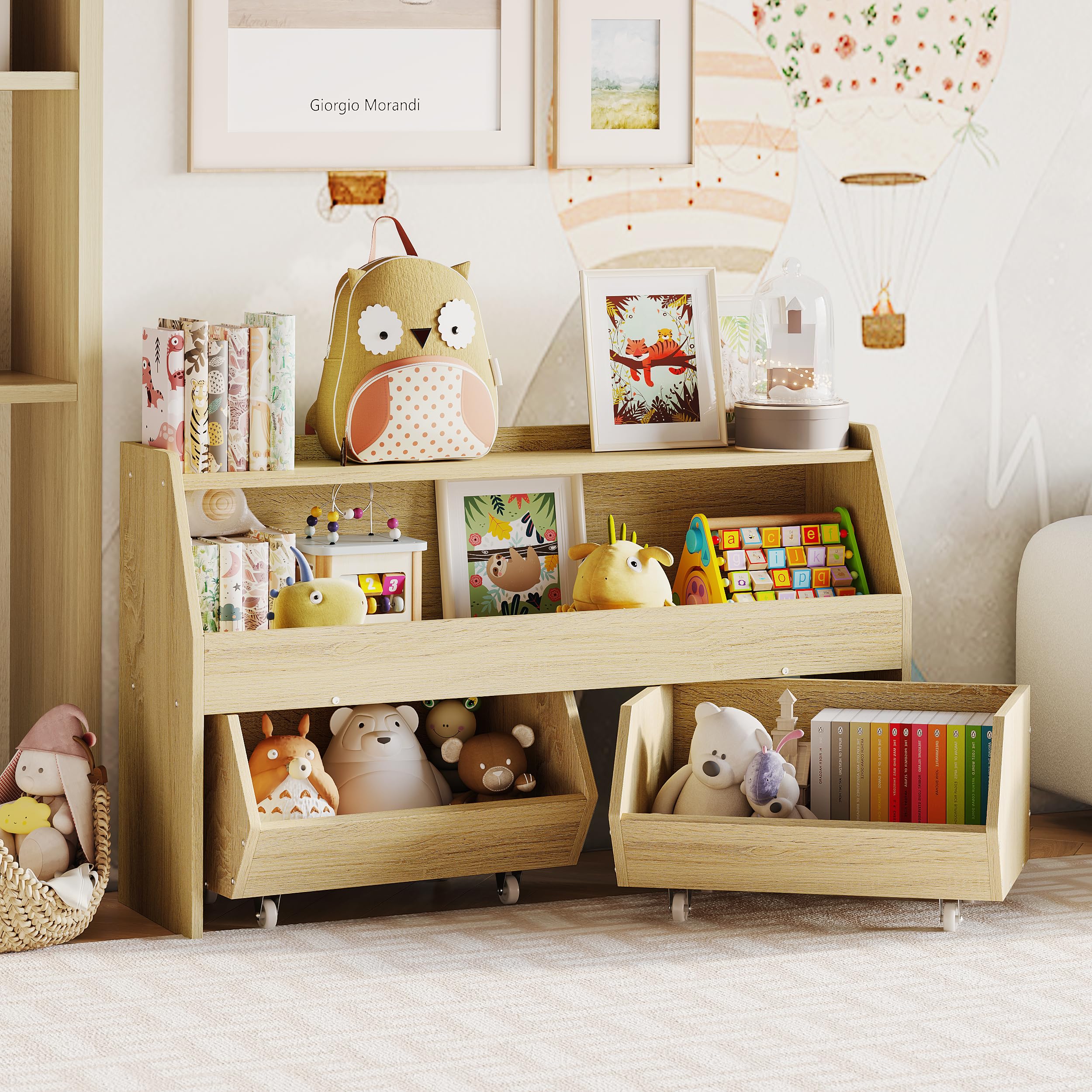
Two of the five compartments tip forward, and that is not a gimmick. Watch a four-year-old use one: the bin comes out to them, they dig through it on the floor, and it tips back in. Every other unit here asks a small child to reach into a dark cubby and feel around for what they want.

It is also the best-looking of these, and we mean that as a buying reason rather than a decorative note. The rustic brown finish and the tilted fronts let it sit in a living room or hallway without announcing itself as toy storage, and the three plain compartments above take picture books and puzzles face-out.

The footprint is the friendliest here for a tight room: 11.8 inches deep, 35.4 wide and 29.5 high, narrow enough to tuck into a corner or beside a sofa. Assembly is quick with the included tools, the anti-tip device comes in the box, and the whole frame is rated to 78.5 pounds, which is more than most of us will ever ask of a kids' shelf.

Bottom Line: The best-looking organizer in this group, and the tilt-out bins genuinely help small hands, so buy it for a room where the storage stays on show.
#3

Best for a Long Wall

SpaceAid 12-Bin Organizer

SpaceAid 12-Bin Organizer

9.0/10 Outstanding
  • Bins: 12 (8 small, 4 large)
  • Shelves: 6
  • Material: Solid pine
  • Assembled Size: 52.3"W x 13.6"D x 31.5"H
Check Price on Amazon

Pros

  • 52-inch span covers a real wall
  • Twelve bins plus six open shelves
  • Solid pine with rounded edges
  • Light enough to position alone

Cons

  • Thin panels crack under a hard knock

Fifty-two inches is a lot of wall, and that is the entire point. This is the unit to buy when the playroom has one long blank stretch and a pile of toys that never had a home: six shelves, twelve bins in two sizes, and enough span that books, bins and the odd display piece all get a place.

It is solid pine with rounded edges and a front-extended base that widens the stance, and at just over 20 pounds it is light enough to position and reposition on your own before you commit to the anchor. The white finish keeps it from dominating a small room, and the 13.6-inch depth leaves the floor in front of it usable.

For a long wall, we think it is the best use of space in this group, and nothing else here does the same job at half the length. Give it the wall anchor and keep the heavy bins low, and it will hold a playroom's worth of small toys and books without crowding the room.

Bottom Line: If your playroom has one long empty wall, this is the organizer that fills it properly, with twelve bins and six shelves that stay shallow.
#4

Best Solid Wood

EXPERLAM Pine Organizer

EXPERLAM Pine Organizer

9.0/10 Outstanding
  • Bins: 12 (8 small, 4 large)
  • Material: Solid pine
  • Assembled Size: 42.0"W x 11.0"D x 31.5"H
  • Side Shelf Heights: 3 positions
Check Price on Amazon

Pros

  • Solid pine frame, not melamine board
  • Shallow 11-inch depth fits a landing
  • Twelve bins in two sizes
  • Side shelves adjust to three heights

Cons

  • Screw-heavy assembly takes an evening

Solid pine is the reason to look here. Most of this group is melamine-faced board, and while that is perfectly serviceable, it is also why several of those units weigh far more and sound hollow when you knock on them. This frame is pine, rounded at the edges, and light enough at under 16 pounds to shift with one hand.

The layout is twelve bins in two sizes and three open shelves, with the side shelves set at three heights so taller books and puzzles fit without a fight. At 42 inches wide, 11 deep and 31.5 high it is the shallowest full-width unit here, which is what makes it work on a landing or in a small bedroom.

That shallow depth cuts both ways. Cars, figures, art supplies and board games sit happily in it; the big ride-on toys and oversized plush will not, because the bins are correspondingly shallow. If your floor is mostly large items, a deeper unit earns its space more honestly.

For a narrow room, this is the one we point to, and the pine is a real upgrade over printed board rather than a cosmetic one. It also takes the wall anchor the instructions call for, which a tall, light cabinet should never go without.

Bottom Line: Solid pine, a 42-inch span and an 11-inch depth that fits narrow rooms make this the one we point solid-wood shoppers to first.
#5

Best Rolling Drawers

FOTOSOK Rolling Drawer Organizer

FOTOSOK Rolling Drawer Organizer

9.0/10 Outstanding
  • Cubbies: 5
  • Drawers: 3 on casters
  • Assembled Size: 13"D x 39.4"W x 35.4"H
  • Total Capacity: 60.3 lb
Check Price on Amazon

Pros

  • Three drawers on 360-degree casters
  • Five open cubes plus a usable top
  • Reads as furniture, not a toy bin
  • Anti-tip anchor included

Cons

  • 60 pounds, and it does not move easily

The bottom three drawers pull all the way out on casters, and the first time a two-year-old carts a drawer of blocks across the rug to the build site, the extra money makes sense. They roll back in just as easily, which is the part we care about at eight o'clock at night.

Above them sit five open cubes and a flat top that takes a lamp, a nightlight or the overflow of bedtime books. At 35.4 inches tall and 39.4 wide it reads as a small dresser rather than a toy bin, and the white finish will not fight anything else in the room.

Use the anti-tip anchor. A tall, narrow unit with drawers that pull out shifts its balance as soon as a child leans on one, and the hardware is in the box. The top row of cubes also sits above a toddler's reach, so keep current favourites in the drawers and the long-term toys up top.

Bottom Line: Best for a child who hauls toys around the room: the castored drawers move the storage to the play instead of the other way round.
#6

Best for Toddlers

Fulhope Toddler Organizer

Fulhope Toddler Organizer

9.1/10 Outstanding
  • Frame: Engineered wood, beech finish
  • Drawers: 2 on swivel casters
  • Assembled Size: 11.7"D x 40.2"W x 23.7"H
Check Price on Amazon

Pros

  • 23-inch height keeps everything reachable
  • Two drawers on 360-degree casters
  • Wide 40-inch span for the height
  • Lowest price tier in this group

Cons

  • Low frame holds less than the taller units

Twenty-three inches tall is the whole argument. A one-year-old can reach the top row without a step, and the two bottom drawers run on swivel casters, so they come out and travel to wherever the playing is happening. Most organizers here are built to a 31-inch standard that assumes a four-year-old; this one assumes a smaller person.

It is also the least expensive way into a proper piece of furniture in this group, and we think that is the right way to buy a first organizer: 40 inches wide, 11.7 deep, with open cube shelves above the drawers and a beech finish that reads as wood rather than a decal. For a nursery or a toddler's first bedroom, this is the one we point to.

Bottom Line: The first organizer to buy for a one- or two-year-old: a 23-inch frame that puts every bin within reach, at the low end of this group on price.
#7

Stuffed animal overflow

ONBRILL Stuffed Animal Organizer

ONBRILL Stuffed Animal Organizer

8.9/10 Excellent
  • Cubbies: 6
  • Assembled Size: 11.6"D x 40.9"W x 35.8"H
  • Soft Toy Storage: Stretchy mesh pockets
Check Price on Amazon

Pros

  • Mesh pockets take soft toys off the floor
  • Six cubes plus the pocket run
  • Anti-tip strap included
  • Narrow 11.6-inch depth

Cons

  • Cubbies run small for bulky toys

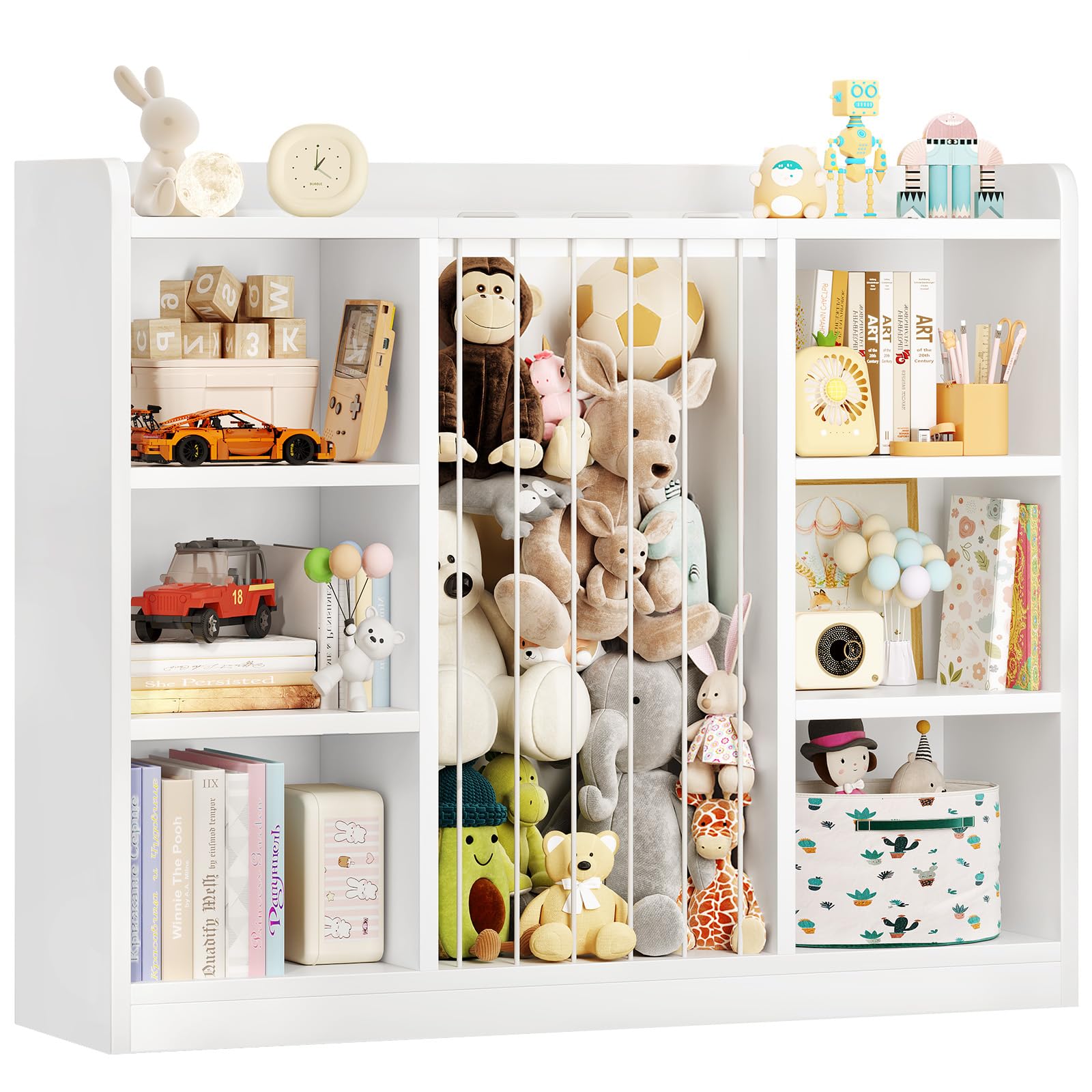
Stuffed animals are their own storage problem: too big for a bin, too light to stack, and always more numerous than anyone admits. This is the only unit here built around them, with stretchy mesh pockets that hold soft toys and six cubes below for everything else.

The frame is particle board with thickened panels, and the anti-tip strap nails straight into the wall, which is worth doing at 43 pounds and 35.8 inches tall. At 40.9 inches wide and 11.6 deep it fits a bedroom wall, and assembly is straightforward rather than quick.

Buy this if the mountain is soft toys; if the problem is loose parts, we think the 16-bin Humble Crew is the better tool, because the two solve different problems. This one is a specialist, and it earns its place on that basis rather than as a general-purpose organizer.

Bottom Line: The one to buy when stuffed animals are the problem: mesh pockets and six cubes, though the cubbies are small for anything chunky.
#8

Big toy collections

HORSTORS 48-Inch Organizer

HORSTORS 48-Inch Organizer

9.1/10 Outstanding
  • Cubbies: 8
  • Drawers: 3
  • Rolling Bins: 2
  • Assembled Size: 11.8"D x 48"W x 46.5"H
Check Price on Amazon

Pros

  • Eight cubbies, three drawers, two rolling bins
  • Raised edges stop things sliding off
  • Shallow 11.8-inch depth for its height
  • Anti-tip hardware included

Cons

  • Needs a 48-inch wall to earn its place

Assembly is the honest cost of this one. The wheel section and the drawer runners are the fiddly parts, and the whole cabinet is a slow build, not difficult but long. Plan an evening for it, and plan to be patient with the last step.

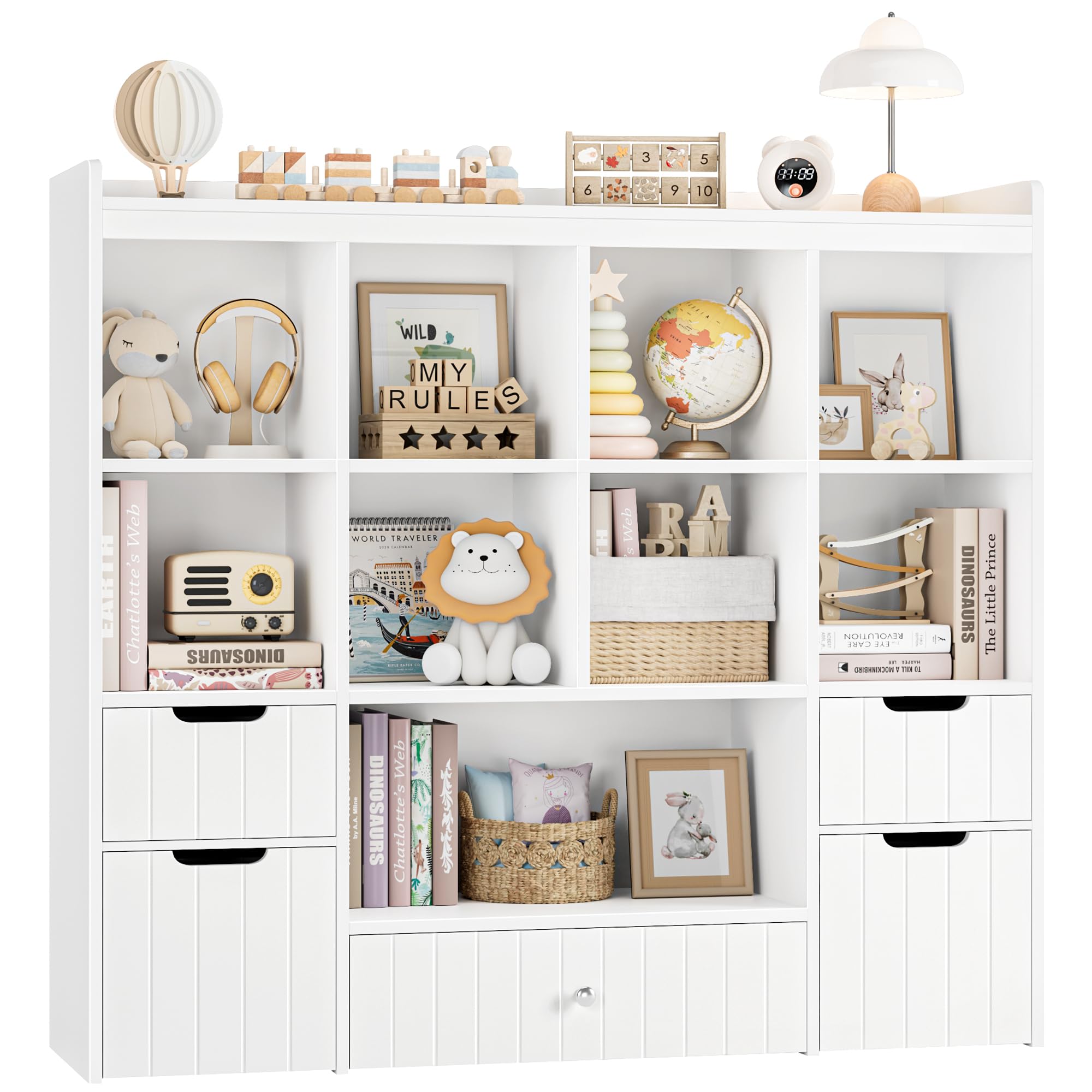
What that buys is a lot of storage in under a foot of depth: eight open cubbies, three gliding drawers in two sizes, and two bins on wheels, across 48 inches wide and 46.5 tall. Raised borders on the shelves stop books and bins from sliding off, and the painted finish wipes clean with a damp cloth.

The height is the thing we kept coming back to. At 46.5 inches the top rows belong to adults, so the toys your child actually plays with have to live in the bottom half or they may as well not be there. Anchor it as well: a tall, shallow cabinet full of toys is not something to leave standing loose.

For a household where the toys have outgrown two organizers, this is the one that ends the argument. Nothing else here stacks cubbies, drawers and rolling bins this tall in this little floor space.

Bottom Line: For a household whose toys have outgrown two organizers, this stacks cubbies, drawers and rolling bins tallest in the least floor space.

How We Tested Toy Storage Cabinets

We started by pulling together more than 40 toy storage cabinets from major retailers and specialty kids’ brands, then narrowed the list to 12 based on dimensions, bin configuration, materials, price, and whether the manufacturer published clear weight limits and assembly details. We skipped anything that hid its shelf spacing or required a wall-anchor kit sold separately.

Each cabinet was assembled solo with the included tools, and we timed how long it took and noted whether the instructions matched the hardware. Once built, we loaded each with the same mix of hardcover picture books, wooden blocks, and die-cast cars, then leaned on the top shelf, pulled the bins in and out, and checked for wobble after a week.

For eight months, the cabinets lived in a playroom, a bedroom, and a living-room corner, where they handled after-school toy dumps, weekend cleanups, and the occasional sippy-cup leak. We wiped sticky fingerprints with a damp cloth, checked whether finishes dulled or corners chipped, and judged how each one looked in a real room rather than under showroom lighting. We also noted how much actually fit once the bins were full—not just the shelf measurements on the box—and compared each cabinet’s condition and usable capacity against what it cost, because a sturdy cabinet with awkward bin sizes is still a bad buy.

How to Choose Toy Storage Cabinets

Bins, cubbies, and what a toddler can manage

Organizers in this group use three access styles: rigid plastic bins that lift out, open cubbies, and drawers that slide or roll. Bins are the most forgiving for small parts, because a child can carry a whole category to the rug and bring it back in one trip. Look at the mix of sizes as closely as the total; four wide bins for bulky toys plus a run of small ones beats sixteen identical tubs.

Watch what carries the bins. Rigid shelves and steel dowels are the durable arrangement, while fabric panels stretched between poles are the part that sags and tears first. A cheaper unit built that way is not a bargain if the shelves fail while the frame is still fine.

Measure the wall, then measure the child

Widths here run from about 35 to 52 inches and depths from 11 to 16, and those two numbers decide whether a unit fits at all. Compact usually means narrow rather than short: one cabinet here is only 11.8 inches deep and still stands 46.5 inches tall. Tape the width and depth on the floor before ordering and leave room in front for bins to pull out.

Height decides how much of the storage your child actually uses. Around 24 inches suits a one-year-old, 31 inches suits a preschooler, and anything near four feet puts the top rows in adult territory. Buy for the child you have, not the one who will grow into it; bins above eye level stop being used and start collecting dust.

Anchor it, and load from the bottom up

Every cabinet here ships with an anti-tip strap or bracket, and it is not a suggestion. These units are light, tall and front-heavy once loaded, and a child leaning on an open drawer adds load exactly where the cabinet is least stable. Fix the strap into a stud or a proper wall anchor rather than drywall alone, and check it again after a few months of use.

Then load from the bottom: heavy bins low, soft toys and books up top, and stay inside the stated per-tier limit, which ranges from 20 pounds on the Humble Crew to 78.5 pounds on the HOOBRO frame.

Open fronts, tilt-outs, and rolling drawers

How a child gets a toy out is the difference between an organizer that works and one that turns into furniture. Open fronts are fastest and keep everything visible, which is why they dominate this group. Tilt-out bins bring the contents to a small hand instead of asking the child to reach into a cubby.

Rolling drawers go one better: the storage travels to wherever the play is happening. That earns its keep if your child builds in the middle of the floor, and matters less in a narrow room where a pulled-out drawer blocks the only walkway.

Frequently Asked Questions

Final Verdict

The Humble Crew 16-bin organizer is the one we point most families to. Sixteen bins in two sizes covers loose parts and bulky toys at once, and 31 inches is a height a four-year-old can work from without help. If your playroom has a long wall instead of a corner, the SpaceAid uses 52 inches better than anything else here.

For a one- or two-year-old, start with the Fulhope: its 23-inch frame puts every bin within reach, which is the only feature that reliably gets toys put back. Buy the height your child is now, not the height they will grow into.