Kids & Nursery

Best Twin Over Full Bunk Beds of 2026

Two kids, one bedroom, and a floor that has to hold backpacks, laundry, and a half-built LEGO city — that's the math a twin-over-full bunk bed is built to solve. The full-size lower bunk means the older kid or an overnight guest isn't crammed into a twin, and the whole setup takes up the footprint of one bed instead of two. What the product photos never show is how much strain that arrangement puts on a frame: a full mattress is heavy, and every trip up the ladder works the joints a little looser.

My team and I have assembled, climbed on, and lived with seven of these beds over the past nine months, and the frames that felt planted shared a few things you can't see online — thicker slats, a ladder that hooks rather than leans, a guardrail that still sits proud of the mattress after a month of use. Assembly splits the field faster than anything else; some go up in an afternoon with one adult and an Allen wrench, others eat a weekend and a second set of hands. Looks and price matter, but only after the thing stops shifting when a kid rolls over. The picks below are the ones that earned their spot.

#1

Best Overall

Max & Lily Twin Over Full

Max & Lily Twin Over Full

8.6/10 Excellent
  • Frame: Solid New Zealand pine
  • Assembled Size: 80"L x 65"W x 60"H
  • Weight Capacity Per Bunk: 400 lb
Check Price on Amazon

Pros

  • 400-pound rating on each bunk
  • Solid pine, not particle board
  • Metal-on-metal structural connections
  • Rounded edges and slatted headboard

Cons

  • Wide slat spacing sags a thin mattress
  • Pictures-only instructions

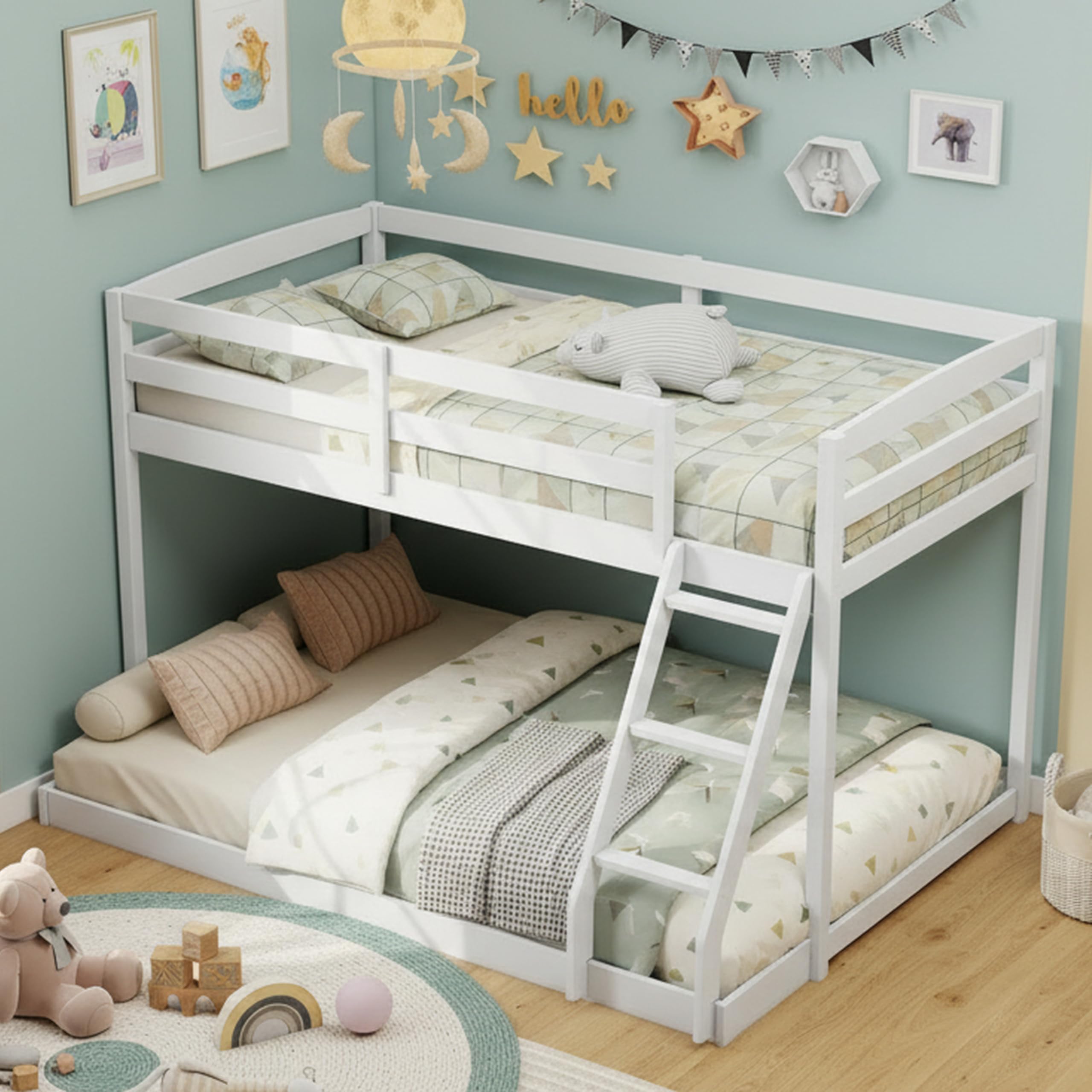
Four hundred pounds per bunk is the number that decides this one. That's what Max & Lily rates the twin up top and the full below, and it's the figure that separates a bed built for a nine-year-old from one that survives a fifteen-year-old flopping down with a backpack. The frame is solid New Zealand pine rather than the particle board hiding under a lot of painted bunks, and the joints are metal-on-metal, which is exactly where a cheap frame loosens first.

The bed stands 60 inches to the top rail — high enough that the lower bunk feels like a proper cave, low enough that an adult can reach over and make the top bed. Rounded edges and a slatted headboard do a lot of the visual work; this is the wood bunk in the group that reads as furniture rather than equipment. No box spring is needed, and the pine slats sit on a metal support bar.

Our reservation is the slats. Spaced as they are, they let a thin mattress sag between them, and that sag is what turns into a shimmy at the corners after a few months of use. A bunkie board, or any mattress six inches thick or more, settles it before it starts. The instructions are drawings with very little text, so budget two people and an evening rather than an hour.

None of that changes the recommendation. On the two dimensions that matter most in this category — how much weight each bunk carries and whether the joints hold — this is the strongest of the wood frames here, and the one we'd put in a room that has to serve a child now and a teenager in five years.
Bottom Line: Our default pick: solid pine, 400 pounds per deck, and joints that stay tight — the bunk to buy when a teenager will be climbing it.
#2

Best Low Bunk for Young Kids

KOMFOTT Low Bunk Bed

KOMFOTT Low Bunk Bed

8.4/10 Very Good
  • Frame: Solid pine and plywood
  • Slats: 14 + 7 plywood
  • Assembled Size: 79.5"L x 58.5"W x 51.5"H
  • Guardrail Height: 12 inches
Check Price on Amazon

Pros

  • 51.5-inch height clear of low ceilings
  • 12-inch guardrails around the top bunk
  • Built-in ladder, no floor space lost
  • Solid pine with 14 + 7 plywood slats

Cons

  • Rated for children, not adults

Most bunks put the top rail somewhere near five feet. This one stops at 51.5 inches, and that single decision reorganizes the whole bed: a small child can be lifted into the top bunk without a chair, you can kneel on the bottom bunk to read a story without cracking your head, and the whole frame disappears under a sloped ceiling that would rule out a standard bunk.

We choose this one when the person sleeping upstairs is small. The guardrails run 12 inches around the top bunk, the ladder is built into the end of the frame instead of hooked over a rail, and solid pine with 14 plywood slats up top and seven below means no box spring to buy. It's the wood bunk here that feels designed around a young child rather than scaled down from an adult bed.

The trade is capacity and headroom. The frame is rated for children rather than adults, so keep grown-ups off the top bunk, and the shorter gap between decks is fine for a five-year-old sitting up and cramped for a teenager. There's also almost nothing underneath for storage boxes — which is the price of a bed a small child can actually use.

Bottom Line: The bunk we point to when the top sleeper is small: 51.5 inches tall, 12-inch rails, and a climb that suits a five-year-old.
#3

Best with Stairs

Giantex Bunk with Stairs

Giantex Bunk with Stairs

8.5/10 Excellent
  • Slats: 14 + 7 plywood
  • Access: Staircase with handrails
  • Max Weight: 250 lb
  • Assembled Size: 94.5"L x 56.5"W x 50.5"H
Check Price on Amazon

Pros

  • Stairs with handrails instead of a ladder
  • Storage compartments in the treads
  • 50.5-inch height under a low ceiling

Cons

  • 94.5-inch length eats floor space
  • 250-pound maximum, the lowest here

A staircase with a handrail changes who can get into the top bunk. A three-year-old who can't manage a vertical ladder can walk up three wide steps with something to hold, and the treads on this one open into storage compartments, which is where the bedtime books and the small toys end up. If the bunk is for a young child and a ladder makes you nervous, this is the design that answers it.

The cost shows up in the footprint. The staircase is integral, so the frame runs 94.5 inches long — at least a foot more floor than any ladder bunk here — and you have to find that length before anything else. Height is only 50.5 inches, so it's also the answer for a low ceiling, and the guardrails run the full length of the top bunk.

We think the trade is worth it in the right room. A child who can climb safely on their own is the entire point of a bunk, and storage stairs turn a safety feature into floor space you get back. What gives us pause is the 250-pound maximum, the lowest here: this is a kids' bed, not one that takes an adult overnight guest up top.

Assembly is the other cost. It's a long build with a lot of parts, and the staircase adds a stage most bunks never reach. Lay everything out, work in daylight, and put the stairs on last. The painted white finish and 14 + 7 plywood slats are the rest of the story; no box spring needed.

Bottom Line: Choose it if a ladder worries you: storage stairs with handrails let a toddler climb alone, in a frame low enough for a sloped ceiling.
#4

Best Low-Profile Metal

KAIFAM Twin Over Full

KAIFAM Twin Over Full

8.4/10 Very Good
  • Frame: Steel
  • Guardrail: Semi-enclosed
  • Assembled Size: 76.77"L x 53.98"W x 54.25"H
Check Price on Amazon

Pros

  • Compact 53.98-inch width
  • Semi-enclosed guardrails
  • Full-size lower bunk for two

Cons

  • No weight rating given for either bunk

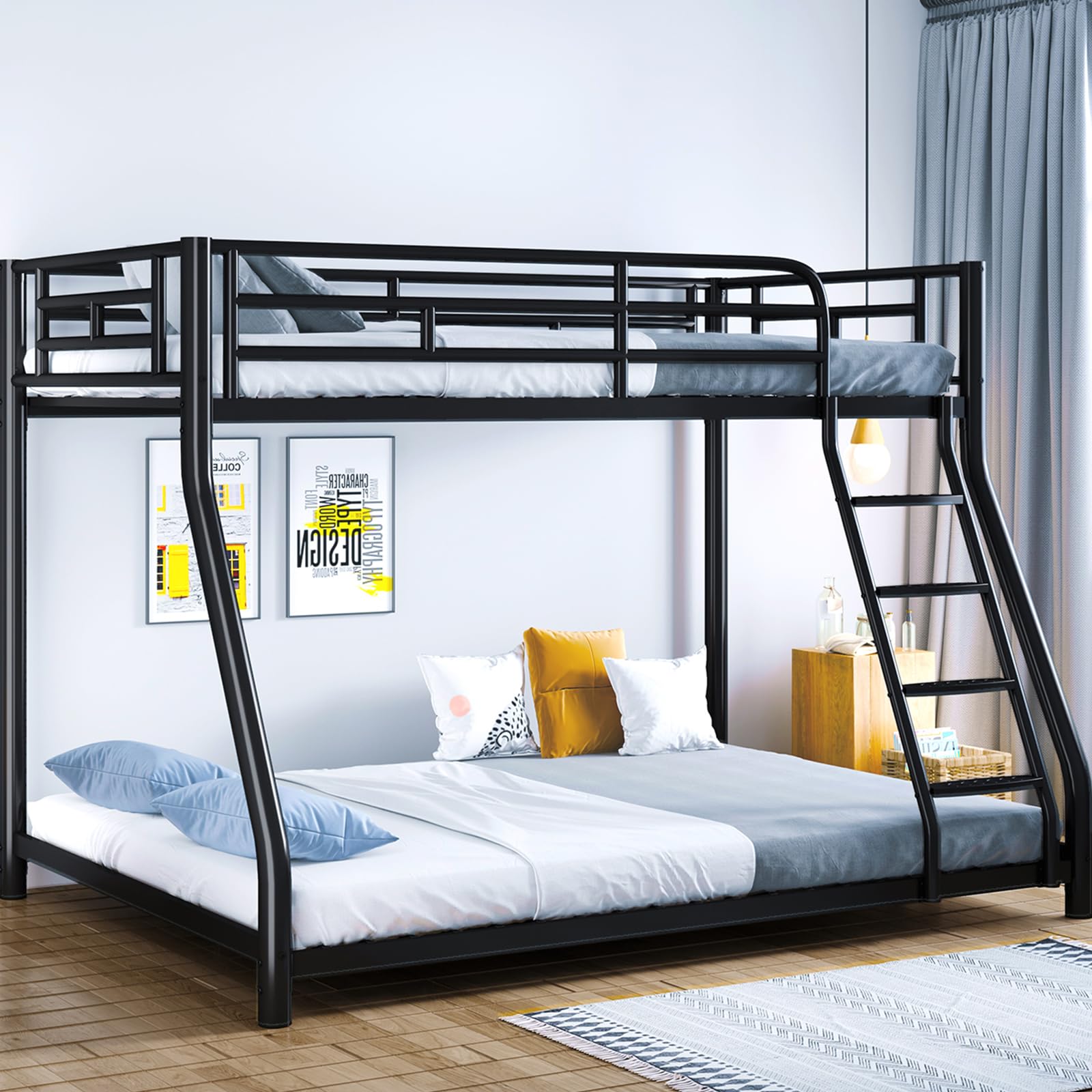
Semi-enclosed guardrails are the detail here. Instead of a single bar at the top of the bunk, the rail wraps the mattress on three sides, and the whole frame sits at 54.25 inches, so the top deck reads as a shallow nest rather than a shelf in mid-air. In a small room with a low ceiling, that combination is what makes the bed feel less like a climbing frame.

For two children under ten sharing a small room, this is the steel frame we reach for. The bottom is a full, wide enough for two small sleepers or one teenager with room to spare, and the rails and fixed ladder are placed so a child can be lifted in and out without a step stool. Assembly takes two people and the parts arrive numbered.

The honest caveats: no weight rating is given for either bunk, so plan on children up top and a teenager below, and the semi-enclosed rail means more reaching over at sheet-changing time. At 76.77 by 53.98 inches it's compact for a twin-over-full, which is most of its appeal in a shared room.

Bottom Line: A compact steel bunk for a tight room: semi-enclosed rails, a 54-inch frame, and a full lower deck that takes two small sleepers.
#5

Best Budget

SDHYL Twin Over Full

SDHYL Twin Over Full

8.3/10 Very Good
  • Assembled Size: 76.8"L x 56"W x 63"H
  • Weight Capacity: 350 lb top / 400 lb bottom
  • Guardrail Height: 9 inches
  • Mattress Thickness: 6 in. top / 8 in. bottom
Check Price on Amazon

Pros

  • Least expensive frame in this group
  • 350 lb top and 400 lb bottom ratings
  • Buildable by one person

Cons

  • Six-inch top mattress limit
  • Narrow round ladder rungs

The least expensive twin-over-full here is also one of the few a single person can build without help: 64.6 pounds of steel, the tools in the box, and bunks rated 350 pounds up top and 400 below. For a dorm, a guest room, or a teenager's first proper bed, we think that's hard to argue with — both decks take an adult, and there's money left over for two mattresses.

The number that will trip you up is mattress thickness. The top bunk takes a maximum of six inches and the bottom eight, which rules out the deep pillow-top already in the house. Go over it and the mattress sits above the nine-inch guardrail — exactly the situation the rail exists to prevent. Buy thin mattresses deliberately rather than discovering this on the first night.

Elsewhere it's plain: 76.8 inches long, 63 inches tall, matte black steel, no storage, and a fixed three-step ladder whose rungs are narrow round bar, which is rough on bare feet on a midnight trip. None of that is a surprise at this end of the market, and none of it undermines what the bed is for.

Bottom Line: The budget answer: the least expensive frame here, rated 350 and 400 pounds, and light enough for one person to build.
#6

Best Guardrail Height

VECELO Twin Over Full

VECELO Twin Over Full

8.7/10 Excellent
  • Frame: Powder-coated steel
  • Slats: 22 metal slats
  • Assembled Size: 78"L x 55"W x 60"H
  • Guardrail Height: 15 inches
Check Price on Amazon

Pros

  • 15-inch guardrails, tallest here
  • 22 slats with noise-damping clips
  • Ships in one box, 85 pounds

Cons

  • Tall rails make bed-making awkward

Fifteen inches of guardrail is the tallest here by a wide margin — the next-highest stated rail in this group is twelve. That measurement is taken from the slats, so it buys real margin: an ordinary mattress leaves a wall of rail above it, and a restless sleeper who rolls in the night meets something solid rather than an edge.

The rest of the frame is straightforward. Powder-coated matte black steel, 22 slats, 78 by 55 inches on the floor and 60 to the top rail, shipped in one box. The slats clip down with plastic buckles, which is the manufacturer's answer to the noise a steel bunk makes when a sleeper turns over.

We suggest it for the family whose five-year-old sleeps like a windmill. Rail height is the first specification we check when a fall is the worry, and this one wins that comparison comfortably. You pay for it at bed-making time, because you're reaching over a foot and a quarter of rail to tuck the top bunk in, and the frame underneath is otherwise unremarkable.

Bottom Line: Fifteen-inch guardrails make this the pick when a restless sleeper is up top; buy it for the rail height and accept a plain frame.
#7

Best with Desk and Storage

BTHFST Bunk with Desk

BTHFST Bunk with Desk

8.7/10 Excellent
  • Storage: Desk, 5 drawers, 5 pockets
  • Charging: 2 AC, 1 USB-C, 1 USB-A
  • Lighting: App and remote RGB
  • Assembled Size: 77.8"L x 77.1"W x 72"H
Check Price on Amazon

Pros

  • Desk usable from either side
  • Five drawers plus desk pockets
  • Charging built into the desk

Cons

  • 77.1-inch width needs floor space
  • Fabric drawers, not wood joinery

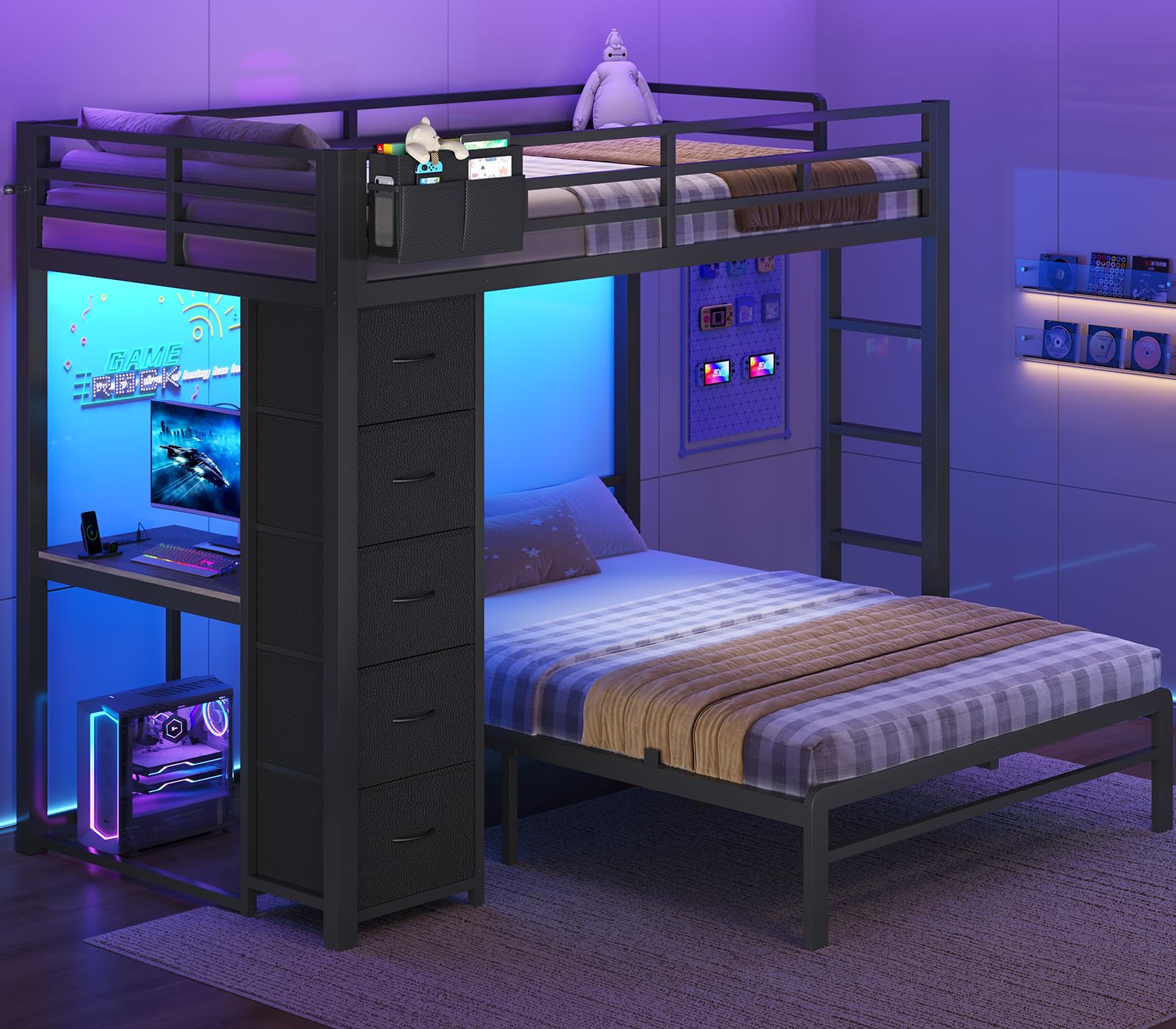
The desk is why this bed exists. It runs along one end of the frame and works from the outside on a chair or from the inside sitting on the bunk, which is a more useful arrangement than it first sounds: homework space, a shelf for a lamp, and somewhere to put a glass down that isn't the mattress. Under it sit five fabric drawers, with pockets along the desk side.

There's a power strip built into the desk — two AC outlets, one USB-C, one USB-A — and RGB lighting run from an app or a remote. The lighting will matter enormously to a ten-year-old and not at all to you, which is fine; the outlets are the part that earns their place, because a bunk in a small room is usually nowhere near a wall socket.

You pay for all of it in width. The frame measures 77.1 inches across, wider than anything else here, and stands 72 inches tall, so the room needs to take both numbers. The drawers are fabric boxes rather than furniture-grade joinery, and this is the longest build in the group, with instructions that are the weakest part of the package.

We think it earns its space for a teenager in one room: bed, desk, dresser, and charging in a footprint that replaces three separate pieces of furniture. For a young child it's overkill, and in a guest room the desk goes to waste.

Bottom Line: For a teenager in one room, this replaces a bed, a desk, and a dresser — five drawers, outlets, and a work surface in one frame.
#8

Shared kids' rooms

LIKIMIO House Bunk Bed

LIKIMIO House Bunk Bed

8.5/10 Excellent
  • Design: House-shaped frame
  • Assembled Size: 76.8"L x 56.1"W x 71.7"H
  • Weight Capacity: 350 lb top / 450 lb bottom
Check Price on Amazon

Pros

  • House silhouette children respond to
  • 450-pound lower bunk
  • Rubber stoppers quiet the slats

Cons

  • 71.7-inch height needs ceiling room
  • Thin ladder rungs underfoot

A peaked roofline over the top bunk, in black steel, is a bold thing to put in a bedroom — and it's the reason this bed turns a shared kids' room into something with a bit of theatre. The shape reads as a house rather than a frame, without the fussiness of a fabric canopy or the cost of a custom build.

It isn't only styling. The lower bunk is rated 450 pounds, the highest bottom-bunk figure in this group, and the top 350, so a parent can lie down with a toddler below without thinking about it. Assembled it's 76.8 by 56.1 inches, it ships in one box, and rubber stoppers hold the slats down.

Two things to measure. The frame stands 71.7 inches to the top of the roof, the tallest here, so check the ceiling at the wall where it will sit and check any fan. And the ladder rungs are thin, which adults notice on the way up to make a bed.

We like it most for a small room shared by two children under eight, where the shape does work a decorated wall would otherwise do. Past that age the roofline starts to feel like a costume, and the height becomes the thing everyone notices.

Bottom Line: A house-shaped bunk that gives a shared kids' room some character, with a 450-pound lower deck that takes a parent at story time.

How We Tested Twin Over Full Bunk Beds

We started with a field of roughly 40 frames and cut it to seven, filtering on weight capacity, guardrail height above a standard mattress, slat spacing, and footprint measured to the inch, then cross-checking the survivors against owner reviews that mentioned wobble, missing hardware, or instructions that skip steps. Every bed that made the cut was built in a garage or spare bedroom, timed, and then lived with for nine months.

Assembly came first, and it was the most revealing part. We laid out every piece, counted the hardware against the parts list, and noted whether the bags were labeled and whether the diagrams matched what was actually in the box. Each frame was put together by one adult using the included tools where possible, and we clocked the build so we could tell you whether it's an afternoon or a whole weekend. Then the ladder: whether it hooked securely or just leaned, whether it could mount on either end, and whether it landed in the middle of the walking path.

Once built, the beds went to work. A 60-pound kid climbed up and rolled around on the top bunk while we watched the corner posts for sway; adults sat on the bottom rail and pushed sideways; we re-tightened everything after a month to see which bolts had backed out. We slept on both levels with foam and innerspring mattresses to judge slat support and check whether the guardrail still cleared the mattress after a night of shifting. Over the nine months we tracked squeaks, scuffs on the finish, and whether the wood tone matched from one box to the next.

Space got measured rather than eyeballed — tape on the floor for the footprint, a laundry basket slid under the bottom bunk, a check on whether a kid sitting up top had headroom. And we let the kids vote, because a bed they won't climb into is a bed nobody uses.

How to Choose Twin Over Full Bunk Beds

Who sleeps up top

Ratings on these frames are per bunk, not for the whole bed, and they run from 250 pounds on the stairs model to 400 and 450 on the pine and steel ones. Pick by the heaviest person who will realistically climb up, and think three years ahead — the eight-year-old who suits a 250-pound bunk today becomes the eleven-year-old who doesn't.

Guardrails matter as much as the rating. Fifteen inches of rail leaves room for a thicker mattress and a sleeper who rolls; nine inches leaves very little margin, and the mattress has to be thin to keep its top well below the rail.

Ladders, stairs, and low frames

Access decides who can use the bed unsupervised. A ladder takes no floor space and is the wrong answer below about six years old. A staircase with a handrail and storage treads lets a four-year-old get in and out alone, but it adds length: the stairs model here runs 94.5 inches against 75 to 80 for everything else.

A low bunk, 51 to 54 inches tall, shortens the climb for everyone and clears a sloped ceiling. The trade is headroom between the decks, which a small child never notices and a teenager immediately does.

Wood, steel, and what you're paying for

Solid pine carries the highest per-bunk ratings in this group and the heaviest frames, and wood joints don't work loose the way bolted steel can. Steel is lighter — easier to move, easier to build alone — and costs less.

What keeps a steel bunk quiet is how the slats are held down. Rubber stoppers and plastic buckles do real work; a frame that relies on gravity and hope is the one that creaks at two in the morning.

Height, length, and the room

An eight-foot ceiling is 96 inches, and these frames stand 50.5 to 72 inches, so clearance above the top rail runs from about two feet to nearly four. Measure where the bed will actually sit rather than at the doorway, and account for a ceiling fan.

Length is just as unforgiving: most of these need 75 to 80 inches of wall, while the staircase model needs 94.5. Check the route to the room as well, because a bunk arrives as one long, awkward box.

Frequently Asked Questions

Final Verdict

Buy the Max & Lily if you want one bunk that will outlast a childhood: solid pine, 400 pounds on each deck, and joints that don't work loose. If someone small is doing the climbing, spend less on the KOMFOTT — the low frame and 12-inch rails fit a four-year-old better, and what you give up is adult capacity rather than safety.

And if a ladder is the thing you can't live with, the Giantex with stairs is the one to measure the room for.