Kitchen

Best Baker's Racks of 2026

A baker’s rack looks like the answer to a cramped kitchen: open shelves for the stand mixer, a landing spot for the bread box, maybe a little wine storage. Then you load it up, and the shelves bow, the frame racks, or the whole thing wobbles every time the mixer runs. The right rack gives you that extra stretch of storage without turning into a wobbly science experiment; the wrong one just moves your clutter six inches to the left.

I’ve lived with a couple of hand-me-down baker’s racks, and over the past nine months my team and I tested 12 new ones. We assembled each from the box, loaded the shelves with cast-iron skillets, flour canisters, and cookbooks, and paid attention to the things you notice only after a few weeks: whether the finish still looks good after a wipe-down, whether the frame stays square, and whether the shelves start to warp under a real kitchen’s worth of weight. The picks below are the ones that earned their footprint.

#1

Best Overall

Denkee 5-Tier Baker's Rack

Denkee 5-Tier Baker's Rack

9.6/10 Exceptional
  • Cord: 6.56 ft
  • Outlets: 3 AC
  • Max Load: 242 lb
  • Dimensions: 15.75"D x 38"W x 66.9"H
Check Price on Amazon

Pros

  • 38-inch width fits two appliances side by side
  • Three AC outlets with a 6.56-foot cord
  • 242-pound total capacity across five tiers
  • Labeled parts and a fast flat-pack build

Cons

  • Needs a 39.4-inch doorway to get inside
  • Engineered-wood shelves, not a solid wood top

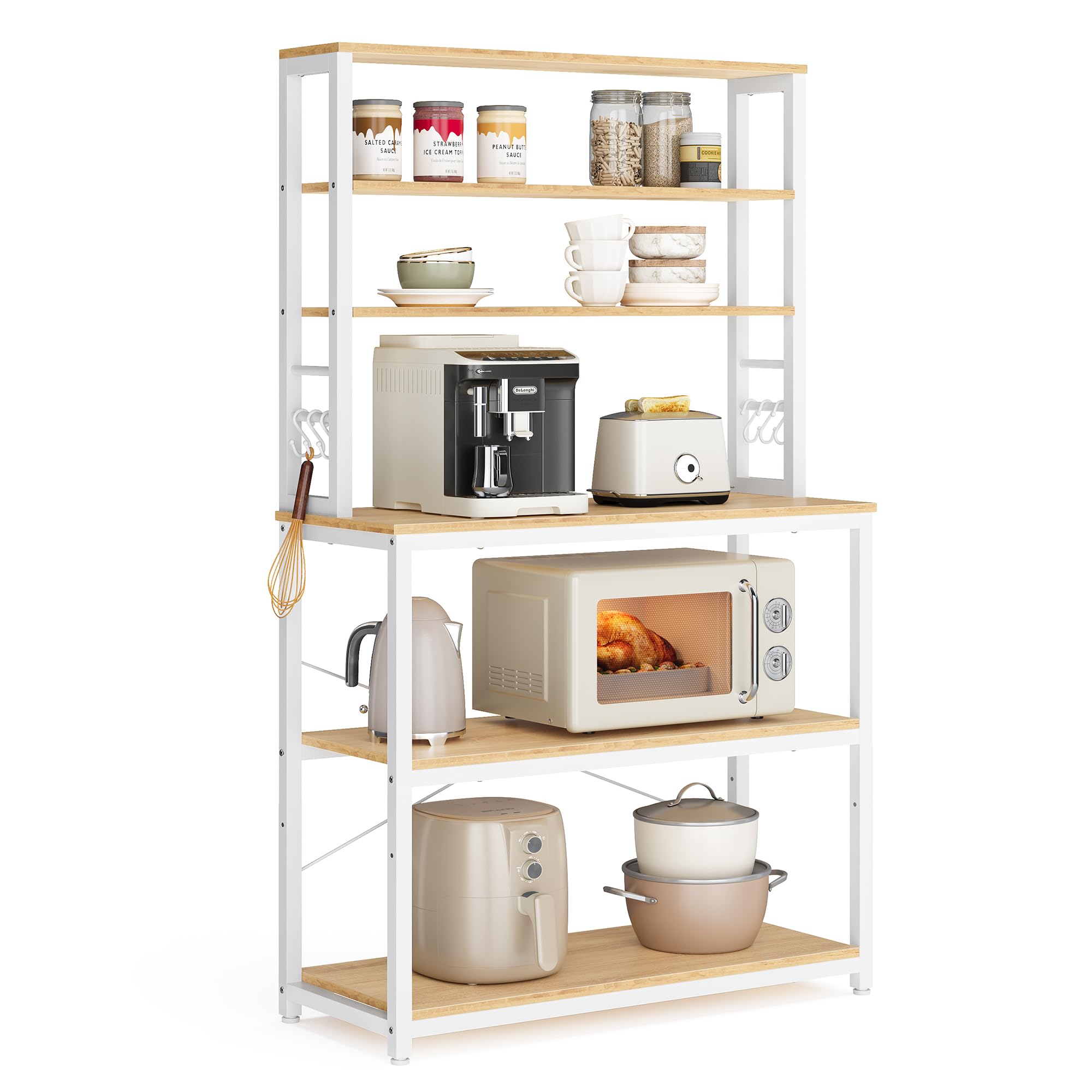
Thirty-eight inches of width is what put this rack at the top of the list. It's the widest one here, and those extra inches are the difference between a microwave and a coffee maker sharing a shelf and one of them living on the floor. Five tiers run up to 66.9 inches, the shelves are 15.75 inches deep, and a three-outlet strip is built into the frame.

The load figures are worth reading rather than skimming: 242 pounds in total, with the top two shelves rated at 33 pounds each and the lower ones at 66. Load it bottom-heavy — microwave and stand mixer low, jars and mugs up top — and a rack this tall stays planted. Assembly is a flat-pack sequence of labeled parts and short steps, and fifteen minutes is a fair estimate for one person.

The outlets earn their keep in the ten minutes before dinner, when the microwave, the rice cooker and the coffee maker all want power at once and nobody has to unplug the grinder to make room. A 6.56-foot cord gives you some choice about where the rack sits relative to a socket, which is more freedom than most built-in strips allow.

Nothing else in this group puts that width, that capacity and a strip in one frame. That's the recommendation in a sentence: it does the two-appliance job, then gets out of the way.

Bottom Line: We think this is the rack to buy when two appliances are camped on your counter: 38 inches wide, five tiers, and outlets already where the cords end.
#2

Best for Narrow Spaces

VASAGLE 23.6-Inch Baker's Rack

VASAGLE 23.6-Inch Baker's Rack

9.2/10 Outstanding
  • Outlets: 4 AC
  • Dimensions: 15.7"D x 23.6"W x 66.9"H
  • Middle Shelf: 80 lb
  • Power Rating: 1875 W
Check Price on Amazon

Pros

  • Four switched outlets with overload protection
  • Fourteen hooks plus a wire back panel
  • 66.9 inches of storage in a 23.6-inch footprint
  • Middle shelf adjusts by 1.6 inches

Cons

  • One appliance per shelf at 23.6 inches wide
  • Middle shelf rated for 80 pounds

A 23.6-inch gap between the counter and the door is dead space in most kitchens, and this rack is built to fill exactly that. It stands 66.9 inches, so the storage goes up rather than out, and it packs five shelf levels, fourteen hooks and a wire back panel into barely two feet of wall.

The power strip is the best executed one here: four AC outlets, an on-off switch, and overload and leakage protection, rated to 1875 watts. Cords stay behind the frame instead of hanging down the front, and the middle shelf shifts by 1.6 inches so a tall coffee maker or a blender stands upright without a rebuild.

We rate the hardware above what the price suggests — labeled parts, photo steps, and both an anti-tip kit and leveling feet in the box, which on a 66.9-inch frame matter more than the shelf boards. Those are 0.75-inch engineered panels, and they do the job a coffee bar asks of them.

What we like most is how little it asks of the room: two feet of wall, one socket, and the coffee station is off the counter. In a narrow kitchen that's the whole brief answered.

Bottom Line: The pick for a tight kitchen: four switched outlets, fourteen hooks and five shelf levels inside a 23.6-inch footprint, standing 66.9 inches tall.
#3

Best Budget Coffee Bar

SUPERJARE 4-Tier Baker's Rack

SUPERJARE 4-Tier Baker's Rack

9.3/10 Outstanding
  • Outlets: 2 AC
  • Dimensions: 16.5"D x 23.6"W x 50.6"H
  • Shelf Rating: 80 lb
Check Price on Amazon

Pros

  • Two built-in outlets at the lowest price here
  • Light 22.4-pound frame is easy to move
  • Numbered parts and short assembly steps
  • Pre-drilled shelf heights for tall appliances

Cons

  • Outlets sit on the visible side, so plugs show
  • Each shelf rated for 80 pounds

Two outlets on the least expensive rack here is the whole pitch, and it holds up: the strip lives in the frame, the cords disappear behind the shelves, and the coffee maker never has to move to be plugged in.

At 23.6 inches wide and 50.6 inches tall, this is the smallest rack we recommend. That's exactly right in a galley kitchen or under a window, and wrong if you pictured a full-height tower, so measure the appliance going on the top tier before you order. Shelf heights follow pre-drilled positions, which means an air fryer gets the gap it needs without a rebuild.

It's also the lightest at 22.4 pounds, which we appreciated while shuffling it between two walls working out where it looked right. Parts are numbered, the steps are short, and the finished rack sits square on a level floor.

The air switch is the detail we didn't expect to matter: one press and the strip is live, so nobody is reaching behind the shelves at six in the morning. It's a small thing that the racks at twice the money don't all get right.

Bottom Line: We send budget buyers here: two outlets, pre-drilled shelf heights and a 22.4-pound frame that fits a two-foot gap for the least money in this group.
#4

Best for Open Shelving

VASAGLE 6-Tier Coffee Bar

VASAGLE 6-Tier Coffee Bar

9.3/10 Outstanding
  • Hooks: 6 S-hooks
  • Shelves: 6
  • Max Load: 120 lb
  • Dimensions: 15.7"D x 31.5"W x 65.7"H
Check Price on Amazon

Pros

  • Six tiers in a 31.5-inch footprint
  • Anti-tip kit and adjustable feet included
  • Six S-hooks for mugs and utensils
  • Middle lower shelf adjusts between two heights

Cons

  • 120-pound total capacity across six shelves
  • 44.5 pounds before anything goes on it

Six tiers in a 31.5-inch footprint is the arithmetic that earns this rack its place. It stands 65.7 inches and gives you a column of open shelving on a wall that would only take a bookcase, with six S-hooks along the top for mugs.

There's no power strip, and that's the point of this version rather than a shortcut: with no cord to route, it works as an entryway catch-all, a hallway shelf or a pantry overflow as readily as a coffee bar. We were struck by how much six open tiers change a small kitchen — the appliances come off the counter and the shelves take over the job the cupboards were failing at.

Leveling feet handle an uneven floor, and the anti-tip kit in the box isn't decoration on a 65-inch frame. The middle lower shelf moves between two heights, which covers a blender or an air fryer and won't make room for anything much taller.

The finish is what makes it feel like furniture rather than utility shelving: golden oak and cloud white, with the grain reading through instead of disappearing under paint. In a room where the rack is on show, we think that's worth as much as another shelf.

Bottom Line: We choose this one when there's no socket to spare: six open tiers, a 31.5-inch footprint, leveling feet and a wall anchor, with no cord to route.
#5

Best Low-Profile Pick

HOOBRO 35.4-Inch Baker's Rack

HOOBRO 35.4-Inch Baker's Rack

9.2/10 Outstanding
  • Basket: Mesh, included
  • Outlets: 4 AC
  • Shelves: 6
  • Dimensions: 15.7"D x 35.4"W x 52"H
Check Price on Amazon

Pros

  • 35.4-inch width at a low 52-inch height
  • Four AC outlets and a mesh basket
  • Six shelf levels in a low frame

Cons

  • No load rating published for it

Fifty-two inches is the number to start with. This rack is more than a foot shorter than the tallest ones here, which is how it slides under a window, sits below a wall cabinet or fills a living-room wall without looming — and it still fits six shelf levels into 35.4 inches of width.

Four AC outlets and a mesh basket decided it for us. The outlets sit in the frame, so the coffee maker, the kettle and the frother stay plugged in, and the basket catches the pods, tea bags and odds and ends that otherwise spread across a countertop. Four S-hooks take the mugs.

The frame is particleboard over steel, the finish is rustic brown and black, and it's the one here that suits a darker kitchen rather than fighting it. Assembly runs in a predictable order and the shelves go on without any head-scratching.

When you do want to move it — a different wall, a different room, a different apartment — 37.4 pounds and a straightforward frame make that an errand rather than a project.

Bottom Line: This one earns its place under a window: 35.4 inches wide, 52 inches tall, four outlets and a mesh basket to catch the clutter.
#6

Best for Maximum Storage

SNTD 6-Tier Baker's Rack

SNTD 6-Tier Baker's Rack

9.0/10 Outstanding
  • Outlets: 3 AC
  • Shelves: 10
  • Max Load: 366 lb
  • Dimensions: 14.6"D x 35.9"W x 72.1"H
Check Price on Amazon

Pros

  • 366-pound rated capacity
  • Ten shelves in mixed sizes
  • Three outlets with an air switch
  • Pull-out basket, fourteen hooks, three anti-tip devices

Cons

  • Dozens of hex screws make for a long build
  • 72.1 inches needs a full-height wall

Ten shelves and 366 pounds of rated capacity is a pantry's worth of storage on a footprint under three feet wide. At 72.1 inches this is the tallest rack here and the only one that comes close to replacing a closet.

Three outlets with an air switch sit in the frame, there's a pull-out basket and fourteen hooks, and SNTD fits three anti-tip devices plus an X-shaped back brace. That's more bracing than anything else in this group, and we'll take all of it on a tower this tall.

The build is 12 mm wood panels on a 15 mm metal frame with an anti-rust coating, and the shelves come in mixed sizes, which is what lets one rack hold sheet pans, spice jars and a slow cooker without them fighting for the same gap.

Where this earns its keep is the back half of a kitchen that never had enough cupboard: it takes the appliances, the dry goods and the pans, and it organizes small clutter better than anything else here. Nothing else in this group turns one wall into that much separate storage, and for a house with a small pantry that's the whole argument.

Bottom Line: If you're replacing a cupboard rather than adding a coffee bar, this is the pick: ten shelves, 366 pounds of rated capacity and three outlets in the frame.
#7

Best Wire-and-Wood Design

Amazon Basics 3-Tier Baker's Rack

Amazon Basics 3-Tier Baker's Rack

9.3/10 Outstanding
  • Shelves: 2 wire, 1 wood, 1 wire half
  • Max Load: 270 lb
  • Wood Top: Removable, 16–18 mm
  • Dimensions: 14"D x 35.83"W x 63.31"H
Check Price on Amazon

Pros

  • 270-pound total capacity
  • Removable wood top, 16–18 mm thick
  • Snap-together frame needs no tools

Cons

  • No built-in power outlet
  • 14-inch shelves, the shallowest here

Chrome wire and a wood top is a look, and this is the only rack here that offers it. In a small kitchen that's not just style: the open frame lets light and sightlines through, so the corner doesn't close in the way a solid-backed unit does. You get two wire shelves, one wood shelf, a wire half shelf, a hanging bar and four S-hooks, all adjustable in one-inch steps.

The wood top is 16 to 18 mm thick and lifts out, which makes it the one work surface here you could carry to the sink, and 270 pounds of total capacity is more than most of this group manages.

Where our verdict lands is on the build. Wire and wood together look better in a small room than any of the flat-pack panels here, and the frame goes up without tools — shelves stacked onto plastic collars on the posts — faster than anything else we tested. The caveat arrives in the box: unwrap every panel and sight along its edge before you assemble, because a shelf that starts out twisted leaves the frame out of square, still standing and still holding a load but never quite straight.

Availability has been patchy, so check before you plan the corner around it. What you're buying is a rack that looks light, carries 270 pounds and goes up without a screwdriver — a combination none of the solid-panel racks here can offer.

Bottom Line: We like it where the rack is on show: chrome wire, a removable wood top and 270 pounds of capacity, with a tool-free build and no outlet.

How We Tested Baker’s Racks

We started by scanning reviews and retailer listings, then narrowed the field by shelf dimensions, footprint, material, and price, skipping racks that were too shallow for a stand mixer or too tall for a standard wall. Twelve models made the cut, and we spent nine months using them in real kitchens rather than a showroom.

Each rack was assembled solo with the included tools, and we checked welds, shelf pins, and hardware as we went. We timed the build, noted unclear steps, and checked whether the finished frame sat level before adding weight. Then we loaded it as a baker would: stand mixer on one shelf, flour and sugar canisters on another, cast-iron skillets and cookbooks on the bottom. We reached for ingredients mid-task, wiped spills with a damp cloth, and watched how the finish handled daily wear.

Sturdiness and warping got the longest look. We left the heaviest loads in place for weeks, then checked shelves with a straightedge and shook the frame to see if it still felt solid. We also moved each rack a few feet across the floor to see whether it racked or wobbled. The racks that made the list stayed square, looked good after cleanup, and held a useful amount without crowding the counter.

How to Choose Baker's Racks

Start With the Wall, Not the Finish

The racks here run from 23.6 to 38 inches wide, and that figure decides how you'll live with one. A 23.6-inch rack takes one appliance per shelf; a 35- or 38-inch rack takes a microwave and a coffee maker side by side. Height splits the field again: 50 to 52 inches fits under a window or a wall cabinet, while 66 to 72 inches wants a clear stretch of wall. Don't trust the word compact — it describes the footprint, not whether your microwave fits. Shelves here are 14 to 16.5 inches deep, so measure the depth of anything you plan to park on one.

Outlets: Convenience With a Ceiling

A built-in strip turns a rack into a coffee station: no cord dangling down the front, no socket hunt behind the toaster. The strips here give two to four outlets and, on the better ones, a switch plus overload protection. Add up what you plan to plug in before you load it, because the strip's rating is the ceiling for everything on it — the strongest here is rated to 1875 watts.

Also look at where the strip sits and which way its cord leaves the frame, since a strip on the back panel can hold the rack a couple of inches off the wall. If you already have a socket at counter height, the version without a strip is cheaper and moves rooms more easily.

Read the Load Rating as a Ladder

Capacity is usually quoted as a total, and the individual shelves are not equal: our widest pick carries 242 pounds but rates its top two shelves at 33 pounds each and its lower ones at 66. Heavy appliances belong low — a microwave near the floor stiffens the whole frame. Board thickness tells you something too, and 12 to 18 mm engineered panels are the norm at this level. If a rack publishes no rating at all, treat it as a coffee bar and pantry shelf rather than a stand-mixer stand.

Budget an Evening, Not Ten Minutes

Build times here run from about fifteen minutes on the snap-together wire rack to a couple of hours on the ten-shelf tower, and the difference is mostly parts count and hex screws. Numbered components, symbol-marked hardware and a video guide all shorten the job. One person can assemble most of these on the floor; a 66- to 72-inch frame is much easier to raise with a second pair of hands. Clear the space first — you'll be lying down next to it.

Anchor It Before You Load It

Any rack over about 60 inches is a lever, and a loaded one is a heavy lever. The better models ship with an anti-tip kit — one here adds three devices and a cross brace — and it's worth using, into a stud where you can find one. Keep the heaviest appliance on a lower shelf, run cords so a passing arm can't hook them, and leave the top tier for jars and mugs. In a rental, one strap into a stud is a small patch at move-out.

Frequently Asked Questions

Final Verdict

Seven racks, one answer. The Denkee is the only one here that lets a microwave and a coffee maker share a shelf while putting outlets exactly where the cords end, and it backs that up with 242 pounds of rated capacity across five tiers.

If your gap is closer to two feet, buy the 23.6-inch VASAGLE instead: four switched outlets, fourteen hooks, and the same vertical thinking in a much narrower footprint. And if the problem is a pantry rather than a counter, compare the SNTD's ten shelves and 366-pound rating before anything else.