Kitchen

Best Folding Kitchen Tables of 2026

A folding table earns its keep by disappearing, but too many of them announce themselves the moment you lean on one. The wobble, the pinch at the hinge, the tabletop that sags under a stockpot: that's the trade most people assume comes with saving floor space. It doesn't have to be. What a good one really fixes is the daily math of a small kitchen, where the table is a prep counter at noon, a laptop desk at three, and dinner for four by seven.

I've eaten holiday dinner at a card table and prepped on one that never stopped rocking, so I know the difference when I feel it. Over the past eight months my team set up, sat at, leaned on, and folded away 11 tables, from slim consoles that hide against a wall to drop-leaf models that open into a four-top. The thing that surprised me most: the number of hinges tells you almost nothing about how solid a table feels, the bracing underneath does. The picks below are the ones that kept earning their spot.

#1

Best Overall

Ashley Hammis Drop Leaf Table

Ashley Hammis Drop Leaf Table

8.7/10 Excellent
  • Seating: 2 to 4
  • Assembly: Required, tool included
  • Open Size: 36.38 in diameter
  • Folded Width: 22.38 in
Check Price on Amazon

Pros

  • Narrows to 22.38 inches against a wall
  • Seats two to four at 36.38 inches round
  • Simple leg assembly, tool included
  • Furniture look in a small kitchen

Cons

  • Still 22 inches deep with leaves down
  • Finish can look darker than photos

At 22.38 inches wide with both leaves down, the Ashley Hammis is the folding kitchen table we picture against a wall rather than folded into a closet. Open it to 36.38 inches round and it seats two comfortably or four in a squeeze, which is the right range for a couple who host now and then. We like that it looks like a dining table first and a space-saving trick second; the tapered legs and dark espresso finish give it a settled, furniture-like presence that a plastic table cannot match.

The legs are the main assembly job, and the necessary tool and hardware come in the box. We appreciate that the top arrives largely put together, because the last thing a small kitchen needs is a half-built table blocking the floor. Once it is up, the four-leg base feels stable for everyday meals, and the drop-leaf hinges let you change the footprint without clearing the table entirely. The catch is that the leaves do not turn it into a portable table: with both down it is still 22 inches deep and about 30 pounds, so this is one to leave in place and slide against the wall.

The trade-offs are mostly about expectations. The finish runs darker than some photos suggest, which is worth knowing if you are matching medium-toned cabinets; in a room with warm light it reads as a deep brown rather than black. And four people can eat here, but the round top is cozier than a rectangular dining table, so keep the place settings simple. For a small kitchen where the table stays put, that is a fair exchange: you get a real dining surface without giving up the walkway.
Bottom Line: We recommend the Ashley Hammis as the default small kitchen table: it seats four when you need them and narrows to a walkway-friendly 22.38 inches when you do not.
#2

Best No-Assembly Option

Stakmore Wood Folding Table

Stakmore Wood Folding Table

9.1/10 Outstanding
  • Weight: 29 lb
  • Assembly: None required
  • Open Size: 32 x 32 x 29.5 in
  • Folded Depth: 3.375 in
Check Price on Amazon

Pros

  • Arrives fully assembled
  • Folds to 3.375 inches deep
  • Solid wood feels substantial
  • Seats four in a compact square

Cons

  • Top stays 32 inches wide when folded
  • Tight for four full place settings

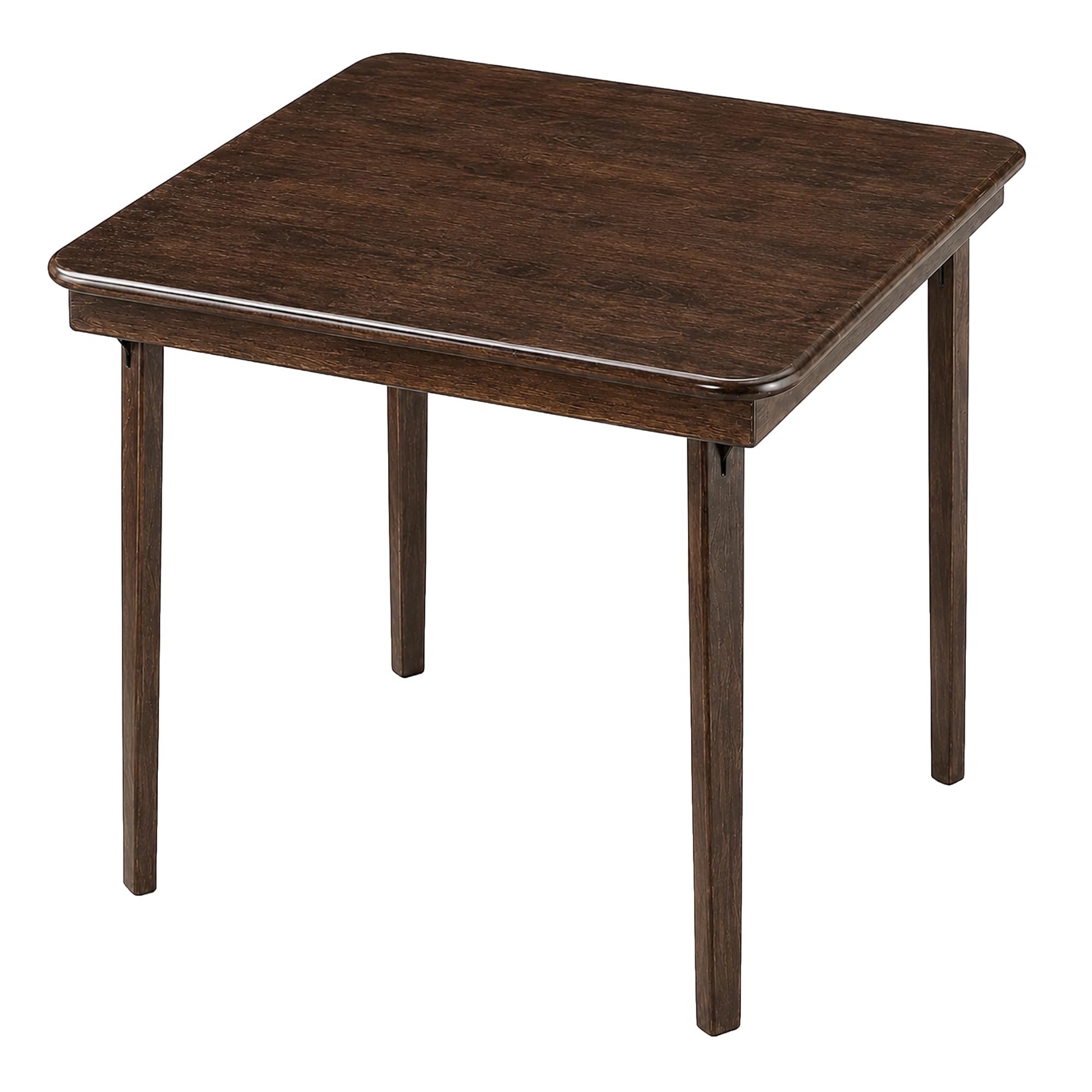
There is no bag of bolts to sort through with the Stakmore: it arrives fully assembled, and the legs unfold from underneath the top. That alone makes it a useful answer for a kitchen that is already short on project time. The table is 32 inches square and 29.5 inches high, so it tucks into a breakfast nook or stands in for a dining table without overwhelming the room. The solid wood build is the reason it feels more substantial than the typical folding card table, and the espresso finish looks tidy enough to leave out.

What we like most is how completely it disappears when the meal is over. The legs fold under the top and the whole thing stores at 3.375 inches deep, so it can go into a closet, behind a door, or under a bed. That slim profile is why it is one of the easiest tables here to put away. The trade-off is weight: at 29 pounds, it is a two-hand carry when folded, and hauling it out every night gets old. Keep it for occasional meals, extra seating, or a room where it can stay open most of the week.

The 32-inch top is the other limitation. Four people can sit down, but the place settings will be close, and a serving dish in the middle leaves little elbow room. For two or three it feels generous enough. We also noted that only the legs fold; the top stays 32 inches wide, so you need a closet or wall with that much clear width. If you want a table that seats four for a holiday and then vanishes, this is the one we point to.

Bottom Line: We recommend the Stakmore when the table has to disappear between meals: solid wood, no assembly, and a folded profile slim enough for a closet.
#3

Best for Storage

COMUHOME Drop Leaf Table

COMUHOME Drop Leaf Table

8.9/10 Excellent
  • Wheels: Locking casters
  • Storage: Two cabinets
  • Open Size: 60.2 x 31.5 x 28.5 in
  • Folded Footprint: 15 x 31.5 in
Check Price on Amazon

Pros

  • Two drop leaves shrink the footprint
  • Built-in cabinets add storage
  • Locking casters make it movable
  • 300-pound capacity supports daily use

Cons

  • Assembly is more involved than the others
  • Eight-person seating is optimistic

The COMUHOME answers a different small-kitchen question: not just where to eat, but where to put the table linens, the board games, and the stack of mail that always lands on the dining table. With both leaves up it measures 60.2 by 31.5 inches, and the two storage cabinets sit underneath. That makes it the most furniture-like pick here for a dining nook that has to work harder than a dining nook should. We think the walnut finish and metal legs give it a warmer look than its utility suggests.

The drop leaves are the practical part. Fold them down and the table shrinks to a 15-by-31.5-inch footprint, which is narrow enough to tuck against a wall or roll into a corner on the locking casters. We appreciate the casters more than we expected: they let you pull the table out for a meal and push it back without lifting 55 pounds. The cabinet storage is genuinely useful in a small apartment, and the 300-pound capacity means it does not feel like a temporary card table when everyone leans in.

The cost is assembly. This is not a table you unfold from a box; it arrives in pieces, and the build is more involved than the other picks here. Give yourself floor space and a clear stretch of time, and have a second person nearby for the top. The eight-person seating claim is also optimistic: four to six is the realistic everyday count, and eight only works as a party squeeze. In exchange you get storage, mobility, and a table that looks settled in a room rather than staged for temporary use.

Bottom Line: We recommend the COMUHOME for a small dining room that needs storage and wheels more than it needs a table you can hide in a closet.
#4

Budget overflow

Amazon Basics 4 Ft Table

Amazon Basics 4 Ft Table

8.8/10 Excellent
  • Weight: 15.8 lb
  • Open Size: 47.8 x 23.9 x 33.9 in
  • Folded Design: Fold-in-half with handle
  • Height Settings: 4
Check Price on Amazon

Pros

  • Large 4-foot top seats four
  • Folds in half with a carry handle
  • Four height settings add flexibility
  • Light enough to carry at 7.18 kg

Cons

  • Folding mechanism can be stiff

The Amazon Basics table is the one that lives in the closet until the holiday crowd arrives. It is a 4-foot rectangular surface, 47.8 by 23.9 inches, with four height settings and a fold-in-half body plus a carrying handle. That makes it more versatile than a dedicated dining table: set it low for kids or a buffet, raise it for standing work, then fold it away. It is not the table we choose for a permanent kitchen, and that distinction matters.

We like it for overflow seating because the top is large enough for four plates and a couple of serving dishes, and the height adjustment is more useful than it sounds. The push-button legs let you match the table to a counter or a low chair, which makes it a better buffet station than a fixed-height card table. The plastic top wipes clean after a messy meal, and the whole table is light enough to carry with one hand by the handle.

The catch is the height adjustment: the table will not fold with the legs extended, so you have to reset it before storing it. That is the kind of fuss that matters if you plan to set it up and take it down every day. It also looks like what it is: a portable utility table, not a piece of dining furniture. For a permanent kitchen, choose a wood or drop-leaf table; for a buffet, a craft project, or two extra place settings, this one earns its closet space.

Bottom Line: We recommend the Amazon Basics table for overflow seating and buffet service, not as the dining table you leave set all week.

How We Tested Folding Kitchen Tables, From Setup to Fold-Away

We started by pulling every folding kitchen table we could find, from slim consoles that lean against a wall to drop-leaf and gateleg designs, then cut the list to those with published dimensions, a stated weight capacity, and a footprint that plausibly fits a small kitchen. That left 11 tables, which we assembled or unpacked ourselves and moved into real homes rather than a showroom.

Each table lived in a kitchen for at least a week. We unfolded and refolded it twice a day, timing the process solo with nobody holding the other leaf, and noted where fingers got pinched or a latch demanded two hands. We measured the footprint open and closed, counted how many people could sit without knees touching, and weighed each one on a bathroom scale before carrying it up and down a flight of stairs.

Sturdiness got the least gentle treatment. We leaned our full weight on one edge, pushed the top diagonally to check for racking, and set a heavy pot of water on the end farthest from the legs. We looked at each finish in daylight and under kitchen lighting to see whether the color read warm or gray next to white oak cabinets, and we compared what each table cost against what it was made of, solid wood versus veneer, steel versus plastic brackets.

How to Choose Folding Kitchen Tables

Decide how it should fold

There are three useful mechanisms here: legs that fold under a rigid top, a top that folds in half, and drop leaves that hinge down at the sides. They solve different space problems. A folding-leg table can go into a closet; a drop-leaf table usually stays in the room and becomes narrow against a wall. A fold-in-half table sits between the two, with a smaller storage footprint and a carrying handle. Before you choose, measure the folded shape, not just the open one, and check the width of the closet or doorway it has to pass through. The trap is treating folds as one feature: the Stakmore's 3.375-inch depth still needs 32 inches of clear width.

Size for the meals you actually host

Open size and seating are related but not identical. A 32-inch square table can seat four, but the plates will be close; a 36-inch round table is more comfortable for four and still compact; a 4-foot rectangular table gives serving space but takes more wall length. Decide whether the table is primarily a two-person breakfast spot or a four-person dinner table. If you host a crowd, a larger surface helps, but check that the folded footprint still fits your storage. A 60-inch table is generous for four to six; eight is a party squeeze.

Check the lock, not just the top

Stability comes from the joints and the lock, not the thickness of the top. A folding table should lock open with the legs or leaves fully engaged; if it does not, the tabletop will rock when someone leans on it. Look for a locking leg mechanism, a center lock under a fold-in-half top, or leaf supports that swing into place. If you are buying in person, open and close the table before you pay. Online, read the return policy and check the table as soon as it arrives.

Plan for assembly, weight, and cleanup

Assembly is where small tables surprise people. A folding-leg table like the Stakmore arrives ready to use; a drop-leaf model usually needs legs attached; a storage table like the COMUHOME is a real build. If you are not handy, pay attention to that difference. Weight matters too: a 29-pound wood table is a two-hand carry, while a 55-pound storage table is furniture you move on wheels. For the surface, solid wood and veneer look warmer but need coasters and quick spill cleanup; HDPE plastic is the practical choice for buffets and outdoor use.

Frequently Asked Questions

Final Verdict

For most small kitchens, the Ashley Hammis is the table we recommend first. It gives you a 36-inch round dining surface when you need it and a 22-inch-deep profile when you do not, which is the right trade for a room where the table stays put. If the table has to go into a closet between meals, the Stakmore is the better buy; if you need storage and wheels, choose the COMUHOME. The Amazon Basics table makes sense for overflow seating, not as the everyday kitchen table.