Kitchen

Best Kitchen Carts of 2026

Kitchen carts look like the simplest piece of furniture in the catalog — a top, some legs, a few shelves — and that is exactly why so many of them disappoint. The wrong one wobbles when you chop, arrives with a bag of bolts and a diagram that makes no sense, or turns out two inches too wide for the only wall you had in mind. The right one gives you a landing spot for the stand mixer, a place to stash the sheet pans, and a surface that holds steady while you work.

Over the past eight months, my team and I have built, loaded, rolled, and wiped down 12 kitchen carts at a range of prices. We judged them on the things you notice after the boxes are gone: whether the instructions made sense, how much the cart shifted when we leaned on it, whether the finish survived a spill, and if the size matched the space we had. The keepers felt solid on day one and still felt solid months later.

#1

Best Overall

Amazon Basics 3-Tier Cart

Amazon Basics 3-Tier Cart

9.3/10 Outstanding
  • Assembly: No tools needed
  • Dimensions: 14.96 in D x 20.87 in W x 36.73 in H
  • Top Surface: 1.5 in wood
  • Total Capacity: 175 lb
Check Price on Amazon

Pros

  • Wood top lands at counter height
  • Shelves adjust in one-inch steps
  • Assembles with no tools

Cons

  • Open shelves leave everything on show
  • Modest 175 lb total next to commercial carts

Thirty-six inches is the number that matters here. That is standard counter height, and this cart's wood top sits at 36.7 inches, close enough that when we rolled it alongside a counter the two surfaces read as one run of workspace. The top is a 1.5-inch wood slab, 21 inches wide and 15 deep, which takes a microwave, a coffee station, or a cutting board with a bowl beside it.

The shelves are the reason we keep recommending it. They lift off the four chrome poles and drop back on at one-inch intervals, so the gap between them is yours to set: a tall space for a stand mixer with the head up, or two even tiers for bins. Two chrome shelves rated at 50 pounds each, a microwave's worth of wood on top, and a build that needs no tools at all covers most of what a small kitchen wants off its counter.

The frame is four poles with no side bracing, and you notice it when you push a loaded cart over a threshold — the top sways a little before the casters catch up. Keep the heavy appliance centred, lock both casters when it is parked, and it stops mattering. At 25.7 pounds it is also light enough to shove aside one-handed, which is more than the commercial carts here can say.

Bottom Line: Our pick for most kitchens: a wood top at counter height, shelves that adjust in one-inch steps, and tool-free assembly for less than the stainless carts.
#2

Best for Prep Work

Seville Classics Prep Table Cart

Seville Classics Prep Table Cart

9.1/10 Outstanding
  • Height: 36 in
  • Work Surface: 24 x 20 in stainless steel
  • Certification: NSF certified
  • Lower Storage: Wire shelf plus sliding basket
Check Price on Amazon

Pros

  • Stainless top takes hot pans and raw prep
  • Stands at counter height for standing work
  • NSF certified construction
  • One person can move it at 24.6 lb

Cons

  • Sliding basket rattles on its tracks

We put a hot sheet pan straight down on the Seville, which is the short version of why it is here. The top is a brushed stainless slab 24 inches wide by 20 deep, with a bullnose edge and bracing underneath, and at 36 inches the whole cart stands level with a standard counter. A real work surface, at counter height, on wheels: that is what the wood-topped carts here cannot quite give you.

Underneath there is an adjustable wire shelf and a sliding basket rather than drawers, so storage is open and quick to grab from. It is NSF certified, which matters if you are setting up anything semi-commercial, and at 24.6 pounds one person can shift it without unloading it first. Twenty-four by twenty inches is a small footprint for the surface you get, and it slots into the dead space at the end of a counter run.

This is the cart we choose when someone actually plans to stand at it: chop, plate, roll the lot to the sink. The one thing to know is that the sliding basket rides loose on its tracks and rattles when the cart moves loaded. Nothing falls out, but it is not the solid piece the top is. What the extra spend buys is the only genuinely wipe-clean, heat-proof work surface in this group.

Bottom Line: The cart we choose when prep is the job: a stainless top at counter height, NSF certified, on locking casters with open storage underneath.
#3

Best for Hiding Clutter

Yaheetech Rolling Island Cart

Yaheetech Rolling Island Cart

9.1/10 Outstanding
  • Casters: 4 swivel, 2 locking
  • Storage: Drawer, cabinet, 6 hooks
  • Capacity: 138 lb
  • Dimensions: 18 in D x 22 in W x 35 in H
Check Price on Amazon

Pros

  • Cupboard door hides the clutter
  • Drawer plus six side hooks
  • Compact 22-inch width
  • Top reads as wood furniture

Cons

  • Assembly is the low point, with thin instructions

A door changes what a cart is. The Yaheetech is 22 inches wide, narrow enough for the end of a counter run, and it hides its contents behind a cupboard door with a drawer above and open shelves below, so coffee bags and clutter go away while the everyday things stay in reach. It is the tidiest pick of this set for a small kitchen, and the wood-grain top means it does not read as utility furniture.

Capacity is 138 pounds total, which is a microwave or a coffee station rather than a stack of cast iron. The middle opening takes a six-bottle wine rack, which says more about the proportions than the dimensions do. Six hooks on the side hold towels and utensils, and the drawer takes cutlery or the small things that otherwise colonise the counter.

It is engineered wood over a pine frame at 26 pounds, light enough to roll one-handed and light enough that you feel it when the top shelf is loaded. Treat 138 pounds as a real ceiling: a microwave and a coffee maker, yes; a stand mixer plus a case of drinks, no. Set against the open carts here it is the quieter choice, and it costs a fraction of the full-size islands.

Bottom Line: This is the cart we hand to anyone whose small kitchen has run out of cupboard: a drawer, a door, six hooks and a top that reads as furniture.
#4

Best Full-Size Island

Homestyles Dolly Madison Island

Homestyles Dolly Madison Island

9.1/10 Outstanding
  • Top: Natural wood with drop leaf
  • Storage: 3 drawers, 2 adjustable shelves
  • Capacity: 250 lb
  • Dimensions: 18 in D x 53 in W x 36 in H
Check Price on Amazon

Pros

  • Drop leaf turns it into a breakfast bar
  • Three drawers and two adjustable shelves
  • 250 lb rated capacity
  • Solid wood top over a painted body

Cons

  • Assembly is a long job with many parts
  • Drop leaf is the part to watch over time

Fifty-three inches with the leaf up, eighteen with it folded down. That swing is the whole idea: a piece of furniture that sits against a wall most of the time and becomes an island, somewhere to perch with a coffee or a surface to serve from, when you need one. Nothing else here changes size like that.

The storage is island-grade rather than trolley-grade: three drawers, two adjustable shelves behind doors, a spice rack and a towel bar. The top is natural wood over an off-white painted body, rated to 250 pounds, on four swivel casters.

At 134 pounds it is not a cart you nudge out of the way with a hip. Rolling it across a kitchen takes two people and a clear run, and the casters are for repositioning rather than for shuttling between stove and table the way a 25-pound trolley's are. You buy this one for where it will mostly stay.

If what you want is an island, with seating and a serving surface and drawers that hold actual cutlery, this is the one here that does it, and the price reflects that it is furniture. Set it against a wall and the kitchen gains a drawer stack, a serving surface and a seat; pull the leaf up and the room gains a place to gather.

Bottom Line: Our pick when you want a movable island rather than a trolley: a drop-leaf counter, three drawers and a wood top, at furniture prices.
#5

Best for Heavy Loads

Finnhomy 3-Tier Wire Cart

Finnhomy 3-Tier Wire Cart

9.3/10 Outstanding
  • Wheels: 4 in industrial, 2 with brake
  • Capacity: 500 lb
  • Shelf Size: 30 in W x 18 in D
  • Certification: NSF listed
Check Price on Amazon

Pros

  • 500 lb across three shelves
  • Four-inch casters clear thresholds and mats
  • Handle bar steers a full cart
  • NSF listed and easy to wipe down

Cons

  • Wire shelves let small items tip through
  • No drawer or door, so nothing is hidden

Five hundred pounds across three shelves puts this in a different class from the basket carts most people picture. It is a commercial-style unit: dense chrome wire, four-inch industrial casters with two brakes, a push handle welded to the frame, NSF listed. If the cart is going to hold appliances, stock or tools rather than a few jars, this is where we start.

The 30-by-18-inch shelves adjust at one-inch intervals, and the handle bar makes a loaded cart steerable in a way that a cart pushed from the top never quite is. Four-inch wheels are what matters in a real kitchen: they roll over a threshold or a mat instead of catching on it. At 32.4 inches tall it sits lower than the counter-height carts, which makes the top shelf a good place for a heavy appliance you lift down from rather than up to.

The casters are the known weak spot on carts of this style, and when a wheel mount lets go the cart is finished. Keep the load spread, check the mounts when it arrives, and do not drag it sideways over a lip. Ours has been fine, and the rest of the build backs up the rating: the wire is dense, the chrome wipes clean, and the whole thing weighs 26.5 pounds.

Bottom Line: We point heavy loads here: 500 pounds on industrial casters, plus a handle bar that steers a full cart through a doorway.
#6

Best If You Need to Store It Away

WORKPRO Collapsible Cart

WORKPRO Collapsible Cart

9.4/10 Outstanding
  • Assembly: None required
  • Capacity: 210 lb, 70 lb per shelf
  • Dimensions: 17.3 in D x 24 in W x 34.8 in H
  • Folded Width: 6 in
Check Price on Amazon

Pros

  • Folds to about six inches wide
  • No assembly required
  • 210 lb total, 70 lb per shelf
  • Rubberised casters roll quietly

Cons

  • No drawer, door or wood worktop
  • Costs more than solid carts with more capacity

It ships folded, and there is nothing to assemble: unfold it, push the casters in, start loading. After a run of flat-pack carts, that is not a small luxury.

Folded, it collapses to about six inches wide, which is the number to remember. This is the cart for a kitchen that cannot dedicate floor space to a cart: it lives in a closet or behind a door and comes out for the grocery run or the buffet.

Open, it is three shelves of 24 by 17 inches at 70 pounds each and 210 total, on four swivel casters with two brakes. The wheels are rubbery rather than hard plastic, so they grip and roll quietly instead of skidding, and the aluminium frame weighs 13.4 pounds.

What it is not is furniture. There are no drawers, no door, no wood worktop, and it costs more than the solid carts that do have those things. The trade you are making is storage and finish for a cart that takes up no floor between jobs.

Bottom Line: If the cart has to disappear between uses, this is the one we name: no assembly, a six-inch folded width, 210 pounds when open.
#7

Best Budget Cart

Simple Houseware 3-Tier Cart

Simple Houseware 3-Tier Cart

9.4/10 Outstanding
  • Casters: 2 in, 2 locking
  • Shelves: 3 metal mesh baskets
  • Capacity: 220 lb
  • Dimensions: 12.5 in D x 17 in W x 31.5 in H
Check Price on Amazon

Pros

  • Narrow 17-inch footprint
  • 220 lb on a steel frame
  • Two locking casters
  • Curved push handles at a natural height

Cons

  • Top basket is smaller than the two below it
  • Wheel mounts are the weak point under heavy loads

Seventeen inches wide by twelve and a half deep is a narrow cart, and that is the point: it slides into the gap between a fridge and a wall, or a bathroom or laundry corner, where nothing else here fits. The three mesh baskets are open on every side, so you can see what is on them from across the room.

What we appreciate is how much it does for the money: a steel frame, 220 pounds of capacity, four two-inch casters with two that lock, and curved handles bent into the top of the frame so you push from a natural height. It goes together quickly and rolls smoothly on hard floors and low carpet alike.

It is a utility cart doing kitchen duty, and that shows in the baskets: small items migrate into the mesh corners and nothing sits truly flat. If you want a surface to chop on or a door to hide things behind, this is not that cart. If you want somewhere for the onions, the foil and the cleaning spray to live, it is, and it will follow you out to the garage later without complaint.

Bottom Line: The cheapest cart we cover, and the one for narrow gaps: steel baskets, 220 pounds, and two locking casters.
#8

Dorm rooms

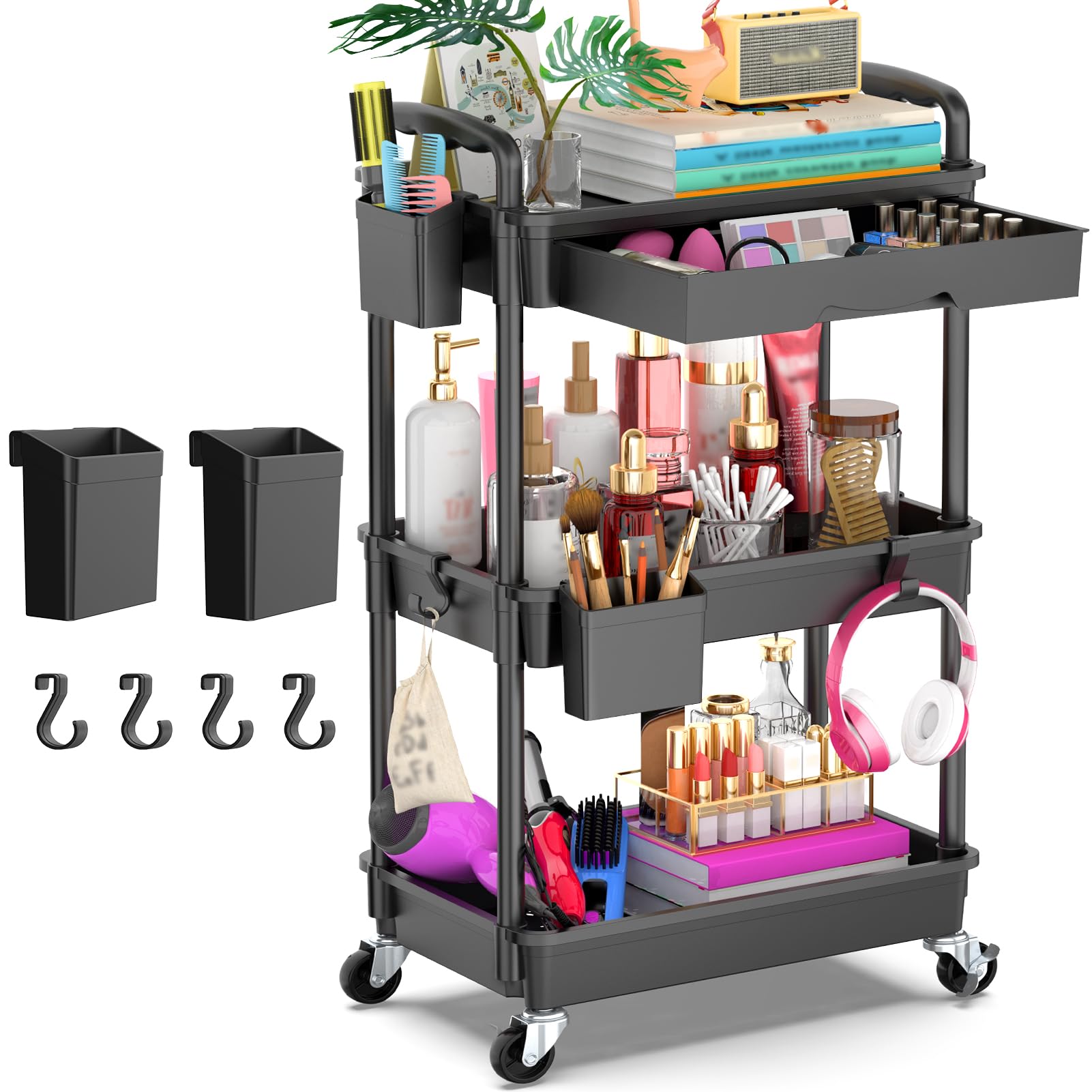
Goovilla 3-Tier Cart with Drawer

Goovilla 3-Tier Cart with Drawer

9.1/10 Outstanding
  • Drawer: Removable top drawer
  • Extras: 2 cups, 4 hooks
  • Capacity: 124 lb, 24 lb top shelf
  • Material: Plastic
Check Price on Amazon

Pros

  • Lift-out drawer works as a tray
  • Snaps together with no tools
  • Two locking casters
  • Least expensive cart in this group

Cons

  • Plastic frame flexes under a full load

The drawer lifts right out of the top tier. We did not expect to care and then used it constantly: carry it to the table, wipe it out, drop it back, and the cart keeps working while it is gone. That one removal turns a shelf into a tray.

It is plastic and it snaps together without tools, no screwdriver and no hex key, which is why it is the one to hand a teenager heading to a dorm or to stand in a bathroom where nothing should be drilled. Two of the four casters lock, and there are four hooks and two hanging cups on the side.

The caveats come from the material and the scale. It arrives smaller than the photos suggest, so plan on bottles, boxes and shampoo rather than a microwave, and the top tier takes 24 pounds against 50 on the lower two. For a dorm, a bathroom or a craft corner, that is exactly the right size and the right amount of cart.

Bottom Line: We recommend it for a dorm, bathroom or craft corner where the load is light and the cart moves daily; the lift-out drawer earns its keep.

How We Tested 12 Kitchen Carts

We started with more than 60 carts from major furniture and kitchen retailers, then narrowed the list to 12 based on dimensions, counter height, weight capacity, material, and price. We ruled out carts with vague weight limits or hardware that reviewers repeatedly called flimsy.

Assembly was the first test. One person built each cart with the included tools and a screwdriver, timing the process and noting missing pilot holes, unclear diagrams, or steps that needed a second set of hands. After assembly, we loaded the bottom shelf with 40 pounds of canned goods and the top with a stand mixer and a cutting board, then chopped a pile of carrots to see if the cart rocked or slid. We rolled each one across tile, over a threshold, and down a hallway, checking the casters and how well it steered when full.

Size and appearance came next. We measured the footprint and work surface height against standard counter height, then checked whether each cart fit through a 30-inch doorway and under a windowsill. Every week we wiped the top with a damp cloth and a mild cleaner, watching for water rings, scratches, and edge wear. We also checked joints and shelves after months of use, looking for wobble, loose hardware, or sagging.

At the end, we compared what each cart delivered for its price: hardware quality, finish, usable shelf space, and whether it still felt solid after eight months. The highest scorers were not always the most expensive, but they needed no retightening, no touch-up paint, and no apology when a guest leaned on them.

How to Choose Kitchen Carts

Measure the gap, then the height

The width on a product page is usually the shelf, not the cart. Handles, casters and a push bar all add inches, and a cart that misses by half an inch is a cart you will be hauling back to a drop-off point. Measure the gap you have in mind, leave two inches of slack so you can reach behind the cart, and check the route it has to travel to get there.

Then put height against your counter. A standard counter is 36 inches, the Amazon Basics cart sits at 36.7 and the Seville at exactly 36, so either one extends your work surface. The carts around 31 to 33 inches are storage first and work surface second, which is fine as long as that is what you wanted.

Pick the top for the job you will actually do

Wood, stainless, wire and plastic answer different questions. A wood top, like the 1.5-inch slab on our top pick, is a landing zone: warm, forgiving, good for a coffee station or a bowl of ingredients, less good under a wet cutting board. Stainless, as on the Seville, is the one you can chop on, set a hot pan on and wipe down in ten seconds.

Wire shelves ventilate and hold appliances, but nothing sits level on them, so plan on liners or shallow bins for small items. Plastic is light, cheap and for light loads only. If you will genuinely stand and work at the cart, buy the surface first and let everything else follow.

Read capacity as two numbers

Total capacity and per-shelf capacity answer different questions. A 175-pound cart rated at 50 pounds per shelf takes a microwave on top and groceries below; a 500-pound commercial cart is built for appliances, stock or tools. Match the figure to what you are storing rather than buying the biggest number you can find.

Treat the rating as a ceiling, not a target, and remember the cart has to be pushed with that weight on it. A cart loaded to its limit rolls like a loaded cart, and the frame joints are what notice.

Wheels decide whether you use it

Two-inch casters are fine on tile and hardwood and catch on thresholds and thick carpet; four-inch industrial wheels, as on the Finnhomy, roll over a mat without stopping. Check that at least two casters lock, because a cart that wanders while you are working at it is worse than no cart.

The wheel mount, not the wheel, is the part that fails on inexpensive carts. Keep loads inside the rating and stop dragging a loaded cart sideways over a lip, which is how mounts let go.

Open shelves or a door

Open tiers let you see and grab; a cupboard and drawer, as on the Yaheetech, let you stop looking at your own clutter. For the same footprint you get less usable volume behind a door, so a closed cart suits a kitchen where the mess is on show and an open one suits a pantry corner where the contents are the point.

One practical note: whatever you cannot see, you will forget. If the cart is holding food, open wire or mesh beats a closed cupboard for knowing what needs using up.

Frequently Asked Questions

Final Verdict

For most kitchens the Amazon Basics cart is the one to buy. A wood top at counter height, shelves that adjust in one-inch steps and an assembly that needs no tools make it the easiest cart here to live with, and it holds everything a small kitchen actually needs off the counter.

If you will stand and work at the thing, spend up for the Seville and its stainless top. And if the cart has to disappear between jobs, the WORKPRO folds to six inches and asks nothing of your floor.