Living Room

Best Entertainment Centers of 2026

An entertainment center has one job—hold the TV, the console, the soundbar, and whatever else lives under the screen—but the wrong one makes that job feel like a constant negotiation. You want a piece that keeps cables out of sight, puts the screen at a comfortable height, and stays solid when the room fills up. Over the past eight months, we assembled and lived with 10 different entertainment centers, from compact consoles to full-wall units, and the differences came down to how they went together, how they looked in a real room, and whether they stayed steady after the novelty wore off.

I've learned that the best entertainment centers are the ones you stop noticing—no wobbly shelf, no mystery screw left over, no finish that shows every fingerprint. The models that made our list got the basics right: clear instructions, hardware that didn't strip, shelves that held weight without bowing, and enough size and color options to fit a real room rather than a showroom. A few even included electric fireplaces, which we judged on actual heat output, not just the glow. The picks below are the ones we'd happily assemble again.

#1

Best Overall

VASAGLE 58-Inch TV Stand

VASAGLE 58-Inch TV Stand

9.1/10 Outstanding
  • Weight: 50.4 lb
  • Materials: Particleboard, MDF, rubber wood
  • Dimensions: 58"L x 15.7"W x 21.7"H
  • Fits TVs Up To: 65 inches
Check Price on Amazon

Pros

  • Sliding doors need no swing clearance
  • Fits a 65-inch TV on a 58-inch top
  • Rubber wood legs under a walnut-finish cabinet
  • One-person assembly with labeled hardware

Cons

  • 21.7-inch top sits low for bed viewing

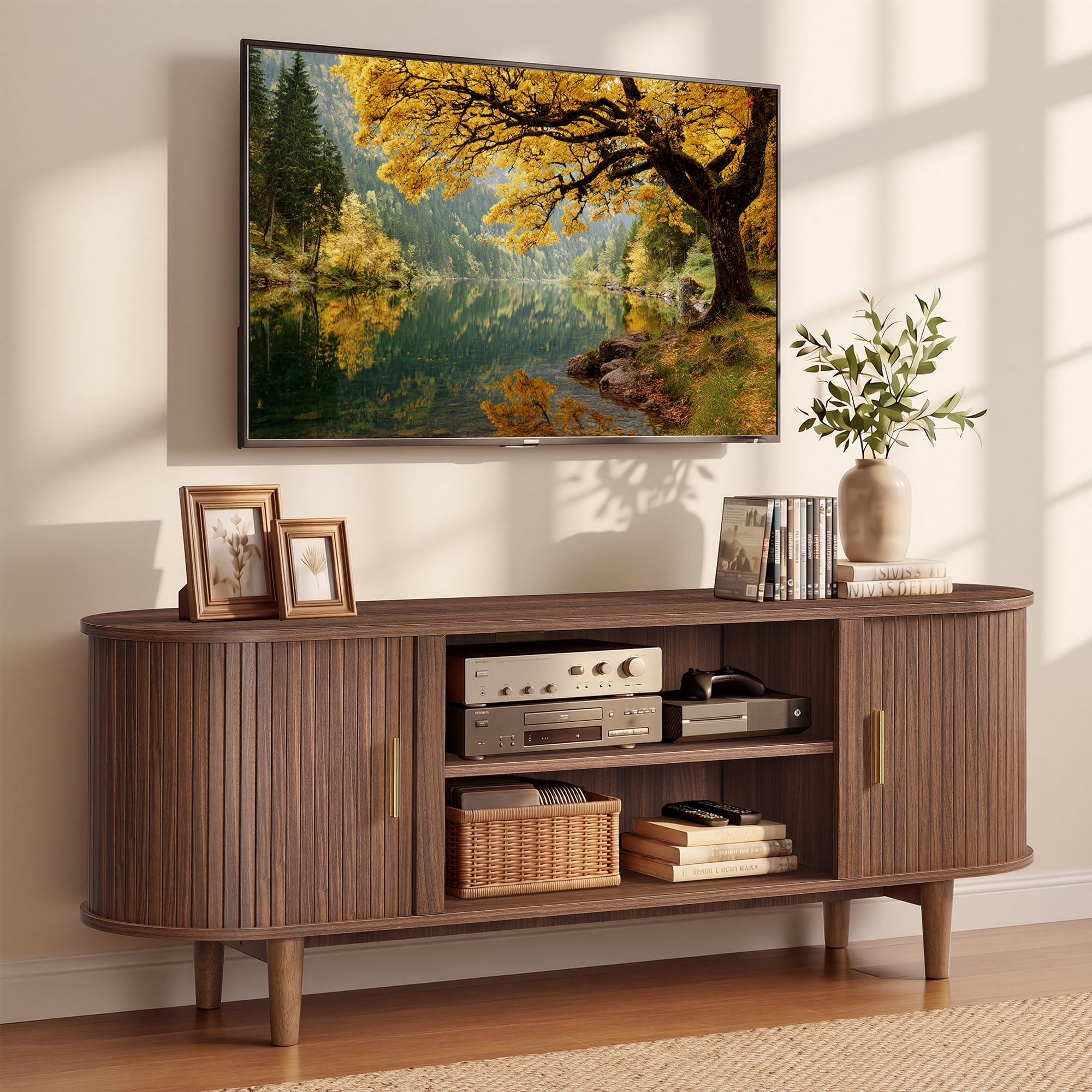
Sliding doors are what sold us. Two curved, slatted panels run on tracks across the front, so a cable box and a nest of controllers disappear without a door swinging out into the room. That matters more than it sounds: a hinged cabinet at this size wants about a foot and a half of clear floor in front of it, and most living rooms don't have it to spare. This one asks for nothing.

The top is 58 inches by 15.7, rated for televisions up to 65 inches. A 65-inch set measures roughly 57 inches across, so it sits with the screen edges almost flush with the cabinet's — clean, and tight enough that you won't want to balance anything else up there. Depth is the more generous number: 15.7 inches leaves room to park a soundbar in front of the screen without pushing the console far off the wall.

Underneath, rubber wood legs carry an MDF and particleboard cabinet in chestnut walnut, which is why it weighs 50.4 pounds instead of 130. Assembly is genuinely a one-person job — labeled hardware, a clear booklet, and panels light enough to hold square with one hand while you drive a screw with the other.

The one measurement to check before you commit is height: 21.7 inches to the top of the cabinet. In front of a low sofa that lands the screen about right; at the foot of a tall bed you'll spend the evening looking down at it. And because the doors are slatted rather than solid, a shadow of what's behind them shows in bright light, so treat this as a console for hiding clutter rather than displaying gear.

Bottom Line: We recommend the VASAGLE for most living rooms: a 58-inch walnut console whose sliding doors hide clutter, with room for a 65-inch TV and no swing clearance to plan for.
#2

Best for Large TVs

OKD 70-Inch TV Stand

OKD 70-Inch TV Stand

9.2/10 Outstanding
  • Weight: 138 lb
  • Dimensions: 70 x 16 x 34 inches
  • Top Support: 300 lb
  • Fits TVs Up To: 80 inches
Check Price on Amazon

Pros

  • 70-inch top rated for 300 pounds
  • Soft-close side cabinets hide clutter
  • 36-inch open center bay for a receiver
  • Four built-in cable holes behind

Cons

  • 138 pounds, so plan a two-person build

A foot wider than our top pick and close to ninety pounds heavier, the OKD is the stand you look at when the television is 75 inches or bigger. The top runs 70 inches across and is rated for 300 pounds — more than any screen you'll sit on it plus a center-channel speaker, with margin left over.

What we appreciated is how the storage divides. Soft-close cabinets tuck into each end, and the middle is a 36-inch open bay split into two tiers — that's where a receiver or a console belongs, because it's the part with air moving through it, while the doors take the routers, remotes and cables you'd rather not look at. Four cable holes sit behind the shelves, so wires drop down the wall instead of looping around a leg.

A 3.5-inch plinth base rather than legs makes it feel built in: no wobble, no dust line under the cabinet, and no room to slide a vacuum underneath. At 34 inches tall it holds the screen higher than most of the picks here, which suits a room with a high couch or a bed at the other end. Give the build an evening and a second person — the directions are the weakest part of the package, and there is a lot of engineered wood to walk around.

Bottom Line: For a 75- or 80-inch screen, we point you to the OKD: a 70-inch top rated for 300 pounds, soft-close side cabinets, and four cable holes in a plinth-based piece.
#3

Best for a Soundbar

IFGET 70-Inch Farmhouse Stand

IFGET 70-Inch Farmhouse Stand

9.0/10 Outstanding
  • Weight: 177.4 lb
  • Dimensions: 17.75"D x 70"W x 37.4"H
  • Fits TVs Up To: 80 inches
  • Soundbar Shelf: 6"H x 65.3"L x 15.31"D
Check Price on Amazon

Pros

  • Dedicated 65.3-inch soundbar bay
  • 37.4-inch height lifts the screen
  • Two sliding barn doors, eight compartments
  • Handles televisions up to 80 inches

Cons

  • Ships in two boxes that can arrive separately
  • Painted finish marks at bumped corners

At 37.4 inches to the top, this is the tallest stand in the guide, and that single number is the argument for it. In a bedroom where you watch from a high bed, or a room with a counter behind the couch, a 22-inch console leaves you looking down at the screen all evening. This one puts the middle of a 75-inch picture closer to eye level.

The second argument is the shelf under the top: 65.3 inches wide, 6 inches tall and 15.31 deep, built for a soundbar so the bar sits in its own slot instead of being propped on the television's feet. Two sliding barn doors cover eight compartments, and the hardware arrives in individually coded bags — the difference between a two-hour build and a two-evening one.

Two practical warnings. It ships as two packages that can turn up days apart, so don't schedule the build for the day the first box lands, and at 177.4 pounds it wants two people and a clear floor. The painted finish on engineered wood also marks at bumped corners, and an edge scuffed during assembly stays scuffed. What you get in return is the only stand here with a dedicated soundbar bay, a big-screen top and a genuinely high viewing position at once; a compact bar will look a little lonely in a slot that wide.

Bottom Line: We think the IFGET is the answer for a high bed and a soundbar: 37.4 inches to the top, a 65.3-inch bay underneath, and sliding doors that need no clearance.
#4

Best for Storage

Huuger 11-Drawer TV Stand

Huuger 11-Drawer TV Stand

8.8/10 Excellent
  • Drawers: 11
  • Outlets: 4 AC, 2 USB, 1 USB-C
  • Dimensions: 13"D x 70.9"W x 26.8"H
  • Fits TVs Up To: 80 inches
Check Price on Amazon

Pros

  • Eleven drawers in three sizes
  • 4 AC outlets plus USB and USB-C
  • 70.9-inch top handles 80-inch TVs
  • Adjustable feet keep it level

Cons

  • Fabric drawers sag under heavy gear
  • 13-inch depth leaves no room for receivers

Some rooms have to be two rooms. A bedroom with a television in it, a rental where the dresser and the media console are the same piece of furniture, a teenager's room that needs clothes storage more than it needs a cabinet. The Huuger is built for that overlap.

Eleven drawers in three sizes run the length of a 70.9-inch frame, and the top is wide enough for an 80-inch television. Along one side sits a power panel — four AC outlets, two USB and a USB-C — so the TV, a lamp and a phone charger all plug into the furniture instead of a strip on the floor. LED lighting under the top edge handles the mood, and adjustable feet handle the floor in an old building.

It is not a media cabinet in the traditional sense. Front to back it measures 13 inches, so a receiver or a full-size console won't sit inside it, and the drawers are fabric — right for clothes, blankets, controllers and cables, wrong for anything heavy. That's the trade for the capacity.

Where it earns its place is storage for the money: nothing else here hides this much, and the outlet panel is the detail that makes a bedroom work. The middle drawers are shallow enough for one layer of folded sweaters, which tells you what to expect from the rest — think T-shirts and controllers rather than bedding.

Bottom Line: We like the Huuger for bedrooms doing double duty: eleven drawers, built-in outlets, and a top wide enough for an 80-inch screen.
#5

Best for Small Rooms

Huuger 6-Drawer TV Stand

Huuger 6-Drawer TV Stand

8.8/10 Excellent
  • Drawers: 6 fabric
  • Outlets: 2 AC, 2 USB, 1 USB-C
  • Dimensions: 11"D x 50"W x 25"H
  • Fits TVs Up To: 55 inches
Check Price on Amazon

Pros

  • Six drawers in a 50-inch footprint
  • Outlets on the left or right side
  • Anti-tip device included
  • Builds in about an hour

Cons

  • 11-inch depth leaves no room for AV gear
  • Fabric drawers suit clothes, not hardware

Small is the point, and it's worth being blunt about how small: a 50-inch top, 11 inches deep, 25 inches high. That's a guest room, a teenager's bedroom or the corner of a studio, not the main wall of a house. For those rooms it's smart — six fabric drawers for clothes and blankets, and a 55-inch TV sits on top with barely an inch spare at each end.

The power panel is on the side, left or right depending on how you build it: two AC outlets, two USB and a USB-C, enough to retire the power strip behind the nightstand. The LED strip runs through thousands of colors from a controller or an app, and an anti-tip device comes in the box. Build time is about an hour, and one person can manage it.

Two things to accept. The depth is the real limit — 11 inches means a soundbar either overhangs the front edge or lives somewhere else — and the light strip is decoration rather than lighting: it washes the wall behind the drawers instead of brightening the room. In a dark bedroom that's a nice effect; in a bright one you'll forget it's there.

Bottom Line: We hand the small rooms to the Huuger 6-Drawer: side-mounted outlets, an anti-tip device, and a 50-inch top that takes a 55-inch TV without eating floor space.
#6

Best with a Fireplace

VITESSE 70-Inch Fireplace Stand

VITESSE 70-Inch Fireplace Stand

8.8/10 Excellent
  • Weight: 96 lb
  • Heat Output: 1500 watts
  • Fits TVs Up To: 80 inches
  • Heating Coverage: 400 sq ft
Check Price on Amazon

Pros

  • 70-inch top for TVs up to 80 inches
  • 1500-watt heater rated for 400 square feet
  • Flames run with or without heat
  • Two cabinets plus open side storage

Cons

  • Heating element can quit; test it early
  • Two packages may arrive separately

A 1500-watt heater is a space heater, and that's the honest way to read this console. The firebox is rated for 400 square feet, which is a den, a bedroom or the cold end of an open plan — not much more. What it buys you is atmosphere with a practical bonus: flames you can run with or without heat, in 20 colors and five brightness levels, so the effect is still there in July.

As a TV stand the numbers are serious: a 70-inch top rated for screens up to 80 inches, two cabinets plus open storage on both sides of the firebox, and 96 pounds of engineered wood that stays put when someone leans on it. The firebox sits low and centered, so a large screen rides above a wide band of flame — the proportion is what makes it look deliberate rather than bolted on.

Two things to plan around. Test the heater inside the return window; an afternoon on high tells you whether it's warming the room or just running, and a firebox that quits leaves you with a plain console. And like the IFGET, it ships as two packages that can land on different days, so don't book the build until both boxes are in the hallway.

Bottom Line: We chose the VITESSE when the room wants a fireplace: 1500 watts of supplemental heat, a 70-inch top for big screens, and flames you can run without the heat.
#7

Best Budget

Furologee 55-Inch TV Stand

Furologee 55-Inch TV Stand

8.7/10 Excellent
  • Shelving: 2 open mesh shelves, 4 hooks
  • Dimensions: 11.8"D x 55"W x 21.8"H
  • Fits TVs Up To: 55 inches
  • Top Weight Limit: 160 lb
Check Price on Amazon

Pros

  • The least expensive stand here
  • Open mesh shelves let consoles vent
  • Under 20 pounds, one person can move it
  • Four hooks and open cable access

Cons

  • 21.8-inch height sits low for beds
  • Open shelves leave cables on show

The least expensive stand here, and the most honest about it: a metal frame, a particleboard top, two open mesh shelves and four hooks. There's no cabinet, no drawer, no slatted door — and in a dorm, a game room or a first apartment, that's often the right set of sacrifices.

What the open design buys is air and access. A console that vents out the back sits on a mesh shelf with nothing around it, and cables drop straight through instead of being threaded behind a panel. The top is 55 inches by 11.8, rated for 55-inch televisions and 160 pounds, and the whole thing weighs under 20, so one person can carry it upstairs and build it before dinner. The four hooks are the detail we noticed first — hang a headset and a controller and the shelf stops looking like a wire rack.

Where it runs out is height: 21.8 inches to the top is low, fine in front of a couch, wrong at the foot of a bed. And with no doors, everything is on show — the boxes, the cables, the spare controller. That's a fair trade for the money, as long as you buy two baskets the same week you build it; open shelving only looks deliberate when the cables are tied.

Bottom Line: We keep the Furologee on the list for dorms and game rooms: open mesh shelves that vent a console, a 55-inch top, and under 20 pounds to carry upstairs.
#8

White farmhouse rooms

Casaottima 59-Inch TV Stand

Casaottima 59-Inch TV Stand

8.8/10 Excellent
  • Extras: Power outlet, LED strip light
  • Storage: 2 cabinets, 4 open compartments
  • Dimensions: 59.1 x 13.8 x 25.6 inches
  • Fits TVs Up To: 65 inches
Check Price on Amazon

Pros

  • Built-in outlet with cable cutouts
  • LED strip lights the shelves
  • 59-inch top for 65-inch TVs
  • One-inch thick top resists warping

Cons

  • 13.8-inch depth crowds deep receivers

An outlet is built into the back of this console, with cable cutouts beside it, so the TV, the soundbar and a charging cable all plug in behind the furniture rather than into a strip on the floor. It's a small thing that changes how the wall looks.

The LED strip is the other half of the pitch. It runs along the shelves, so at night the compartments glow instead of disappearing into shadow, and the effect reads as lit shelving rather than a lamp in the room.

Behind the light there's a proper cabinet: 59.1 inches wide, 25.6 tall, two closed compartments and four open ones with an adjustable center shelf, under a one-inch top sized for a 65-inch TV. It weighs 54.5 pounds and builds from illustrated instructions with numbered parts — a job for one person with an evening to spare.

Depth is where it asks you to compromise: 13.8 inches front to back means a deep receiver or a big console will sit proud of the front edge, and the open compartments are shaped for slim gear. Measure your deepest component first — if it runs past about a foot, this is the wrong cabinet and the OKD is the right one.

Bottom Line: The Casaottima is our white-farmhouse pick with the wiring sorted: a built-in outlet, cable cutouts, and an LED strip that lights the shelves after dark.

How We Tested the Best Entertainment Centers

We started with a shortlist of about 30 models from brands known for flat-pack furniture and media consoles, then filtered by size, price, available finishes, and whether the specs could hold a TV at least 55 inches. That left us with 10 units, which we assembled, loaded, and lived with for eight months in living rooms, apartments, and a family room with a 65-inch TV and two game consoles.

Assembly was the first test: we timed how long each unit took one person to build, noted whether the instructions matched the labeled parts, and flagged any hardware that stripped or cams that slipped. We weighed every box before assembly and again once loaded, because a unit that's too heavy to move solo is a problem when you rearrange. Quality showed up in the details—drawer glides, shelf pins, edge banding—and we checked finishes under daylight and lamplight to see how they handled fingerprints and dust.

Once built, we loaded each shelf with actual media gear, slid the unit across a wood floor, and nudged it to see if it wobbled. We measured the footprint against a typical apartment wall, checked sightlines at seated eye level, and tested whether the back panel had enough room for cables and venting. For models with an electric fireplace, we ran it for an hour with a thermometer nearby to see if it actually warmed the room or just looked cozy. Durability came down to daily use—opening drawers, wiping spills, and watching for sagging shelves after a few months.

Value wasn't about the lowest price; it was whether the materials, hardware, and finish felt worth the money after eight months of use. We also compared color swatches to the real finish, since a "walnut" online can arrive looking orange. The units that scored highest were the ones we'd buy for our own homes—and the ones we'd warn a friend about.

How to Choose Entertainment Centers

Match the top to the screen, then the depth to the soundbar

A 55-inch television is roughly 48 inches across, a 65-inch about 57, a 75-inch about 65. That means a 58-inch console takes a 65-inch set with almost no margin — clean, but unforgiving — while a 70-inch top gives a 75-inch screen proper breathing room. Leave an inch or two on each side if you want the TV to look seated rather than balanced.

Depth decides what else fits. Fifteen to 16 inches, as on the VASAGLE or the OKD, leaves room to park a soundbar in front of the screen. At 13.8 inches on the Casaottima or 11 inches on the Huuger dresser stands, the bar either overhangs the front edge or lives somewhere else entirely.

Height is the spec most buyers get wrong

Seated on a sofa, your eyes sit around 40 to 42 inches above the floor, and you want the middle of the screen near that line. A 22-inch console with a 65-inch TV puts the center of the picture around 39 inches — close to right. The same TV on a 37-inch stand lands the center near 54, which is why tall units like the IFGET suit bedrooms and high beds rather than a low couch.

Sit where you actually watch, measure from the floor to your eyes, then do the arithmetic before you order. It takes a minute and settles more arguments than a finish sample will.

Choose storage by what you need to hide, and vent what needs to stay cool

Cabinets hide clutter, open shelves let hardware breathe, drawers hold clothes. A game console pulls air in the front and pushes heat out the back, so an open bay — the OKD's 36-inch center or the Furologee's mesh shelves — runs cooler than a closed cabinet, though a cabinet with cutouts in the back works too. Fabric drawers, as on both Huugers, are for clothes, blankets and controllers; a receiver will sag them.

Count the boxes you need to house, add one for whatever you buy next, and shop for that many compartments. It's the difference between a stand that stays tidy and one with a router balanced on the top.

Sliding doors are a floor-space decision

A hinged door on a 58-inch cabinet needs roughly a foot and a half of clear floor to swing open. A sliding door needs none. In a narrow living room, next to a doorway, or with a coffee table parked close, that difference decides the whole layout — and it's why the sliding picks here earn their places.

The trade is the track. Sliding panels run on rails that collect dust and bind if the cabinet isn't level, so take the time to square the unit while you build it. On the slatted VASAGLE the door is a screen rather than a solid panel, and a hint of what's inside shows through in bright light.

Budget for the build, not just the box

Everything in this category arrives flat. Assembly is where flat-pack furniture usually goes wrong, and anything past about 70 pounds wants two people and an evening, whatever the instructions promise. Open the boxes and check every panel before you turn a screw — chipped corners and cracked edges are the most common damage here, and it's far easier to sort out before the piece is half-built.

Keep the packaging until the stand is standing and the TV is on it.

Frequently Asked Questions

Final Verdict

For most living rooms, the VASAGLE 58-inch mid-century console is the entertainment center we point to: sliding doors that need no swing room, a top that takes a 65-inch set, and a walnut finish that carries a room without shouting. Step up to the OKD if the screen is 75 inches or bigger, and to the IFGET if a soundbar needs its own bay and the TV sits high.

When the budget is the constraint, the Furologee does the structural job for a fraction of the money — open shelves, a 55-inch top, and under 20 pounds to move. Start there, and spend more only when a specific requirement, whether screen size, storage, or a fireplace, demands it.