Living Room

Best TV Stands for a 75-Inch TV of 2026

A 75-inch TV is basically a small billboard, and the stand under it has to do more than look nice — it has to convince you it won't tip over when the dog bumps it. I've seen too many good-looking consoles feel shaky under the weight, or arrive with a top surface so shallow the TV's feet hang off the edge. The right stand fixes both: it gives that screen a footprint wide enough to feel secure, hides the cable nest behind a door, and looks like furniture instead of a tech accessory.

Over eight months, my team and I assembled, loaded, and lived with 12 stands built for screens this size. We judged them the way you would: how long assembly took on a Tuesday night, whether the finish held up after months of dusting, and if the whole thing still felt solid after we stacked it with weight equal to the TV plus a soundbar. The best ones nailed sturdiness, looks, and value — and kept the cables out of sight. Here's what earned a spot.

#1

Best Overall

HOOBRO 70.9-Inch TV Stand

HOOBRO 70.9-Inch TV Stand

9.0/10 Outstanding
  • Height: 20.5 inches
  • Outlets: 4
  • Top Width: 70.9 inches
  • Weight Capacity: 130 lb
Check Price on Amazon

Pros

  • Widest top here at 70.9 inches
  • Four outlets built into the frame
  • Three tiers hold a soundbar and consoles
  • Clear enough for one person to build

Cons

  • Open shelves leave gear and cables on show

Four outlets are built into the back of this stand, right where the TV, the console, and the soundbar cables already converge, and that one decision removes the power strip that otherwise ends up on the floor behind everything. Below the top there are three tiers: a middle shelf sized for a media player and a bottom shelf deep enough for a receiver or a row of game cases. Matte black steel frame, rustic brown shelves, open on all sides.

Seventy-point-nine inches is as wide as anything in this group, and width is what a 75-inch TV actually asks for. The panel is about 65 inches across, so it sits with a couple of inches of breathing room on each side — the margin that makes a big screen look placed rather than balanced. We had no concerns about the 130-pound rating either, since a 75-inch set on its feet lands somewhere around half that.

Height and concealment are the trade. At 20.5 inches this is the lowest stand here, which puts the bottom of a big screen close to the floor: lovely from a low sofa, less so if you watch from tall chairs. And with open shelves, the console, the remotes, and every cable stay on display. Assembly is the easy part — labeled parts, clear steps, and one person can manage it.

Bottom Line: We recommend the HOOBRO to most people with a 75-inch TV: the widest top in this group, four outlets where the cables gather, and a steel frame that stays steady.
#2

Best Furniture-Grade Look

OKD Modern 70-Inch TV Stand

OKD Modern 70-Inch TV Stand

9.2/10 Outstanding
  • Cabinets: 2 hidden, soft-close
  • Top Width: 70 inches
  • Cable Holes: 4
  • Weight Capacity: 300 lb
Check Price on Amazon

Pros

  • 300-pound top rating with room to spare
  • Thick panels with a convincing woodgrain
  • Hidden cabinets plus a two-tier open bay
  • Plinth base, no wobbling legs

Cons

  • Heaviest stand here at 138 pounds
  • Picture-only directions leave room for error

At 138 pounds, the OKD is the heaviest stand we moved, and the weight explains most of what's good here: thick engineered-wood panels, a one-piece plinth base instead of four legs, and a top rated for 300 pounds. Next to the flat-pack competition it's the piece that reads as furniture from across the room, with a woodgrain you can see and cabinet doors that close softly instead of clacking.

Storage splits between two hidden side cabinets and an open center bay divided into two tiers, so a console can breathe while the discs and spare remotes disappear. Four cable holes in the back keep the wires organized, and the 70-by-16-inch top gives a 75-inch panel comfortable room with its edges inside the stand's footprint rather than hanging over it.

Assembly is the one part of ownership that isn't relaxing. The directions are picture-only and thin in places, the panels are heavy enough that a second pair of hands helps with the flip, and this is not a piece you want to build in one room and carry to another. Build it where it's staying, then load it. What you're paying for is panels and finish rather than features, which is the right trade if the stand is the centerpiece of the room.

Bottom Line: Our pick for anyone who wants the stand to look like furniture: heavy panels, soft-close cabinets, and a 300-pound top that won't flinch under a 75-inch set.
#3

Best Mid-Century Style

VASAGLE 70-Inch Mid-Century Stand

VASAGLE 70-Inch Mid-Century Stand

9.1/10 Outstanding
  • Depth: 15.7 inches
  • Doors: 2 sliding, fluted
  • Height: 21.7 inches
  • Top Width: 70 inches
Check Price on Amazon

Pros

  • Fluted sliding doors need no swing clearance
  • Open center keeps the console reachable
  • Solid rubberwood legs, not a steel frame
  • Straightforward solo assembly

Cons

  • Panels can arrive chipped or cracked
  • Engineered-wood top needs an eye on the middle

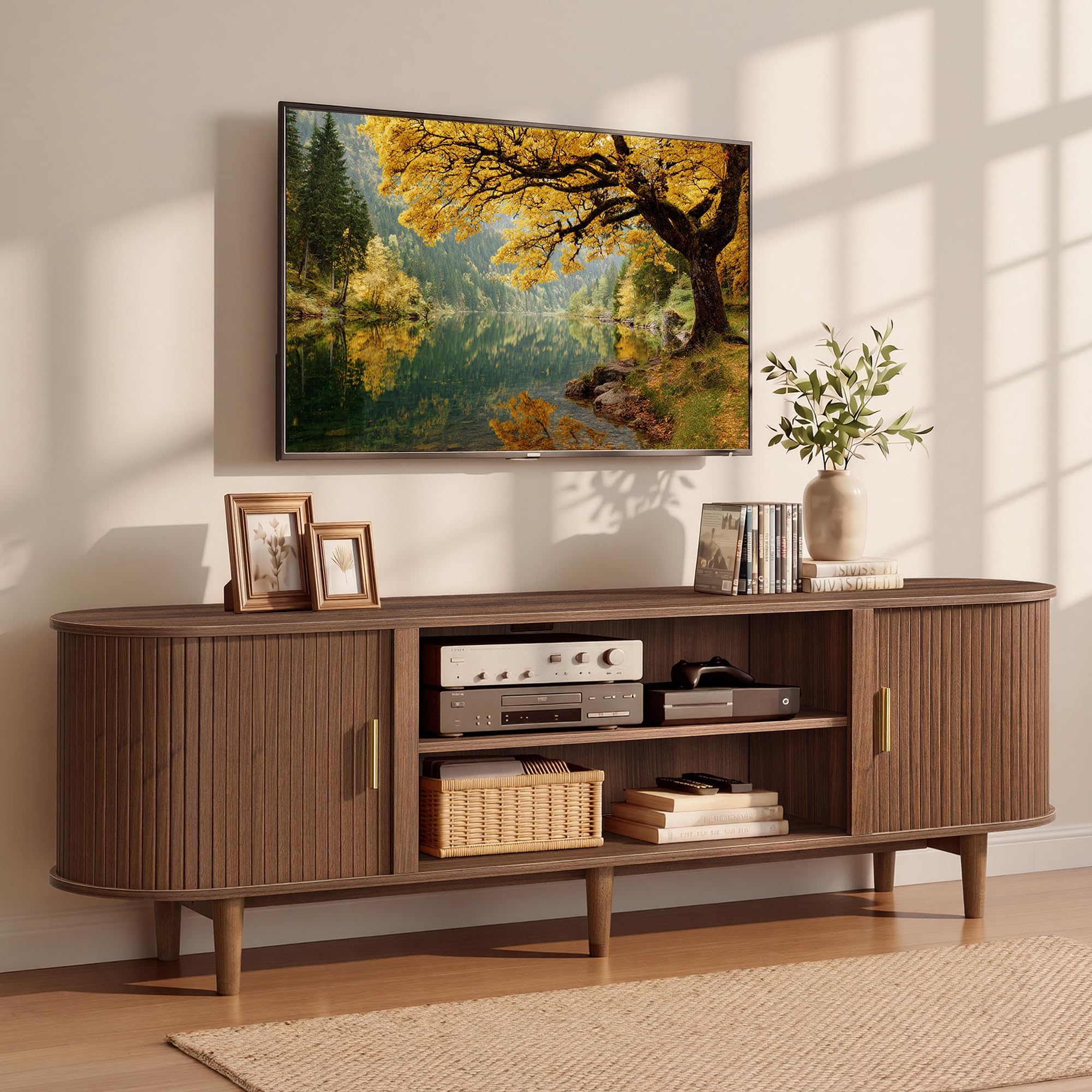
Two curved sliding doors with a fluted front are the reason to look at this one. They slide rather than swing, so the stand needs no clearance in front of it — handy beside a doorway or in a narrow room — and the center stays open for the cable box and the console you actually touch. Clutter goes behind the slats; the gear you use stays out.

The proportions suit a big panel: 70 inches wide, 15.7 deep, 21.7 high, with solid rubberwood legs giving it a softer, furniture-like stance than the steel frames here. Chestnut walnut is the finish, and it matches the pictures, which is not a given at this level.

Assembly is a genuine strength. Labeled parts, clear steps, and a build one person can finish. The weak spot is durability: panels do turn up chipped or cracked, so unbox onto a rug and inspect before you start, and keep an eye on the middle of the top once the TV is on it — the span is engineered wood, and the middle is where a heavy set will show it first.

Among these picks this is the one for a room where the furniture matters and the electronics are an afterthought. It hides more than the open-shelf stands, asks less than the furniture-grade ones, and the fluted front is a shape nothing else here offers.

Bottom Line: We point style-first buyers to the VASAGLE, whose fluted sliding doors hide the clutter without needing clearance, in a walnut finish that matches the photos.
#4

Highest Weight Capacity

LINSY HOME 66-Inch Farmhouse Stand

LINSY HOME 66-Inch Farmhouse Stand

9.0/10 Outstanding
  • Shelves: 3, height adjustable
  • Cabinets: 2 with glass doors
  • Top Width: 66 inches
  • Weight Capacity: 360 lb
Check Price on Amazon

Pros

  • Highest top rating here at 360 pounds
  • Glass doors with height-adjustable shelves
  • Cable cutouts in both cabinets
  • Sealed surface wipes clean

Cons

  • 66-inch top leaves no margin for a 75-inch panel

Three hundred and sixty pounds is the highest top rating in this group, and it's worth putting in perspective: a 75-inch TV on its feet weighs a fraction of that, so the weight question is settled before you open the box. What the rating buys is calm — a wooden support base under the cabinets, glass doors that don't rattle, and a top that stays flat.

Inside, the shelves adjust for height, which matters when a tall router or a soundbar has to fit, and there are cable cutouts in the back of both cabinets. The surface is sealed, so a spilled drink wipes up instead of soaking in. Assembly is well labeled and manageable solo, with everything clearly marked.

Here's the catch, and it's about width: the top is 66 inches, narrower than a 75-inch panel, so the screen's edges sit flush with or just past the ends of the stand. Plenty of people like that tailored look, and the feet sit well inboard, so nothing is at risk. If you want visible margin on both sides, look at the wider picks; if the TV is going on the wall and the stand is carrying the gear, take the capacity and the glass.

Bottom Line: If your 75-inch TV hangs on the wall and the stand is there for the gear, we think the LINSY's 360-pound rating and glass doors make it the smart buy.
#5

Best with a Fireplace

oneinmil 70-Inch Fireplace Stand

oneinmil 70-Inch Fireplace Stand

8.9/10 Excellent
  • Fireplace: 36 inches
  • Top Width: 70 inches
  • Max TV Size: 80 inches
  • Flame Colors: 16
Check Price on Amazon

Pros

  • Sixteen flame colors plus accent lights
  • Heats roughly 400 square feet
  • Cabinets and cable holes keep gear tidy
  • Top takes TVs up to 80 inches

Cons

  • Heaters can quit months in
  • Flames look electronic up close

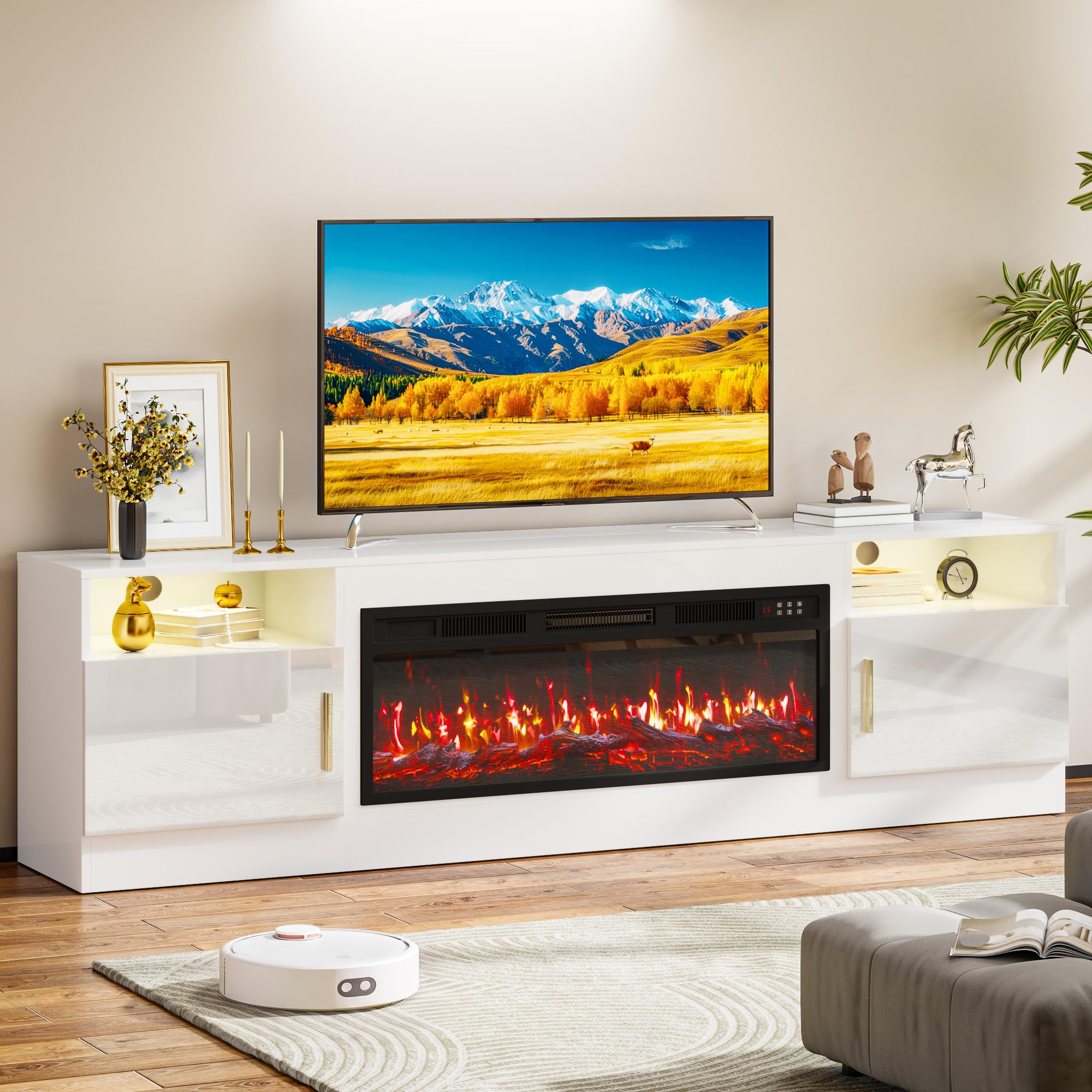
Sixteen flame colors, more in the lit cubbies at either end, and a 36-inch firebox in the middle: the oneinmil is less a TV stand with a heater than a lighting feature that happens to hold a television. After dark it does more for a room than a lamp does, and the flame is the part you'll show people.

Under the glow it's a competent 70-inch console: 13.8 inches deep, 23 high, rated for sets up to 80 inches, with two closed cabinets and cable holes that keep the wires out of the light. The fireplace is rated for 400 square feet and it earns that in a small room, taking the chill off a den or bedroom quickly. Up close the flames read as electronic rather than real, which is the trade for a plug-in fire.

The heater is the piece to watch. It works and it throws genuine warmth, but that's where the trouble clusters: heaters that quit months in while the lights and the flame carry on. We treat the heat as a bonus rather than the reason to buy, and we run a full heat cycle in the first week while a return is still easy.

Bottom Line: Buy the oneinmil for the room it makes after dark — sixteen flame colors, accent lighting, and heat for a small space — and treat the heater as the bonus.
#6

Best for a Bright Room

LEMBERI 70-Inch Fireplace Stand

LEMBERI 70-Inch Fireplace Stand

9.0/10 Outstanding
  • Fireplace: 36 inches
  • Top Width: 70 inches
  • Heat Output: 1500 watts
  • Weight Capacity: 300 lb
Check Price on Amazon

Pros

  • High-gloss white wipes clean
  • 300-pound top for TVs up to 80 inches
  • Fireplace heats around 400 square feet
  • Cabinets hide the gear

Cons

  • Panels can arrive missing holes or with loose dowels
  • Remote ships without AAA batteries

White, high-gloss, and 70 inches wide, the LEMBERI is built for light rooms that don't have a fireplace. The 36-inch firebox is the draw, and the glossy cabinet doors wipe clean in one pass — a real advantage over the woodgrain finishes here if you have small children or a shedding dog. The top is rated for 300 pounds and takes sets up to 80 inches.

Depth is the catch with the fireplace format: 13.8 inches, which is fine for a modern set's feet but leaves little shelf in front for a soundbar. Assembly asks for patience — the directions run thin in places, the parts are labeled but not always obvious, and a second person plus a power driver make it far less tedious. The remote needs AAA batteries, which aren't in the box.

Build quality is the compromise. Panels can arrive without the holes they need, dowels that don't seat, doors that need a second try to line up. None of that stops the stand from holding a TV — the 300-pound top is real — but it's the reason this one sits behind the other fireplace stand here rather than ahead of it.

Bottom Line: For a bright room that wants a fire, the LEMBERI delivers the look: glossy white, real warmth, and a wide top, once you get through a fiddly build.
#7

Closed storage

Huuger 70.9-Inch Drawer Stand

Huuger 70.9-Inch Drawer Stand

8.8/10 Excellent
  • Depth: 13 inches
  • Drawers: 11
  • Charging: 4 AC, 2 USB, 1 USB-C
  • Top Width: 70.9 inches
Check Price on Amazon

Pros

  • Eleven drawers of closed storage
  • Four outlets plus USB and USB-C
  • Top as wide as any here at 70.9 inches
  • Adjustable feet for uneven floors

Cons

  • Fabric drawers run smaller than the photos imply
  • 13-inch depth is the shallowest here

Eleven drawers is the number that stops you, and it should: this is the only stand here that doubles as a dresser. The top runs 70.9 inches, level with the widest in the group, and there's a four-outlet strip at the back with two USB ports and a USB-C. LED lighting runs under the top edge, the surface is black PU leather over a metal frame, and adjustable feet take up a floor that isn't level.

The drawers are fabric boxes on that metal frame, in three sizes, and they do what fabric drawers do: they slide easily, stay light, and swallow more than you expect — game cases, controllers, cables, the things that otherwise colonize a shelf. They're also smaller than the photos imply, and the depth shows it: 13 inches front to back is the shallowest stand here, so measure the spread of your TV's feet before you commit.

Where it wins is a bedroom or a den where the screen shares a wall with everything else. At 26.8 inches the top lifts a TV above a bed, and all that storage disappears behind closed drawers. Where it loses is a living room, where the PU leather and the fabric boxes read as exactly what they are.

Bottom Line: When storage matters more than furniture looks, the Huuger is the one to beat here: eleven drawers, built-in charging, and a top as wide as any.
#8

Tight budgets

GYIIYUO 63-Inch TV Stand

GYIIYUO 63-Inch TV Stand

9.0/10 Outstanding
  • Depth: 14.57 inches
  • Drawers: 2 fabric
  • Top Width: 63 inches
  • Weight Capacity: 120 lb
Check Price on Amazon

Pros

  • Lowest price in this group
  • Clear instructions and included tools
  • Two drawers plus an open shelf
  • Finish looks better than the price

Cons

  • 63-inch top is narrower than a 75-inch TV
  • Fabric drawers, not wood

At the bottom of the price range sits a 63-inch console with two fabric drawers, one open shelf, and a rustic brown finish that photographs better than it has any right to. It's the lightest, smallest thing here, and it's the one to think hardest about — 63 inches is narrower than a 75-inch panel, so the TV will overhang both ends.

Assembly is the pleasant surprise. Clear instructions, labeled parts, tools in the box, and a build that comes together in an evening. The finish looks better in person than the price suggests, the open shelf swallows a soundbar and a couple of consoles, and the fabric drawers take remotes, cables, and the odds and ends that otherwise clutter the top.

The 120-pound rating is well beyond what a 75-inch set weighs, so strength isn't the issue. Width is. The feet sit inboard and the stand will hold the TV, but the screen hangs past both ends, and at 20.7 inches high the whole arrangement sits low.

That makes it a specific buy rather than a bad one: a wall-mounted 75 where the stand only carries the soundbar and the consoles, a smaller set in a guest room, or a first apartment where the budget decides. If the TV itself is going up top and it's 75 inches, spend a little more and get the width.

Bottom Line: We recommend the GYIIYUO when the TV is wall-mounted or smaller than 75 inches — the finish and the build beat the price, and the 63-inch top is the honest limit.

How We Tested 12 TV Stands Built for 75-Inch Screens

We started by narrowing the field to stands with a top surface at least 60 inches wide and a published weight capacity north of 100 pounds — a 75-inch TV can weigh 60 to 70 pounds before you add a soundbar. From there we filtered by material, shelf adjustability, and price, aiming for a mix of open shelving, closed consoles, and corner-friendly designs. Twelve made the cut.

Each stand was assembled by one person first, stopwatch running, to see how clear the instructions were and whether the hardware came sorted. We noted every time we re-read a step or hunted for a missing bolt, then rebuilt each one with two people to see if an extra set of hands actually helped. After assembly, we measured the top depth against the footprint of a 75-inch TV base and checked whether the TV's feet had room to sit fully on the surface.

Then came the weight test: we loaded each shelf with sandbags matching the TV's weight plus a soundbar and a stack of books, and left them for a week. We nudged the top corners to check for sway, bumped the sides the way a vacuum or a kid might, and slid the stands across hardwood and carpet to see if the feet scratched or caught. Over eight months we cleaned each finish weekly and looked for scratches, peeling veneer, or sagging shelves.

Finally, we lived with them — routing cables through the back panels, reaching for the remote, and seeing whether open shelves collected dust or hid it. The stands that scored highest were the ones where assembly didn't require a second trip to the hardware store, the top felt dead solid after loading, and the price felt fair for the materials.

How to Choose TV Stands for a 75-Inch TV

Start with the footprint, not the diagonal

A 75-inch TV is a marketing size. The panel itself runs about 65 inches across, and the feet sit inboard of that — how far inboard varies enough between models that it's worth measuring both the panel width and the outer edge of the feet before you shop. That's why a 63-inch stand can physically hold a 75-inch set and still look wrong: the screen hangs past both ends. Our rule is an inch or two of top on each side of the panel. The HOOBRO and the Huuger both run 70.9 inches; the LINSY at 66 is the tightest of the wide stands here.

What the weight rating does and doesn't tell you

A 75-inch set on its feet usually lands between 60 and 75 pounds, and every stand here is rated for at least 120, so the headline number is rarely the thing that fails. The OKD at 300 pounds and the LINSY at 360 buy margin you probably won't use. What does matter is the support underneath: a long engineered-wood top braced only at its ends can bow over months under a heavy panel. Look for a center brace, a plinth, or legs set inboard, and check the middle of the top a few weeks in.

Open shelves, glass doors, or drawers

Open shelving keeps consoles reachable and cool, and puts every cable on display while it does. Glass doors hide the mess without hiding the equipment, provided the back is vented or the doors stay cracked. Solid doors and fabric drawers hide everything, including heat — that's the trap. A game console sealed in a closed cabinet runs hotter and louder than one in an open bay, so if the console lives in the stand, give it open air and use the closed storage for discs, remotes, and the things nobody needs to see.

Height and depth decide how it feels in the room

Height is the spec most people skip. A 75-inch screen on a 20-inch stand puts its bottom edge near your knees; on a taller stand you look straight into the middle of the panel. Sit where you actually watch, and pick the height that puts your eyes around the middle third of the screen — a bedroom setup usually wants the taller dresser-style stand. Depth is the quieter constraint, running 13 to 16 inches across these picks, so measure the front-to-back spread of your TV's feet and leave room in front for a soundbar.

Do you want a fireplace in the middle of it?

A 36-inch electric firebox adds a focal point a plain console can't match, plus roughly 400 square feet of heat and, on the models here, sixteen flame colors you can dial from a remote. It also constrains depth: both fireplace stands are 13.8 inches, enough for a modern TV's feet but with little shelf left in front for a soundbar. Decide whether you're buying heat or atmosphere. For one room on a cold evening the heat is real; for a whole floor it's a supplement, not a furnace.

Frequently Asked Questions

Final Verdict

For most 75-inch TVs, the HOOBRO is the stand we point people to. It's as wide as anything here at 70.9 inches, it has four outlets right where the cables already gather, and a steel frame that doesn't need a second thought with a big panel on top. Nothing else in this group pairs that width with that little money.

Spend more if the stand has to carry the room: the OKD's thick panels and hidden cabinets are the closest thing here to a piece from a furniture store. And if the TV is going on the wall and the stand exists for the gear, the LINSY's 360-pound rating and glass doors make more sense than extra width does.