Outdoor

Best Deck Boxes of 2026

A deck box looks simple until a cheap lid warps in the rain or your cushions end up sitting in an inch of water. I have hauled enough soggy patio cushions to know that the difference comes down to unglamorous details: a lid that seals, walls that do not bow, and a size that actually fits your deck. The right box keeps cushions, pool toys, and garden gear dry and out from underfoot. Over eight months, we tested nine deck boxes in real backyards, judging assembly, sturdiness, capacity, and how they held up.

Capacity is where shoppers get fooled: a box with a generous footprint can have a narrow opening. Measure your cushions and check the lid's clearance. We also noted which boxes assembled solo in ten minutes and which needed a second person, whether the walls flexed when loaded, and whether the finish faded or cracked after weather. Appearance matters, too—this is furniture, not a cooler. The best ones still looked tidy after a season outside, and their lids closed firmly enough to keep out rain and wind.

#1

Best Overall

Keter Westwood 150 Gallon

Keter Westwood 150 Gallon

9.0/10 Outstanding
  • Lid: Hydraulic piston
  • Capacity: 150 gallons
  • Seat Rating: 660 lb
  • Exterior Dimensions: 61 x 28.3 x 25.2 in
Check Price on Amazon

Pros

  • 150 gallons takes a full deep-seat cushion set
  • Hydraulic lid stays up while you load
  • 660-pound bench rating seats two adults

Cons

  • Long 61-inch footprint rules out small decks

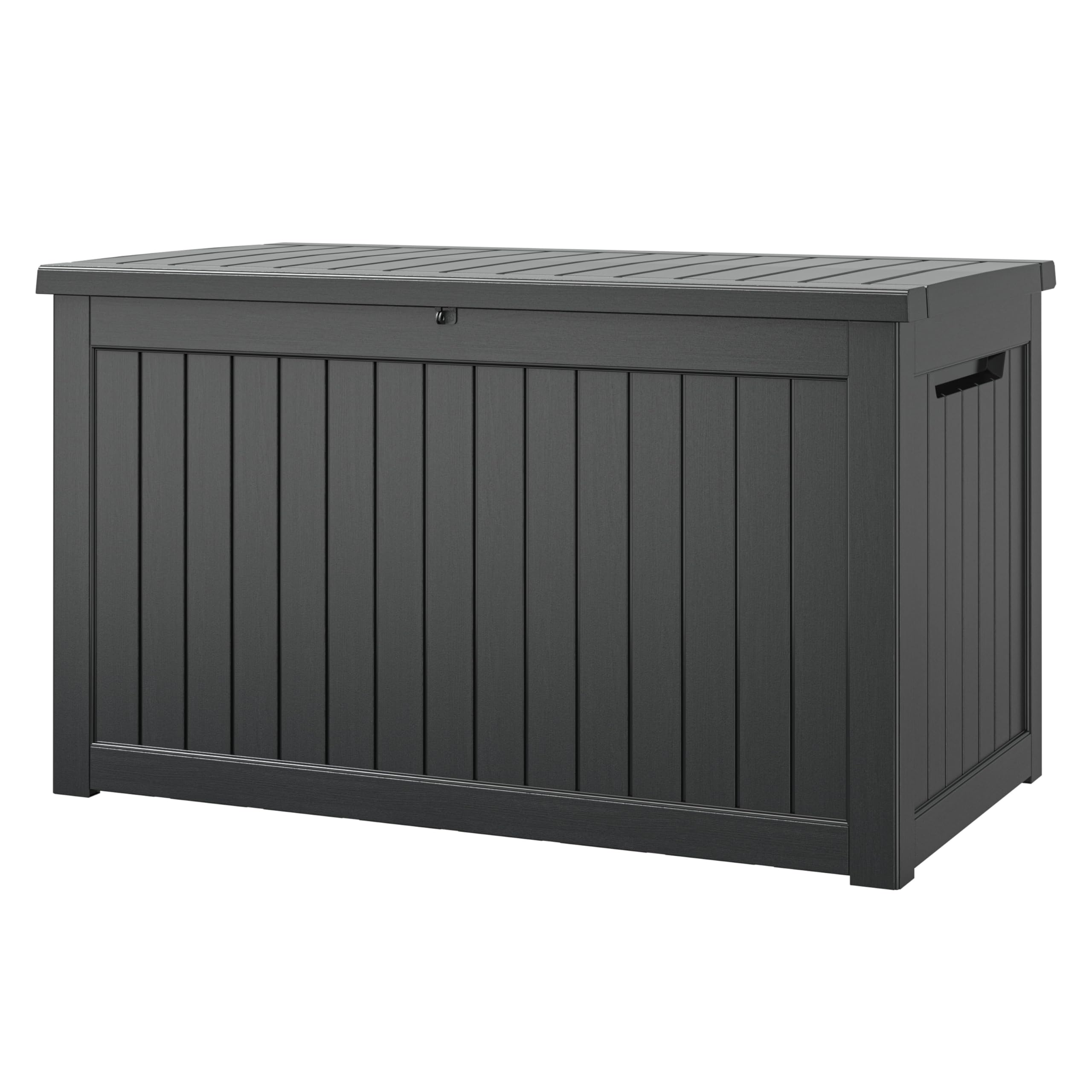
Sixty-one inches long and 25 inches tall, the Westwood reads as a bench first and a storage box second, and the wood-grain panels finish the illusion — from across the patio it passes for furniture rather than plastic. That footprint is the deal you're making. It wants a wall's worth of deck, and in return 150 gallons takes a full deep-seat cushion set with the pool floats stacked on top and the grill cover wedged down one end. On a narrow balcony, this isn't the box.

The lid is what sells it. Hydraulic pistons take over the moment you lift, so it rises on its own and waits while you load with both hands — a small thing until you've spent a season propping a lid on your shoulder. It's rated for 660 pounds, so two adults can sit down at the end of a party without anyone worrying, and the latch takes a padlock if the cushions need securing overnight.

Water is where the ownership story gets conditional. Keter calls the box waterproof, and in ordinary rain it behaves that way: the lid overlaps the rim and sheds instead of seeping. Left in all-day direct sun, though, the lid can lift at the corners, and once it stops sitting flat, rain finds its way in. Under an eave or in shade, the problem disappears; in full afternoon sun, check the corners each spring.

Against the Lifetime, you give up steel hinges and eight years of warranty and gain the extra space and the self-opening lid. That trade is the whole reason this one sits at the top of our list: the daily handling is easier, and the Westwood is the box we picture people actually opening twice a day.

Bottom Line: Our pick for most decks: 150 gallons of dry space, a lid that lifts itself, and a bench two adults can share.
#2

Best Build Quality

Lifetime 60012 130 Gallon

Lifetime 60012 130 Gallon

8.9/10 Excellent
  • Capacity: 130 gallons
  • Warranty: 10-year limited
  • Seat Rating: 900 lb
  • Exterior Dimensions: 60 x 24 x 27.2 in
Check Price on Amazon

Pros

  • 900-pound seat rating, the highest of these picks
  • Steel hinges backed by a ten-year warranty
  • Fits a full cushion set in a narrower body

Cons

  • Rated water-resistant, not waterproof
  • 52 pounds empty before you load it

The Lifetime arrives as flat panels and screws rather than a stack of snap-together plastic, and that's the first clue about what it is. High-density polyethylene walls, powder-coated steel hinges, and a controlled spring hinge that opens past 90 degrees and won't slam on your fingers. The Westwood is a resin box built to look like wood; this is a plastic box built like a cooler.

We rate it the most solid box in this group. Two adults on the lid don't produce so much as a creak at 900 pounds, the highest seat rating here, and 130 gallons swallows the same cushion set the Westwood takes — in a body an inch shorter and four inches narrower, though two inches taller. If your deck is long on people and short on width, that shape is the better fit.

Assembly is the tax on all that solidity. The panels screw together, the lid wants a second pair of hands, and the job takes longer than clicking a Keter together; budget an afternoon, a helper and a screwdriver. Decide where it lives beforehand too, because 52 pounds empty is already a two-person shuffle. Lifetime calls it water-resistant rather than waterproof, and with the box level and the latch pulled down, contents stay dry through storms.

Bottom Line: We name this one when a buyer wants to buy once: steel hinges, high-density polyethylene, a ten-year warranty and a 900-pound lid.
#3

Best for Large Cushion Sets

Devoko 120 Gallon

Devoko 120 Gallon

8.8/10 Excellent
  • Lid: Gas-lift soft close
  • Capacity: 120 gallons
  • Material: Weather-resistant resin
  • Exterior Dimensions: 52.2 x 24.2 x 25.2 in
Check Price on Amazon

Pros

  • 120 gallons without a premium price
  • Gas struts hold the lid open and close it softly
  • Sits at bench height and rated for three

Cons

  • No published seat weight rating

A hundred and twenty gallons at the value end of the midrange is the pitch, and the 52-inch length is what makes it work. Deep-seat cushions lie flat end to end instead of going in on the diagonal, the 25-inch height means the lid is a real seat rather than a perch, and Devoko rates the top as a bench for three. The panels are reinforced and there's a metal bar across the top, so the walls have some backbone once it's built.

The gas struts are the difference between this and a cheaper box, and they're why we rank it above the budget picks rather than alongside them. On something this deep you lean in with both arms, and a lid that holds itself open and then settles instead of slamming is a detail we noticed the first week and stopped noticing after that — the best thing you can say about a hinge.

Rain has stayed out of the ones that sit level and latched; water gets into any of these boxes through a lid left a couple of inches open, not through the walls, and the resin shrugs off sun without the chalky fade cheap plastic develops. The one gap is the paperwork: Devoko publishes no seat weight limit, so if three adults on the lid matters to you, the Lifetime is the pick with a number attached.

Bottom Line: Our value pick for big cushion sets: 120 gallons, gas struts that hold the lid open, and a top rated as a bench for three.
#4

Best for Small Decks

Keter Kentwood 50 Gallon

Keter Kentwood 50 Gallon

8.7/10 Excellent
  • Lid: Lockable flip top
  • Assembly: No tools required
  • Capacity: 50 gallons
  • Exterior Dimensions: 32 x 17.5 x 22.75 in
Check Price on Amazon

Pros

  • Fits a balcony or a narrow porch
  • Snap assembly with no tools required
  • Doubles as a lockable side table

Cons

  • Too small for a full deep-seat cushion set

Thirty-two inches wide and 17.5 deep, this is the deck box for people who don't have a deck — a balcony, a concrete stoop, the strip of porch between the door and the railing. Beside a chair it works as a side table for a drink. Open it and 50 gallons takes the cushions off a bistro set, the hose and a bag of potting soil with room left over. Of everything here, it's the one that earns its space rather than demanding it.

No tools, no screws. The panels click together, the finished box is light enough to carry out to the porch yourself, and the lockable flip top takes a small padlock. The wood-look texture is convincing enough that guests sit on it before they realise what it is, which is about the highest compliment a resin box gets.

One thing to check before you fill it: the front panel on this family of boxes can bow outward, and a bowed panel holds the lid a few millimetres off its latch, so the lid needs a push to catch. Ours went together square, and the fix if yours doesn't is to reseat the panel before loading. What 50 gallons won't do is take deep seat cushions — they go in on end and there's no room above them.

Bottom Line: Our compact pick: it slips into the gap beside a door, goes together without tools, and gives a small patio storage and a side table at once.
#5

Best Budget

Devoko 78 Gallon

Devoko 78 Gallon

8.7/10 Excellent
  • Lid: Hydraulic hinge
  • Handles: Both sides
  • Capacity: 78 gallons
  • Exterior Dimensions: 45.3 x 19.2 x 20.8 in
Check Price on Amazon

Pros

  • The least expensive of these picks
  • Hydraulic hinges on a budget box
  • Narrow 19-inch depth fits a porch

Cons

  • Panels flex until the last joint is seated

Seventy-eight gallons in a 45-inch box means thinner panels than the Lifetime's, and you can feel it when you lift the flat pack out of the carton. It's the kind of box that flexes until the last joint clicks home and then stiffens into something more solid than the cardboard it arrived in. That's not a criticism so much as a warning about the ten minutes before it's built.

Once it's square, the numbers work. Forty-five inches long, 19 deep and 21 tall takes a pair of chair cushions, the garden tools, the pool toys, or the delivery boxes that would otherwise sit on the step in the rain. Handles on both sides let you shift it while it's empty, the hydraulic hinges keep the lid from dropping on your hands, and the latch is lockable for the price of a padlock.

The thing to check — the one fault that shows up on snap-fit boxes — is that the base panel is fully seated before you fill it. A base a click short shows up later as a lid sitting proud at the front edge, which reads as a warped lid and is usually nothing of the sort. Ours lined up, the lid met the rim all the way round, and for a porch that needs storage rather than a landmark, this is the box we hand someone on a budget.

Bottom Line: We hand this one to anyone on a tight budget: 78 gallons, hydraulic hinges, and a footprint that fits a porch without eating it.
#6

Maximum volume

NUNU LAB 300 Gallon

NUNU LAB 300 Gallon

8.5/10 Excellent
  • Lid: Gas-lift hinge
  • Weight: 68.2 lb
  • Capacity: 300 gallons
  • Exterior Dimensions: 58 x 32.2 x 34 in
Check Price on Amazon

Pros

  • Largest capacity here by a wide margin
  • Gas-lift lid and lockable latches
  • Tool-free snap assembly

Cons

  • 68 pounds, and it doesn't move once loaded
  • Lid and hinges vulnerable in high wind

The name says 300 gallons; the same listing quotes 230 gallons of storage volume; the footprint says 58 inches long, 32 deep and 34 tall, and that last number is the one that matters. This is closer to a small shed than a bench. At nearly three feet tall it stands above the back of most patio chairs, so it wants a corner rather than the gap between two loungers.

Build it where it stands. The panels snap together without tools, but 68 pounds of them means you aren't carrying the finished box anywhere, and the gas-lift hinges and lockable latches are the right hardware for something this size. Inside, it takes the pool equipment, the inflatable, the garden tools, bags of soil and the winter covers in one go — the sort of capacity that clears a garage rather than a patio.

The trade-off is stiffness. It holds its shape assembled and closed, but this much surface area catches wind, and the lid is the part that pays: a box left unlatched through a storm can lose a hinge or a lid panel. Keep it latched, put it against a wall if the deck allows, and treat it as a store for the things you don't need daily rather than the box you open every evening.

Bottom Line: Only worth it if volume is the whole point: the biggest box here, and the one that asks the most of your deck and of a windy day.

How We Tested the Best Deck Boxes

We started by narrowing a long list of deck boxes using specs, owner reviews, and price, focusing on usable interior space, a lid that could be secured, and a footprint that would not swallow a normal deck. From there, nine boxes moved into real yards and patios for eight months. They held patio cushions, pool floats, garden tools, charcoal, and delivery boxes. We opened and closed each one daily and left them outside through sun, rain, and wind.

Assembly came first. We timed each build alone with a screwdriver, noting whether panels lined up, holes matched, and instructions made sense without a second pair of hands. Once built, we pushed on the walls and loaded the boxes with cushions to see whether sides bowed or the base stayed flat. For capacity, we measured the interior and tried to fit a standard stack of four patio cushions plus towels; for size, we checked the exterior footprint against a chair and the opening against a full cushion. Appearance was judged after setup and again months later, because a box can look sharp in the garage and tired on a sunny deck.

Lid closure and lid functionality got their own tests. We filled each box, closed the lid, and checked for gaps; then we left them through windy afternoons to see if lids rattled or lifted. On rainy days, we checked whether water pooled on top or seeped inside, and whether a wet lid could be opened with one hand while the other held a cushion. Hinges, latches, and prop-open mechanisms were used repeatedly to see if they stuck or pinched. After eight months, we looked for fading, cracking, warped panels, and lids that no longer sat flush—the slow failures that separate a durable deck box from a temporary one.

How to Choose Deck Boxes

Start with the footprint and the depth

A deck box is furniture, and it has to fit a particular wall, so exterior dimensions come before capacity. The Westwood is 61 inches long because it holds 150 gallons; the Kentwood 50 is 32 inches because it doesn't. Neither is better in the abstract. The measurement that catches people out is depth: most of these boxes are 17 to 20 inches front to back, and a deep-seat cushion is longer than that lying flat, so it goes in on its end and eats the space above it.

Measure the wall you're willing to give up and the stacked height of your cushion pile, then compare interior length and depth. Gallons only tell you which of two boxes is bigger, not whether your cushions fit.

Pay for the lid, not the gallon count

Three kinds of lid turn up here. A plain hinge means one hand holds the lid while the other loads. A controlled spring hinge, which the Lifetime uses, opens past vertical and closes itself slowly. Hydraulic or gas struts do the same with less effort, and on a deep box they're the difference between loading with two hands and loading with one.

The lid is also where these boxes fail: a hinge that cracks, a latch that stops catching, a front panel that bows and holds the lid off its seat. If you'll open the box twice a day for a decade, the money is better spent here than on another twenty gallons.

Waterproof, water-resistant, and what actually keeps things dry

Most of these boxes claim waterproof; the Lifetime says water-resistant, which is the more honest description of a plastic chest with a lid that overlaps the rim rather than sealing to it. What keeps contents dry is a lid sitting flat on a level rim, a box standing on pavers rather than soil, and a latch that pulls the lid down.

Driving rain finds seams, and a lid left ajar after a sunny afternoon lets in more water than any storm. Site the box out of the worst of the weather, rock the lid with one hand before you fill it, and never store cushions damp.

Seating, material, and how long it should last

Sitting on a deck box is the fastest way to break a cheap one, so if two adults will use it as a bench, buy a box with a published seat rating. The ratings here run from 660 to 900 pounds, and one of our picks has no rating at all. Height matters too: a 25-inch top is a comfortable lean, not a dining chair.

Material decides lifespan. High-density polyethylene with steel hinges is the longest-lived combination in this group and comes with a ten-year warranty against two years for the resin boxes. Resin still wins on looks and on weight, but buy it knowing you're trading some of that life for a wood-grain finish.

Frequently Asked Questions

Final Verdict

Most decks want the Keter Westwood. It makes the daily routine easier — the lid lifts itself, a full cushion set goes in flat, and two adults can sit down afterwards — and it's the box here with the least to apologise for.

If you plan to buy once, the Lifetime is the better-built object: steel hinges, thick polyethylene, a ten-year warranty and a 900-pound lid, in exchange for a little less space and a longer afternoon with a screwdriver. On a balcony, take the Kentwood 50 and stop reading, because nothing else here fits the space.