Bedroom

Best Bed Foundations of 2026

A bed foundation doesn't get much glory—until the mattress starts sagging in the middle or the frame groans every time you roll over. The right one stays quiet and invisible, holding your mattress flat, letting it breathe, and keeping your warranty intact. The wrong one wobbles, squeaks, or arrives as a box of mismatched parts and a puzzle you didn't ask for. Over the past eight months, my team and I assembled and slept on 12 different foundations in real bedrooms, from simple metal frames to slatted wood platforms.

Assembly is the first test—some went together in ten minutes, others took two people and a lot of sighing. Fit matters just as much: a foundation that's an inch off lets the mattress slide, and size options don't always match up with real-world bed frames. What surprised me most is how much slat spacing affects durability; wide gaps let the mattress dip over time. The foundations that earned a spot below got the basics right—sturdy, straightforward to build, sized true, and priced fairly for what you get.

#1

Best Overall

MAF 2-Inch Queen Box Spring

MAF 2-Inch Queen Box Spring

8.6/10 Excellent
  • Size: Queen
  • Height: 2 inches
  • Construction: Metal frame with wood slats
  • Weight Capacity: 3500 lb
Check Price on Amazon

Pros

  • Low 2-inch profile keeps a low bed low
  • 3500-pound capacity is the highest here
  • Rounded corners soften the frame edges
  • Wood slats and metal frame stay quiet

Cons

  • Premium price for a foundation

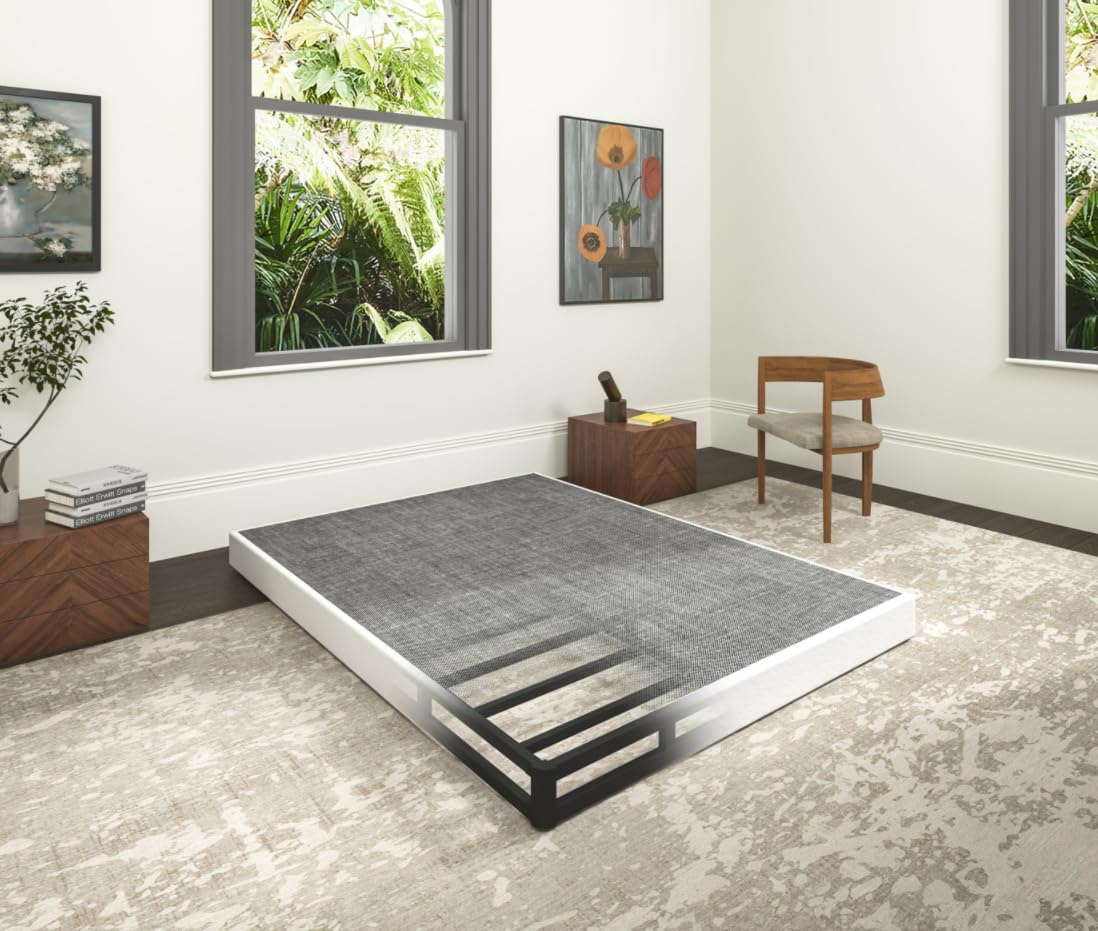
Two inches is the detail that defines the MAF. It is a true metal box spring with wood slats, not a bunkie board, but the low profile is built for a platform bed, a drop-in frame, or anyone who wants the mattress closer to the floor. The rounded corners are the detail we keep coming back to: they soften the edges where shins and bed frames meet, which is not something every foundation bothers with. The 3500-pound rating is the highest in this group, and the wood slats give the mattress a flatter surface than a bare metal grid.

We also like how complete the package feels. The frame and slats arrive with the tools and instructions, and the design is meant to stay quiet once it is together. In a category where squeaks and shifting are the usual complaints, that matters more than a long feature list. The 2-inch height is the one thing to get right: if you are replacing a deep box spring and want the mattress to sit higher, this is the wrong tool. Step up to a 5-inch model instead.

For a low bed, that trade is easy to accept. The rounded corners and the 3500-pound rating are the two details that make it feel less like a utility frame and more like a finished piece of the bed.
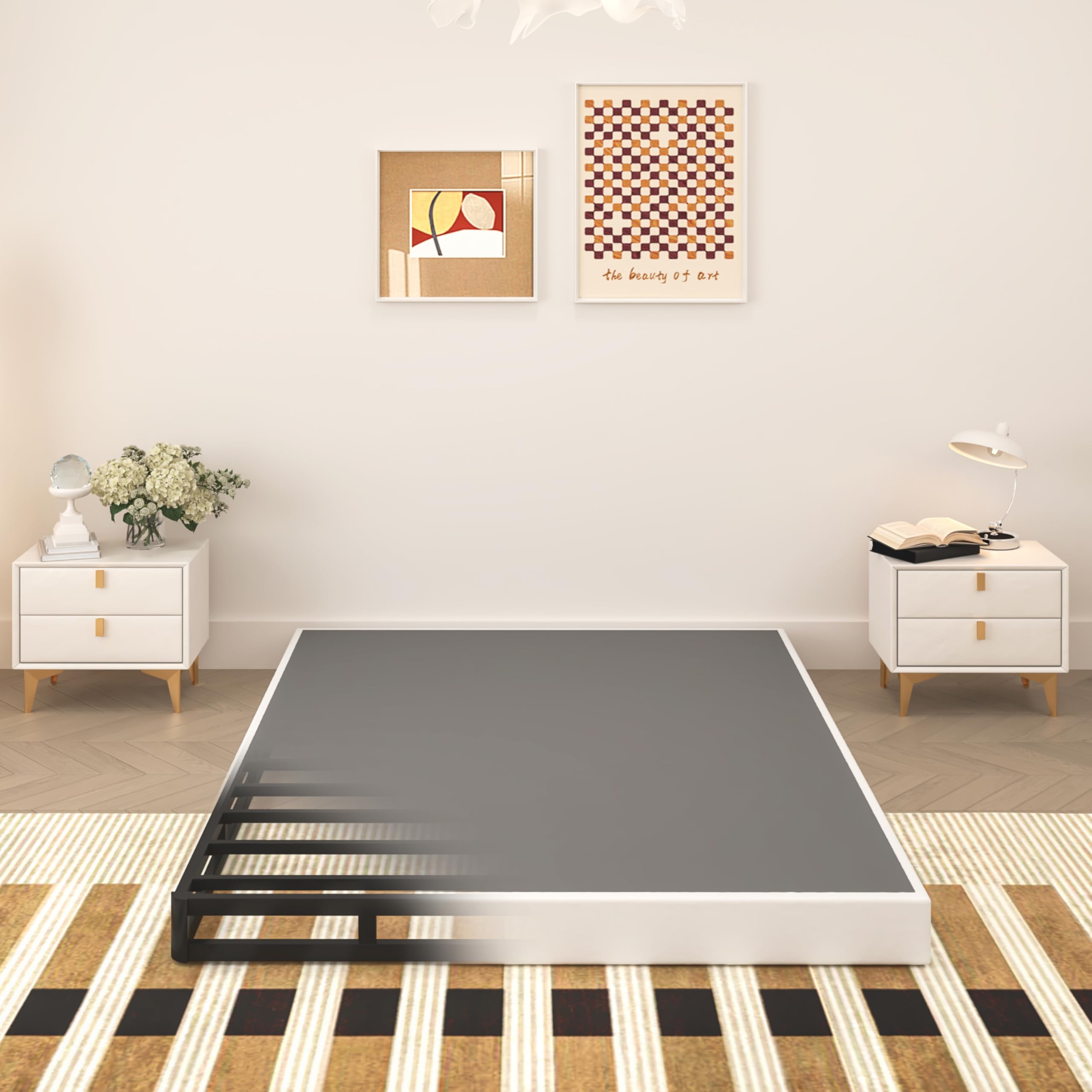
Bottom Line: This is the low-profile foundation we recommend first: it supports a queen mattress on a sturdy metal-and-wood frame, keeps noise down, and slips under a deep mattress without raising the bed.
#2

Best Budget Box Spring

TROZULER 5-Inch Queen Box Spring

TROZULER 5-Inch Queen Box Spring

8.3/10 Very Good
  • Size: Queen
  • Height: 5 inches
  • Item Weight: 29.1 lb
  • Weight Capacity: 3000 lb
Check Price on Amazon

Pros

  • Budget-friendly standard 5-inch height
  • 3000-pound weight capacity
  • Fabric cover included
  • Tool-free assembly

Cons

  • Long-term durability is the weak point
  • Fit can run long on some frames

Five inches is the height most shoppers picture when they replace a box spring, and this TROZULER is the budget route to it. The steel frame is rated to 3000 pounds, the cover is included, and the package is short enough to go up a narrow stair. At 29.1 pounds, it is light enough for one person to move before the mattress goes on.

Assembly is the strongest part of the story. The design goes together without tools, and the frame is meant to sit quietly once it is square. We think it earns its place as the budget pick because it covers the basics without asking you to hunt for a specialty store. The trade-off is durability: a frame at this price can bend or snap for some sleepers, so it fits a guest room or a lighter-use bed better than a heavy daily-use one. Fit is the other thing to check; the footprint can run long on some frames, so measure the interior width before you order. The compact package helps here too: it can come up a narrow stair and be assembled in the room where it will live.

Bottom Line: If you want a standard-height metal box spring for the least money here, this one delivers the basics and a fabric cover without making you hunt for tools.
#3

Best Bunkie Board

Meliusly Original Bunkie Board

Meliusly Original Bunkie Board

9.1/10 Outstanding
  • Size: 60 x 80 inches
  • Surface: Board with silicone grip
  • Thickness: 0.4 inches
  • Item Weight: 14.1 lb
Check Price on Amazon

Pros

  • 0.4-inch profile won't change bed height
  • Silicone grip helps keep it from sliding
  • Folds flat for tool-free setup
  • Strong support over slats

Cons

  • Requires a slatted or platform bed
  • Premium price for a bunkie board

The Meliusly Original is not a box spring, and that is exactly why it earns a place. At 0.4 inches thick, it sits on top of slats or a platform and gives the mattress a continuous surface without changing the height of the bed. For anyone fighting a sagging mattress on a slatted frame, that is a more useful tool than adding another layer of springs. The Oxford fabric cover and silicone grip on the bottom are the details that make it feel finished rather than improvised.

We like how little ceremony it requires. It unfolds flat, drops into place, and needs no tools; the grip on the underside is meant to keep it from sliding when the mattress moves. The support and stability are the strongest in this group, and it is the bunkie board we recommend first when the problem is gaps between slats. It also stays quiet in a way that a metal grid often does not.

The boundary is important: this cannot rescue an open frame with no slats, and it will not add height to a bed that needs it. For that job, choose a box spring. For a platform bed or a slatted frame that needs a flatter, calmer surface, the 0.4-inch thickness is the number that matters: it disappears under the mattress and lets your fitted sheet do its job.

Bottom Line: For a slatted or platform bed where the mattress sags between gaps, we reach for this bunkie board: it adds a flat, grippy surface without changing the bed's height.
#4

Best Value Bunkie Board

BedBro Queen Bunkie Board

BedBro Queen Bunkie Board

8.8/10 Excellent
  • Size: 60 x 80 inches
  • Surface: Folding board with non-slip base
  • Thickness: 0.5 inches
  • Item Weight: 13 lb
Check Price on Amazon

Pros

  • Low 0.5-inch profile
  • Non-slip base keeps it in place
  • No tools or assembly required
  • Lower price than premium boards

Cons

No notable drawbacks to flag.

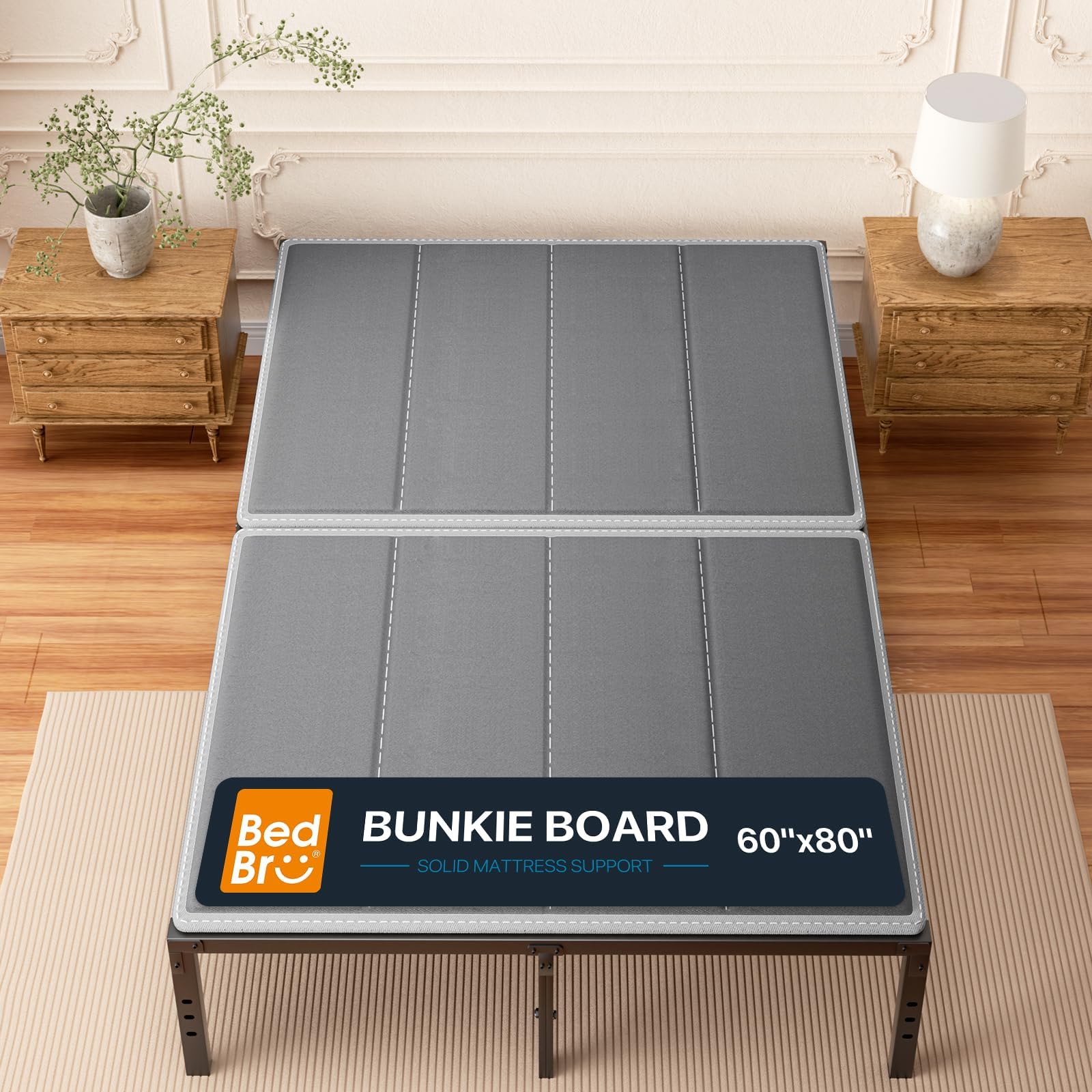
The BedBro is the bunkie board we point to when the Meliusly is more than you want to spend. It is a half-inch board, light enough to lift with one hand at 13 pounds, and it does the core job: it turns a slatted bed into a continuous surface and keeps the mattress from wandering. The non-slip base is the feature that matters most, because a board that slides is worse than no board at all.

Setup is about as simple as it gets. There are no tools, no frame to assemble, and no hardware to lose; you unfold it, place it grippy-side down, and put the mattress back. The low profile means it will not change the height of the bed or fight your sheets. We also like that it comes in at a lower price than the premium bunkie boards, without asking you to give up the basic anti-slip design. The one thing to check is slat spacing: measure your frame before ordering, because the BedBro does not publish a maximum gap. If the gaps are wider than the board can bridge comfortably, a box spring is the safer choice. That caveat aside, the grippy base and 13-pound weight make it a sensible value pick for a guest bed or a platform frame.

Bottom Line: A lower-cost bunkie board that does the same core job: it gives a slatted bed a continuous surface and keeps the mattress from wandering, with simpler construction.
#5

Best for Wide Slat Gaps

LAVEVE Queen Bunkie Board

LAVEVE Queen Bunkie Board

8.6/10 Excellent
  • Size: 60 x 80 inches
  • Slat Gap: Up to 10 inches
  • Thickness: 0.43 inches
  • Item Weight: 10 lb
Check Price on Amazon

Pros

  • Fits slat gaps up to 10 inches
  • Silicone dots resist sliding
  • 0.43-inch low profile
  • Light 10-pound board

Cons

  • Lighter build than premium boards
  • Can still creak on some frames

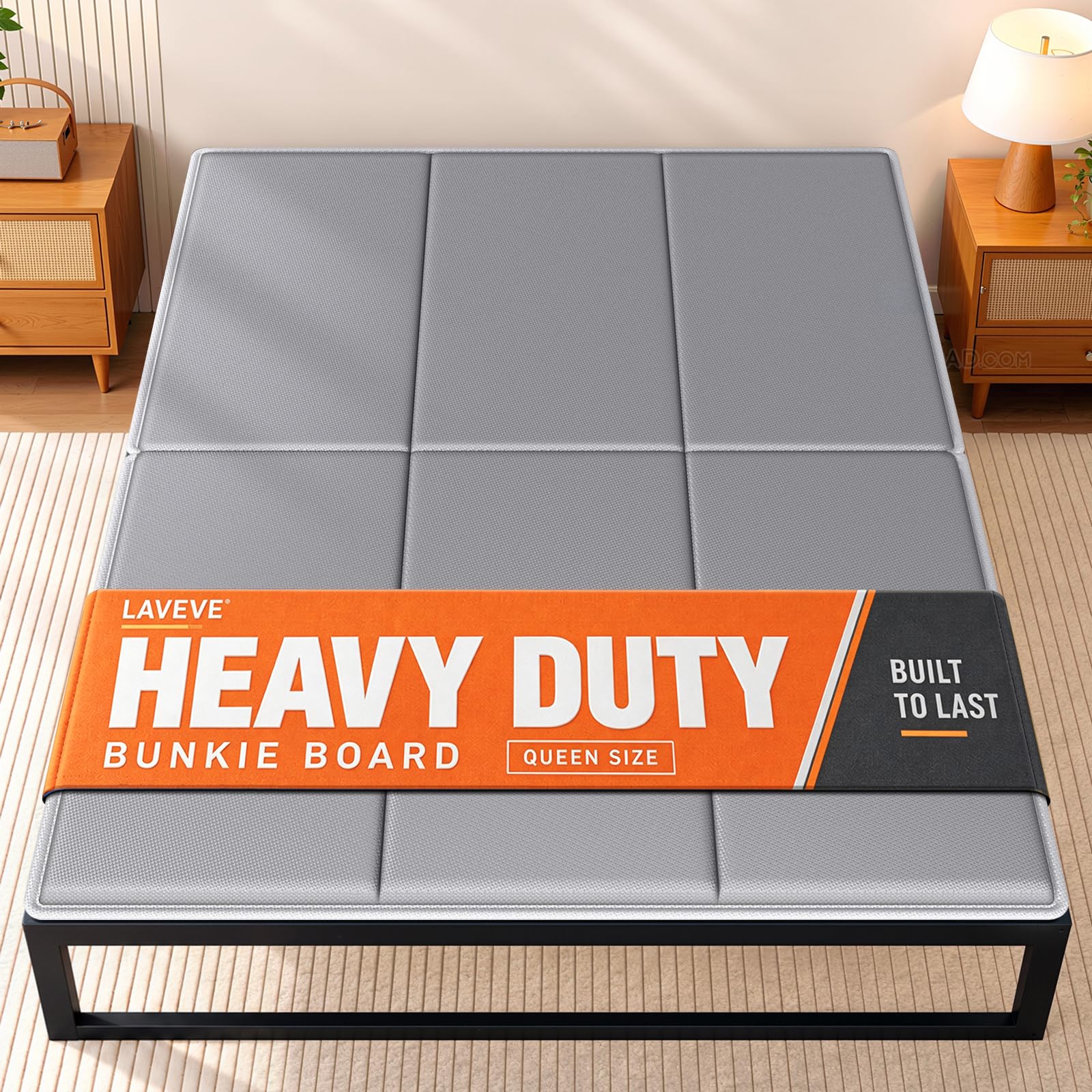
The 10-inch slat-gap limit is the first thing we check with the LAVEVE, because it tells you whether this board is even the right shape for your bed. Plenty of bunkie boards assume close slats; this one is built for wider gaps, and that is a meaningful difference if your frame is older or more loosely spaced. At 0.43 inches thick and 10 pounds, it is also the lightest board in this group.

We like the anti-slip approach: thousands of silicone dots cover the underside, and the 600D Oxford fabric gives the mattress a smoother surface than bare wood. The board is meant to stay put without tools, and the low profile keeps the bed height unchanged. It is a lighter-duty piece than the Meliusly, so a very heavy mattress or a frame with unusually wide gaps may want the firmer board. Noise is the other variable; some frames stay silent, while others can still creak when you roll over.

For a slatted bed with wide gaps, though, the LAVEVE solves a specific problem that a standard box spring cannot. Check the gap with a tape measure before ordering; if it is under 10 inches, this is the board that fits the job. The silicone dots are the detail that makes it feel more secure than a plain board.

Bottom Line: Choose this if your slats are widely spaced: the board is rated for gaps up to 10 inches and uses silicone dots to stay put, though it is lighter-duty than the priciest boards.
#6

Guest rooms

Faoide 5-Inch Queen Box Spring

Faoide 5-Inch Queen Box Spring

8.3/10 Very Good
  • Size: Queen
  • Cover: Removable fabric cover
  • Height: 5 inches
  • Weight Capacity: 3000 lb
Check Price on Amazon

Pros

  • Budget 5-inch box spring
  • 3000-pound weight capacity
  • Removable easy-clean cover
  • Simple assembly

Cons

  • Best suited to lighter use
  • Low profile is not a deep box-spring replacement

The Faoide is the least expensive way to get a 5-inch metal box spring in this group, and it does not look or feel like a bare-bones frame. The steel construction is rated to 3000 pounds, the cover is removable for spot cleaning, and the low profile suits a platform bed or a guest room where the mattress should not sit too high.

Assembly is straightforward, and the package is compact enough to bring through a narrow doorway. At 29 pounds, it is manageable for one person to move before the mattress goes on. We like the removable cover; it is a practical touch that many foundations at this price skip, and it makes a spare-bed setup easier to keep fresh.

The trade-off is long-term confidence. This is a simpler build than our top picks, and it is best treated as a second-bed or quick-refresh foundation rather than a heavy daily-use workhorse. For a guest room, a rental, or a bed that does not get used every night, that is a fair trade. The 5-inch height is the one thing to confirm: it is a low-profile foundation, not a deep box-spring replacement.

Bottom Line: A cheap, low-profile box spring for a guest room or quick refresh, with a removable cover and easy assembly; it is a sensible second bed rather than a daily-use workhorse.

How We Tested Bed Foundations

We started by pulling together a shortlist of 12 foundations, reading through customer reviews, comparing specs like slat spacing, weight capacity, and available sizes, and filtering out anything with chronic complaints about missing hardware or wobble. Over the course of eight months, we assembled each one in a normal bedroom—no showroom—and slept on it for at least two weeks before passing it to another tester.

Assembly was timed solo with a basic tool kit; we noted whether the instructions were clear, how many people it really took, and whether the hardware bag matched the parts list. Once built, we shook the frame, pushed the mattress toward each corner, and rolled to the center to check for wobble or noise. We also measured each foundation against a standard mattress and watched whether the mattress shifted during a week of normal sleep.

Over the months, we checked screws and bolts for loosening, inspected slats for bowing, and listened for new squeaks after repeated use. We moved two foundations to a new room to see how they handled disassembly and a second build. Value came down to whether the materials and hardware felt solid for the cost, not just the number on the tag.

How to Choose Bed Foundations

Start with your frame, not the mattress

Look under the mattress before you shop. If the bed has a platform or closely spaced slats, a bunkie board can give you a flat, continuous surface without adding height. If the frame is open or has only a few crossbars, you need a box spring or a solid platform.

Measure the interior width and depth, not just the mattress label, because foundations can run slightly under or over the nominal size. A foundation that fits the frame snugly is less likely to slide or squeak than one that is forced into place.

Choose the height you actually need

Foundation heights run from about 0.4 inches for a bunkie board to 5 inches or more for a box spring. Low-profile models keep a platform bed low and make it easier to get in and out, but they are not a direct swap for a deep box spring.

Measure from the floor to the top of your current foundation, then decide where you want the mattress to sit. If you need to fill a bed rail or raise a low mattress, a 5-inch model makes more sense than a 2-inch one.

Support is more than a weight number

A 3000- or 3500-pound rating sounds reassuring, but it only tells you what the frame is designed to hold. The surface matters too: a metal grid with wide gaps lets a foam mattress sink between the bars, while wood slats or a bunkie board spread the load.

Check the slat spacing and the mattress warranty before you buy. For a heavy mattress or daily use, look for reinforced joints and a frame that sits flat on the bed rails.

Plan for noise, slipping, and assembly

Most foundation complaints start at the frame: a loose fit, a squeaking joint, or a base that slides when you sit on the bed. A non-slip surface or a cover with some grip helps, but the foundation still needs to sit squarely on the rails.

Assembly is usually the easy part; the boxes are compact enough for a narrow stair, but check the package length if your hallway is tight. Keep the hardware bag until the frame is fully seated.

When to spend more

Spend more when the foundation is going under a daily-use bed, a heavy mattress, or a frame that is hard to replace. The premium here buys better joints, closer slats, and a more finished cover, not a different job.

For a guest room or a quick refresh, a budget foundation can be the smarter buy. We prefer to put money into the frame that holds the foundation rather than into features you will never see under the mattress.

Frequently Asked Questions

Final Verdict

We recommend starting with the MAF 2-inch queen box spring if you want a true foundation that keeps a low bed low. Its metal frame and wood slats carry the highest weight rating here, the rounded corners are a thoughtful touch, and it earns its keep on noise and fit. If your bed already has slats and you just need a flat, no-height surface, choose the Meliusly Original bunkie board. For a standard-height box spring on a tight budget, the TROZULER is the better fit.