Bedroom

Best Mattress Foundation of 2026

A mattress gets all the glory, but the foundation underneath decides whether your bed feels solid or squirmy at 2 a.m. A good one stays quiet when you roll over, supports foam and innerspring mattresses without sagging, and matches the frame and mattress size you already own. The wrong one announces itself with creaks, gaps, or a mattress that shifts every time you sit down. I care less about fancy labels than whether a foundation goes together without a second person, holds its shape after months of use, and feels worth the money.

We tested 12 mattress foundations over nine months, from metal frames to box-spring alternatives, and the differences came down to assembly, fit, and how quietly they carried weight. Some assembled in minutes; others fought back. We paid attention to size — twin, full, queen, king — because a foundation that's an inch off can make a perfectly good mattress feel wrong. The picks below are the ones I'd trust under a guest bed or my own, whether you're replacing a sagging box spring or starting fresh.

#1

Best Overall

Zinus Victor 4-Inch Foundation

Zinus Victor 4-Inch Foundation

9.3/10 Outstanding
  • Size: King (79 x 75 in)
  • Height: 4 inches
  • Item Weight: 59.5 lb
  • Weight Capacity: 700 lb
Check Price on Amazon

Pros

  • Quiet steel frame with no creaking joints
  • 700-pound total capacity, 350 per person
  • Four-inch height suits a thick mattress
  • Five-year limited warranty included

Cons

  • 59.5-pound king is a two-person lift
  • Premium price next to the rest of the group

Four inches is the whole argument for this foundation. Most metal boxes in this category sit at five or nine inches, which is fine until a deep mattress goes on top and the bed ends up high enough that you notice it every time you get in. At four inches, the Victor keeps a thick mattress at a normal sleeping height, and it does it with a steel frame and steel slats rather than the thin wire grid the cheaper boxes here use.

It's the one we tell people to buy first, because there's no obvious compromise in it. Two adults and a heavy mattress sit well inside the 700-pound rating, which is really 350 pounds per person, and the frame stays quiet as you move across it instead of announcing every shift. It also carries a five-year limited warranty, which is rare in this group and says something about how the maker expects the joints to hold up.

The weight is the price. At 59.5 pounds for the king, it's a two-person carry up a staircase, and you want to build it where it's going to live rather than dragging it into place afterwards. It also needs a bed frame or platform underneath — the foundation is not a standalone bed — and the fabric cover is slick enough that a mattress will creep over a month or two. A gripper pad between cover and mattress ends that.

What we didn't expect to care about was how flat it stays. The slats sit close enough together that a soft hybrid doesn't dip between them, so the surface under the mattress stays level instead of developing a shallow bowl in the middle. If you're coming down from a nine-inch box spring, measure the drop first: four inches is a real change, and the point of it is to keep a tall mattress at a sensible height, not to lift a thin one.

Bottom Line: The one we send most people to: a quiet, rigid four-inch steel foundation that keeps a thick mattress at a normal height, provided you have a frame under it.
#2

Best for Sagging Slat Beds

Meliusly Original Bunkie Board

Meliusly Original Bunkie Board

9.1/10 Outstanding
  • Size: Queen (60 x 80 in)
  • Setup: Folds flat, no tools
  • Profile: 0.4 inches
  • Item Weight: 14.1 lb
Check Price on Amazon

Pros

  • Adds only 0.4 inch, so sheets still fit
  • Silicone grip base holds it to the slats
  • Folds flat for stairs and storage

Cons

  • Needs slats or a solid platform underneath

A dip in the middle of a mattress usually isn't the mattress. If your bed has slats with gaps between them, foam and springs press down into those gaps, and no topper fixes a surface that is already bowed. The Original Bunkie Board is the simplest fix we've found — a rigid panel that goes straight over the slats and gives the mattress one continuous surface — and it is the board we recommend for most slatted beds.

At 0.4 inches thick you will not notice it, which is the point. A wooden bunkie board adds an inch and a half to three inches and shows at the corners of the sheets; this one slips under and disappears. It arrives as two folding panels of a fluted core wrapped in Oxford fabric, with a silicone grip pattern on the underside that holds it to the slats. Setup is unfolding it and laying it down, and the whole thing weighs 14 pounds.

It is not a box spring replacement and doesn't try to be: with no slats or solid platform beneath it, there is nothing for it to bridge. Where it earns its place is over slats, over a platform bed too low for a box spring, and under a mattress that has already started to dip. What we appreciate most is that it buys a mattress a few more years without changing anything else about the bed — the height, the sheets, the look. Lay the panels out and check the seam sits flat before the mattress goes on.

Bottom Line: If your mattress dips between slats rather than sitting too low, this folding board is the cleanest fix we've found and it barely changes the bed.
#3

Best Low-Profile Queen

JWIFSEF 5-Inch Queen Foundation

JWIFSEF 5-Inch Queen Foundation

8.6/10 Excellent
  • Size: Queen (79.5 x 59.5 in)
  • Cover: Removable stretch-knit
  • Height: 5 inches
  • Weight Capacity: 3,500 pounds
Check Price on Amazon

Pros

  • 3,500-pound rated steel frame
  • Removable, washable stretch cover
  • Sits flush inside a standard queen frame

Cons

  • Footprint is unforgiving in older, off-size frames

The 3,500-pound capacity on this one is a number on a page. Two adults and a mattress are nowhere near it, and no foundation in this guide fails in a normal bedroom because of weight. What actually separates the five-inch queens here is rigidity and footprint, and the JWIFSEF gets both right.

The frame is high-grade steel with reinforced connections, and the cover is a stretch knit with elastic all the way round that pulls off for washing — a small thing until a child has a nosebleed on it. It goes together with the hardware in the box, and it's light enough to flip on your own while you're building it rather than needing someone to hold the far side.

We rate it the best five-inch queen here for a frame with real rails, because 79.5 by 59.5 inches fills a standard queen opening almost exactly — no slack, no rattle, no gap at the corners where a fitted sheet can pull through. That precision is also the catch, and the reason to measure before you order rather than after.

Bottom Line: A five-inch queen that fills a proper bed frame exactly and stays silent doing it, as long as your rails measure to standard.
#4

Best Budget Twin

TROZULER 5-Inch Twin Foundation

TROZULER 5-Inch Twin Foundation

8.3/10 Very Good
  • Size: Twin
  • Height: 5 inches
  • Assembly: No tools required
  • Weight Capacity: 2,500 pounds
Check Price on Amazon

Pros

  • Cheapest foundation in this guide
  • Light enough to move and flip alone
  • Soft, washable fabric cover

Cons

  • Twin only
  • Durability is mixed under heavy daily use

Twin is the size this category forgets about, so it's worth saying plainly: the TROZULER is a five-inch metal foundation for a twin bed, it's the cheapest thing in this guide, and it's light enough that one person can carry it up the stairs and flip it over without waiting for help. For a kid's room, a daybed, or a spare bed that gets used a few weeks a year, that combination is most of what you need.

For exactly what it is, this one earns its place: a cheap twin base that doesn't pretend to be furniture. The frame is welded steel tube with a fabric cover, assembly is tool-free with the wrench in the box, and the cover is soft and washable — worth more than it sounds on a bed a child will jump on. It isn't the foundation for an adult's main bed, and that's the honest limit of it.

The practical wrinkle is the included wrench, which is small enough to turn a short build into a long one; a socket set from the toolbox cuts the irritation in half. And check the length against your frame before you start, because the twin runs a little long for some bed rails. Neither problem is serious, and neither is the kind of thing you notice again once the mattress is on.

Bottom Line: The twin we recommend for a kid's room or a daybed: cheap, light, and easy to build alone, with durability the honest limit.
#5

Best for Raising a Low Bed

Faoide 9-Inch Queen Foundation

Faoide 9-Inch Queen Foundation

8.3/10 Very Good
  • Size: Queen
  • Height: 9 inches
  • Item Weight: 31 lb
  • Weight Capacity: 3,000 pounds
Check Price on Amazon

Pros

  • Nine inches restores a traditional bed height
  • Removable, easy-clean cover
  • 31 pounds, manageable alone

Cons

  • Nine inches is too much under a thick mattress

Nine inches is a lot of foundation, and that is the reason to buy this one. If you're replacing an old nine-inch box spring and want the bed to land at the same height, a five-inch base drops you four inches and changes how the whole room feels. The Faoide is the tallest foundation here and the least expensive route back to a traditional bed height.

The build is straightforward: a reinforced steel frame, a removable fabric cover, all the tools in the box, and a 31-pound weight that one person can handle on their own. The cover comes off for cleaning, and the frame is rated to 3,000 pounds, again far more than a bed ever sees.

We call it a solid pick for a low frame or a thin mattress, because the height is the feature and you should want it. One thing to know before you order: this is sold as low profile, and nine inches is the tallest foundation in this guide. Read the number, not the label — it's the difference between a bed that's easy to get into and one you climb.

Bottom Line: The buy for a bed that sits too low: nine inches of steel that restores a traditional height, though it is not the low-profile base the listing calls it.
#6

Edge support on a budget

EMODA 5-Inch Queen Foundation

EMODA 5-Inch Queen Foundation

8.3/10 Very Good
  • Size: Queen (79.6 x 59.6 in)
  • Height: 5 inches
  • Item Weight: 33 lb
  • Weight Capacity: 3,000 pounds
Check Price on Amazon

Pros

  • Extra side slats support the mattress edges
  • Removable cover for spot cleaning
  • Five-inch profile suits a thick mattress

Cons

  • Tight fit in older, off-size bed frames

This foundation moves. The fabric cover shifts against the frame rails, the mattress creeps on the cover, and after a few weeks the whole stack has drifted to one side. A gripper pad between the cover and the mattress fixes it, and so does a frame with a lip on the rails, but it's a step the leaders here don't ask of you.

Underneath the cover it's a five-inch metal frame with four extra support slats on each side, which is a sensible place to spend material — the edges are where a mattress sags first, and side slats are what stop it. There's a removable cover for spot cleaning, and 3,000 pounds of rated capacity, which is more than the job needs.

Assembly takes more patience than the snap-together frames: you're building a grid of slats rather than clipping four sides together, and the cover goes on last. That's a job to do with a second pair of hands, ideally before the bed is in its final corner of the room.

We rank it behind the JWIFSEF and the Zinus because you're buying a fix-up job as well as a foundation. That's a shame, because the frame is decent and the side slats are a genuine plus. If you already own a gripper pad and want a five-inch queen with better edge support than the cheapest boxes offer, it's a reasonable buy; without one, add it to the order.

Bottom Line: A decent five-inch queen with useful side slats, but budget for a gripper pad because this foundation does not stay where you put it.
#7

Wide slat gaps

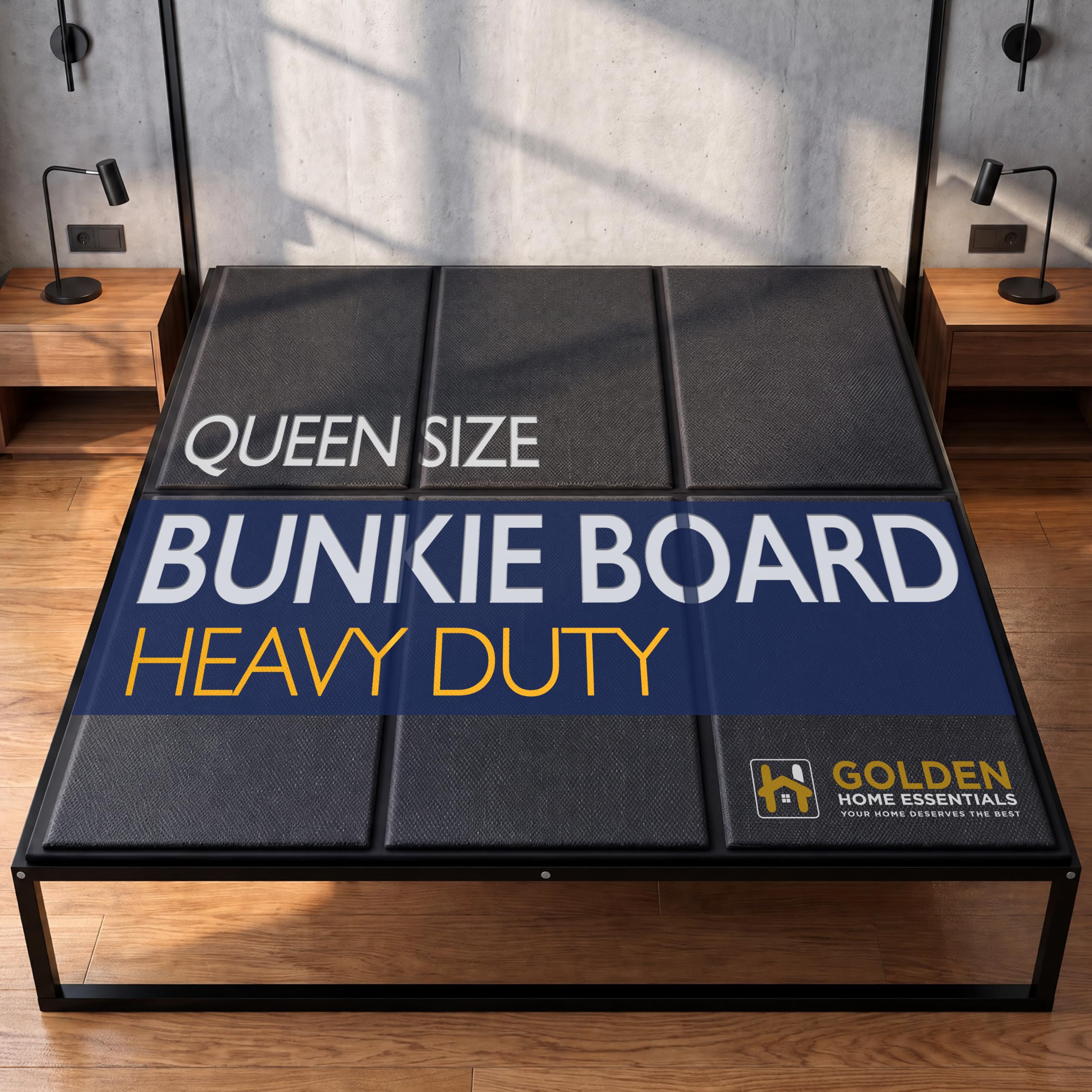
Golden Home Bunkie Board

Golden Home Bunkie Board

8.6/10 Excellent
  • Size: Queen (60 x 80 in)
  • Profile: 0.39 inches
  • Item Weight: 14.9 lb
  • Max Slat Gap: 12 inches
Check Price on Amazon

Pros

  • Load limits published for each slat gap
  • Two 6.7-pound halves, easy to place alone
  • Breathable core with airflow holes

Cons

  • Not for slat gaps wider than 12 inches

Most bunkie boards tell you they stop sagging and leave it there. This one puts numbers on it: 2,600 pounds across 8-inch slat gaps, 2,200 across 10-inch ones, with the full results printed on the listing. Slat spacing is what decides whether a board like this works in your bed at all, so a published limit is worth more than another adjective. For a frame with wide, uneven slats, this is the board to get.

It's built as a fluted core with airflow holes punched through, wrapped in 600D Oxford, and it arrives as two halves of about 6.7 pounds each — light enough to carry up a ladder one-handed and place without help. The grip base holds it to metal slats and the fabric top gives the mattress something to bite on. At 0.39 inches it changes nothing about the bed except the sag.

Where it gives ground is staying put on bare steel. On a fabric-covered platform or a frame with a lip it sits; on smooth metal slats it can walk, and a liner underneath sorts that out. It is also the cheaper of the two boards here, which matters if you're buying one to rescue a mattress rather than to finish a room.

Bottom Line: The board for a frame with wide, uneven slats, because it is the one that tells you exactly how wide a gap it will span.

How We Tested Mattress Foundations

I started by narrowing the field to foundations that came in standard mattress sizes, listed clear slat spacing and weight limits, and used hardware that looked serviceable rather than disposable. I ruled out anything with vague dimensions, missing assembly details, or a price that didn't match its materials, then brought 12 units into our bedrooms.

Over nine months, I assembled each foundation in a primary bedroom and a guest room, solo, using only the included tools, and timed how long it took from opening the box to tightening the last bolt. I noted whether the instructions matched the parts, whether holes lined up, and whether I needed a second set of hands. Then I measured each one against standard twin, full, queen, and king mattresses and against common bed frames, because fit is where a lot of foundations quietly fail.

Once a mattress was on top, I rolled over, sat on the edges, and shifted my weight from corner to corner, listening for creaks and feeling for sway. I checked whether slats stayed evenly spaced under an innerspring and a foam mattress, whether the center support held, and whether the foundation stayed square after being moved. I also lived with them for months, watching for sagging, loose joints, bent slats, and hardware that worked itself free. Value came last: I compared what each one was made of, how solid it felt, and what it cost.

How to Choose the Right Mattress Foundation

Box Spring or Bunkie Board?

Two different products share the name. A box-spring-style foundation is a steel frame four to nine inches tall with a fabric cover; it raises the mattress and needs a bed frame or platform underneath. A bunkie board is a rigid panel under half an inch thick that lies on slats and stops the mattress dipping between them. If your bed is already the right height and the mattress sags in the gaps, you want the board. If you are replacing a box spring, you want the frame.

Buying the wrong one is the most common mistake here, and no weight rating rescues it. A nine-inch foundation under a mattress on a low platform makes a bed you climb into; a 0.4-inch board under a sagging mattress on a bare metal frame does nothing at all, because there are no slats for it to bridge.

Match the Height to the Mattress

Measure from the floor to the top of the mattress you want to end up with. A thick mattress on a four-inch foundation lands near a normal sitting height; the same mattress on nine inches turns getting into bed into a climb. Go the other way and a thin mattress on a four-inch base leaves you too low, with a gap under the bed skirt.

Nine inches is for replacing an old nine-inch box spring or lifting a frame that sits close to the floor. Watch the labels while you do it: one of the tallest foundations in this guide is sold as low profile. Read the number, not the description.

Measure the Inside of the Frame

A queen foundation is nominally 60 by 80 inches, and the ones here come in at 59.5 to 59.6 wide so they drop inside the rails. That half inch is the whole fit. A modern frame has a 60-inch opening and the foundation settles in; an antique or imported frame often does not, and the foundation sits proud or refuses to drop in at all.

So measure the opening between your rails and the length front to back, and compare those numbers to the foundation's footprint — not to your mattress size. A foundation that matches the mattress can still be the wrong buy for the bed it is going into.

Weight Ratings Do Less Than You Think

Two thousand five hundred pounds, three thousand, three thousand five hundred — every claim in this group is several times what a bed ever sees, and none of them tells you whether the middle will hold. What decides that is the steel, the number of slats, and whether your bed frame has a center rail or a leg under the middle.

If your frame has no center support, the middle of any foundation is unsupported, and that is where bending starts. Add a leg or a center rail before you blame the foundation for sagging. On a bed shared by two adults, that single piece of frame hardware matters more than any capacity figure printed on a box.

Noise, Movement, and the Gripper Pad

Metal foundations creak at the joints and walk on smooth rails; fabric covers let the mattress creep. None of it is structural and all of it is cheap to prevent. A non-slip gripper pad between the cover and the mattress stops the creep, a liner between the foundation and metal rails stops the walk, and going back over every fastener after the first week stops most of the noise.

Do that on assembly day and you will barely think about the foundation again. Skip it and you will spend a year convinced the frame is failing when the whole problem is a mattress that has drifted two inches to the left.

Frequently Asked Questions

Final Verdict

The Zinus Victor is the foundation we point most people to: four inches of steel that stays quiet, holds its shape, and keeps a thick mattress at a sensible height. If your mattress sags between slats rather than sitting too low, the Meliusly Original Bunkie Board fixes that without changing the bed's height or your sheets. For a twin in a kid's room, the TROZULER is the sensible spend.

Measure the inside of your frame rails before anything else. That half inch decides more of these purchases than any specification on the page.