Dining Room

Best Dining Room Display Cabinets of 2026

The good plates come out a few times a year — Thanksgiving, a birthday, the dinner party where someone brings wine worth decanting. The rest of the time they sit on display, which means whatever holds them has to earn its keep every single day. A dining room display cabinet solves two problems at once: it gives your china, glassware, and barware a real home, and it turns that storage into something worth looking at in the room where you actually eat. What it shouldn't do is wobble when the front door slams, hang crooked by the third month, or leave you squinting into a dim shelf you can't see the back of.

I've lived with a few of these, including a hand-me-down whose door never latched and a glass-front piece I assembled alone on a Sunday, and the gap between a keeper and a regret usually comes down to hinges and light. My team and I spent eight months with seven cabinets, loading them with actual dishes and living with them through holidays and ordinary weeknights. One thing I'd tell any first-time buyer: measure the doorway and the stairwell clearance, not just the wall.

#1

Best Overall

BROTTAR 4-Tier Display Cabinet

BROTTAR 4-Tier Display Cabinet

8.7/10 Excellent
  • Shelves: 4 tiers
  • Lighting: 3-color LED, motion sensor
  • Material: FSC-certified wood, glass, acrylic
  • Dimensions: 31.5" W x 65" H x 14" D
Check Price on Amazon

Pros

  • Shallow 14-inch depth saves dining-room floor
  • Motion-sensor LED in three colors, with dimming
  • Four full tiers across a 31.5-inch width
  • Handle-free glass doors leave the view clear

Cons

  • No closed storage; every shelf is on display

Thirty-one and a half inches wide, 65 tall and 14 deep is the shape of a narrow bookcase, and that is exactly why this cabinet works in a dining room rather than against one. The shallow depth keeps it close to the wall instead of jutting past the chair backs, and the height puts the top tier where you can see what's on it. We kept coming back to that footprint, because depth is the dimension that decides whether a display cabinet belongs in a room or merely fits in it.

The doors are the next thing you notice. Handle-free glass pops open instead of swinging wide on a handle, which keeps the front clean and means you aren't clearing a swing path to reach the back shelf. Because the whole front is glass, room light reaches the top tiers and the cabinet reads as furniture rather than a solid block in the corner.

The lighting is more considered than it needed to be: 36 watts of LED, three color temperatures, a dimmer and a motion sensor that comes on as you walk up. The sensor sounds like a gimmick until you are holding a stack of plates with no free hand for a switch. Four tiers across 31.5 inches also lets you group by type, with the good china on one shelf and glassware on the next, instead of cramming everything wherever it lands.

Assembly takes two people thanks to the glass and an 83.6-pound finished weight, and the anti-tip bracket in the box is worth fitting on anything less than a perfectly level floor, because a tall narrow case can shift when a door is pushed. What you end up with is the best balance of depth, lighting and shelf space in this group.
Bottom Line: Our pick for most dining rooms: 14 inches deep, four lit tiers, and glass doors that leave the view alone.
#2

Best for a Formal Dining Room

BELLEZE 67" Jagger Glass Cabinet

BELLEZE 67" Jagger Glass Cabinet

9.0/10 Outstanding
  • Levels: 6
  • Weight: 134.9 lb
  • Material: Engineered wood, glass
  • Dimensions: 31.5" W x 67.6" H x 15.8" D
Check Price on Amazon

Pros

  • Ebony finish and gold handles look like furniture
  • Six display levels, top and bottom adjustable
  • Heavy engineered-wood build stays rigid

Cons

  • Engineered wood rather than solid timber

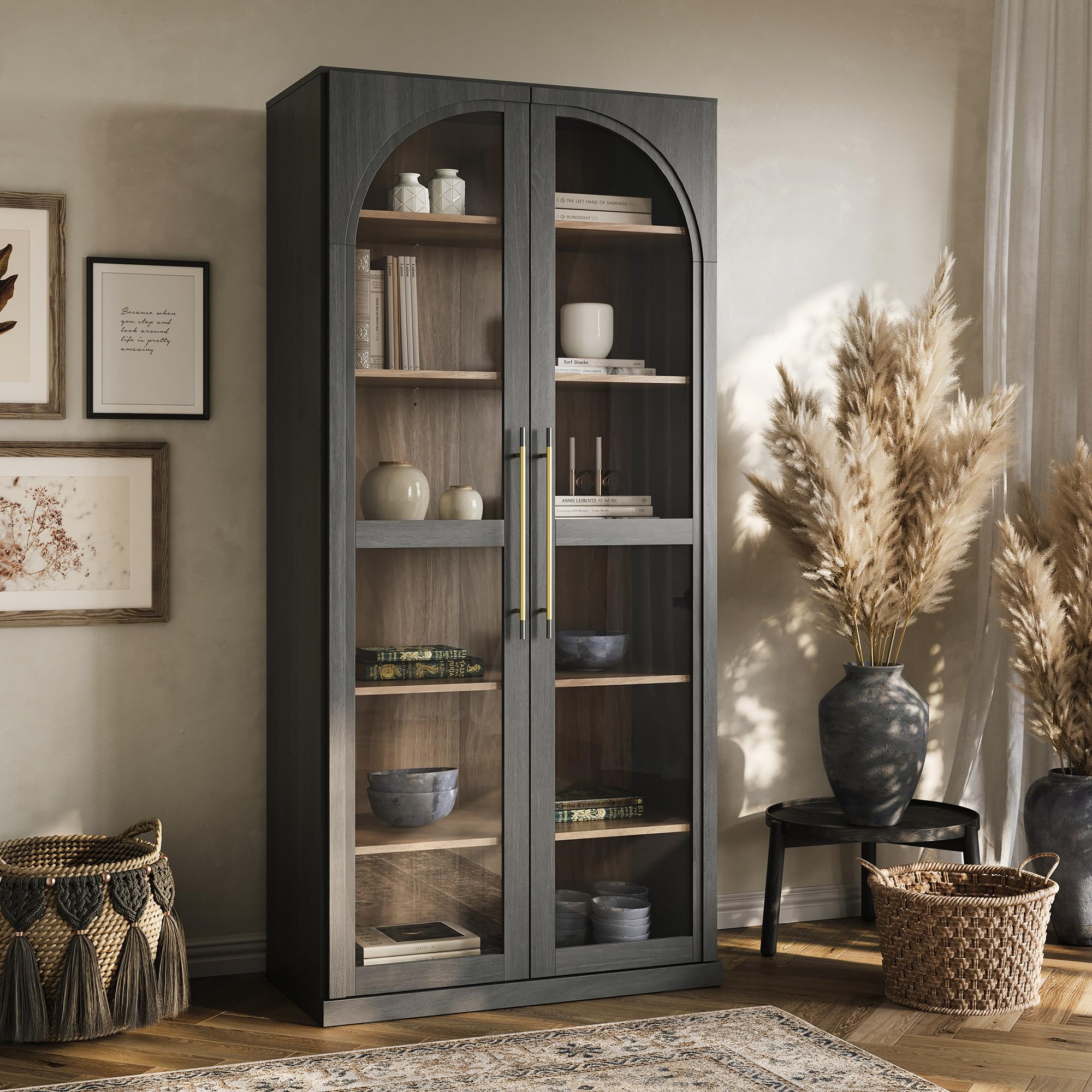
This is the most expensive cabinet here, and the money goes where it should: an ebony finish, gold handles, glass doors set into a proper frame, and 135 pounds of engineered wood that doesn't flex when a door is pulled open. From across a dining room it reads as furniture first and display case second, which is the whole argument for spending more on this one.

Six display levels put more room between your pieces than the four-tier cabinets in this group, and the top and bottom shelves adjust when you need height for a vase or a trophy. The frame is what you notice while handling it: thick sides, glass sitting flat in its rebates, and a case that stays quiet when someone leans on it.

Assembly is the honest cost of all that weight. Budget two people and an evening, one to hold each door while the hinges go on. The parts are labeled and the instructions are clear, and the payoff is a carcass that goes up square instead of needing to be talked into alignment.

Where it earns the premium is presence. The ebony finish and gold hardware give a dining room the thing most glass cabinets lack, which is a piece that still looks deliberate with the lights off. If the cabinet is headed for a hallway or a spare room, the same money buys more shelf space and better lighting elsewhere in this group; if it stands where you eat every night, this is the one we point to.

Bottom Line: We point to it when the cabinet is as much a piece of furniture as what's inside: ebony finish, gold handles, six levels.
#3

Best Closed-Storage China Cabinet

ARTPOWER 72" China Cabinet

ARTPOWER 72" China Cabinet

8.5/10 Excellent
  • Doors: Glass upper, solid lower
  • Shelves: 3 adjustable
  • Material: Engineered wood
  • Dimensions: 28.7" W x 72.1" H x 15.6" D
Check Price on Amazon

Pros

  • Glass uppers over solid lower storage
  • Three adjustable shelves behind glass
  • Distinctive dark teal finish
  • Tall 72-inch case on a narrow footprint

Cons

  • Shelves can sag under heavy serving dishes

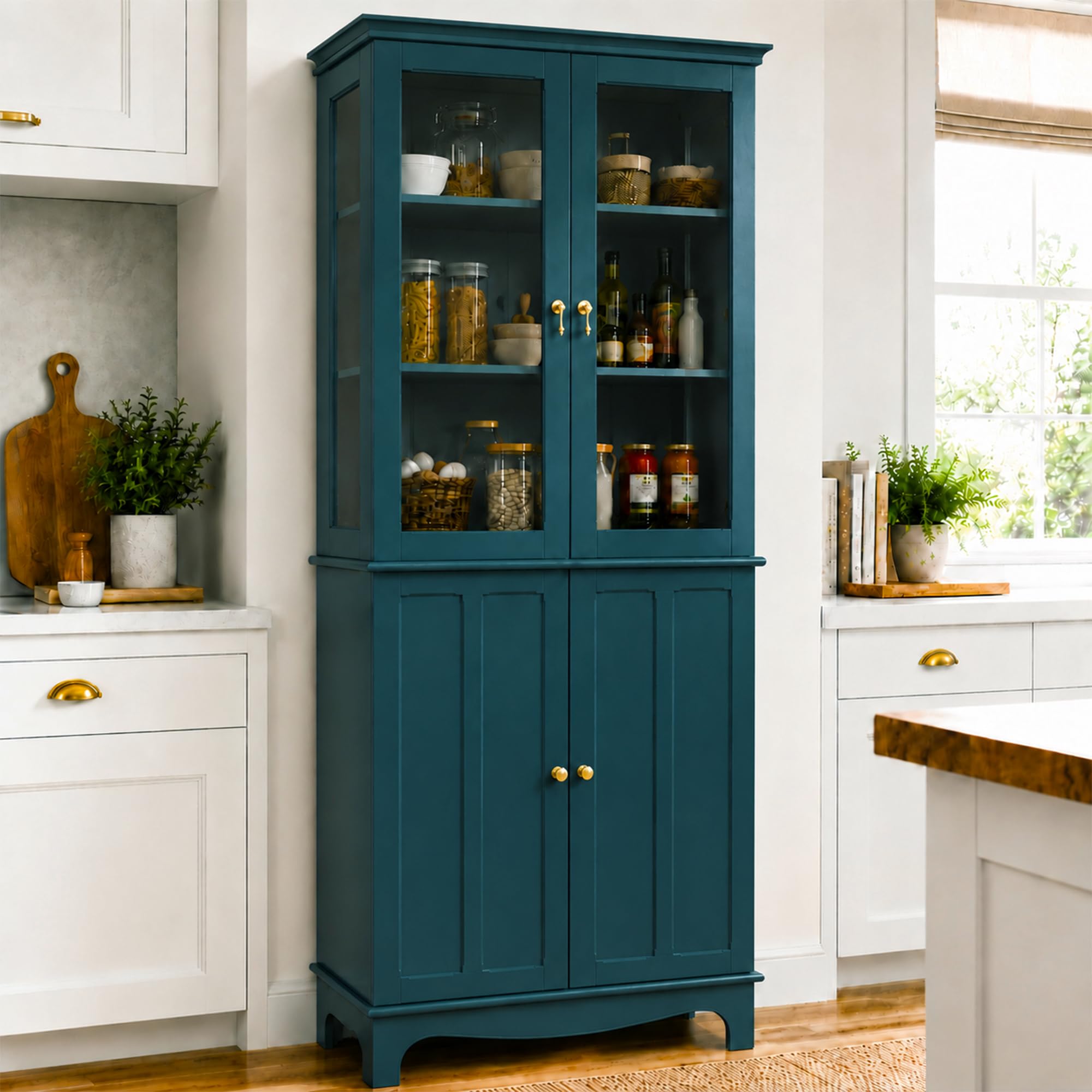
Glass on the top half, solid doors on the bottom: the oldest china-cabinet arrangement there is, and still the most useful. The tempered-glass uppers show off stemware and the good plates, while the lower solid doors take the serving pieces, the cake stand and everything else that doesn't need to be looked at.

The layout earns its place when your collection is bigger than your display space. Three adjustable shelves behind the glass let you open a gap for a tall vase or close it down for a stack of bowls, and 72 inches of height gives you storage no sideboard can match. The dark teal is the most distinctive finish in this group, a real color rather than a woodgrain compromise, and in a room with warm bulbs it looks richer than the photograph suggests.

The doors are the part to check. Hinges adjust, and a visible gap between the two glass panes is usually a matter of squaring the frame and taking your time during assembly rather than a fault in the door itself, which is why it's worth sorting before the shelves go in rather than after. At 28.7 inches wide it's also one of the narrower tall cabinets here, which matters on a dining wall broken up by a doorway or a window.

Bottom Line: We prefer this layout for anyone with more china than display space: glass above, solid doors below, 72 inches tall.
#4

Best White Cabinet with Drawers

TAGELIER 67" Cabinet with Drawers

TAGELIER 67" Cabinet with Drawers

8.4/10 Very Good
  • Drawers: 2
  • Lighting: Motion-sensor LED
  • Material: Tempered glass front, acrylic sides
  • Dimensions: 29.5" W x 67" H x 14.9" D
Check Price on Amazon

Pros

  • Two drawers hide linen and candles
  • Motion-sensor LED in three colors
  • Adjustable shelves behind tempered glass

Cons

  • Side panels are acrylic, not glass

Two drawers at the base is the detail that makes this one work in a dining room. Table linen, candles, spare place cards, all the things that otherwise live in a kitchen drawer or on a sideboard, sit directly under the display shelves, so you can set the table from one piece of furniture. It's a small planning decision that changes how the room functions.

The rest is a standard white display case done well: motion-sensor LED lighting in three colors, a tempered-glass front, and shelves that adjust so a tall vase or a stack of bowls fits behind the glass. White is the right call in a small dining room, where a dark case can make a wall feel heavy.

Assembly is the trade. This is the fussiest build in the group, with a lot of hardware, a long evening and instructions that assume some patience, so inspect the panels and count the fittings before you start rather than halfway through. What the effort buys is a white cabinet that doesn't read as a bookcase with glass in it: the drawer line and the light trim hold a small room together.

Bottom Line: We reach for this one in a white dining room with linen to store: two drawers under the display, motion-sensor lights, tempered glass.
#5

Best Budget

UNICOLY 4-Tier Glass Display Cabinet

UNICOLY 4-Tier Glass Display Cabinet

8.7/10 Excellent
  • Weight: 75.2 lb
  • Shelves: 4
  • Material: Steel, tempered glass
  • Dimensions: 27.5" W x 66.1" H x 14" D
Check Price on Amazon

Pros

  • Steel frame with tempered-glass doors
  • Light 75-pound cabinet, easy to move
  • Narrow 27.5-inch width fits short walls
  • Moisture-resistant powder-coated finish

Cons

  • No built-in lighting, so it needs a bright spot

Steel plate, tempered glass, powder coat: this is a workshop cabinet dressed for a dining room, and at just over 75 pounds it's one of the lighter tall cases here. The frame is what you're paying for, rigid and squared up, with doors that hang flat without the shimming a wood cabinet sometimes needs.

Four shelves inside a 27.5-inch width make it four inches narrower than the top pick, which is the difference on a short wall between fitting beside a doorway and not. It can be fixed to the wall, and with a case this tall and this light you should, using the brackets that come with it. Tempered glass is the other quiet advantage: if it does take a knock, it breaks into small blunt pieces rather than shards.

There's no lighting, and that's the honest trade. In a room with a chandelier or a window the glass does the work; against a dark wall you want one of the lit cabinets here instead. Where it wins is cost, since it's the least expensive cabinet in this group, and a moisture-resistant steel frame that doesn't care about a humid summer the way engineered wood can.

Bottom Line: Our budget answer: a steel-framed, tempered-glass case with four full shelves and nothing you don't need.
#6

Narrow walls

Dystler 5-Tier Display Cabinet

Dystler 5-Tier Display Cabinet

8.4/10 Very Good
  • Shelves: 2 adjustable, 2 fixed
  • Lighting: 3-color LED, motion sensor
  • Material: Engineered wood
  • Dimensions: 27.56" W x 64.96" H x 13.78" D
Check Price on Amazon

Pros

  • Lights on both sides of each shelf
  • Five tiers in a 27.56-inch width
  • Two adjustable shelves

Cons

  • Built-in lights can stop working early

The lighting is the draw here: three colors, a motion sensor, and LED strips on both sides of the case so the glow comes from behind the objects rather than straight down on them. In a dim hallway that turns a corner into a display; in a dining room it makes glassware look like it's sitting in a lit case rather than a box.

At 27.56 inches wide and just under 14 deep, this is the narrowest way to get five tiers onto a dining-room wall, and two of those shelves adjust. We like it for the awkward spot, the strip beside a doorway that's too shallow for a sideboard, because the lights do the decorating for you. The black finish and glass front keep it neutral enough to sit under almost any wall color.

Assembly is a long evening rather than a hard one; parts are labeled and the instructions are better than average for flat-pack. The listed capacity is 200 pounds for the whole case, so keep the heaviest pieces low and treat the upper shelves as display space rather than storage. For a narrow wall that needs height more than width, it does a job the wider cabinets here can't.

Bottom Line: We like it for a narrow wall: 27.56 inches wide, five tiers, and motion-sensor lights that make a dark corner usable.
#7

Kitchen-dining rooms

COFaR 71" Glass Door Cabinet

COFaR 71" Glass Door Cabinet

8.6/10 Excellent
  • Weight: 77.2 lb
  • Shelves: 4 adjustable
  • Material: Powder-coated steel, glass
  • Dimensions: 31.5" W x 70.87" H x 15.75" D
Check Price on Amazon

Pros

  • Five tiers, four of them adjustable
  • Powder-coated steel resists chipping
  • Tall 71-inch case on a 31.5-inch width
  • Anti-tip bracket included

Cons

  • No built-in lighting for a dark corner

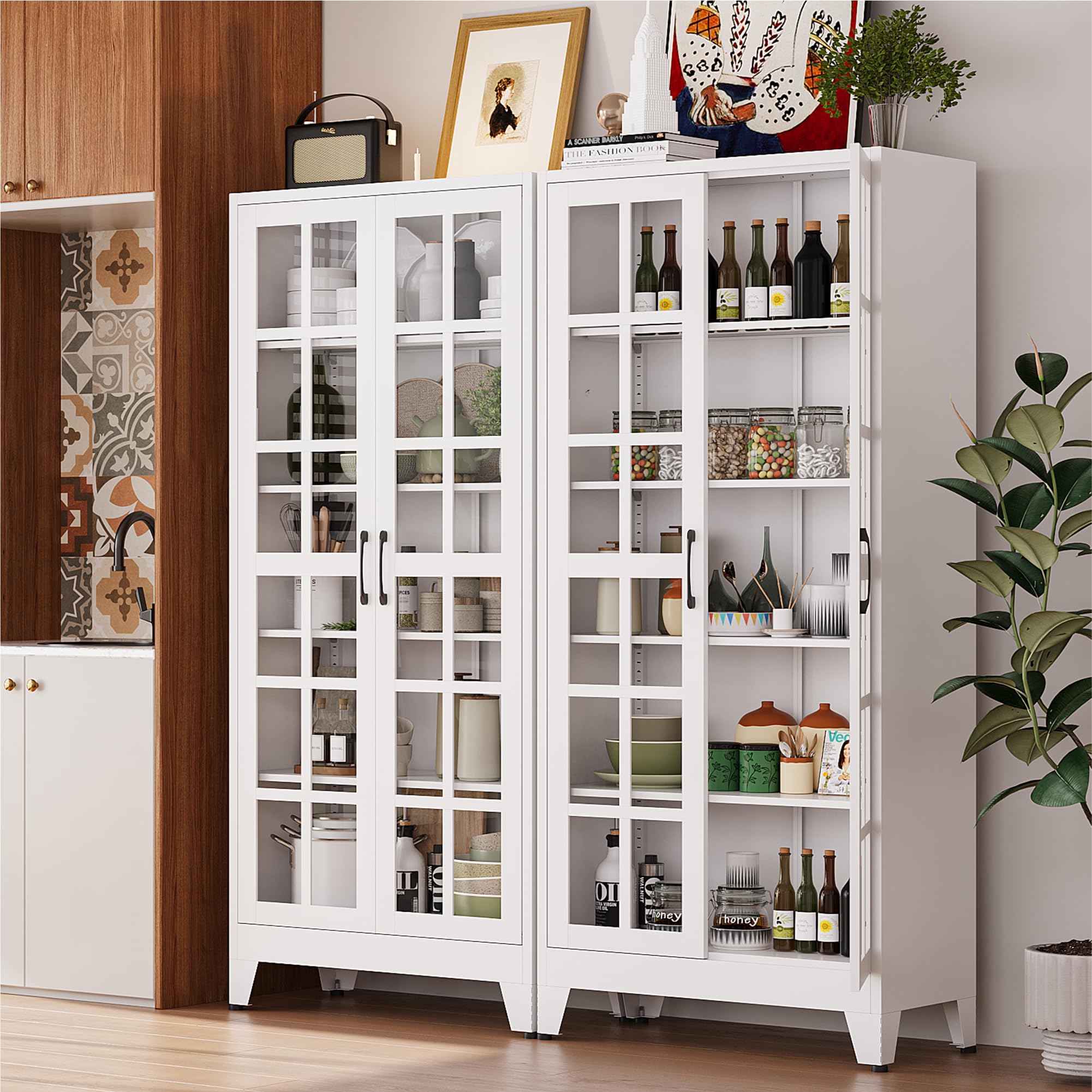
White steel, windowpane glass doors, black handles: this is the one for a bright kitchen-dining room rather than a formal one. At 71 inches tall and 31.5 wide it holds five tiers, four of which adjust, so you can set a shelf for dinner plates and the next one for a row of jars without wasting the gap between them.

It's built as a pantry, and the glass is what lets it work in a dining room. Serving pieces stay visible and dust-free, the metal frame means no veneer to chip when a chair backs into it, and the shelves reset in seconds when the collection changes. The square-grid doors divide the display into four windows rather than one sheet of glass, which suits shelves of dishes and glass jars better than a single showpiece.

This is the cabinet for a dining room that is also the pantry: a small house, an open plan, a wall that has to do two jobs. The grid is the giveaway that it's storage doing display duty, and in the right room that isn't a criticism.

Bottom Line: We recommend it for a bright kitchen-dining room where you want white, height and adjustable shelves rather than a wood curio.

How We Tested Seven Cabinets in Real Dining Rooms

We started with a long list of roughly 40 cabinets from brands we already trust for case goods, then cut anything that wouldn't fit a standard dining wall, anything with fixed glass shelves that couldn't hold a stack of dinner plates, and anything where the price didn't match the material listed in the specs. Seven made it into homes, where they stayed for eight months.

Assembly came first: two of us built each one and timed it, noting whether the cam locks lined up on the first pass or needed a re-drill, and whether the back panel went on square. Then we loaded them like real people do — stacks of plates, a row of stemware, a case of wine on the bottom shelf — and checked for wobble on an old, uneven floor to see whether the leveling feet did anything. We opened and closed every door 20 times at install, then again at weeks two, eight, sixteen, and thirty-two, watching for sag, rubbing, and rattles, and noting whether the soft-close mechanism still caught at the end.

For lighting, we left each cabinet on for six straight hours to see whether the LEDs dimmed, flickered, or warmed the glass, and whether the switch was reachable without opening the door. We wiped fingerprints off the finish, watched the veneer edges and glass shelves under a west-facing window for fading and clouding, and asked ourselves at the end whether we'd pay the asking price again.

How to Choose Dining Room Display Cabinets

Start with the footprint

The cabinets here run 27.5 to 31.5 inches wide and 65 to 72 inches tall, and roughly 14 to 16 inches deep. Depth is the dimension people forget: at 14 inches the case sits close to the wall, at 16 it starts to compete with chair backs. Tape the footprint on the floor, then walk the delivery route. Flat packs arrive long and heavy, and a tight stairwell decides more purchases than a finish does.

Decide what stays hidden

An all-glass front gives you the most display for the width, and it keeps a small room feeling light. A cabinet with solid lower doors gives you somewhere for the serving dishes and the pieces that don't deserve a shelf behind glass. Neither is better; the question is whether your collection is mostly objects to show or mostly things to store. Our top pick is all glass, and the ARTPOWER splits the difference with glass above and solid doors below.

Look at shelf spacing, not shelf count

Five shelves set at the wrong heights hold less than four you can move. Adjustable shelves let you open a gap for a tall vase or close it down for a row of cups, and two adjustable shelves is the minimum worth having in a tall case. Then check the depth: 14 inches takes a dinner plate standing on edge, but a covered tureen wants more. Heavy stoneware also loads the shelf supports harder than glassware does.

Lighting: useful, not essential

Built-in LEDs turn a case into a display and a dull corner into a feature, and the motion sensors on the lit cabinets here mean you aren't hunting for a switch with your hands full. Two things to weigh. The light is one more component that can fail, and every lit cabinet needs power, so work out where the cord runs before you commit to a wall. In a bright room, an unlit case is perfectly good.

Build, assembly and anchoring

Steel frames arrive square and bolt together; engineered wood is heavier and reads more like furniture, and the weight is a fair guide to how rigid the finished case feels. Either way, plan an evening and two people once glass is involved. Then anchor it. A tall glass cabinet should be fixed to the wall with the bracket in the box, because a case that tips is a hazard whether or not anyone is in the room.

Frequently Asked Questions

Final Verdict

We recommend the BROTTAR to most dining rooms. The 14-inch depth is the practical part, because the cabinet stays out of the chair zone, and four lit tiers let you rotate a collection instead of cramming it.

If your china and your serving dishes are competing for the same shelves, the ARTPOWER adds a closed lower half and 72 inches of height. Buy the BELLEZE only when the cabinet itself has to carry the room.