Dining Room

Best Small Buffet Cabinets of 2026

A buffet cabinet is the piece you don't think about until you're hosting and every serving dish, platter, and bottle of wine is fighting for the same two feet of kitchen counter. In my last apartment the dining table doubled as a sideboard, and I moved the same stack of plates three times before dinner. A small buffet fixes exactly that: one waist-high surface that stores the tableware and holds the drinks without taking over the wall. The trouble is that small scale is where cheap furniture gets exposed—thin panels, doors that hang crooked the moment they're on their hinges.

Over the past seven months I've built, loaded, and lived with 10 of them, and the pattern was clear: the ones that survive a dinner party are sturdy and aligned first, good-looking second. Something first-time buyers learn the hard way—measure the wall, then subtract for baseboard and trim, because a cabinet that's flush on paper rarely is once it's in the room. The picks below all did that math and held up.

#1

Best Overall

Smuxee Walnut Sideboard

Smuxee Walnut Sideboard

8.9/10 Excellent
  • Depth: 14.9 in
  • Shelf: Adjustable, 3 heights
  • Width: 31.5 in
  • Storage: 2 compartments behind 2 doors
Check Price on Amazon

Pros

  • Walnut line-groove doors look far richer than the price
  • Shelf adjusts to three heights for tall bottles
  • Labeled parts and straight holes make the build easy

Cons

  • No drawers, just two shelf compartments

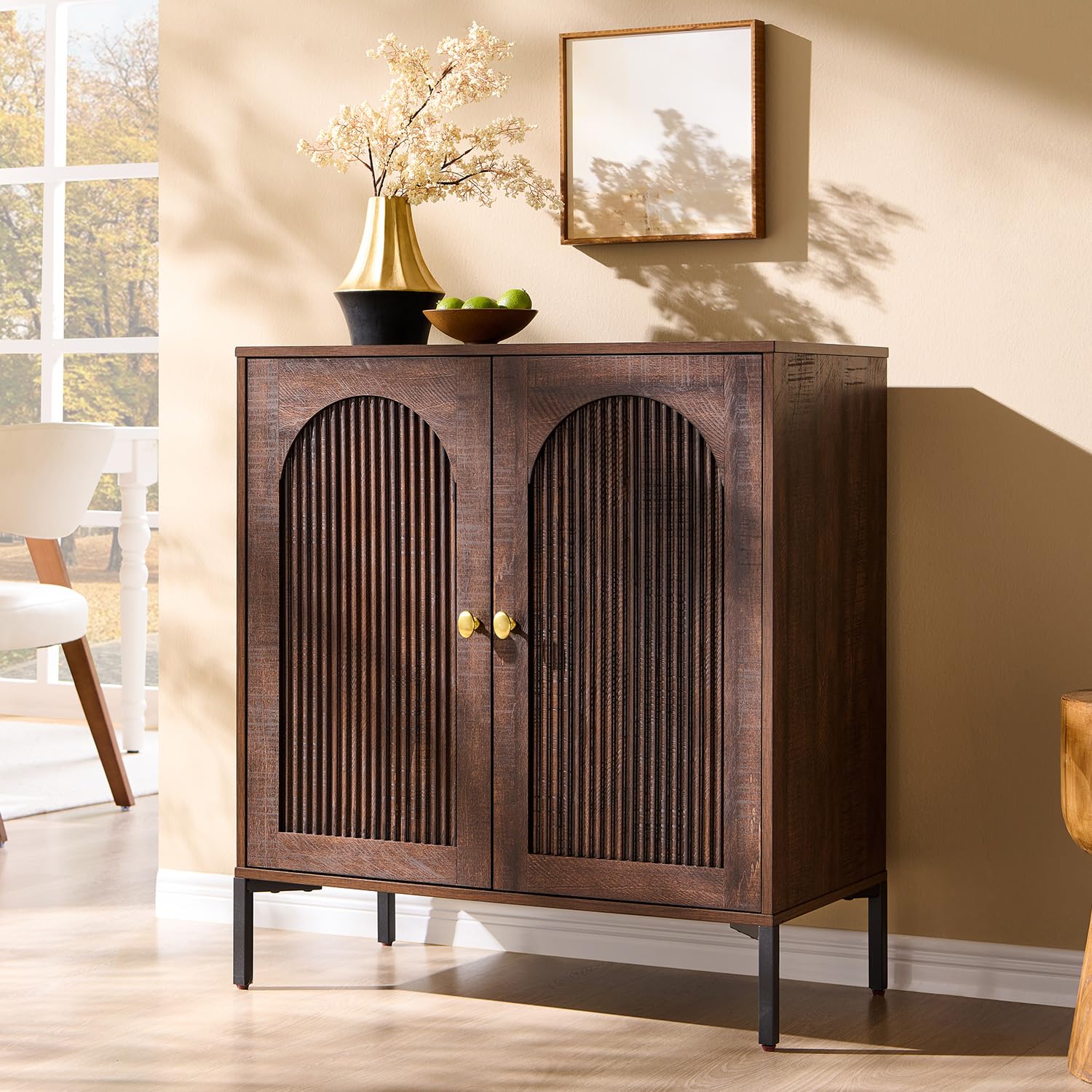
Line-groove doors are the first thing a cheap sideboard drops, so finding them on a cabinet priced alongside the plain boxes here got our attention. The walnut finish reads warmer in a room than it does on a screen, the gold handles are small and quiet, and at 31.5 inches wide and 14.9 inches deep the whole thing asks for a wall rather than a room.

Inside, each of the two compartments takes a shelf that moves through three heights. We set ours high so a coffee maker and tall bottles stand upright, then dropped one back down for plates. That adjustability is the reason this ends up as our default ahead of cabinets with fixed shelves. The top sits at 30.6 inches, comfortable for pouring and serving and lower than a kitchen counter, so plan on a sideboard rather than a prep surface.

The build is the quiet win. Panels are labeled, the holes line up, and one person gets through it in an evening without improvising. Ours needed a small turn of a hinge screw before the doors sat flush, and then they stayed flush.

What you give up is heft. This is veneered engineered wood, and the edges will show it if you drag the cabinet across a floor or move it every spring, so treat it as furniture for a spot you are keeping.

It is the one we kept coming back to, and the small buffet most people should start with. If the space grows, a second unit pushed alongside makes a longer run without looking like two cabinets.
Bottom Line: Buy this if you want a small buffet that looks considered: walnut line-groove doors, three shelf heights, and a genuinely easy build.
#2

Best for Tight Corners

Mericonia Grille Buffet

Mericonia Grille Buffet

8.9/10 Excellent
  • Depth: 15.6 in
  • Width: 28.3 in
  • Door Style: Grille slats, no handles
  • Compartments: 3 behind 2 doors
Check Price on Amazon

Pros

  • 28.3-inch width fits corners and short walls
  • Three compartments with an adjustable shelf
  • Handleless doors will not snag in a hallway
  • 15.6-inch depth takes a full coffee maker

Cons

  • No drawer, so small items sit on the shelves

It ties for the highest rating in this group, and the proportions explain it: 28.3 inches wide, 15.6 inches deep, 31.5 inches tall. That is small enough for the corner between a sofa and a doorway and deep enough for a real coffee setup.

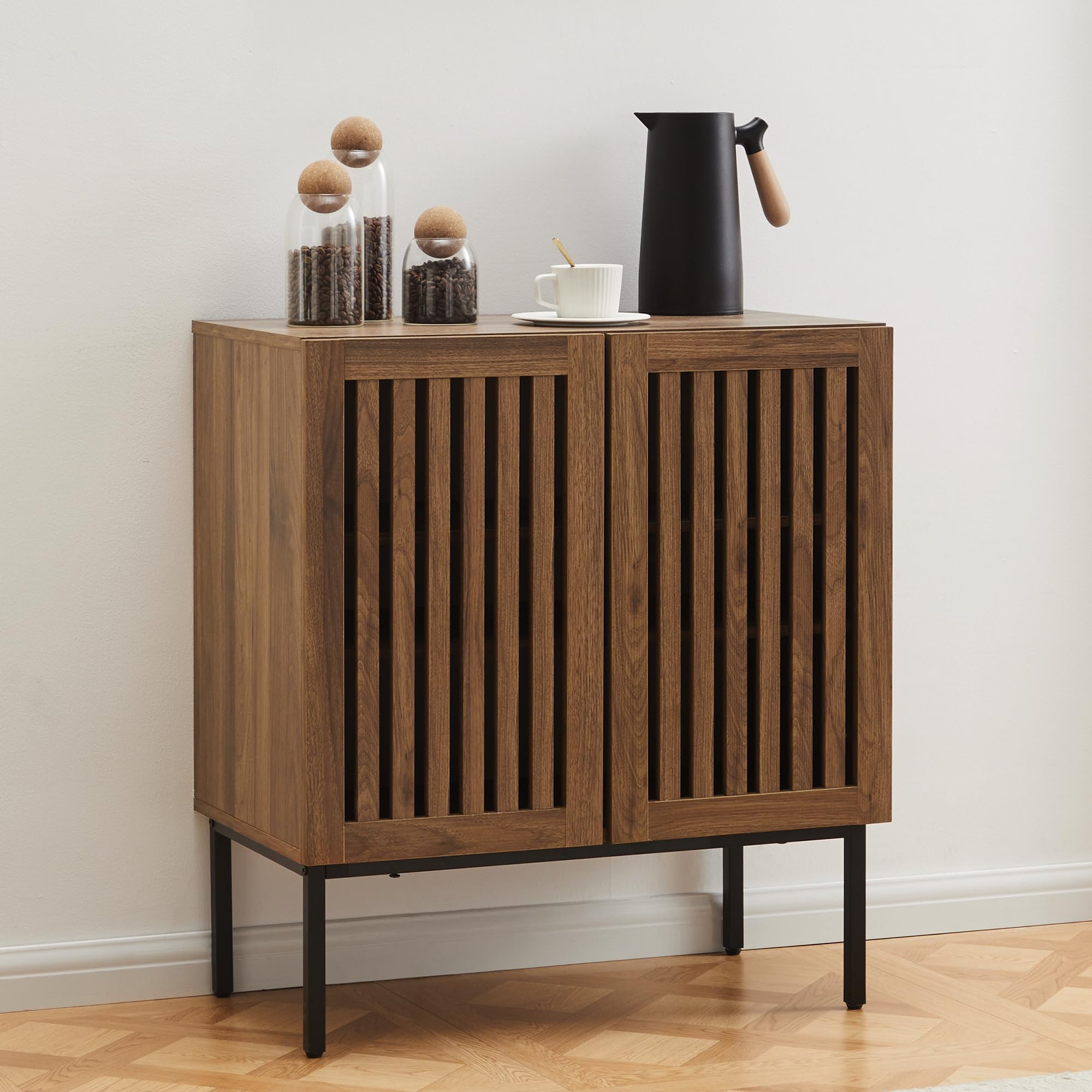
Three compartments sit behind the two grille doors, with a shelf that moves to take taller items, and there is no hardware on the front at all, so nothing catches a coat sleeve or a shopping bag in a hallway. The walnut tone is warm without going red, and the metal base lifts the whole thing off the floor, which keeps a small room feeling less crowded.

The grille is the detail to weigh before you buy. Those slats let you see what is on the shelves, which is charming when they hold matching canisters and much less so when they hold the paperwork you stuffed in five minutes before guests arrived. If the point is hiding clutter, this is the wrong cabinet; if the point is showing off jars and a good set of cups, it is the right one.

Bottom Line: Our narrow-corner pick: the joint-highest rating here, a 28-inch footprint, and grille doors that suit a display rather than a hiding place.
#3

Best for Drawer Storage

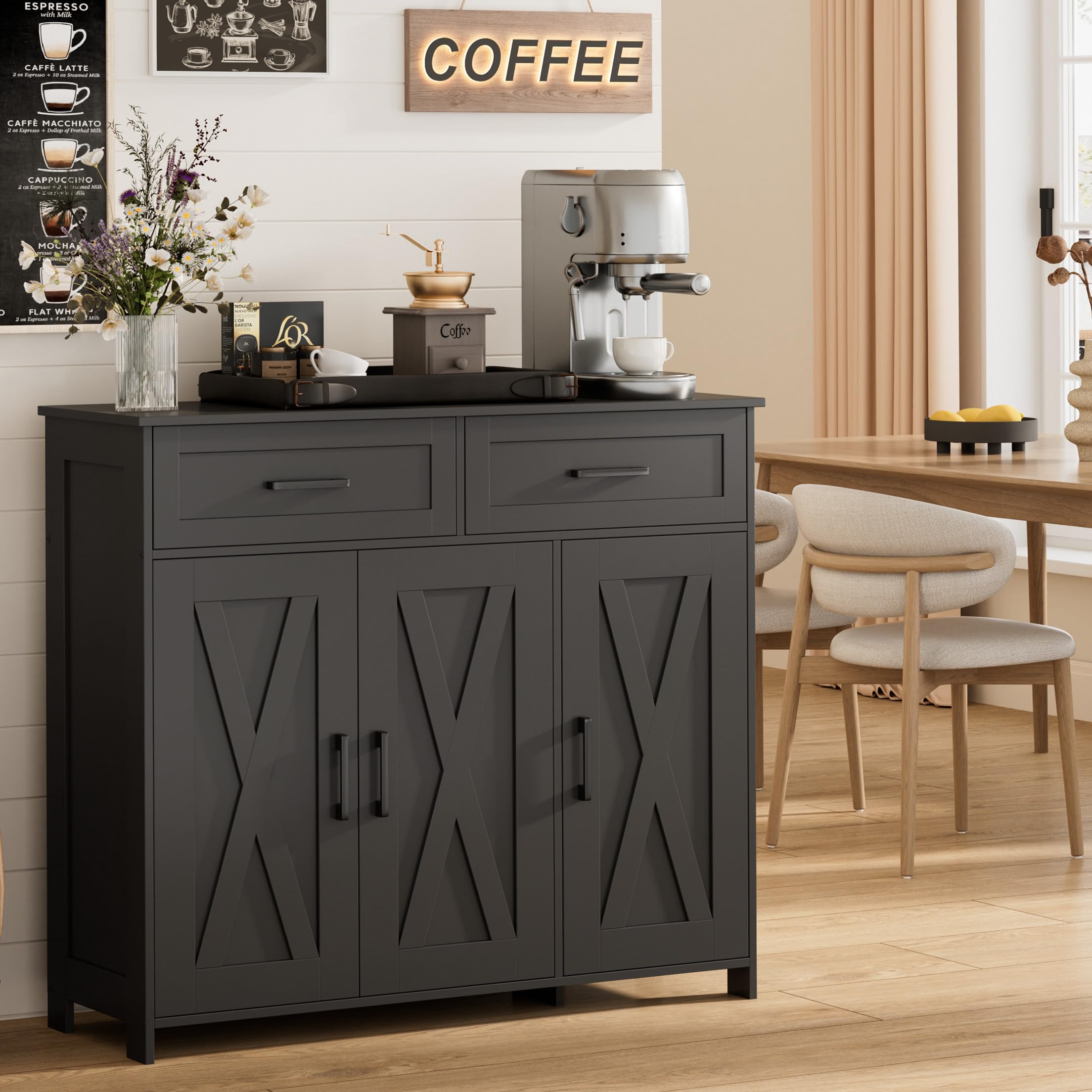
Homhedy Farmhouse Cabinet

Homhedy Farmhouse Cabinet

8.5/10 Excellent
  • Depth: 11.8 in
  • Shelf: Adjustable, 3 heights
  • Width: 35.4 in
  • Storage: 3 doors, 2 drawers
Check Price on Amazon

Pros

  • Three doors and two drawers, the most storage here
  • Shelf adjusts through three height levels
  • Anti-tip kit included in the box
  • Shallow body hugs a hallway wall

Cons

  • Only 11.8 inches deep inside

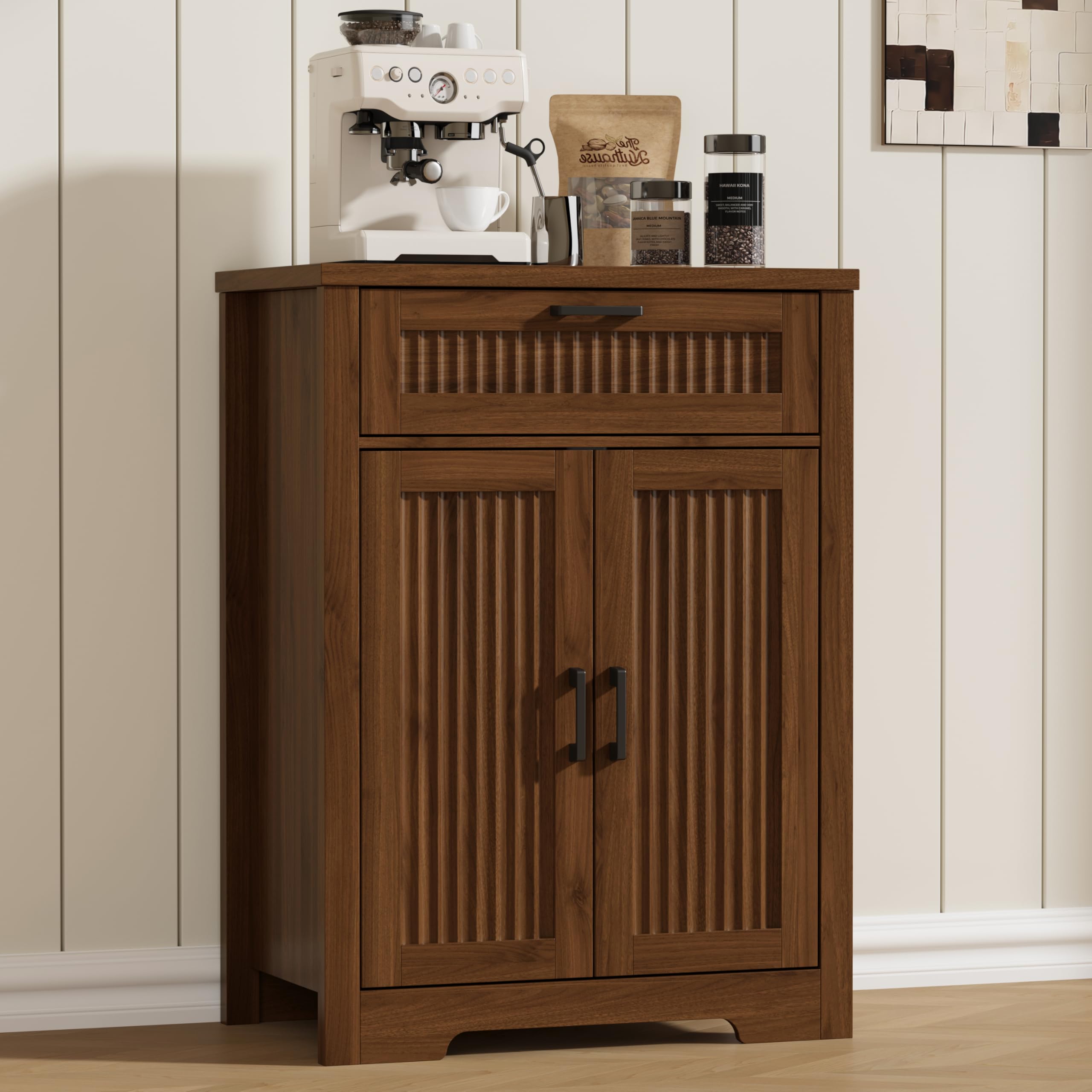
Two drawers and three doors behind a 35.4-inch front is more closed storage than any other cabinet here, and that is the whole case for this one: it is the pick when the clutter is small, varied, and needs a lid on it.

The layout does what a buffet is supposed to do. The top takes a coffee machine and a row of cups, the three doors open onto a shelf that adjusts through three heights, and the drawers swallow cutlery, napkins, pods, chargers, everything that otherwise lives in a bowl on the counter. An anti-tip kit comes in the box, which we are glad to see on a cabinet with this much frontage.

The drawers are the honest compromise: they run on wooden grooves rather than metal slides, so they are smooth with light contents and stubborn once you fill one with cast iron. Keep them for the small stuff and they do the job. Assembly is well handled, with labeled panels, diagrammed steps, and nothing beyond a screwdriver.

At 11.8 inches deep it tucks into a hallway where a standard sideboard would block the walk, and at 35.4 inches wide it is the broadest cabinet in this group, so give it a wall with room to spare.

Bottom Line: For a small room that needs drawers, this is the one: three doors, two drawers, adjustable shelving, and a body shallow enough to hug a hallway wall.
#4

Best Budget Coffee Bar

SWTYMIKI Coffee Bar Cabinet

SWTYMIKI Coffee Bar Cabinet

8.6/10 Excellent
  • Depth: 11.81 in
  • Frame: Iron and wood
  • Width: 27.95 in
  • Storage: 1 drawer, 1 see-through door
Check Price on Amazon

Pros

  • Espresso finish and see-through door look like a cafe
  • Adjustable feet level out an uneven floor
  • Light enough to position alone
  • The cheapest coffee-bar cabinet here

Cons

  • 11.8-inch depth suits coffee gear, not dinnerware

There is a coffee-shop look to this one, with an espresso finish, a see-through door and a top made to hold the machine, and it is the cheapest way here to turn a dead corner into something that looks deliberate.

The adjustable feet are the detail we did not expect to care about and did. Kitchen floors and rental floors are rarely level, and a cabinet that rocks every time you pull the drawer open gets old in a week; a couple of turns and this one sits flat. The drawer takes pods and a scoop, the shelves take mugs and beans, and the see-through door means you can see what you are low on without opening anything. For the money, that is a better coffee station than the price suggests.

At 7 kg it is light enough for one person to walk into position, and the instructions take a read-through before they click, so lay the panels out and match them to the diagrams first. Do that and it goes together without drama.

Bottom Line: The budget coffee-bar pick: espresso finish, a see-through door, and adjustable feet that settle it flat on a floor that is not level.
#5

Best Fluted Style

REHOOPEX Fluted Cabinet

REHOOPEX Fluted Cabinet

8.6/10 Excellent
  • Depth: 13.7 in
  • Width: 30.3 in
  • Weight: 45 lb
  • Storage: 2 doors, 2 shelves
Check Price on Amazon

Pros

  • Fluted doors read as texture, not a flat panel
  • Shelf adjusts for taller items
  • Neutral natural finish suits most rooms
  • Hinge screws let you level the doors yourself

Cons

  • No drawer, so small items stay on the shelves

The fluted fronts are the pitch, and they deliver: vertical grooves read as texture from across a room, which is exactly what a small cabinet needs to stop looking like a box. They also collect dust, which settles into the channels, so a soft brush every couple of weeks keeps it from becoming the first thing you notice.

Behind the doors, two compartments take a shelf you can move, so a tall bottle or a coffee maker fits upright. The natural finish is neutral enough to sit under almost any wall, the metal handles feel sturdier than the rest of the cabinet's price suggests, and the surface is finished to shrug off a wiped-up spill.

Check the doors when it arrives. If they do not sit flush, the adjustment lives in the hinge, where a screw inside each hinge pulls the door level a quarter turn at a time. Ours settled that way, and it is ten minutes of fiddling rather than a return.

Where it gives ground to the top pick is depth: 13.7 inches against 14.9, which you will notice with dinner plates, since they have to go in at an angle. On a dining wall where the machine lives on top and the plates live in the kitchen, that is an easy trade for a finish this good.

Bottom Line: The fluted look without the designer price: textured doors, a movable shelf, and a natural finish that makes a small cabinet look like a choice.
#6

Narrow hallways

Iwell Herringbone Cabinet

Iwell Herringbone Cabinet

8.3/10 Very Good
  • Depth: 11.8 in
  • Width: 27.5 in
  • Safety: Anti-tip device included
  • Top Capacity: 150 lb
Check Price on Amazon

Pros

  • Shallowest body here at 11.8 inches
  • Herringbone front adds pattern to a plain wall
  • 150-pound top takes a microwave
  • Anti-tip device included

Cons

  • Shallow interior limits what fits on the shelves

At 11.8 inches, this is the shallowest cabinet in the group, and that is the reason to look at it. In a hallway or a galley kitchen, a cabinet that stands off the wall by less than a foot leaves the walkway alone, which is the difference between a piece of furniture and an obstacle.

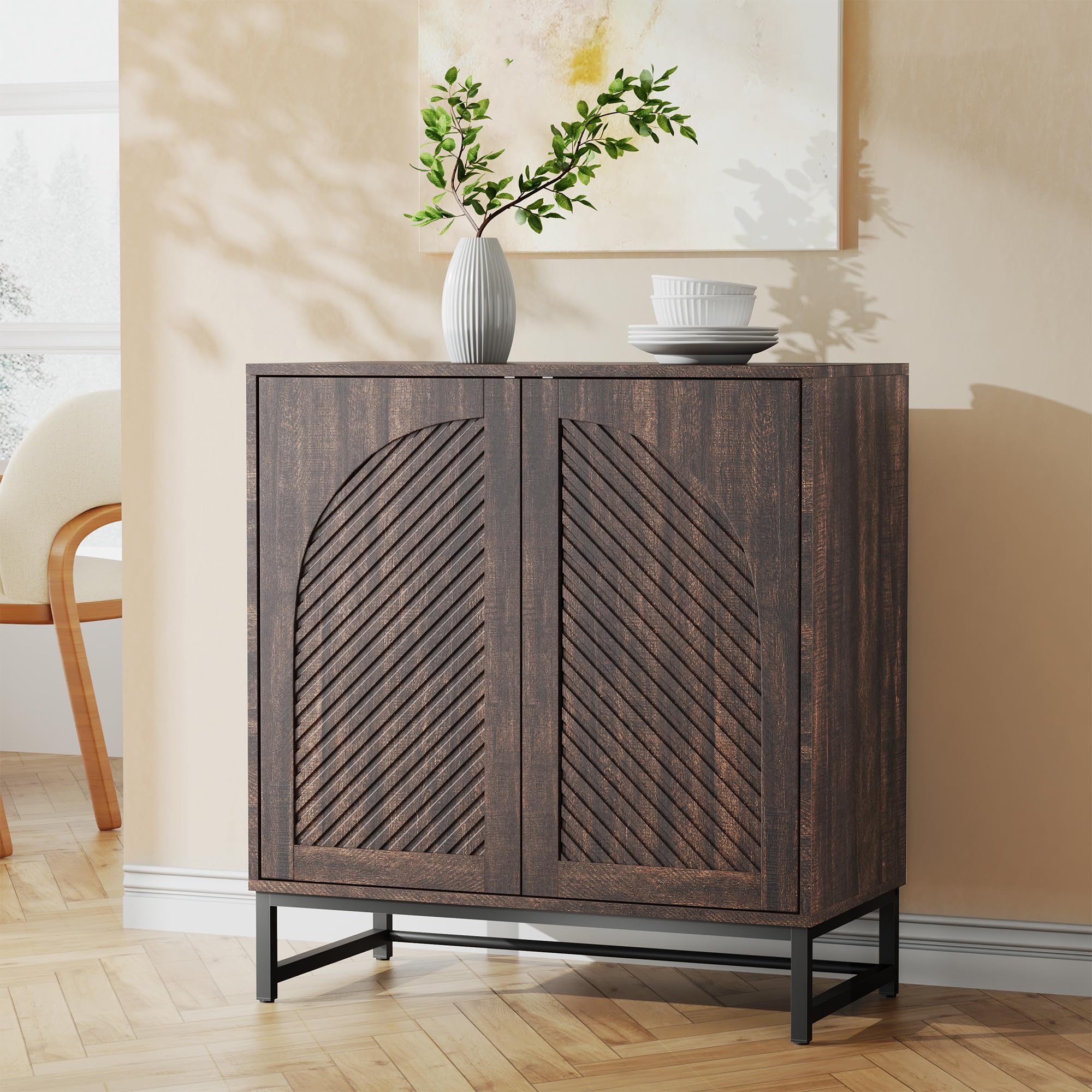
The front is the other draw. A staggered herringbone grain in dark and light tones gives it more pattern than anything else here, which is useful when the cabinet is the only furniture in a narrow entry. The top is rated to 150 pounds, so a microwave or a full coffee setup sits well within it, and an anti-tip device comes in the box.

Inside is one open compartment with two shelves, so it rewards a little organising: a couple of canvas bins for the ugly stuff, a tray for the cups, and the top left for a lamp and a bowl. That is a cabinet you arrange rather than one that arranges for you, and for a hallway that is usually fine.

Bottom Line: The shallowest cabinet here, and the right one for a hallway: herringbone front, a 150-pound top, and room for a microwave.
#7

Statement wall piece

IFGET Arched Sideboard

IFGET Arched Sideboard

8.6/10 Excellent
  • Depth: 15.75 in
  • Width: 30.88 in
  • Height: 34 in
  • Base Clearance: 5.7 in
Check Price on Amazon

Pros

  • Arched fluted doors look far more expensive than they are
  • 34-inch height uses wall space in a small room
  • 5.7-inch clearance lets a robot vacuum under
  • Adjustable shelf behind the doors

Cons

  • No drawer, and only one shelf to divide the space

The arch is doing real work. Two fluted doors under a curved top make this the best-looking cabinet in the group, and at 34 inches tall it fills a wall that a 30-inch sideboard leaves looking bare. In a small room where the furniture has to carry the decorating, that is most of the argument.

The 5.7-inch gap under the base is the detail we did not expect to like as much as we did, because a robot vacuum gets underneath and a cabinet that does not collect a grey skirt of dust is a small daily win. Inside, one adjustable shelf splits the space, which is enough for a coffee maker up top and serving pieces below.

The doors are where this one asks for patience. They can arrive out of square, and getting them flush and even takes repeated small adjustments to the hinge screws: doable, occasionally fiddly, and not always perfect. One more caution if you buy, peel any label or sticker slowly, because the finish can lift with it.

Bottom Line: It earns its place on looks: arched fluted doors, a 34-inch height that uses wall space, and a base high enough for a robot vacuum to pass under.
#8

Modular runs

HOLCEPZN Fluted Sideboard

HOLCEPZN Fluted Sideboard

8.7/10 Excellent
  • Doors: Push-to-open
  • Shelf: Adjustable
  • Safety: Anti-tip device included
  • Modular: Combine up to 3 units
Check Price on Amazon

Pros

  • Buy one, two or three and combine them
  • Push-to-open doors with no handles to snag
  • Arched fluted front adds real texture
  • Anti-tip device included

Cons

  • One unit covers less than a full sideboard

Buy one, two or three and line them up, that is the premise here, and for a first apartment it is a better one than it sounds. One unit handles an entryway now; a second turns the pair into a sideboard when you move somewhere with a dining wall.

The details back it up. Push-to-open doors mean no handles to snag on a bag or sit crooked, the arched fluted front gives it more texture than the flat-panel cabinets here, the shelf adjusts, and an anti-tip device comes in the box. Walnut panels over a dark base read modern without going cold, which is harder to pull off than the photos suggest.

The build is the tax. This is a cabinet to spread over an afternoon with a second pair of hands rather than a quick evening job, and the flat-pack hardware is unforgiving if you rush the panels. What you end up with looks like a modular system rather than a single piece of flat-pack, which is the point.

Bottom Line: For renters and growing spaces: a single fluted unit with push-to-open doors that you can add to later.
#9

Tightest gaps

jmhdyg Fluted Buffet

jmhdyg Fluted Buffet

8.5/10 Excellent
  • Depth: 15.35 in
  • Width: 25.19 in
  • Height: 34.25 in
  • Storage: 1 drawer, 2 doors
Check Price on Amazon

Pros

  • Narrowest cabinet here at 25.19 inches
  • Drawer keeps small clutter off the top
  • 34.25-inch height uses wall space
  • Hinges adjust in height and depth

Cons

  • Narrow top leaves little room beside a coffee maker

Twenty-five inches wide is a gap most sideboards cannot fill, and that is the niche: the wall segment between a door frame and a window, the slot beside a fridge, the strip at the end of a counter. At 34.25 inches tall it spends height instead of floor, which is the right trade in a small room.

The drawer is what makes it useful rather than merely narrow. It takes the clutter that otherwise migrates to the top, things like bottle openers, spare pods and takeaway menus, and the door below opens onto a shelf that moves for a taller machine. That mix of a drawer, a full-height door and adjustable shelving is what separates it from the cheaper coffee-bar cabinets.

The fluted walnut front is a nicer finish than the price suggests, and the hinges adjust in both height and depth, so squaring the doors is a matter of small turns rather than luck. Seat the panels gently during the build, because engineered wood does not enjoy being forced.

Bottom Line: The narrowest cabinet in this group, and the one for a 25-inch gap: a drawer, adjustable shelving, and height instead of floor space.

How We Tested: Assembly, Alignment, and a Real Plate Load

We started with a list of roughly 60 cabinets and cut it down using the things you can check before you buy: footprint, listed materials, weight, and whether the dimensions in the photos matched the dimensions on the spec sheet (more often than you'd think, they don't). Anything wider than 42 inches, or that clearly belonged in a full dining room, came off. That left 10, a mix of flat-packed and partially assembled pieces running from budget particleboard to solid wood.

Each one was assembled in a real dining room with the tools a normal person owns, and I timed it solo from unboxing to the last screw. I followed the instructions in order and wrote down every place they skipped something: hardware counts that didn't match, diagrams showing a panel from the wrong side, a step that assumed two people.

Then we loaded them. Every cabinet took the same 30-pound kit—dinner plates, a stack of bowls, glassware, a few bottles. I ran a finger along each door gap before loading and again after, opened and closed every door 50 times to see whether the hinges drifted, and pressed down on one top corner to feel how much the frame racked. Doors that rubbed, or sat proud at the top and tucked at the bottom, got flagged.

Over seven months they lived through dinner parties, holiday storage, and one cross-town move. Spills got wiped with a damp cloth and checked for rings, corners got knocked against chairs, shelves were adjusted and reloaded. At the end we asked the only question that really settles value: knowing how it looks after seven months of use, would I buy this again at this price?

How to Choose Small Buffet Cabinets

Measure the wall, then measure the room

Width is the easy half. The cabinets here run from 25 to 36 inches, so almost any short wall has a candidate. Depth is what catches people out: an 11.8-inch cabinet leaves a hallway walkable, a 15.75-inch one turns the same hallway into an obstacle course, and that gap is most of a doorway swing.

Then think about what goes inside. Dinner plates are 10 to 11 inches across, so anything under about 12 inches deep takes them at an angle or lying flat, and a full-size coffee machine wants 12 to 14 inches plus room for the plug. Tape the footprint on the floor and walk past it for a day before you order.

Decide whether the top is a work surface or a display

A cabinet 30 to 32 inches tall puts the top below kitchen counter height, which is comfortable for pouring and serving and less so if you picture standing at it with a knife. The 34-inch cabinets here sit closer to counter height and read more like furniture than like a side table.

The other half of that decision is the outlet. A coffee station wants a socket within reach of the machine without a cable stretching across the top, so check where the wall plug is before you fall for a cabinet that covers it.

Look for shelves that move

An adjustable shelf is the feature that keeps earning. Three height positions let you stand a coffee maker, a syrup bottle or a blender upright, then drop back down when the machine moves to the counter. Cabinets with fixed shelves photograph identically and limit you from day one.

Drawers are the other half of the layout. The Homhedy's run on wooden grooves rather than metal slides, which is fine for cutlery and pods and frustrating with anything heavy. Watch the door style too: grille slats and see-through panels show what is inside, which is charming for matching jars and unforgiving for clutter.

Expect flat-pack, and plan for the finish

Every cabinet here arrives as panels, and the build is the most variable part of owning one: numbered parts and diagrammed steps make an evening's work, while a wordless instruction sheet turns the same job into a weekend. Lay the panels out and match them to the pictures before you tighten anything, and expect to adjust hinges once the cabinet is standing.

The material is engineered wood with a veneer or laminate, so lift rather than drag when you move it, wipe coffee spills promptly, and peel any label slowly because the finish can come with it. Fit the anti-tip strap where one is supplied, particularly if a machine is going on top.

Frequently Asked Questions

Final Verdict

The Smuxee walnut sideboard is our pick for most small rooms: it looks like a considered piece rather than a flat-pack compromise, the shelf moves to take a coffee maker, and it comes together in an evening.

Go to the Homhedy if drawers are non-negotiable and the wall can take 35 inches. Go to the Mericonia if the corner is genuinely tight and the shelves will hold jars rather than paperwork.