Entryway

Best Boot and Shoe Racks of 2026

A shoe rack has one easy job until winter shows up, and then a much harder one. Wet leather, heavy rubber soles, and a pair of tall boots that outweigh everything else on the shelf will expose a flimsy rack faster than any product photo can. I learned that the expensive way, with a wire rack that bowed in the middle and kept a permanent dent shaped like a heel. The right one gets wet boots off the floor, keeps the pile from spreading into the hallway, and looks like furniture instead of a dorm-room afterthought.

Over the past eight months, my team and I have assembled and loaded 12 racks, from slim bamboo towers to steel frames. Assembly is usually where the favorites separate themselves, and anything that needs two people and a hex key had better earn it. One piece of advice for first-time buyers: capacity ratings are counted in flats, so if your household lives in boots, halve the number on the box. The picks below survived that math.

#1

Best Overall

KEETDY 3-Tier Long Shoe Rack

KEETDY 3-Tier Long Shoe Rack

9.3/10 Outstanding
  • Capacity: Up to 15 pairs
  • Stackable: Two sets make six tiers
  • Dimensions: 11.4 x 43 x 24.4 inches
  • Shelf Clearance: 8 inches
Check Price on Amazon

Pros

  • 8-inch shelf gaps keep tall boots upright
  • Holds up to 15 pairs across three tiers
  • Two sets stack into six tiers
  • 50 lb frame takes boots and baskets

Cons

  • Needs 43 inches of clear wall
  • Wire frame looks utilitarian outside a closet

Most three-tier racks are spaced for sneakers, which is why a pair of tall boots ends up on its side across two shelves, creased at the ankle and eating a slot and a half. This one leaves 8 inches of clearance and lets you lift the middle tier out entirely, so a boot stands up the way it does in a shop. That detail is why it is our top pick: it handles the boot half of the job better than anything else here without giving up shoe capacity to do it.

Forty-three inches wide, 11.4 deep, up to 15 pairs — five to a shelf, or more if you double up smaller shoes and use the floor beneath. A second set stacks into six tiers, which is how one of these ends up serving a whole household instead of one person's rotation. The frame is rated to 50 pounds, enough for boots and for the occasional basket of gloves and hats.

We liked the finish more than we expected to. Matte black wire disappears against a closet wall and doesn't look cheap beside decent hangers. It is still a wire rack, though, and in a finished hallway it reads as utility — the HOOBRO is the pick when the rack has to be looked at.

The real constraint is length. Forty-three inches is a long wall: ideal under a closet rail with boots standing, impossible in a narrow entry, where the LANTEFUL tower gets a similar pair count into 17 inches. Measure the wall before ordering, because the length is the whole decision.

Bottom Line: If you own tall boots, this is the one we point you to: 8 inches between shelves, a tier you can lift out, and 15 pairs across a 43-inch span.
#2

Best for Small Closets

Simple Houseware 3-Tier Wired Rack

Simple Houseware 3-Tier Wired Rack

9.2/10 Outstanding
  • Capacity: 9 pairs
  • Stackable: Yes
  • Dimensions: 10.6 x 26.5 x 19 inches
  • Weight Capacity: 30 lb per shelf
Check Price on Amazon

Pros

  • Slides under hanging clothes at 19 inches tall
  • Nine pairs in a very small footprint
  • 30 lb per shelf for a wire frame
  • Connects to a second unit

Cons

  • Fixed shelves leave no room for tall boots

The strip of floor under a rail of hanging clothes is dead space in most closets, and this rack is cut for it: 19 inches tall, 26.5 wide, 10.6 deep. It slides under the hems, holds nine pairs across three shelves, and takes a second unit on top when the shoe count outgrows the floor.

We recommend it for exactly that closet job, because the design commits to compact rather than versatile. The shelves are fixed, which is fine for sneakers, flats and sandals and hopeless for a calf-height boot. What it does well is the footprint math: nine pairs in less floor than a laundry basket, on a wire grid rated to 30 pounds a shelf, so a stack of trainers won't bow it.

Two things to know before you order. The listing photos flatter the size — 26.5 inches across is the number to check against your space, not the picture. And although the frame goes together quickly, there is more fastening involved than the snap-together wording implies, so keep a screwdriver handy. Stacked two high, it becomes a genuinely useful six-tier closet rack.

Bottom Line: We recommend it to anyone whose shoes live in a closet with clothes hanging above it: it slides under the hems, holds nine pairs, and stacks when you need more.
#3

Best Looking

HOOBRO 5-Tier Shoe Rack

HOOBRO 5-Tier Shoe Rack

9.1/10 Outstanding
  • Shelves: 5, tilt or level
  • Capacity: 16-20 pairs
  • Top Load: 44 lb
  • Dimensions: 11.8 x 29.5 x 31.8 inches
Check Price on Amazon

Pros

  • Tilting shelves stop heels sliding forward
  • Wood top doubles as an entryway landing spot
  • 16 to 20 pairs over five tiers
  • Looks like a console in a hallway

Cons

  • Two-piece top; painted mesh can arrive marked

A shoe rack standing in a hallway is furniture whether or not the maker admits it, and this is the one pick that behaves accordingly. The greige top over a matte black frame reads as a slim console, and it gives you somewhere to drop keys, mail and the dog lead.

Underneath, five metal mesh shelves take four to five pairs each, so 16 to 20 in total, and every shelf tilts or sits level. Tilted, heels stay put instead of sliding forward; level, you get a flat run for trainers and baskets. The top holds 44 pounds and each shelf 22, comfortably more than a row of shoes weighs.

We think it is the right choice when the rack sits where people actually put shoes on — a bench without the bench. You pay more than the wire racks here, and in exchange you get something you don't have to apologize for when someone knocks at the door.

Two caveats. The top arrives in two pieces, which surprises anyone expecting a single plank, and the painted mesh can turn up marked, so open the box while the return window is still open. Assembly is the longest of the small racks here, and the last stretch of frame is easier with two people.

Bottom Line: Buy it if the rack will stand where guests see it: the wood top and tilting mesh shelves make it furniture, and five tiers swallow 16 to 20 pairs.
#4

Best for Narrow Hallways

LANTEFUL 10-Tier Narrow Shoe Rack

LANTEFUL 10-Tier Narrow Shoe Rack

8.7/10 Excellent
  • Tiers: 10, one removable
  • Assembly: No tools required
  • Capacity: 20-25 pairs
  • Dimensions: 10 x 17 x 68 inches
Check Price on Amazon

Pros

  • 20 to 25 pairs in 17 inches of width
  • One tier lifts out for tall boots
  • No tools needed to assemble
  • Side hooks hold bags and umbrellas

Cons

  • Fabric shelves suit light footwear only

Seventeen inches of wall, 68 inches of height, 20 to 25 pairs of shoes. That is the entire pitch, and in a hallway with no floor left it is a good one: the tower goes up where nothing else can, and the 10-inch depth keeps it out of the walkway.

We reach for this one when the available space is a sliver between a door frame and a closet. The shelves are non-woven fabric slung on metal tubes, 3 pounds light, and one tier lifts out so tall boots can stand. Hooks on the side take a tote or a folded umbrella. A fabric shelf is the honest limit: trainers, flats, sandals and ankle boots, not a pair of wet rain boots or a bag of winter gear.

Assembly is by hand — no tools, no screws, a lot of parts — and the finished tower is tall and light, so stand it in a corner or against a wall before the top shelves get loaded. The Kitsure cover rack is the same idea with a dust cover over it; this one is the cheaper route to the pair count.

Bottom Line: For a hallway with seventeen inches to spare, we haven't found a better use of that sliver: twenty-plus pairs, a shelf you can pull for boots, and no tools.
#5

Best with a Cover

Kitsure 10-Tier Shoe Rack with Cover

Kitsure 10-Tier Shoe Rack with Cover

8.8/10 Excellent
  • Cover: Zippered, roll-up front
  • Tiers: 10, removable
  • Capacity: Up to 20 pairs
  • Dimensions: 12.4 x 17.5 x 69.3 inches
Check Price on Amazon

Pros

  • Zip cover hides and dust-proofs 20 pairs
  • Slim 17.5-inch footprint for hallways
  • Shelves lift out to fit boots
  • Side pockets hold polish and laces

Cons

  • Fabric shelves flex under heavy footwear

A zip-on cover sounds like a small thing until the rack lives in a hallway, where the gap between visible shoes and a closed black tower is the gap between clutter and furniture. This one hides 20 pairs behind a zippered front that rolls up out of the way, with side pockets for polish, laces and insoles.

We were surprised by how much the cover changes the room — it reads as a slim cabinet rather than a rack of shoes. Underneath is the familiar tall tower: 10 tiers of non-woven fabric on metal tubes, 17.5 inches wide and 12.4 deep, with shelves that lift out for boots. Keep the heaviest pairs low; fabric is the material, and it is at its best with trainers and flats.

Assembly is tool-free and quick, and the tower takes about a foot and a half of wall, little enough to fit beside a door. Rolling the flap up and down is one more step on a busy morning, though the flap stays where you put it. The cover is the only real difference between this and the LANTEFUL; the design underneath is the same idea at the same sort of money.

Bottom Line: Choose this if you'd rather not look at your shoes: the zip cover hides 20 pairs, keeps dust off, and the tower takes barely a foot and a half of wall.
#6

Awkward gaps

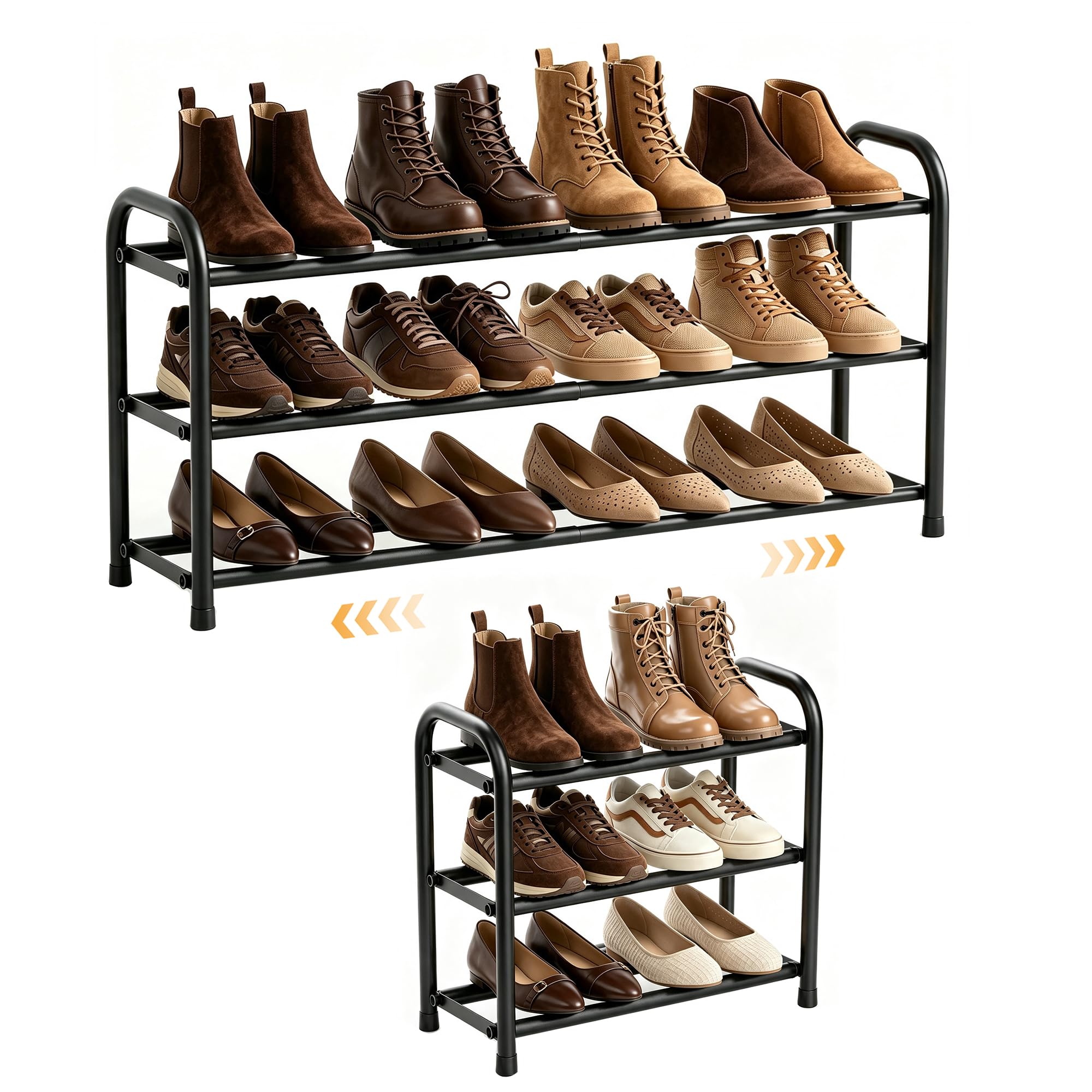
ENJOYBASICS 3-Tier Expandable Rack

ENJOYBASICS 3-Tier Expandable Rack

9.2/10 Outstanding
  • Depth: 8.9 inches
  • Width: 17.8 to 32.8 inches
  • Assembly: No tools required
  • Capacity: 6-12 pairs
Check Price on Amazon

Pros

  • Width adjusts from 17.8 to 32.8 inches
  • 6 to 12 pairs depending on width
  • Assembles by hand, no tools

Cons

  • Shallow 8.9-inch shelves

Some walls are the wrong length. A 26-inch rack leaves a gap, a 43-inch rack won't fit, and that in-between space is where this one earns its place: it runs from 17.8 inches to 32.8, so you set the width to the gap rather than hunting for a gap to fit the rack.

Fully extended it takes up to 12 pairs, pulled in about 6, in three tiers of black wire that stand 17 inches tall and 8.9 deep. Assembly is by hand with the included screws and no tools, and the whole thing is light enough that shifting it around the room is a one-person job.

We think of it as the spare-room, under-the-window or rental-apartment rack: shallow, light, easy to take with you when you move. The 8.9-inch depth is the number to check, since a shallow shelf is fine for average shoes and tight for the largest men's sizes. It also sits best on a hard floor — on deep carpet a light wire frame has nothing to grip.

Bottom Line: The one we suggest when the space is an awkward in-between width: it stretches from about eighteen to thirty-three inches, so it fills gaps a fixed rack can't.
#7

Heels

SNTD 2-Tier Expandable Shoe Rack

SNTD 2-Tier Expandable Shoe Rack

9.2/10 Outstanding
  • Width: 18.6 to 30.5 inches
  • Capacity: Up to 8 pairs
  • Load Rating: 200 lb
  • Shelf Height: Adjustable
Check Price on Amazon

Pros

  • Dense mesh keeps heels standing upright
  • Shelf height adjusts for tall boots
  • 200 lb capacity in a two-tier frame
  • Leveling feet on uneven floors

Cons

  • Two tiers hold only 8 pairs
  • Costs more than larger racks here

Two tiers, eight pairs, and a price above most of the three-tier racks here. That is the trade you accept for the thing this one does that the others don't: a dense mesh shelf that holds a heel upright instead of letting it drop through the wire.

Width runs from 18.6 to 30.5 inches, shelf height adjusts so a tall boot fits under the top tier, and the feet level out on a floor that isn't true. The frame is rated to 200 pounds, the highest load rating in this group, and it is powder-coated steel rather than tube and plastic.

It is also the only rack here built around heels as a design goal. On open wire grid a stiletto finds the gap; on this mesh it doesn't. If the collection is mostly heels and boots rather than trainers, that counts for more than the tier count does.

Where it falls short is volume. Eight pairs is one person's everyday rotation, not a household's, and two tiers will never be more than that; a second unit stacked doubles it, but you buy twice. For a hallway where the shoes on show are the good ones it earns the money, and for a family closet the KEETDY holds nearly twice as many pairs for less.

Bottom Line: The rack we point heel owners to: dense mesh that keeps a stiletto upright, shelf heights you can set for boots, and a frame rated for 200 pounds.
#8

Large collections

Mavivegue 9-Tier Shoe Rack

Mavivegue 9-Tier Shoe Rack

8.9/10 Excellent
  • Hooks: Two side hooks
  • Capacity: 50-55 pairs
  • Warranty: 12 months
  • Configuration: Splits into 8, 7 or 2 tiers
Check Price on Amazon

Pros

  • Holds 50 to 55 pairs on one wall
  • Rebuilds into 8, 7 or 2 tiers
  • Pull a shelf for tall boots
  • Side hooks and a 12-month warranty

Cons

  • Many parts make for a long build
  • ⚠️ Tall frame needs anchoring against a wall

Fifty to 55 pairs is not a shoe rack, it is a shoe wall: 50 inches wide, about 62 tall, built from powder-coated tubes and plastic connectors into three columns. The parts rebuild — an 8-tier, a 7-tier or a low 2-tier unit — so the layout follows the wall rather than the other way round.

That flexibility is the reason to buy it. Pull a shelf and a row of tall boots fits, run three narrow columns down a garage wall, or split it into a low unit for the door and a tall one for the back of the closet. There are hooks for bags and a 12-month warranty, and the frame takes shoes, baskets and boxes without complaint.

Construction is the trade for all that height. Towers like this are stiff once they are loaded and sway while they are empty, so every connector needs pressing fully home — one that isn't seated is the difference between a solid grid and a rattling one.

We like it for a garage, mudroom or long closet wall, and not for a hallway, where 50 inches of black grid is a lot of furniture. Assembly is the slow part — many pieces, an evening's work — and the order matters: build it where it will stand, anchor it to the wall, then fill the bottom tiers before the top ones.

Bottom Line: If the collection has outgrown the furniture, this holds 50 to 55 pairs on one wall, and it rebuilds into 8, 7 or 2 tiers when the room changes.

How We Tested the Best Boot and Shoe Racks

We started with a list of about 40 racks and narrowed it by material (solid wood, bamboo, powder-coated steel, coated wire), footprint, and whether the stated capacity accounted for anything taller than a sneaker. Review complaints did a lot of the filtering — wobble, missing hardware, shelves that bowed in the middle — so racks with a pattern of those dropped out before we opened a box.

Each of the 12 finalists was assembled by one person using only the included tools, and we noted how long it took and how much of the instructions we actually needed. Then we loaded them in stages: everyday shoes first, a pair of tall rubber boots on the top shelf, and finally a 20-pound weight where the boots had been, watching for sway, sagging shelves, and feet that slid on tile or sank into carpet. We also pulled a boot out one-handed to see whether the whole rack walked across the floor with it.

They've spent eight months in an entryway and a mudroom through a wet spring and a humid summer, and we checked them monthly for rust at the welds, splitting slats, chipped coating, and joints that loosened. Appearance was judged by whether we'd leave the thing visible in a hallway, and capacity by counting real footwear — boots laid flat, tall boots standing — rather than trusting the box. Value came down to what survived: a rack that still looks new after eight months of wet boots is the better buy, whatever it cost up front.

How to Choose Boot and Shoe Racks

Boot height comes before pair count

Boots are what make this category awkward. A rack with shelves fixed for trainers forces a tall boot onto its side, where it creases at the ankle and eats two slots. Two designs solve it: a fixed gap tall enough to stand a boot in, or a shelf you can lift out or move up. The KEETDY leaves 8 inches between tiers; the LANTEFUL and the Kitsure cover tower both give you a removable shelf instead.

If the household owns more than a couple of pairs of tall boots, treat adjustable or removable tiers as a requirement rather than a bonus, and measure your tallest boot against the gap before ordering.

Measure the wall, then the floor

Width is where most returns begin. The racks here run from about 17.5 inches to 50, and that range decides which wall each one suits: a narrow tower fits a hallway sliver, a 43-inch rack needs a closet run or a long empty wall, and a 50-inch frame belongs in a garage. Depth matters just as much, because a 12-inch rack stands further into the room than a 9-inch one.

Compact in a listing means it fits a closet, not that it fits anywhere. Measure the width, the depth and the door swing, and check whether you want to vacuum under it — a tall tower on four legs leaves the floor clear, a flat-based rack does not.

Wire, mesh, fabric or wood

Shelf material decides what actually stays put. Open wire lets a stiletto heel drop through and lets air around damp trainers. Dense mesh, as on the SNTD, holds a heel upright. Non-woven fabric on the tall towers is quiet, cheap and light, and it flexes under anything heavy. A wood-topped unit like the HOOBRO is the only kind here you would leave in a hallway on purpose.

Match the material to the load and to the audience: fabric in a closed closet, mesh and wood where the rack is on show.

Plan for growth, and for gravity

Stackable and expandable designs let a rack grow without another piece of furniture. Two Simple Houseware units stack, two KEETDY sets make six tiers, the ENJOYBASICS stretches to fill a gap, and the Mavivegue rebuilds into a low unit plus a tall one.

The catch is height. A loaded 68-inch tower is a top-heavy object and a 50-pair grid is heavier still, so stand tall racks in a corner or against a wall and load the bottom tiers first. Where children or a large dog share the hallway, anchoring a tall rack is worth doing.

Frequently Asked Questions

Final Verdict

The KEETDY earns the top spot on one design decision: 8 inches of shelf gap plus a tier you can lift out, which is what separates a boot rack from a shoe rack. At 43 inches wide it wants a closet run or a long wall, and if you don't have one, the LANTEFUL tower holds a similar pair count in 17 inches.

If the rack is going where people will see it, the HOOBRO is the one to spend on — the wood top is what makes it furniture instead of storage.