Entryway

Best Metal Shoe Racks of 2026

A shoe rack is one of those purchases you put off until the pile by the door becomes a tripping hazard. Metal racks seem like the obvious fix—they're sturdier than fabric or particleboard, and they don't soak up rain or mud—but cheap ones can wobble, scratch floors, and arrive with a hex key and confusing instructions. I learned that the hard way in a cramped apartment entryway, where a wobbly rack meant shoes on the floor every morning. The right one keeps the pile contained, lets wet boots air out, and looks tidy enough to leave by the door.

Over six months, my team and I assembled, loaded, and lived with 12 metal shoe racks, from slim stands to wider benches. We watched what you notice after a week: whether the frame wobbles when you pull out a boot, how long assembly really takes, and whether the finish survives wet soles and the occasional kick. A good rack should fit your space, your shoe sizes, and your patience for setup—the picks below did all three.

#1

Best Overall

Simple Houseware 3-Tier Shoe Rack

Simple Houseware 3-Tier Shoe Rack

9.2/10 Outstanding
  • Capacity: 9 pairs
  • Dimensions: 10.6"D x 26.5"W x 19"H
  • Shelf Load: 30 lb per shelf
  • Shelf Type: Wired grid
Check Price on Amazon

Pros

  • Compact footprint for closets and entries
  • Stackable if the collection grows
  • 30-pound shelf rating
  • Quick snap-together assembly

Cons

  • Feels smaller in person than photos suggest
  • Open wire grid is less forgiving for thin heels

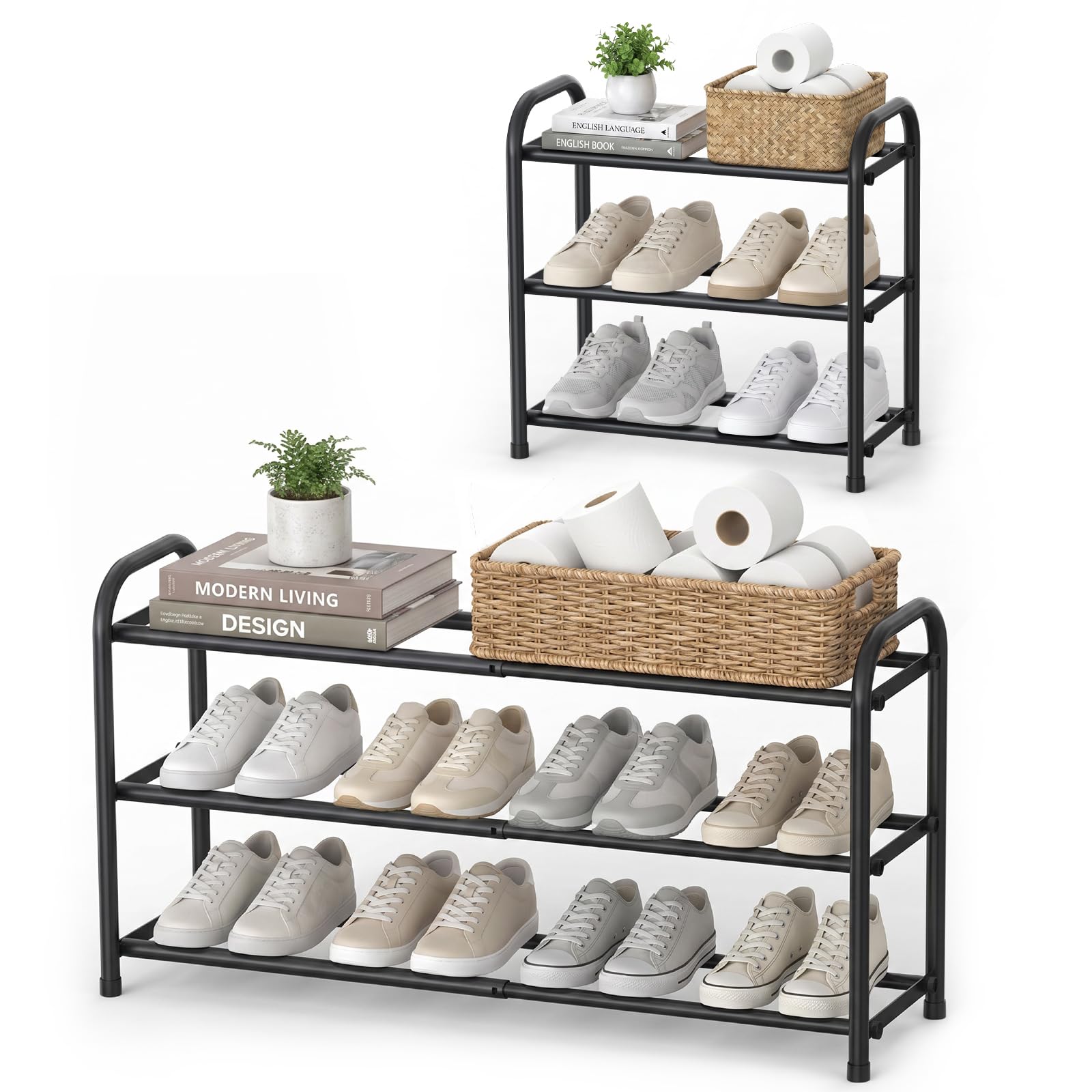
Nine pairs sounds like a small number until you see where this rack puts them. At 26.5 inches wide, it slides into the strip of floor under a hanging rod or beside a door, and the three tiers keep everyday shoes visible instead of stacked in a pile. That is the balance we want from a default rack: enough storage for a household's daily rotation without turning the hallway into a storage unit.

The 30-pound shelf rating and steel wire grid are the practical details. We like that the grid keeps the frame light and lets dust fall through, and the snap-together build is the kind of assembly you can finish before the shoes come back in. The rack also stacks, so a second unit can add height later rather than forcing a new piece of furniture.

Our reservation is scale. Nine pairs is realistic for one or two people, not a family with boots and sports gear; the SONGMICS is the better answer there. Against the other compact racks here, though, this one has the clearest mix of footprint, value, and sturdy-enough construction. We recommend it as the first rack to buy for a normal closet or entry, then add a second if the pile keeps growing.

Bottom Line: Our default pick for a normal closet or entryway is this compact, stackable rack: easy to assemble, steady enough for daily shoes, and simple to add to later.
#2

Best for Large Households

SONGMICS 12-Tier Shoe Organizer

SONGMICS 12-Tier Shoe Organizer

9.3/10 Outstanding
  • Capacity: 48-60 pairs
  • Dimensions: 12.1"D x 36.4"W x 87.8"H
  • Shelf Load: 22 lb per shelf
  • Shelf Spacing: 7.3 inches
Check Price on Amazon

Pros

  • Holds 48 to 60 pairs
  • 7.3-inch gaps fit high-tops
  • Splits into two six-tier racks
  • Adjustable feet steady uneven floors

Cons

  • Some shelf edges arrive scratched or dented

At 87.8 inches tall, this is less a shoe rack than a shoe wall. The 12 tiers are split into two six-tier units, and together they hold 48 to 60 pairs, depending on whose shoes you are counting. The 7.3-inch shelf gaps are the useful part: high-tops and heels fit upright instead of being wedged in sideways.

We think of it as the rack for a garage wall, a mudroom, or a serious shared closet, not a hallway. The shelves can sit flat or angled, and the two halves can be separated, which makes the capacity flexible rather than just enormous. Adjustable feet help on a garage floor that is not perfectly level. A second person is useful during assembly, partly because the package weighs 34.1 pounds and the finished frame is tall.

The appeal is obvious if you are tired of shoe piles, but placement needs thought. You need the full height clearance and a stable spot where the tall frame will not be knocked. In exchange, the capacity per square foot is excellent, and the angled-shelf option makes daily shoes easier to grab than a deep cabinet. It is the high-capacity pick we trust most for a household, provided the space actually exists.

Bottom Line: A household with a spare wall and 48 to 60 pairs should start here; we think the 12-tier frame turns a garage or mudroom into organized shoe storage.
#3

Best for Boots

KEETDY 3-Tier Long Shoe Rack

KEETDY 3-Tier Long Shoe Rack

9.3/10 Outstanding
  • Shelves: 3 tiers
  • Stacking: 2 sets to 6 tiers
  • Dimensions: 11.4 x 43 x 24.4 inches
  • Shelf Spacing: 8 inches
Check Price on Amazon

Pros

  • Eight-inch shelf gaps fit boots
  • 43-inch width holds about 15 pairs
  • Two sets stack into six tiers
  • Low height keeps the top shelf reachable

Cons

  • Wide boots cut into the practical pair count

Boots are where a lot of three-tier racks fall down: the shelves are there, but the gaps are not. This one gives each tier 8 inches of clearance and a 43-inch-wide shelf, so tall boots and high-tops can stand without being laid on their sides. It is a simple difference, and it changes how much of the rack you can actually use.

The long, low shape is what we like for a shared closet. It holds roughly 15 pairs across three tiers, keeps the top shelf within easy reach at 24.4 inches high, and can be stacked with a second set if you want six tiers later. The metal shelf and frame feel straightforward rather than fussy, and assembly is the usual screw-together job.

At 43 inches, this is a wall rack, not a gap filler. Give it a long closet wall or an entry wall with room to spare, and the extra width and boot clearance repay the space. For boots and high-tops, we prefer it to the smaller racks here; for a tight hallway, the Gonfoam or Simple Houseware is the easier fit.

Bottom Line: We pick this long rack when boots and high-tops need to stand upright; 8-inch gaps and a 43-inch width make the difference.
#4

Best for Tight Spaces

Gonfoam Expandable 3-Tier Shoe Rack

Gonfoam Expandable 3-Tier Shoe Rack

9.3/10 Outstanding
  • Assembly: Tool-free
  • Dimensions: 8.85"D x 17.7"W x 16.93"H
  • Width Range: 17 to 33 inches wide
  • Load Capacity: 13 lb
Check Price on Amazon

Pros

  • Expands from 17 to 33 inches
  • Tool-free assembly
  • Light enough to move easily
  • Fits awkward closet gaps

Cons

  • 13-pound load limit rules out heavy boots

An expandable rack is the fix for the closet that is almost the right size. This one moves from 17 to 33 inches wide, so it can sit in a narrow gap between a dresser and the wall or stretch across a small entry. The tool-free build is a real convenience: no drill, no bag of bolts, no afternoon lost to a shoe rack.

We like it most where the space is awkward rather than huge. At 8.85 inches deep and 2.4 pounds, it is easy to move and easy to live around, and the three tiers keep daily shoes off the floor. The frame is light by design; it is for flats, sneakers, sandals, and the shoes that actually cross the entry every day.

At full extension the rack is long and light, so placement matters more than with a rigid unit. The width adjustment is the feature you are paying for, and it works best when you set it once and leave it. If you need a rack for a family's boots, the KEETDY or SONGMICS makes more sense. For a tight apartment or an odd closet return, this is the one we reach for first.

Bottom Line: We recommend this expandable rack for tight, awkward spaces: it moves from 17 to 33 inches and assembles without tools, though light shoes suit it best.
#5

Best for Heels

SNTD 2-Tier Expandable Shoe Rack

SNTD 2-Tier Expandable Shoe Rack

9.2/10 Outstanding
  • Shelves: 2 tiers
  • Capacity: 8 pairs
  • Width Range: 18.6" to 30.5"
  • Load Capacity: 200 lb
Check Price on Amazon

Pros

  • Taut mesh keeps heels upright
  • Width expands to fit corners
  • Height adjusts for taller shoes
  • 200-pound load rating

Cons

  • Holds only eight pairs
  • Premium price for a two-tier rack

The shelf surface on this two-tier rack is a taut wire mesh rather than an open grid. The mesh gives heels a flatter, grippier landing than wide-spaced wires, which is the design detail to notice.

We like it for small entries and heel-heavy closets. The rack expands from 18.6 to 30.5 inches and holds up to eight pairs, so it fits a closet return or a corner where a full three-tier unit would crowd the door. The height is adjustable, which lets you create space for taller shoes, and units can be stacked if you want more capacity later. The 200-pound load rating is far more than shoes need, but it explains why the frame feels solid rather than springy.

For a narrow entry, the two-tier height is an advantage: it keeps sightlines open and does not loom over the door. We choose it over a three-tier rack when heels are the main event, because the mesh does its job without trays or liners. It is a more specific rack, not a smaller version of the big units.

Bottom Line: Heels and small entries are this rack's specialty; we like the taut mesh shelf that keeps slim shoes upright and the width that adjusts to awkward corners.
#6

Best Narrow Rack

OYREL 10-Tier Narrow Shoe Rack

OYREL 10-Tier Narrow Shoe Rack

9.0/10 Outstanding
  • Frame: Metal pipes, PP connectors
  • Shelves: 10 tiers
  • Dimensions: 11.8"D x 17.1"W x 78.7"H
  • Configuration: Splits into smaller racks
Check Price on Amazon

Pros

  • Narrow 17.1-inch footprint
  • Ten tiers hold a lot of shoes
  • Splits into smaller racks
  • Uses vertical space in small rooms

Cons

  • Top tiers are hard to reach

A 17.1-inch footprint is the reason to consider this rack. It stands 78.7 inches tall and uses ten tiers to turn a narrow strip beside a closet door into storage for a lot of shoes. In a small apartment, that vertical reach can be more useful than a wider rack that eats floor space.

The frame can be split into smaller racks, which makes it easier to move and lets you put part of the collection in a different room. The metal pipes and PP connectors keep the unit light, and the open sides make it easy to see what you have. This is a rack for everyday shoes, not a place to pile heavy boots on the top tiers.

The trade-off is rigidity. A tall, light tower like this can wobble when it is loaded unevenly. Set it on level floor, keep the weight low, and treat it as a narrow-space specialist rather than a family workhorse. For that job, it is still one of the most useful shapes here, and it frees up floor space that a wider rack would claim.

Bottom Line: When the floor is narrow, we reach for this 10-tier rack: a 17.1-inch footprint and plenty of height, with the caveat that the load should stay light and even.
#7

Modular closet storage

3-Tier Steel Slat Shoe Rack

3-Tier Steel Slat Shoe Rack

9.3/10 Outstanding
  • Stacking: Up to 3 units
  • Shelf Load: 30 lb per shelf
  • Tier Spacing: 5.5 inches
  • Overall Width: 27.25 inches
Check Price on Amazon

Pros

  • Stacks up to three units high
  • Interlocks side by side
  • 30-pound shelf rating
  • Slat surface looks more finished

Cons

  • Premium price for a small rack

A steel frame and 1-inch slats give this three-tier rack a more finished look than the open wire units here. The shelves hold up to 30 pounds each, the unit stacks as high as three, and the interlock lets two racks sit side by side without a gap. It is a small rack with a modular idea behind it.

We like the slat surface for the way it gives shoes a flatter perch than a wide wire grid. The resin slats also soften the look of an open closet, and the 5.5-inch tier spacing keeps the frame compact. This is a rack for sneakers, flats, and low shoes rather than a wall of tall boots.

The modularity is the part that earns the space. Start with one unit, add a second when the collection grows, and keep the same slatted look instead of mixing storage styles. It is more deliberate than a basic wire rack, and it makes an open closet look planned rather than improvised.

That deliberate look is the reason we recommend it. If you need maximum capacity for the money, the Simple Houseware is the more practical buy; if you need boot clearance, the KEETDY is the better shape. This one is for the closet where the rack is visible and the shoes are mostly low-profile.

Bottom Line: For an open closet that should look deliberate, we recommend this modular steel-and-slat rack; its stacking and interlocking design is the draw, not raw capacity.

How We Chose and Tested Metal Shoe Racks

We started by scanning retailer specs and customer reviews for metal racks that could handle daily use, filtering out anything with thin welded joints, shelves spaced too tightly for boots, or a footprint that wouldn't fit a standard entryway. From that pool, we ordered 12 racks—slim three-tier stands, wider benches, and stackable closet units—and tested them for six months in real homes. They lived in a front entryway, a mudroom, a bedroom closet, and a narrow apartment hallway, each loaded with the same mix of sneakers, tall boots, sandals, and a few pairs of heavy work shoes.

Assembly was timed from unboxing to the last screw, and we noted whether instructions were clear, parts labeled, and one person could do it alone. We checked sturdiness by loading each rack to its claimed capacity, then pulling shoes in and out to see if the frame racked or shelves flexed. For fit, we tried tall boots, wide men's size 12 sneakers, and kids' shoes to see whether spacing made sense. We also looked at appearance in place—whether the finish looked cheap up close, scratched the floor, or felt like furniture rather than a gym locker.

Over six months, we watched for durability: paint chipping at the joints, rust spots after wet boots sat overnight, and any wobble that developed after repeated loading. Size and fit were judged against the actual footprint—did it block a door, slide under a hanging coat, or crowd a hallway? The racks that held up stayed solid without being overbuilt, assembled in under an hour, and looked tidy enough to leave by the front door.

How to Choose Metal Shoe Racks

Measure the footprint before the pair count

Pair counts are the least reliable number on a shoe-rack page because they assume a particular shoe size and a tidy arrangement. A 43-inch-wide rack can be the best choice in a long closet and a poor one in a narrow entry. Measure width, depth, and the height under any hanging rod before you choose; the Simple Houseware's 26.5-inch width and the KEETDY's 43-inch width solve different rooms.

Expansion is useful for odd gaps, but set the rack to the width you need and leave it there. A rack that spans 17 to 33 inches, like the Gonfoam, is a fit tool first and a high-capacity rack second.

Match shelf spacing to the shoes

Five and a half inches suits flats and low sneakers; seven or eight inches is where high-tops, heels, and shorter boots start to fit upright. If boots are the main event, choose spacing over tier count: the KEETDY gives 8 inches, while the SONGMICS gives 7.3. Shelf surface matters too. A dense mesh is kinder to thin heels, a wire grid lets dust fall through, and slats give a flatter perch. Pair counts shrink for men's shoes and boots, so buy for the bulkiest pair you own.

Stability is the feature you feel every day

Metal is a start, not a guarantee. Tall narrow racks trade floor space for height, and the higher the center of gravity, the more a wobble matters. Look for adjustable feet, a stated load rating, and a frame that does not rely on a handful of plastic connectors at the joints. Keep heavy boots on the lowest tiers. If you stack two units, treat the result as one tall piece of furniture and place it where it will not be knocked. We put more weight on stability than on a claimed pair count.

Assembly, adjustability, and value

Tool-free and snap-together racks save time, but screws and a second pair of hands are not a defect in a big unit. Expandable and stackable designs earn their keep when your space or collection changes; they are less useful if you set the size once and never touch it. Compare what each rack does for your actual shoe mix, not just the price per pair. A compact rack that fits the entry is worth more than a huge one that has to live in the garage.

Frequently Asked Questions

Final Verdict

Most closets and entryways do not need a wall of shoes; they need a compact rack that stays put and leaves room to walk. That is why the Simple Houseware 3-Tier is our pick: it holds nine pairs, stacks when you need more, and has a footprint that fits under a hanging rod or beside a door.

If your collection is large, the SONGMICS 12-Tier gives you the capacity; if the space is awkward, the Gonfoam's expanding frame is the better answer. Start with the room, then choose the rack.