Entryway

Best Boot Scraper Mats of 2026

A wet walk through the woods is one of the great pleasures of fall—until you hit the back steps and track half the trail into the kitchen. A boot scraper mat is the unglamorous piece of gear that catches the mud, grit, and wet leaves before they cross the threshold. The good ones scrape clean with a few scuffs and stay put while you do it; the bad ones skid, shed bristles, or turn into a soggy mess by February.

I've gone through more of these than I'd like to admit—my last one looked fine until the first real rain, when it slid across the porch and left a crescent of mud on the doormat. Over the past four months, we've tested 14 boot scraper mats side by side, paying attention to how well they cleaned a range of boots, how they held up to daily stomping, and whether they looked decent enough to leave by the front door. Size and stability turned out to matter more than most listings let on—a mat that's too small means you shuffle to find it, and one without a grippy back is a slip waiting to happen. The picks below are the ones that earned their spot.

#1

Best Overall

Clean Machine High Traffic Dirt Trapper

Clean Machine High Traffic Dirt Trapper

9.2/10 Outstanding
  • Size: 23.5 x 35.5 in
  • Backing: Rubber
  • Thickness: 0.5 inch
  • Scraping Surface: Molded plastic blades
Check Price on Amazon

Pros

  • Scrapes mud and grit, then stores it below the surface
  • Room for both feet at 23.5 by 35.5 inches
  • Shake or hose clean, no tray to empty

Cons

  • Plastic surface wears and gets replaced every few years

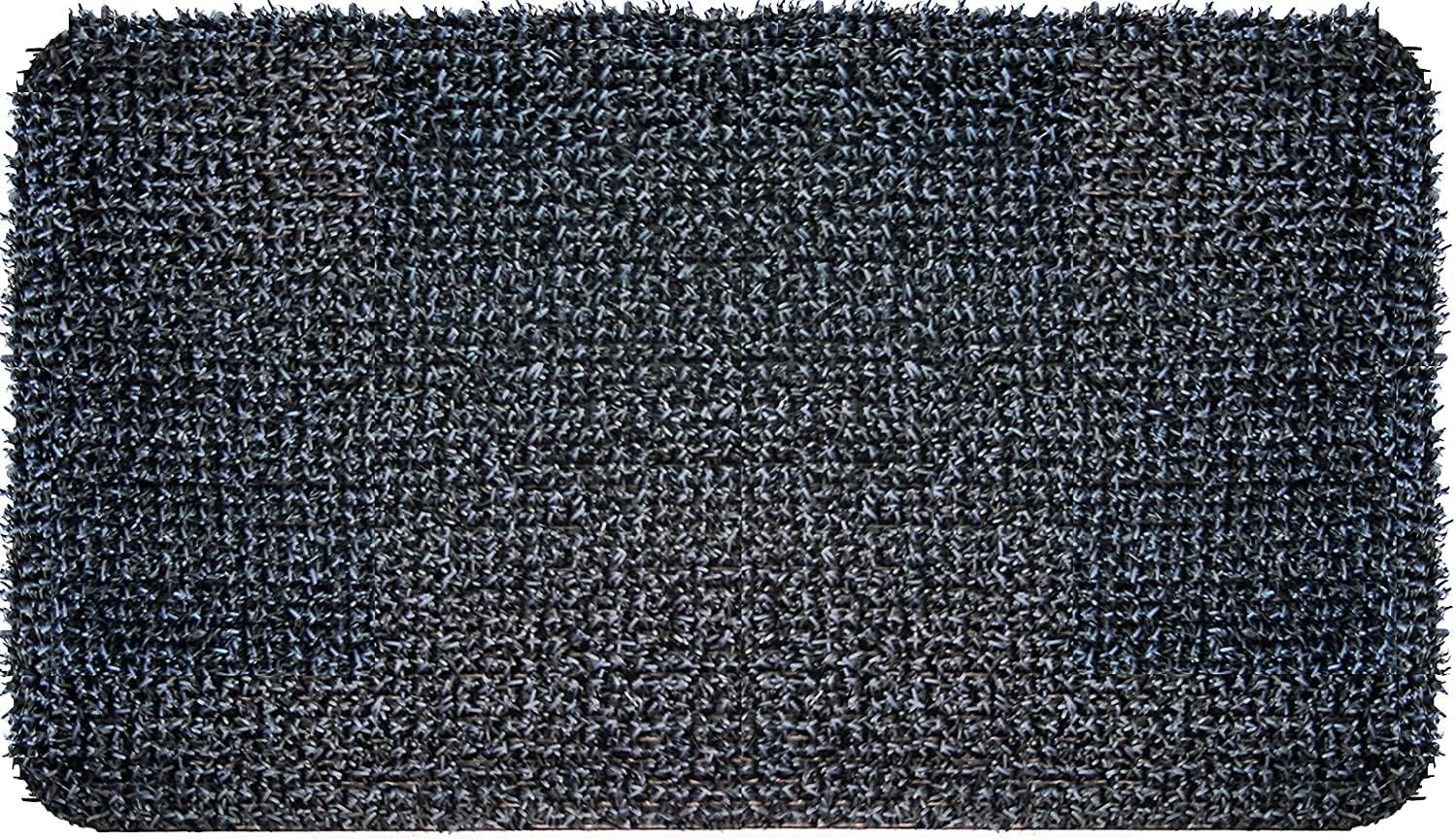
A mat that claims to hold up to a pound of dirt and sand a week below its surface sounds like ad copy until you see where the grit actually goes. On this one, a dense field of small molded plastic blades stands up from a rubber-backed sheet; you scuff a boot across it, the blades comb the tread, and the loosened mud drops underneath instead of sitting on top for the next pair of shoes to pick up. That is the whole reason it is our top pick: it scrapes and stores in one flat half-inch sheet, with no tray to empty.

What we noticed most in use is how little aiming it takes. At 23.5 by 35.5 inches there is room for both feet at once and a step of travel between them, so you scuff twice and go in rather than shuffling on a postage stamp. Half an inch of thickness slips under most doors, and because the surface is flat and stiff you can drag a heel across it without the mat folding over on itself the way a soft coir pad will.

Cleanup is the part that won us over. Lift a corner and shake, or drag it onto the driveway and run a hose over it; the trapped grit goes with it and the mat is dry in minutes. Nothing sheds, nothing frays, and you never handle a wet clump of fiber. Dark gray hides what it has not swallowed yet, and it reads as a utility mat rather than a decorative one, which suits a mudroom door and looks plain at a formal front entry.

Longevity is where it gives ground. The blades are plastic, and this is a mat that gets replaced after a few seasons rather than handed down; the tire-link mat below is the one to buy if you want to do it once. For everyday mud, dog traffic, and a household that kicks its boots off at the same door every night, this is still the one we put down first.

Bottom Line: Our pick for most entryways: it scrapes mud and grit off both boots at once and hides the mess under the surface until you shake it out.
#2

Best for Wet Weather

Durable Dura-Rug Tire-Link Mat

Durable Dura-Rug Tire-Link Mat

9.4/10 Outstanding
  • Size: 20 x 30 in
  • Weight: 11 lb
  • Pile Height: 0.75 inch
  • Construction: Recycled tire links, steel rods
Check Price on Amazon

Pros

  • Water drains through instead of pooling
  • 11 pounds holds it in wind and underfoot
  • Tire rubber and steel resist rot and mildew

Cons

  • Industrial look, not a decorative mat

Rain exposes most entrance mats. The pile soaks, the backing holds a puddle against the step, and by midwinter the thing smells like a pond. The Dura-Rug avoids that by having holes in it: strips of recycled tire are woven onto galvanized steel rods with real gaps between them, so water runs straight down to the ground and the surface is close to dry as soon as the rain stops.

We rate it at the top of this set for staying put and for wet weather, and both come from the same place: 11 pounds of tire rubber and steel. Wind does not lift it, a wet sole does not skate it across the porch, and mud and leaves comb off into the gaps rather than collecting on a pile. At 20 by 30 inches it is small for two people coming in together, though — fine at a side door or a garage, cramped as the only mat at a busy front door.

What you get in return is time. Tire rubber and galvanized rod do not rot, mildew, or fray, and durability is the strongest part of this mat's story rather than a caveat tacked on the end. Shake it, vacuum it, or rinse it; roll it up in spring if you want it out of the sun. Buy it for the door that takes the weather, not the one guests photograph.

Bottom Line: Rain falls straight through this one, so it never sits waterlogged, and 11 pounds of tire rubber keeps it exactly where you set it.
#3

Best for Heavy Mud

Footmatters Ninamar Mud Scrubber Mat

Footmatters Ninamar Mud Scrubber Mat

9.2/10 Outstanding
  • Size: 29.5 x 17.5 in
  • Weight: 8.8 lb
  • Surface: Coir in a rubber tray
  • Thickness: 1.25 inches
Check Price on Amazon

Pros

  • Rubber tray catches the scraped-off mud
  • Wide enough for both boots at once
  • Stiff coir scrubs boot sides, not just soles

Cons

  • Brush sections can shift out of line
  • Coir sheds and thins with heavy use

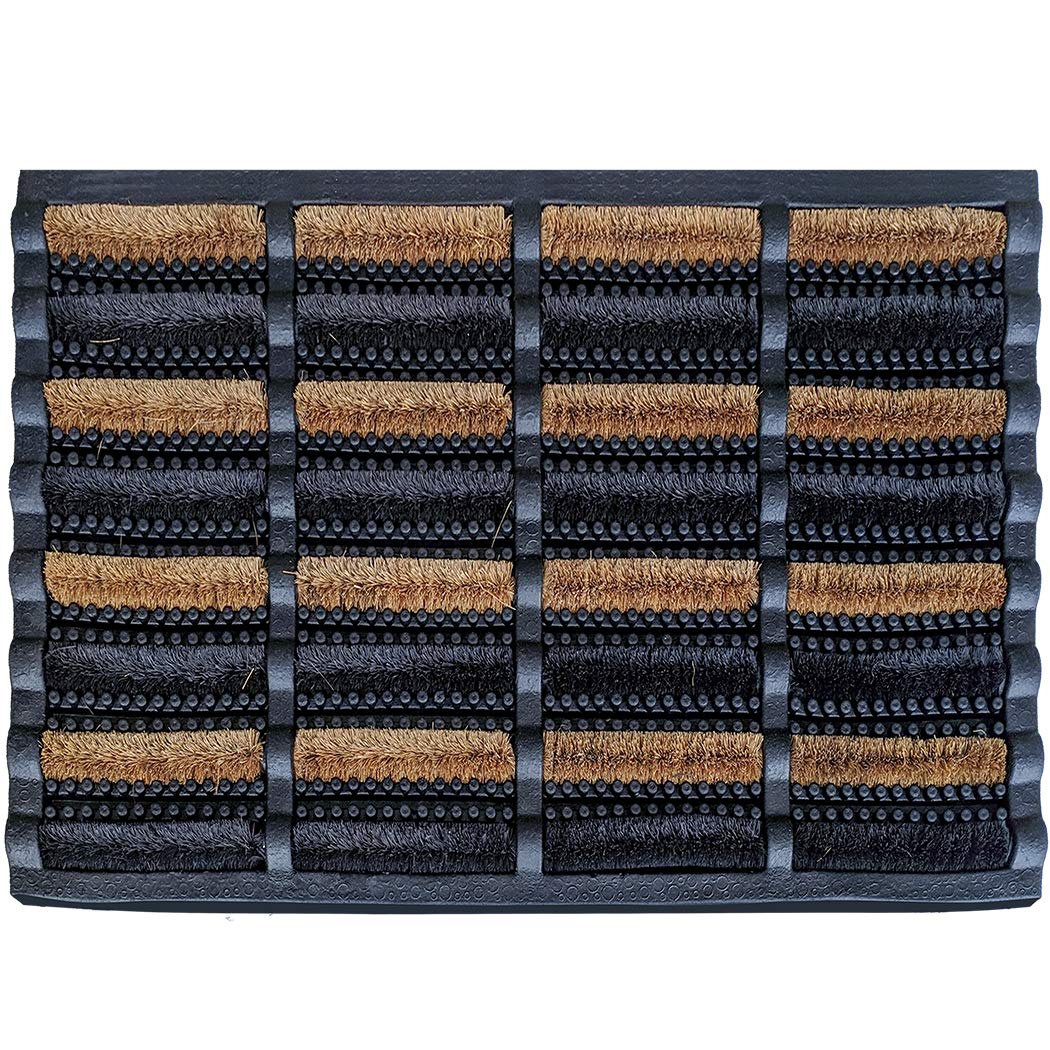
Mud is a two-part problem. It has to come off the sole, and then it has to go somewhere that is not the kitchen floor. This mat is built around the second half: a rubber tray holds a thick pad of stiff coir, and whatever you knock loose drops into the tray instead of scattering across the step. That is why it earns its place at a garden door, where mud arrives wet and in clods rather than as a dusting of sand.

At 29.5 by 17.5 inches it is the widest scraper here that is still a mat rather than a runner. You can stand with both boots on it and work each sole properly, and the coir is stiff enough to reach the sides of a boot where a flat rubber tread only wipes. Heavy, too, at 8.8 pounds, which keeps it planted while you lean into a heel.

For the messy end of the range, this is the mat we choose. The tray keeps wet debris off the concrete instead of letting it fall through to stain it, cleaning is a hose-down plus an afternoon in the sun, and the whole thing shrugs off a winter outdoors. It is also the pick here if your entryway is really an RV step or a basement door where the mud comes in by the clod.

Bottom Line: Wet clods are what this mat is for: the rubber tray catches whatever the stiff coir scrapes off, and the 29-inch width takes both boots.
#4

Best Large Rubber Scraper

Guardian Clean Step Scraper Mat

Guardian Clean Step Scraper Mat

9.0/10 Outstanding
  • Edges: Beveled
  • Tread: Molded, raised pattern
  • Weight: 16 lb
  • Material: Natural rubber
Check Price on Amazon

Pros

  • Deep tread digs into lug soles
  • Beveled edge reduces trip risk at the threshold
  • 16 pounds lies flat and stays put

Cons

  • Delivered size can run short of the listed dimensions

Molded rubber tread with beveled edges: this is the mat a building puts at its entrance, and it scrapes like one. We rate it the most aggressive of the rubber mats here — the raised pattern is deep enough to bite into a lug sole and hold it while you twist, and 16 pounds of natural rubber means it lies dead flat and stays that way even when you lean on one foot to dig mud out of a tread.

The 3 by 5 foot version is a genuine walk-on mat: two strides of scraping before the door rather than one perfunctory wipe, which is what a busy household or a shop entrance actually needs. The beveled lip matters more than it sounds, because it brings the edge down flush so nobody catches a toe, and it keeps the corners from curling up after a winter of being walked on.

Care is a hose or a shake, and the black rubber does not show dirt the way coir or gray surfaces do. It is heavy enough that moving it for sweeping is a two-hand job, and it will not flatter a porch. Buy it for the door that gets hammered; the smaller scrapers here are for the door that does not.

Bottom Line: A doorway that gets hammered wants this: deep molded tread, a beveled edge, and enough rubber that it never shifts under a twisting boot.
#5

Best Long Runner

Climatex Rubber Scraper Mat 2 x 6

Climatex Rubber Scraper Mat 2 x 6

9.0/10 Outstanding
  • Size: 2 x 6 ft
  • Tread: Triangular pattern
  • Material: Rubber
  • Thickness: 0.18 inch
Check Price on Amazon

Pros

  • Six-foot run takes several strides of dirt
  • Triangle tread scrapes and rinses clean
  • Heavy rubber lies flat without curling

Cons

  • Length can run short of the stated 6 feet

Where our top pick is a rectangle you stand on, this is a run you walk along. Two feet by six is a different job entirely: a porch, a garage apron, or the floor of a mudroom, where the boot hits rubber three steps before the door instead of one. The triangular tread does the scraping, a hose does the rest, and at 0.18 inches thick it lies flat with no lip to trip over.

We like it most in spaces where a square mat looks like an afterthought. A pair of these covers a garage bay, one covers a long deck, and the rubber is heavy enough that it does not curl at the corners or shift when the car pulls in. The catch is water: there are no drainage holes, and meltwater can sit in the channels between the triangles. Under a covered porch that is irrelevant; fully exposed, the tire-link mat above handles rain better.

The surface can be trimmed if your run is not a clean two feet, and the plain black disappears against asphalt and concrete. It is a working mat, not a welcoming one — no pattern, no border, nothing to look at, which is exactly the point on a garage floor.

Bottom Line: Six feet of rubber tread takes several strides of mud before the door, and a hose does the cleaning — the pick for porches and garage aprons.
#6

Best for Two Doors

Ninamar Natural Coir Scraper 2-Pack

Ninamar Natural Coir Scraper 2-Pack

9.1/10 Outstanding
  • Size: 13 x 12 in each
  • Pieces: 2 mats
  • Material: Coir
  • Thickness: 2 inches
Check Price on Amazon

Pros

  • Two mats cover two doors
  • Stiff coir flicks off dried mud and grass
  • Thick two-inch pad to scuff against

Cons

  • Only about one boot wide per mat
  • Coir pads shed fibers as they age

The two-pack is the appeal: a mat for the front door and one for the back for roughly what a single large scraper costs. Each pad is 13 by 12 inches, small enough to sit on either side of a step without swallowing the doormat's job. If your porch only ever gets one muddy pair of boots a day, this is the least expensive honest answer here.

Coir earns its place at a door for a simple reason: the fibers are stiff and springy, so they flick dried mud and grass off a sole instead of smearing it. These are dense pads with a herringbone weave that looks tidier than plain bristle, and at two inches thick there is something to scuff against at the threshold. Hand wash only, which in practice means shaking them out and never soaking them.

We treat them as a second mat rather than the only one. On smooth wet concrete a light coir pad can skate when you scuff hard, so put them on a rough step or a sheltered porch and that stops being a problem. At this money you replace them without wincing, and two doors covered for the price of one is hard to argue with.

Bottom Line: A cheap way to put a real scraper at two doors: stiff coir that flicks mud off, though each mat is only about one boot wide.
#7

Small stoops

Ninamar Mud Scrubber Brush Mat

Ninamar Mud Scrubber Brush Mat

8.9/10 Excellent
  • Size: 15.35 x 12.6 in
  • Weight: 3.1 lb
  • Surface: Rubber bristles
  • Placement: Indoor or outdoor
Check Price on Amazon

Pros

  • Bristles clean treads and shoe edges
  • Fits steps too narrow for a full mat
  • Light enough to move between doors or pack for the RV

Cons

  • Bristles can come away after a few months
  • Small enough that a big boot overhangs

Bristles do something a flat scraper cannot: they get into the tread pattern and around the welt of a shoe. This mat puts them on a rubber platform — stiff angled tufts across the top face, a brush edge down the sides — in a 15.35 by 12.6 inch footprint that fits a stoop where nothing bigger will sit.

It is the mat we take to a patio door or an RV step. Cleats, sandy sandals, and muddy trainers come off it clean in a couple of passes, and at 3.1 pounds it is light enough to pick up and move between doors or pack in the camper. That lightness has a price: on smooth tile it can shift under a hard scuff, so it is happiest on concrete or a rubber-backed step.

It is rated for both sides of the door, and hosing it off is all the maintenance it asks for. The rubber does not absorb water, does not freeze into a slab in winter, and dries fast enough that you can put it straight back down.

Where it lands for us is the best side-scrubber here per square inch. If your door only has room for one small mat and you wear cleats, hiking boots, or anything with deep lugs, this cleans more of the shoe than a coir pad the same size ever will. For a wide, busy entry, the bigger mats in this guide do more per step.

Bottom Line: Stiff rubber bristles clean treads and shoe edges that a flat scraper only wipes — the best side-scrubber here, and small enough for a narrow step.
#8

Tight door swings

Calloway Mills Bootscraper Doormat

Calloway Mills Bootscraper Doormat

8.8/10 Excellent
  • Size: 15 x 12 in
  • Weight: 5.5 lb
  • Backing: Rubber
  • Material: Coir and rubber
Check Price on Amazon

Pros

  • Low profile clears a tight door swing
  • Bonded rubber edge keeps the coir from unravelling
  • 5.5 pounds stays put on a painted step

Cons

  • Covers about one pair of boots at a time

Fifteen by twelve inches sounds small until you have a door that barely clears the threshold. This mat is built for exactly that door: a coir pad on a rubber backing, low profile, 5.5 pounds, with no frame or tray to catch the bottom of the door as it swings.

The coir is dense and stiff, and the rubber edge is what separates it from a plain coir mat — the fiber stays bound at the border instead of unravelling into the walkway. It grips a painted step and does not slide when you work a boot on it, which is the complaint that sinks most light coir pads.

Durability is the strongest part of its story, and the bonded edge explains why: there is nothing stapled on and nothing to detach. It sits outdoors through rain and sun without the fiber going soft, and a shake or a vacuum is the whole maintenance routine.

We keep it as the small-mat answer. It handles a pair of boots at a time, it looks better at a front door than a black rubber tread, and it holds its edge better than the thin coir pads here. If two people come in together on a wet day it is cramped, and that is a job for a wider mat.

Bottom Line: Where the door barely clears the threshold, this is the mat: dense coir on a bonded rubber backing, heavy enough to stay put and small enough to live there.

How We Tested Boot Scraper Mats

We started by pulling together the mats that kept showing up in reviews and at local hardware stores, then filtered by size options, backing material, and price—no novelty shapes or flimsy versions that would flatten after a week.

Fourteen mats came home with us and stayed by the back door, front porch, mudroom, and garage entry for four months—through wet leaves, slush, and the kind of clay-heavy mud that cakes onto treads. Each morning and after every dog walk, we stomped in with dirty boots and noted how much muck came off on the mat versus how much came inside.

We nudged each mat with a boot to see if it slid on wet concrete, and measured how much of the doorway each one covered—a full-size boot needs room to scrape without stepping off the edge. To check dirt collection, we hosed them down after a week of heavy use and looked at whether grit stayed trapped or washed toward the door. Durability meant watching for cracked backing, bent scraper blades, and bristles that flattened or pulled out. And because these sit in plain view, we judged whether each one looked tidy enough to leave out when guests arrived.

Value came down to whether a mat kept doing its job after a month of daily abuse, not just how it looked on day one. The ones that rose to the top shared a stable backing, a size that matched the doorway, and a surface that actually scraped rather than just wiped.

How to Choose Boot Scraper Mats

Match the surface to your dirt

Coir, the stiff coconut fiber used on the classic scrapers here, is at its best with dried mud, grass, and sand: the springy fibers flick debris off a sole instead of smearing it. Molded rubber tread bites harder into wet clay and lug soles, and a bristle mat is the only design that gets around the welt and the sides of a shoe.

The trap with coir is water. A pad that stays soaked packs down, mats flat, and starts shedding fiber, so it belongs on a covered porch or under a carport. Buy coir for a sheltered step, rubber for the one that takes the weather, and bristles when the sides of the boot matter as much as the sole.

Size it to your stance, not your doorway

Width is what decides whether a mat works. Around two feet across lets you plant both boots and scuff properly; the 12-to-15-inch pads here are one-boot mats, which is fine for a narrow step but means shuffling on a wet day. The widest scraper in this group is just under 30 inches, and that is the difference between cleaning a sole and dabbing at it.

Length is a separate question. A square mat suits a single door; a run of four to six feet suits a garage, a barn, or a porch where the boot hits rubber several strides before the threshold. Measure the run and expect to pay more for the extra material.

Weight and backing decide whether it stays put

Scraping means pushing sideways with your foot, and a light mat loses that argument. Anything around three pounds will skate on smooth wet concrete or tile; the mats here that hold still are either heavy — 8 to 16 pounds — or built on a rubber backing that grips. Beveled or flattened edges also help, since a curled corner is what catches a toe.

If a light mat is all your step can take, put it on a rough surface rather than a sealed one, and keep it out of standing water. Anchoring a mat is possible but usually more trouble than choosing a heavier one in the first place.

Know where the dirt goes

Every scraper here answers the same question differently. Bladed mats swallow grit below the surface and give it up when you shake them. Tray designs — coir held in a rubber base — catch the debris in a shallow well you tip out. Open weaves and tire-link mats let dirt and water fall straight through to the ground.

That choice decides your maintenance. A tray is the neatest on a patio but has to be emptied; a bladed mat needs a shake; a through-weave mat needs nothing but occasional sweeping underneath. The trap is a solid mat with no drainage: water sits between mat and floor, and on a deck that leaves a permanent damp patch and a slick surface.

Frequently Asked Questions

Final Verdict

For most entryways, the Clean Machine High Traffic Dirt Trapper is the one we recommend. It takes both boots at once, scrapes mud and grit into its own surface rather than across the step, and shakes or hoses clean without a tray to empty.

Change the requirement and the answer changes. If your door is exposed to rain and wind, the Durable Dura-Rug drains instead of soaking. If your mud arrives wet and in clods, the Footmatters Ninamar and its rubber tray keep the mess off the concrete.