Entryway

Best Boot Storage of 2026

There's a specific satisfaction to an entryway where every pair has a place — rain boots on the tray, work boots up top, snow boots where a kid can reach them without asking. Then real life arrives: boots in a heap by the door, wet soles on the floor, one of every pair missing. A boot rack, tray, or storage bench fixes that — it gets boots off the ground, keeps pairs together, and has to survive a wet, muddy, heavy daily life.

Over the past six months, my team and I have put 12 different setups through real entryways, closets, and garage walls, and the differences are mostly in details you can't see in a product photo. Measure your tallest boot shaft and your narrowest stretch of floor before you buy anything; plenty of racks that promise to hold tall boots come up an inch short once the boots are wet, and a bench that swallows four pairs is a different animal from a tray that slides under one. The picks below are the ones we were still using after the testing period ended.

#1

Best Overall

HzTinT Boot Rack

HzTinT Boot Rack

8.6/10 Excellent
  • Base: Braced base with support rods
  • Pairs Held: 6 pairs
  • Pole Length: 19.5 inches
  • Load Capacity: 40 lb
Check Price on Amazon

Pros

  • Long 19.5-inch poles suit knee-high shafts
  • Braced base with two extra support rods
  • Screwdriver assembly, no fuss
  • Stated 40-pound load capacity

Cons

  • Six-pair capacity caps a large collection
  • 28.7 inches of wall space required

Nineteen and a half inches of pole is what separates this rack from the others on this page. A knee-high boot draped over a short rod folds at the ankle, and that crease is where leather ages fastest. Here the shaft hangs clear of the floor, and the rounded tips spread the weight instead of pressing a hard edge into the lining. Six pairs is the honest capacity — a focused rotation rather than an entire collection.

The base is what convinced us it would stay put. A filler piece sits between the base and the poles, two extra support rods run underneath, and the parts go together with a screwdriver rather than an afternoon. We also appreciate that the load rating is stated at all: 40 pounds is the only figure of its kind here, and it tells you the frame was designed for boots rather than borrowed from a shoe rack.

Plan for the floor it stands on. On deep carpet the whole thing can shift as you pull a boot off, so give it a wall or a level patch and keep it out of a doorway where it will get knocked.
Bottom Line: Our default for tall boots: long poles keep shafts straight, the braced base stays put, and six pairs covers a real rotation.
#2

Best for Boots and Shoes

DIMJ 4-Tier Boot Rack

DIMJ 4-Tier Boot Rack

8.5/10 Excellent
  • Feet: Adjustable leveling feet
  • Tiers: 4 tiers
  • Material: Powder-coated metal
  • Pairs Held: 8 pairs
Check Price on Amazon

Pros

  • Hangs boots and shelves shoes together
  • Adjustable feet level uneven floors
  • Eight pairs in one footprint
  • Screws together without fuss

Cons

  • Bulkiest footprint of the racks here

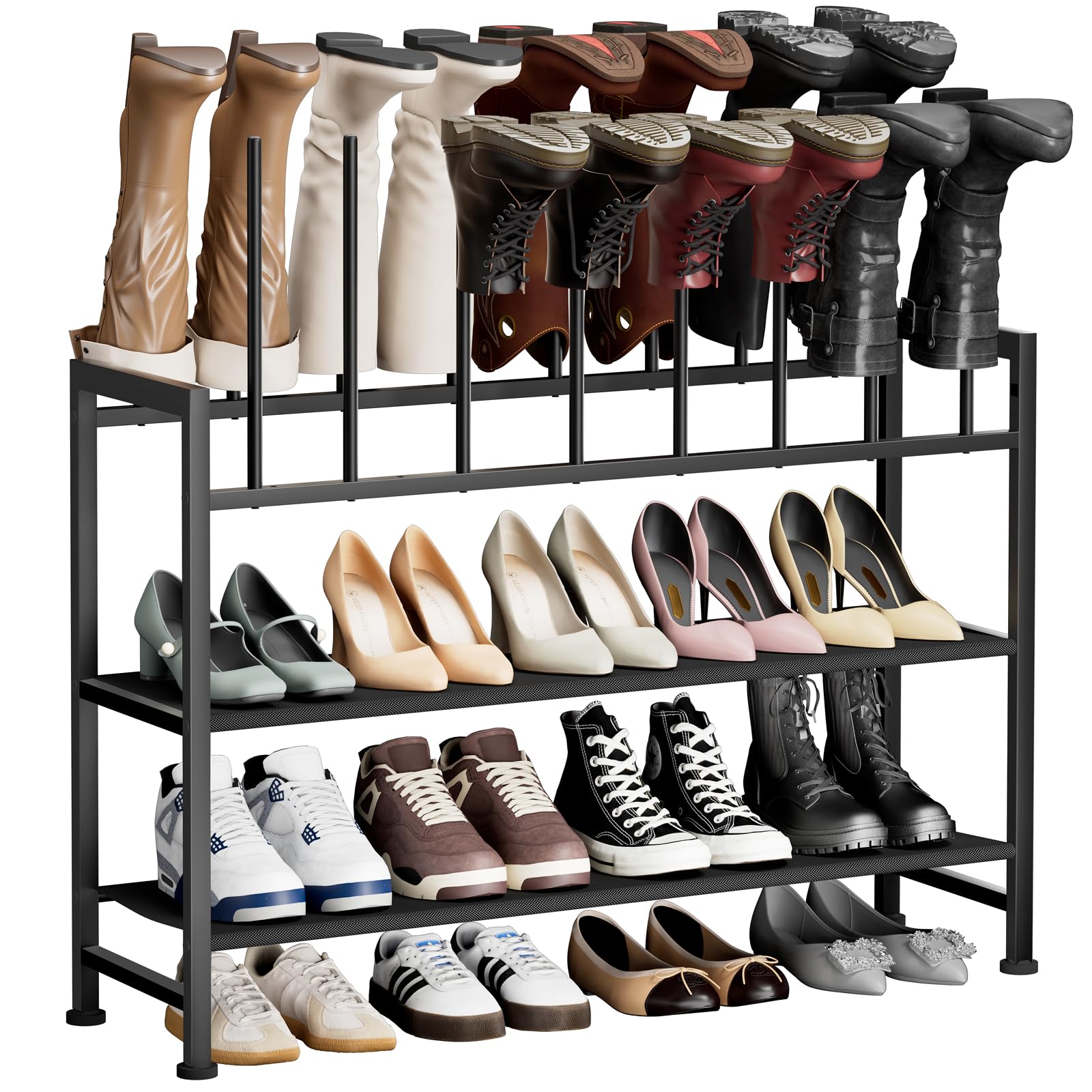
Most boot racks make you choose between boots and everything else. This one does not. The top rods hang boots upside down, and two lower tiers take the slippers, sneakers and short boots that do not need hanging — which is what makes it useful in a hallway where boots share space with school shoes.

The frame is powder-coated metal that screws together, and four feet adjust so you can level it on a floor that slopes. That last detail matters more than it sounds: a rack that rocks is a rack you stop using, and adjustable feet are the cheap fix.

As a boot rack alone, we still prefer the longer poles and braced base of our top pick. The DIMJ earns its place by covering a mixed household in one footprint — eight pairs of footwear, boots on the rods and shoes below. It is the bulkiest thing on this page, though, so measure the wall before you commit.

Bottom Line: The one we point to when boots share a hallway with sneakers: four tiers, eight pairs, and feet you can level.
#3

Best for Closet Shelves

Whitmor Clear Vue Boot Box

Whitmor Clear Vue Boot Box

8.7/10 Excellent
  • Lid: Lift-off
  • Length: 20.5 inches
  • Material: Clear vented plastic
  • Boxes Per Set: 2
Check Price on Amazon

Pros

  • Clear sides show what is inside
  • Vent holes keep stored boots fresh
  • Folds flat with no tools
  • Set of two covers a shelf's worth

Cons

  • Flexible sides sag in a tall stack
  • Lift-off lid does not latch

Clear plastic earns its keep in a way that is easy to underestimate. You see the pair you want without unstacking anything, which is the difference between a shelf you use and a shelf you avoid. These boxes are vented too, so a pair that went away slightly damp is not sealed in with its own smell.

They arrive flat and fold into shape in seconds — no tools, no screws, nothing to lose. Boots go in lying down, so a tall shaft fits fine, but you are spending shelf depth rather than height. Two boxes per set, a pair per box.

The plastic is the trade-off. Sides flex, the lid lifts off rather than latching, and a tall stack sags under its own weight. Keep it two or three high with the lighter pairs on top and it does its job; build a tower and you will be picking boxes off the floor.

Bottom Line: We reach for these when a shelf needs to hold boots: clear, vented and easy to see into, as long as you keep the stack low.
#4

Best for Travel

Suohheh 4-Pack Boot Bags

Suohheh 4-Pack Boot Bags

8.4/10 Very Good
  • Window: Clear plastic
  • Closure: Full-length zipper
  • Material: Non-woven fabric
  • Bags Per Pack: 4
Check Price on Amazon

Pros

  • Four bags cover four pairs
  • Full-length zip opens wide
  • Clear window ends the guesswork
  • Breathable, dust-proof fabric

Cons

  • Tight fit on wide-calf and large boots

Boot bags live two lives: they go in a suitcase, then they sit in a closet until the next trip. This four-pack handles both without asking you to do anything different — a handle on top, a clear window on the side, and a zipper running the length of the bag.

What we appreciated most is how wide that zip opens. You can lay a tall boot in without fighting the fabric, and once it is in, the window tells you which pair you are looking at. Non-woven fabric is also the right material for storage: it breathes, so leather is not sealed in, and it keeps dust off without trapping anything.

Two things to know before you buy four. These are dust bags, not armor — they belong inside a suitcase, not in a cargo hold, and they will not protect a shaft from being crushed. And the sizing assumes a normal shaft; wide-calf or large square-toe boots will strain the seams.

Bottom Line: Four breathable bags that travel well and then guard boots through the off-season — our pick when storage has to move.
#5

Full closet systems

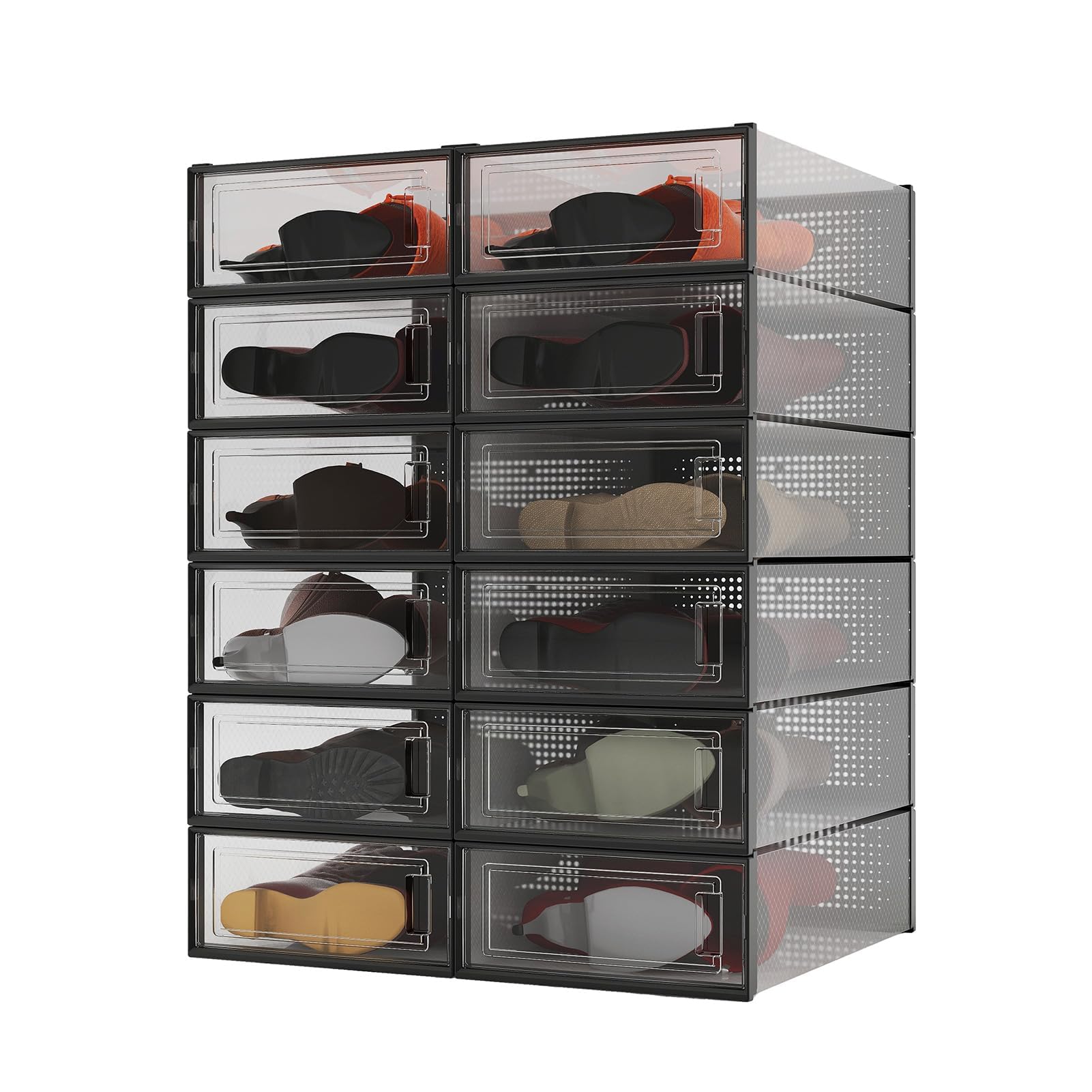
PARANTA 12-Piece Boot Boxes

PARANTA 12-Piece Boot Boxes

8.0/10 Very Good
  • Access: Front hinge door
  • Stacking: Top groove
  • Boxes Per Set: 12
  • Box Dimensions: 20.5"L x 12.5"W x 5.5"H
Check Price on Amazon

Pros

  • Front doors mean no unstacking
  • Top groove keeps stacks aligned
  • Clear body with rigid frames
  • Twelve boxes in one order

Cons

  • Fiddly panel-by-panel assembly

Twelve boxes is a project, not a purchase. If you are fitting out a closet wall, though, the front door on each box is what makes this set worth a look: you open the face and reach in, instead of pulling a column apart to get at the pair on the bottom.

The bodies are clear with rigid front and back frames, and the top groove centres a stack so the boxes stop sliding around. Nothing locks them together, so a stack near a doorway is worth pushing back against the wall.

Assembly is the weak point. Every box is a set of panels that has to be seated properly or it never squares up, and doing that twelve times is an evening's work. Budget the time, not just the boxes.

Here is where we land: it is the priciest option on this page by a wide margin, and that is a lot to spend on plastic. But if you are covering a wall for a serious collection, nothing else here gives you front-door access and a stack that stays straight. For four pairs, buy something smaller.

Bottom Line: We recommend it for a full closet wall — the front doors save you unstacking, and twelve boxes finish the job in one order.
#6

Under-bed storage

Whitmor Underbed Boot Bag

Whitmor Underbed Boot Bag

7.9/10 Good
  • Top: Clear vinyl
  • Sections: 4 per bag
  • Dimensions: 23"D x 37"W x 6"H
  • Bags Per Pack: 2
Check Price on Amazon

Pros

  • Four deep sections fit tall boots unfolded
  • Clear vinyl top shows contents
  • Two bags per pack
  • No assembly at all

Cons

  • No frame; sides fold in on carpet

Four deep sections, 37 inches wide, and enough room for knee-high boots to lie without folding — that combination is why this bag made the list. Most under-bed storage asks you to flatten a shaft or lay boots diagonally. This one takes them at full length.

The clear vinyl top lets you check what is inside without unzipping, and the sections are generous enough for two pairs of ankle boots or one pair of tall ones. There is no assembly at all: it arrives as a bag and it stays a bag.

That is the honest limitation — no frame anywhere. It slides on a smooth floor and fights you on carpet, where the sides fold in as you push. Pull it by the two handles instead of shoving from behind and most of that goes away. Two come in the pack, so one can stay flat until you need it.

This is the bag we reach for at a seasonal swap: tall boots in, under the bed, out of the way, for very little money. What it is not is a daily-access solution. If you are in and out of the same pair every morning, a rack earns its keep instead.

Bottom Line: An inexpensive way to put tall boots under the bed for the season; we like it for swaps, not daily access.
#7

Shoes and short boots

Onlyeasy Under-Bed Organizer

Onlyeasy Under-Bed Organizer

8.7/10 Excellent
  • Handles: 4 reinforced handles
  • Dimensions: 33.9"L x 23.6"W x 5.9"H
  • Compartments: 14 + 4 cells
  • Organizers Per Pack: 2
Check Price on Amazon

Pros

  • 18 cells across two organizers
  • Clear window and four handles
  • Stands up on its own when empty

Cons

  • Compartments will not take tall knee-high shafts

Here is the limit up front: this organizer is for shoes, ankle boots and mid-calf pairs. A stiff knee-high shaft will not go into the compartments, and if that is your collection, the racks further up this page are the better answer.

What it does, it does with a lot of capacity: 14 larger cells and 4 smaller ones across two organizers, a clear window so you can find a pair without unzipping, and four handles so you can pull it out from any side. The sides are cardboard-reinforced, so it stands up on its own when empty.

Where it earns its place is the shoe half of a closet that also holds boots — somewhere to put the flats, sneakers and short pairs, sealed off from dust under the bed. Once it is full it sags when you lift it, so slide it rather than carry it.

Bottom Line: For shoes and short boots under the bed, this is the one we hand people; tall shafts need a rack instead.
#8

Spare-room closets

Housen Solutions Boot Rack

Housen Solutions Boot Rack

8.0/10 Very Good
  • Poles: 6 long, 6 short
  • Rod Ends: Rounded beads
  • Dimensions: 31.7"W x 9.9"D x 17.7"H
  • Pairs Held: 8 pairs
Check Price on Amazon

Pros

  • Light frame you can carry one-handed
  • Rounded rod ends protect linings
  • Rust-resistant finish suits porches
  • Eight pairs at a lower price than the four-tier rack

Cons

  • Half the poles are short for tall shafts
  • Light frame wants a level floor and a wall

Eight pairs from a frame weighing under two kilos is the claim worth testing. The Housen is the lightest rack on this page, it goes together with the supplied spanner and a handful of screws, and it costs less than the four-tier option — which is most of why we kept it in.

What we noticed first were the rounded beads on the ends of each rod. They matter: a bare metal tip pressed into the inside of a shaft is where a dent starts, and the curve spreads the load instead. The rust-resistant finish is the reason this one can sit by a back door without complaint.

The kit splits six long poles and six short ones, so tall boots hang clear while ankle boots leave a gap. If your collection runs from ankle to over-the-knee, that gap is wasted height and the top pick suits better. If it is mostly tall shafts and the budget is tight, this lines them up neatly.

Bottom Line: A light, inexpensive rack that holds eight pairs upright, with rounded tips that protect the inside of a shaft.

How We Tested 12 Boot Racks, Trays, and Benches

We started by pulling together every boot storage option we could find that was actually in stock and could plausibly work in a real entryway — trays, freestanding racks, stackable shelves, benches with cubbies — then filtered by size range, stated weight limits, and price. That left 12 units, which went into our own homes for six months, from the first slushy snow through muddy spring dog walks. Every tester lived with theirs through a full rotation of boots: tall rain boots, ankle Chelsea boots, heavy lug-sole work boots, and kids' boots that come off at the door at a run.

I assembled each one myself with whatever came in the box, timing how long it took and noting whether the pre-drilled holes actually lined up and whether the instructions made sense without squinting at the pictures. Then we measured everything against the boots we own: where a 15-inch shaft actually landed, whether a size 12 boot sat fully on the rail or hung over the edge, and how much floor or wall space the footprint really ate compared with the advertised dimensions.

In daily use we watched for the things that go wrong. We yanked heavy boots out one-handed to see whether the whole thing rocked or tipped, stacked the stackable models two and three high and gave them a shove, and counted how many pairs genuinely fit versus what the packaging claimed — usually one or two fewer. Trays were checked the morning after wet boots sat on them overnight, and we noted whether pairs stayed paired or drifted into a jumble. Six months in, we looked for rust, sagging rails, split seams, and whether it was still easy to put a pair away without thinking, then weighed value as pairs stored per dollar rather than price alone.

How to Choose the Right Boot Storage

Start with the space, not the rack

Four kinds of storage cover almost every home: a floor rack, a box for a shelf, a bag that slides under the bed, and a soft bag for travel. Each asks something different of the room. A rack needs floor and a wall behind it. A shelf box needs depth. An under-bed bag needs about six inches of clearance and a smooth floor, because fabric drags on carpet and folds in on itself as you push.

Measure that gap under the bed before you fall for a capacity claim. It is the one number that decides whether an under-bed bag will be used or abandoned.

Check the shaft against the storage

A pair count tells you nothing about whether a knee-high boot will fit. What matters is the length the boot hangs or lies at: the pole length on a rack, the depth of a box, the height of a bag. Inverted storage, with boots hanging upside down from rounded rods, is the kindest to leather because the shaft stays open and air moves through it.

The trap is a rack sold as a boot rack whose rods are short enough that a tall shaft folds over the end — exactly the crease you were trying to avoid. Compare the longest boot you own to the pole or compartment length before ordering.

Decide whether boots share space with shoes

If boots are the whole collection, a single-tier rack with long poles uses the height best. If they share a hallway with sneakers and slippers, a four-tier rack earns its extra footprint: eight pairs of footwear in one place beats a boot rack plus a separate shoe rack.

Count the pairs you actually wear in a week, not the ones stored in the loft. Off-season boots are better served by a bag or a box than by permanent floor space.

Weigh dust protection against airflow

Plastic boxes and fabric bags both keep dust off, and they are not interchangeable. Vented boxes hold their shape and let some air through. Non-woven bags breathe more but collapse when empty. Sealed plastic with no vent holds moisture against leather.

Whichever you choose, boots go in dry. Storage protects a clean, dry pair and makes a damp one worse.

Plan for the load, not just the count

A rack rated for eight pairs is rated for eight average pairs. Wide shafts, thick soles and heavy work boots take more room and more weight than the count suggests, and a light frame with every rod full will lean.

Give a freestanding rack a level floor and a wall, spread the heavy pairs across the frame rather than clustering them at one end, and check the stated load limit where the maker gives one.

Frequently Asked Questions

Final Verdict

After handling all of these, the HzTinT rack is the one we point tall-boot owners to. Long poles, a braced base and a stated load limit are what separate it from lighter racks that loosen once they are full, and six pairs covers most collections.

If boots share a hallway with sneakers, the DIMJ's lower shelves earn their extra footprint. If your boots travel, the Suohheh bags cover four pairs for very little. Start with the rack, then add bags for whatever is out of season.