Entryway

Best Corner Hall Trees of 2026

Every entryway has one: the corner where nothing fits. A corner hall tree is built for exactly that wedge of floor, with a bench, a row of hooks, and usually a shelf or two angled so the whole piece hugs the wall instead of jutting into the walkway. What it fixes is the daily pile — coats landing on the back of a dining chair, bags dropped just inside the door, the shoe heap nobody deals with until company comes. The right one turns that dead corner into a working drop zone; the wrong one wobbles, sags under a single winter coat, and becomes an expensive thing you're afraid to hang anything on.

Something I didn't appreciate until I lived with a few of these: corners are almost never a true 90 degrees, and baseboards eat an inch of clearance you didn't budget for. Over eight months my team assembled and lived with 10 corner hall trees in real entryways, from cramped apartment doors to full mudroom-style setups, and the ones that held up had a lot in common. They were honest about their footprint, they came with hardware worth using, and their hooks didn't bend. What follows is what survived actual coats, boots, and backpacks.

#1

Best Overall

GiftGo Corner Hall Tree

GiftGo Corner Hall Tree

9.0/10 Outstanding
  • Hooks: 10 movable metal
  • Weight: 33.5 lb
  • Shelves: 3
  • Dimensions: 19.7"D x 19.7"W x 71.3"H
Check Price on Amazon

Pros

  • Ten hooks slide along the bars
  • Bench, shoe rack, and three shelves together
  • Adjustable feet level it on uneven floors
  • Fits a 19.7-inch corner

Cons

  • Particle-board panels mark when wet

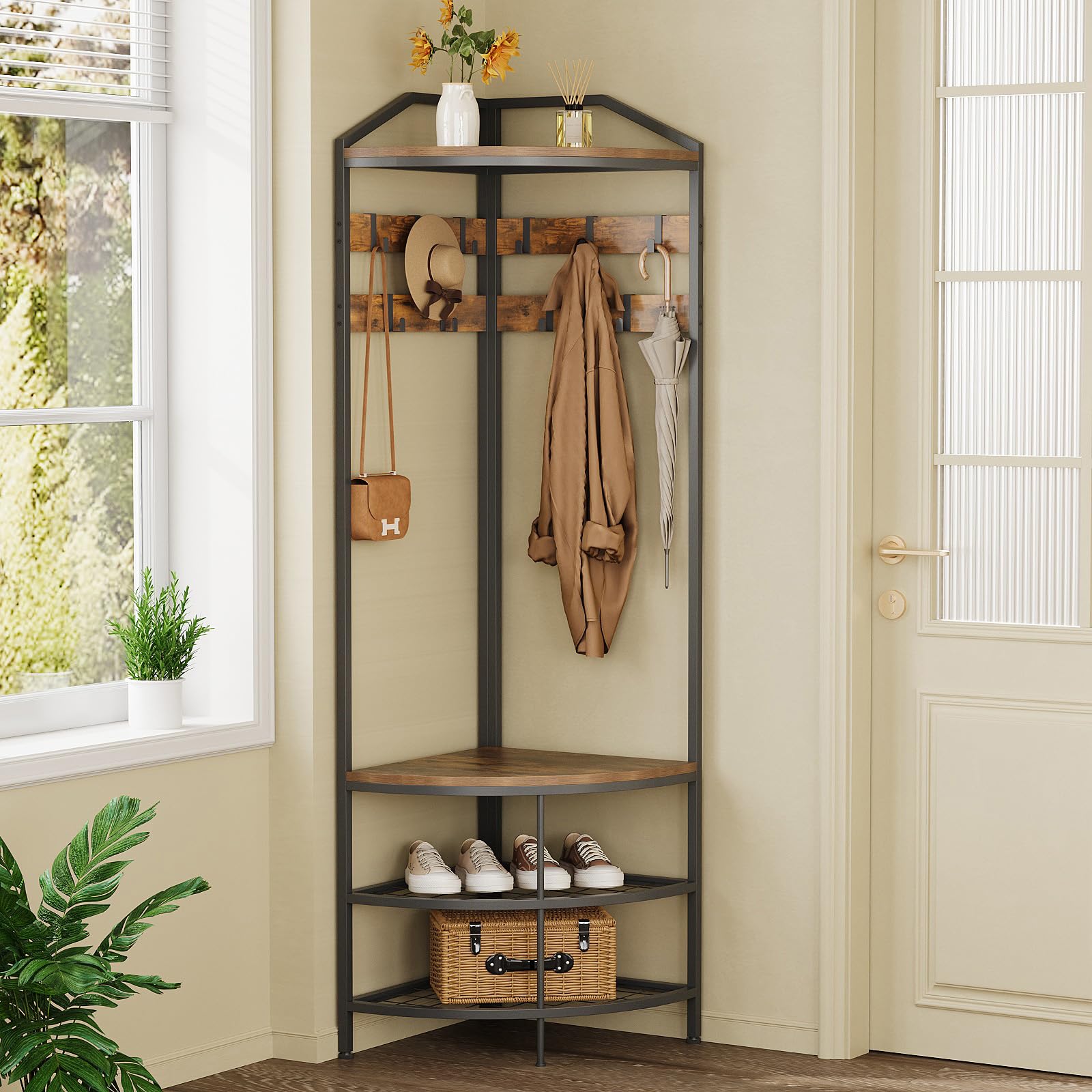
Just under twenty inches along each wall is all the GiftGo asks for, and that is the number that puts it first in this group. Sink it into a corner and the height does the work: a top shelf for baskets, an open shelf, a bench over a shoe rack, and ten hooks between them. Where a console table eats the door swing, this takes the coats, the shoes, the school bags, and the mail at once.

The hooks are the detail we appreciate most. They hang from bars rather than being screwed into the panels, so you can slide three of them together where the kids dump their jackets and spread the rest out for guests. No drill, no holes in the frame, and nothing to strip when somebody yanks a bag off in a hurry.

Assembly is a screwdriver job, and the four adjustable feet earned their keep in the hallway we set it up in, where the floor runs slightly off level — a few turns and the bench sat flat instead of rocking. Anti-tip hardware comes in the box, and on a 71-inch frame in a busy hallway, use it.

The panels are particle board under the rustic finish, so treat them that way: a soaked umbrella left against the back will leave a mark, and a printed grain hides dents less gracefully than real wood. Hang wet things on the outer hooks and it stays sharp. What you are buying here is the layout, that corner-hugging funnel of storage, not heirloom furniture.

Bottom Line: This is the one we recommend first: ten movable hooks, a bench, and shoe storage inside a 19.7-inch corner footprint.
#2

Best Built-In Look

Crosley Seaside Hall Tree

Crosley Seaside Hall Tree

8.5/10 Excellent
  • Hooks: 4 double-prong
  • Weight: 81.3 lb
  • Dimensions: 33.5 x 20 x 70 inches
  • Hook Capacity: 5 pounds each
Check Price on Amazon

Pros

  • Beadboard and distressed finish look built in
  • Drop-down cabinet hides shoes
  • Open shelf takes keys and post

Cons

  • Hooks rated at five pounds each
  • Only four hooks

Distressed white, beadboard panels, a black metal hook plate: the Seaside is the only pick in this group that looks installed rather than delivered. In a hallway that opens straight into the living room, that counts for more than an extra shelf.

The bench hides a drop-down cabinet with a magnetic catch, and that is the detail we like best. Shoes disappear behind a panel that reads as wainscoting, the door swings up and stays up while you load it, and the floor by the door stops being a shoe pile. Two compartments keep boots apart from sneakers, which is more organisation than an open rack gives you.

Then there is the arithmetic of four double hooks rated at five pounds each. A dry anorak, a tote, a school bag — fine. Four wet winter coats — no. If your household runs on heavy outerwear, this is a beautiful piece being asked to do a job it was never rated for, and the honest answer is to hang the parkas somewhere else.

It also arrives flat and heavy, at 81.3 pounds, and takes an evening rather than an hour. Build it in the corner it will live in and keep a second pair of hands for the final lift. What you get for the effort is a piece guests assume came with the house.

Bottom Line: We recommend it when the entryway is on show: beadboard panels and a drop-down shoe cabinet that read like built-in millwork.
#3

Best Budget Pick

Kings Brand Corner Hall Rack

Kings Brand Corner Hall Rack

8.8/10 Excellent
  • Depth: 18.5 inches
  • Frame: Black metal
  • Hooks: 6
  • Weight: 17.6 lb
Check Price on Amazon

Pros

  • Narrow triangular frame tucks into small corners
  • Padded seat and a top shelf
  • Labeled, separated hardware speeds assembly

Cons

  • ⚠️ Can tip forward if it isn't anchored
  • Open space under the seat, no shoe rack

If your entryway is a doorway and a slice of wall, this is the rack built for it. The Kings Brand is a triangular steel frame — six hooks, a shelf across the top for keys and post, a padded seat, and open space underneath for shoes. At 18.5 inches deep it hugs the corner, and at 17.6 pounds one person can shift it to sweep behind it.

It looks better than its place in the price order suggests, and we had it standing in a single sitting with a screwdriver. The black frame reads as wrought iron from across the room, the seat is a real seat rather than a slab, and the hardware arrives labeled and separated into compartments instead of one rattling bag.

The catch is how light it is. Four heavy coats on one side will pull this triangle forward, and the seat is only as steady as the wall it is fixed to. Anchoring solves it — there is a mounting point on the frame — but driving those screws squarely takes patience, and it goes faster with someone holding the frame while you work.

What is left is a piece for the daily layer: the leash, the tote, tomorrow's jacket, a hat. Where it wins is the narrow spot behind a door, turning a strip of dead floor into somewhere things land other than the stairs.

Bottom Line: For a narrow hallway and light layers, we reach for this one: six hooks, a padded bench, and a frame that needs anchoring to behave.
#4

Best for Narrow Corners

LTTROMAT Corner Coat Rack

LTTROMAT Corner Coat Rack

9.1/10 Outstanding
  • Weight: 23 lb
  • Shelves: 4
  • Dimensions: 17"D x 17"W x 72"H
  • Load Capacity: 50 lb
Check Price on Amazon

Pros

  • 17-inch footprint fits the tightest corner
  • Stated 50-pound load capacity
  • Four shelves plus a bench
  • Light enough for one person to move

Cons

  • Fewer hooks than the ten-hook picks

There are corners nothing else in this group will take: the strip beside a fridge, a stair nook, the gap behind a door that opens flat to the wall. At 17 inches along each side and 72 inches tall, this is the one that goes there, taking barely more floor out of the room than a dining chair.

Inside that footprint: four shelves, a bench, hooks along the top rails, and a stated load capacity of fifty pounds, which is more than most of us will ever stack on it. At 23 pounds it is one of the few here you can carry in from the porch and reposition on your own, and the rustic brown boards against the black X-frame give it a farmhouse look that suits a hallway more than it suits an office.

The X-brace across the back is what we credit for how solid it feels once loaded. Corner units live or die on that diagonal — without it the frame racks sideways every time someone pulls a coat off a hook — and running it behind the shelves means the bolts stay reachable later without unpacking everything.

The shelves are open, so boots, reusable bags, and the dog towels are all on display. Baskets fix most of that, and open shelving does let damp footwear air out instead of sitting in the dark behind a door. That is the trade for a hall tree that fits where nothing else will.

Bottom Line: We put it in corners the others can't take: 17 inches a side, four shelves, and a stated 50-pound load.
#5

Large corners

GiftGo Deformable Hall Tree

GiftGo Deformable Hall Tree

8.7/10 Excellent
  • Hooks: 10 double
  • Setup: Corner or straight
  • Weight: 42.3 lb
  • Dimensions: 33.07"D x 33.07"W x 70.87"H
Check Price on Amazon

Pros

  • Converts between corner and straight setups
  • Ten double hooks across four panels
  • Adjustable feet and anti-tip hardware included

Cons

  • Hooks handle light loads only
  • Needs 33 inches on each side

It calls itself deformable, and the trick is real: the same frame sets into a corner or straightens out along a wall. In corner mode it wants 33 inches on each side, so this is the pick for a roomy foyer rather than the sliver behind a door — and once it is set, the wrap of shelves and bench makes a proper drop zone rather than a coat rack with ambitions.

Ten double hooks across four panels, open display shelves, a bench with shoe storage, and adjustable feet for a floor that is not level. The greige finish is calmer than the rustic brown of its sibling here, and the anti-tip hardware is in the box, which on a 42-pound unit this tall you should use.

The hooks are where our enthusiasm cools. They are the part of a hall tree that takes the daily beating, and on this one they are the weak link — a tote, a cap, a light jacket, spread across several hooks rather than bunched on one. A soaked wool coat is asking too much of them.

Assembly takes a couple of hours and a second pair of hands: the panels are heavy and the hook plates are fiddly to line up straight. Do it in the room, check the feet against the floor before you start filling it, and the extra space you paid for is genuinely usable.

Bottom Line: We like the convertible frame for a big corner, but the hooks are the light-duty part of an otherwise roomy hall tree.
#6

Bedroom corners

BUZUEY Corner Coat Rack

BUZUEY Corner Coat Rack

7.8/10 Good
  • Base: Storage basket
  • Depth: 15.7 inches
  • Hooks: 3
  • Shelves: 2
Check Price on Amazon

Pros

  • 15.7-inch depth suits shallow corners
  • Gold finish reads as decor
  • Bottom basket holds gloves and bags

Cons

  • Only three hooks

Gold powder-coated steel, 15.7 inches deep, a bottom basket, and three hooks. This is the one that reads as furniture first and storage second, and in a bedroom corner that is exactly the right order — it holds what you would otherwise drape over a chair, and it looks deliberate doing it.

Three hooks settles it for us. That is a rack for one or two people's daily layer — a robe, a tote, a cap — not the four-coat family drop zone the bigger picks handle. Where it earns its keep is the corner of a bedroom or dressing area, holding tomorrow's outfit so it is not on the chair again.

It is a light tubular frame, so wobble is the thing you manage. On a level floor with the basket loaded it stands quietly; on deep carpet it can rock until you shim a foot, and the two shelves are open, so whatever is on them is what you see.

The top shelf is the surprise: flat and steady enough for a plant or a lamp, which is more than most coat racks offer. What it will not do is seat you while you tie boots, since there is no bench anywhere on it, and that is fine by us if the real coat closet is elsewhere in the house.

Bottom Line: We think of it as furniture with a job: a slim gold rack for a bedroom corner, with three hooks rather than a family's worth.

How We Tested the Best Corner Hall Trees

We started by gathering every genuinely corner-shaped hall tree we could find — not flat benches shoved into corners — then narrowed the list by footprint depth, bench height, hook count, and whether mounting hardware came in the box. That left 10 units, which we assembled, anchored, and loaded over eight months. Each one went into a working drop zone: coats on the way out the door in the morning, backpacks and muddy boots after school, grocery bags, leashes, and the mail pile that never stops.

For assembly, I built every unit solo with only the tools included and timed the process from opened box to stable furniture. I noted whether the hardware bags were labeled, whether the illustrated steps matched the parts in front of me, and where I got stuck. A couple came together in under an hour; a few ran past three, usually because a mislabeled panel or a cam lock sent me back a step.

To test stability, I set each unit on a level floor and then on a slightly uneven one, watching for wobble and rocking. I recorded what came in the box for wall attachment — a real anchor and strap, a token screw, or nothing at all — since a loaded hall tree that isn't secured is a tipping hazard, especially in a house with kids or dogs. For hook durability, I hung loaded totes and heavy winter coats on every hook, then checked back weeks later for hooks that had bent, pulled loose, or rotated under weight.

Fit was measured rather than eyeballed: footprint against baseboards, door swing, and outlet clearance. For appearance, I looked at each piece in daylight and again under hallway light at night, mostly for finish consistency and whether the back panel showed once it was against a wall. Quality and value came down to the joints, the veneer edges, and whether the thing felt worth its price next to a solid-wood alternative.

How to Choose Corner Hall Trees

Measure the corner before the storage

The figure that decides whether a corner hall tree works is how far it stands proud of the wall, not how tall it is. The picks here run from 15.7 inches deep to 33 inches along each arm, and that spread is the difference between a unit that slips behind a door and one that turns a hallway into a squeeze. Measure both walls out from the corner, baseboard included — quarter-round pushes a frame forward by half an inch or more, and that is enough to stop a tight unit seating properly.

Then mark the depth on the floor with painter's tape and walk past it for a day. A corner unit you brush against every time you carry groceries in is one you stop using.

Hook count is easy; hook rating is the real question

A hall tree's working life is decided at the hooks. Count two per person in the household for the daily layer, then look for a stated weight limit — the Crosley rates each of its hooks at five pounds, which tells you more about a winter coat than any photograph of a styled entryway does. A wet wool coat is a serious load, and a hook that bends takes the frame's balance with it.

How the hooks attach matters too. Sliding hooks, like the GiftGo's, let you cluster weight over the frame's legs instead of out at the ends, and they need no drill — useful if you rehang the same three hooks every autumn.

Open shelves, a closed cabinet, or a basket

Where the shoes go changes how the piece looks six months in. Open shelves are quick to use and always visible; a drop-down cabinet like the Crosley's lets you shut the mess away and costs you the storage space the door occupies. A deep bottom basket, as on the BUZUEY, catches gloves and scarves without adding a door at all.

If your household generates a genuine shoe pile, favour closed storage or budget for baskets. If you want the tidying to take one motion, open shelves win.

Anything you sit on needs anchoring

A bench turns a coat rack into furniture you put weight on, and that changes the physics. Any unit with a seat should be fixed to the wall with the anti-tip hardware that ships in the box: find a stud, or use the drywall anchor supplied, and fix the top rail rather than the middle of the frame.

The light steel racks are the ones that move. The Kings Brand is the clearest example — a triangular frame well under twenty pounds is stable once tethered and vague about it until then. If you rent and the wall is off limits, choose a unit with no bench and keep the load modest.

What the panels are made of

Nearly everything here is engineered wood with a printed grain or powder-coated steel, and that is not a fault — it is how a hall tree costs less than a coat closet. It does set the upkeep: wipe drips promptly, keep soaked outerwear off the back panel, and respect the stated shelf or hook limit rather than testing it.

Weight tells you what arrival day looks like. The Crosley is the heaviest of these at 81.3 pounds, and every one of them ships flat, so a second pair of hands is worth arranging before the boxes come in.

Frequently Asked Questions

Final Verdict

The GiftGo corner hall tree earns the top spot because it does the whole job inside a corner just under two feet wide: ten hooks that slide where the week needs them, a bench, a shoe rack, and three shelves. It isn't the most handsome piece here and its panels won't outlast solid wood, but it ends the pile by the door in the space most of us actually have.

If the entryway is on show, the Crosley buys you beadboard and a cabinet door at the cost of four lightly rated hooks. If the corner is genuinely tight, the LTTROMAT takes 17 inches a side, and the Kings Brand asks least of all — provided you anchor it.