Entryway

Best Doormats of 2026

A doormat has one job, and most of them blow it by the second week — curling at the corners, sliding across the porch, or turning into a soggy welcome for whatever the dog dragged in. A good one scrapes grit off shoes, soaks up the worst of a rainy day, and stays put while you wipe your feet. It should also look like you meant to put it there. And size matters more than most people expect: too small a mat just gives muddy shoes a landing pad before they hit your floor.

I've lived with flimsy coir squares and rubber-backed mats that weighed a ton, and the difference shows up fast. Over the past six months, we put 14 doormats through real entryways — muddy boots, dog paws, slushy mornings — watching how they trapped dirt, whether they shifted underfoot, how soft they felt, and how they held up after scrubbing. Price didn't predict much: a few affordable mats beat pricier ones on durability and water capacity. The picks below are the ones that earned their spot.

#1

Best Overall

Gorilla Grip SoakSTOPPER

Gorilla Grip SoakSTOPPER

9.2/10 Outstanding
  • Care: Hand wash
  • Size: 36" x 24"
  • Backing: TPR rubber
  • Pile Height: 1 inch
Check Price on Amazon

Pros

  • Covers a full doorway and step-off zone
  • Deep chenille takes water off boots and paws
  • TPR backing grips tile and hardwood
  • OEKO-TEX Standard 100 certified

Cons

  • Care instructions call for hand washing

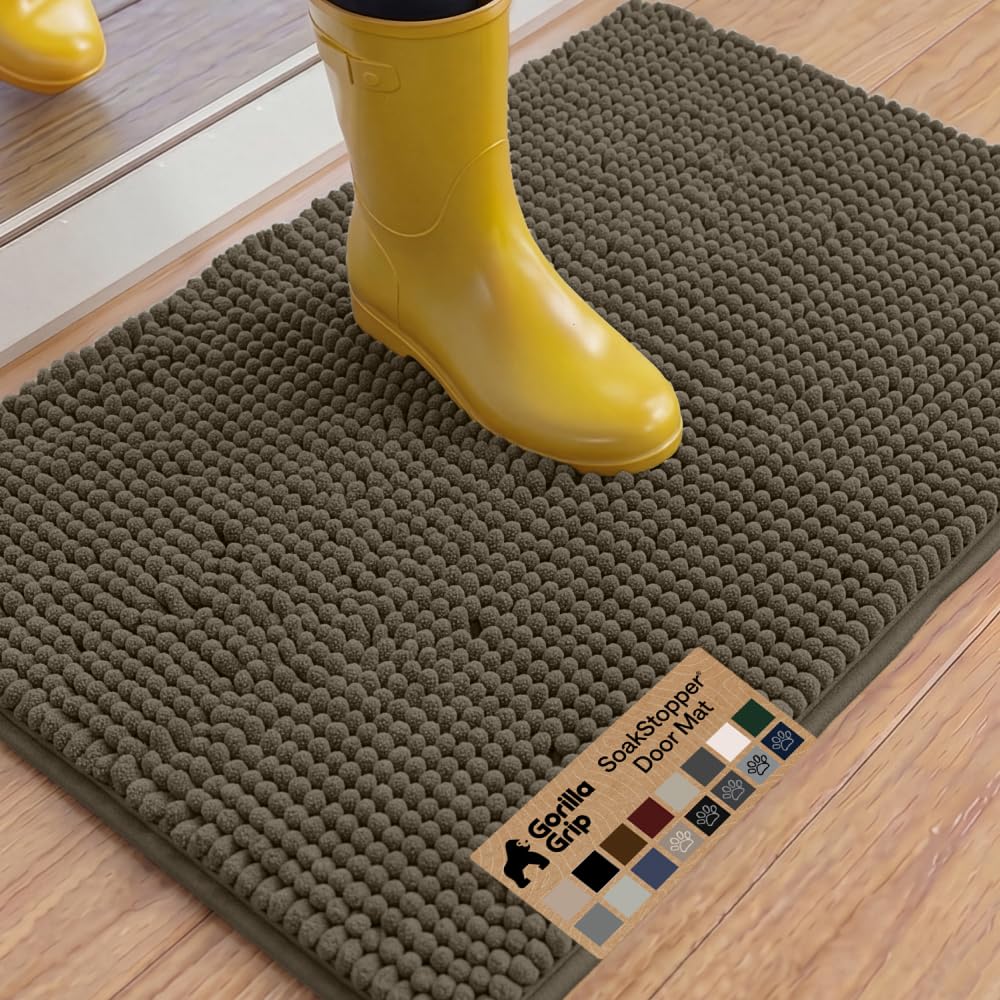
Thirty-six by twenty-four inches is a lot of mat. Across a standard entry it covers the door width and the step-off zone on both sides, which is the patch wet boots and muddy paws actually land on. The pile is an inch of dense chenille — closer to a bath mat than a scraper underfoot — and the underside is TPR rubber rather than the stiff PVC that cheaper mats use.

We made it the top pick because that combination is what most entryways need. Water goes into the pile instead of tracking across the floor, and there is enough weight and grip in the backing that it stays where you put it. Nothing else here pairs that much pile with that much surface area, and in a wet week that is the difference between one damp patch and a trail of footprints through the house.

The details hold up. Gorilla Grip lists an OEKO-TEX Standard 100 certification, which matters on a mat a crawling baby or a dog will lie on, and the top is fade resistant. The water-resistant backing keeps moisture from wicking through to the floor beneath, and the cappuccino color hides the grey wash road grit leaves behind.

Two things to know before you commit. The care instructions call for hand washing, which is a genuine chore at this size — plan on spot cleaning and an occasional deep clean in the tub. And the mat belongs inside; a deep chenille pile left out in the rain stays soaked. If your front door has no roof over it, the WeatherMAX below is the better buy.
Bottom Line: Our pick for most entryways: a big, deep-pile mat that swallows water from boots and paws, grips hard floors, and covers the mess zone a smaller mat misses.
#2

Best for Exposed Entries

Gorilla Grip WeatherMAX

Gorilla Grip WeatherMAX

8.8/10 Excellent
  • Use: Indoor and outdoor
  • Size: 29" x 17"
  • Backing: Natural rubber
  • Thickness: 0.3 inch
Check Price on Amazon

Pros

  • Sheds rain, snow, and sun without soaking
  • 0.3-inch profile clears a tight door sweep
  • Grooved top scrapes mud off boot soles
  • Hoses or vacuums clean in minutes

Cons

  • Spot clean only, no machine washing

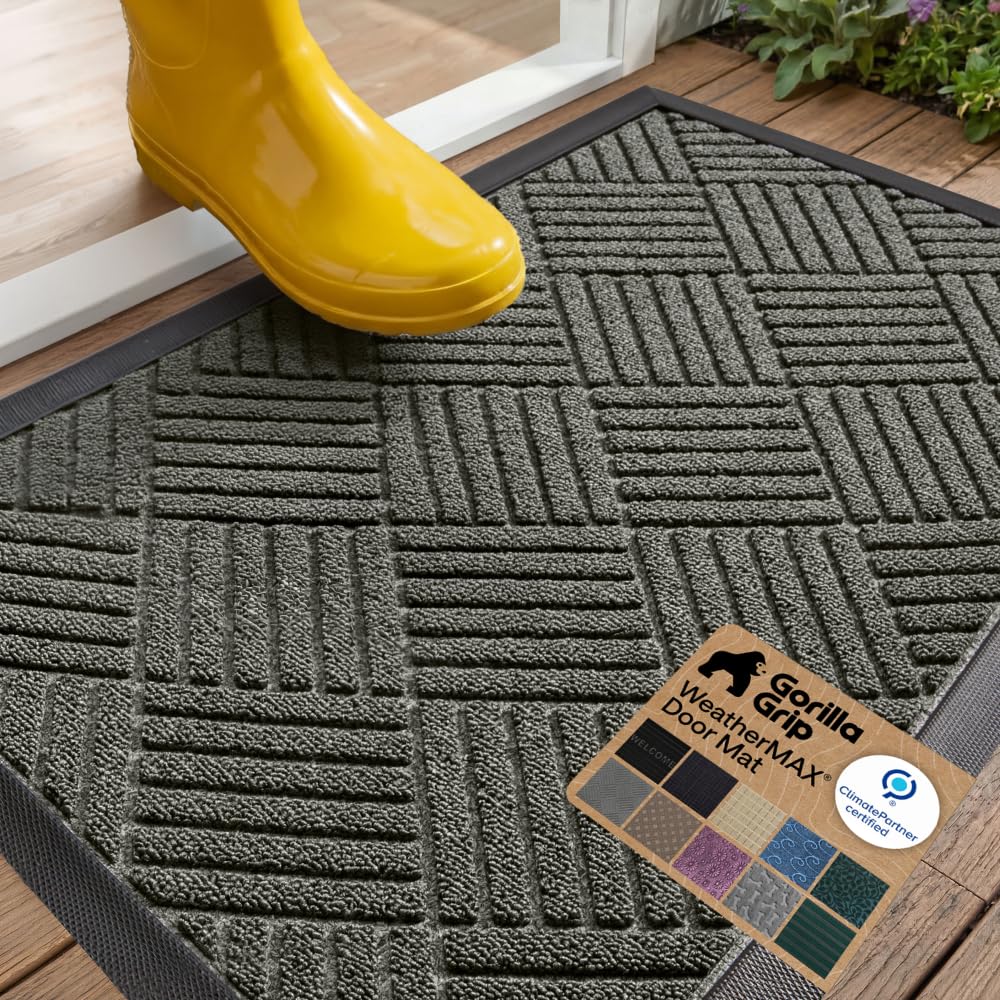
An uncovered porch is the hardest job a doormat has: sun, rain, snow, and grit, with nothing overhead to soften it. Most of this list is wrong for that spot — chenille holds water and coir stains once it stays wet. The WeatherMAX is built for it, with a knitted polypropylene top and a natural rubber back that sheds weather instead of absorbing it.

It scrapes rather than soaks. The deep grooves and beveled edge work mud and grit off boot soles, and at three-tenths of an inch it sits low enough that a door with a tight sweep passes over it without catching. We like the diamond pattern more than the usual ribbed grey, and it vacuums or hoses clean in a couple of minutes.

Where it gives ground is grip. On dusty concrete or a smooth garage floor it can shift when someone pivots on it, so sweep before you set it down and check it after a windy week — a mat that has slid half a foot out of place is a trip hazard, not just an annoyance. Against the rest of this list, though, it is the best all-weather scraper of the ones we covered, and the low profile is why it works on doors that reject everything else. Sweep it, hose it, and forget it until spring.

Bottom Line: If your front door has no roof over it, buy this one: a low-profile, rubber-backed scraper that sheds weather and clears a tight sweep.
#3

Best Plush Indoor Mat

Muddy Mat Chenille Doormat

Muddy Mat Chenille Doormat

9.4/10 Outstanding
  • Care: Machine wash
  • Size: 19" x 30"
  • Surface: Chenille
  • Pile Height: 1 inch
Check Price on Amazon

Pros

  • Inch-deep chenille is soft underfoot
  • Soaks water off wet paws and boots
  • TPE backing holds on tile and hardwood

Cons

  • Backing can tear after repeated washes
  • Indoor only, and small for a main entry

Plush is the wrong word for how deep this pile sits. The Muddy Mat is an inch of tufted chenille, and it feels like a bath mat underfoot rather than a doormat — which is exactly why we like it for the door you cross barefoot: the bathroom, the en-suite, the kitchen side of a back door. It takes the water off wet feet, and it is genuinely pleasant to stand on while you do it.

It works on dirt too. The pile traps grit and hair rather than pushing it around, the TPE backing holds on tile and hardwood, and shaking it out on the step takes thirty seconds. The grey reads as a plain, tidy rug rather than a pet product, which is more than some of the fluffy mats here can claim.

The backing is the weak point. It can tear after a few trips through the washing machine — the waterproof layer separates from the pile — so wash it cold, wash it rarely, and air dry it flat. Pair it with a scraper outside the door and it does its best work.

Bottom Line: Softest and thirstiest of the lot — plush chenille for the door where bare feet land, provided it stays out of the weather and out of the drum.
#4

Best Two-Mat Value

Sierra Concepts 2-Pack

Sierra Concepts 2-Pack

9.0/10 Outstanding
  • Size: 30" x 17" each
  • Pieces: 2 mats
  • Backing: PVC
  • Thickness: 0.25 inch
Check Price on Amazon

Pros

  • Two mats per order for two doors
  • Quarter-inch profile clears most doors
  • Ribbed top scrapes grit off soles
  • Hoses off instead of needing a washer

Cons

  • Rubber edging can peel with use

Two mats come in one order, both 30 by 17 and both a quarter-inch thick, which is thin enough to slide under a door with a sweep and never think about again. One for the front, one for the back, or one inside and one out — you cover two doors for about what a single plush mat here costs.

We like them where a mat has to take abuse and then be hosed down: a garage-to-kitchen door, a patio slider, a workshop entrance. The ribbed polyester top works grit off soles, the PVC backing is water resistant, and none of it is precious — shake, sweep, rinse, done. A ten-year refund policy backs them, which tells you how the maker expects them to be treated.

The compromises are the edging and the footprint. The rubber border can peel away in chunks with use, and vacuuming over it repeatedly seems to hurry that along. The 30-by-17 size also reads smaller in person than in the photos, so measure the doorway before you commit — and on a very smooth floor these can walk when someone pivots, so a grippy pad underneath is worth the small extra.

Bottom Line: Two doors, one order: a pair of low-profile scraper mats that cover the front and the back for about what one mat elsewhere here costs.
#5

Best for Tight Door Clearance

BEQHAUSE Dirt Trapper

BEQHAUSE Dirt Trapper

9.1/10 Outstanding
  • Care: Machine wash cold
  • Size: 20" x 32"
  • Backing: TPR rubber
  • Thickness: 0.4 inch
Check Price on Amazon

Pros

  • 0.4-inch profile clears tight door sweeps
  • Dense pile vacuums and shakes clean
  • TPR backing stays put on hard floors

Cons

  • Indoor use only, not for an exposed step

Four-tenths of an inch is the number that matters here. That is how thick the BEQHAUSE sits, and it is thin enough that a door with a weather strip or a tight sweep passes over it without grabbing. If you have ever had a mat bunch up and jam a door, this is the fix — and at 20 by 32 there is more mat there than the thickness suggests.

The surface is dense low-profile polypropylene, not plush chenille. It traps dirt and moisture in the yarn rather than in a deep pile, which means a vacuum or a good shake actually clears it instead of pushing grime deeper. Daily traffic has not flattened the yarn in our use, and the mat does not shed — no fuzzy halo around the edges, which is the usual giveaway on cheap polypropylene.

The backing is a textured TPR that held on both wood and tile without a pad. Nothing about the mat moves when it is stepped on, and the beige hides road grit without going muddy the way a pale grey does.

What we keep coming back to is how little it asks of you: no washing-machine anxiety, no edge curl, no sliding, and a color that still looks tidy after a fortnight of wet shoes. The trade is softness — there is nothing cozy about it underfoot, and that is the wrong reason to buy it. For a front door that gets traffic rather than puddles, that is a good trade.

Bottom Line: Four-tenths of an inch of dense, non-slip matting that clears a tight door sweep, with none of the shedding or edge curl to put up with.
#6

Best Classic Coir

AMARU Coir Welcome Mat

AMARU Coir Welcome Mat

9.3/10 Outstanding
  • Care: Shake clean
  • Size: 17" x 29"
  • Surface: Natural coir
  • Thickness: 0.6 inch
Check Price on Amazon

Pros

  • Coir bristles scrape mud off boots
  • Best-looking mat in this set
  • Heavy enough to stay put on a porch

Cons

  • Needs a covered spot
  • Shake clean only, never washed

Coir is the oldest doormat there is, and it still does the one thing synthetics struggle with: coconut fiber bristles scrape mud off boot soles instead of smearing it around. This one is 17 by 29 and six-tenths of an inch thick, with a PVC backing and a printed flock of birds across the top — and it is, comfortably, the best-looking mat in this group.

The feel is what sells it. The weave is dense and slightly springy, the colors are saturated rather than washed out, and the mat has enough heft that it stays where it lands on a porch instead of skidding when someone kicks it. Sweeping it off weekly keeps the pattern readable, and there is nothing to wash — either a relief or a nuisance, depending on how you feel about maintenance.

The catch is water. Coir and standing water do not get along: the care instructions ask for a shaded spot and warn about staining on damp surfaces, so this is a mat for a covered porch or a sheltered step, not an open one. Sweep it weekly and there is nothing else to do.

Bottom Line: Coir that scrapes boots properly and looks better than anything else here, provided you can keep it under a roof.
#7

Budget wet-weather

OLANLY Chenille Mud Mat

OLANLY Chenille Mud Mat

9.2/10 Outstanding
  • Size: 30" x 20"
  • Backing: TPR rubber
  • Surface: Chenille
  • Pile Height: 1 inch
Check Price on Amazon

Pros

  • Soft, absorbent chenille for very little
  • Light enough to shake out one-handed
  • TPR backing grips tile

Cons

  • Weakest backing durability in this set
  • Listed size runs small in person

In the hand, the OLANLY is a smaller version of our top pick: 30 by 20, an inch of chenille, a TPR backing, the same soft, thirsty feel. What you are not getting is the surface area — a 20-inch depth covers the threshold and not much of the step — or the same confidence in the backing.

As a second or third mat it makes a lot of sense. It goes by a shower, under a dog crate, in a car footwell, or at the back door, and it shakes out in seconds. The chenille traps dirt well for the size, it does not slip on tile, and the grey hides mud until you get around to dealing with it.

Where it falls down is durability. Of everything here, its backing is the weakest — it can peel away from the pile after limited washing — so treat it as a mat you will replace rather than one you will keep. Cold wash, air dry, and do not expect it to take the same treatment as the mat at the top of this list. As the cheapest way into a genuinely absorbent chenille mat, it earns its place.

Bottom Line: Budget chenille that feels like our top pick in a smaller footprint, with a backing that rewards gentle washing.
#8

Double-door entries

Mibao Half-Round Mat

Mibao Half-Round Mat

9.1/10 Outstanding
  • Size: 24" x 36"
  • Shape: Semicircular
  • Backing: Natural rubber
  • Thickness: 0.5 inch
Check Price on Amazon

Pros

  • Half-circle frames a door with sidelights
  • Beveled rubber border holds grit and meltwater
  • Heavy enough to stay put in wind
  • Vacuums or hoses clean

Cons

  • Costs more than any other mat here

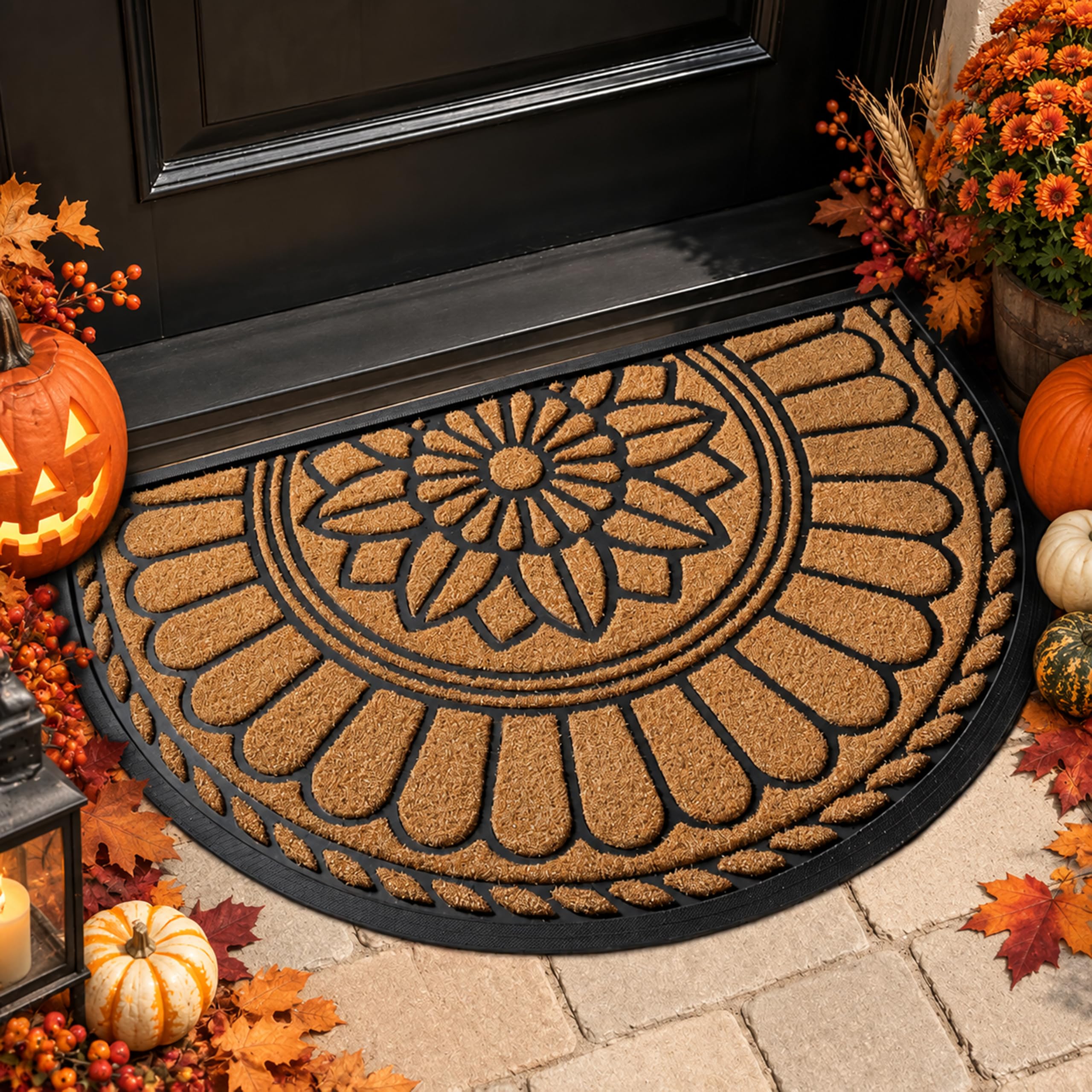
A half-circle is a shape with a job. The flat edge sits along the threshold, the curve takes the traffic, and the whole thing frames a single door with sidelights in a way a rectangle never does. It is 24 by 36 — a big mat by any standard — and half an inch thick, flat-woven polypropylene over a natural rubber back.

The build is the reassuring part. A beveled rubber border runs the whole way around and forms a shallow tray, so grit and meltwater collect there instead of walking in. It does not shed, the edges do not curl, and it vacuums or hoses clean without any real effort.

What it will not do is dry your feet. Flat-woven polypropylene is a scraper; water sits on the surface or in the tray rather than soaking away, so a wet footprint still leaves a wet footprint. On an open step the tray can fill in a downpour and stay full, and if the temperature drops that is ice on your landing.

Under a porch roof none of that matters, and the mat is genuinely excellent: heavy enough to stay through wind that moves lighter mats, sturdy underfoot, and the most substantial-looking mat here. Whether it earns its place on your step depends on how much you care what the front of the house looks like from the street — we cared more than we expected to.

Bottom Line: A heavy, handsome half-circle that scrapes boots and stays put in wind, made for a sheltered entry that wants some presence.

How We Tested 14 Doormats

We started by pulling together a shortlist from the mats that show up again and again in reviews and in stores — coir, rubber, microfiber, and indoor-outdoor styles — then filtered it by size options, price, and the materials that make sense for wet or dry climates. That left 14 mats, which we rotated through real entryways for six months. The test homes had a mix of covered porches, exposed steps, and apartment hallways, so each mat saw muddy boots, dog paws, and at least one stretch of slushy weather.

At the door, we paid attention to the things you notice every day: whether a mat shifted when we wiped our feet, whether it curled at the edges, and whether it felt soft or scratchy under bare feet. To check dirt containment, we stepped in with muddy shoes, wiped, then looked at the floor underneath. For water capacity, we poured measured cups of water onto each mat and watched whether it soaked in, pooled on top, or leaked through to the floor. We also measured each mat against common door widths so we could say plainly when a smaller size was a false economy.

Durability and appearance got the least glamorous part of the test: vacuuming, shaking out, scrubbing spots with a brush, and leaving each mat in place for weeks at a time. We noted which ones shed fibers, faded, or flattened, and which still looked presentable after cleaning. Value came last — we compared what each mat cost against how it performed, not against how it looked on a shelf. The mats that scored well did the boring stuff right: they stayed put, caught grit, and didn't turn into a wet sponge.

How to Choose Doormats

Decide how exposed the door is

Three settings behave differently. A mat inside the door, or on a covered porch, can be plush: chenille and microfiber wick water off a wet footprint and hold it until it evaporates, which is exactly what you want one step from the kitchen. A mat fully open to rain should drain instead, because a deep pile left in the weather stays soaked, heavy, and hard on its backing. Coir sits in between — a superb boot scraper that compacts and stains once it stays wet.

We keep the plush mats under cover and the scrapers out in the weather; that division does most of the work. Pick the material for the weather first, then the look.

Match the thickness to the gap under the door

A quarter to four-tenths of an inch clears most doors, including ones with a sweep or a weather strip. The inch-thick chenille mats are better kept where the door swings away from them, which is usually the case inside.

The trap is the phrase low profile. On a listing it normally means thin for this kind of mat, not thin enough for your threshold. If your door has an inch of clearance and a draft seal, measure before buying plush — a mat that catches on the door gets kicked aside within a week.

Measure the doorway, not the old mat

Most mats sold for a single door run 17 to 20 inches deep and 29 to 32 wide. That covers the threshold but not much of the step-off zone, and it is why a 19-by-30 mat feels small the moment two people come in at once. If a dog shakes off just inside the door, or the entry gets family traffic, go to 36 inches wide or more.

Expect listed sizes to run slightly small and treat the dimensions as a target rather than a promise. Buy for the traffic the door gets, not for the rectangle that was there before.

The backing decides whether it stays, and how it dies

A rubber or TPR underside is what keeps a mat from walking across tile, and natural rubber generally grips harder than a stiff recycled PVC. It is also the part that fails first: on washable plush mats, a waterproof layer separating from the pile after repeated washing is what ends the mat's life, long before the top looks worn.

A beveled rubber border that forms a shallow tray is worth having on an exposed step, because it holds grit and meltwater instead of letting them walk inside.

Choose the cleaning route before you buy

Almost every plush mat claims to be machine washable, and most are, once or twice. Frequent hot washes are what stress the backing, so the sensible routine is a weekly shake or vacuum, a cold wash only when the mat looks dirty, and flat air drying rather than a dryer.

Grooved rubber and coir need less: hose or sweep, and keep coir out of standing water. If you know you will wash monthly, a low-pile mat with a rubber backing will outlast deep chenille — and the top pick here is the exception that rewards hand washing instead.

Frequently Asked Questions

Final Verdict

The Gorilla Grip SoakSTOPPER is the mat we point most people to. Most front doors open onto a floor that a wet footprint will ruin, and its 36-by-24-inch pile handles that better than anything else here — more coverage, more absorbency, and enough grip to stay where you put it.

If your door has no roof over it, the answer changes. The Gorilla Grip WeatherMAX is the one that survives open weather, and spending less on a plush mat you leave out in the rain is money thrown away.