Entryway

Best Narrow Entryway Cabinets of 2026

A narrow entryway cabinet is a compromise you make on purpose: you trade floor space for a place to put your keys down, and you hope the thing doesn't shudder every time the front door closes. Slim usually means shallow, which is why so many of them end up with boots hanging off the front edge and mail sliding down behind the back panel. What you're actually buying is a landing strip — the spot where shoes come off, the bag gets hung, and your keys live somewhere you can find them at 7 a.m. Get the footprint and the depth right and a hallway that felt cramped starts to feel handled.

I've measured more hallway walls than I care to admit, and my team and I just spent nine months assembling and living with 11 narrow cabinets, from shoe-storage hybrids to slim consoles. Here's the thing first-time buyers don't anticipate: the listed width is almost never the usable width once baseboards and door swing are in play, so measure the wall, then measure again at ankle height. The picks below are the ones that stayed planted, swallowed more than they appeared to, and didn't eat an entire Saturday in assembly.

#1

Best Overall

BORNOON 3-Drawer Shoe Cabinet

BORNOON 3-Drawer Shoe Cabinet

9.1/10 Outstanding
  • Material: P2 engineered wood
  • Drawer Layout: 3 flip drawers
  • Shoe Capacity: 18 to 24 pairs
  • Overall Dimensions: 9.45"D x 31.5"W x 47.24"H
Check Price on Amazon

Pros

  • Fits 18 to 24 pairs in a 9.45-inch depth
  • Three flip drawers with adjustable, removable dividers
  • Top display shelf adds entryway utility
  • Anti-tip hardware included

Cons

  • Boots can be tight in the flip compartments

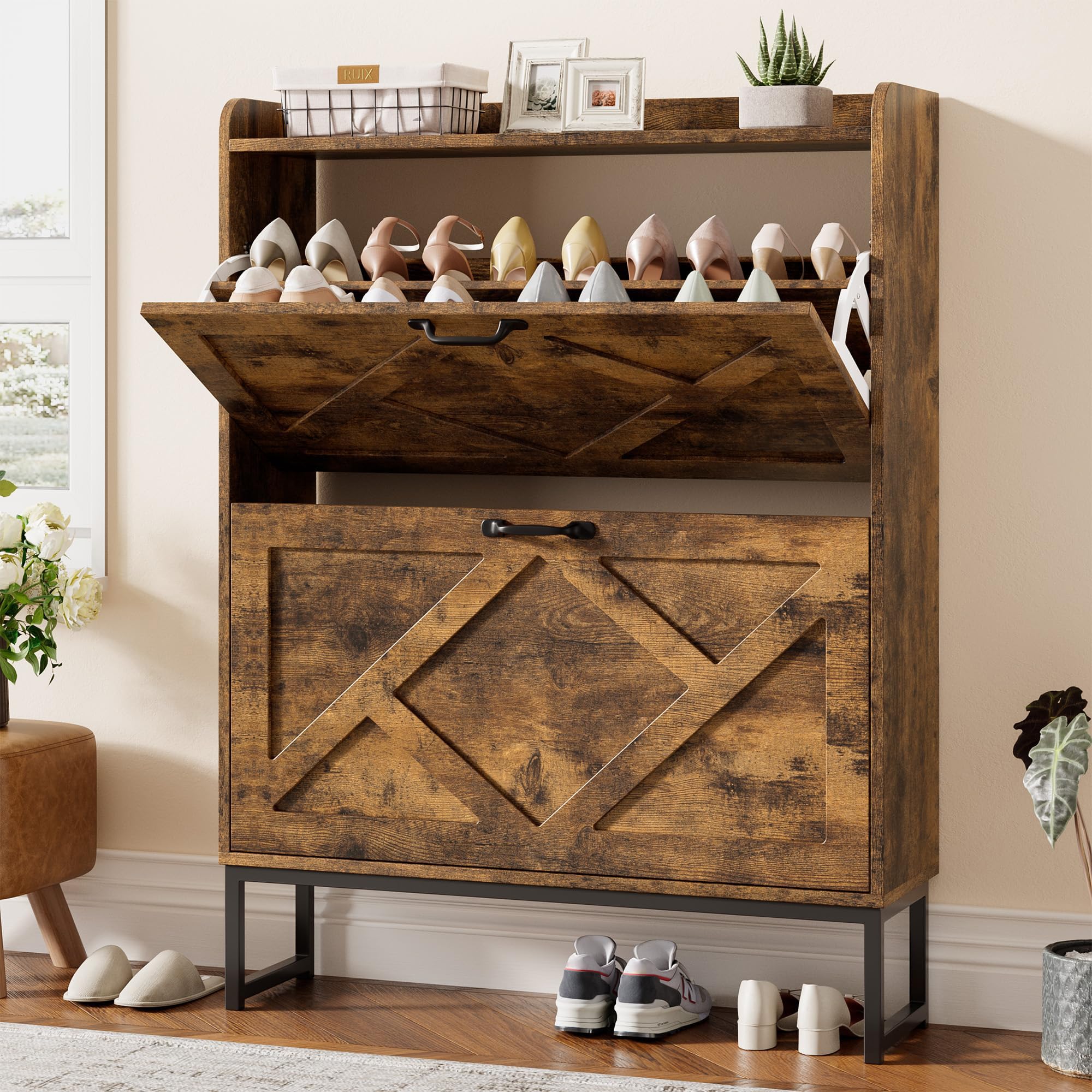
The BORNOON earns its place at the top of this list because of what it packs into a genuinely shallow cabinet. Three flip drawers give you room for 18 to 24 pairs, and the whole thing is only 9.45 inches deep, so it sits close to the wall instead of turning the hallway into an obstacle course. The walnut finish and top shelf make it feel more like furniture than a shoe rack.

We like the three-drawer layout for a busy front door: each drawer has two tiers and adjustable dividers, so sneakers can be grouped, and the removable panels let you make space for taller footwear. The top surface is the detail that pushes it ahead for us; it gives keys, mail, or a small plant a place to land without adding another piece of furniture. We also appreciate that the anti-tip hardware is part of the design.

The trade-off is boot storage. The flip compartments are shallow, and tall boots are the one category that can be awkward; if boots dominate your rotation, a door-front cabinet with adjustable shelves is the better shape. For everything else, the combination of capacity, shallow depth, and a usable top is hard to beat here.

Bottom Line: For most hallways, the BORNOON is our pick: it hides 18 to 24 pairs in a 9.45-inch-deep body and leaves a top surface that earns its keep.
#2

Best for Smaller Entryways

QIVOMIX 2-Drawer Shoe Cabinet

QIVOMIX 2-Drawer Shoe Cabinet

8.8/10 Excellent
  • Top Load: 80 lb
  • Drawer Layout: 2 flip drawers
  • Shoe Capacity: About 14 pairs
  • Overall Dimensions: 9.4"D x 31.5"W x 38"H
Check Price on Amazon

Pros

  • Lower 38-inch height suits smaller entryways
  • Holds about 14 pairs in a 9.4-inch depth
  • Top is rated for 80 pounds
  • Anti-tip device included

Cons

  • About 14 pairs is the ceiling

At 38 inches tall, the QIVOMIX is the cabinet we point to when a 47-inch tower feels like too much furniture for the entry. It still gives you two flip drawers, a slim 9.4-inch depth, and a top rated for 80 pounds, but it does it in a lower package that leaves more visual breathing room. For a smaller hallway or apartment, that shorter height is the reason to choose it.

The capacity lands around 14 pairs of adult shoes, with children's shoes stretching closer to 20. That is enough for a couple's daily rotation and a few extras, not a whole household's seasonal wardrobe. The top is usefully thick and the anti-tip device is included. The arc-shaped handles are a nice change from the usual bar pulls, and the walnut grain gives it a more considered look than the basic shape suggests.

We did find the two-drawer layout less flexible than the three-drawer top pick: you get two tiers in each drawer, but there is less room to separate categories. The lower capacity is the real limit. If you need one cabinet to swallow everybody's shoes, this is not it; if you need a calmer, shorter piece for a small entry, it is an easy one to live with.

Bottom Line: A 38-inch cabinet makes more sense than a tower in a smaller entry, and the QIVOMIX is the one we choose there, with a 14-pair ceiling as the trade-off.
#3

Best for 12 to 24 Pairs

Nicetree 2-Drawer Shoe Cabinet

Nicetree 2-Drawer Shoe Cabinet

8.6/10 Excellent
  • Frame: MDF and metal
  • Drawer Layout: 2 flip drawers
  • Shoe Capacity: 12 to 24 pairs
  • Overall Dimensions: 9.5"D x 31.5"W x 42"H
Check Price on Amazon

Pros

  • Stated 12-to-24-pair range with adjustable panels
  • Metal-reinforced MDF frame
  • Four shelf levels for organization
  • Warm rustic brown finish

Cons

  • Top capacity assumes compact shoes

The Nicetree's headline is capacity: two flip drawers, two adjustable panels, and a stated range of 12 to 24 pairs in a cabinet that is only 9.5 inches deep. That range is real, but the top end depends on what you own. Compact sneakers and flats stack efficiently; chunky high-tops and men's shoes eat into the count quickly, so treat 24 as a best-case number rather than a promise.

We think this is the best pick here for a mixed household that wants a tall shoe cabinet without a huge footprint. The MDF body is reinforced with metal framing, and the four shelf levels and two adjustable panels give you more ways to organize than the simpler two-drawer cabinets. The rustic brown finish is warm rather than orange, and the metal legs keep the base from looking bulky.

The 42-inch height is a sensible middle ground between the shorter 38-inch cabinet and the 47-inch top pick, though it still needs anchoring. Assembly is manageable but not instant; the numbered parts help, and the instructions are clearer than most. What we came away with is a cabinet that feels more substantial than expected, provided your shoe collection is not dominated by boots or very large sizes.

Bottom Line: We see the Nicetree as the best capacity-focused choice for a mixed household, as long as your shoes are mostly compact and the cabinet is anchored.
#4

Best 24-Inch Footprint

WINWY 24-Inch Shoe Cabinet

WINWY 24-Inch Shoe Cabinet

8.8/10 Excellent
  • Color: Navy blue
  • Storage Layout: 2 flip drawers plus open shelf
  • Shelf Adjustment: 2 positions
  • Overall Dimensions: 9.4"D x 23.6"W x 42.5"H
Check Price on Amazon

Pros

  • 23.6-inch width fits narrow walls
  • Two hidden flip drawers plus open shelf
  • Adjustable shelf has two positions
  • MDF build with anti-tip kit

Cons

  • Holds only about eight pairs

The WINWY's 23.6-inch width is the number that matters if your wall is narrow rather than your floor space. It is roughly eight inches narrower than the 31.5-inch cabinets that dominate this group, yet it still offers two flip drawers, an open shelf, and a top surface. We think that combination makes it the best fit for a genuinely tight wall, even though it holds far fewer shoes.

The layout is the appeal: two hidden drawers for the daily pairs you want out of sight, an open shelf for the ones you kick off at the door, and a top that can take keys or a small tray. The adjustable shelf inside each drawer has two positions. Navy blue is a nice alternative to the usual walnut and white, and the clean rectangular door lines keep it from looking busy.

Capacity is the catch. This is a cabinet for about eight pairs, not for a family's full collection; the open shelf also means you are choosing to display whatever lands there. If you have the width for a 31.5-inch model and need more storage, the BORNOON or Nicetree makes better use of the same depth. If your wall stops at 24 inches, this is the one that fits the space and still looks like furniture.

Bottom Line: When the wall stops at 24 inches, the WINWY is the cabinet we point to; its width and open shelf matter more than a larger shoe count.
#5

Best Looking

HOKYHOKY Rattan Shoe Cabinet

HOKYHOKY Rattan Shoe Cabinet

8.9/10 Excellent
  • Material: Engineered wood and rattan
  • Shoe Capacity: 16 to 25 pairs
  • Storage Layout: 2 flips plus 2 drawers
  • Overall Dimensions: 10"D x 31.5"W x 45.5"H
Check Price on Amazon

Pros

  • Rattan and gold hardware lift the look
  • 16-to-25-pair capacity
  • Two extra drawers for small items
  • Sturdy MDF body and one-piece legs

Cons

  • Assembly can stretch to a few hours

Rattan doors, gold hardware, and two small drawers above the flip compartments give the HOKYHOKY a look that is closer to a piece of living-room furniture than a utility shoe cabinet. It is the most style-led option here, and the 31.5-inch width and 10-inch depth keep it in the same slim family as the others.

The storage is more generous than the pretty exterior suggests: the two flip drawers hold 16 to 25 pairs, and the two top drawers are useful for keys, socks, or leashes. A top surface gives you a place to drop keys and mail in a hallway where flat space disappears fast. The MDF body and solid one-piece legs give it a stable stance.

We think this is the one to choose when the entry is visible from the living room and you want the cabinet to earn its place as decor. The trade-off is assembly: there are a lot of pieces, and the job can stretch to a few hours. The capacity is real, but it comes at the highest price position in this group. If you want the look, the extra effort and cost are the price of getting it.

Bottom Line: The HOKYHOKY is our style pick because the rattan finish, extra drawers, and 16-to-25-pair capacity justify the higher price.
#6

Best Low Cabinet

Homleke Barn Door Shoe Cabinet

Homleke Barn Door Shoe Cabinet

8.8/10 Excellent
  • Material: Particleboard
  • Storage Layout: 5 tiers behind 2 doors
  • Adjustable Shelves: 3
  • Overall Dimensions: 13.8"D x 27.6"W x 31.5"H
Check Price on Amazon

Pros

  • 31.5-inch height fits under windows
  • Five tiers behind two doors
  • Three adjustable shelves
  • Narrow 27.6-inch width

Cons

  • 13.8-inch depth protrudes more
  • Rows are low for tall boots

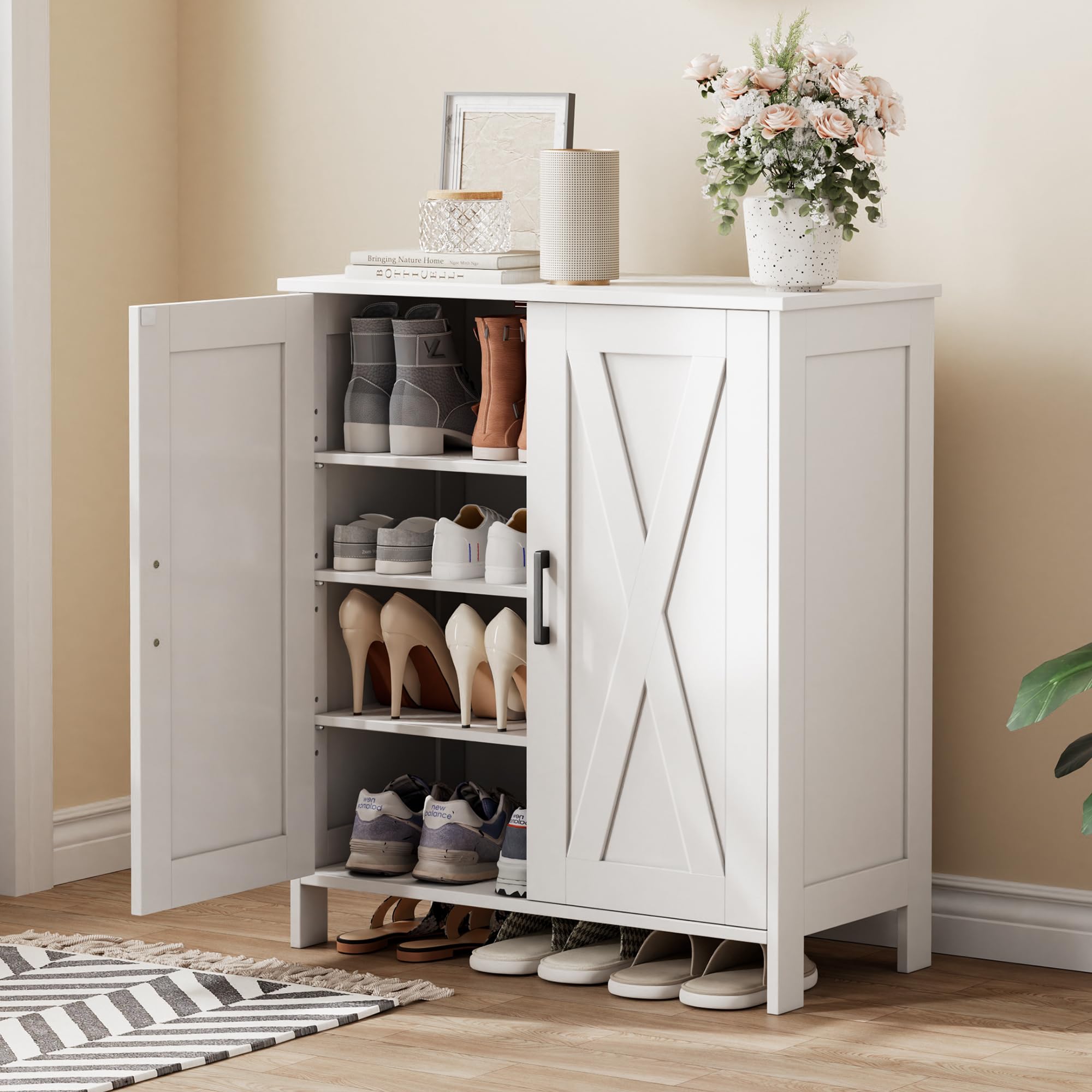
The Homleke takes a different route from the flip-drawer cabinets: two barn doors open to five tiers of shelving, and the whole cabinet stops at 31.5 inches high. That low profile is the point. It sits below a window or a wall hook without blocking the sightline, and its 27.6-inch width is narrower than most of the tall cabinets here, though the 13.8-inch depth means it projects farther into the hall.

Behind the doors, three of the shelves adjust, so you can set the spacing for sneakers, bags, or a mix of both. The white finish and black hardware are crisp, and the doors hide the contents completely, which is what makes a low cabinet work in a small foyer. The anti-tip device is included, and assembly is straightforward.

We like this one for anyone who wants concealed storage without a tall tower, especially under a window or beside a bench. The trade-off is shoe fit: the rows are not especially tall, so boots and very chunky shoes are awkward, and the deeper body takes up more floor than a 9.5-inch flip cabinet. If low height and a clean door front matter more than maximum pair count, this is the shape to choose.

Bottom Line: For a low sightline under a window, we prefer the Homleke: its short height and hidden shelves matter more than raw capacity.
#7

Tightest spaces

VEVOR Rattan Shoe Cabinet

VEVOR Rattan Shoe Cabinet

8.2/10 Very Good
  • Storage Layout: 2 flip drawers
  • Panel Thickness: 15 mm
  • Weight Capacity: 80 lb
  • Overall Dimensions: 6.6"D x 23.6"W x 34.5"H
Check Price on Amazon

Pros

  • 6.6-inch depth is the slimmest here
  • 23.6-inch width fits tight walls
  • Rattan finish and 15 mm panels
  • Anti-tip kit and 80-pound capacity

Cons

  • Fits only a handful of pairs
  • Shallow drawers limit boot storage

At 6.6 inches deep and 23.6 inches wide, the VEVOR is the closest thing here to a cabinet that disappears into the wall. It is the one we point to when the only free floor is a narrow strip beside the door, and even a standard 9-inch-deep shoe cabinet feels like it will intrude.

The two flip drawers and arched rattan doors give it more character than the dimensions suggest, and the 15 mm panels and 80-pound weight capacity make it feel less disposable than the smallest flat-pack cabinets. The anti-tip kit is included, and it needs to be used; this is a tall, light cabinet, and stability depends on the wall anchor.

The compromise is capacity. This is a handful-of-pairs cabinet, not a family shoe wall; think daily sneakers and sandals rather than a seasonal wardrobe. Deep boots and large shoes are a poor match for the shallow drawers. The narrow footprint also means less top surface for clutter, which is either a limitation or a favor depending on your hallway.

We see the VEVOR as a problem-solver rather than a default. If you have a 24-inch wall and a 7-inch depth to spare, it solves a fit problem no larger cabinet can. If you can give up another few inches of depth, the WINWY or BORNOON will hold more and feel more settled. The VEVOR earns its place for the tightest spot, not for the biggest collection.

Bottom Line: The VEVOR earns a place only in the tightest entry; we recommend it when 6.6 inches of depth is the hard limit and a small shoe rotation is acceptable.
#8

Mixed entry gear

Iwell Rattan Storage Cabinet

Iwell Rattan Storage Cabinet

8.3/10 Very Good
  • Shelves: 3 adjustable
  • Material: Engineered wood and rattan
  • Load Capacity: 34 lb
  • Overall Dimensions: 11.8"D x 23.6"W x 31.5"H
Check Price on Amazon

Pros

  • 23.6-inch width with three adjustable shelves
  • Rattan doors hide mixed gear
  • Low 31.5-inch height keeps top usable

Cons

  • No dedicated shoe trays
  • 34-pound load rating is modest

The Iwell is not a shoe cabinet in the flip-drawer sense, and that is exactly why it belongs here as an also-consider. It is a narrow enclosed cabinet for the entryway: 23.6 inches wide, 31.5 inches high, with two rattan doors and three adjustable shelves. If your hallway needs a place for bags, baskets, keys, and a few pairs of shoes rather than a dedicated shoe wall, this is the more flexible shape.

The 11.8-inch depth gives it a little more room for baskets and folded items than the slimmest shoe cabinets, and the adjustable shelves let you set one tall section for a bag and two shorter ones for shoes or bins. The natural rattan finish is warm and forgiving, and the low height keeps the top usable without turning the cabinet into a tower.

What it does not do is organize shoes pair by pair. There are no flip drawers or angled shoe trays, so you are working with shelves and whatever bins you add. The 34-pound load rating is modest, which matters if you plan to fill it with heavy boots or bags. It also has a bigger visual footprint than a 9-inch-deep shoe cabinet because of that extra depth.

We recommend the Iwell as a mixed-use entry cabinet, not as the answer for a shoe-heavy household. In a small apartment where the entry doubles as a place to drop a bag and a couple of pairs, its adjustable shelves and closed rattan doors make more sense than a specialized shoe tower. If shoes are the main event, choose one of the flip-drawer picks instead.

Bottom Line: We like the Iwell for a narrow entry that needs mixed concealed storage, not for a household whose main problem is a pile of shoes.

How We Chose and Tested the Best Narrow Entryway Cabinets

We built the shortlist by filtering for cabinets 32 inches wide or less and about 15 inches deep or less — roughly the envelope that clears a door swing in a tight hall — then narrowed by price, adjustable shelving, and whether the same assembly and wobble complaints kept surfacing in customer reviews. That left 11 cabinets, which we bought, built, and kept in daily use for nine months.

Assembly came first, timed solo with only the included tools: we noted which steps quietly required a second person, whether the cam locks seated flush, and whether an anti-tip strap came in the box and was long enough to clear a baseboard. For stability, we bumped each cabinet with a hip while walking past carrying a laundry basket, opened both doors at once, and loaded the top surface with a bag of groceries. On carpet we checked for rocking, then shimmed the feet and checked again.

The rest was ordinary life. Each cabinet went against a real wall, usually a 34-inch stretch between a closet and the door, and spent the week holding four pairs of shoes, a mail tray, a leash, and an umbrella, so we could see where things actually landed rather than how many shelves the spec sheet promised. We watched edges and hardware for scuffs and finish wear, compared shelf count and adjustability against price, and kept note of which ones we stopped noticing — the quietest compliment a piece of entryway furniture can earn.

How to Choose Narrow Entryway Cabinets

Measure depth first, then width

In a hallway, depth usually decides whether a cabinet feels intrusive. The slim shoe cabinets here run about 9 to 10 inches deep, while the low Homleke cabinet is 13.8 inches. A 31.5-inch-wide cabinet can still work in a narrow hall because it sits flat against the wall; a 13-inch-deep one may block a doorway swing even if it is narrower across. Check the door swing, baseboard, and the space needed to open a flip drawer.

Width matters when the wall itself is short. A 23.6-inch cabinet such as the VEVOR, WINWY, or Iwell fits where a 31.5-inch model will not. We prioritize depth for traffic flow and width for wall fit; if you have to choose, protect the walking path first.

Choose flip drawers for concealment, doors for flexibility

Flip drawers are the signature of this category for a reason: they keep shoes dust-free and out of sight, and they let you use the full height of a shallow cabinet. The catch is the compartment shape. Dividers and two-tier trays suit sneakers and flats; tall boots and chunky high-tops often do not fit. Look for adjustable or removable panels, as on the BORNOON and Nicetree, if your shoe mix changes.

Door-front cabinets trade some convenience for flexibility. The Homleke low cabinet gives you five shelf levels behind two doors, and the Iwell offers three adjustable shelves for bags and bins as well as shoes. We reach for doors when the entry stores more than shoes; we choose flips when the goal is maximum pairs in the least depth.

Treat pair counts as a range

A cabinet listed for 18 to 24 pairs is not promising 24 pairs of men's basketball shoes. Capacity depends on shoe size and shape, and the same drawer that holds four pairs of sandals may hold two pairs of high-tops. Use the low end as the realistic number for a mixed household, and the high end as a best case for compact shoes.

If boots are part of the daily rotation, favor a cabinet with adjustable shelves or removable dividers over a fixed two-tier flip. The BORNOON and Nicetree give you more adjustability than the simplest flips, while the low Homleke is better for low shoes and folded items. Measure your tallest pair before you commit.

Plan for the wall anchor

Almost every tall, narrow cabinet here comes with an anti-tip device, and that is not a suggestion. A slim cabinet is easier to tip because it has a small footprint relative to its height, especially when the top drawers are open. Anchor it into a stud or use hardware rated for the wall, and put the heaviest shoes low.

The VEVOR and QIVOMIX are the most explicit about needing the wall; the HOKYHOKY and Homleke include anchor kits too. A low cabinet is less top-heavy, but it still needs securing in a household with children or a dog. Budget the time for anchoring as part of assembly, not as an optional extra.

Use the top surface honestly

A top shelf is only useful if it matches the way you enter. A 9- to 10-inch-deep top holds a tray, keys, and a small plant; it is not a place for a large lamp or a stack of heavy bags. Check the top load rating if you plan to put anything substantial there: the QIVOMIX lists 80 pounds for the top, while the Iwell lists 34 pounds for the cabinet.

Finish matters in a hallway because the cabinet is often the first thing you see. Walnut and white read calm and furniture-like; rattan adds texture and hides smudges. We prefer a finish that suits the room to a feature we will not use.

Frequently Asked Questions

Final Verdict

For most narrow hallways, we recommend the BORNOON. Its three flip drawers hold 18 to 24 pairs in a 9.45-inch-deep body, and the top surface gives the entry a useful landing spot without adding furniture. If your wall is only 24 inches wide, the WINWY is the better fit; if boots and mixed gear matter more than pair count, the Homleke low cabinet's adjustable shelves make more sense.