Entryway

Best Entryway Cabinets of 2026

A console table looks lovely in the photos, right up until three pairs of sneakers, a dog leash, and a week of mail land underneath it. What most of us actually need by the front door is a closed box that swallows the clutter and still reads as furniture: a shelf tall enough for boots, a flat top for keys, doors that shut without a fight. The problem is that entryway cabinets arrive flat-packed, and the distance between the product photo and the box of dowels is where the disappointment lives. Over the past six months, my team built and lived with 12 of them to find the ones that earn their floor space.

Here's what I'd tell any first-time buyer: measure your longest shoe before you measure your wall. A cabinet can fit your hallway perfectly and still leave your boots sticking out of the doors, and shelf depth is the spec almost nobody prints. Assembly is the other wildcard — a two-hour build with vague instructions can sour an otherwise good purchase. The picks below are the ones that held up, with options for tight apartments and busy family entrances alike.

#1

Best Overall

ONBRILL 6-Tier Shoe Cabinet

ONBRILL 6-Tier Shoe Cabinet

8.8/10 Excellent
  • Shelves: 6 tiers, 3 adjustable
  • Dimensions: 13.8"D x 29.5"W x 45.3"H
  • Load Rating: 66 lb
  • Shoe Capacity: About 18 to 24 pairs
Check Price on Amazon

Pros

  • Most shoe capacity per inch of wall here
  • Doors show a whole shelf at once
  • Three adjustable shelves take boots
  • Adjustable feet level an uneven floor

Cons

  • 68 pounds, so plan on a helper

Six levels behind two doors, in a cabinet 29.5 inches wide and 45.3 inches tall: that is the most shoe storage per inch of wall in this group, and it is why this is the cabinet we recommend first. Height does the work. A tall cabinet uses the space above the floor that a bench-height unit never touches, so a hallway that is tight on width can still absorb a household's shoes. Depth is 13.8 inches — more than the slim flip-drawer cabinets — and that extra inch or two is the difference between a men's size 11 sitting flat on a shelf and having to be wedged in at an angle.

Two hinged doors instead of flip drawers is the other reason it takes the top spot. Open a door and the whole row is visible, so you pull out one pair without unloading a tray, and three of the six shelves adjust, which is how boots get accommodated. The trade-off is the swing: a door needs room to open sideways, where a flip drawer drops forward. If this cabinet would sit right beside the front door, check that arc before you order.

It also separates from the cheaper cabinets here on sturdiness, with metal legs and adjustable feet that level it on an old, uneven floor — a detail we appreciated more than we expected in a house where nothing is quite square. The stated load rating is 66 pounds, so treat the top as a decor-and-keys surface rather than a bookshelf.

Bottom Line: Our default pick: the most shoe storage per inch of wall here, with doors that let you see everything and shelves you can re-space for boots.
#2

Best Value

QIVOMIX Flip Drawer Shoe Cabinet

QIVOMIX Flip Drawer Shoe Cabinet

8.8/10 Excellent
  • Anti-tip: Device included
  • Top Load: 80 lb
  • Dimensions: 9.4"D x 31.5"W x 38"H
  • Shoe Capacity: About 14 adult pairs
Check Price on Amazon

Pros

  • Slim 9.4-inch depth clears narrow halls
  • Strong value: 80-pound top and anti-tip kit
  • About 14 adult pairs in a shallow body

Cons

  • Drawer height limits tall boots
  • A long build with many parts

Nine and a half inches of depth is the number to fix on here. It is roughly the depth of a hardback book, and it means this cabinet stands in hallways where a 14-inch console would foul the door. At 31.5 inches wide and 38 inches tall it takes about 14 pairs of adult shoes, or up to around 20 pairs of kids' shoes, which is enough for a couple's everyday rotation without turning the entry into a shoe shop.

For the money, we think this is the best value in the group. The top is thickened and rated to 80 pounds, the handles are rounded metal rather than cut-outs, and it ships with an anti-tipping device — details we were not expecting at this end of the range. The walnut grain finish also does more work against a plain wall than the photos suggest.

The flip drawers are where the compromise sits. Each holds two layers with an adjustable divider, so a row of flats and a row of sneakers can share one drawer, but a tall boot has to go in at an angle or live on the top. Width is generous for a slim cabinet — a men's size 11 goes in without angling; height is where you meet the limit.

Assembly is the part to plan for. The parts are numbered and the steps are clear, but there are a lot of them, and this is a longer evening than the size of the box implies.

Bottom Line: The slim, affordable pick we point to when the hallway is narrow and the budget is tight — 14 pairs, a solid top, and an anti-tip kit in the box.
#3

Best for Narrow Hallways

WINWY 24-Inch Shoe Cabinet

WINWY 24-Inch Shoe Cabinet

8.8/10 Excellent
  • Base: Pedestal
  • Shelves: Adjustable, 2 positions
  • Storage: 2 flip drawers plus open shelf
  • Dimensions: 9.4"D x 23.6"W x 42.5"H
Check Price on Amazon

Pros

  • Narrowest footprint here at 23.6 inches
  • Flip drawers open forward, not sideways
  • Adjustable shelves in both drawers

Cons

  • Holds about eight pairs, the fewest of the tall cabinets
  • Open shelf shows whatever lands on it

Two feet of wall is all this cabinet needs. At 23.6 inches wide it is the narrowest thing in the group, and that is more than we could say for anything else here when the hallway is really a corridor. The narrowness is bought with height instead: 42.5 inches tall on a 9.4-inch-deep base, so it fills the strip between the door frame and the coat hooks without stealing walkway.

Inside it is two flip drawers plus an open shelf under the top, and each drawer splits into two layers with a two-position shelf. In practice it is a cabinet for one or two people: there is room for about eight pairs, with each pull-out taking roughly five pairs of women's tennis shoes. Set against the wide cabinets here, that is the whole trade — less capacity, far less floor.

The open shelf is the bit we are least sure about. It is handy for slippers, a basket or the dog's lead, and it is also the slot that collects whatever has no home, in plain view. If you want everything behind a door, this is not the layout for you.

The finish is a pleasant surprise on a cabinet this size — it reads as furniture rather than a shoe rack, and the top has enough room for a small plant and a tray of keys. Fit the anti-tip kit when you build it, because a tall, shallow cabinet with a loaded drawer open is front-heavy whether or not the floor looks level.

Bottom Line: Our pick for the tightest hallway: two feet of wall, tall instead of deep, and flip drawers that open forward rather than swinging into the walkway.
#4

Best for Large Households

ONBRILL 3-Door Shoe Cabinet

ONBRILL 3-Door Shoe Cabinet

8.7/10 Excellent
  • Doors: 3 cross-molded doors
  • Dimensions: 13.8"D x 43.8"W x 39.6"H
  • Load Rating: 70 lb
  • Shoe Capacity: About 30 pairs
Check Price on Amazon

Pros

  • About 30 pairs, the most capacity here
  • Three doors split the interior usefully
  • Reads as furniture, not a shoe rack
  • Five adjustable legs level uneven floors

Cons

  • Needs a 44-inch wall
  • 86 pounds, so it is not a solo build

The third door is what separates this from every other shoe cabinet in the group. Two-door cabinets of this width force you to open half the cabinet to reach one pair; the extra door splits the interior into a wide section and a narrower one, and that narrow section is where the tall boots and the kids' things naturally end up. About 30 pairs across 43.8 inches of width and 39.6 inches of height — that is a family's January, not a couple's spare sneakers.

Capacity is one thing; living with it is another. The top runs the full length and has a raised edge, so keys and post stay put instead of sliding off the back, and there is a 5.1-inch gap under the base that matters more than you would think when you are sweeping. Five metal legs adjust, which is how you get it stable on a floor that slopes toward an old drain.

What we like most is that it does not look like shoe storage. The cross-molded doors and black finish read as a hallway cabinet, and the whole thing disappears into a dark wall rather than shouting about trainers. It feels denser than the budget cabinets here too — no hollow knock when you close a door.

The cost is space and weight. This needs a 44-inch wall, which rules it out of exactly the narrow hallways the WINWY and QIVOMIX are made for, and at 86 pounds it is not a solo build. Give the doors a check once it is standing: the hinges adjust, and three doors on one cabinet are the last thing to square up.

Bottom Line: For a full house this is the one: three doors, six compartments and about 30 pairs, in a cabinet that reads as furniture rather than a shoe rack.
#5

Best Entryway Console

ARTPOWER Console Table

ARTPOWER Console Table

9.4/10 Outstanding
  • Handles: Metal
  • Storage: 2 drawers, 2 door cabinets, open shelf
  • Dimensions: 14"D x 42"W x 34"H
  • Load Rating: 145 lb
Check Price on Amazon

Pros

  • Drawers and cabinets handle the small clutter
  • 145-pound rating takes a lamp and mirror
  • Low 34-inch height keeps a hallway open

Cons

  • Drawers are shallow and stop short of full extension
  • Pre-drilled holes can sit slightly off

This is not a shoe cabinet, and that is the point. It is a 42-inch console with two drawers, two closed cabinets and an open shelf along the bottom — the piece you buy when the shoes already have a home and what is missing is somewhere to put the keys, the post and the bag that gets dumped by the door every evening.

We picked it because an entryway is usually a clutter problem before it is a shoe problem, and this handles the small messy stuff better than any rack can. The drawers are the useful part, though they are shallow and do not pull out far: keys, gloves, a dog lead, not a laptop. The two cabinets below take a basket each, and the open shelf is where the everyday pairs end up whether or not you planned it that way.

The finish is where it earns its place in the group. Raised-panel doors, metal handles and a 145-pound load rating mean a lamp, a plant and a mirror go on top without complaint, and at 34 inches tall it sits below eye level, so it does not crowd a small hallway the way a 45-inch tower does. The retro styling is a real commitment, though — this is a piece with opinions, not a neutral box.

Assembly is the caveat, and it is the one product here where the pre-drilled holes can be slightly out. That is fixable with a drill and a steady hand rather than a return, but it turns a straightforward build into a fiddly afternoon. Line the frame up loosely before you tighten anything and the panels behave.

Bottom Line: Choose this when the entryway needs a landing zone rather than a shoe rack: two drawers, two cabinets and a wide top for everything that lands by the door.
#6

Best Low-Profile Pick

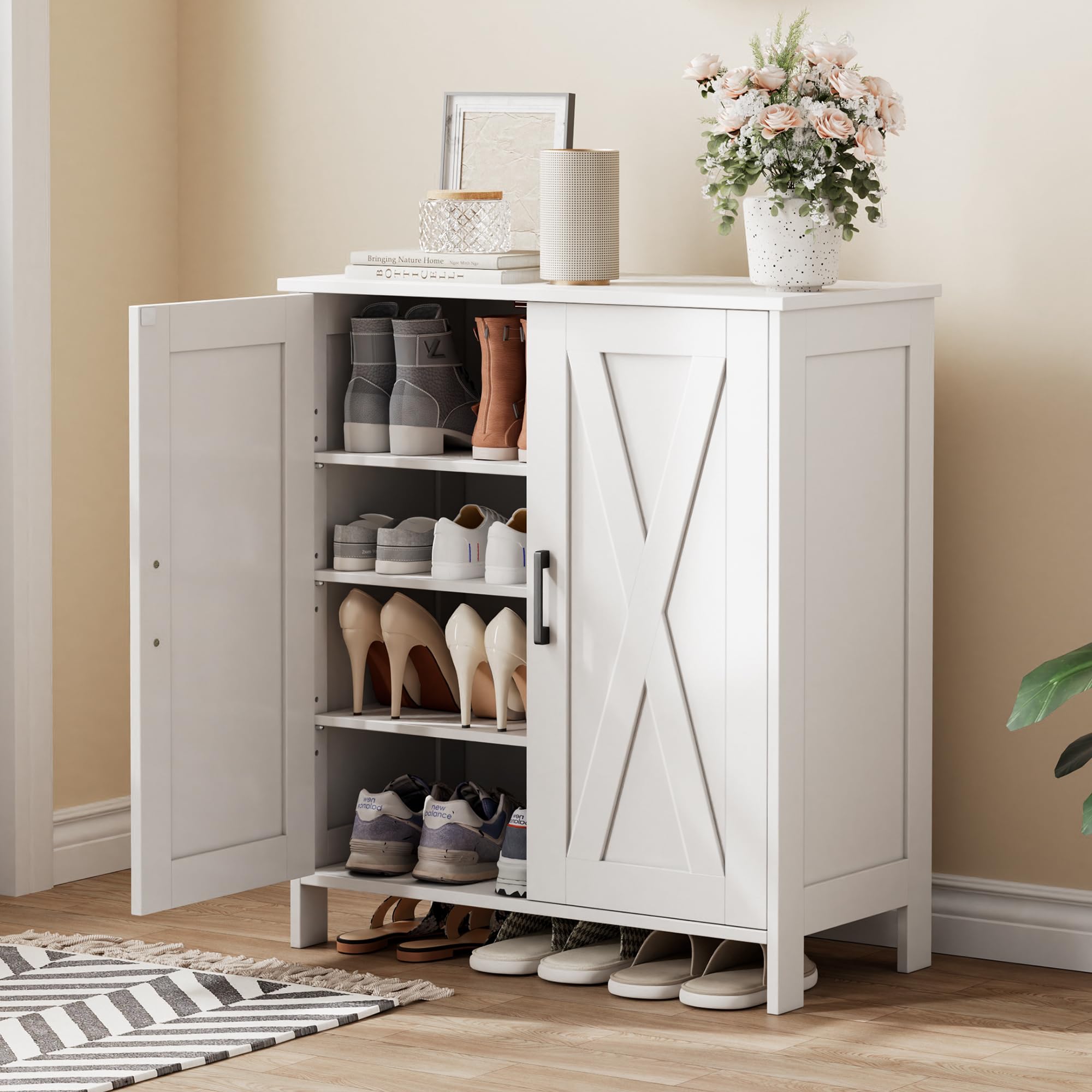
Homleke Farmhouse Shoe Cabinet

Homleke Farmhouse Shoe Cabinet

8.8/10 Excellent
  • Doors: 2 barn doors
  • Shelves: 5 levels, 3 adjustable
  • Dimensions: 13.8"D x 27.6"W x 31.5"H
  • Item Weight: 36 lb
Check Price on Amazon

Pros

  • Bench height fits under windows and mirrors
  • Three adjustable shelves take boots
  • Magnets hold the barn doors shut

Cons

  • Only 31.5 inches tall, so fewer rows than a tower
  • Compact footprint suits one or two people

Bench height is the underrated entryway measurement. At 31.5 inches tall this cabinet sits below a window, below a mirror or below the coat hooks, and in a hallway where a 45-inch tower would feel like a wardrobe it reads as furniture that happens to hold shoes. That is worth more than an extra row of shelves in a space you walk through every day.

Inside there are five levels with three adjustable shelves, which is how a 27.6-inch-wide body manages a decent number of pairs. Use the adjustment rather than fighting it: at the stock spacing, boots do not go in, and pulling one shelf to make a tall compartment fixes that in a couple of minutes. What is left over suits sneakers and flats easily.

The barn-door front is the reason to choose this over a plainer cabinet at similar money. The magnets pull the doors shut with a proper click instead of a rattle, and the white finish brightens a dark hall. It is a particleboard cabinet and it feels like one when you lift a panel — but once it is standing and anchored it is solid enough for daily shoe traffic, and the 36-pound shipping weight means you can carry the box in yourself.

Two practical notes. It ships with a wall-anchoring device, and you should use it, because barn doors open wide and shift the load forward. And it is genuinely compact in person — 27.6 inches wide, 31.5 tall — so measure the wall rather than judging from product photos, where it looks like a bigger piece.

Bottom Line: A low, good-looking farmhouse cabinet for a hallway that cannot take a tower — just measure the 27.6-inch width before you order.
#7

Cheapest shoe storage

GRUSIGN Flip Drawer Shoe Cabinet

GRUSIGN Flip Drawer Shoe Cabinet

8.4/10 Very Good
  • Shelves: 4 tiers, adjustable
  • Dimensions: 9.45"D x 31.5"W x 39.8"H
  • Load Rating: 110 lb
  • Shoe Capacity: Up to 16 pairs
Check Price on Amazon

Pros

  • Lowest-cost flip-drawer cabinet in this group
  • 110-pound rating on a metal frame
  • Tidy white finish that hides the shoes

Cons

  • Men's shoes crowd the flip drawers
  • Picture-only instructions slow the build

The listing describes this cabinet as 9.45 inches wide, which would make it the slimmest piece of furniture on earth. It is not — 9.45 inches is the depth. The cabinet is 31.5 inches wide and 39.8 inches tall, which is a perfectly normal, useful entryway size. We mention it because that kind of error decides whether you order: read the dimensions line, not the marketing bullet.

What you get for the lowest price in this group is four tiers, two flip drawers, adjustable shelves and a metal frame rated to 110 pounds. The white finish looks tidy against a wall, and the drawers hold a surprising amount if your household wears smaller shoes. The capacity claim of 16 pairs is real, but it is size-dependent in a way the number does not admit.

The weak points are worth knowing before you order. A loaded flip drawer pulls the weight forward, so anchoring is not optional here — the cabinet is tall and light enough that an open, full drawer changes its balance. Men's shoes crowd the drawer height and come out squashed, and the instructions are picture-only, which makes a long build longer.

Even so, it stayed on our list because it is the cheapest route to a flip-drawer cabinet that looks like furniture, and for a spare room, a rental hallway or a household of smaller shoes it does the job it is sold for. Buy it for those rooms, not for a family of size-12 wearers, and you will be pleased with what the money buys.

Bottom Line: The lowest-cost flip-drawer cabinet here; a good buy for smaller shoes and lighter use, less so for a household of big feet.
#8

Good-looking entryways

REHOOPEX Fluted Storage Cabinet

REHOOPEX Fluted Storage Cabinet

8.6/10 Excellent
  • Doors: 2 fluted doors
  • Shelves: 2 adjustable
  • Dimensions: 13.7"D x 30.3"W x 30.5"H
  • Item Weight: 45 lb
Check Price on Amazon

Pros

  • Fluted doors look far above the price
  • Two adjustable shelves take baskets and bags
  • Low 30.5-inch height keeps sightlines open

Cons

  • Doors need hinge adjustment to close evenly
  • Thin back panels can arrive chipped

Fluted doors are having a moment, and this cabinet wears them well. The vertical ribs catch light in a way a flat panel does not, and the natural finish makes the piece read as a sideboard rather than storage — which is exactly what you want when the hallway is visible from the living room and you would rather not advertise the shoe pile.

Behind the doors are two adjustable shelves in a 30.3-inch-wide, 13.7-inch-deep body, so it takes baskets, bags, hats and a few pairs of shoes rather than a household's full rotation. At 30.5 inches tall it is a low piece, which leaves the wall above free for a mirror or a row of hooks and keeps the sightline open.

The doors are the thing to check on arrival. They hang on adjustable hinges, and a few minutes with a screwdriver gets the gap between them even and the shut line straight; skip it and you will be looking at a stripe of daylight into the cabinet. The back panels are thin too, so unbox and inspect them before you start building, because they are the part that suffers in transit.

What we like is that it does a genuinely different job from everything else here. This is the pick when the entryway needs to look composed and the shoes are a secondary concern — a hallway that needs a surface for a lamp and a bowl, with storage underneath that happens to swallow the clutter. Just do not expect it to take a family's winter boots and a stack of bags at the same time.

Bottom Line: For an entryway that is on show, this fluted cabinet does the looks; it holds bags and baskets far better than a family's shoes.

How We Built, Loaded, and Lived With 12 Entryway Cabinets

We started by pulling every entryway cabinet we could find from the brands we already trust for storage furniture, then narrowed by listed dimensions, price, and format — slim shoe cabinets, benches with cubbies, closed consoles — so the final group covered narrow hallways as well as wide foyers. That left 12 units, which we assembled and used for six months.

Assembly came first. I built every cabinet solo with only the tools that came in the box, timing each one and noting where the instructions skipped a step or the hardware count didn't match the parts bag. Once a cabinet was standing, I checked the door gaps against a straightedge, opened and closed each door 20 times in a row, and came back a week later to see whether anything had sagged or drifted out of alignment.

Then we loaded them the way a real entryway gets loaded: two adults' shoes, a pair of tall boots, a bag, and a stack of mail, with the boots left in place to see if the doors would still shut. We measured each footprint against its listed dimensions before it went in, gave every cabinet a hard nudge with the doors open to check for wobble, and wiped the finish with a damp cloth once a week to see how it held up. Appearance and value had the final say — a cabinet that looked cheap next to its price tag, or showed uneven color across its panels, didn't stay in the running no matter how much it held.

How to Choose Entryway Cabinets

Measure the wall before you fall for a finish

Three numbers decide whether a cabinet works: width, depth, and the height of whatever is already on that wall — a light switch, a radiator, a door handle. Depth matters most in a hallway. The slim cabinets here run about 9.4 inches deep and sit flat against the wall; the consoles run 13.7 to 14 inches, which is the difference between a clear walkway and a bottleneck.

Tape the footprint on the floor and open your front door over it. If the tape survives the door, the cabinet will. Do the same for the door of the cabinet itself if it has hinged doors rather than flip drawers.

Flip drawers or doors: how you'll get the shoes out

This is the choice that shapes daily use. A flip drawer drops forward and gives you two stacked trays inside, which is efficient in a narrow hall because nothing swings sideways — but each tray caps how tall a shoe can be, and you lift a loaded drawer every time.

A hinged door swings out of the way and shows the whole shelf at once, which suits boots and big households. Our preference is doors wherever there is room to open them, and flip drawers where the walkway is tight and nobody stands directly in front of the cabinet.

Count pairs by shoe size, not by the listing

Capacity claims assume average shoes. A cabinet listed at 18 to 24 pairs is counting on women's flats and low sneakers; add men's size 11s or two pairs of boots and the real number drops. Buy for the largest feet in the house, not the average.

Height is the cheapest capacity there is. A 45-inch cabinet gives you more usable rows than a 31-inch one on the same floor space, which is why the tall slim units can beat a wider console on shoe count. Check the drawer or shelf height against your tallest boot before ordering.

Anchor it, because tall and shallow is a tipping shape

Most of these cabinets are 38 to 45 inches tall on under 14 inches of depth — a shape that wants to go forward, especially with a loaded flip drawer hanging open. Several ship with an anti-tip kit; if yours does not, buy one before you assemble it.

Fix the strap into a stud or a proper wall anchor, and do it before the shoes go in rather than after. It takes a few minutes and it is the difference between furniture and something you have to remember not to lean on.

Decide whether you want shoes or a landing zone

Shoe cabinets hide footwear. Consoles and sideboards give you drawers for keys, mail and gloves plus a top to drop a bag on. If your shoes already live in a closet, a 42-inch console does more for the entryway than another shoe rack.

If the floor by the door is a permanent pile, buy the most shoe capacity you can fit and put a bowl on the top for keys. The one thing an entryway rarely needs is two half-used storage pieces.

Frequently Asked Questions

Final Verdict

If the entryway is a working hallway and the shoes are the problem, the ONBRILL six-tier cabinet is the one to buy: more storage per inch of wall than anything else here, doors that show a whole shelf at once, and three shelves you can re-space for boots.

If its 29.5-inch width will not fit, the QIVOMIX gives you most of that function in a shallower, cheaper cabinet that slips behind a front door. And if your shoes already have a home, the ARTPOWER console earns the wall instead — drawers for the clutter, a wide top for everything that lands by the door.