Entryway

Best Shoe Racks of 2026

Almost every shoe rack looks tidy in the product photo and turns into a leaning pile by February — shelves bow under a pair of boots, the cam locks strip the first time you tighten them, and the "holds 30 pairs" claim turns out to have been counting flip-flops. What a rack actually has to do is duller than that: stay level when it's full, keep heels and tall boots from toppling into each other, and put shoes somewhere you'll bother to use instead of kicking them under the bench. I've watched one fold down the middle mid-winter, so my patience for thin board and mystery hardware is short, and I'd rather pay once for something that survives a move than twice for something that doesn't.

We've spent the last six months living with a dozen racks in entryways and closets, assembling them alone, overloading them, and dragging a few between rooms. The thing that surprised me most is how little the pair count on the box tells you — footprint and shelf spacing decide whether your shoes actually fit, and an open wire rack will dust whatever sits beneath it. The picks below are organized around how much floor they eat and what they genuinely hold, so measure your doorway first and read down from there.

#1

Best Overall

VASAGLE 6-Tier Shoe Rack

VASAGLE 6-Tier Shoe Rack

9.5/10 Exceptional
  • Frame: Steel, dense mesh, particleboard
  • Shelves: 6
  • Dimensions: 11.8 x 39.4 x 43.3 in
  • Stated Capacity: 24–30 pairs
Check Price on Amazon

Pros

  • Solid top panel doubles as a drop zone
  • Dense mesh stops thin heels slipping through
  • Adjustable feet and an anti-tip kit included
  • Finish reads more expensive than it is

Cons

  • Needs 39.4 inches of clear wall

The part we appreciate most isn't a shelf at all — it's the panel across the top. VASAGLE finishes this 43-inch frame with a rustic brown board wide enough for keys, a bag and the day's mail, which is what an entryway rack actually has to do. Plenty of racks end at the last wire shelf and leave you nowhere to put anything down.

Below it sit five mesh shelves on a steel frame, and the dense mesh is a real advantage over an open wire grid: thin heels and strappy sandals don't drop through, so you aren't fishing a shoe out from under the bottom tier. The 24-to-30-pair headline counts women's sizes; plan on four pairs of men's shoes to a shelf and you'll be close. Put the heaviest boots on the bottom — the mesh gives a little under a full shelf of them, though the frame stays square.

Assembly is the usual labeled-parts routine, and the adjustable feet earn their keep on old, uneven floors. VASAGLE also includes an anti-tip kit in the box. Use it: a rack this tall should be fixed to the wall in a house with children or a large dog, and it's good to see the hardware supplied rather than sold separately.

The catch is the footprint. At 39.4 inches wide and 11.8 inches deep it wants a proper run of wall, and it's one of the pricier open racks in this group. If your hallway is already crowded, one of the narrow or adjustable picks will serve you better.

Bottom Line: The rack we recommend first for most homes: room for a household's shoes, a solid top for keys and bags, and hardware that keeps it upright.
#2

Best for Large Collections

SONGMICS 8-Tier Metal Shoe Rack

SONGMICS 8-Tier Metal Shoe Rack

9.3/10 Outstanding
  • Shelf Gap: 8.1 in
  • Dimensions: 12.1 x 36.4 x 64.4 in
  • Load Per Shelf: 22 lb
  • Stated Capacity: 32–40 pairs
Check Price on Amazon

Pros

  • Splits into two four-tier racks
  • 32–40 pairs at 22 pounds a shelf
  • 8.1-inch gaps and removable tiers for boots
  • Shelves tilt for easier access

Cons

  • Plastic shelf connectors on a metal frame
  • 64.4-inch tower needs wall anchoring

Two four-tier racks arrive in one box, and the four plastic connectors in the hardware bag join them into a single 64-inch tower. That's the smartest thing about this SONGMICS: run it tall against a garage wall, or keep the halves apart and put one in a closet and one by the door.

The shelves go in flat or angled, and that choice is worth thinking about. We like them flat for boots and anything with a heel that slides, and angled for a front row of sneakers you want to read at a glance. With 8.1 inches between tiers, high heels and high-tops fit without gymnastics, and you can pull a tier entirely for something taller.

Capacity is the reason to choose it over anything else on this page: 32 pairs of men's shoes or 40 of women's, at 22 pounds a shelf. The frame is light for its size, and the mesh is the part most likely to arrive with a ding — open the box, check the shelves, and photograph any damage before you start bolting tiers together.

Two things to know before you commit. The connectors that hold each shelf are plastic on an otherwise metal frame, which is where wear tends to show after a few moves. And at 64.4 inches tall, this is a rack to fix to the wall rather than trust to gravity.

Bottom Line: Our pick for a big collection: the tallest open rack here, and the only one that splits into two shorter racks when you move.
#3

Best for Boots

KEETDY 3-Tier Long Shoe Rack

KEETDY 3-Tier Long Shoe Rack

9.3/10 Outstanding
  • Shelves: 3
  • Shelf Gap: 8 in
  • Dimensions: 11.4 x 43 x 24.4 in
  • Load Capacity: 50 lb
Check Price on Amazon

Pros

  • 8-inch gaps take knee-high boots
  • Low enough to sit under a clothes rod
  • 50-pound capacity with a rust-resistant finish
  • Two sets stack into six tiers

Cons

  • 43 inches wide and can't be shortened

Eight inches is the figure that decides this one. That's the clearance KEETDY leaves between its three shelves — enough for knee-high boots and high-tops to stand upright instead of flopping across two tiers. Most racks at this height make you pull a shelf to get there, and that costs you the pairs it was holding.

At 24.4 inches tall and 43 inches wide it does a job the tall racks can't: it slides under a hanging clothes rod in a closet, runs along a low wall beneath a window, or sits below a coat rail in a mudroom without cutting the room in half. The open frame sits high enough on its legs that a robot vacuum passes underneath, which matters more than it sounds when wet shoes come in daily.

The wire grid is rated to 50 pounds and the finish is rust-resistant, so rain boots and garden clogs don't need a towel first. Assembly is screwdriver work with numbered parts, the whole thing is light enough to move alone, and two sets stack into a six-tier unit when the pile by the door outgrows one.

The trade-off is width: 43 inches of wall, with no way to shorten it. In a narrow hall, one of the adjustable or slim racks is the better answer. Anywhere else, this is the rack we look to first when boots are the problem.

Bottom Line: The one to buy if boots dominate your collection: eight inches of clearance on every tier, 50 pounds of capacity, and a low frame that fits under a clothes rod.
#4

Best Adjustable Fit

Gonfoam Expandable 4-Tier Shoe Rack

Gonfoam Expandable 4-Tier Shoe Rack

9.3/10 Outstanding
  • Tiers: 4
  • Middle Load: 13 lb
  • Width Range: 17.7 to 33.8 in
  • Stated Capacity: 16 pairs
Check Price on Amazon

Pros

  • Width adjusts from 17.7 to 33.8 inches
  • Tool-free assembly in minutes
  • Light enough to carry in one hand
  • Up to 16 pairs when extended

Cons

  • Middle section holds only 13 pounds

Most racks come in one width, and the gap between your closet rod and the wall is rarely that width. Gonfoam's answer is a frame that slides between 17.7 and 33.8 inches, so you set the length after you've measured instead of shopping around a fixed number.

Four tiers, up to 16 pairs fully extended, and no tools — the rods push into the joints and a few screws hand-tighten. It's the rack we point to for a dorm or a first apartment, where furniture has to survive being taken apart again. Treat that 16-pair figure as a women's-size estimate; men's shoes will land closer to a dozen.

Two limits follow from the design. The sliding middle section is rated to 13 pounds, lighter than the ends, so heavy boots belong at the outer edges or on the bottom tier. And at 2.4 pounds the whole rack is light enough to carry in one hand — good on moving day, and a reminder that this is a rack you set in place rather than lean on.

In a finished entryway it looks plain next to the wood-topped VASAGLE. In a closet, a dorm, or the awkward strip beside a bed, plain and adjustable is exactly right.

Bottom Line: Our pick when the space is an odd width: the frame slides from 17.7 to 33.8 inches, and it goes together without tools.
#5

Best for Small Closets

Simple Houseware 3-Tier Shoe Rack

Simple Houseware 3-Tier Shoe Rack

9.2/10 Outstanding
  • Tiers: 3
  • Dimensions: 10.6 x 26.5 x 19 in
  • Load Per Shelf: 30 lb
  • Stated Capacity: 9 pairs
Check Price on Amazon

Pros

  • Fits under a clothes rod at 19 inches tall
  • Stacks with a second unit

Cons

  • Only nine pairs

Nine pairs is the number that defines this rack, and it's worth being honest about it: three per shelf, which is a child's collection, one pair of running shoes per family member, or a rental's worth of sneakers. It isn't the rack for a household with work boots and a dog.

What it does well is disappear. At 19 inches tall and 26.5 inches wide it slides under hanging clothes or beside a door, and the 30-pound-per-shelf rating is generous for the size — more than several bigger racks here will give you. Stack a second unit on top when the pile grows; the legs key into another set.

Assembly is the one bit of friction: expect to drive a fair number of screws, and a power driver saves your wrists, especially if you're building two. Measure before you order, too. The photos make it look bigger than it is, and 26.5 inches is the real width.

For a kid's room, a rental, or the corner of a shared hallway, that's the right trade — small, steady, and easy to move when you do.

Bottom Line: A small-space workhorse: nine pairs in a footprint that fits under a clothes rod, stackable when the collection grows, and steady for the size.
#6

Best for Narrow Hallways

OYREL 10-Tier Narrow Shoe Rack

OYREL 10-Tier Narrow Shoe Rack

9.0/10 Outstanding
  • Tiers: 10
  • Dimensions: 11.8 x 17.1 x 78.7 in
  • Construction: Metal pipes, plastic joints
Check Price on Amazon

Pros

  • Ten tiers on a 17.1-inch footprint
  • Splits into shorter separate racks
  • Light enough to move alone

Cons

  • Plastic joints where the metal rods meet
  • Top-heavy at 78.7 inches; needs anchoring

Seventeen inches of width and 78.7 inches of height: this is the rack that fits the strip of floor beside a closet door or against a hallway wall, and almost nothing else here will. If your problem is floor space rather than wall space, start with this one.

Ten tiers hold roughly two pairs each, and the frame splits into shorter racks when you'd rather spread them across rooms — a genuinely useful option in a rental where you can't add shelving. Assembly is the usual push-together tube build, and the whole thing is light enough to reposition on your own.

It is also the least steady rack we're comfortable recommending. The rods are metal, the joints are plastic, and a full top tier makes the frame feel top-heavy. Keep boots and heavy shoes on the bottom two shelves, stand it against a wall rather than out in the open, and anchor it: at nearly six and a half feet, this is not a rack to leave free-standing in a house with children.

What it buys is pairs per square foot, and on that measure nothing else here comes close. What it doesn't buy is furniture. This is a utility rack, it looks like one, and that's the deal.

Bottom Line: For a hallway with 17 inches to spare: ten tiers, room for about 20 pairs, and the option to split it into shorter racks.
#7

Bedrooms

ROMGUAR CRAFT Bamboo 3-Tier Shoe Rack

ROMGUAR CRAFT Bamboo 3-Tier Shoe Rack

8.7/10 Excellent
  • Tiers: 3
  • Material: Bamboo
  • Dimensions: 11 x 27 x 20 in
Check Price on Amazon

Pros

  • Bamboo finish looks like furniture
  • Two units stack into a taller rack
  • Around ten minutes to assemble

Cons

  • Rocks if the frame isn't squared and level
  • Light load

Bamboo rather than steel, and it changes where this rack belongs. In a bedroom, a finished hallway or a dressing room, the ROMGUAR reads as furniture rather than storage, and the natural finish sits easily against wood floors and pale walls.

Three tiers at 27 inches wide and 20 inches tall hold about three pairs of adult shoes per shelf, and two units stack into a taller rack if the collection grows. Assembly is short work — the instructions estimate about ten minutes — and the boards arrive finished, so there's nothing to oil or seal.

The build is where it gives ground, and it's the least rigid rack in this group. Tighten every fixing, square the frame before you load it, and check that all four feet sit flat, because a unit that isn't level will rock every time someone walks past. Keep it to flats, sneakers and sandals.

Buy it for looks and light use. If the rack is going to hold work boots and garden clogs, one of the steel frames will take the abuse better.

Bottom Line: The good-looking one: bamboo, three tiers, and a finish that belongs in a bedroom rather than a mudroom — as long as the load stays light.
#8

Dust-free storage

SONGMICS 10-Tier Covered Shoe Rack

SONGMICS 10-Tier Covered Shoe Rack

8.8/10 Excellent
  • Tiers: 10
  • Dimensions: 11 x 33.1 x 63 in
  • Load Per Tier: 6.6 lb
  • Stated Capacity: 40–50 pairs
Check Price on Amazon

Pros

  • Zip cover hides shoes and dust
  • Holds 40–50 pairs
  • Side pockets and wipe-clean tiers

Cons

  • 6.6 pounds per tier is the lightest here
  • Plastic connectors and a zip that wears

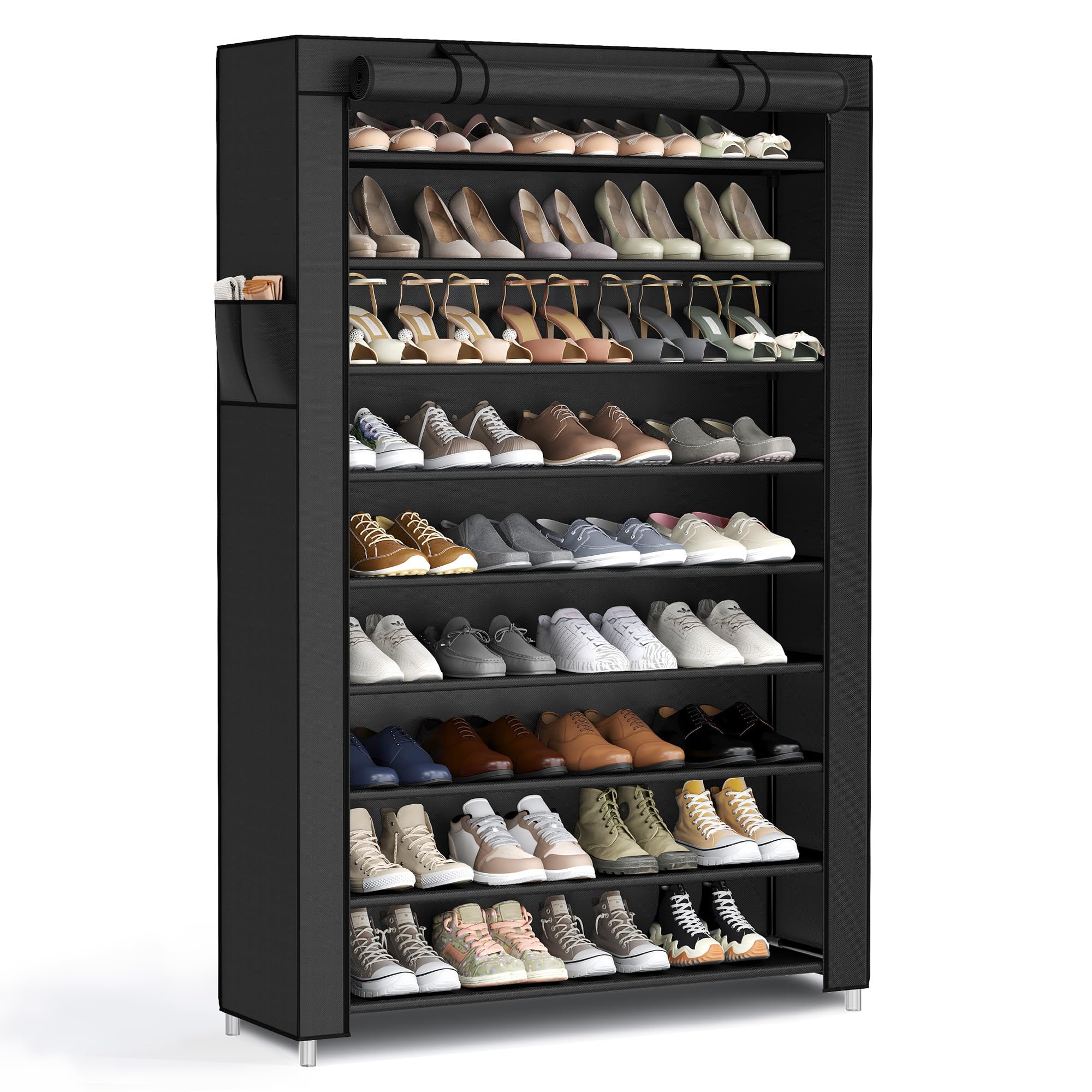
Zip the cover and the shoes disappear. That's the whole argument for this SONGMICS, and it's a strong one in a small apartment where the entryway doubles as the living room: ten tiers of fabric shelves behind a dust cover, with side pockets for brushes and laces.

There's room for 40 to 50 pairs, you can pull a shelf to fit boots, and the tiers wipe clean if something leaks. The trade-off is strength. Each tier is rated to 6.6 pounds, the lightest per-shelf figure here, and the frame is metal tubes pushed into plastic connectors rather than welded steel.

So treat it as shelving for everyday shoes, not storage for a family's worth of hiking boots. Load the heavy pairs low, don't over-tighten the connectors, and go slowly with the zip — it's the part with the most to prove on a rack like this, and when it goes you've lost the reason you bought the thing.

If the shoes live in a closet nobody sees, an open rack is more honest and more durable. If they live where guests walk past, the cover earns its keep, and the price of that is a lighter frame.

Bottom Line: For anyone who hates looking at shoes: ten tiers behind a zip cover, room for 40 to 50 pairs, and the dust kept off the pairs you wear twice a month.

How We Chose and Tested the Best Shoe Racks

We built the shortlist by measuring rather than reading the box. I compared each rack's footprint and shelf spacing against a pair of men's size 11 sneakers, a pair of heeled boots, and a jumble of kids' shoes, then dropped anything whose advertised capacity only worked if you turned every pair sideways. That left 12 racks in solid wood, coated steel, and particle board, which we used for six months.

Every rack arrived at my door, so I logged how it was packed, whether the hardware came bagged and labeled, and whether the parts in the box matched the instructions — a couple didn't, which is exactly the kind of snag that turns a Saturday project into a return. I assembled each one solo with the tools included and timed how long it took from box to upright, then checked every joint again a week later to see which had loosened on their own.

Then came the real work of loading them. Racks went into a two-bedroom apartment entryway, a mudroom bench two kids use daily, and a closet floor, and we filled each past what we'd normally keep and watched for bowing shelves, wobble on hardwood, tipping when a bag got tossed on top, and scuffed finish where shoes get dragged in and out. We slid them across carpet and hard flooring to see whether the feet held, broke down and rebuilt two of them the way you would for a move, and weighed what the money actually buys — board thickness, weld quality, a real back panel or none at all.

How to Choose Shoe Racks

Start with the wall, not the shoe count

The first measurement is the run of floor you can give up, not the number of pairs you own. Most racks run 11 to 12 inches deep, so depth rarely decides it; width does. A 39- or 43-inch rack needs a clear stretch of wall and looks wrong wedged between a door and a coat hook, while a 17-inch rack slots into a hallway nothing else fits.

Tape the footprint on the floor and stand in front of it for a moment. If you can't bend down comfortably to the bottom tier, nobody else in the house will either.

Tier gaps decide which shoes actually fit

Eight inches between shelves is the number to look for if you own knee-high boots or high-tops; below seven, boots end up lying on their sides across two tiers. Pair counts are usually worked out on women's sizes, so plan on roughly four pairs of men's shoes to a mesh shelf.

Pulling a tier is the standard fix for tall footwear, but it costs you the capacity that tier was giving you. Buying the right gap in the first place beats rearranging later.

Frame and shelf surface carry the weight

Steel tube frames with dense mesh shelves are the sturdiest thing at this level, and the mesh catches thin heels that an open wire grid lets through. Fabric tiers over plastic connectors are lighter and cheaper, with per-shelf ratings down around 6.6 pounds; wire grids and steel frames here run from 15 up to 50 pounds.

Check the per-shelf figure before anything else, and put boots on the bottom tier either way — the lowest shelf is both the strongest and the safest place for the heaviest shoes.

Stack, split and expand as the pile grows

Several racks here are built to multiply: a three-tier unit that accepts a second on top, an eight-tier tower that separates into two four-tier racks, and expandable frames that slide from 17 to 34 inches. That flexibility only works within a model — frames and connectors are matched, so a second rack from another maker won't key into the first.

If you expect the collection to grow, buy the same model twice rather than sizing up now and paying for space you don't use yet.

Tall racks get fixed to the wall

Anything over about 43 inches tall should be anchored, and that includes racks that ship with an anti-tip kit — use it. A loaded tall rack is heavy at the top and light at the base, which is the wrong way round when a child pulls on it or a door swings into it.

Stand it against a wall rather than across a corner, keep heavy shoes low, and check the feet after the first week; adjustable feet settle into carpet.

Frequently Asked Questions

Final Verdict

Start with the VASAGLE 6-tier. It holds a household's shoes, gives you a flat surface for keys and mail, and comes with the anti-tip hardware a 43-inch rack ought to have — that combination is why it's our default for an entryway or a hall.

From there the decision is usually shape rather than quality: eight-inch gaps if boots dominate, 17 inches of width if that's all the floor you have, or a zip cover if you'd rather not look at the shoes at all.