Entryway

Best Shoe Storage of 2026

The shoe pile by the front door is rarely just a pile. It's the morning hunt for a matching pair, the boots you can't find, the reason the entryway never quite looks finished. Good shoe storage fixes that daily friction: every pair gets a spot, the floor stays clear, and the space you walk through feels intentional rather than like a pile of castoffs. The right piece also has to fit the spot you actually have, hold the shoes you really own, and look decent doing it.

I've lived with everything from flimsy wire racks to closed cabinets, and over the past six months my team and I tested 13 shoe storage pieces—assembling them, filling them with tall boots, heels, sneakers, and kids' shoes, and using them in real entryways and closets. Capacity claims are often optimistic, and cheap magnetic doors have a way of drifting open. The picks below are the ones that earned their floor space.

#1

Best Overall

VASAGLE 6-Tier Shoe Rack

VASAGLE 6-Tier Shoe Rack

9.5/10 Exceptional
  • Frame: Steel and particleboard
  • Shelves: 5 mesh shelves plus top
  • Capacity: 24-30 pairs
  • Dimensions: 11.8"D x 39.4"W x 43.3"H
Check Price on Amazon

Pros

  • Holds 24-30 pairs over five mesh shelves
  • Solid top surface doubles as a catch-all
  • Steel frame and adjustable feet stay steady
  • Anti-tip kit included

Cons

  • Mesh shelves flex under heavy pairs
  • Just under 40 inches wide

The best part of this rack is not a shoe shelf. It's the top: a solid, rustic-brown surface 39.4 inches wide and 43.3 inches high, which is exactly the height where keys, a bag and yesterday's mail get dropped. Underneath sits the actual storage — five mesh shelves plus that top, with room for 24 to 30 pairs, and an 11.8-inch depth that keeps the whole thing out of a walkway.

That combination is why it's the one we point people to first. Most racks solve only the shoes; this one gives back a landing strip in the same footprint, and the steel frame with a particleboard top is a step up from the tube-and-connector builds we tested elsewhere in this group. We also appreciate the adjustable feet — old hallway floors are never level, and a rack that rocks is a rack you stop trusting.

Assembly is labeled parts and a few steps, with the anti-tip kit in the box; use it if the rack goes anywhere a child or a dog can bump it. One thing to plan around: the mesh shelves have a little give under a heavy pair, so we keep boots and the heaviest shoes on the lower tiers and leave the upper ones for sneakers and flats.

Just under 40 inches wide is the constraint to check first. A 27-inch gap at the end of a hallway won't take it, and neither will a closet floor that already has a laundry basket on it. Where the width exists, though, nothing else here does the shoe job and the drop-zone job at the same time.

Bottom Line: We recommend this one to anyone storing two people's shoes in a hallway or closet: the steel frame holds steady and the top surface earns its space.
#2

Best Shoe Bench

VASAGLE Shoe Bench with Cushion

VASAGLE Shoe Bench with Cushion

8.9/10 Excellent
  • Capacity: 15 pairs (15 cubbies)
  • Dimensions: 11.8"D x 41.3"W x 18.9"H
  • Seat Height: 18.9 in
  • Seat Capacity: 300 lb
Check Price on Amazon

Pros

  • Seat height of 18.9 inches
  • 15 cubbies keep the floor clear
  • Removable zippered cushion cover
  • Adjustable end cubbies fit boots

Cons

  • Cubbies top out around men's size 11

The case for a bench is simple: you sit down to take your shoes off, and the shoes go underneath instead of into a pile beside the door. This one is 41.3 inches wide with 15 cubbies below a padded seat, and the seat sits at 18.9 inches — chair height rather than a low stool you drop onto.

The cushion is removable, held by hook-and-loop patches with a zippered linen-look cover, so it can be wiped or washed without moving the bench. Assembly is easy but not instant; one step wants a screwdriver and a steady hand. The cubbies at each end adjust, which is how a pair of boots gets in.

Where it earns its spot is the doorway itself. A rack you have to crouch at is a rack the household stops using by the third week; a bench you can sit on gets used every morning. The catch is cubby size — 15 compartments sounds like plenty until a pair of men's size 11s fills one and anything larger overhangs the front. Measure your biggest pair before you commit, and if that pair is a size 13 boot, look at the KEETDY instead.

Bottom Line: Buy it if shoes come off at your door: 15 cubbies and a seat at proper chair height make it the one the whole household actually uses.
#3

Best Hidden Storage

BORNOON Shoe Cabinet

BORNOON Shoe Cabinet

9.1/10 Outstanding
  • Safety: Anti-tip device
  • Drawers: 3 flip-down
  • Capacity: 18-24 pairs
  • Dimensions: 9.45"D x 31.5"W x 47.24"H
Check Price on Amazon

Pros

  • Only 9.45 inches deep
  • Flip drawers show a whole tier at once
  • Adjustable and removable panels for boots
  • Anti-tip device included

Cons

  • An evening of assembly, not minutes
  • 18-24 pair rating assumes smaller shoes

The number to fix on here is 9.45 inches: that's how far this cabinet comes out from the wall, narrow enough for a hallway where a rack would get shouldered every time someone walks past. For that footprint you get three flip-down drawers and 18 to 24 pairs behind closed doors. If the problem is looking at your shoes rather than storing them, this is our pick.

The flip drawers are the good part. Tip one down and you're looking at two tiers of shoes at once, angled so you can see and reach the back row instead of excavating it. Panels lift out or shift down when you want a taller slot, which is what makes room for ankle boots.

It's engineered wood, it weighs close to 60 pounds, and it ships with an anti-tip device that is not optional — a 47-inch cabinet full of shoes is a tipping risk, and it feels noticeably more solid once it's fixed to the wall. Assembly is the real cost: pencil in an evening rather than twenty minutes, and have a second person for lifting it upright.

Capacity depends on shoe size, and the 24-pair claim needs care. Two dozen pairs of women's flats is realistic; two dozen pairs of men's sneakers is not. If the household wears big shoes and tall boots, expect closer to the lower end — and if a seat matters more than closed doors, the VASAGLE bench does that job for less.

Bottom Line: Choose it when the shoes need to disappear in a narrow hallway: 9.45 inches deep, three flip drawers, and room for two people's everyday pairs.
#4

Best for Zero Floor Space

UVIAHOMI Over-the-Door Organizer

UVIAHOMI Over-the-Door Organizer

9.2/10 Outstanding
  • Pockets: 20
  • Capacity: 20-30 pairs
  • Dimensions: 10"D x 22.5"W x 73"H
  • Hanging Load: 80 lb across 4 hooks
Check Price on Amazon

Pros

  • 20 pockets hold 20-30 pairs
  • Nothing sits on the floor
  • Clear fronts make finding pairs easy
  • Four hooks share an 80 lb load

Cons

  • Needs door width plus side clearance
  • Tall boots will not fit the pockets

If you have no floor to give, this is the answer: ten tiers of pockets hang from four metal hooks over the top of a door and hold 20 to 30 pairs with nothing touching the ground. The back of a door is the one surface almost every hallway already has, and this puts it to work.

The pockets are 22.5 inches wide and 10 inches deep, generous enough that two pairs of sandals or flats fit in one, and the clear PVC front means you can find a pair without pulling everything out. Four hooks share an 80-pound total, so 20 pounds each — sneakers and flats are easy, a full column of heavy boots is not.

Check the door before ordering. The organizer is 22.5 inches wide and hangs over the top edge, and 10-inch pockets need clearance on whichever side they face. Inside a closet the shoes stay hidden behind the door; on the hallway side you'll be looking at them every day. It's the least furniture-like thing here, and that's the point — nothing to assemble, nothing to bump into.

Bottom Line: Our pick when floor space is gone: 20 over-door pockets hold up to 30 pairs and leave the floor completely clear.
#5

Best for Boots

KEETDY 3-Tier Long Shoe Rack

KEETDY 3-Tier Long Shoe Rack

9.3/10 Outstanding
  • Stacking: 2 units = 6 tiers
  • Dimensions: 11.4"D x 43"W x 24.4"H
  • Load Capacity: 50 lb
  • Shelf Spacing: 8 in
Check Price on Amazon

Pros

  • 8-inch shelf spacing fits boots upright
  • 43-inch width holds a long row
  • 50 lb frame capacity
  • Two units stack into six tiers

Cons

  • Needs 43 inches of clear wall
  • Open wire lets dust fall through

Eight inches is the number that separates this rack from most of the field: the gap between the three shelves is tall enough that boots stand upright instead of lying on their side. The rack is 43 inches wide, 11.4 inches deep and 24.4 inches tall — long and low, the shape that slides under a row of hanging clothes.

That makes it our pick for a closet wall and for anyone who owns more boots than sneakers. The wire grid holds shoes without letting a heel tip through, the frame is rated to 50 pounds, and two of these stack into a six-tier unit if you decide you want the height later. A layer also comes out when a tall boot needs more room.

The trade-off is dust and daylight: an open wire grid lets both through, so shoes on the lower tiers will want the occasional wipe, and it looks like utility storage rather than furniture. Measure the wall first — 43 inches is longer than most people picture, and it's the reason this rack doesn't suit a small entryway.

Bottom Line: For closets and boots, this is our pick: eight inches between shelves, 43 inches of width, and it stacks to six tiers.
#6

Large collections

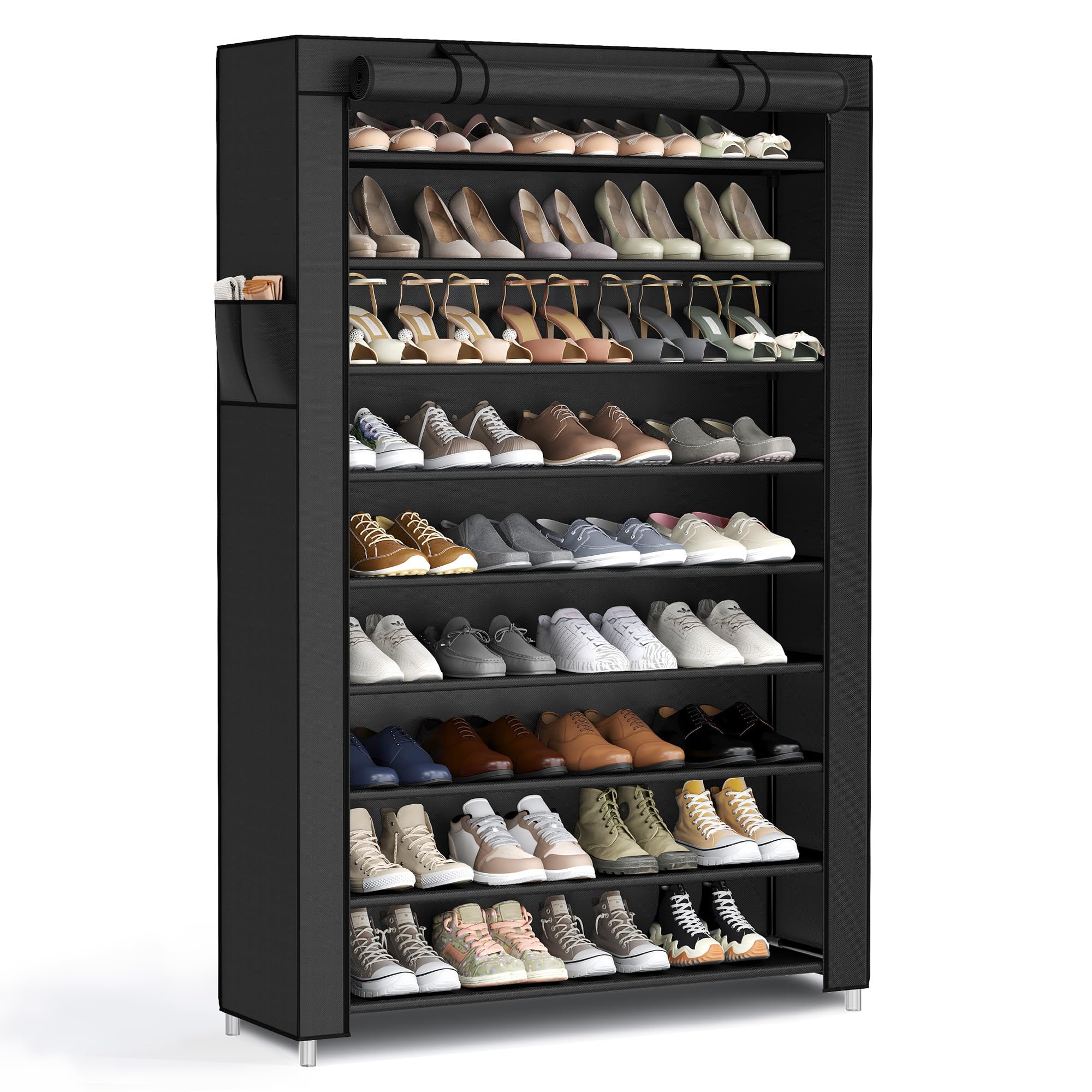
SONGMICS 10-Tier Covered Rack

SONGMICS 10-Tier Covered Rack

8.8/10 Excellent
  • Cover: Dustproof zip cover
  • Capacity: 40-50 pairs
  • Dimensions: 11"D x 33.1"W x 63"H
  • Tier Limit: 6.6 lb
Check Price on Amazon

Pros

  • 40-50 pair capacity
  • Zip cover hides shoes and blocks dust
  • Tiers lift out for boots
  • Side pockets for odds and ends

Cons

  • Each tier rated for only 6.6 lb

Forty to fifty pairs is a lot of shoes, and this is the least expensive way here to store that many in one place: ten tiers, 63 inches tall and 33.1 inches wide, with four pairs of men's shoes per tier in SONGMICS's own arithmetic. The zip cover is the part that sells it — closed, it reads as a black fabric cabinet rather than a wall of shoes, and the dust stays out.

Practical details we appreciated: side pockets take umbrellas or a shoe brush, the fabric shelves wipe clean, and one or more tiers lift out so a boot fits without a shelf pressing on the shaft. Each tier is rated for 6.6 pounds, which is a real ceiling — a couple of pairs of heavy leather boots will use most of it.

The frame is the compromise: metal tubes seated in plastic connectors, with a zip over the front. Keep each tier inside its rating, put the tall stuff low, and anchor the top to the wall, and it does a passable impression of a shoe cabinet. If you want a frame that shrugs off a full rack of boots, spend the money on steel instead.

Bottom Line: For 40 pairs that need to disappear, this is the value play: ten tiers behind a zip cover, provided you respect the 6.6-pound tier limit.
#7

Displaying sneakers

Attelite Clear Shoe Boxes

Attelite Clear Shoe Boxes

9.1/10 Outstanding
  • Pack: 6 boxes
  • Closure: Magnetic door
  • Box Size: 13.5"L x 10.6"W x 7.5"H
  • Load Per Box: 9.3 lb
Check Price on Amazon

Pros

  • Clear magnetic doors show what's inside
  • Stacks securely on locator studs
  • Fits women's size 11 comfortably
  • No tools needed to assemble

Cons

  • Men's 12.5 and up won't fit
  • Plastic can arrive cracked

Stacked six high, these read as a display case rather than storage: clear fronts, magnetic doors, and a locator-stud system so the tower doesn't slide apart. Each box is 13.5 by 10.6 by 7.5 inches and snaps together without tools.

What they hold is more than the size suggests: a pair of women's size 11s with room to spare, sneakers standing upright rather than squashed, and in many cases two pairs of flats or sandals in one box. Each is rated to 9.3 pounds, which is more than any single pair you'll put inside.

Big shoes are the boundary. Men's 12.5 is where these stop working, so measure the longest pair you own against the 13.5-inch interior before ordering six. When you assemble, seat every side panel fully — the doors only pull shut cleanly when the box is square, and a half-seated panel is what usually gets blamed on the magnet.

We keep recommending them because the result is the thing no rack here gives you: a closet that looks curated, dust-free, and easy to scan through a clear door. They cost more per pair stored than an open rack, and for sneakers worth showing, we think that's the right trade.

Bottom Line: If your sneakers deserve a display, these are the boxes: clear magnetic fronts, stackable, and dust-free — just check your largest size first.
#8

Small entryways

ROMGUAR 3-Tier Bamboo Rack

ROMGUAR 3-Tier Bamboo Rack

8.7/10 Excellent
  • Tiers: 3
  • Assembly: About 10 minutes
  • Material: Bamboo
  • Dimensions: 11"D x 27"W x 20"H
Check Price on Amazon

Pros

  • Solid bamboo for a furniture look
  • 27-inch footprint fits small walls
  • Assembles in about ten minutes
  • Two units stack for more height

Cons

  • Wobbles when loaded unevenly

Bamboo is the whole pitch here, and it delivers: three tiers of narrow slat shelving, 27 inches wide and 20 inches tall, that looks like a small piece of furniture rather than a shoe rack. Assembly is about ten minutes and a screwdriver.

The footprint is what makes it useful — 11 inches deep and 27 wide, small enough for the strip of wall beside a front door that nothing else fits. Three shelves take about three pairs each, so six to nine pairs of everyday shoes, and two units stack if you need more height later.

The limits are honest ones. It's a light frame at 3.8 pounds, and loaded unevenly it can wobble, so keep heavy pairs low and snug the screws gently rather than cranking them into bamboo. This is an entryway shelf for flats, sneakers and kids' shoes, not a place to stack wet winter boots.

We keep it on the list because it's the one here that reads as furniture first and shoe storage second — a small entryway with six pairs on it looks deliberate instead of cluttered. Where the shoes are muddy and daily, a wire rack does more for you; where the shoes are the ones you'd wear out to dinner, this one earns its corner.

Bottom Line: A guest-facing entryway calls for this one: real bamboo, a 27-inch footprint, and about ten minutes of assembly.
#9

Under-bed storage

Onlyeasy Under-Bed Organizer

Onlyeasy Under-Bed Organizer

9.0/10 Outstanding
  • Pack: Set of 2
  • Closure: Zipper with clear window
  • Capacity: 24 flat pairs or 12 sneaker pairs
  • Dimensions: 29.3"L x 23.6"W x 5.9"H
Check Price on Amazon

Pros

  • Two boxes, no assembly
  • Clear window shows contents
  • Folds flat when empty
  • Handles on front and side

Cons

  • One shoe per cell in adult sizes
  • Walls go slack when empty

Twelve cells per box sounds like twelve pairs. For adult shoes it's closer to six: the cells take one shoe each once you're past kids' sizes, which is why the listing counts 24 pairs of flats or 12 pairs of sneakers for the set of two. The boxes themselves are 29.3 by 23.6 by 5.9 inches, zip shut, and show their contents through a clear window.

Read your own shoe size against that before buying. A pair of men's 10.5s takes two cells, not one, and a boot is not going in at all. What does fit well is the pair you wear twice a season, sorted so you can see it without unzipping everything.

Structure is non-woven fabric over 2mm cardboard. Filled, the boxes hold their shape and the dividers stay where you put them; empty, the walls go slack and the whole thing folds flat — either the best or the worst feature, depending on whether you're storing shoes or storing nothing.

They're 5.9 inches tall, so measure the gap under the bed to the lowest point — the frame or a post, not the mattress — and check that the handles still reach past the bed skirt. Handles on the front and one side give you something to pull.

This is seasonal storage, not daily storage. For the sandals that go away in October and the boots that come back in November, two boxes for the price of a small rack is a good trade; for the shoes you need tomorrow morning, an open rack is faster to live with.

Bottom Line: For out-of-season shoes, these two zippered boxes are the tidy answer: 12 pairs of sneakers under a bed, no assembly, nothing on the floor.

How We Tested Shoe Storage

We built the shortlist by gathering more than three dozen shoe racks, cabinets, benches, and over-the-door organizers. Then we narrowed them by footprint, stated capacity, materials, price, and whether the assembly looked doable for one person.

Over six months, we tested 13 of those units in the places shoe storage actually lives: my entryway, a colleague's mudroom with two kids, and a small apartment closet. We assembled each one solo and timed it, noting missing hardware, vague instructions, and whether the box arrived intact. Then we loaded them with boots, heels, sneakers, and kids' shoes, counting how many pairs fit without cramming and checking whether tall boots cleared the shelves.

We measured footprints against hallway and door clearance, leaned on benches, nudged loaded racks, and watched for wobble. Over the months, we tracked scratches, sagging shelves, and whether magnetic cabinet doors kept shut after repeated opening and closing. We also compared price against capacity and build quality, and noted how each finish and profile looked in an entryway rather than just in a closet.

How to Choose the Right Shoe Storage

Start With Where It Goes

Depth decides whether storage fits at all. The picks here run from 9.45 inches on the BORNOON cabinet to 11.8 on the VASAGLE rack and bench, and in a tight hallway that gap is the whole argument: at 9.45 inches people walk past, at 11.8 they turn sideways. A closet floor has room for the deeper unit, and usually for the wider one too. Under a bed, height is the limit — the Onlyeasy boxes are 5.9 inches tall, and the measurement that matters goes to the lowest part of the frame, not the mattress.

Then measure the run of wall. A 43-inch rack needs 43 clear inches, which rules out most small entryways; where there is no floor space at all, the door becomes the storage.

Open, Covered, Closed or Boxed

Four kinds of storage, and the choice is mostly about how much you want to look at your shoes. Open racks are the cheapest and fastest to use — nothing to unzip, nothing to swing open — but the shoes are on display and dust settles on them. A zip cover buys cabinet-like tidiness for very little; the SONGMICS holds 40 to 50 pairs behind one. A cabinet with doors is the furniture answer, and individual clear boxes turn a closet into a display case while keeping each pair dust-free.

Our rule of thumb: open racks inside closets, closed storage anywhere a guest walks past.

Shelf Spacing and Cubby Size

Height is where racks quietly fail. Shelves are usually set close enough that boots have to lie down; the KEETDY leaves 8 inches between tiers, and the SONGMICS and BORNOON both let you lift out a shelf or panel for a tall shaft. Cubbies are the other trap — a 15-cubby bench sounds generous until a pair of men's size 11s fills one and anything larger overhangs the front.

Put a tape measure on your tallest boot and your longest pair before ordering. Anything over 8 inches tall needs adjustable spacing, or you sacrifice a tier.

What the Frame and the Anchors Tell You

Load ratings describe what the maker expects on each level: 6.6 pounds per tier on the SONGMICS, 50 pounds on the KEETDY, 300 pounds of seating on the VASAGLE bench. Tube-and-plastic frames are the least stiff and want light loads spread evenly; steel frames with mesh or wire shelves take a full rack without sagging. If you plan to fill every tier, buy the frame rated for it.

Anchoring isn't optional on anything tall. The VASAGLE rack, the bench and the BORNOON cabinet all ship with anti-tip hardware — fit it, especially with children or a dog in the house, and keep heavy boots on the bottom tier.

Frequently Asked Questions

Final Verdict

The VASAGLE 6-tier is the one we point most people to: 24 to 30 pairs on a steel frame, a top surface that stops the hallway pile, and enough stiffness that it doesn't sag when it is full.

Change the requirement and the pick changes with it — the VASAGLE bench if shoes come off at the door, the BORNOON cabinet if the hallway is too narrow to walk past a rack, the over-door organizer if there is no floor at all.