Game Room

Best Home Bar Cabinets of 2026

A bar cart looks great until the third bottle of bourbon and a stack of mismatched glasses turn it into clutter. A cabinet does the same job behind a door: bottles out of the light, stemware hanging where you can grab it, and one dedicated surface for the shaker instead of three half-used kitchen shelves. That's the fix — a home bar that stays set up instead of getting packed away every time you host.

Over eight months I've lived with 11 of these in a dining room, a basement, and a cramped apartment corner, and the gaps show up fast: doors that don't sit flush after assembly, shelf-pin holes drilled a half-inch off, a walnut finish that arrives distinctly orange. Measure your tallest bottle before you commit — a cabinet that can't clear a 13-inch bourbon bottle is one you'll quietly resent. Value isn't the cheapest tag; it's the cabinet that still closes squarely two years in. The picks below run from slim corner pieces to sideboards that read like built-ins.

#1

Best Overall

Unikito LED Wine Bar Cabinet

Unikito LED Wine Bar Cabinet

9.2/10 Outstanding
  • Power: 3 AC outlets, 2 USB ports
  • Dimensions: 47.5"W x 15.8"D x 36"H
  • Weight Capacity: 200 lb
  • Wine Bottle Capacity: Up to 10 bottles
Check Price on Amazon

Pros

  • Wide 47.5-inch counter for real mixing
  • Three AC outlets and two USB ports
  • Ten bottle cradles plus a hanging glass rack
  • 200-pound rating with adjustable feet

Cons

  • Open shelving shows and gathers dust
  • Ten bottles is the ceiling

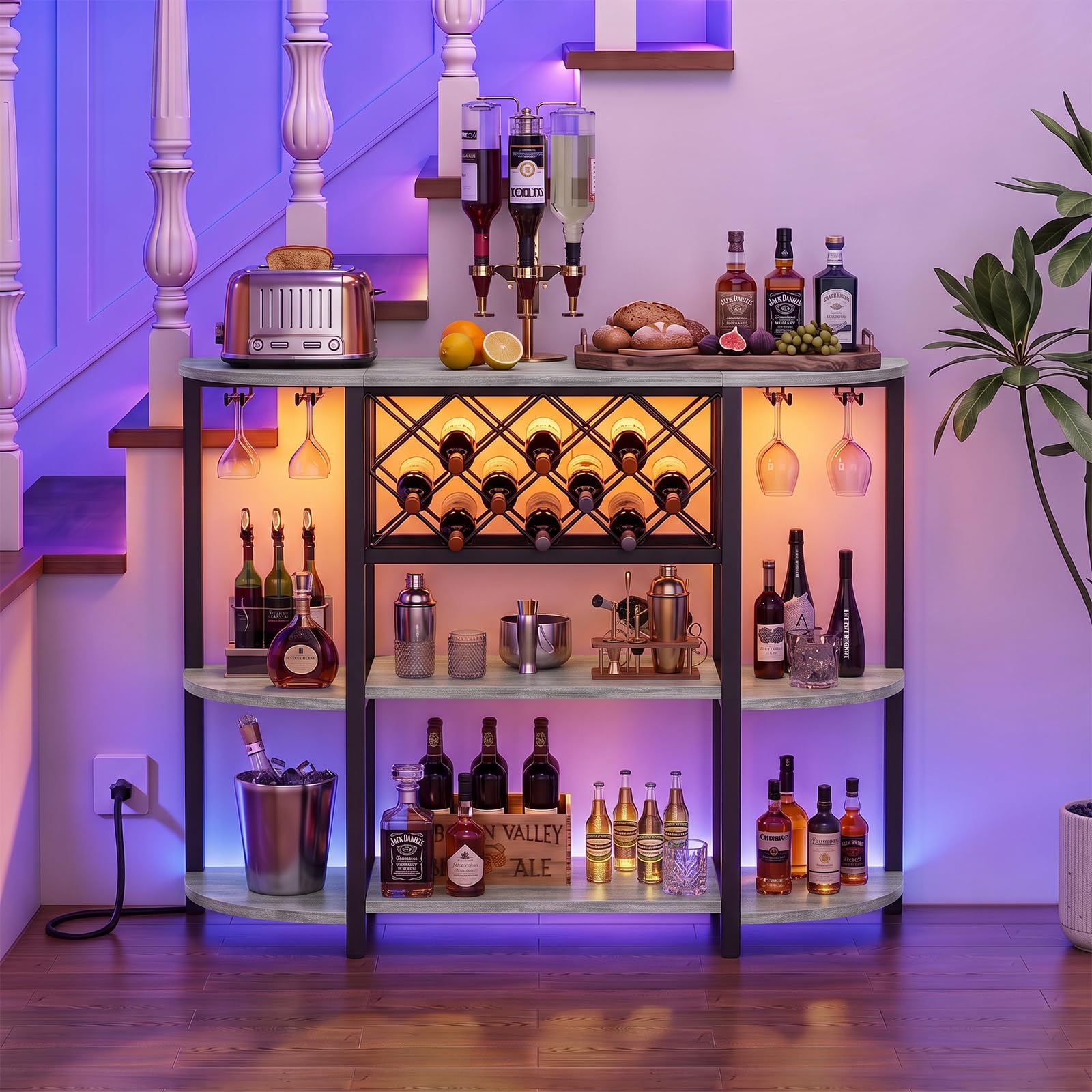
The 47.5-inch top is what settled this one for us. Most of the cabinets here give you a shelf barely wide enough for a shaker; this gives you a counter, with space for three bottles, an ice bucket and a row of glasses and room left to pour. It stands 36 inches high, which is counter height, so you mix at a comfortable level instead of crouching over a side table.

The storage is laid out the way a home bar actually works. Ten cradles keep bottles on their sides, a rack under the top shelf hangs stemware by the foot, and the remaining shelves take the awkward things: the shaker, the bitters, the stack of coasters nobody puts away. It is rated to 200 pounds, and the adjustable feet let you level it on a floor that isn't flat.

The built-in power is the part we didn't expect to lean on. Three AC outlets and two USB ports along the back mean the blender, a speaker and a phone can live at the bar instead of fighting for the kitchen counter. The LED strip adds color and a bit of evening atmosphere; it is there to tint the bottles, not to light the room.

Two things to know before you order. Everything sits on open shelves, so dust collects on the glassware and nothing hides; this is a display bar, not a cupboard. And check that the light strip works the day the box arrives, before you have filled the shelves and thrown out the packaging.
Bottom Line: Our default pick: the widest working counter here, with power built in and room for ten bottles, for anyone whose bar lives against a wall.
#2

Best for Entertaining

GDLF Bar Cabinet with Fridge Space

GDLF Bar Cabinet with Fridge Space

9.0/10 Outstanding
  • Power: AC, USB and USB-C outlets
  • Storage: 3-tier rotating lazy susan
  • Dimensions: 60.2"W x 21.7"D x 39.8"H
  • Fridge Bay: 19.8"W x 20"D x 34.7"H
Check Price on Amazon

Pros

  • Fridge bay takes a compact beverage fridge
  • 60-inch top with a rotating lazy susan
  • Glass door with three stemware rows
  • AC, USB and USB-C outlets on board

Cons

  • Beverage fridge sold separately
  • Single amber light, no color modes

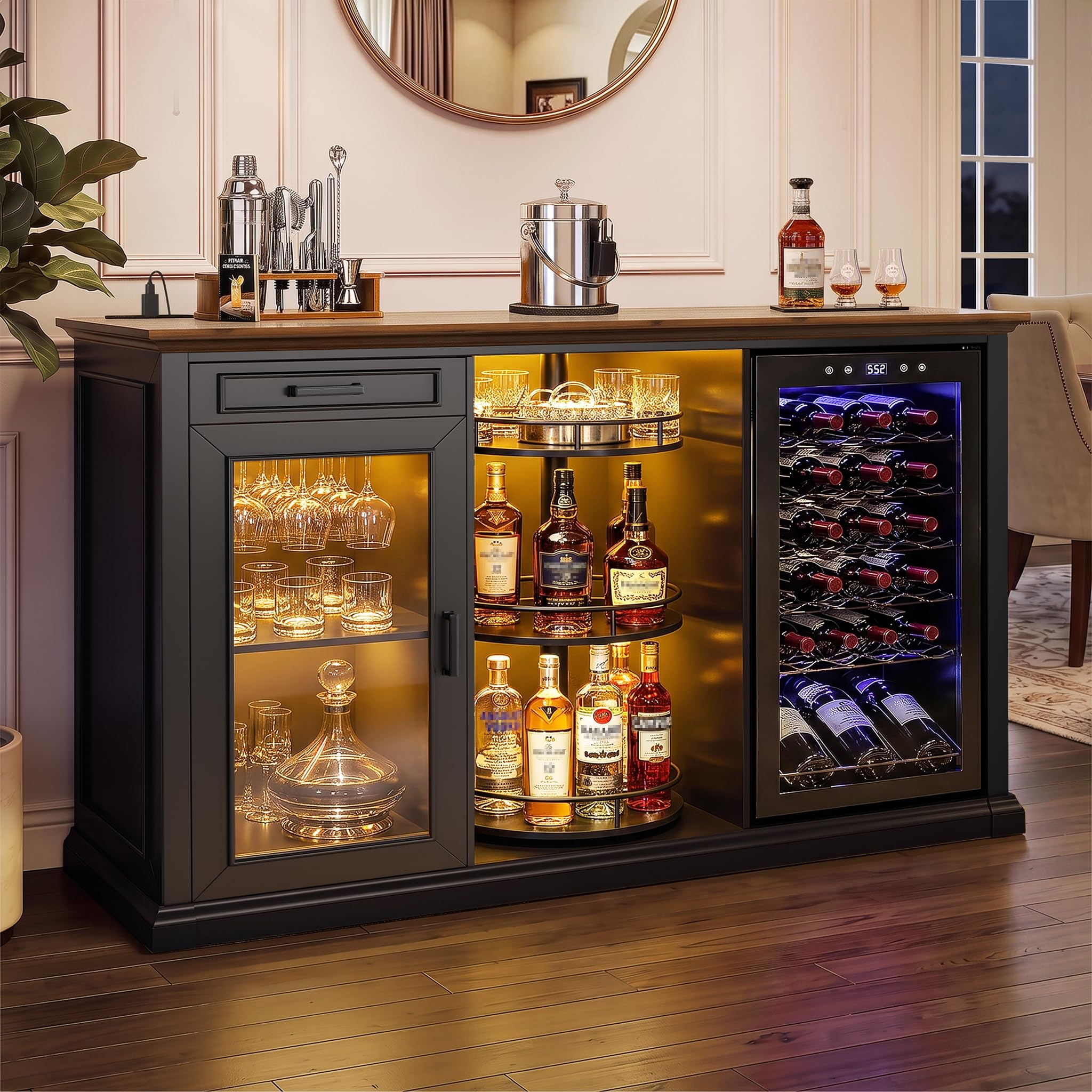
Only one cabinet here is built around a fridge, and that is the whole argument for the GDLF. The compartment in the middle measures 19.8 inches wide, 20 deep and 34.7 tall, sized for a compact beverage fridge, with a 60.2-inch serving top running above it. The fridge isn't included, so build that into your planning before you fall for the rest of it.

The rest is designed for someone who hosts. The lazy susan is the clever part: glasses ride the top tier, and the two tiers below hold eight to ten bottles each, all of them a half-turn from your hand rather than a reach past six others. Behind the glass door, three rows of stemware racks keep glasses visible and out of the way, and there is a drawer for openers, napkins and the corkscrew that always goes missing. Add AC, USB and USB-C power and this is the most complete bar station in the set.

The compromises are narrow but worth naming. The lighting is a single warm amber rather than the color-cycling strips on cheaper cabinets, which is less fun and better with whiskey. It also ships in two boxes that can arrive on different days, and at 120 pounds across a 60-inch span it is a two-person build.

Bottom Line: The one to buy when a cold drink belongs in your bar: a fridge bay, a 60-inch top and rotating storage, with the fridge itself a separate purchase.
#3

Best for Corners

Aheaplus Corner Bar Cabinet

Aheaplus Corner Bar Cabinet

9.2/10 Outstanding
  • Power: 3 outlets, 2 USB ports
  • Lighting: RGB LED strip
  • Shelving: 5 tiers
  • Dimensions: 17.5"W x 17.5"D x 64.2"H
Check Price on Amazon

Pros

  • Fits a 17.5-inch corner without stealing floor
  • Five tiers with outlets and USB at the top
  • RGB lighting over a metal frame

Cons

  • Doors can need realigning after assembly
  • LED panel can stop working

Every home has a corner that swallows a lamp and nothing else. This cabinet is 17.5 inches square at the base and 64.2 inches tall, so it takes that dead angle without borrowing floor from anywhere else, and at that height it puts bottles and glassware at eye level instead of down by your knees.

Five tiers give you room to spread out, three outlets and two USB ports sit up top, and the RGB strip cycles through enough colors to change the mood of a room. The open shelves are the right place for what you pour from; two doors below hide everything you don't want on show. The metal frame and adjustable feet keep it level on a floor that isn't.

We rate it the best corner solution here, because nothing else in this set fits a 17.5-inch angle and still gives you five usable levels. Assembly is the part that divides people: the parts are labeled, but the sequence isn't always obvious, and this is not a piece to build an hour before guests arrive.

Bottom Line: The corner answer: 17.5 inches of footprint, five levels of storage and power up top, made for the room where floor space is the constraint.
#4

Best for Small Spaces

X-cosrack Wine Bar Cabinet

X-cosrack Wine Bar Cabinet

9.2/10 Outstanding
  • Door: Mesh with magnetic catch
  • Wine Rack: 5 bottles, detachable
  • Dimensions: 23.6"W x 13.4"D x 31.1"H
  • Weight Capacity: 330 lb
Check Price on Amazon

Pros

  • 330-pound capacity in a 24-inch footprint
  • Detachable wine rack and glass holder
  • Mesh door with a magnetic catch

Cons

  • No lighting or built-in outlets

Five bottles is not a collection, it is a week of evenings. If that is your version of a home bar, this is the cabinet we point to: 23.6 inches wide, 13.4 deep and 31.1 tall, with the five-bottle rack and the glass holder both removable, so the interior changes shape as your habits do.

The mesh door is the detail that makes it work in a small room. It keeps the clutter, the half-empty bottles and the snack tins, from being the first thing anyone sees, and the magnetic catch does the work of closing it. It is rated to 330 pounds, more than any other cabinet here, so glassware and mixers can pile up well past five bottles' worth, and the adjustable feet sort out an uneven floor.

Bottom Line: For a small room and a small collection, this is the sensible buy: a 24-inch footprint, a mesh door that hides the clutter, and capacity far beyond its five-bottle rack.
#5

Best Furniture Finish

ONBRILL Fluted Wine Bar Cabinet

ONBRILL Fluted Wine Bar Cabinet

8.9/10 Excellent
  • Doors: Sliding
  • Power: Charging ports and RGB LED
  • Wine Rack: 12-bottle grid
  • Glass Storage: 3 tiers, 9 glasses
Check Price on Amazon

Pros

  • Fluted walnut front reads as furniture
  • 12-bottle grid plus nine hanging glasses
  • Sliding doors need no swing room

Cons

  • Walnut reads darker in person than online

Fluted walnut is doing a lot of work here. Most bar cabinets announce themselves; this one reads as a sideboard from across the room, with an open center that shows off the glasses and sliding doors that need no swing room in front of them.

We rate the finish the best-looking in this set. The walnut has a warmth the black metal-and-MDF cabinets can't match, and it is the one here you can put in a dining room without the room turning into a bar. The storage backs it up: a twelve-grid wine rack, three tiers holding nine glasses, adjustable shelves, an RGB strip with a remote and charging ports, so it works as a coffee station the morning after.

One caution: the walnut runs darker in person than the product photos suggest. In a warm room with lamplight that reads as expensive; in a dark hallway it just reads as brown.

Bottom Line: If the bar has to live in a dining or living room, buy this one: the best-looking finish here, and storage that works as hard as the furniture it resembles.
#6

Best Budget

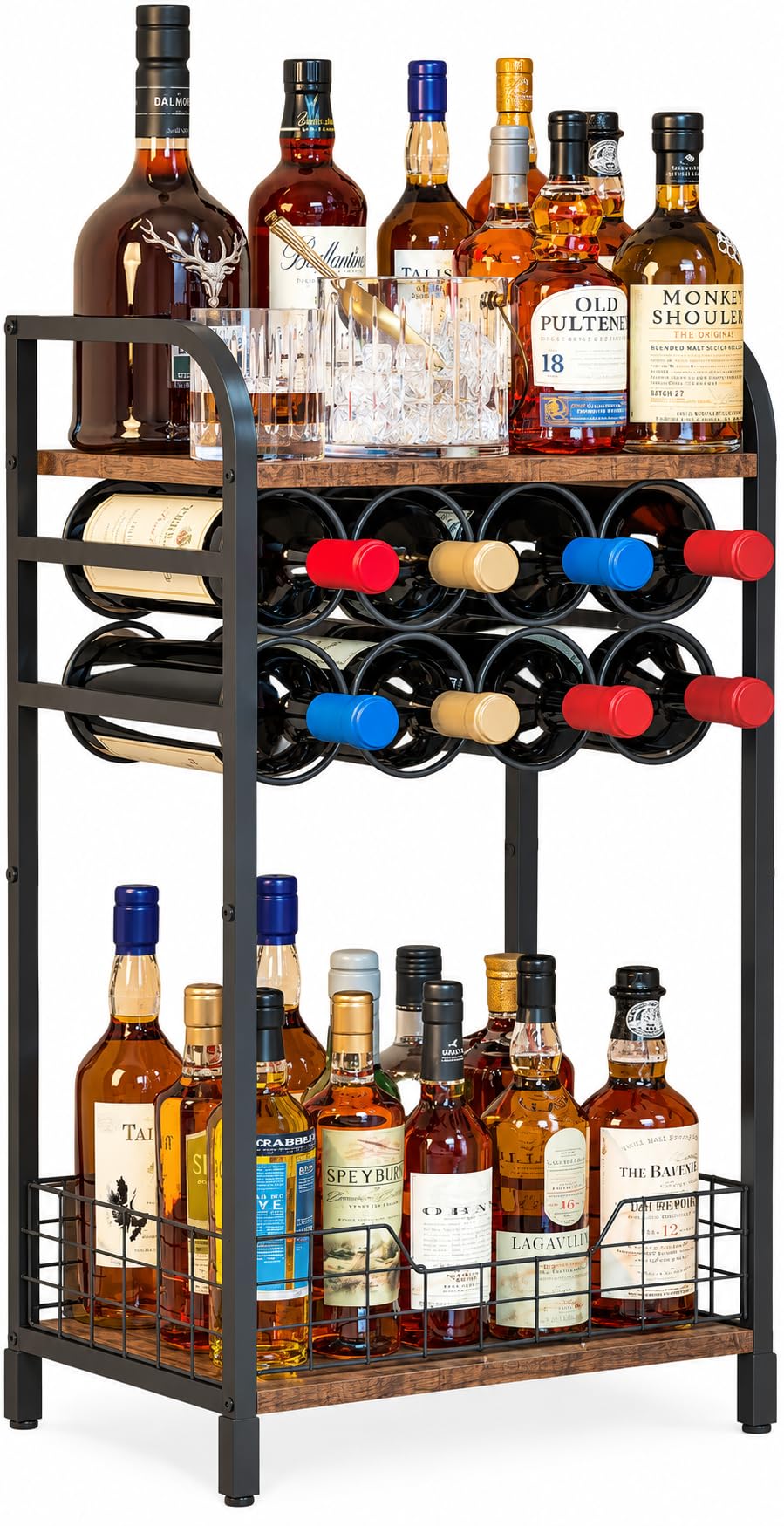
Bosimeca 3-Tier Wine Rack

Bosimeca 3-Tier Wine Rack

9.0/10 Outstanding
  • Frame: Steel with wood-grain shelves
  • Dimensions: 16.8 x 13.4 x 29.5 inches
  • Wine Slots: 12 on middle shelf
  • Stated Capacity: Over 30 bottles
Check Price on Amazon

Pros

  • Twelve bottle slots plus open shelving
  • Steel frame with a wood-grain finish
  • Under 30 inches tall and the least expensive here

Cons

  • Smaller in person than the photos suggest

No doors, no lights, no outlets. This is a rack with a worktop, and that is exactly what keeps it the least expensive way into a home bar here. Three tiers, a wood-grain top and a black steel frame: it looks like furniture from the side and like a wine shop from the front, which is the point.

Twelve bottle slots sit in the middle shelf, holding bottles on their sides, and the open shelves above and below take everything else, the upright liquor, the glasses, the mixers. The stated capacity runs past thirty bottles once the top and bottom shelves are in use, though the twelve in the rack are the only ones held safely on their sides. At 29.5 inches tall it tucks under a window or against a blank wall without dominating either.

We send people to this one when the budget is the constraint and the room is small, with a warning: it arrives smaller than the photos make it look. The shelves are sized for standard bottles, and anything taller than a standard wine or liquor bottle is the first thing to foul the shelf above.

Bottom Line: The budget entry: twelve bottle slots, open shelves and a usable worktop, best for a first bar in a small room where nothing needs hiding.
#7

Narrow walls

Aheaplus 67-Inch Tall Bar Cabinet

Aheaplus 67-Inch Tall Bar Cabinet

8.8/10 Excellent
  • Power: 3 outlets, 2 USB ports
  • Lighting: RGB LED strip
  • Dimensions: 26.9"W x 15.7"D x 66.9"H
  • Open Shelves: 4 in upper hutch
Check Price on Amazon

Pros

  • 67 inches of storage on 27 inches of wall
  • Outlets and USB in the hutch
  • Two closed doors hide the overflow
  • RGB lighting along the shelves

Cons

  • Narrow shelves crowd wide appliances
  • Many parts make assembly a long job

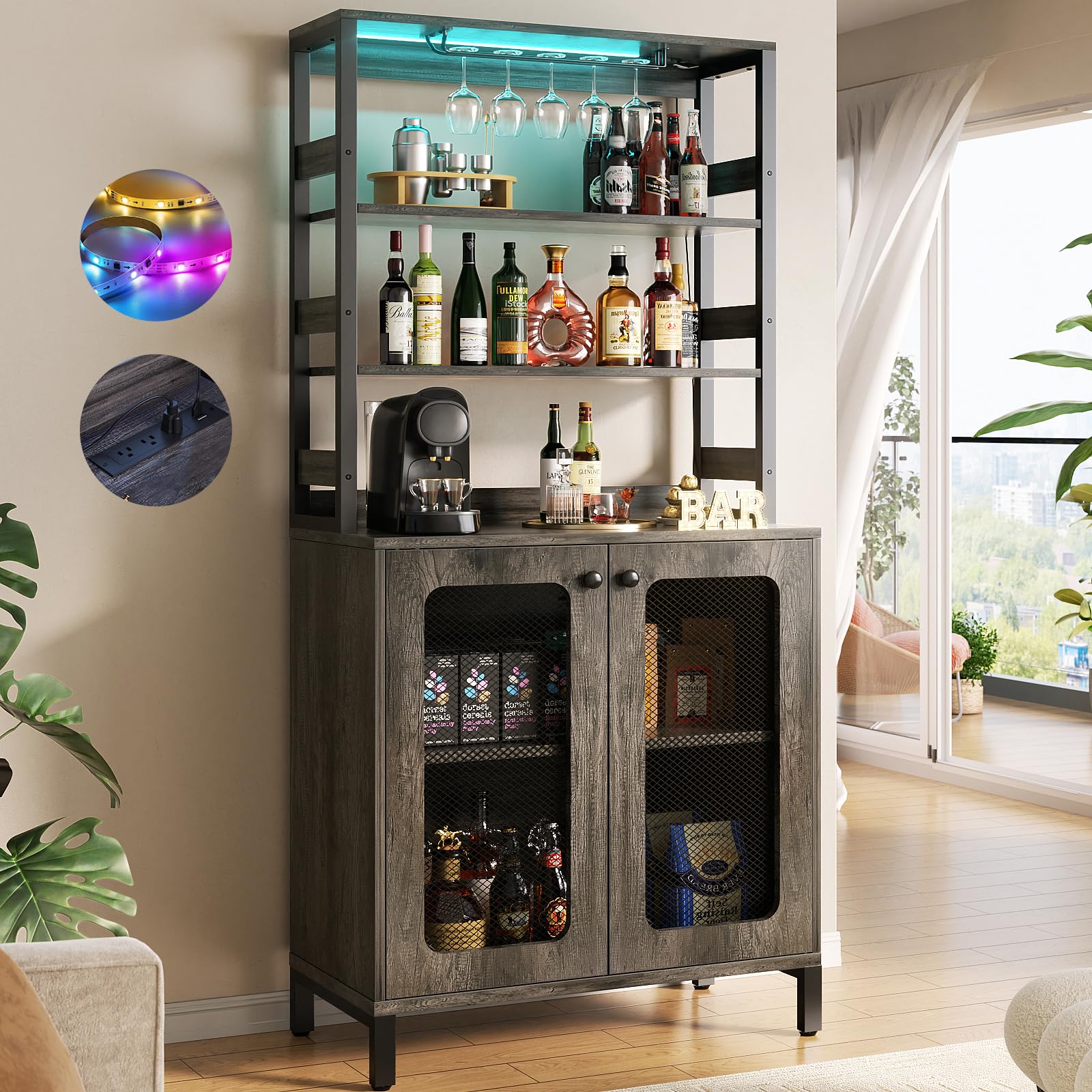
There is a particular wall in a lot of apartments: about 27 inches wide, nothing on it, too narrow for a sideboard. This cabinet is built for that strip. It measures 26.9 inches across, 15.7 deep and 66.9 tall, and it goes up rather than out, with four open shelves in the upper hutch over a two-door base.

The hutch is where the bar lives: bottles and glasses at eye level, three outlets and two USB ports for a blender or a coffee machine, and an RGB strip running along the shelves. Below, the closed base takes the ugly stuff, the spare bottles, the ice bucket, the bags of snacks.

Two things we noticed. The upper shelves are the ones that crowd: at 26.9 inches wide, a big mixing bowl or a wide appliance takes a whole level, and that is where the wish for a wider version comes from. And assembly is a long, many-parts job, labeled and doable alone, but not quick.

As a tall, narrow bar for a small footprint, it earns its place. It is the most vertical storage per inch of wall in this set, and the outlets make it a working station rather than a display. Just don't start the build at nine in the evening.

Bottom Line: For a narrow wall that needs vertical storage, this is the pick: 67 inches of shelving, power in the hutch and a closed base for the overflow.
#8

Game rooms

Tribesigns L-Shaped Bar Cabinet

Tribesigns L-Shaped Bar Cabinet

8.7/10 Excellent
  • Shelving: 4-tier L-shape
  • Dimensions: 51.2"W x 39.4"D x 44.1"H
  • Stemware Racks: 2
  • Weight Capacity: 300 lb
Check Price on Amazon

Pros

  • L-shape wraps a corner with two runs
  • Two stemware racks under the top
  • 44-inch top works as a standing bar

Cons

  • Needs a real corner: 39.4 inches of depth
  • No doors, drawers or outlets

This one asks a lot of the room: 51.2 inches along one wall, 39.4 along the other, 44.1 tall. That is a genuine corner commitment. If you have the space, whether a finished basement, a game room or the end of an open-plan living area, the L-shape does something no rectangular cabinet here can: it wraps the angle and gives you a serving surface at standing height along both runs.

Storage is open, four tiers, with two stemware racks under the top and room for dozens of bottles and mixers. It is rated to 300 pounds, second in this set only to the little X-cosrack, and because nothing is behind a door you can see what you have at a glance. This is a bar for people who like looking at their bottles.

Assembly is the weak point. It is a lot of panels and a lot of cam locks, and it is a two-person job in a way the smaller cabinets here aren't. Build it in the corner where it will stand, because moving 116.8 pounds of open shelving afterward is nobody's idea of a good evening.

We rate it the best open bar unit here for a dedicated room: the corner wrap and the 44-inch top make it feel like furniture rather than a shelf, as long as you are not expecting doors, drawers or a single outlet.

Bottom Line: If you have a real corner and a room that deserves a bar, this is the one: the L-shaped 44-inch counter turns an awkward angle into the best seat in the house.

How We Chose and Tested Home Bar Cabinets

We started with a long list of roughly 60 cabinets and cut it down by measuring footprints, checking whether standard 750-milliliter bottles could stand upright on every shelf, and noting what each frame was actually made of. Eleven made the cut, and each spent eight months in a real room — a dining room, a basement rec area, a cramped apartment corner — living through Friday-night hosting, weekly restocking, and the occasional spilled simple syrup.

Assembly came first, timed solo with only the included tools and whatever instructions shipped in the box. I noted how long each build took, how many steps the diagrams skipped, and whether the hinges had any adjustment left once the doors went on. Shelf-pin holes got checked with a straightedge before anything was loaded: a few cabinets had holes drilled slightly off, so the shelf rocked no matter which position I used. Cam-lock and dowel holes were just as telling — clean bores seated flush, ragged ones split or refused to draw tight.

Once built, each cabinet was loaded with bottles, a shaker, and glassware, then nudged and leaned on to see whether it rocked, whether the doors drifted out of alignment, and whether shelves bowed. I counted how many bottles actually fit per shelf, whether the stemware rack cleared my tallest glasses, and whether a bottle could be pulled out without knocking the shelf above it. Finishes were judged in daylight and in the warm light of a dinner party, held next to a wood sample — more than one walnut leaned orange. Value came down to price per usable bottle slot, plus what still felt solid after eight months.

How to Choose Home Bar Cabinets

Measure the wall, the depth and the door swing

The cabinets here run from 23.6 inches wide to 60.2, and depth varies from 13.4 to 39.4, which is enough range that guessing gets expensive. Tape the footprint on the floor and stand inside it before you order.

Corner units are roughly square at the base, like the 17.5-by-17.5 Aheaplus, so they need a genuine 90-degree corner rather than a flat wall with a chair pushed in front of it. Flat-wall consoles want 48 to 60 inches of run plus clearance for doors, drawers and, on the GDLF, a fridge that opens.

Open display or closed storage

An open rack costs less, shows the collection and collects dust. A closed cabinet hides the mess and charges for the privilege. Between the two sit the mesh door on the X-cosrack and the sliding doors on the ONBRILL, which keep bottles visible without putting the clutter on display.

Sliding doors earn their place in a tight room because they need no swing space in front. Decide by how the room gets used: a bar in a living room should hide its clutter, while a bar in a basement can show everything it has.

Count the bottles that actually live there

Wine cradles hold bottles on their sides, and the counts here run from five in the X-cosrack to twelve in the Bosimeca and ONBRILL. That number tells you less than it seems, because upright liquor, mixers and glasses eat shelf height rather than cradle space.

Count what you actually keep, then check the shelf gaps against your tallest bottle. A cabinet with ten cradles and shallow shelves is less useful than one with five and headroom for a half-gallon of bourbon.

Power and lighting: what earns its place

Outlets turn a bar cabinet into a station. Three AC sockets and two USB ports is the common arrangement here, and that is enough for a blender, a speaker and a phone. Look at where they sit, since a back rail is easier to reach than the inside of a cabinet.

LED strips are atmosphere rather than task lighting. They tint the bottles and make a dark corner look expensive, and they are also the part most likely to be dead in the box. Switch the strip on the day it arrives, before the packaging goes out.

Materials, finishes and the flat-pack reality

Everything here is engineered wood on a metal frame, with load ratings from 150 to 330 pounds where they are stated, so judge the finish and the build rather than the material label. Walnut and wood-grain veneers read darker in a room than on a screen, and fluted or mesh fronts gather dust in their grooves.

Assembly is the real cost. Parts counts are high, labeling is usually decent, and the tall units want two people for door alignment. Build it where it will stand, because a finished 60-inch cabinet is not something you slide across a room.

Frequently Asked Questions

Final Verdict

The Unikito is the cabinet we send most people to: a 47.5-inch counter, ten bottle cradles, hanging stemware and three outlets, in a footprint that fits an ordinary wall. It is the best balance of working space and price here, and it doesn't demand that you build a room around it.

Two alternatives change the answer. If a cold drink is part of the ritual, the GDLF's fridge bay, 60-inch top and rotating storage justify the step up. If floor space is the constraint rather than wall space, the Aheaplus corner turns 17.5 inches of dead angle into a five-tier bar.