Game Room

Best Home Bar Furniture of 2026

A home bar looks effortless in photos and turns into a pile of bottles on the kitchen counter in real life. What a good one actually fixes is simple: the glasses, the ice bucket, and the half-empty bottle of rye get a permanent home, so pouring a drink stops being a scavenger hunt. The category splits fast, though — rolling carts, fold-out cabinets, full back-bar units — and the wrong pick either wobbles when you lean on it or doesn't fit the wall you bought it for.

I've set up drinks in a cramped apartment and in a house with a dedicated corner, and the pieces that worked in both had less to do with style than with sturdiness and a top at the right height. Over eight months, my team and I assembled, loaded, and leaned on 11 bar pieces to see which ones held up. Nobody tells you first that bar height runs about 42 inches and counter height about 36, and mixing the two in one room reads as an accident. The picks below are sorted by how much wall and storage you're actually working with.

#1

Best Overall

Auromie LED Bar Cabinet

Auromie LED Bar Cabinet

9.0/10 Outstanding
  • Weight: 101.4 lb
  • Storage: Wine rack, glass holders, 2 drawers
  • Lighting: LED light strip
  • Dimensions: 15.75"D x 47.24"W x 45.28"H
Check Price on Amazon

Pros

  • Glass doors keep bottles on display
  • Two drawers plus a wine rack
  • Shallow 15.75-inch depth fits tight walls
  • LED strip lights the display

Cons

  • 47-inch width rules out corners

A home bar has two jobs that pull against each other: showing off the bottles, and keeping everything else out of sight. The Auromie does both in one 47-inch run — tempered glass doors over the wine rack and glass holders, solid drawers below for openers, napkins, and the tangle of things that never looks good on a shelf. Against a dining-room wall, that combination is what we keep coming back to.

At 15.75 inches deep it hugs the wall, which matters in a room where the bar shares floor space with a table and chairs. The top is sized to take a microwave or a coffee maker, and there is room left for a tray of glasses and a shaker at the same time. The LED strip runs behind the glass, so after dark the cabinet reads as a lit display instead of a dark box in the corner.

Of the cabinets here, this is the one we point most people to first. The storage is genuinely mixed — a rack, glass holders, drawers, doors — rather than the same shelf repeated, and the glass makes it read as furniture instead of utility. Our reservation is the build. Two doors and two drawers is a lot of hardware to line up, and a 101-pound flat-pack this size is not a one-person afternoon. Recruit a second pair of hands for the carcass and use a drill on the cam locks.

At 45.28 inches tall it lands between a sideboard and a hutch, which is why it works in a dining room without looming — and why you should not plan on perching stools at it. The top is a serving height, not a sitting height. If you want a bar you sit at rather than open, that is a different piece of furniture.
Bottom Line: We recommend the Auromie as the default: glass doors for the bottles you want seen, drawers for everything you do not, in one wall-width cabinet that suits a dining room.
#2

Best for Narrow Spaces

Aheaplus 67-Inch Bar Cabinet

Aheaplus 67-Inch Bar Cabinet

8.8/10 Excellent
  • Outlets: 3 AC outlets, 2 USB ports
  • Shelves: 4 open upper shelves
  • Lighting: RGB LED with flashing modes
  • Dimensions: 15.7"D x 26.9"W x 66.9"H
Check Price on Amazon

Pros

  • Outlets and USB on the cabinet
  • Tall storage on a narrow footprint
  • RGB lighting for the shelves

Cons

  • Narrow shelves crowd wide appliances

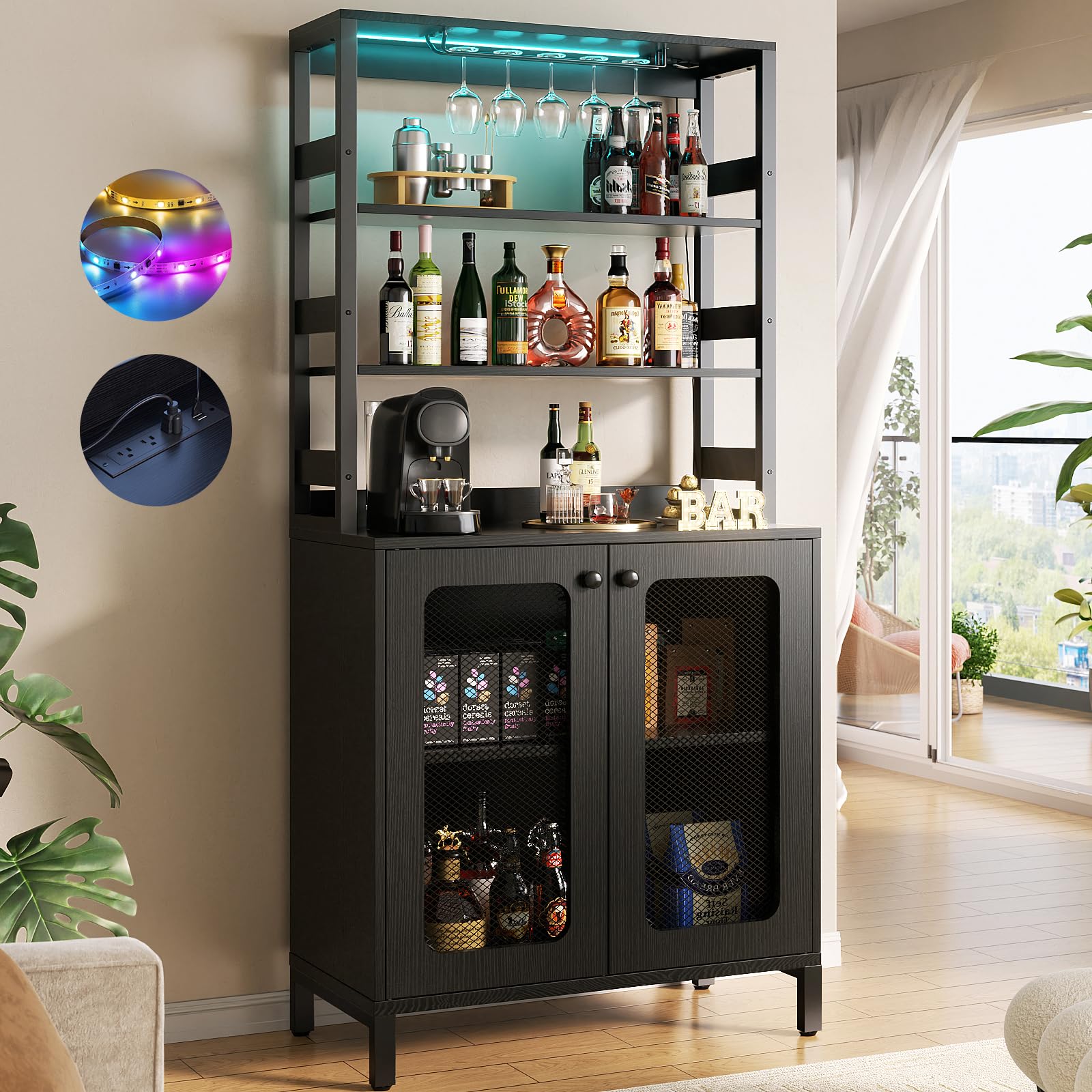
Two feet of wall is all the Aheaplus asks for, and it spends the space upward: 66.9 inches tall on a 26.9-inch width, with four open shelves in the upper hutch over a closed cabinet below. In an apartment where the bar has to live beside the sofa, that vertical build is exactly why we recommend it — a sliver of floor becomes bottle storage without blocking the walkway.

The outlets are the detail that sells it. Three AC sockets and two USB ports sit on the cabinet, so a blender, a coffee maker, or a phone charger plugs in where the drinks are rather than across the room. The RGB strip does the same job for atmosphere, running behind the shelves in whatever color you set; it sounds gimmicky and turns out to be useful in a dark corner at nine in the evening.

Assembly is the part to plan for. This is a tall flat-pack with a metal frame and a lot of hardware, and it goes together far more comfortably with a power driver and a second person holding the other end. Everything above the cabinet is open display rather than workspace, so treat the shelves as storage and keep the mixing somewhere else.

Bottom Line: Two feet of wall and a lot of height — this is the bar cabinet for a narrow room that still needs outlets, light, and room for a full bottle collection.
#3

Best Corner Cabinet

JKsmart Corner Bar Cabinet

JKsmart Corner Bar Cabinet

9.2/10 Outstanding
  • Frame: Metal X-frame with engineered wood
  • Storage: 4 tiers with glass holder
  • Lighting: LED, 16 colors and 4 modes
  • Dimensions: 18.7"D x 18.7"W x 50.8"H
Check Price on Amazon

Pros

  • Fits an 18.7-inch corner
  • Open and closed storage in one tower
  • Guardrails keep bottles in place

Cons

  • No work surface for mixing

Corners are where floor space goes to die — too narrow for a chair, too awkward for a bookcase. The JKsmart is built for exactly that dead zone: an 18.7-inch square with a 90-degree back, four tiers of storage, and a footprint small enough to tuck between a door and the wall.

It is the cabinet we suggest when someone sends a photo of an empty corner, and what earns the recommendation is not the size but how the storage is split: open levels with guardrails for bottles and glasses, a closed cabinet below for everything else, and a glass holder on the frame. At 50.8 inches tall the top shelf sits at chest height — reachable without a step, which is not true of the 67-inch towers.

Bottle fit is where corner units usually come up short, and the open levels here take tall liquor bottles rather than forcing them under a low shelf. What you give up is a work surface: there is no counter to mix on, so this is storage that happens to look good rather than a station for making drinks.

Bottom Line: A corner is the cheapest floor space you own, and this 18.7-inch tower turns it into bottle storage with light and a surprising amount of capacity.
#4

Best Compact Design

ARTPOWER Green Bar Cabinet

ARTPOWER Green Bar Cabinet

8.9/10 Excellent
  • Doors: Tempered glass
  • Finish: Green with gold hardware
  • Storage: Pull-out wine storage, 3 stemware racks, 1 drawer
  • Dimensions: 14.96"D x 31.49"W x 37"H
Check Price on Amazon

Pros

  • Green finish with gold accents
  • Pull-out wine drawer loads easily
  • Tempered glass doors and three stemware racks

Cons

  • Holds a small collection only

Most bar cabinets are black boxes. The ARTPOWER comes in a deep green with gold legs, gold hardware, and fluted glass in the doors, and that one decision changes where the piece can go: it reads as a small sideboard or a living-room accent rather than a wet-bar fixture. If the bar has to live in a room you actually decorate, this is the one we point to.

At 37 inches wide and 31.5 tall it is closer to a console than a hutch, and the pull-out wine storage is the smartest thing in it — the bottle tray slides toward you instead of making you reach into a dark shelf. Three stemware racks hang above, tempered glass doors keep the glassware visible without leaving it open to the room, and a single drawer handles openers and coasters.

Capacity is the trade-off. At 31.5 inches tall there is less height for shelves, so this is a cabinet for a considered collection — a dozen bottles, the glasses you actually use, a decanter — rather than the place everything gets parked. It is also a compact piece on four legs, so it wants a wall behind it rather than the middle of a room where it gets knocked.

Bottom Line: The green finish is the reason to choose it, but the pull-out wine drawer and glass doors are why it works — a compact cabinet for a room you actually decorate.
#5

Best for a Mini Fridge

Leteuke Fridge-Space Bar Cabinet

Leteuke Fridge-Space Bar Cabinet

9.2/10 Outstanding
  • Storage: 6-bottle rack, 3 rows of glass holders, 2 drawers
  • Charging: Built-in power station
  • Countertop: 53.1 x 20.1 in
  • Fridge Bay: 20"W x 19.8"D x 34.8"H
Check Price on Amazon

Pros

  • Fridge bay fits most mini fridges
  • Wine rack, glass holders, and drawers
  • Built-in power station

Cons

  • Needs a long wall at 53 inches

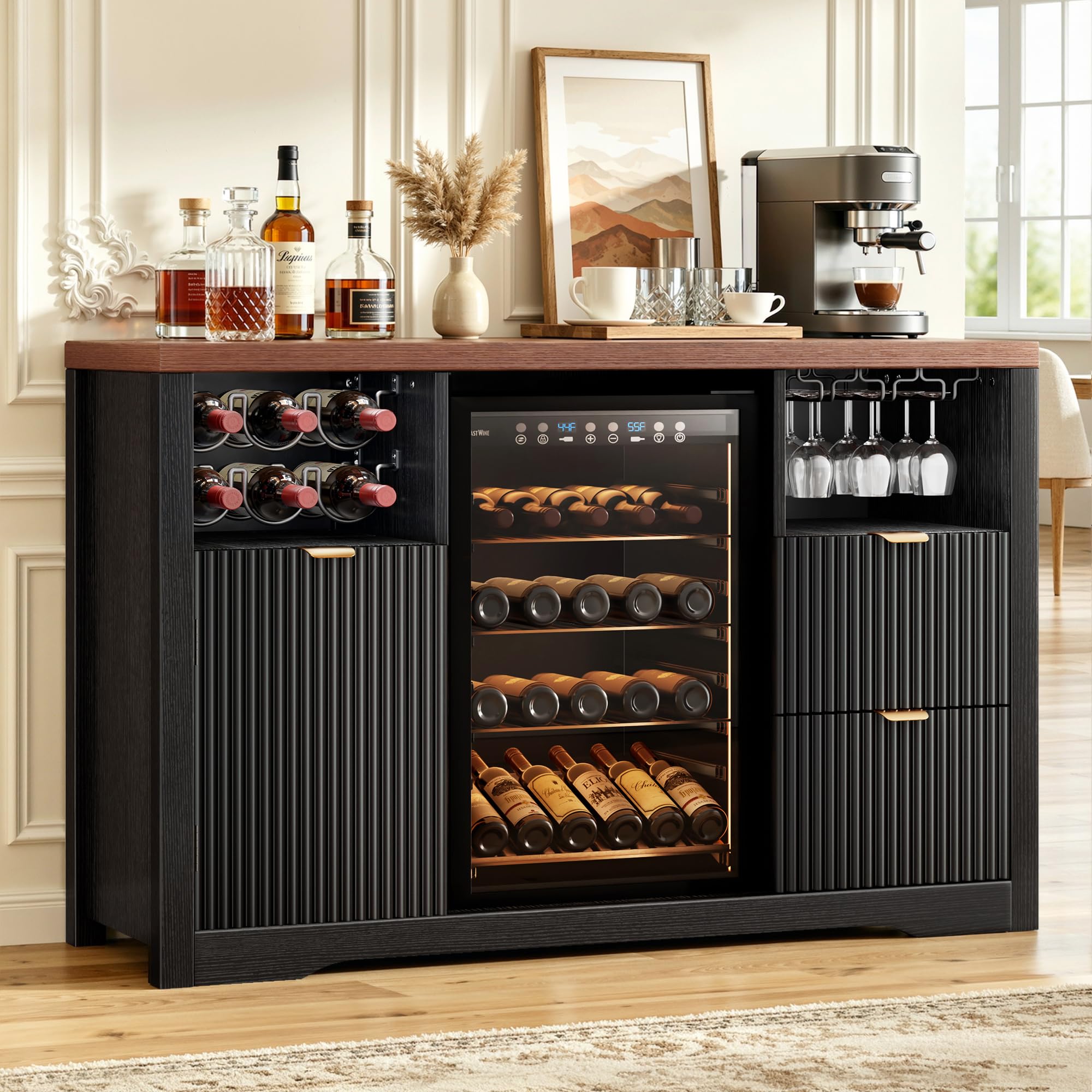
A fridge bay is only useful if your fridge fits, so start with the number: 20 inches wide, 19.8 deep, 34.8 tall. That opening swallows most standard mini fridges, including the one already in your basement. Everything else in the Leteuke is arranged around that hole, which is why it is our pick for a bar that doubles as a coffee station.

The countertop above it is 53.1 by 20.1 inches of wood — deep enough for a coffee maker, a grinder, and a tray of cups at once. Around the bay there is a six-bottle wine rack, three rows of glass holders, two drawers, and a built-in power station, so the appliances plug in where they sit. The fluted doors and dark wood top do the rest; this is the most built-in-looking cabinet here.

What we appreciate is that the storage is planned rather than stacked. Bottles have slots, glasses have racks, and the drawers take the small stuff that otherwise colonizes a countertop, so a 53-inch run stays usable instead of turning into a pile. The trade-off is scale: this needs a long wall, and it is happiest standing alone rather than wedged between two other pieces.

Bottom Line: If a mini fridge belongs in your bar, this is the cabinet shaped around one, with a 53-inch counter and a wine rack on top of that.
#6

Best for Hosting

GDLF U-Shape Bar Cabinet

GDLF U-Shape Bar Cabinet

8.7/10 Excellent
  • Height: 49.7 in
  • Footprint: 63.1 x 24.3 in
  • Fridge Bay: 19.8" W x 19.9" D x 34.7" H
  • Work Surface: 52 x 20 in
Check Price on Amazon

Pros

  • 52 x 20-inch mixing surface
  • Fridge bay under the counter
  • Metal bracing keeps the frame rigid

Cons

  • Top sits at 49.7 inches, so plan on tall stools

If the point of your bar is making drinks for other people, the surface matters more than the shelf count. The GDLF gives you 52 by 20 inches of it — deep enough for a shaker, a board of garnishes, and four glasses without shuffling — set into a 63-inch U-shaped frame with open shelving on both sides.

Under the counter there is a fridge compartment at 19.8 by 19.9 by 34.7 inches, plus wine slots and a hanging glass rack on the frame. The top is thickened and edged, the side panels are reinforced, and the cabinet is braced with metal bars inside, which is the detail that keeps a U this wide rigid.

The build is the price of the footprint. This is a 126-pound flat-pack with a lot of separate panels, and the internal bracing has to go in at the right step or you will be taking it apart again. Two people, an afternoon, and a power driver turn it from a project into a bar.

We like it for the job nothing else here does: it is a bar you stand behind, not a cabinet you open. In a basement or a den that changes the room — the piece becomes the destination instead of something parked against a wall — and it is why it tops our list for anyone finishing a space with hosting in mind.

Bottom Line: For a den or basement where you stand behind the bar and make drinks, this is the only piece here with a work surface that keeps up.
#7

Best Bar-Height Table

Tribesigns 70.9-Inch Bar Table

Tribesigns 70.9-Inch Bar Table

8.2/10 Very Good
  • Weight: 30.9 lb
  • Seating: 2
  • Dimensions: 23.62"D x 70.87"W x 43.31"H
  • Weight Capacity: 200 lb
Check Price on Amazon

Pros

  • Seats two at bar height
  • Four tiers of storage underneath
  • Full-length footrest

Cons

  • 30.9 lb, so it shifts unless anchored

Every other pick here is a cabinet. The Tribesigns is the one piece that gives you somewhere to sit: a 70.9-inch oak-finish top at 43.31 inches — bar height rather than counter height — with a black footrest running the length and four tiers of open shelving underneath.

We like it for a basement or a bonus room where the bar is also the table. Two people can sit with a drink, the shelves below keep the bottles within reach instead of across the room, and it carries far less visual weight than a hutch: an oak top and a black frame rather than a wall of panels. For a room that has to work as a game room on Saturday and a bar on Saturday night, that matters.

Assembly is friendlier than most here — the tiers go on in sequence and the instructions are step-by-step, so one person can work through it in an afternoon. Where it belongs is a basement, a converted garage, or a dorm-style bonus room; it is a bar table, not a dining table, and it looks best with the shelves stocked and the top mostly clear.

Bottom Line: The one pick that gives you somewhere to sit, with storage underneath and a footrest that makes it a real bar rather than a shelf.
#8

Bottle collections

Tribesigns L-Shaped Bar Cabinet

Tribesigns L-Shaped Bar Cabinet

8.7/10 Excellent
  • Weight: 116.8 lb
  • Shelving: 4 tiers, 2 stemware racks
  • Dimensions: 39.4"D x 51.2"W x 44.1"H
  • Weight Capacity: 300 lb
Check Price on Amazon

Pros

  • Four open tiers for bottle display
  • Two built-in stemware racks
  • 300-pound weight capacity

Cons

  • No closed storage or drawers

This is the opposite of the Auromie's hide-everything approach: four open tiers in an L, two stemware racks, and not a single door. If the bottles are the decor — a bourbon collection, a row of gins, the good tequila — open shelving is the honest way to show them, and this is the largest open display in the group.

Thirty-nine inches of depth is the number that decides whether it works in your room. This is a true corner unit that wraps a right angle and puts shelves on both legs, so it needs a real corner with clearance on both sides, not a nook beside a door. In exchange you get four tiers that will hold dozens of bottles, two stemware racks, and 300 pounds of capacity — enough that the limit is your collection, not the shelf.

It is also the fussiest build here. An L has more panels than a straight cabinet and more places for the frame to twist, so build it where it will stand, check both legs for level before you load it, and give the job two people and a couple of hours.

We rate it as a display piece rather than a working bar. There is no door to close on clutter, no drawer for openers, and no work surface beyond the top shelf. For someone whose hobby is the collection, that is the whole point; for anyone who wants the bar to also catch the mail and the keys, closed storage will serve you better.

Bottom Line: Open shelving, two stemware racks, and 300 pounds of capacity for a bottle collection that deserves to be seen.

How We Chose and Tested the Best Home Bar Furniture

We started with about 40 pieces — rolling carts, fold-out cabinets, freestanding back bars — and narrowed them using what actually decides whether one fits your room: listed dimensions against real wall space, material (solid wood and metal versus engineered wood with veneer), height, and usable storage. That left 11 pieces to test over eight months.

Assembly came first, because it's where cheap bar furniture gives itself away. I built each one alone with the tools in the box and timed it, noting whether the hardware matched the diagram, whether the cam locks seated flush, and whether I needed a second person to get a cabinet square. Each piece then took the same load — a dozen bottles, a glass rack, and the clutter that accumulates on a bar top — and sat a week before I judged sturdiness.

The rest of the eight months looked like actual hosting. Guests leaned elbows on the tops, doors and drawers were opened and shut dozens of times a night, and I moved every piece to a second wall to see whether the footprint worked under a window and whether a door swing cleared a stool. Each top got measured against both counter height and bar height, with real stools pulled up to it.

Finish took the spill test — a glass of red left overnight, a wet bottle set down without a coaster — and I wiped each surface to see whether rings lifted or the veneer dulled. Value came last: what the piece was made of, how it looked after eight months, and whether the price bought material or just a name.

How to Choose the Right Home Bar Furniture

Measure the Footprint Before the Finish

Bar cabinets here run from an 18.7-inch corner tower to a 70.9-inch table, and depth is the number people forget. Most cabinets are 15 to 16 inches deep and hug a wall; the L-shaped Tribesigns needs 39.4 inches to wrap a corner, and the GDLF U-shape needs 24.3. Tape the outline on the floor — width and depth — before you order, then check that doors and drawers open without hitting a chair. A cabinet that fits the wall but blocks the walkway is the classic error.

Open Shelves or Closed Doors

Open tiers turn a bottle collection into the decoration. Doors hide the mismatched labels, the half-empty bottles, and the tin of cocktail picks. Glass splits the difference: visible, dust-free, and it makes a cabinet read as furniture rather than utility shelving. Be honest about dusting, because every open shelf in a home bar is a weekly job.

We lean toward glass or a mix of open and closed for a bar in a main room, and pure open shelving for a basement or den where the collection is the point.

Check the Fridge Bay Before You Fall for the Cabinet

The bays in this group run about 20 inches wide, 20 deep, and 35 tall, which fits most standard mini fridges and not much else. Measure your fridge across the body and the door, then add an inch of slack for the plug and airflow. If you are not putting a fridge in, remember that the bay is 35 inches of shelf you are giving up — a cabinet without one stores far more per inch of wall.

Budget a Day for Assembly

Flat-pack is the norm at every price here: panels, cam locks, and a bag of hardware. The biggest cabinets in this group weigh over 100 pounds finished, which makes the box a two-person lift and the carcass easier to square with someone holding the far end. Build it in the room where it will live, because an assembled 47-inch cabinet does not fit around a stair turn the way a box does. A power driver saves an hour; a level saves a return.

Decide Whether You Are Sitting or Standing

Counter height is around 36 inches and bar height 40 to 43, which is why the Tribesigns table at 43.31 suits stools with a seat 28 to 30 inches off the floor. The GDLF U-shape tops out at 49.7 — nearer a standing counter than a place to perch, and standard stools will leave you looking at the shelf edge. Settle whether your bar is for sitting at or standing behind, then choose a table or a cabinet. Tall narrow units belong against a wall and, with kids or a dog in the house, strapped to it.

Frequently Asked Questions

Final Verdict

The Auromie is the cabinet we point most people to, and the reason is simple: it does both halves of the job — glass-door display up top, drawers and closed storage below — in a piece that fits a dining-room wall without dominating it.

If your only free floor is a corner, the JKsmart turns 18 inches of dead space into bottle storage. If a mini fridge is part of the plan, the Leteuke is shaped around one. Buy the Auromie unless your room has a more specific shape than a wall.