Home Office

Best Adjustable Drafting Tables of 2026

A drafting table is supposed to meet your hand where it works, tilting up so you're not hunched over a flat desk or dragging your forearm through wet ink. But the joint that makes that possible is also the part that wobbles, slips mid-stroke, and drops half an inch the moment you lean on it. An hour on a bad one buys you an hour of rubbing out the line it ruined.

I've drawn and cut on a drafting table in a spare-room studio for years, and my team and I have now assembled, tilted, shaken, and rolled 11 of them over eight months. The lesson that surprised me: the locking mechanism matters more than the printed degree markings, since a tilt that creeps is worse than one that's two degrees off. Price was a weak predictor of sturdiness, and looks mattered more than I expected once a table sat in a room we actually use. Below are the ones that earned their footprint.

#1

Best Overall

MEEDEN Beechwood Drafting Table

MEEDEN Beechwood Drafting Table

9.0/10 Outstanding
  • Frame: Solid beech wood
  • Tabletop: 35.5 x 23.5 in
  • Tilt Range: 0 to 45°
  • Height Range: 29.7 to 38.4 in
Check Price on Amazon

Pros

  • Steady solid beech frame
  • Height range suits seated to standing work
  • Built-in pencil ledge and included T-square
  • Compact top for small studios

Cons

  • No built-in storage
  • Tilt stops at 45 degrees

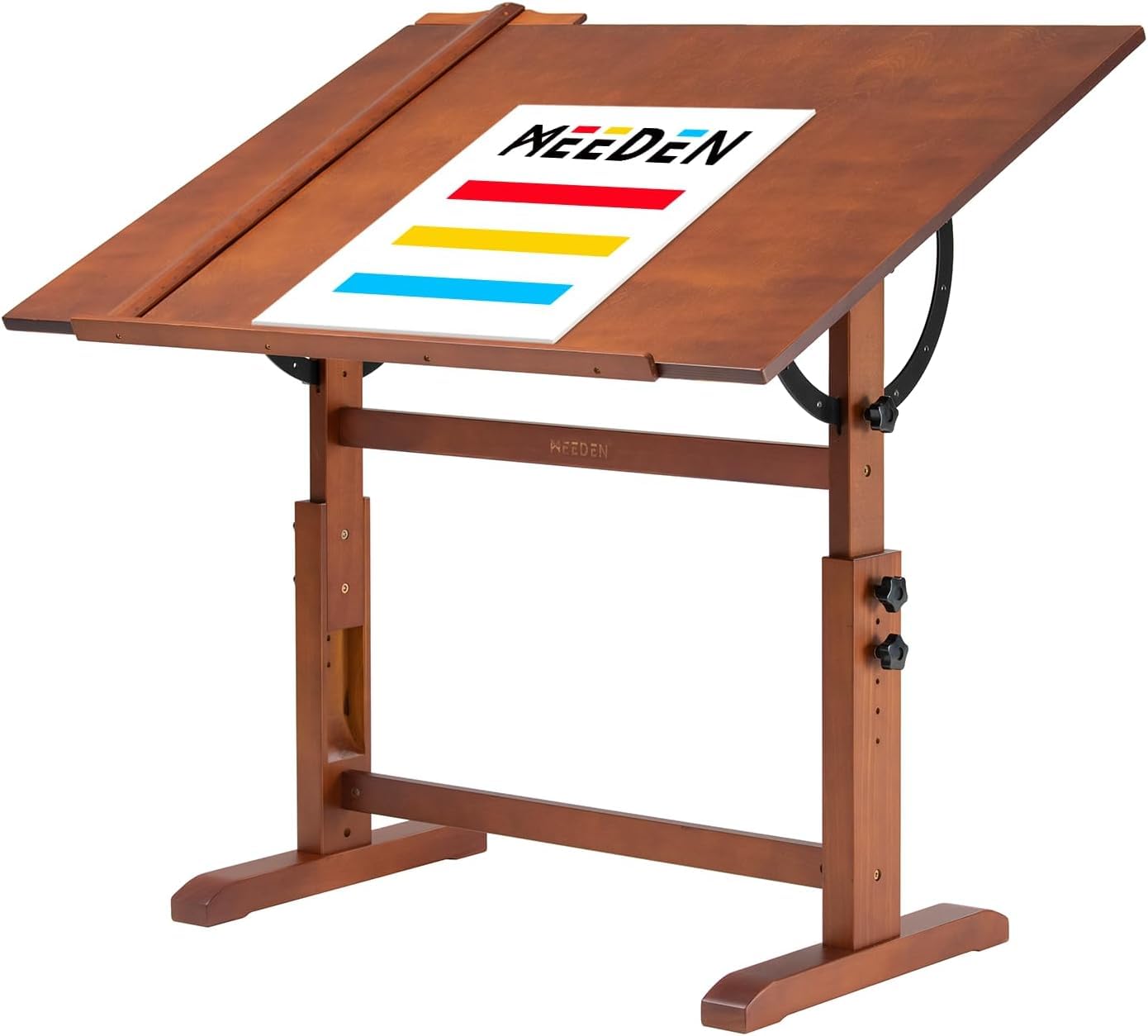
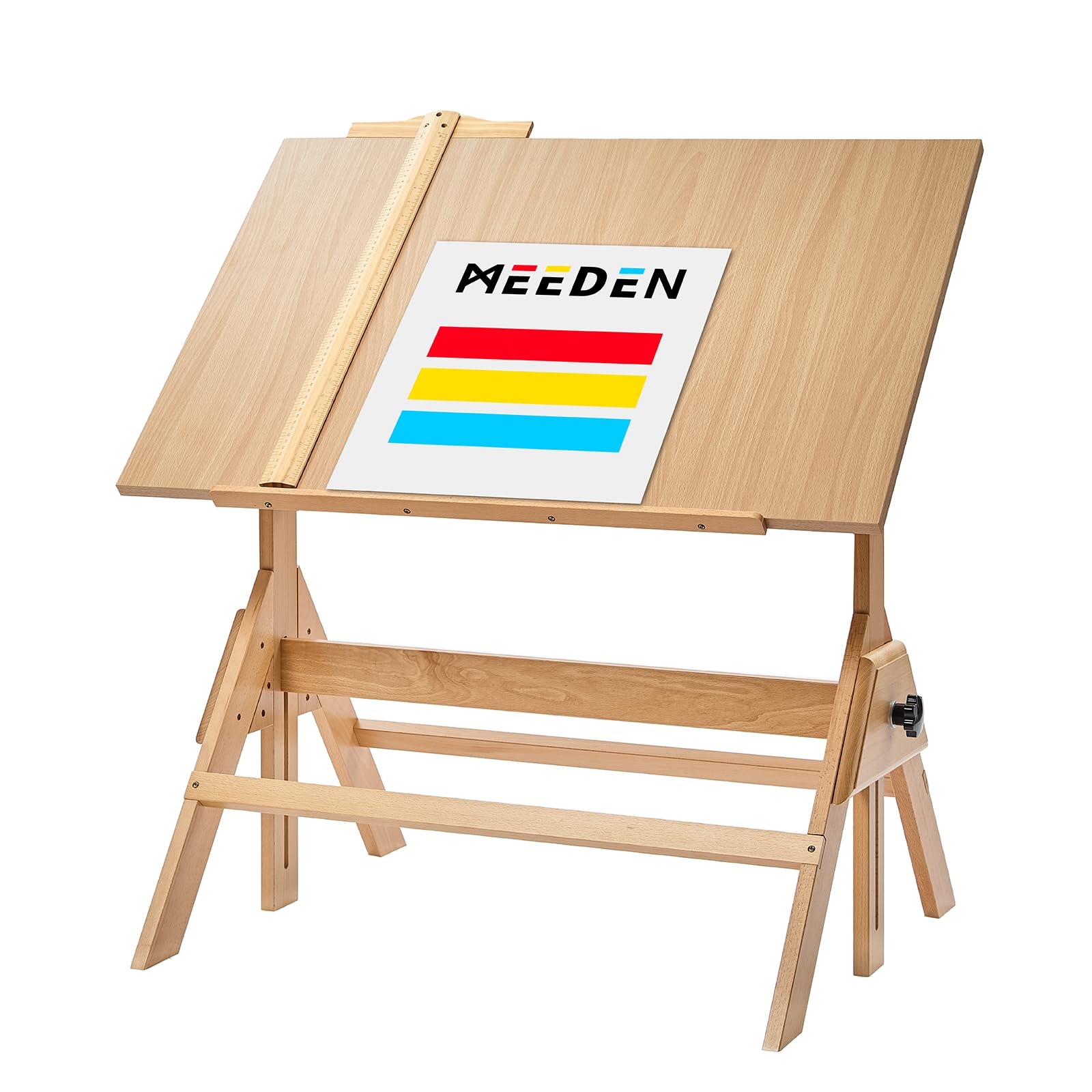
We chose the MEEDEN Beechwood as our default because it solves the two problems that make drafting tables frustrating: a top that shifts under your hand and a height range that belongs in a different room. The 35.5-by-23.5-inch surface is big enough for a full sheet without taking over a small studio. The solid beech frame feels like furniture, and the 29.7-to-38.4-inch height range moves from a normal chair to a comfortable standing lean. The full-width pencil ledge and the included T-square, with both inch and metric markings, make it feel ready to work.

The 45-degree tilt is the one place this table asks you to compromise. It is plenty for sketching, lettering, and most drafting, but it will not give you the near-vertical board that some illustrators like. We found the adjustment controls need two hands: one to lift the top, one to tighten. That is normal for this class, but it means the MEEDEN is happiest when you set the angle once and leave it.

What it does not have is built-in storage. For a pure drawing table, we do not mind; a nearby cart or drawer unit is easier to organize anyway. The lack of drawers keeps the frame open and the footprint tidy. If you want a place to park markers and paper, the VECELO is the closer fit. Otherwise, this is the table we clear space for first.

Bottom Line: We recommend the MEEDEN Beechwood for artists who want a steady, furniture-grade table with a broad seated-to-standing height range and no fuss.
#2

Best Budget

Yaheetech White Drafting Table

Yaheetech White Drafting Table

8.9/10 Excellent
  • Frame: Powder-coated steel
  • Tabletop: 41.7 x 23.6 in
  • Tilt Range: 0 to 30°
  • Height Range: 30 to 41 in
Check Price on Amazon

Pros

  • Wide 41.7 x 23.6 work surface
  • 30 to 41 inch height range
  • Steel frame with crossbar
  • Casters included

Cons

  • 30-degree tilt limits steep drafting

The Yaheetech White is the large-surface budget pick, and the 41.7-by-23.6-inch top is the reason to start here. It gives you room for a big sketchbook, a laptop, and a row of pencils without crowding, yet the 23.6-inch depth keeps it against a wall. The powder-coated steel frame has an X-shaped accent and a crossbar underneath, which is the right structure for a table at this level. The height range runs from 30 to 41 inches, so it works with a standard chair and can rise for standing sessions.

The 30-degree tilt is the catch. That is a gentle slope, good for writing, light sketching, and reading, but not the steep board angle that serious drafters often want. We think of this as a flat-or-slightly-tilted workhorse rather than a full drafting board. If your work lives at 45 degrees or higher, the MEEDEN or JupiterForce is the better match. The height adjustment is the more useful part of the package for daily changes.

At about 33 pounds, it is light enough to slide to a different wall, and the included casters make that easier. The open base leaves room for a rolling cart; plan on one if you need storage. We noted that assembly is straightforward with two people. For a first drafting table or a budget studio setup, that trade-off makes sense.

Bottom Line: We point budget-minded artists to this Yaheetech when a wide, stable surface matters more than a steep tilt or built-in storage.
#3

Best Glass-Top

Yaheetech Glass Drafting Table

Yaheetech Glass Drafting Table

9.0/10 Outstanding
  • Storage: Two mesh drawers and shelf
  • Tabletop: 35.4 x 23.6 in
  • Tilt Range: 0 to 40°
  • Height Settings: 5 positions
Check Price on Amazon

Pros

  • Wipe-clean tempered glass top
  • Matching stool included
  • Side counter and two mesh drawers
  • Five height positions

Cons

  • Tilt stops at 40 degrees
  • Glass shows fingerprints and smudges

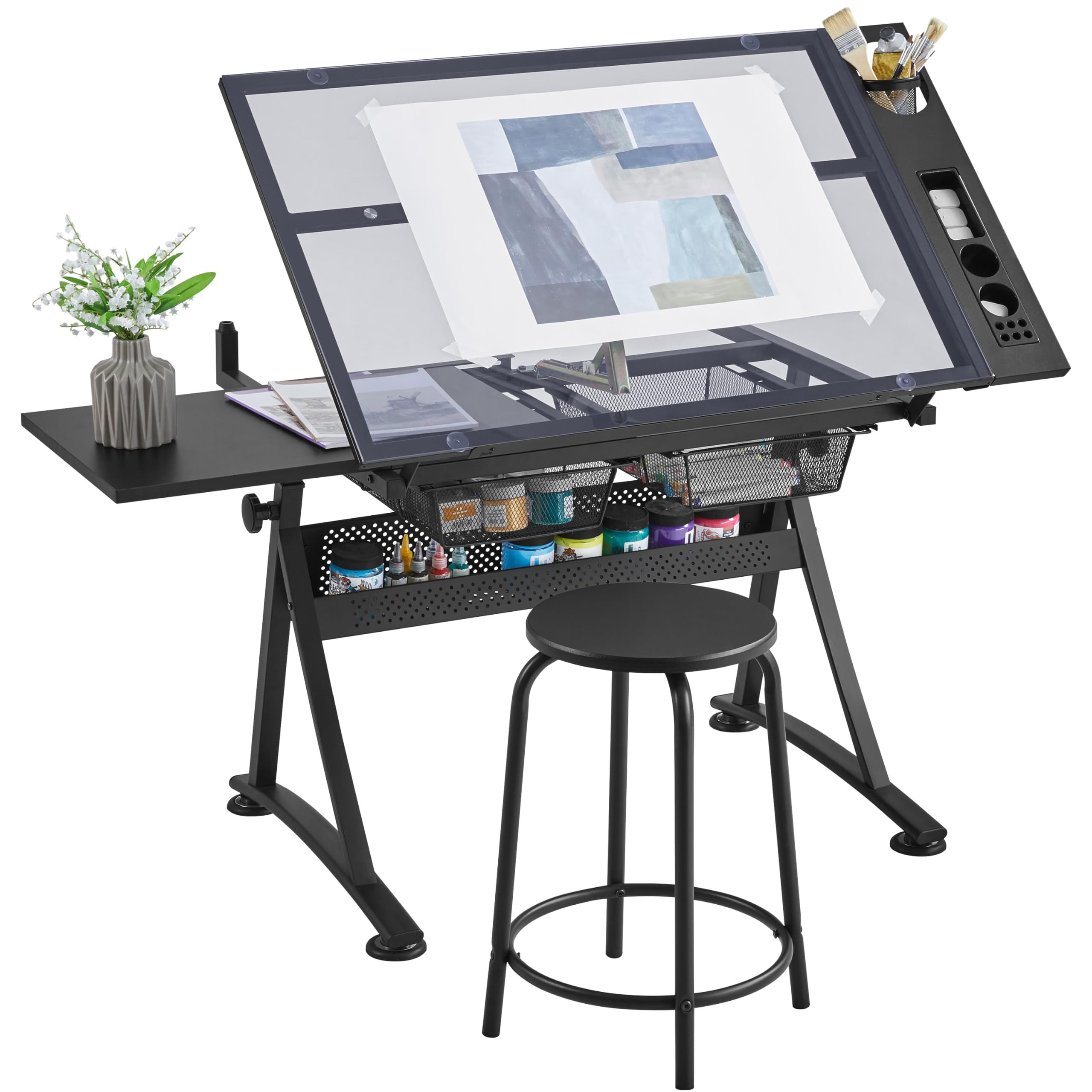
The glass top is the reason to choose this Yaheetech. It wipes clean after paint or coffee, and the clear surface lets you trace with a light pad without moving to a window. The 35.4-by-23.6-inch top tilts to 40 degrees, enough for most sketch and drafting work. The black frame and glass look tidy in a room, and the MDF side counter gives you a place for a laptop or a cup of pencils.

What we like most is that it arrives as a complete station: a matching stool, two mesh drawers, and a lower shelf. The stool is a convenience, not a luxury office chair, so plan on a cushion for long sessions. The mesh drawers are better for paper and lightweight tools than for a heavy stack of books. The side counter is MDF rather than glass, so it does not get the same wipe-clean treatment as the top.

The 40-degree tilt is a real ceiling. If you like to work on a steep board, this is not the one. The glass also shows fingerprints and needs a damp cloth rather than a quick sleeve wipe. Assembly is a two-person job because the top is heavy and awkward. For a studio where cleanup and a built-in side surface matter, those are fair trades.

Bottom Line: We choose the Yaheetech glass table for artists who want wipe-clean glass, a side counter, and a stool without buying pieces separately.
#4

Best Mobile

JupiterForce Glass Drafting Table

JupiterForce Glass Drafting Table

9.0/10 Outstanding
  • Storage: 2 drawers, 4 trays
  • Tabletop: 41.25 x 24 in
  • Tilt Range: 0 to 60°
  • Height Range: 31.5 to 49.5 in
Check Price on Amazon

Pros

  • Tall 31.5 to 49.5 inch range
  • 60-degree tilt for steep drawing
  • Lockable casters and four removable trays
  • Broad 41.25 x 24 glass top

Cons

  • Angle mechanism can be finicky
  • Heavy to lift or set up alone

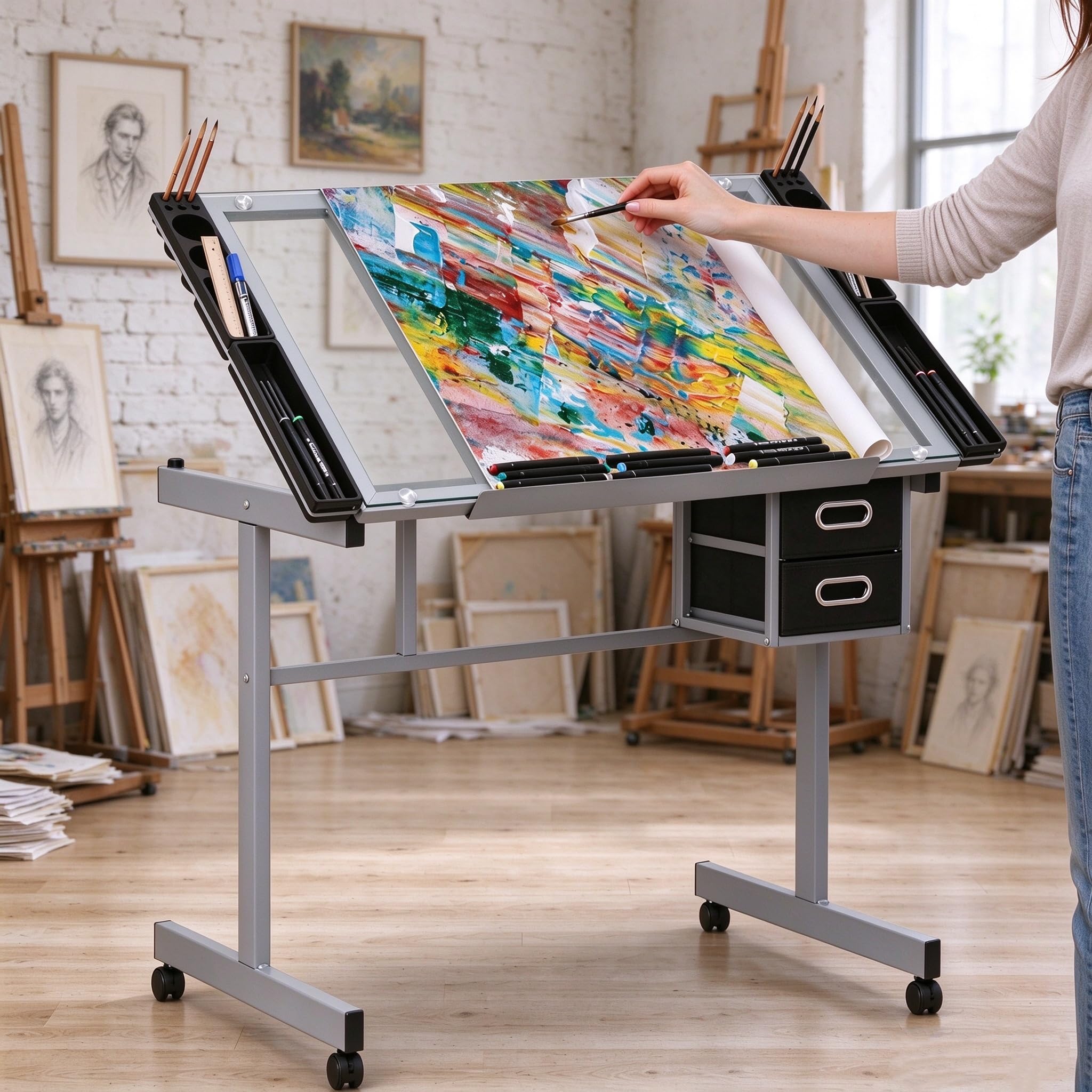
The JupiterForce goes higher than any other table here, all the way to 49.5 inches, and that changes how you can use a drafting desk. At its lowest, it is a normal seated table; at the top, it is a standing workstation for sketching or a laptop. The 41.25-by-24-inch glass top is broad enough for large paper, and the 60-degree tilt covers the steep drawing angles the budget Yaheetech cannot. Four casters, two of them lockable, make the whole thing easy to move.

The storage layout is another good idea: two sliding drawers and four removable single-slot trays that lift out and come with you. That is more useful for markers, brushes, and small tools than a single deep drawer. The glass surface is easy to wipe down, though it is heavy and needs care when you attach the top. Check the glass mounts and fasteners before you tilt it; a loose mount is the one thing that should stop you.

The angle mechanism is the fussy part. It can be finicky to release and reset, especially when you are lowering the top from a steep angle. We also found the table heavy enough that moving it is a two-person job unless you roll it. For a studio that needs one table to switch between sitting, standing, and drawing, the range is worth the extra setup attention.

Bottom Line: We recommend the JupiterForce for artists who move between rooms or like to work tall, thanks to its casters and unusually high top.
#5

Best for Large-Format Work

MEEDEN 42-Inch Wood Table

MEEDEN 42-Inch Wood Table

8.0/10 Very Good
  • Base: Beech wood
  • Tabletop: 42 x 30 in
  • Tilt Range: 0 to 65°
  • Height Range: 32.7 to 40.2 in
Check Price on Amazon

Pros

  • Large 42 x 30 inch work surface
  • 65-degree tilt
  • Height adjusts from 32.7 to 40.2 inches
  • Dual knobs lock the tilt evenly

Cons

  • No drawers or storage shelf
  • Tilt adjustment is slower than quick-lift designs

A 42-by-30-inch top is the whole point of this MEEDEN. That is the largest surface in this group, and it is the one we point to when a 24-by-36 sheet needs to sit flat with room for a T-square and a reference image. The height range runs from 32.7 to 40.2 inches, and the top tilts to 65 degrees, so it can handle both seated work and a steep board. The walnut finish and H-frame give it a more traditional studio look than the glass desks.

The dual knobs are a detail we appreciate: one on each side lets you lock the tilt evenly instead of chasing a single center knob. The top is 1.5 centimeters thick, so it feels substantial without making the table impossible to move. What it does not have is a drawer or a shelf. We see that as a deliberate trade for the wider surface, but it means your supplies need a separate home.

The finish is the part to inspect on arrival. This is a studio table, not a workbench, so use a cutting mat and lift it with two people when you move it. We also noticed the tilt adjustment is slower than the quick-lift tops; it is a set-it-and-work design rather than something you change every ten minutes. If you need one broad, stable surface for big drawings, it earns the space.

Bottom Line: We pick the MEEDEN 42-Inch for large drawings that need a full 42-by-30-inch surface and a steep tilt, with the caveat that storage is absent.
#6

Best Compact with Storage

VECELO Drafting Table with Stool

VECELO Drafting Table with Stool

8.6/10 Excellent
  • Height: 29.5 in fixed
  • Storage: 2 drawers and shelf
  • Tabletop: 40.2 x 23.7 in
  • Tilt Range: 0 to 65°
Check Price on Amazon

Pros

  • 65-degree tilt for steep drafting
  • Two drawers and a lower shelf
  • Matching stool included
  • Compact 40.2 x 23.7 footprint

Cons

  • Fixed 29.5-inch height
  • Fabric drawers suit only light supplies

Two drawers and a 40.2-by-23.7-inch top make the VECELO the compact storage pick. The surface is a useful middle ground: wide enough for a drawing board and a pencil cup, shallow enough for a bedroom corner. The top tilts from flat to 65 degrees, which is near the top of this group and more than enough for steep drafting. The matching stool is 20 inches high, so the set works as a starter station without a separate chair purchase.

Storage is the reason to choose it. Two fabric drawers and a lower fabric shelf hold paper, rulers, and lightweight supplies, and the fabric keeps the cost and weight down. Those drawers are not the place for hardcover books or heavy jars; use them for the kind of supplies that pile up around a drawing table. The frame is metal with a 12mm MDF top, and the whole thing is light enough to shift when you clean.

The height is fixed at 29.5 inches. That is standard desk height and works with a normal chair, but it means this is a tilt-adjustable table, not a standing desk. If you need to raise the work surface for a taller stool or for standing, look at the Yaheetech or JupiterForce instead. The VECELO earns its place when the footprint is tight and the supplies need somewhere to live.

Bottom Line: We like the VECELO for compact studios that need a tilting top, two drawers, and a stool in one tight footprint.
#7

Wheeled crafts

MoNiBloom Glass Art Desk

MoNiBloom Glass Art Desk

8.4/10 Very Good
  • Height: 31 in fixed
  • Mobility: 4 casters, 2 lockable
  • Tabletop: 41.5 x 23.5 in
  • Tilt Range: 0 to 65°
Check Price on Amazon

Pros

  • 65-degree tilt on a wide glass top
  • Four removable supply trays
  • Lockable casters plus rubber feet
  • Easy-clean work surface

Cons

  • Fixed 31-inch height
  • Assembly needs two people and hardware checking

The MoNiBloom is a craft station first and a drafting table second. The 41.5-by-23.5-inch tempered-glass top tilts to 65 degrees, and the four removable stationery trays have honeycomb pen holes and slots for brushes, pencils, and small tools. That layout is made for diamond painting, tracing, and mixed-media work, where you want supplies on both sides of the board rather than in a drawer.

The wheels are the other useful idea. Four 360-degree casters roll the desk between rooms, two lock to hold it still, and the box includes rubber feet if you want to plant it permanently. That flexibility matters in a shared studio or a room that has to serve more than one purpose. The two fabric drawers are best for lightweight supplies, and the glass top wipes clean after paint or glue.

The height is fixed at 31 inches, so this is not the table for someone who needs to switch between sitting and standing. Assembly is also more involved than the wood MEEDEN, with a glass top and a lot of frame pieces; count the hardware before you start, and use a second pair of hands for the top. If your work is craft-heavy and mobile, those compromises are easy to live with. If you need a pure drafting surface, the fixed height is the reason to look elsewhere.

Bottom Line: We see the MoNiBloom as a craft-first glass desk for diamond painters and makers who want to roll their workspace around.

How We Tested the Adjustable Drafting Tables

We started with roughly 60 adjustable drafting tables from studio-furniture, art-supply, and home-office brands, then filtered by price, surface dimensions, height range, tilt range, and whether a matching caster set existed. That left 11, which we bought ourselves rather than accepting samples. They went into a home studio, a garage workshop, and the corner of a small apartment, where they were used for drawing, cutting, and — honestly — a fair amount of laptop work.

Assembly came first. I built each table alone with a stopwatch running, counted every bolt against the parts list before turning a single one, and noted which frames genuinely needed a second person to flip upright. Hardware that arrived missing or mislabeled went straight into the notes, and I re-checked every joint after a week of use to see what had already started to loosen.

To judge the tilt, I worked each table through its full range at the marked stops, then leaned on the top edge with a T-square to see whether the mechanism crept. Height changes were done seated and standing, one-handed and with the surface loaded. I rolled each one across a low-pile rug and over a threshold, locked the casters, and pushed hard against the frame to check for rock.

Eight months of daily use covered the rest: eraser grit, rotary-knife cuts on a mat, a spilled mug, a move between rooms. We tracked wobble at the joints, chipped edges, and scratched laminate, and judged appearance the way a buyer would — standing in the doorway with real furniture around it, not under showroom light. Value went to the tables still sitting square after all of that.

How to Choose Adjustable Drafting Tables

Start With the Height Range, Not the Number of Settings

Height is where most drafting-table purchases go wrong. A table that starts at 35 inches can be perfect for standing and miserable with a standard office chair, while a 29-inch low end is comfortable for seated work but limited if you like to stand. Look at the bottom of the range first, then the top.

In this group, the MEEDEN Beechwood runs from 29.7 to 38.4 inches, the Yaheetech White goes from 30 to 41, and the JupiterForce stretches to 49.5. Match the low end to your chair and the high end to the way you work. A table that only rises a few inches is still useful, but it is not a standing desk.

Pick a Tilt Range That Matches Your Drawing Angle

A 30-degree tilt is a gentle slope for writing, sketching, and reading. A 45- to 65-degree range is what you want for steep drafting, lettering, and large sheets that need to face you more squarely. The trade-off is not just the number: glass tops are easier to wipe clean, while wood gives a warmer surface and a little more grip under paper.

The Yaheetech White stops at 30 degrees; the MEEDEN 42-inch reaches 65. Decide whether you need a slight lift or a proper board angle. If you mostly write and sketch, the smaller range is fine. If you routinely work on a steep board, pay for the range.

Stability Is the Feature You Feel All Day

At full tilt, every wobble is magnified. Look for an H-frame, a crossbar, or a solid wood base rather than a thin metal stand. The MEEDEN Beechwood is the most furniture-like frame here; the budget Yaheetech White uses a steel frame with a crossbar to stay steady.

Check the tabletop weight limit, too, but do not read a high limit as a promise of rigidity. A drafting table should stay put when you lean on it to erase or rule a line. If a table rocks on a level floor, the frame or the feet are the problem, not your chair.

Storage and Footprint: Decide What Lives on the Table

Storage is convenient, but it takes space. Two shallow drawers suit pencils and paper; a lower shelf holds a bin or a stack of boards. Fabric drawers keep weight and cost down, though they sag under heavy supplies. The VECELO packs two drawers and a stool into a 40-inch footprint.

If you move between rooms, casters are worth more than a drawer: the JupiterForce and MoNiBloom roll, and both lock in place. Measure the footprint before you buy; a 42-by-30-inch top needs a different corner from a 35-inch table.

Frequently Asked Questions

Final Verdict

For most artists, the MEEDEN Beechwood Drafting Table is the right first choice: a stable solid-wood frame, a useful seated-to-standing height range, and a compact top that fits a real studio. If you need to cover 24-by-36 sheets, the MEEDEN 42-Inch Wood Table gives you the extra surface and a steeper tilt. For a wheeled, tall, or glass-topped setup, the JupiterForce and Yaheetech Glass are the alternatives we point to.