Home Office

Best Drafting Tables for Artists of 2026

Anyone who has spent an afternoon hunched over a flat kitchen table knows exactly where the ache lands — between the shoulder blades, about an hour in. A drafting table fixes that by tilting the surface toward you so the page meets your line of sight, and by giving you a ledge that keeps pencils off the floor. What separates a good one from a bad one usually isn't the top; it's the joint underneath, which either holds firm under your hand or sags mid-line.

I've drawn on a hollow-core door propped on sawhorses, so I have opinions about stability. My team and I have spent eight months with 10 tables, from slim folding models to full studio pieces, sketching and inking on every one. Two things surprise first-time buyers: how much assembly a table that looks finished in the photo actually needs, and how much a few inches of height adjustment matters by hour three. The picks below span small rooms and different budgets; none is the cheapest thing you can buy, but each earns its footprint.

#1

Best Overall

MEEDEN Wood Drafting Table

MEEDEN Wood Drafting Table

9.0/10 Outstanding
  • Tilt Range: Up to 45°
  • Height Range: 29.7 to 38.4 in
  • Top Material: Solid beechwood
  • Work Surface: 35.5 x 23.5 in
Check Price on Amazon

Pros

  • Solid beechwood top feels stable
  • Height and tilt adjust for seated work
  • Pencil ledge and 24-inch T-square included

Cons

  • No drawers or side trays

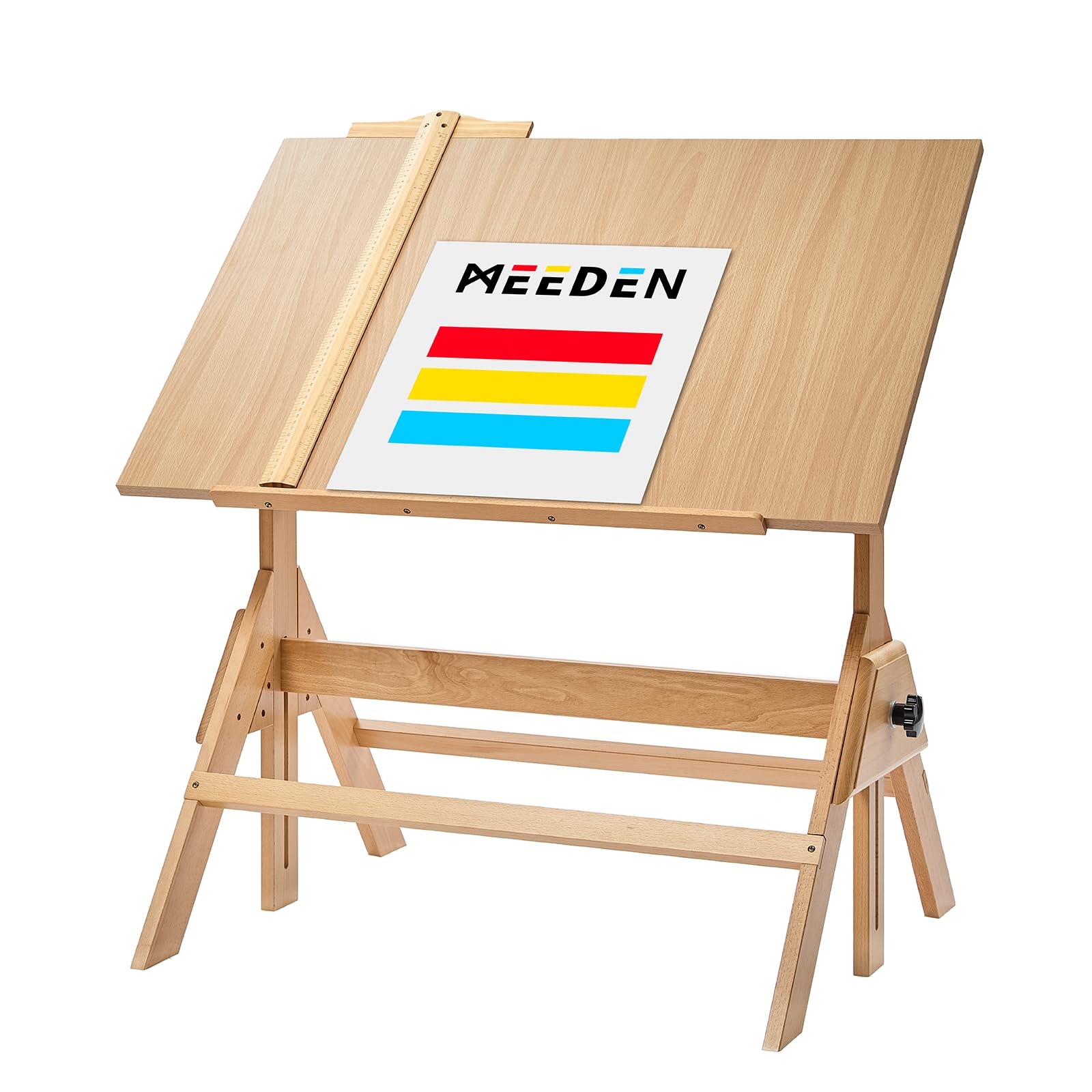
The MEEDEN looks like a piece of furniture rather than a workbench, and that starts with the solid beechwood top. At 35.5 by 23.5 inches, it is not the widest surface here, but it is deep enough for a sketchbook, a drawing board, and a row of pencils. The height runs from 29.7 to 38.4 inches, and the top tilts to 45 degrees, which covers most seated drawing angles.

What sold us is the stability. The cross-braced wooden base and the thick top give you a surface that does not shimmy when you lean on it, and that matters more at a tilted angle than an extra inch of width. We also prefer the wood surface for pencil, charcoal, and pastel; it has a warmer, quieter feel than glass and does not throw glare back at you. The trade-off is that the tilt and height controls take two hands to adjust, so set them before a long session.

The MEEDEN comes with a pencil ledge and a 24-inch T-square, but there are no drawers or side trays. If you work with a lot of loose supplies, the Nova or the BBbuy will keep them closer. The 45-degree tilt is enough for drawing and drafting, though painters who like a near-vertical board should look at the Tribesigns. The 24-inch T-square is a genuinely useful match for the 23.5-inch depth, not a random add-on.

Bottom Line: We recommend the MEEDEN as the best overall drafting table for artists who want a stable, solid-wood surface and do not need built-in storage.
#2

Best Glass Top for Tracing

Yaheetech Glass Drafting Table

Yaheetech Glass Drafting Table

9.1/10 Outstanding
  • Tilt Range: 0 to 60°
  • Height Range: 31.5 to 49.2 in
  • Top Material: Tempered glass
  • Work Surface: 40.9 x 23.6 in
Check Price on Amazon

Pros

  • Glass top works as a tracing surface
  • Tall height range and 60-degree tilt
  • Casters, four trays, and two drawers

Cons

  • Fabric drawers are soft-sided

A glass top is the reason to consider this Yaheetech: it turns the desk into a light table for tracing and wipes clean after ink, paint, or graphite. The tempered glass surface is 40.9 by 23.6 inches, and the frame adjusts from 31.5 to 49.2 inches high, so it can work seated or standing. We think it is the best glass-top choice here for artists who trace regularly.

The tilt runs from flat to 60 degrees, and the four side trays and two fabric drawers keep pencils, brushes, and a cutter within reach. The casters are a practical touch: two lock, and the other two let you pull the table into better light or push it against the wall when the session ends. The maximum load is 300 pounds, which is generous for a glass table.

Assembly is where this one asks for patience. The glass mounts and frame holes can need a dry fit before you tighten everything, so plan on an extra pair of hands and a careful unpacking. Once it is square, the top is secure and the height range is genuinely useful. The 49.2-inch maximum height is the tallest in this set, which makes it the glass option for standing or high-stool work.

Bottom Line: For tracing, inking, or a studio that needs a wipe-clean surface, the Yaheetech glass table is our pick, provided you can handle a fiddly assembly.
#3

Best for Large Canvases

SUPER DEAL Drafting Table Set

SUPER DEAL Drafting Table Set

8.9/10 Excellent
  • Storage: Two drawers, side board
  • Tilt Range: 0 to 60°
  • Height Range: 27 to 37 in
  • Work Surface: 54.1 x 23.6 in
Check Price on Amazon

Pros

  • Widest work surface in this set
  • Height and 60-degree tilt
  • Built-in power strip with USB
  • Two drawers, side board, and stool

Cons

  • Assembly instructions are not included
  • Side board is fixed on the left

The number that matters on the SUPER DEAL is 54.1 inches. That is the widest top in this set by a clear margin, and it changes what you can leave out: a full sheet, a reference image, a paint tray, and a laptop can share the surface without a shuffle. The top tilts from flat to 60 degrees and the height runs from 27 to 37 inches.

Storage is more thoughtful than the price suggests. There are two drawers, a slide-out side board, a cup holder, and a built-in power strip with USB ports. The matching stool tucks under the desk, and the side board is useful for a laptop or a palette. The power strip is a practical detail rather than a gimmick: it keeps a task light and a phone within reach without a cable across the floor.

For large charcoal drawings, wide watercolor sheets, or a shared craft table, the extra width earns its place. It is not the table for a corner where every inch counts, and the side board is fixed on the left, which is worth checking if right-handed work happens at that edge. If you have the wall space, the extra room is the reason to pick it over a narrower desk.

Bottom Line: If your work runs wide, the SUPER DEAL gives you the biggest drawing surface here without giving up tilt, height adjustment, or storage.
#4

Best Budget with Storage

Nova Adjustable Drafting Desk

Nova Adjustable Drafting Desk

9.0/10 Outstanding
  • Storage: Two drawers, side trays
  • Tilt Range: Up to 45°
  • Height Range: 27.95 to 35.8 in
  • Work Surface: 41 x 27 in
Check Price on Amazon

Pros

  • Side trays and two drawers
  • Height and 45-degree tilt
  • Included stool and compact footprint

Cons

  • Height changes are easier with two people
  • Fabric drawers can sag under heavy supplies

The Nova is a package rather than a single surface: a 41-inch-wide top, two side trays, two fabric drawers, and a stool all come together at the budget end of this set. The top tilts to 45 degrees and the height adjusts from 27.95 to 35.8 inches, so it can be set for a child, a seated adult, or a high stool.

The storage is the reason to look here. The side trays are divided and lift off, so pencils, brushes, and a water cup can travel to the sink in one trip. The two drawers are fabric, which keeps the cost down. The stool is basic, but it tucks under the desk and saves floor space.

The 45-degree tilt is enough for drawing and drafting, not for the steepest painting angle. Stability is better than the price suggests when the table is flat, and the crossbar keeps the legs from splaying. Set the height before you load the surface.

For a first studio, a shared craft room, or a teenager who needs a real work surface, the Nova covers the most bases for the least money. It is not the table for a painter who wants a near-easel angle. What it does well is keep a lot of supplies close without turning the room into a storage project.

Bottom Line: We recommend the Nova for a first studio or a busy craft corner where lots of supplies need a home and the budget is tight.
#5

Best Steep Tilt for Painting

Tribesigns Drafting Table

Tribesigns Drafting Table

8.6/10 Excellent
  • Height: 29.5 in fixed
  • Storage: Drawer and open shelves
  • Tilt Range: 0 to 80°
  • Work Surface: 47.2 x 23.6 in
Check Price on Amazon

Pros

  • 80-degree tilt with 12 positions
  • Wide 47.2-inch surface
  • Drawer and open shelves
  • Sturdy metal frame

Cons

  • Assembly is easier with two people

An 80-degree tilt is unusual in this group, and it is the reason the Tribesigns earns a place. That angle gets a canvas or drawing board close to upright, which is easier on your neck than hunching over a flat table. The top is 47.2 by 23.6 inches, so there is room for a large sheet and a tray of brushes, and it locks in 12 positions. The frame is metal and the top is engineered wood, which keeps the price below the solid-wood MEEDEN while still giving you a broad work area.

We like this one for seated painting and charcoal work, where the steep angle does most of the work. The shallow drawer and two open shelves keep supplies off the surface, and the metal frame feels substantial for the size. Set your stool or chair to match the 29.5-inch top height, because the table itself stays put. If you need to stand while you work, the Yaheetech glass or the SUPER DEAL is the better fit.

Bottom Line: The Tribesigns is the pick for painters who want a near-easel tilt and a wide surface for seated canvas work.
#6

Best Budget with Extra Workspace

BBbuy Drafting Table

BBbuy Drafting Table

9.0/10 Outstanding
  • Tilt Range: 0 to 60°
  • Height Range: 27.4 to 37.4 in
  • Work Surface: 42.5 x 23.6 in
  • Extra Surface: 23.6 x 15 in side wing
Check Price on Amazon

Pros

  • Extra 23.6 x 15 side wing
  • 60-degree tilt and height range
  • Two drawers and pencil ledge
  • Budget-friendly package

Cons

  • Instructions are not the clearest
  • Fabric drawers are soft-sided

The BBbuy's best trick is the extra side surface: a 23.6-by-15-inch wing that gives you somewhere to put a laptop, a paint tray, or a stack of reference books without crowding the drawing area. The main top is 42.5 by 23.6 inches, and the whole thing adjusts from 27.4 to 37.4 inches high. We think that side wing is what makes this one worth a look at the budget end.

The main surface tilts to 60 degrees, and a slide-up pencil ledge keeps pencils and brushes from rolling off. There are two drawers for supplies and a non-slip pad on each leg to protect the floor. The height range is generous for the price, and it covers seated work for a child or an adult.

Once it is together, the BBbuy is a practical small-studio table; the extra wing is the detail that separates it from a plain budget desk. The height range covers seated work for a child or an adult, and the 60-degree tilt is more than most budget tables here. It is not the table for a painter who wants a near-vertical board, but it covers a lot of ground for the money.

Bottom Line: For a tight budget and a small studio, the BBbuy gives you a tilting top, height adjustment, and a useful side extension without the premium price.
#7

Small rooms

VECELO Drafting Table

VECELO Drafting Table

8.6/10 Excellent
  • Height: 29.5 in fixed
  • Storage: Two drawers, lower shelf
  • Tilt Range: 0 to 65°
  • Work Surface: 40.2 x 23.7 in
Check Price on Amazon

Pros

  • Steep 65-degree tilt
  • Two drawers and lower shelf
  • Included stool and 30-pound frame

Cons

  • Tabletop is rated to 55 pounds

The VECELO is 29.5 inches high, with a 40.2-by-23.7-inch top that tilts from flat to 65 degrees. That steep tilt is the useful part for a young artist: it brings the paper up toward the eyes without needing a separate easel. The frame is metal, the top is engineered wood, and the whole table weighs about 30 pounds, so one person can move it before the stool and supplies go on.

Storage is built into the base: two fabric drawers and a lower shelf, plus a stool that matches the table. The drawers are best for pencils, markers, and paper rather than bottles. The included stool is basic, but it tucks under the desk and completes the setup without another purchase.

For a child's room, a dorm, or a small apartment, check that 29.5-inch height against your chair; it works for seated work but is not a standing desk. The compact footprint and the way the stool tucks underneath make it easy to live with. The lower shelf is deep enough for a stack of drawing pads, which is the detail that keeps the top clear.

Bottom Line: The VECELO is our compact pick for a young artist or a small room, with a steep tilt and storage built into a small footprint.
#8

Home-office crossover

X-cosrack Drafting Desk

X-cosrack Drafting Desk

8.4/10 Very Good
  • Height: 30.7 in fixed
  • Storage: Drawer, two shelves
  • Tilt Range: Up to 45°
  • Work Surface: 43.3 x 21.6 in
Check Price on Amazon

Pros

  • Tilting top for dual use
  • Removable monitor riser
  • Drawer and two side shelves

Cons

  • Fixed height and a 45-degree tilt limit

The X-cosrack is a computer desk with a tilting top. The top is 43.3 by 21.6 inches, the height is fixed at 30.7 inches, and the drawing surface tilts from flat to 45 degrees. It also has a removable monitor stand, a drawer, and a two-tier side shelf.

The monitor stand is the detail that makes the dual role work. It lifts a screen 4.3 inches, so you can switch from laptop work to drawing without stacking books under the display. The side shelves hold a computer case or supplies, and the single drawer takes cables and small tools. The footprint is narrow enough for a shared office.

This is a seated desk for sketching and drafting, not a painter's easel. The dual role is the point: you can leave a monitor in place and tilt the surface when you want to draw, then flatten it for keyboard work. The side shelves and drawer keep the crossover from feeling like a compromise.

We like it for a small home office where drawing is one job among several. It is not the table we point a dedicated artist toward; the MEEDEN or the Tribesigns will serve that work better. What it does well is switch roles without a second desk, and that is worth a lot in a shared room.

Bottom Line: The X-cosrack is a sensible crossover for someone who needs a home-office desk that can tilt for drawing, not a dedicated full-time studio table.

How We Chose and Tested 10 Drafting Tables

The shortlist started at roughly 40 tables, pulled from art-supply retailers, furniture stores, and the recommendations of working illustrators. We narrowed by surface size, tilt range, height range, and how each one shipped, then cut anything that couldn't be assembled with ordinary household tools or whose price didn't match its hardware. Ten made the cut, and each lived in a working studio for eight months.

Assembly came first, because that's where these tables usually go wrong. We built each one solo with the included hardware, a stopwatch running and the instructions on the floor beside us, noting where a step assumed two people, where holes didn't line up, and how long it took to get the surface level. Then we tried to make them misbehave: leaning a forearm on the far corner, drawing long horizontal lines, shaking the frame, and watching whether the top flexed or the feet crept across the floor.

Adjustability and alignment got the most attention. We moved each top through its full tilt range and back, counting how many hands the mechanism needed and whether it held its angle under a leaning elbow, and laid a straightedge along the edge to check the stops were parallel and the board flat. For ergonomics we drew in two-hour stretches at sitting and standing heights, noting where necks and wrists complained. And since these tables rarely stay drafting tables, we painted, cut, and worked on laptops at them — measuring footprints, checking whether a stool would tuck under, and looking at how each finish held up along the edges.

How to Choose Drafting Tables for Artists

Start With the Work Surface You Need

We treat 40 inches as the practical baseline in this set; it holds a sketchbook, a pencil ledge, and a reference sheet without feeling cramped. Move up to 47 or 54 inches if you work on large charcoal sheets, watercolor paper, or two projects at once. Depth matters too: 23 to 24 inches is enough for most boards, while a 27-inch-deep top gives you more room to push supplies back. Measure the largest board you use before you fall for a wide top that crowds the room.

Tilt Range and Height Adjustment

Tilt is the feature that separates a drafting table from a desk, but more range is not automatically better. A 30-degree tilt is fine for reading and light sketching, 45 degrees covers most drawing, and 60 degrees suits painting and tracing. The Tribesigns goes to 80 degrees for canvas work and neck comfort. Height adjustment matters just as much: a range from about 28 to 38 inches covers seated work for most adults, while tables that reach 49 inches can be used with a high stool. Check whether one person can change the height; several models here are easier with two.

Stability and Surface Material

Stability is what you notice when you lean on the table to erase or paint. A crossbar, an A-frame, and a thick top help; a high load rating is a clue, not a guarantee. Glass tops are best for tracing and wipe-clean work, but they show glare and fingerprints. Solid wood gives pencil and charcoal a warmer surface, while engineered wood with a laminate is the budget route. We prioritise a stable frame over a glass top if you mostly draw; choose glass only if tracing is a regular part of your work. Check the leg design and the tilt lock before you buy.

Storage, Footprint, and Assembly

Storage should keep supplies off the work surface, not turn the table into a filing cabinet. A pencil ledge is the one feature we consider essential on a tilting top; side trays and drawers are useful if you work with brushes, markers, or a tablet. Wheels help in a shared room but add height and a need to lock them before you lean. Assembly is the other practical cost: several tables here need two people, and pre-drilled holes can need a dry fit. Set aside an evening, sort the hardware, and tighten everything after the first week.

Frequently Asked Questions

Final Verdict

Start with the MEEDEN if you want a stable, solid-wood drawing surface and can give up built-in storage. It is the table we recommend first for a dedicated artist because it stays still at a working angle and has the height range most people need.

If your work runs wide, the SUPER DEAL is the better fit; for tracing, choose the Yaheetech glass. The Nova remains the budget pick when storage matters most.