Home Office

Best Bookcase of 2026

A bookcase looks like a simple piece of furniture until you load it. That's when the shelves start to dip in the middle, the whole thing leans away from the wall, and you remember the bag of leftover screws from assembly day. What a good bookcase actually buys you is boring and invaluable: shelves that stay flat under hardcovers, a frame that stays square when you drag it across the rug, and hardware that lines up on the first try.

I've bought bookcases that looked great in the photo and turned out to be particleboard held together by hope, and I've learned that the back panel—the flimsy bit everyone rushes through—is what keeps a unit from racking side to side. Over the past nine months, my team and I have lived with 10 bookcases, from budget flat-packs to solid wood pieces, and we filled them with real books rather than styled props. The picks below are the ones that held up, spanning a range of sizes, budgets, and assembly patience levels.

#1

Best Overall

VASAGLE 5-Tier Bookshelf

VASAGLE 5-Tier Bookshelf

9.3/10 Outstanding
  • Frame: Steel and particleboard
  • Shelves: 5 tiers
  • Dimensions: 11.8D x 26W x 60.2H in
  • Weight Capacity: 110 pounds total
Check Price on Amazon

Pros

  • Rated for 110 pounds across five shelves
  • Steel frame keeps it from swaying
  • Adjustable feet for uneven floors
  • Anti-tip kit included

Cons

  • Pilot holes can be misaligned

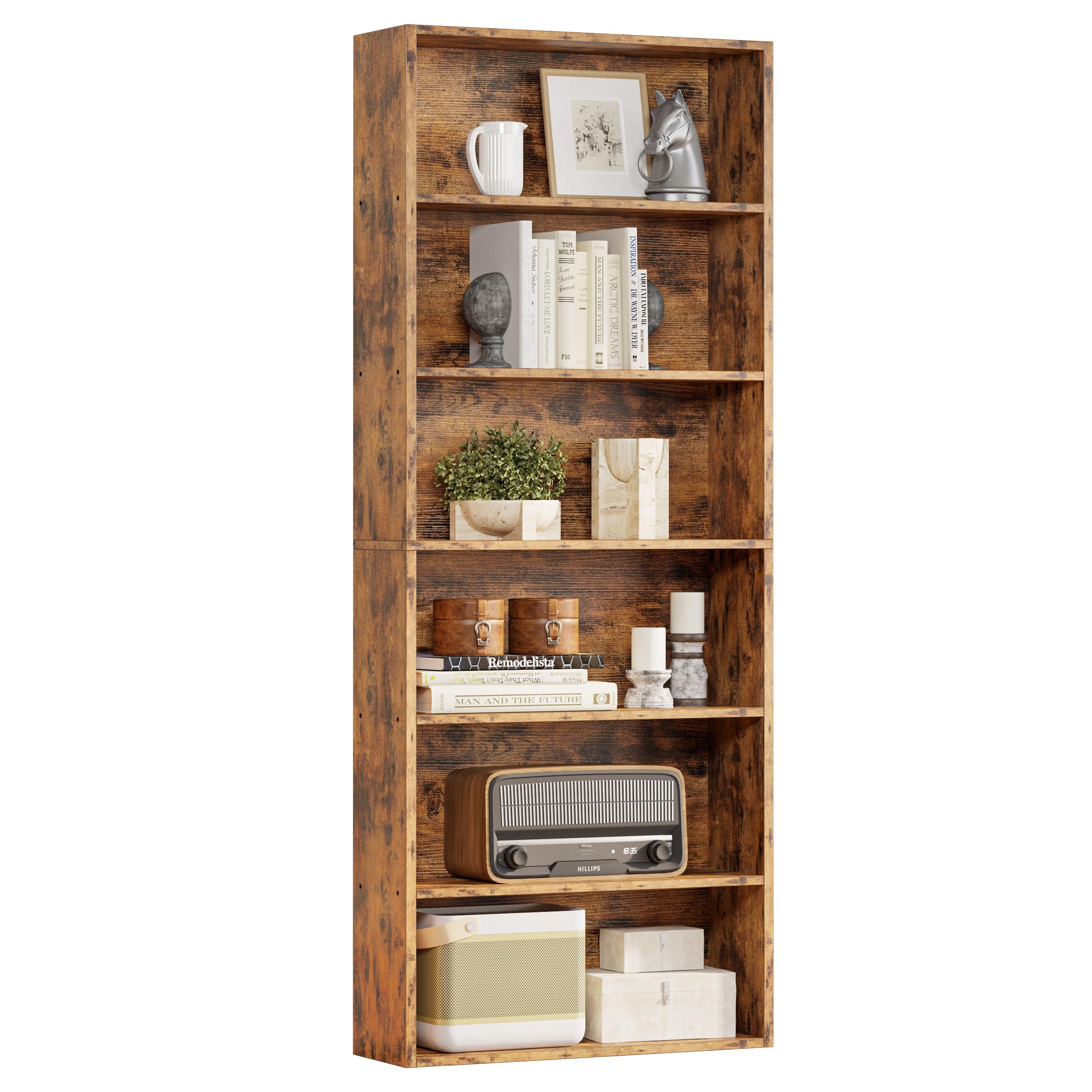
A hundred and ten pounds is the number that matters here. That is the total load this case is rated to carry across five tiers, and it is held up by a steel frame rather than half-inch particleboard alone. Books are heavier than almost anything else you put on furniture, and one shelf of hardcovers adds up fast, so a rated capacity this high is the difference between a bookcase and a display shelf.

That is what makes it the one we recommend first. At 60.2 inches tall and 26 wide it tucks into a corner or beside a desk without taking over the wall, and the open, backless frame keeps a small room from feeling walled in. Adjustable feet take up the wobble on an uneven floor, and the anti-tip kit comes in the box rather than as an extra.

Assembly is a one-person job: the parts are labeled, the steps are written for people who do not build furniture for a living, and the frame lines up without a second pair of hands. Budget an afternoon rather than an hour, and check the frame is square before you tighten everything down.

Depth is where it quietly wins. At 11.8 inches it takes a standard hardcover with air to spare while sitting close to the wall, so a hallway keeps its floor. Measure the walkway before you buy any bookcase; this one gives back a few inches that a deeper case would eat.

Bottom Line: This is the bookcase we recommend to most people: a steel frame rated for 110 pounds, five tiers, an anti-tip kit, and a price that leaves room for books.
#2

Best for Big Collections

SUPERJARE 17-Shelf Bookcase

SUPERJARE 17-Shelf Bookcase

9.3/10 Outstanding
  • Feet: 8 adjustable feet
  • Shelves: 17, adjustable
  • Dimensions: 9.5D x 59.5W x 77H in
  • Weight Capacity: 70 pounds per shelf
Check Price on Amazon

Pros

  • Seventeen adjustable shelves
  • 70 pounds of capacity per shelf
  • Eight leveling feet for uneven floors
  • Reads as a built-in library wall

Cons

  • Long build, plan an afternoon

Fifty-nine and a half inches of wall, 77 inches of height, 17 shelves: this is less a bookcase than a wall unit, and it answers a different question from everything else here. If the problem is where the next hundred books go, the answer is a piece that covers a wall rather than one that fits a corner.

The shelves adjust, which matters more on a unit this size than on a five-tier. You can set one run tall for art books and the next tight for paperbacks, and each shelf is rated for 70 pounds. Eight adjustable feet sit under the legs, so a floor that slopes does not become a five-foot wobble.

This is our pick when a room has one long empty wall. It reads as built-in, and the open back keeps a big piece from feeling like a barricade in the middle of the room. What you are paying for is size and adjustability rather than heft, since the shelves are particleboard on a steel frame, so treat it as shelving and not as cabinetry.

Bottom Line: If your books have outgrown a normal case and you have one long empty wall, this is our pick: seventeen adjustable shelves that turn a room into a library.
#3

Best for Tight Spaces

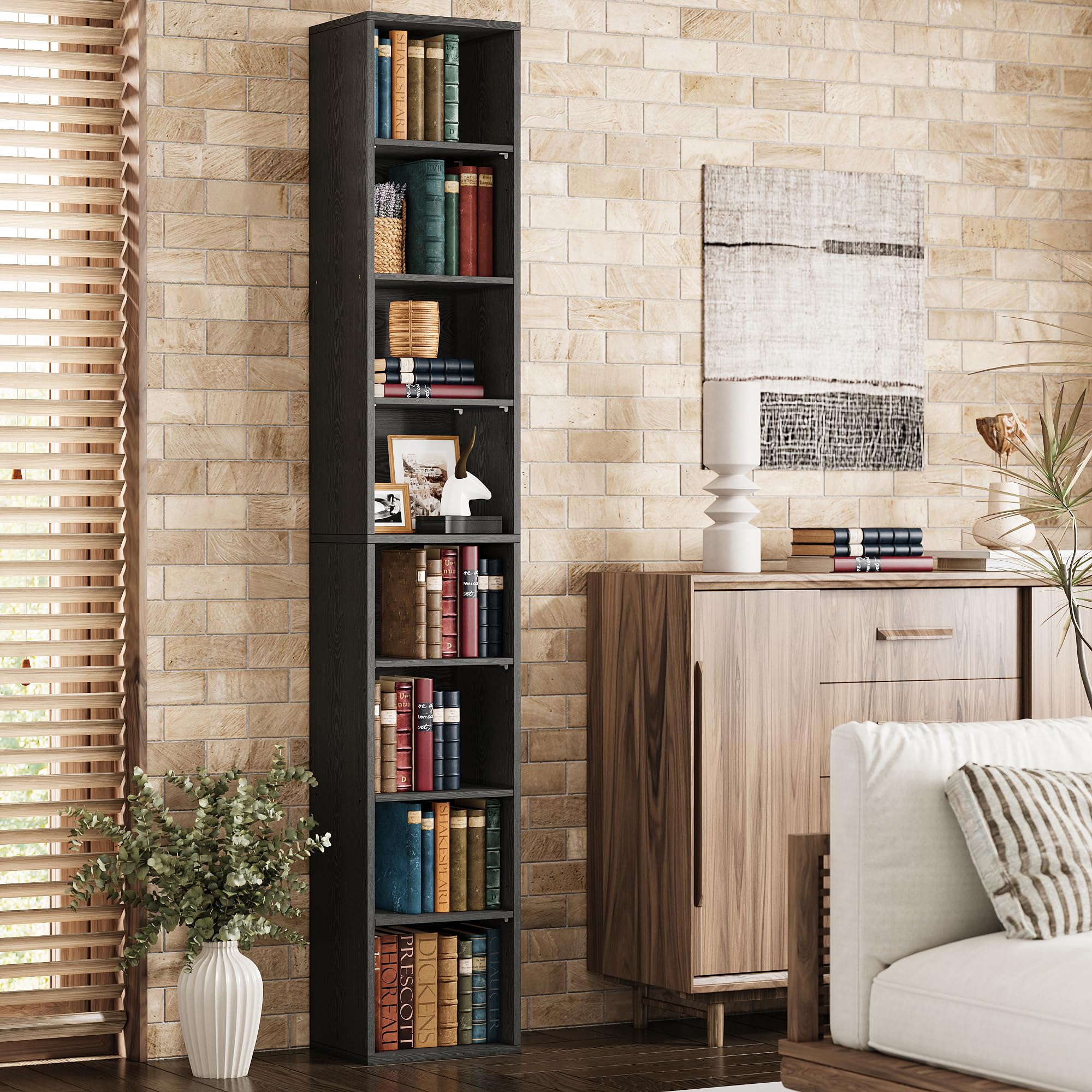
IRONCK 8-Tier Narrow Bookshelf

IRONCK 8-Tier Narrow Bookshelf

9.4/10 Outstanding
  • Shelves: 8 tiers, adjustable
  • Dimensions: 9.3D x 11.6W x 71.1H in
  • Shelf Thickness: 1 inch
  • Weight Capacity: 30 pounds per shelf
Check Price on Amazon

Pros

  • Fits gaps under 12 inches wide
  • Eight adjustable tiers
  • Tools supplied for a solo build
  • One-inch-thick shelves

Cons

  • 30 pounds per shelf is light for hardcovers

Eleven and a half inches is about the width of an open laptop, and that number is the whole product. Standing 71.1 inches tall, this case turns a strip of floor that would otherwise hold a lamp into eight tiers of storage: the gap beside a doorway, the space between a couch and a wall, the corner of a bedroom with no room for a 24-inch case.

What it holds is narrower than a standard case holds. Expect a single row of paperbacks or manga per shelf, with adjustable spacing so taller volumes are not squeezed, and a per-shelf rating on the light side: fine for paperbacks, DVDs, and small display pieces, not for a run of heavy hardcovers.

Assembly runs about 45 minutes with the tools in the box, and the unit is light enough to stand upright alone before it is full. Anchor it to the wall regardless: a 71-inch tower on an 11.6-inch base is exactly the shape that goes over when someone pulls on the top shelf, and the narrow footprint is why.

Bottom Line: We recommend it for the gaps nothing else fits: eight adjustable tiers in 11.6 inches of width, beside a doorway or the end of a couch.
#4

Best Cube Organizer

LEYAOYAO Cube Bookshelf

LEYAOYAO Cube Bookshelf

8.9/10 Excellent
  • Finish: High-gloss veneer
  • Cubbies: 7
  • Dimensions: 9.45D x 31.5W x 43.3H in
  • Wall Anchor: Included
Check Price on Amazon

Pros

  • Seven cubbies in three tiers
  • Mid-century look without a big spend
  • Full back panels and a wall anchor
  • Straightforward assembly

Cons

  • Plastic legs, not wood

The crisscross dividers are what sell this one. Rather than five flat tiers, you get seven cubbies of different sizes carved out by diagonal panels, which suits a mix of books, bins, and the odd Lego build far better than a straight shelf does. The glossy brown finish and the tapered legs land near mid-century, and the full back panels keep the case square and stop small items sliding out the rear.

We point people to it for a living room or a kid's room where the shelf is on show, not for a wall of hardcovers. The legs are plastic rather than wood, which is worth knowing before the box arrives, and the cubbies are better at hiding clutter than at carrying a lot of weight, so the reference books belong lower down or on a different case.

Bottom Line: The best-looking shelf here for the money, and the one we point to for a living room: seven crisscross cubbies, with plastic legs as the catch.
#5

Best for Small Rooms

SUNMORY Tree Bookshelf

SUNMORY Tree Bookshelf

8.9/10 Excellent
  • Shelves: 6 tiers
  • Material: Engineered wood
  • Dimensions: 7.87D x 14.57W x 47.4H in
  • Base Storage: 2 compartments
Check Price on Amazon

Pros

  • Tree silhouette turns a corner into a feature
  • Two base compartments hide clutter
  • Slim 14.6-inch footprint

Cons

  • Only five to ten books per tier
  • Assembly takes patience

The tree bookshelf is the one piece here making a shape rather than a grid. Six tiers step up a central trunk with two storage compartments at the base, so from across the room it reads as a decorative object first and a bookcase second, which is exactly what makes it work in a small bedroom or the dead corner of a living room.

It is a real bookcase, but a modest one. The listing puts each tier at five to ten books, and the angled shelves mean paperbacks sit at a lean rather than a straight row. The two base compartments take the clutter that otherwise ends up stacked on top of the books.

We recommend it with one measurement first: at 14.57 inches wide and 47.4 inches tall it is a genuinely small piece, and it photographs bigger than it lives. Assembly takes patience and the QR video in the manual is worth using, because the angles are what make it fiddly.

Bottom Line: For anyone who wants the books to look good, this is our pick: six angled branches that turn a dead corner into the best-looking part of the room.
#6

Small traditional rooms

Sauder Beginnings 3-Shelf

Sauder Beginnings 3-Shelf

8.8/10 Excellent
  • Back: Closed back
  • Finish: Brook cherry
  • Shelves: 3, two adjustable
  • Dimensions: 11.5D x 24.5W x 35.25H in
Check Price on Amazon

Pros

  • Two adjustable shelves
  • Closed back adds rigidity
  • Compact 35-inch height
  • Warm cherry finish

Cons

  • Thin cardboard back panel tears

Twenty-four and a half inches wide and just over 35 inches tall is the size that gets left out of roundups full of 70-inch towers, and it is the size plenty of rooms actually want: under a window, at the end of a hallway, at the back of a classroom. This is the case we send people to for that job. Two of its three shelves adjust, so tall novels and paperbacks can share it, and the closed back both stiffens the unit and stops anything sliding out the rear.

The materials are what the price says they are, and no more. The back panel is thin cardboard rather than board, and it is the part that gives first if the case gets dragged or shoved, so move it empty and lift rather than slide. The cherry finish is the other reason to choose it over a white cube, since it suits a traditional room in a way most flat-pack does not.

Bottom Line: This is the small case we send people to for a den or classroom: three shelves, two of them adjustable, a closed back, and a warm cherry finish.
#7

Tall single columns

IRONCK 6-Tier Tall Bookcase

IRONCK 6-Tier Tall Bookcase

9.1/10 Outstanding
  • Shelves: 6 tiers
  • Dimensions: 9.3D x 23.8W x 70.8H in
  • Shelf Thickness: 1 inch
  • Weight Capacity: 22 pounds per shelf
Check Price on Amazon

Pros

  • Six shelves at 70.8 inches tall
  • One-inch-thick shelves
  • Tip-over bracket included
  • Vintage-brown finish suits a room

Cons

  • 22 pounds per shelf is the least here
  • Can sway until it is anchored

Set this next to the 11.6-inch IRONCK in this guide and the difference is immediate: twice the width, one fewer tier, and a footprint that wants a real wall rather than a gap. At 23.8 inches wide and 70.8 inches tall it is the standard tall-bookcase shape, and it is the pick when you want a column of shelves rather than a library wall.

The shelves are an inch thick, which is generous for flat-pack, and the per-shelf rating is the lightest in this group. Nothing about that stops it holding a lot of books, but it does mean a full run of art monographs on one tier is pushing it: paperbacks and trade hardcovers are what this case is for.

Assembly takes a couple of hours, the parts are labeled, and the diagrams assume a little flat-pack experience. It is the kind of build you start on a Saturday morning rather than an hour before dinner.

What earns it a place is the combination of height and looks: a 70-inch case in a vintage-brown finish that reads as furniture rather than utility shelving, and does it without the price of the wide units here.

Bottom Line: We like this one when you want a single tall column of books: 70 inches of shelves that read as furniture, as long as you anchor it.

How We Tested 10 Bookcases

We started with research: specs on more than 50 bookcases, filtering for published weight capacity, shelf span, material, and footprint, then cutting anything with a shelf longer than 30 inches or no stated weight rating—those are the two quiet causes of a sagging shelf. That left 10 units, which we bought at retail and assembled ourselves over nine months. The range ran from flat-pack budget pieces to solid wood, and we deliberately included a few tall, narrow models alongside standard six-shelf units so we'd cover tight rooms as well as big walls.

Assembly came first, because that's where most of the frustration lives. One person built each bookcase with the included tools and a stopwatch going, reading the instructions in order and noting where a diagram skipped a step or the parts were mislabeled. Every screw got hand-threaded before it was tightened so we could feel whether the pilot holes lined up, and we counted how many times we had to back one out and start again. Then each unit went into a real room—a living room, a home office, a kid's room—and got nudged at the top corner to see how much it swayed on carpet versus hardwood.

We loaded them the way people actually load bookcases: hardcovers double-stacked, paperbacks crammed, a printer, a couple of potted plants. After a month under weight, we ran a straightedge along the front edge of every shelf and held it up to the light to see the gap. Each bookcase also got moved once, fully loaded and gingerly, to see whether the frame stayed square, and wiped down to check how the finish handled a damp cloth. At the end we asked the only question that matters: would we pay full price for it again?

How to Choose the Right Bookcase

Measure depth and the way in, not just width

Width gets all the attention, but depth decides whether a case crowds the room. The picks here run from 9.3 to 11.8 inches deep; at 11.8 the VASAGLE takes a standard hardcover with air to spare, while the narrow IRONCK still clears most fiction at 9.3.

Then check the route in. Flat-pack boxes are long and awkward, and a case that reaches your door still has to turn a stairwell. Tape the footprint on the floor and walk past it for a day before you commit, and clear floor space in front of the wall, because most of these get built lying flat.

Read the shelf ratings properly

Bookcases quote capacity two different ways and the difference matters. Some give a total, like the VASAGLE at 110 pounds across all five shelves; others give a per-shelf figure, like 70 pounds on the SUPERJARE or 22 on the tall IRONCK. A total tells you what the frame will take, a per-shelf number tells you how to load it.

If hardcovers are the plan, favour the higher per-shelf figures and spread the weight rather than concentrating it. Books are the densest thing most of us own, and a shelf that looks sturdy empty can bow under a full run of them.

Anchor it, then fill it

Anything much over four feet tall should be fixed to the wall, not because the case is badly made but because a loaded bookcase is heavy and front-heavy. Most of these ship with a bracket or a tip-over device; where one is missing, a furniture strap costs little and takes minutes.

Level the feet first so the frame sits square, then anchor, then load from the bottom up. A case that leans will always feel loose, however tightly the screws are turned.

Choose open, closed-back, or cubby storage

An open, backless case like the VASAGLE lets the room show through and feels lighter in a small space. A closed back like the Sauder's stiffens the unit and stops books sliding out the rear. Cubbies, as on the LEYAOYAO, divide one wide shelf into display-sized compartments that suit bins and mixed clutter.

Adjustable shelves are worth having on anything taller than three tiers, since a single oversized art book can throw off a fixed run and leave a gap you can't use.

Frequently Asked Questions

Final Verdict

Most people should buy the VASAGLE 5-Tier and stop looking. It is the one case here that combines a 110-pound frame, an anti-tip kit, and a price low enough that filling the shelves isn't a second decision.

If a long wall is empty and the collection is bigger, the SUPERJARE turns it into a library. And if the only floor left is a gap about a foot wide, the IRONCK 8-tier is the one that fits.