Home Office

Best Bookcase for a Home Office of 2026

A bookcase is the quiet workhorse of a home office: it holds binders, printer paper, and reference books, and it has to look composed behind you on a video call. The trouble is that many shelves look fine empty and turn into a wobbly, bowing mess once loaded; I once packed one with legal binders and watched the middle sag before lunch. Size and material matter, but so do the joints you can't see, the instructions you have to follow, and whether the screw holes line up while you're balancing a side panel on your foot. The right bookcase fixes all of that—it keeps the office organized, stays solid under weight, and looks intentional from the desk chair.

Over eight months, we assembled and lived with 10 bookcases, filling them with everything from paperbacks to archive boxes to see which stayed square and which only looked good in photos. We noted how finishes held up, how much usable shelf space each gave us, and whether the finished piece felt worth the money. The picks below earned their footprint.

#1

Best Overall

VASAGLE 5-Tier Bookshelf

VASAGLE 5-Tier Bookshelf

9.3/10 Outstanding
  • Frame: Particleboard and steel
  • Shelves: 5
  • Max Load: 110 lb
  • Dimensions: 11.8"D x 26"W x 60.2"H
Check Price on Amazon

Pros

  • Five tiers in a 26-inch footprint
  • Steel frame and X-brace stay rigid
  • Adjustable feet for uneven floors
  • Anti-tip kit included

Cons

  • 110-pound total load is modest for hardbacks

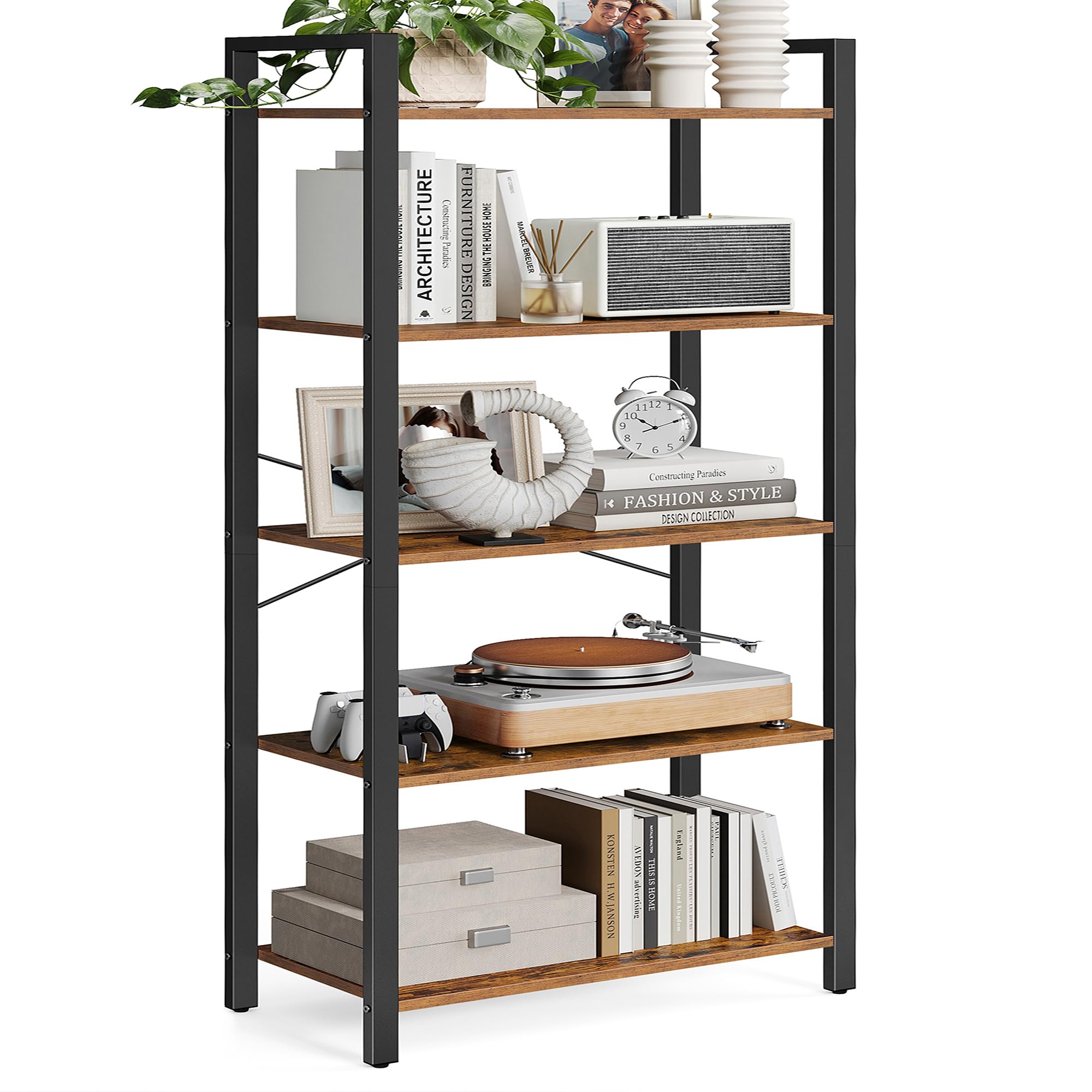
Eleven and eight-tenths inches deep, 26 inches wide, just over five feet tall — those are the numbers that get this bookcase into a home office. A desk, a chair and a door swing eat most of a spare wall, and a unit this narrow slips into what's left without turning the room into a corridor.

What earns it the top spot is the frame. Steel uprights, an X-brace across the back and a 110-pound overall rating put it near the top of this group for stiffness at the size, and the adjustable feet mean it sits level on a floor that isn't. The anti-tip kit comes in the box rather than as an optional extra, which matters for a 60-inch bookcase in the room where you work.

Assembly is straightforward with labeled parts, but the pre-drilled holes are where it can fight you. Thread every bolt loosely first, square the frame, then tighten in opposite pairs; go panel by panel from the start and you are the one who introduces the misalignment.

The backless frame is a small bonus in a workspace: the wall color shows through, so a narrow room doesn't feel lined with furniture, and a charger cable can drop straight down behind it. Load the bottom three tiers with books and keep the upper two for what you want at eye level.

Bottom Line: For most home offices this is the bookcase we recommend: five steel-framed tiers on a 26-inch footprint, with the anti-tip kit in the box.
#2

Best for Large Collections

IRONCK Double Wide 5-Tier

IRONCK Double Wide 5-Tier

9.2/10 Outstanding
  • Shelves: 5
  • Dimensions: 13"D x 53.1"W x 70"H
  • Load Per Shelf: 135 lb
  • Board Thickness: 1.1 inches
Check Price on Amazon

Pros

  • 135 pounds per shelf
  • 53-inch span holds a full library
  • Thick 1.1-inch boards
  • Two wall brackets included

Cons

  • Needs 53 inches of clear wall

Fifty-three inches wide, 70 inches tall and rated for 135 pounds on each of its five shelves, this is the only bookcase in the group built for someone whose books are the point of the room. It arrives heavy — 86 pounds of board and steel — and it wants two people and the floor space in front of the wall where it will live.

The 1.1-inch boards are the thickest here, and the 12.1 inches between shelves clears a lever-arch file standing upright, which the shallow towers can't manage. Woodgrain panels on a black frame give it the industrial look that dominates this category, and two metal wall brackets come with it.

Assembly is the trade-off. Some panels arrive with pre-drilled holes a fraction out, and the boards are heavy enough that you feel every one of them while you walk the frame upright. What you get back is a wall unit that doesn't budge once the brackets are in — the sturdiest thing in this group at full load by a wide margin.

Bottom Line: If the office wall is long and the books are heavy, this is the one: 135 pounds on every shelf across a 53-inch span.
#3

Best Low and Wide

SUPERJARE Triple Bookshelf

SUPERJARE Triple Bookshelf

9.3/10 Outstanding
  • Shelves: 11
  • Shelving: Adjustable
  • Dimensions: 9.5"D x 59.5"W x 54.9"H
  • Load Per Shelf: 22 lb
Check Price on Amazon

Pros

  • Eleven adjustable shelves
  • Fits under a window at 54.9 inches
  • Eight adjustable feet level it
  • Wide span for the money

Cons

  • 22-pound shelf limit is low for hardbacks
  • 9.5-inch depth is tight for art books

Low, wide and adjustable is a combination nothing else in this group offers. At 54.9 inches tall, this triple-width unit sits under a window or along a long wall where a 70-inch tower would feel like a barricade, and the eleven shelves re-space around binders, a printer or a run of oversized books.

The trade is capacity per shelf: 22 pounds each, which is a row of hardbacks and not much more. Spread the heavy volumes low down, keep paperbacks and plants up top, and it holds its shape. Think of it as a display-and-organize unit rather than somewhere to warehouse a research library.

Assembly is a one-person job with a caveat — eight plastic feet need adjusting individually, and the time to do that is before the shelves go on. It also claims more wall than anything here short of the double-wide IRONCK, so measure the run before you order. The brown-board-and-black-frame look is the one half this category imitates, and it reads better in a long run than in a tower, where every uneven stack is on show.

Bottom Line: Best when the wall is long and the ceiling low: eleven adjustable shelves and eight feet to level them on an uneven floor.
#4

Best Closed-Back Tower

NUMENN 5-Tier Bookshelf

NUMENN 5-Tier Bookshelf

9.1/10 Outstanding
  • Shelves: 5
  • Dimensions: 11.81"D x 23.6"W x 60.4"H
  • Unit Weight: 25.3 lb
  • Load Per Shelf: 30 lb
Check Price on Amazon

Pros

  • 30 pounds per shelf, 150 total
  • Closed back looks finished against a wall
  • Light enough to move alone at 25.3 pounds
  • Anti-tilt bracket included

Cons

  • Solid back panel rules out cables behind

At 23.6 inches wide, this is the narrowest of the five-tier towers here, and the closed back panel is what separates it from our top pick. Against a painted wall it reads as furniture rather than a frame of shelves, nothing small can slide off the back, and the woodgrain panels carry a vintage look that a lot of flat-pack bookcases only pretend to.

The 30-pound shelf rating is the practical argument: 150 pounds across the unit, the most of the tall open-frame towers in this group, and enough for a run of hardbacks on every tier. It is also the one to pick in a room that doubles as something else, because at 25.3 pounds it moves alone when the layout changes, and an anti-tilt bracket comes in the box.

Assembly runs to seven steps with labeled parts and the tool included, and the frame is light enough to stand up yourself once the shelves are on. That lightness is more than the double-wide IRONCK can claim, and in a small office you will notice it every time you rearrange.

Bottom Line: The top pick's tall, narrow shape with a tidier finish: a closed back, 30 pounds per shelf, and a frame light enough to move alone.
#5

Best for Tight Gaps

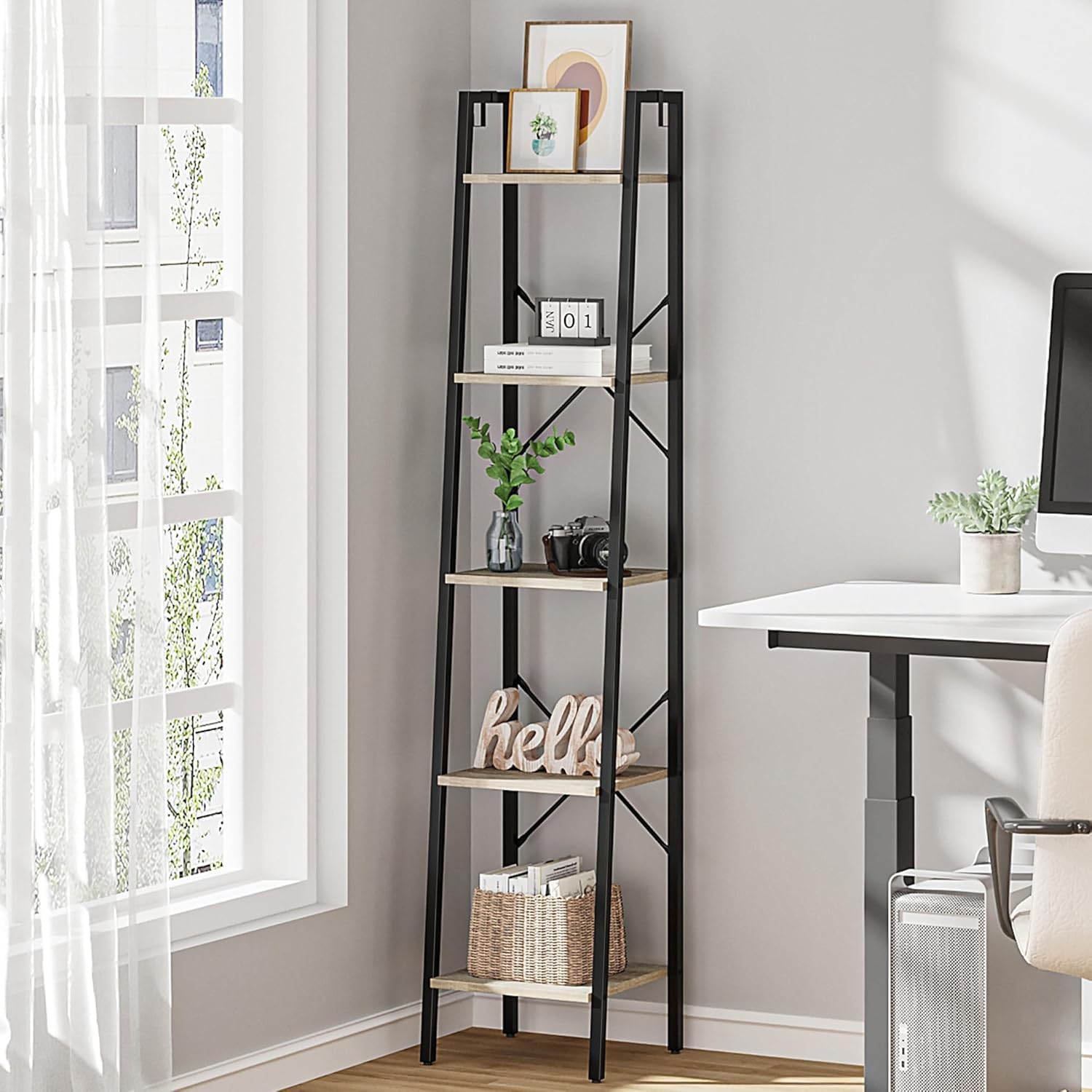
Hzuaneri Ladder Shelf

Hzuaneri Ladder Shelf

9.1/10 Outstanding
  • Extras: 2 hooks
  • Shelves: 5
  • Dimensions: 11.8"D x 13.4"W x 63"H
  • Load Per Shelf: 30 lb
Check Price on Amazon

Pros

  • 13.4-inch width fits gaps
  • 30 pounds per tier
  • Two hooks for headphones or a bag
  • X-braces resist twisting

Cons

  • One narrow row of books per shelf

Thirteen and a half inches wide, five shelves up 63 inches: this is the one for the corner beside the desk that nothing else will take. The ladder angle keeps the floor footprint tiny while the shelves step up into the eye line, and 30 pounds per tier is the same rating the best of the tall towers here carry.

Two hooks under the top shelf take headphones and a bag, the X-braces on the back keep the frame from twisting, and the greige finish is neutral enough to sit beside a filing cabinet without competing with it. Assembly comes from picture instructions with all the hardware in the box, which is why it goes up in one sitting rather than two.

What you get is a display shelf that happens to hold books. A 13.4-inch tread takes one row, so it is a pick for the volumes you reach for daily rather than the whole library, and it gives the floor back to everything else. Check it on a hard floor before you load it — a leg that doesn't sit square is the fault to look for, and an empty shelf is a great deal easier to return than a full one.

Bottom Line: For a gap barely wider than a door frame, this 13.4-inch ladder shelf is the pick that fits, and each tier still takes 30 pounds.
#6

Small rooms

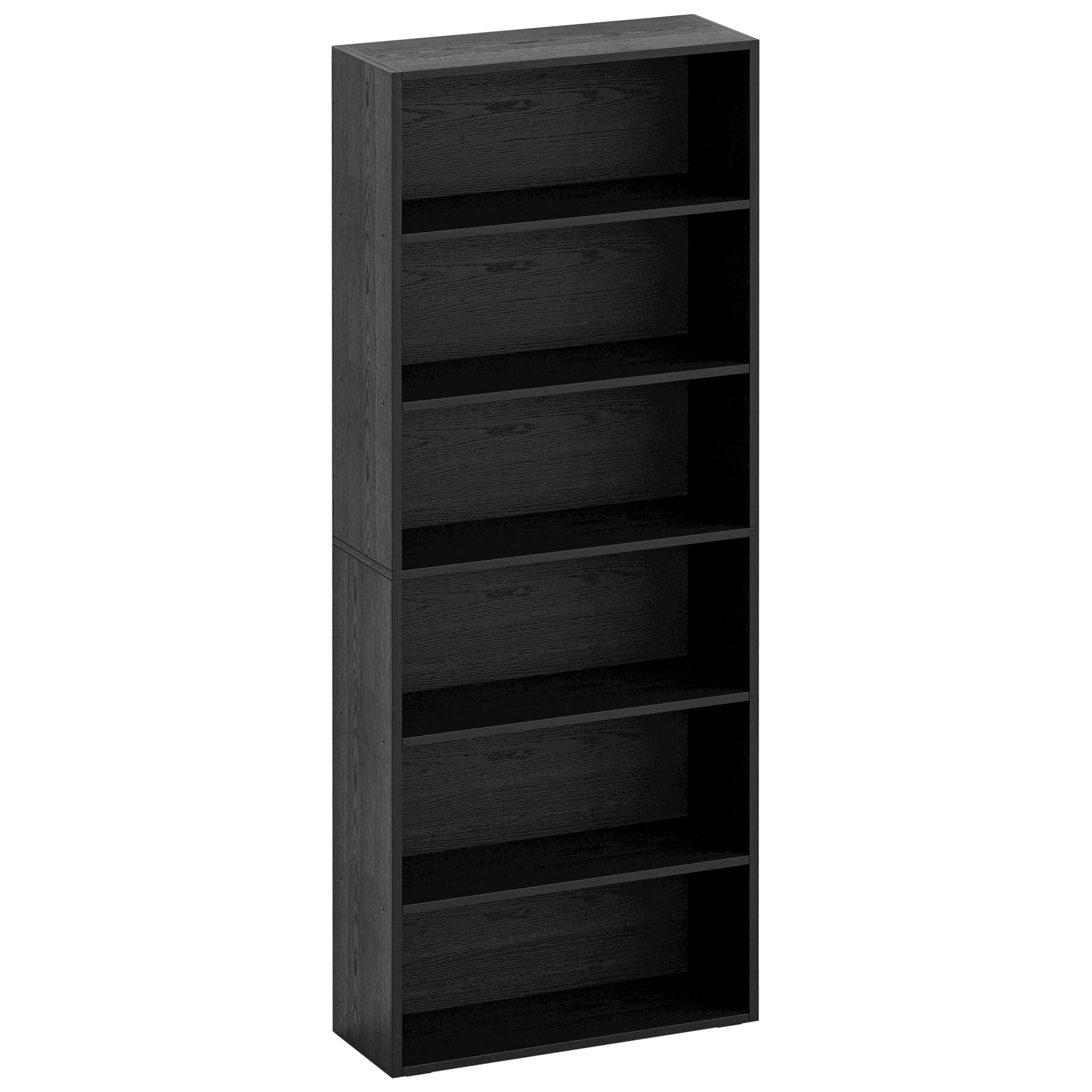
IRONCK 6-Tier Bookcase

IRONCK 6-Tier Bookcase

9.1/10 Outstanding
  • Shelves: 6
  • Dimensions: 9.3"D x 23.8"W x 70.8"H
  • Unit Weight: 37.3 lb
  • Load Per Shelf: 22 lb
Check Price on Amazon

Pros

  • Six tiers in a 23.8-inch width
  • Tipover bracket included
  • Light enough to position alone

Cons

  • Sways until it is wall-anchored
  • 9.3-inch depth suits standard books only

Seventy inches of bookcase in a 23.8-inch width is the pitch, and it is a good one for a small office: six tiers on a footprint you will barely notice, in a black finish that disappears against a dark wall. It costs less than most of the five-tier towers here despite carrying an extra shelf.

Assembly follows picture-only instructions, which is fine until a panel goes on the wrong way round, and the tipover bracket is in the box and worth fitting the same day. At 37.3 pounds it is light enough for one person to walk into place once it is built, which is the practical advantage of a narrower gauge of board.

Stability is where this one asks for patience. Until it is anchored the frame can sway with a knock, and the remedy is the bracket plus weight low down rather than anything you can tighten. Do that and you have six tiers on the footprint most five-tier towers use, which is the whole reason it earns a place here.

Bottom Line: Six tiers of storage in under two feet of width, with one condition: anchor it to the wall before the books go on.
#7

Bins and display

LEYAOYAO Cube Bookshelf

LEYAOYAO Cube Bookshelf

8.9/10 Excellent
  • Cubbies: 7
  • Dimensions: 9.45"D x 31.5"W x 43.3"H
  • Unit Weight: 20 lb
  • Load Per Cubby: 35 lb
Check Price on Amazon

Pros

  • Seven cubbies at 35 pounds each
  • Mid-century look with legs and partition
  • Low 43.3-inch height suits window walls
  • Top surface holds a printer or lamp

Cons

  • Plastic legs don't match the wood finish

Cubes usually mean nursery: plastic bins, primary colors, a grid. This one takes the same idea, gives it legs and adds a crisscross partition, and the result is a low, wide piece that can sit behind a desk without announcing itself as storage.

At 43.3 inches tall it works under a window or as the low half of a wall, and each of the seven openings is rated to 35 pounds — more than any shelf on the tall towers here, and enough for hardbacks or a stack of magazine files. The top surface takes a lamp or a small printer, which is more than a pure tower gives you.

Assembly is quick, with labeled hardware and clear steps, though the pre-drilled holes are tight and reward a proper screwdriver over the stubby one in the box.

Where it earns its place is the room where the bookcase is also the decoration — behind a desk in a living room, or in a spare bedroom that has to pass as an office. The grid keeps books and boxes tidy, the legs lift it off the carpet, and the glossy finish looks like more money than it is.

Bottom Line: A cube organizer that doesn't look like one: seven cubbies, a mid-century frame, and 35 pounds in every opening.
#8

Small office corners

SUNMORY Tree Bookshelf

SUNMORY Tree Bookshelf

8.9/10 Excellent
  • Shelves: 6
  • Dimensions: 7.87"D x 14.57"W x 47.4"H
  • Unit Weight: 15.9 lb
  • Base Storage: 2 compartments
Check Price on Amazon

Pros

  • 14.57-inch width fits corners
  • Six tiers plus two base compartments
  • Assembly video via QR code
  • Light enough to move alone

Cons

  • Shallow angled tiers won't take large books
  • Smaller in person than the photos suggest

A tree-shaped bookcase is the kind of idea that looks good in a photo and terrible in a room. This one mostly lands: the branches step out to one side, the whole thing is 14.57 inches wide, and at 47.4 inches tall it stops below eye level instead of looming over a desk.

It is a display shelf first. The maker plans five to ten books per tier, and the shallow, angled branches take paperbacks and trade hardbacks comfortably while anything reference-sized does not sit well. The two storage compartments at the base are the sleeper feature — a home office always has a stapler, a charger nest and a pile of cables that needs somewhere to go.

Assembly comes with a QR code for a video walkthrough, which is worth using, because the branch joints are the fiddly part of the build. The board is light — 7.2 kg in total — so one person can stand it up alone and slide it into a corner without help.

Where it earns a place is the corner of a small office that would otherwise stay empty: beside a desk, between a door and a window, on the landing outside a study. It will not hold the library, but it holds the books you are actually reading, and it does it without a single straight line.

Bottom Line: The smallest footprint here with the most personality: a six-tier tree shelf with two base compartments for a corner nothing else fits.

How We Tested (and Lived With) Home Office Bookcases

We started by reading spec sheets and owner feedback, then narrowed a long list by dimensions, shelf count, listed materials, and how much weight each shelf was rated to hold. We ruled out pieces whose measurements wouldn't clear a desk chair or fit a standard office wall, and we skipped anything whose assembly instructions were widely described as incomplete. That left 10 bookcases, which we assembled ourselves in living rooms and home offices and then used for eight months.

During assembly, we timed each build solo, noted where the instructions skipped a step or mislabeled a part, and checked whether the pre-drilled holes lined up without forcing a screw at an angle. We inspected the joinery, shelf pins, back panels, and edges of each material—wood veneer, particleboard, and metal—for thin spots or rough finishes, then loaded each case with hardbacks, binders, and stacked printer paper to see how the shelves carried weight. After a week, we checked again for sway, bowed shelves, and loosened fasteners, and we nudged each unit across carpet and hard floor to judge stability.

We also lived with them: I judged the finish and overall quality from the desk chair, checked how visible hardware and exposed back panels looked on video calls, and noted whether fingerprints or dust showed up quickly. Capacity got a real-world test with a full set of binders on one shelf and lighter paperbacks on another, and we compared usable shelf height and depth rather than trusting outer dimensions. At the end, we asked whether each piece still felt solid and worth its cost after eight months of daily use—that mix of appearance, capacity, and value separated the finalists from the also-rans.

How to Choose the Right Bookcase for a Home Office

Measure the wall, then subtract for the chair

Widths in this group run from 13.4 inches for a ladder shelf to 53.1 inches for the double-wide IRONCK, and the gap between fitting and not fitting is often two inches of door swing. Depth matters just as much in an office: 9 to 13 inches is the working range here, and anything deeper pushes your chair away from the desk.

The trap is the word compact on a listing. It describes the room the piece suits, not the gap you own. Measure the wall, then measure again with the chair pulled out and the door open.

Read the load rating per shelf, not per unit

Books are heavier than they look, and every figure here is a static rating. The open-frame towers carry 22 to 30 pounds per shelf; each shelf on the IRONCK double-wide takes 135. That is the difference between a run of paperbacks and a shelf of hardbacks, binders or a printer.

Divide the total by the number of shelves before you trust it, because a 110-pound unit spread over five tiers is 22 pounds a tier. Then put the heaviest volumes on the bottom, where the frame is stiffest.

Adjustable shelves, and when fixed ones are fine

Only the SUPERJARE lets you move the shelves, and that matters if the office stores lever-arch files, a printer or art books. Binders need roughly 11 to 12 inches of clearance, and on a fixed unit the maker's spacing decides that for you.

If your books are mostly the same size, fixed shelves buy more stiffness for the money — the frames here that don't adjust are the ones rated for the heaviest loads.

Stability is a bracket and a floor

Two things keep a tall bookcase upright: the anti-tip bracket and a level floor. Adjustable feet are the feature to look for, especially on carpet, where a rigid frame rocks on the underlay. Drive the bracket into a stud where the wall has one.

A 70-inch tower that sways when you brush past it is telling you something. Fit the bracket the day you build it, load the bottom tiers first, and the frame settles instead of leaning.

Open frame, closed back or cubbies

A backless frame lets the wall color through and keeps a small room feeling open; a closed back hides cable clutter and mismatched spines and reads as furniture. Cubby units sit low, take bins and give you a top surface for a lamp or a small printer.

If your desk faces the shelf on video calls, a closed back and one consistent row of spines is the tidier backdrop.

Frequently Asked Questions

Final Verdict

Start with the VASAGLE if you have 26 inches of wall and a normal mix of books. It is the least expensive way here to get five rigid, anchored tiers into a small office, and the anti-tip kit in the box removes the step people skip.

If the books are the collection rather than the decoration, the IRONCK double-wide is the upgrade worth paying for: four times the shelf rating and a span that turns a wall into a library. And if the only free wall is low and long, the SUPERJARE's adjustable shelves do the job a tower cannot.