Home Office

Best Floating Desks of 2026

A floating desk is the one piece of furniture that has to be both a desk and not a desk. It buys you a workspace without surrendering any floor, then asks the same wall to hold your monitor, your elbows, and everything you lean on it — which is exactly where the doubt creeps in. Will the brackets hold? Will the leaf sag by spring? Will it tear out of the drywall the first time someone leans back in the chair? Hung correctly, though, a wall-mounted desk is the cheapest square footage in the house: a genuine workspace tucked into a corner that hands the room back to you the moment it folds shut.

My own rule came from a rental where the last tenant's desk left two crooked holes and a patch of spackle, so I check what's behind the paint before I fall for the finish. Over the past six months, my team and I installed and lived with 12 floating desks — slim fold-down leaves, corner units, deeper console styles — in a small home office, a kid's homework nook, and one hallway that had no business holding a workspace. The keepers had three things in common: mounting hardware worth trusting, a folded depth that actually clears a doorway, and an assembly you can finish solo in an afternoon. The picks below earned their screws.

#1

Best Overall

SoBuy Folding Wall Desk

SoBuy Folding Wall Desk

9.0/10 Outstanding
  • Storage: 2 shelves, 3 drawers
  • Tabletop: 1 inch thick
  • Desktop Size: 32.3" W x 15.4" D
  • Maximum Load: 66.1 lb
Check Price on Amazon

Pros

  • Folds flat to the wall and locks level again
  • Two shelves and three drawers built in
  • Full-inch top with a 66.1-pound rating
  • Labelled parts and all fixings in the box

Cons

No notable drawbacks to flag.

Fold-down desks live or die on the hinge, and this is the one we trust most in the group. Press the release arm and the 32.3-by-15.4-inch top drops to hang flat against the wall; lift it back and it locks level. Two shelves and three drawers travel with it, so the pens, the notebook and the charger that colonise most desktops have somewhere to live when the desk isn't there. The top is a full inch of painted MDF, more board than the 0.6- and 0.7-inch fold-downs here use.

What makes it our default is the balance of the three things that matter: a 66.1-pound rating, a 32-inch width that fits a laptop plus a second screen, and a footprint that gives the floor back entirely when it's up. Assembly is one of the easier jobs in this group — parts are labelled and every fixing is in the box — and the storage is real, not decorative. Three drawers on a wall desk is unusual among these picks.

The number to check is depth. At 15.4 inches, a monitor on a wide V-stand will crowd the front edge, so measure the stand's footprint before ordering; if it's a big one, the GIANTEX's 21 inches are the answer. Everything else about this desk is the reason it's the first one we mention.

Bottom Line: Our pick for most small rooms: a 32-inch wall desk that folds flat, carries 66 pounds and keeps the clutter in drawers instead of on the desktop.
#2

Best for a Permanent Setup

GIANTEX Wall-Mounted Desk

GIANTEX Wall-Mounted Desk

8.8/10 Excellent
  • Storage: 3 cube compartments
  • Unit Weight: 38 lb
  • Desktop Size: 41.5" W x 21" D
Check Price on Amazon

Pros

  • Deepest desktop here at 21 inches
  • 41.5-inch top takes a full monitor setup
  • Three cube compartments built into the frame

Cons

  • No published load rating
  • Fixed design permanently claims the wall

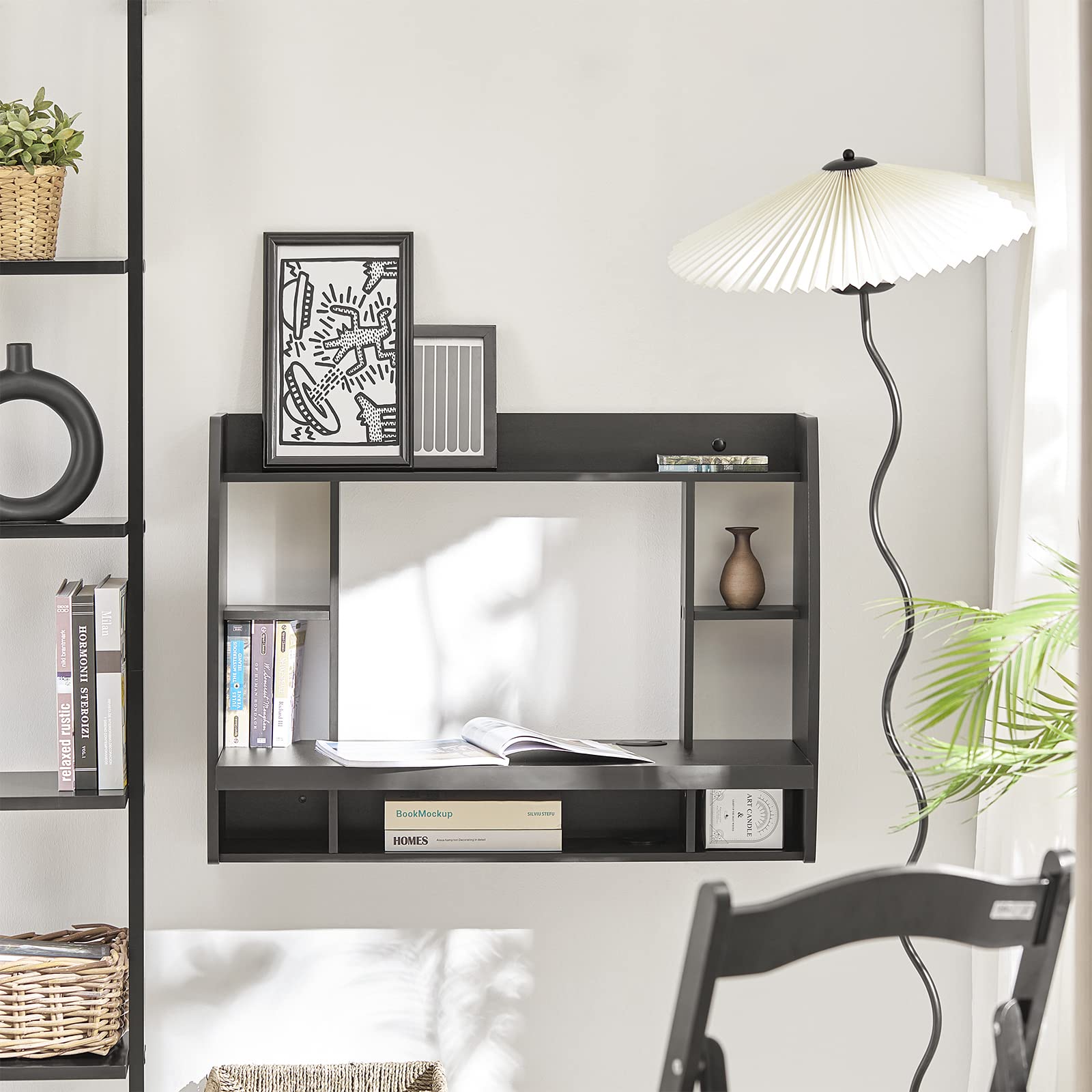
The GIANTEX is what you buy when the desk is never going back up. There's no hinge, no release arm and no folded position: a 41.5-by-21-inch top is held on side support panels and hanging kits, and the 21 inches of depth are the story. That's enough for a monitor on its own stand, a keyboard in front of it, and your forearms still resting on the desk — more depth than anything else here.

As a permanent workstation we found it the easiest of the group to live with. Three cube compartments are built into the frame and take a headset, notebooks and the cable tangle that follows a monitor, and the black finish is plain enough to vanish in a dark room. At 41.5 inches wide it wants a wall of its own; this is not the desk for a hallway.

Two things to plan around. With no load figure published, the anchoring is the whole job: into studs, with fixings you trust, and the tower on the floor rather than the top. And at 38 pounds it's a two-person lift — the hanging kit it ships with is intended for concrete or brick, so a drywall wall needs its own plan.

Bottom Line: If the desk never folds, buy this one: the deepest top in the group and a 41.5-inch surface that takes a monitor, a keyboard and your forearms.
#3

Best for Hiding the Workspace

HOMCOM Foldable Wall Desk

HOMCOM Foldable Wall Desk

8.4/10 Very Good
  • Shelves: 9
  • Closed Depth: 7.7 inches
  • Overall Size: 38.5" W x 20" D x 60.25" H
  • Desktop Capacity: 110 lb
Check Price on Amazon

Pros

  • Nine shelves and compartments in one unit
  • Closes to 7.7 inches with a chalkboard front
  • 110-pound desktop rating
  • Adjustable bottom shelf for books or a printer

Cons

  • Less rigid than a flat wall desk

Closed, it reads as a shallow wall cabinet with a chalkboard front: 7.7 inches off the wall, 60.25 inches tall, the desktop folded up out of sight. Open, it's a 38.5-by-20-inch desk with six compartments above and three shelves below. In a room where the workspace has to be invisible by dinner, that transformation is the whole pitch.

The storage is the most generous here by a distance — nine shelves and compartments in total, an adjustable bottom shelf sized for books or a printer, and a chalkboard that takes the notes which otherwise end up on the desktop. The desktop is rated to 110 pounds on 0.6-inch panelling, which is thin for a top this wide, so treat that figure as a ceiling rather than a target.

Assembly is a genuine two-person afternoon at 46 pounds; plan the day around it rather than squeezing it into an evening. What you get back is a study that becomes a wall when you close it — give it a laptop and a lamp rather than a printer and a tower, and it earns its space.

Bottom Line: For a room where the desk has to vanish: a 60-inch cabinet that opens into a 38.5-inch desk with nine shelves and a chalkboard front.
#4

Best Multi-Room Surface

Neoaider Folding Wall Table

Neoaider Folding Wall Table

8.6/10 Excellent
  • Tabletop: 0.7 inch thick
  • Unit Weight: 10.6 lb
  • Desktop Size: 31.5" W x 15.7" D
  • Maximum Load: 80 lb
Check Price on Amazon

Pros

  • 10.6 pounds, so one person can hang it
  • 80-pound rating on a light board
  • Folds flat and wipes clean

Cons

  • Not a daily workstation at 15.7 inches deep

Not every wall needs a desk. Some need a surface — somewhere to fold laundry, park a laptop for twenty minutes, or set down a tray. The Neoaider is the best of this group at that job: a 31.5-by-15.7-inch white board on folding steel brackets that lifts, locks, and drops flat against the wall when the basket goes back in the cupboard.

The weight is what surprised us. The whole unit is 10.6 pounds, so one person can hold it at chest height and drive screws, and the brackets still carry a listed 80 pounds — the same figure the much heavier TEAMIX claims, and more than the SoBuy. The polyurethane finish wipes clean, the corners are rounded rather than sharp, and the brackets lock firmly when raised and release with a press.

The weak point is the box, not the table. The supplied drywall anchors are the part to replace before you start, and the hinges sit close enough together that two studs aren't guaranteed: a length of timber cleat screwed across the studs solves both problems in about twenty minutes. Do that and this is the most useful small surface in the group.

Bottom Line: Buy it for the laundry room, pantry or spare wall: 80 pounds of capacity on a 10.6-pound board that folds flat when the basket goes away.
#5

Best for Small Bedrooms

YUSING Fold-Down Wall Desk

YUSING Fold-Down Wall Desk

8.4/10 Very Good
  • Unit Weight: 11 lb
  • Closed Depth: 6 inches
  • Desktop Size: 23.5" W x 20" D
  • Maximum Load: 44 lb
Check Price on Amazon

Pros

  • 6-inch closed depth leaves the wall clear
  • Cubbies and paper organizer built in

Cons

  • Lowest load rating of the picks here

A six-inch-deep box on the wall that opens into a 23.5-by-20-inch desk — that's the trick, and it's why we point small bedrooms and hallway corners here. The storage stays put when the top drops: cubbies and an angled paper organizer keep the homework, the pens and the charger in one place even while the thing is shut.

The top folds on hinges rather than a bracket arm, the white MDF wipes down, and at 11 pounds one person can position it on the wall without help. It hangs as furniture rather than as hardware — no brackets on show, no arm to fold around — which is more than most fold-downs here manage.

Two practical notes. The assembly instructions are the weak link, so lay the parts out and check the numbering before you commit or the afternoon runs long. And if the wall isn't solid masonry, replace the supplied fixings with ones you trust before anything goes up. Neither is unusual for this category; both are easy to get ahead of.

Bottom Line: The pick for a kid's room or a hallway corner: a 6-inch-deep wall cabinet that opens into a 23.5-inch desk with cubbies that stay put.
#6

Best Budget Pick

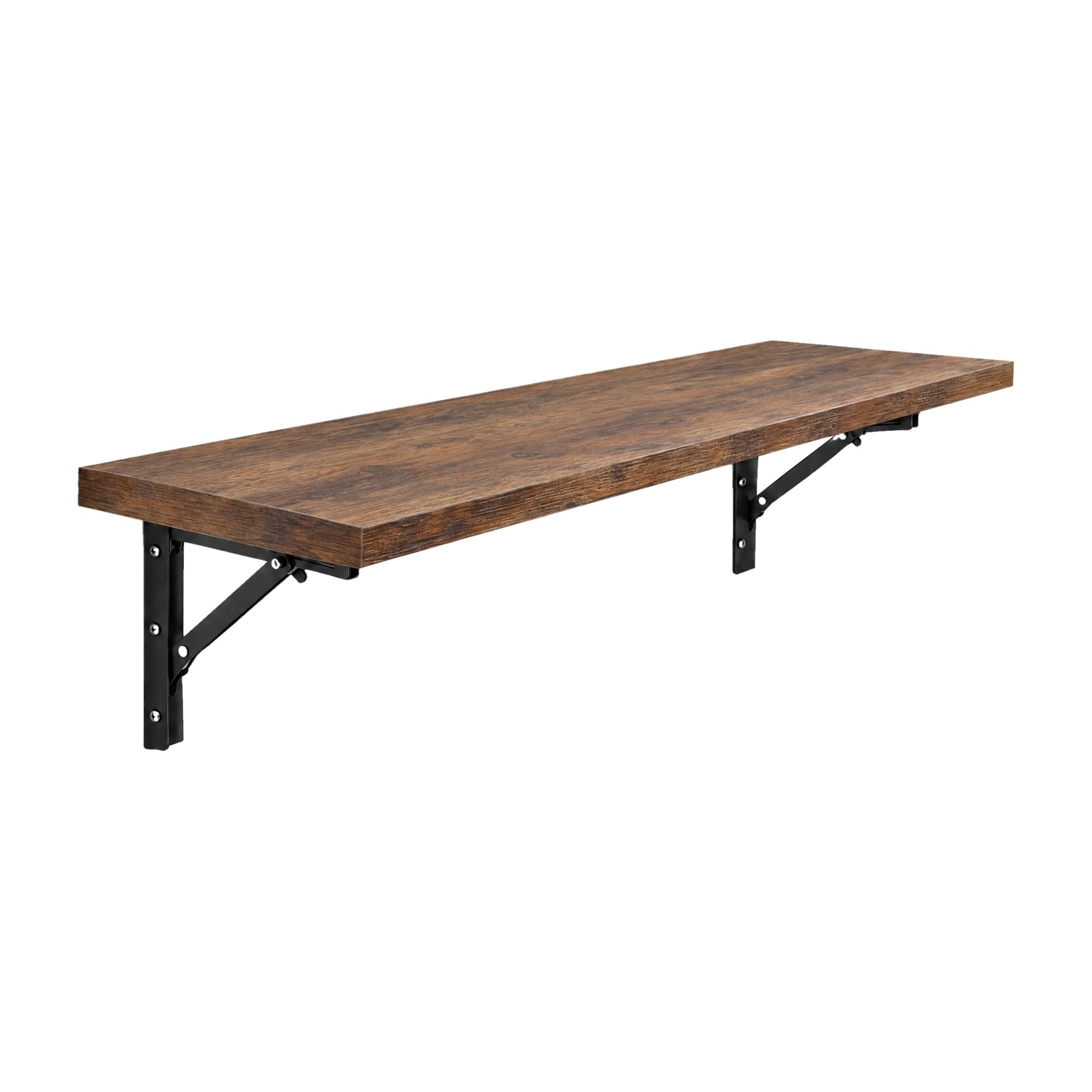
TEAMIX Folding Wall Table

TEAMIX Folding Wall Table

8.6/10 Excellent
  • Unit Weight: 6.5 lb
  • Desktop Size: 23.6" W x 11.8" D
  • Folded Depth: 2 3/8 inches
  • Maximum Load: 80 lb
Check Price on Amazon

Pros

  • Folds to 2 3/8 inches against the wall
  • Lightest pick here at 6.5 pounds
  • 80-pound rating on a small board

Cons

  • 11.8-inch depth rules out a monitor on a stand

23.6 by 11.8 inches is a laptop, a mouse and a coffee, and not a great deal else. The bracket is what makes that useful in a room with no space for a desk: the top drops to 2 3/8 inches from the wall, and the steel supports bring it back level with a lift.

At 6.5 pounds it's the lightest thing here by a wide margin, and the listed 80-pound capacity matches what the much heavier Neoaider carries. It belongs in a laundry, a hallway, a rented studio — anywhere the desk appears for twenty minutes and then goes away. Budget a hardware-store run: the screws in the box are the part to replace before anything goes into the wall.

Our verdict is that this is the right desk for a very small job and the wrong one for a full-time office. What it will do is give you somewhere to answer email that isn't the kitchen table, for the smallest outlay in this group, and it takes up less wall than a picture frame when it's folded.

Bottom Line: The budget pick for a genuinely tiny space: 23.6 inches of board that folds to 2 3/8 inches and still carries 80 pounds.
#7

Long shared surfaces

Houseables Wall Mounted Desk

Houseables Wall Mounted Desk

8.6/10 Excellent
  • Tabletop: 1.25 inches thick
  • Unit Weight: 23 lb
  • Desktop Size: 47.25" W x 15.75" D
  • Maximum Load: 300 lb
Check Price on Amazon

Pros

  • 47.25-inch top seats two in a pinch
  • 1.25-inch top feels substantial

Cons

  • 15.75-inch depth is tight for a monitor and keyboard
  • No storage anywhere on the unit

47.25 inches of desktop is a different proposition from the 23-inch fold-downs here: this is the one you can seat two people at, spread a sewing project across, or use as a bar top against a kitchen wall. The top is 1.25 inches of wood-finish MDF on black steel brackets, and it drops to hang against the wall like the rest.

Twenty-three pounds is the number that decides it for you. That's roughly twice the Neoaider, and it needs studs behind it — a 47-inch span puts real leverage on two brackets. Strong walls are a requirement here rather than a suggestion, and on drywall alone this is the wrong product.

The fold is a drop leaf on metal brackets rather than a cabinet mechanism: it swings up level and stays there, with nothing to latch or adjust. That simplicity is the appeal, and also the limit — there are no shelves, no cubbies and nowhere to put the pencil case except back in the drawer across the room.

We point you here when the wall is long and the need is occasional: dining overflow, a folding station, a desk used in bursts. As a permanent office it's a compromise, because everything you need stays on the top. As the table you open twice a week, it feels more substantial than anything else in this group.

Bottom Line: Worth it when the wall is long and the need is occasional: a 47-inch folding top that takes two people or one big project.

How We Tested the Best Floating Desks

We started with roughly 40 wall-mounted desks from brands we already trust for case goods and office furniture, then cut anything with a vague weight rating, no hardware list, or a folded depth that would block a doorway. That left 12, deliberately mixed between budget fold-downs and pricier consoles, so we could tell whether spending more bought sturdier brackets or just a nicer veneer.

Every desk went into an actual room: a 90-square-foot home office, a bedroom corner where a kid does homework, a kitchen wall that doubles as a bill-paying station, and a hallway. We installed each one ourselves with a drill, stud finder, and level, timing the job and noting whether it was genuinely a solo project — a few needed a second person just to hold the top while the brackets went in. We wrote down exactly what came in the box, since toggle bolts, drywall anchors, and cleats versus plain screws are where the cost-cutting usually shows. Then we used them: laptops, monitors, coffee mugs, and daily open-and-shut cycles on the folding models, counting hinge wobble and checking whether the latch held when closed.

To test sturdiness rather than assume it, we left a 30-pound stack of books on the deepest leaf for a week and watched for sag, then re-checked level and tightened every screw once a month. We wiped each finish with a damp cloth, ran a hand along the seams, and folded each desk to see whether it cleared a chair back and a doorframe. At the end, we asked the only question that matters: did this feel worth what it cost next to the hardware it came with?

How to Choose Floating Desks

Depth decides what the desk can actually do

Fifteen to sixteen inches is the working minimum for a laptop, a mouse and a notebook. Twenty to twenty-one inches is where a monitor on its own stand stops feeling like a balancing act, which is why the GIANTEX is the pick for a permanent workstation and the SoBuy's 15.4 inches suits a laptop-first setup. Under twelve inches — the TEAMIX's 11.8 — you have a shelf that takes a laptop and little else.

We treat depth as the deciding measurement because width is easy to picture and depth is not. Before you compare widths, put a tape on the footprint of whatever currently sits on the desk, monitor stand included.

Fold-down, drop-leaf or fixed

If the desk goes up most evenings, the mechanism matters more than the finish. A bracket-and-latch fold like the TEAMIX and Neoaider swings up quickly and leaves a thin profile against the wall; a cabinet fold like the HOMCOM or the YUSING hides the storage too, at the cost of a deeper box and a heavier lift; a drop-leaf like the Houseables has no latch at all, which is elegant if you use it twice a week and irritating if you use it daily.

And if the desk never comes down — a monitor that stays, a chair that never moves — buy a fixed desk and skip the hinge. You get more surface for the money and nothing to go slack over time.

The bracket carries the load, not the board

Every rating here assumes the fixings hold: 44 pounds on the YUSING, 80 on the Neoaider and TEAMIX, 66.1 on the SoBuy, 110 on the HOMCOM's desktop. In practice the anchors in the box are the most common weak point on wall desks, and drywall plugs alone are no plan for a surface that takes a leaning elbow.

Screw into two studs wherever you can. Where the bracket holes miss 16-inch centers, screw a timber cleat across the studs first and mount the desk to that — it takes twenty minutes and solves both the spacing and the anchoring. Then lean hard on the desktop before you put anything on it. If you can't find studs, this is the wrong category of desk.

Storage that fits real objects

The shelving is where these designs quietly differ. A cube is only useful if a folder fits it, and the compartments under a fold-down top are often sized for stationery rather than for a printer. Measure the tallest and widest thing you plan to park there — binders, a monitor riser, a sewing box — against the internal dimensions before ordering.

Where storage is the main reason you're shopping, the HOMCOM's nine shelves and the SoBuy's drawers do considerably more work than the plain folding boards.

Frequently Asked Questions

Final Verdict

The SoBuy is the desk we point most small rooms to: it folds flat against the wall, carries 66.1 pounds, and keeps the pens and cables in drawers instead of on the desktop.

If the desk will stay up, the GIANTEX gives you the deepest top in this group at 21 inches and a 41.5-inch surface for less money — and that extra depth is the difference between a monitor that fits and one that overhangs. If the whole workspace has to disappear behind a chalkboard door, the HOMCOM is worth the premium.