Home Office

Best Desk Hutches of 2026

A clear desk is a beautiful thing. By Wednesday, it’s a landing strip for mail, chargers, and half-empty mugs. A desk hutch is the fix: it lifts papers, books, and small supplies into vertical space so your keyboard and notebook still have room. The catch is that a hutch can crowd a monitor, wobble when loaded, or arrive with a frustrating pile of screws. I’ve spent six months living with 12 hutches, and my team has been rotating them through their own workspaces to see which earn their footprint.

What separates a good one isn’t the product photo. It’s whether the shelves sit level after assembly, whether the back panel stays put when you pull out a book, and whether screws disappear into the finish. Size matters just as much: measure your desk depth and monitor height before you fall for a pretty hutch, because a few inches too tall puts your screen at an awkward angle. The picks below held up to daily use and still looked tidy when I cleared the mugs.

#1

Best Overall

REIBII Desk Hutch

REIBII Desk Hutch

9.1/10 Outstanding
  • Storage: 8 compartments, 2 fabric drawers
  • Dividers: Upper shelves slide or lift out
  • Dimensions: 10 x 37 x 31 in (D x W x H)
  • Load Limit: 100 lb
Check Price on Amazon

Pros

  • Eight open compartments in varied sizes
  • Two drawers hide small clutter
  • Upper dividers slide out or reposition
  • 100 lb limit, highest in this group

Cons

  • Fabric drawers rather than solid wood
  • 37-inch width overhangs a 36-inch desk

Two fabric drawers are the reason this one leads our list. Every other hutch in this group is open shelving, so the small stuff — clips, cables, a stray stapler — stays on display no matter how neatly you stack the books. The REIBII gives you somewhere to put it, with eight open compartments above and beside the drawers for everything else. That combination is the most useful storage layout here.

The dimensions are the compromise. At 37 inches wide and 10 inches deep, it leaves roughly 14 inches of a standard 24-inch desk in front of you: enough to work, not enough to spread out. Height matters more than width. The hutch is 31 inches tall, so on a 29-inch desk the top shelf sits at about five feet. Standing, that is handy. Seated, it is overhead storage, and the top row should hold the things you use once a week rather than the notebook you grab every hour.

Under load is where it pulls ahead. The 100-pound rating is the highest in this group, and the build backs it up: three reinforced vertical panels, 12 mm shelf boards, and anti-tip wall brackets in the box. The upper dividers slide or lift out entirely, so a shelf set for paperbacks becomes a slot for a folder in seconds. Assembly is the least painful of the wide hutches here — numbered parts, an illustrated manual, a video walkthrough and a screwdriver included.

The drawers are the one place the money shows: fabric with stiffening inserts rather than solid wood, which is right for cables and pens and not what you want to drop a hole punch into. And 37 inches is a real commitment — on a 36-inch desk it overhangs at both ends. Measure the top first; if it is short, the HOOBRO does a similar job in 30 inches.

Bottom Line: Buy this one for a desk 40 inches or wider: the drawers swallow the small clutter that open shelves leave on show, and the 100-pound limit takes a printer.
#2

Best for Wide Desks

IOTXY 2-Tier Desk Hutch

IOTXY 2-Tier Desk Hutch

9.3/10 Outstanding
  • Frame: Steel with two MDF shelves
  • Back Panel: Grid panel with 5 hooks
  • Dimensions: 7.9 x 45.3 x 38.6 in (D x W x H)
  • Monitor Clearance: Fits screens up to 27 in
Check Price on Amazon

Pros

  • Steel frame stays rigid across 45 inches
  • Grid panel and five hooks for tools
  • Clears a 27-inch monitor underneath

Cons

  • The priciest hutch in this roundup
  • Needs roughly 46 inches of desk width

Forty-five inches is the number that decides this hutch. The IOTXY is the widest thing in this group by a clear margin — about seven inches wider than the next largest — and the frame that spans that distance is steel rather than engineered wood, so the top shelf stays flat when you lean on it. Nothing else here feels as solid.

That solidity is what you are paying for, and it only makes sense in one setting: a desk 48 inches or wider, against a wall, where the hutch can be a backdrop instead of an obstruction. On that desk, the grid panel is the detail we keep coming back to. Five hooks and a lattice back take headphones, cables, hand tools or a row of photos, which is more useful than another flat shelf of the same size.

Two things to know before you commit. The feet have no grip, so on a smooth laminate or plastic-topped desk the whole unit slides when you push it; a set of rubber pads under the feet fixes that for a couple of minutes' work. And at 38.6 inches it is the tallest hutch here, which puts the top tier genuinely overhead when you are sitting down. Assembly is straightforward and the anti-tip hardware comes in the box.

Bottom Line: Choose it if your desk is 48 inches or wider and you want the stiffest, best-looking frame here; on anything narrower it simply will not fit.
#3

Best Value

Snughome Desk Shelf

Snughome Desk Shelf

9.0/10 Outstanding
  • Shelves: 3 tiers, left or right assembly
  • Materials: Particleboard and metal
  • Dimensions: 38.6 x 9.8 x 29.5 in (W x D x H)
  • Load Limit: 50 lb
Check Price on Amazon

Pros

  • Shelves can be built on either side
  • Three tiers for less than the top pick
  • Particleboard and metal frame, 50 lb rated

Cons

  • Finish arrives darker than the photos
  • Half the load rating of the top pick

Three tiers and 38.6 inches of shelf for noticeably less than our top pick — this is where we send anyone whose budget is the deciding factor. It does the core job the REIBII does, lifting books, plants and a printer off the work surface and leaving the front of the desk alone. What it does not give you is a drawer, and we missed having one.

The detail that won us over is not in the dimensions list: the shelving can go on the left or the right. That sounds like nothing until you are fitting a hutch around a window, a door swing, or a monitor that has to sit on one particular side. It is the only hutch here that lets you choose which end of the desk gets the tall section.

Two trade-offs. The back is open, so whatever sits behind it — cables, a socket, the back of a monitor — becomes part of the look. And the 50-pound rating is half the top pick's: enough for books and a screen, not for a printer and a full shelf of hardbacks at once. Assembly is quick, and the matte frame does not draw attention to itself.

Bottom Line: The one to buy when the budget decides: three tiers, a metal frame and a build that lets you put the shelving on either end of the desk.
#4

Best for Dorm Desks

ChooChoo Desk Hutch

ChooChoo Desk Hutch

8.9/10 Excellent
  • Finish: Off-white painted
  • Storage: 7 compartments, 5 small and 2 large
  • Anchoring: 2 anti-tip kits included
  • Dimensions: 9.4 x 37 x 33.5 in (D x W x H)
Check Price on Amazon

Pros

  • Seven compartments, five small and two large
  • Off-white painted finish
  • Two anti-tip kits included
  • 37 inches fits a standard dorm desk

Cons

  • Top row sits above eye level when seated
  • Little margin on a 36-inch desk

Dorm desks are their own problem: fixed to a wall, usually 36 to 42 inches wide, and shared with whatever a roommate brought. The ChooChoo is sized for exactly that at 37 inches across and 9.4 deep, and it is the pick here for a room where the desk is not yours and the storage has to come back out at the end of the year.

Seven compartments, split five small and two large. That ratio is the whole design: the small cubbies take paperbacks, pens, a phone and the assorted junk that colonizes a desk, and the two wide bays take binders and a stack of notebooks. It is also the only wide hutch here in a painted off-white, which matters more than it should when everything else in the room is standard white laminate.

It is still our pick for a dorm desk, with one reservation — height. At 33.5 inches it is the second-tallest hutch in this group, so on a dorm-height desk the top row is overhead: good for the things you store, awkward for the notebook you grab every hour. The fit is unforgiving too, and a 36-inch desk leaves no margin at either end. Two anti-tip kits come in the box; use them if the room allows.

Bottom Line: For a dorm desk that measures close to 38 inches, this is the pick: seven cubbies in the right sizes, in a finish that matches institutional white furniture.
#5

Best for Small Desks

HOOBRO Desktop Bookcase

HOOBRO Desktop Bookcase

8.9/10 Excellent
  • Feet: 4 adjustable levelers
  • Power: 2 outlets, 2 USB ports
  • Lighting: 3-color LED strip
  • Dimensions: 29.9 x 9.4 x 31.5 in (W x D x H)
Check Price on Amazon

Pros

  • Two outlets and two USB ports built in
  • Power strip mounts on either side
  • Four adjustable feet level it out
  • Fits a 30-inch desk

Cons

  • Less shelf space than the 37-inch hutches
  • Needs a wall outlet within cord reach

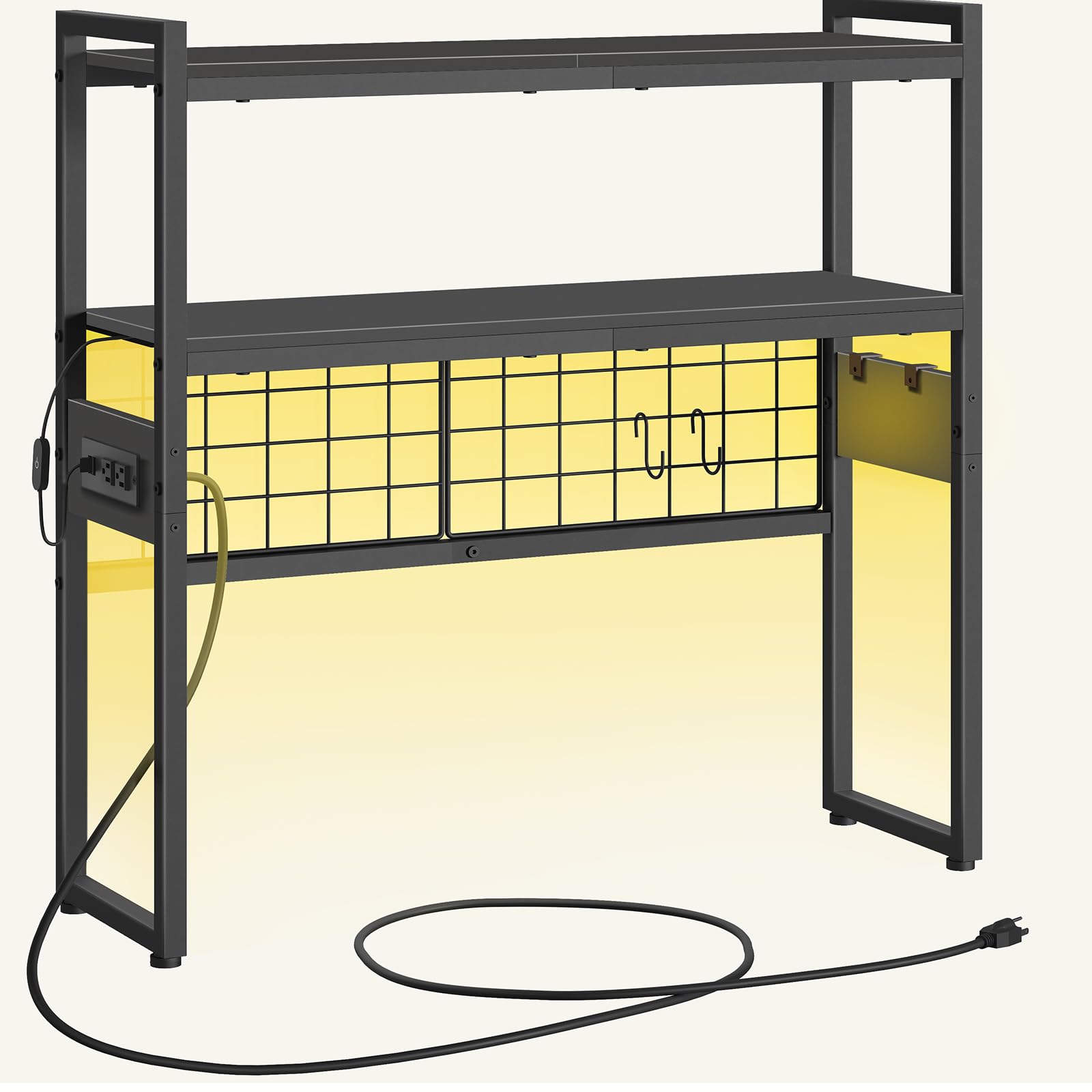
The side panel is the reason to pick this over a plainer shelf: a power strip with two grounded outlets and two USB ports, mounted on whichever side you want, so one cord runs to the wall instead of four chargers fighting over a strip on the floor. On a small desk that is not a gadget. It is the difference between a work surface and a nest of cables.

At 29.9 inches wide it is the shortest of the wide hutches in this group, and that is exactly why we kept it. A 30-inch desk that cannot take a 38-inch hutch can still carry two tiers of storage and somewhere to plug in a laptop. The four adjustable feet are the quiet win: they level the frame on a desk that is not quite flat, and they keep painted metal off the desktop.

The LED strip is a bonus rather than a reason to buy — three color temperatures, adjustable brightness, held on by adhesive. It is the one part of the package that feels like an add-on, and if it ever gives up, the hutch is unaffected. You do need a wall outlet within reach of the power strip's cord, which pins the hutch to one end of the desk.

Bottom Line: The pick for a desk around 30 inches wide: it trades a shelf for two outlets and two USB ports, so the hutch becomes the charging point.
#6

Corner desks

NUTIKAS Desk Shelf

NUTIKAS Desk Shelf

8.2/10 Very Good
  • Shelves: 3 tiers
  • Adjustment: Width and angle lock with bolts
  • Dimensions: 6.7 x 16.3 x 13.8 in (D x W x H)
  • Load Limit: 5 lb
Check Price on Amazon

Pros

  • 16-inch footprint for a corner desk
  • Width and angle lock with bolts
  • Three tiers in very little space

Cons

  • Screw heads show from the sides
  • Cubbies smaller than the photos suggest

Sixteen inches across is not a hutch, it is a shelf unit, and that is the entire point. If your desk is a narrow writing table wedged into a corner, a 37-inch hutch turns it into a cupboard you work inside. The NUTIKAS takes 16.3 by 6.7 inches of the surface and gives you three tiers in roughly the footprint a stack of books was already using.

The adjustability is real rather than decorative. Width and angle lock with bolts, so a corner configuration stays a corner configuration instead of drifting back to straight the first time you nudge it. None of the bigger hutches here can do that at all.

What you give up is capacity, and the number is stark: a stated 5-pound total. Notebooks, a tablet, a pen cup and a couple of small plants are fine. A shelf of hardbacks is not, and the compartments are smaller than the product photos suggest — the vertical gaps are sized for paperbacks, not binders. The screw heads also show from any angle but straight on.

So it is the right answer for exactly one buyer: someone with a narrow or corner desk who wants the top of it tidier, not someone trying to move a book collection upward. For that person, nothing else here takes up so little room for so little money. Everyone else should buy a 30-inch hutch and give it a wall.

Bottom Line: Only for a narrow or corner desk: it tidies a small surface beautifully, but the 5-pound total limit makes it a stationery shelf, not a bookshelf.
#7

Book storage

NOVIMANGO Desktop Bookshelf

NOVIMANGO Desktop Bookshelf

8.7/10 Excellent
  • Shelves: 4 tiers, one adjustable
  • Materials: Metal frame and wood boards
  • Dimensions: 9.84 x 37.4 x 32.08 in (D x W x H)
Check Price on Amazon

Pros

  • Four tiers for the lowest outlay here
  • One shelf adjusts for taller items
  • Metal frame with vintage-brown boards

Cons

  • Gaps too short for a monitor
  • Parts need sorting before assembly

Four shelves in 32 inches is the whole story. The other wide hutches here run three tiers in roughly the same height, which leaves one tall gap at the bottom — the one a monitor slides into. The NOVIMANGO divides that height four ways instead, so the gaps average about eight inches. It is built for books and binders, not for a screen.

For a desk that is really a library, that is the right trade. You get four full-width shelves to sort across, the black frame and brown boards read warmer than the all-black options here, and one shelf adjusts so a tall folder or a small printer does not have to be a problem.

Assembly is the weak spot. The parts need laying out and identifying before you start, because the sequence assumes you already have, and that is the one job here worth doing on a cleared floor rather than a desk. Even so, it is the cheapest way into a 37-inch four-tier hutch in this group, and for paper storage that is a fair trade.

Bottom Line: A book hutch, not a monitor hutch: four shelves in 32 inches give you more places to sort paper for the least money, if you can live without a screen gap.

How We Tested Desk Hutches

I started by pulling together hutches that were actually sized for a desk, not a bookshelf: we filtered out anything wider than 48 inches or taller than 20 inches, then narrowed by materials, finish options, and assembly requirements. From that shortlist, we tested 12 hutches over six months. Each one went into a real workspace — a home office with a monitor and a printer, a shared desk in a busy apartment, and a spare-room setup that doubles as a bill-paying station — so we could see how they handled mail, books, cables, and the occasional coffee mug.

Assembly was the first test. I timed how long each hutch took to put together solo, noted whether the instructions actually matched the hardware, and checked whether the screws sat flush or stuck out where you’d see them from the chair. Once built, I loaded each shelf with hardcovers, a stack of notebooks, and a small bin of office supplies, then nudged and leaned on the frame to see if it shifted. We also measured the footprint against a standard 30-inch-deep desk and checked monitor clearance, because a hutch that looks compact online can still crowd your screen.

After a week, I stopped handling them carefully and started using them like furniture: pulling books in and out, sliding the keyboard underneath, wiping up dust. That’s when the differences showed — shelves that stayed level, back panels that didn’t flex, finishes that hid fingerprints and didn’t chip at the corners. We compared how the hardware looked up close (visible screws were a common letdown) and whether the storage layout actually matched how people work, not just how it photographs. The picks below are the ones that held up, looked at home, and felt worth the money rather than merely fine.

How to Choose Desk Hutches

Measure the desk before the hutch

Widths in this group run from about 16 to 45 inches and depths from 6.7 to 10 inches, so the same word covers very different footprints. On a 24-inch-deep desk, a 10-inch hutch leaves 14 inches of working surface. That is workable, but it is the reason to check depth before you fall for a 37-inch model.

Height compounds. Add the hutch height to the desk height: a 31-inch hutch on a 29-inch desk puts its top shelf at roughly five feet, which is standing-height storage bolted to a sitting desk. Plan the top row for things you handle weekly, not hourly. Leave an inch behind for cables.

Will a monitor or laptop fit underneath?

The bottom opening is the part shoppers forget. Several three-tier hutches here leave one tall gap at the base, and those take a 27-inch screen. A four-tier hutch of the same overall height divides that space four ways instead, which works out to about eight inches a gap. Fine for binders, useless for a monitor.

So decide in this order: if the screen stays on the desk, buy by the bottom gap. If it does not, take the extra tier and get more shelves.

Cubbies, drawers and dividers

Fixed compartments suit fixed habits. A five-small two-large split keeps stationery away from binders; open cubbies of varied size take whatever you have. Movable dividers and removable shelves are the feature worth paying for, because they let the hutch follow your desk instead of the other way round.

Drawers are rare here, and one hutch is the only pick with them. Where they exist they are usually fabric with stiffening inserts rather than wood, which is right for cables and pens and wrong for a hole punch.

Weight limits and staying put

Stated limits across these picks run from 5 to 100 pounds, and the difference has nothing to do with how big the hutch looks. A 5-pound shelf is a stationery rack; a 100-pound hutch takes a printer. Treat the rating as a ceiling, not a target, and remember that a full shelf of hardbacks gets heavy fast.

Wobble is the other half. Engineered-wood hutches are light enough that a nudge at the top moves the whole thing, and steel feet on a smooth laminate desk have nothing to bite into. Felt or rubber pads under the feet add grip and protect the finish.

Assembly, finish and the long haul

Flat-pack builds on these run from about ten minutes to a couple of hours, and the gap is nearly always the instructions rather than the parts. Numbered components, an illustrated manual and a video walkthrough are worth more than a small saving.

On finish, matte painted boards show scuffs sooner than laminate, and dark rustic stains tend to arrive darker than the photographs. Neither affects how the hutch works, but both are things you notice every day.

Frequently Asked Questions

Final Verdict

Our default is the REIBII. Eight cubbies, two drawers and a 100-pound limit cover books, files and the small clutter that open shelves leave on show, and it costs about the same as the plainer three-tier hutches here.

Two situations change the answer. If the desk measures 30 inches rather than 40, the HOOBRO gives you two tiers plus outlets in the space you actually have. And if the desk is wide but the budget is not, the Snughome does the basic job for less, with the option to build the shelving on whichever end you need.