Home Office

Best Ladder Bookcases of 2026

A ladder bookcase is a clever way to add storage to a narrow wall, but the lean that saves floor space can make shoppers pause. Will it wobble when the top shelf is loaded? Will the assembly instructions make sense on a weeknight? And will the finish look like furniture or a dorm-room afterthought? The best versions feel solid under a full shelf of books, look intentional in a living room or home office, and go together without a missing bolt or a misaligned hole.

Over eight months, I tested 10 ladder bookcases, moving them between a narrow living-room wall, a bedroom corner, and a home office. I built each one solo, loaded them with books, plants, and framed photos, and watched for the details that matter later: shelf depth, color match, hardware quality, and whether joints stayed tight after daily use. The picks below are the ones that held up and felt worth the money.

#1

Best Overall

VASAGLE 5-Tier Ladder Shelf

VASAGLE 5-Tier Ladder Shelf

9.5/10 Exceptional
  • Shelves: 5
  • Max Load: 235 lb
  • Footprint: 13.6"D x 22"W x 67.5"H
  • Shelf Spacing: 13 inches
Check Price on Amazon

Pros

  • 13-inch shelf spacing fits hardbacks upright
  • Braced steel frame rated to 235 pounds
  • Anti-tip kit included, not sold separately
  • Assembles solo with labeled parts

Cons

  • Engineered wood panels rather than solid timber

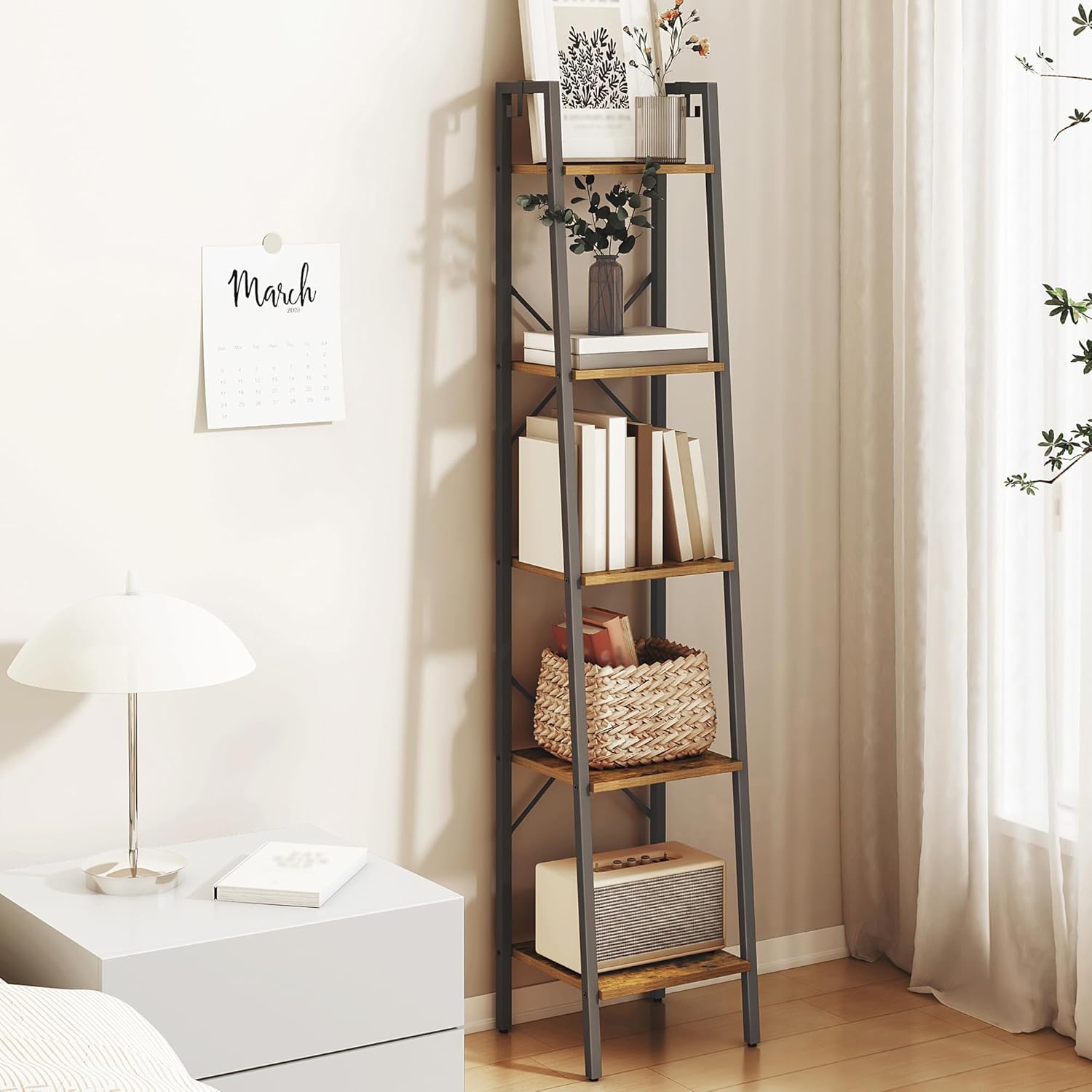
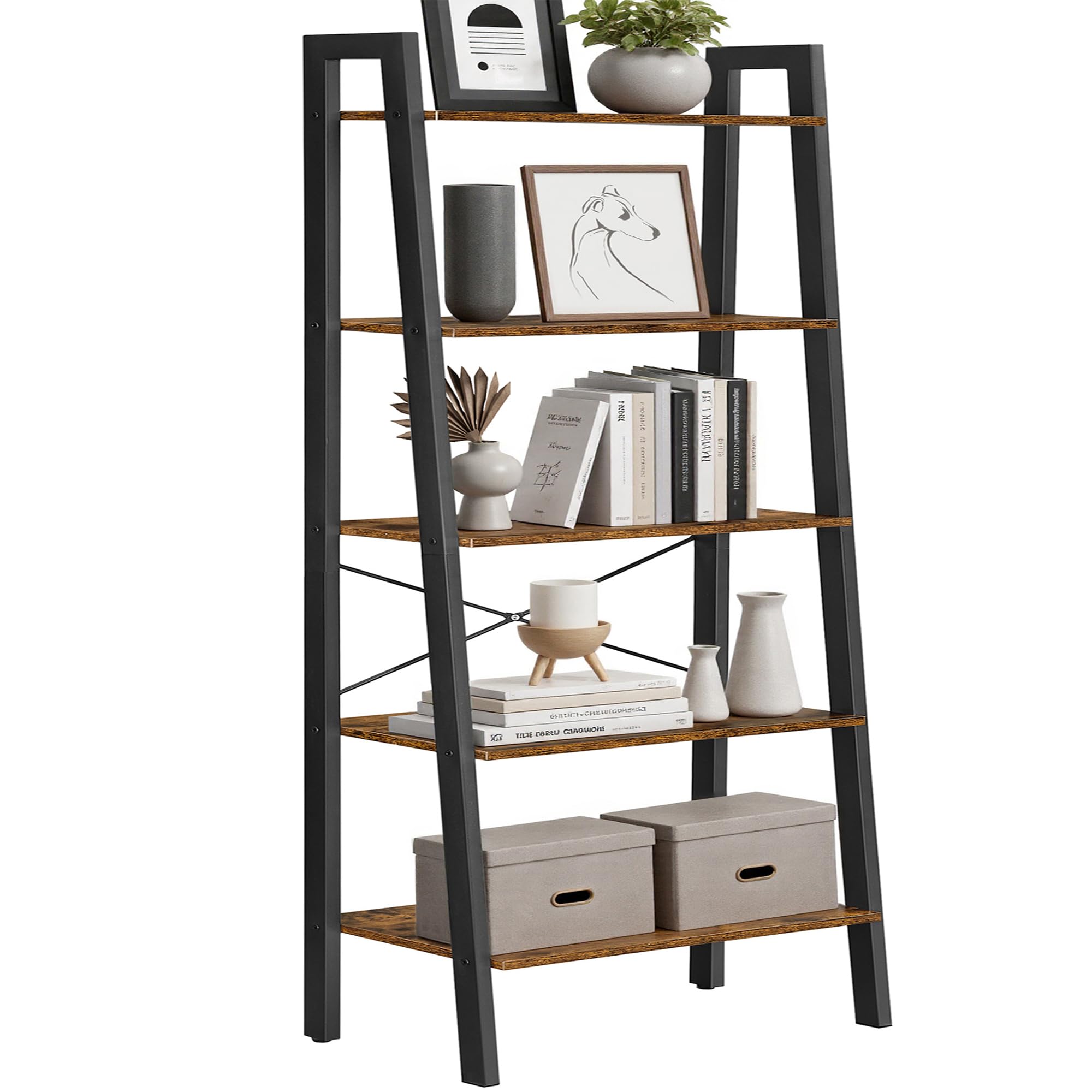
Thirteen inches between shelves is the number that decided this one for us. That gap takes a hardback standing upright, which is more than most ladder shelves manage, and the 22-inch width means it still slips onto a wall a full bookcase would overwhelm. Five levels spread over 67.5 inches adds up to a serious amount of storage in a footprint you barely notice.

The frame backs the claim up: a rust-resistant steel structure with X-braces behind the panels, rated to 235 pounds across the unit, with the anti-tip kit in the box rather than sold as an extra. We built ours alone on a living room floor using the labeled parts, and it felt settled the moment the braces went on. The rustic brown and ink black finish has more depth in person than the photos show.

One thing to plan for: the bolt holes in the legs and shelves don't always line up cleanly. Start every bolt finger-tight, leave the frame slack until all five shelves are threaded, then tighten from the bottom up. Done that way the manufacturer's 15-to-30-minute estimate is realistic; force it and you'll be fighting the frame for an hour.

Set against the solid-wood Casual Home below, this one gives up a little heft and gains a shelf, a lighter frame and a much easier build. The top shelf lands around eye level for most adults, so put the things you want to look at up there and keep heavy volumes low, where the ladder is widest.
Bottom Line: We recommend it to most people: five shelves with room for tall hardbacks, a braced steel frame, and the smallest outlay on this page.
#2

Best Solid Wood

Casual Home Solid Wood Ladder Bookcase

Casual Home Solid Wood Ladder Bookcase

9.1/10 Outstanding
  • Shelves: 5
  • Material: Solid wood
  • Footprint: 16"D x 24.75"W x 72"H
  • Item Weight: 23 lb
Check Price on Amazon

Pros

  • Solid wood frame and shelves
  • 24.75-inch shelves take oversized books
  • Tapered profile looks drawn, not assembled

Cons

  • Chestnut finish reads redder than photos

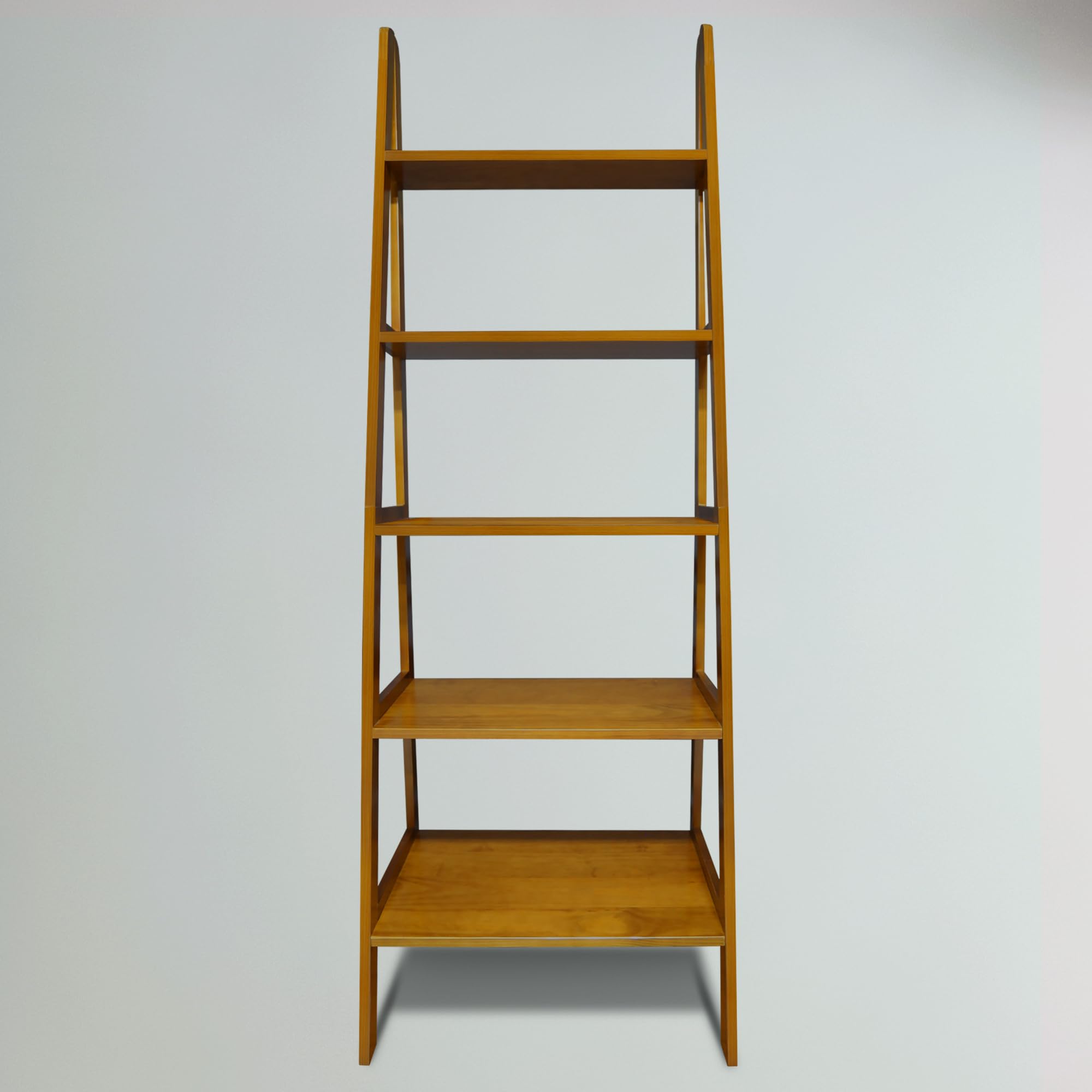
Solid wood is rare in this category, and it's the whole argument for this one. The frame and shelves are real timber rather than particleboard with a wood print, and at 72 inches tall by 24.75 wide it fills a wall the way a proper bookcase does. Ours went together in a single sitting, and the chestnut finish has a warmth the flat-pack picks here can't imitate.

What we noticed after a week of loading it is how much the material changes the feel: heavier shelves, less drumming when you set a book down, and shelf lengths that step down as they rise so the whole thing looks drawn rather than assembled. There's no laminate edge to chip and no veneer to lift, which is more than several picks here can say.

The caveat is at the top. The upper section can sway on carpet until it's fixed, so plan on anchoring the top to the wall or wedging the unit into a corner — once ours was strapped, it stopped moving entirely. At 16 inches deep it also claims more floor than the wall-mounted options, so measure your walkway first. For a landing or a fireplace alcove, though, that depth is exactly what makes the shelves useful.

Bottom Line: Choose this one when you want solid wood and a wide shelf; it's the only solid-timber option here, and it rewards a wall anchor.
#3

Best Wall-Mounted

Nathan James Theo 5-Shelf

Nathan James Theo 5-Shelf

9.3/10 Outstanding
  • Frame: Metal and oak laminate
  • Mounting: Wall mount
  • Footprint: 5.9"D x 23.6"W x 72.5"H
  • Load Per Shelf: 50 lb
Check Price on Amazon

Pros

  • Wall-mounted, so no floor space lost
  • 50 pounds per shelf
  • Lifetime manufacturer warranty

Cons

  • 5.9-inch shelves limit book size
  • Requires drilling into the wall

Six inches of depth is what you're buying here. The Theo fixes flat to the wall at 5.9 inches, so a hallway, a stair landing or the strip beside a door gets five levels of display without a single inch of walkway lost. We were struck by how much that changes a narrow room: nothing to catch a shoulder on, nothing to vacuum behind.

The trade is book size. Shelves 5.9 inches deep take paperbacks, frames, small plants and objects; a standard hardback overhangs the front, so this is display shelving rather than library shelving. What it does hold, it holds firmly — 50 pounds per shelf on a metal frame with oak-laminate panels, backed by a lifetime manufacturer warranty that nothing else on this list offers.

Installation is genuinely a two-step job: the unit screws to the wall, and the assembly guide calls for a drill and a 1/4-inch bit, so renters should clear it with a landlord first. We also wish the edge laminate were tougher, because corners can chip if you knock them while building. Mounted and loaded, though, it reads as fitted furniture rather than a shelf you put up yourself.

Bottom Line: Our pick for a hallway: it hangs on the wall in six inches of depth, so you get display space without giving up floor.
#4

Best with Hidden Storage

IRONCK 4-Tier Ladder Bookcase

IRONCK 4-Tier Ladder Bookcase

9.1/10 Outstanding
  • Footprint: 13.5"D x 27.6"W x 70"H
  • Open Shelves: 4
  • Closed Storage: Louvered base cabinet
  • Load Per Shelf: 50 lb
Check Price on Amazon

Pros

  • Louvered cabinet hides everyday clutter
  • 50 pounds per upper shelf
  • Rustic finish suits hallways and offices

Cons

  • Cabinet costs you one display level
  • Louvered doors make it a two-person build

Most ladder shelves put everything on show, which is fine until you own a router, a stack of paperwork or a child's art supplies. This one hides the mess: four open shelves step up the ladder and a two-door louvered cabinet takes the base, with room for box files and baskets behind it.

At 70 inches tall and 27.6 wide it holds a lot without dominating a room, and the upper shelves are rated to 50 pounds each — enough for hardbacks and a heavy fern. The MDF build is honest rather than lovely; ours was solid once squared up, but the finish is a printed grain rather than timber. The anti-falling hardware comes with it, and you'll want to use it.

But we appreciate the compromise for exactly what it is. You give up one display level to gain a cupboard, and the louvered doors make assembly a two-person job — lining up those panels alone is fiddly. In a home office or an entryway where half the contents shouldn't be visible, that's a trade worth taking.

Bottom Line: We recommend it when half of what you own shouldn't be on display: four open shelves up top, a louvered cabinet below.
#5

Best for Small Spaces

Homykic Bamboo 4-Tier Ladder Shelf

Homykic Bamboo 4-Tier Ladder Shelf

9.0/10 Outstanding
  • Shelves: 4
  • Material: Bamboo
  • Max Load: 140 lb
  • Footprint: 12.5"D x 21"W x 50"H
Check Price on Amazon

Pros

  • Light enough to move one-handed
  • Natural bamboo finish stands out
  • 140-pound total capacity

Cons

  • Four short shelves limit book storage

A 50-inch frame that weighs 12 pounds solves a specific problem: a small room that needs vertical storage but can't take another heavy object leaning on the wall. This one moves with one hand, so it suits a bathroom, a closet or a rented bedroom where the furniture gets rearranged twice a year.

We were surprised by how much the bamboo changes the look. It's a natural material with visible grain, warmer than the black-and-brown industrial finishes most of this list shares, and it shrugs off the odd splash better than the engineered boards elsewhere here — a wet plant saucer won't swell it the way particleboard does. Assembly is a 20-minute job with pre-drilled holes and no surprises.

What you give up is shelf area. Four levels in 50 inches, with the top one short, means this reads as a plant stand more than a library, and the 140-pound total rating is generous for the size rather than a promise about books. If you're shelving a real collection, go to the VASAGLE or the Casual Home; if you need something light and cheerful in a tight corner, this is the one.

Bottom Line: For a bathroom, a closet or a rented room, this light bamboo four-tier is the easiest one here to live with.
#6

Best for Display

IRONCK 5-Tier Tall Ladder Shelf

IRONCK 5-Tier Tall Ladder Shelf

9.1/10 Outstanding
  • Shelves: 5
  • Max Load: 150 lb
  • Footprint: 14.5"D x 31.5"W x 74.8"H
  • Shelf Edge: Raised baffle
Check Price on Amazon

Pros

  • Raised shelf edges stop items sliding
  • 150-pound total capacity
  • 31.5-inch shelves hold wide displays

Cons

  • Top shelf sits above eye level
  • Wide frame needs a long wall

Every shelf on this unit has a raised lip along its edge, and that small detail is the reason to pick it over a plain five-tier. Jars, framed photos and anything round stop at the lip instead of sliding off the front, which matters on a shelf that sits at chest height and above.

At 31.5 inches wide and 74.8 tall it's the largest straight ladder shelf here, with 150 pounds of total capacity and metal-framed wood shelves rather than a printed board. The five levels are wide enough for two rows of books or a proper run of pottery, and the anti-tip device comes in the box.

Height is the other consideration. At 74.8 inches the top shelf sits above eye level for most of us, and the baffles mean you can't slide a tall book forward to read its spine. Plan the lower two shelves for hardbacks and reserve the top for objects you want to look up at.

We paid close attention to how it behaved when loaded, since a tall, deep frame is where wobble usually shows up, and it stayed planted on a level floor with a full shelf of books. The trade is space and money: this one wants a long wall and a bigger budget than the simpler picks, and it earns both only when display is the point.

Bottom Line: If display matters as much as storage, this wide, guarded five-tier gives you the most shelf surface in this group.
#7

Empty corners

Tribesigns Ladder Corner Bookshelf

Tribesigns Ladder Corner Bookshelf

9.0/10 Outstanding
  • Shape: L-shaped stepped corner
  • Max Load: 100 lb
  • Footprint: 11.8"D x 45.6"W x 51.5"H
  • Shelf Surfaces: 12 (9 cubes)
Check Price on Amazon

Pros

  • Turns a dead corner into storage
  • Twelve shelf surfaces at varied heights
  • Sturdy 100-pound frame

Cons

  • Many parts, with rails that need dry-fitting
  • Only 51.5 inches tall at the top step

Corners are where floor space goes to die, and this is the pick that does something about it. Nine cubes climb from right to left in a staircase, so the unit hugs two walls — 45.66 inches across, 51.57 tall — and turns a dead angle into twelve shelf surfaces.

The stepping is more than decoration. Because the cubes rise at different heights, the unit takes tall art books, a row of records and a cluster of small objects without any of them competing for the same clearance, and the varying levels break up what could have been a very boxy wall.

Assembly is the honest cost. There are a lot of parts here — shelves, rails and the hardware to join them — and screw holes on some rails don't line up cleanly, so dry-fit each panel before you tighten anything. Budget an evening and a second pair of hands.

We found the result worth it: 100 pounds of capacity, a frame that stops moving once it's squared, and a piece that reads as built-in rather than bought. If you only have one straight wall to fill, the VASAGLE does that job for considerably less money and far less effort.

Bottom Line: Our corner solution: it turns dead space into a dozen display surfaces, provided you'll spend an evening with the hardware.
#8

Narrowest gaps

Hzuaneri 5-Tier Ladder Shelf

Hzuaneri 5-Tier Ladder Shelf

9.1/10 Outstanding
  • Extras: Two side hooks
  • Shelves: 5
  • Footprint: 11.8"D x 13.4"W x 63"H
  • Load Per Shelf: 30 lb
Check Price on Amazon

Pros

  • Narrowest footprint here at 13.4 inches
  • Two side hooks for keys or cables
  • Quick, tool-light assembly

Cons

  • 30-pound shelf limit rules out heavy books
  • Light frame needs the wall anchor

At 13.4 inches wide, this is the narrowest shelf here by a comfortable margin. It will stand in the gap between a door frame and a wall, or in a closet beside hanging clothes, where nothing else on this list fits at all. Five shelves inside 63 inches is a lot of storage for that footprint.

It's built to a price, though. The frame is light at 14.1 pounds, each shelf takes 30 pounds, and the whole thing depends on the included anti-tip kit and a snug wall to feel planted. We put ours together quickly and it does the job, but a nudge near the top tells you it isn't in the same class as the steel-framed picks above. The two side hooks are a small, genuinely useful addition for keys or headphones.

We keep it on the list because nothing else here fits a 14-inch gap, and those limits are easy to live inside: paperbacks, small plants, a few frames, and the heaviest items on the bottom shelf. If your gap is wider than that, spend a little more and take the VASAGLE instead.

Bottom Line: We keep this for the tightest gap: 13.4 inches wide, with a wall anchor we consider mandatory rather than optional.

How We Tested Ladder Bookcases

We started by narrowing the field to ladder bookcases with published dimensions, clear weight limits, and assembly instructions available before purchase, then compared shelf depth, footprint, finish options, and hardware. From that shortlist, I tested 10 bookcases over eight months. Each one went into a real room—a narrow living-room wall, a bedroom corner, and a shared home office—and stayed there through daily use.

Assembly came first. I unboxed each bookcase, sorted the hardware, and built it solo with the included tools, timing the process and noting whether the pre-drilled holes lined up, whether bolts and cam locks seated cleanly, and whether the instructions matched the parts in the box. I then loaded each shelf from the bottom up with hardcovers, plants, and picture frames, checking whether the frame stayed square, whether the top shelf felt steady, and whether the included wall anchor was practical to install. A firm nudge helped reveal wobble before the books went on.

After that, I lived with them. I measured the footprint against a narrow wall and checked whether tall books, baskets, and frames fit without overhang. I looked at the finish in morning and evening light, compared the color to the swatch, and wiped the shelves with a damp cloth to see how they held up. Over eight months, I moved a couple between rooms and rechecked joints, shelf sag, and hardware tightness. The bookcases that made the list stayed sturdy, looked intentional, and felt worth the space and money they asked for.

How to Choose Ladder Bookcases

Measure the wall before you shop the shelves

The biggest difference between these products isn't the number of tiers, it's the depth. A wall-mounted unit like the Nathan James sits 5.9 inches off the wall; the solid-wood Casual Home takes 16. Tape the footprint on the floor and walk past it for a day before you commit. A 16-inch shelf that clips a doorway becomes a daily annoyance, while a 6-inch one that only holds paperbacks may not clear the pile already on your floor.

Width runs from 13.4 inches on the narrowest unit to 45.66 for the corner model, so measure the gap rather than the room. Height is the easiest dimension to accommodate, because it's the vertical space you were never using anyway.

Shelf spacing and the ladder taper

Ladder shelves narrow as they rise — the bottom shelf is the deepest and the top is the shortest — so your books decide the layout. Thirteen inches of clearance, as on the VASAGLE, stands most hardbacks and cookbooks upright; tighter gaps push you toward paperbacks, art books laid flat, or objects. Measure your tallest book before ordering rather than after.

Then load from the bottom up. Heavy volumes go low, where the frame is widest and a knock is least likely to matter, and light pieces go on the top shelf, which is the shallowest and the most likely to be brushed in passing.

Wall-mounted or freestanding

A leaning shelf needs a wall behind it and its anti-tip strap fitted; a wall-mounted one needs a drill, a fixing and permission. Renters tend to assume the freestanding unit is the safe choice, but a leaning shelf still wants anchoring, and a tall shallow frame standing alone in the middle of a wall is the least stable arrangement there is.

Put it in a corner or flat against the wall and use the strap. If you genuinely can't put a hole in anything, choose a wider, heavier unit rather than a light one — mass buys back some of the steadiness that anchoring would have given you.

What the shelves are made of

Solid wood, engineered board on a steel frame, and bamboo all behave differently in a room. Timber is heavier, quieter under a book and doesn't chip at the edges; engineered panels are lighter and cheaper but can lose their laminate at corners; bamboo is light and copes better with damp than board does.

More useful than the material marketing is the per-shelf load rating — 30 pounds on the cheapest units, 50 on the IRONCK and the Nathan James. Check it shelf by shelf, because a generous total can hide a weak top level where the taper leaves you the least surface.

Decide whether the base should hide something

An open ladder shelf is a display piece, and it shows everything: cables, paperbacks, the folders you meant to file. If half of what you own shouldn't be visible, a unit with a cabinet at the base earns its keep — the IRONCK with the louvered doors trades one display level for a cupboard you can close.

We think that trade is worth making in an entryway or a home office, and not worth making in a living room where the shelves themselves are the point. Decide which room it's for before you decide which unit to buy.

Frequently Asked Questions

Final Verdict

The VASAGLE is the ladder bookcase we tell most people to buy. Thirteen inches between shelves takes real books, the braced steel frame carries 235 pounds, the anti-tip kit comes in the box, and none of the more expensive picks here combine that with such an easy solo build.

Spend more only for a specific reason: the Casual Home if you want solid timber, the Nathan James if the shelf has to hang six inches off a wall, or the IRONCK with the cabinet if half your clutter should stay out of sight.