Home Office

Best Office Bookcases of 2026

An empty bookcase is easy to sell. Any unit looks tidy and level holding a fern and two framed photos, but fill it with hardbacks, binders, and a decade of printer paper and the truth comes out: shelves bow, the whole thing leans off the wall, and the back panel turns out to be a creased sheet of cardboard. A good office bookcase fixes exactly that — it carries your reference shelf, your archive boxes, and whatever you need within reach during a call, and it's still square two years in.

One thing I'd tell any first-time buyer: check the shelf span, not the shelf count. A wide shelf of hardbacks sags within a year unless the board is thick or there's a center support, and most listings don't tell you either way. We built 10 bookcases over nine months — some in twenty minutes, one over an entire Saturday — and loaded each with real books and office gear. The picks below held up on sturdiness, looks, and value, and a few cost far less than they look.

#1

Best Overall

SUPERJARE Triple Bookshelf

SUPERJARE Triple Bookshelf

9.3/10 Outstanding
  • Shelves: 11 adjustable
  • Dimensions: 9.5" D x 59.5" W x 54.9" H
  • Leveling Feet: 8 adjustable
  • Shelf Capacity: 22 lb each
Check Price on Amazon

Pros

  • 11 adjustable shelves hold a working library
  • Shallow 9.5-inch depth saves floor space
  • 22-pound shelf limit suits books and binders
  • Eight leveling feet handle uneven floors

Cons

  • Open shelves leave office clutter visible

A 59.5-inch-wide run of 11 open shelves is a different kind of office bookcase: it keeps the working library at eye level instead of stacking it toward the ceiling. Each shelf is rated for 22 pounds, so hardbacks, binders, and a few display pieces can share the same run. We make it the default for most offices because it turns a blank wall into usable storage without pushing the desk into the middle of the room.

The 9.5-inch depth is the quiet win. It leaves enough room for standard books and magazine files while keeping the unit from becoming a corridor obstruction. The shelves adjust, which matters if your office library mixes tall reference volumes with short paperbacks, and the eight leveling feet take up the wobble on an older floor.

This is a flat-pack project, and the shelf count means it takes longer than a simple three-tier case. The payoff is a piece that reads more like a credenza than a bookcase. We like the industrial brown finish for a home office because it warms up black desk equipment without looking rustic-heavy.

The catch is wall space: 59.5 inches is a real commitment, and a narrow office should look at the NUMENN five-tier or Furologee instead. On a long wall, though, the low profile keeps the room feeling open while giving you more usable shelf frontage than two tall cases.

Bottom Line: Our pick for most offices: 11 adjustable shelves across a wide, shallow frame hold books, binders, and display pieces without swallowing the room.
#2

Best Value Tall Bookcase

NUMENN 5-Tier Bookshelf

NUMENN 5-Tier Bookshelf

9.1/10 Outstanding
  • Shelves: 5
  • Dimensions: 11.81" D x 23.6" W x 60.4" H
  • Shelf Capacity: 30 lb each
  • Total Capacity: 150 lb
Check Price on Amazon

Pros

  • Five 30-pound shelves on a compact footprint
  • 150-pound total capacity
  • Anti-tip hardware included
  • 60.4-inch height uses vertical space

Cons

No notable drawbacks to flag.

Five shelves on a 23.6-inch footprint is the arithmetic that makes this NUMENN useful in a small office. It stands 60.4 inches tall, so it holds a working collection without demanding the wall run of a triple-width unit. The 11.8-inch depth is generous enough for binders, and the closed back keeps small items from sliding through.

We keep coming back to it as the value pick because the useful numbers line up: 30 pounds per shelf, 150 pounds total, and anti-tip hardware included. The metal frame and wood panels are a sensible office compromise rather than a piece you buy for the finish alone.

Assembly is a seven-step job with labeled parts, and the unit weighs 25.3 pounds before you load it. That makes it manageable to slide into position, and the anti-tilt fitting is part of the build rather than an afterthought. The open design also makes it easy to see what you have without pulling every book forward.

At 60.4 inches tall, it splits the difference between a low credenza and a full wall unit: the top two shelves are still within easy reach for most people, and the whole thing stays visually light. That is the version of a tall bookcase we choose for a working office rather than a showpiece library.

Bottom Line: For a tall bookcase at a sensible price, this is our pick: five deep shelves, a 150-pound total limit, and a wall anchor in the box.
#3

Best for Tall Book Walls

HOMISSUE 7-Tier Bookshelf

HOMISSUE 7-Tier Bookshelf

9.2/10 Outstanding
  • Frame: Metal and engineered wood
  • Shelves: 7
  • Dimensions: 11.8" D x 23.6" W x 84.4" H
  • Weight Capacity: 70.6 lb
Check Price on Amazon

Pros

  • Seven shelves in an 84-inch tower
  • 23.6-inch width saves floor space
  • Metal frame adds rigidity
  • Adjustable feet steady uneven floors

Cons

  • Open sides show wall clutter and cords

An 84.4-inch bookcase is a commitment, and the HOMISSUE earns it by doing one thing well: stacking seven shelves into a 23.6-inch-wide strip of floor. In a home office with more height than wall length, that is a better use of the room than another low unit that eats the same footprint and stores half as much.

The metal frame and engineered-wood shelves give it the industrial look the photos promise, and the 70.6-pound listed capacity is enough for a working collection if you spread the weight rather than loading one shelf with hardbacks. Four adjustable feet help it sit level on an old floor.

We like it as the tall option because it does not need a deep footprint to feel substantial. At 11.8 inches deep, it tucks into a narrow office and draws the eye upward. The open frame also keeps the room from feeling walled in, which is the risk with a solid 84-inch case.

Assembly is the part to plan for. Seven shelves and a tall frame mean a long session with a lot of fasteners, and the top shelves sit above eye level, so a step stool belongs nearby. Anchor it to the wall before you load the upper levels; at this height, stability is not something to leave to gravity.

Bottom Line: When you want a floor-to-ceiling library wall without giving up floor space, this 84-inch tower is the one we choose.
#4

Best Compact Bookcase

MNEETRUNG 3-Tier Bookshelf

MNEETRUNG 3-Tier Bookshelf

9.4/10 Outstanding
  • Shelves: 3
  • Dimensions: 11.8" D x 15.7" W x 27.6" H
  • Shelf Spacing: 11.2"
  • Total Capacity: 50 lb
Check Price on Amazon

Pros

  • Fits under a desk or in a tight gap
  • 11.2-inch shelf gap holds binders upright
  • 50-pound total capacity
  • Light enough to move before loading

Cons

  • No concealed storage for office clutter

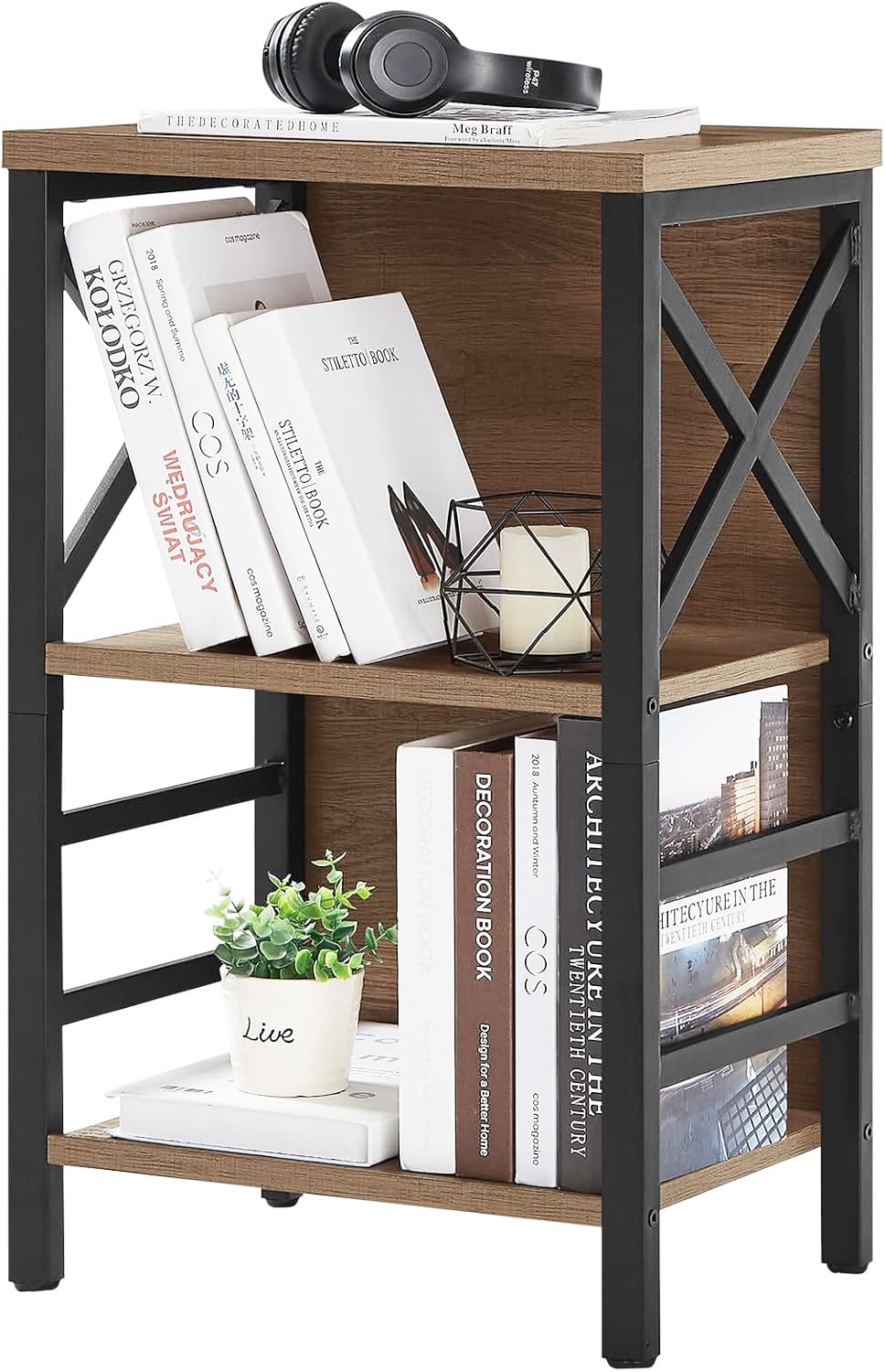
At 27.6 inches tall, the MNEETRUNG fits places a full bookcase cannot: under a desk return, beside a reading chair, or in the gap between a filing cabinet and the wall. The 15.7-inch width keeps it out of the way, but the 11.2-inch shelf spacing means it is not just a knick-knack shelf. Standard binders and most hardbacks stand upright.

The frame is metal with wood shelves, and the X-shaped sides give it a sturdier look than the footprint suggests. Three shelves and a 50-pound total limit mean you should think of it as a focused satellite shelf rather than the office's main library. Put the heavy reference books on the bottom and keep the top for current project materials.

Assembly is one of its better qualities: the parts are labeled, the tools are included, and the whole thing comes together without a drill. The 11.2-pound frame is easy to move before it is loaded, which makes it a good choice for a renter who rearranges a workspace.

What we like most is the restraint. It does not try to be a display wall; it gives a small office exactly enough shelf frontage for the books you reach for daily, then leaves the rest of the room alone. If you need to store a hundred hardbacks, go bigger; for a desk-side working shelf, this is the one we choose.

Bottom Line: The best small-office bookcase here: it tucks under a desk or beside a chair, holds a surprising number of books, and asks almost nothing of the room.
#5

Best for Large Collections

NUMENN Triple Column Bookshelf

NUMENN Triple Column Bookshelf

9.4/10 Outstanding
  • Frame: Metal and engineered wood
  • Shelves: 14 adjustable
  • Dimensions: 10.2" D x 49.4" W x 66.9" H
  • Leveling Feet: Adjustable
Check Price on Amazon

Pros

  • 14 adjustable shelves in one wall unit
  • Triple bays separate books and supplies
  • 10.2-inch depth keeps it close to the wall
  • Adjustable feet handle uneven floors

Cons

  • No closed storage for office supplies

Fourteen shelves in a single 49.4-inch-wide frame is the reason this NUMENN belongs in a busy office. The triple-column layout gives you separate bays for books, binders, and display pieces, and the shelves adjust so a tall reference volume does not force an empty gap above it. We choose it when the goal is maximum storage per square foot of wall.

At 66.9 inches tall and 10.2 inches deep, it stays close to the wall and leaves the floor clear. The 70-pound listed capacity is not huge spread across 14 shelves, so this is a bookcase for paperbacks, files, and carefully distributed hardbacks rather than a solid wall of encyclopedias. That is the honest limit of the design.

The adjustable feet are a small detail that matters in an older office: a slight wobble on a wood floor is easy to chase out before the shelves go in. We also like that the open bays make it easy to see what you have, which is the point of a working shelf rather than a closed cabinet.

Assembly is a longer project than the shelf count suggests, and the 42.6-pound frame is easier to stand upright with a second pair of hands. Once it is square and anchored, though, the result is a wall of storage that looks intentional rather than improvised.

Bottom Line: Our high-capacity pick: 14 adjustable shelves turn one wall into a dense, orderly office library without the footprint of two separate cases.
#6

Best for Tight Corners

SUNMORY Tree Bookshelf

SUNMORY Tree Bookshelf

8.9/10 Excellent
  • Shelves: 6 angled
  • Material: Engineered wood
  • Dimensions: 7.87" D x 14.57" W x 47.4" H
  • Lower Storage: 2 compartments
Check Price on Amazon

Pros

  • 14.57-inch width fits tight corners
  • Six angled shelves display titles clearly
  • Two lower compartments add storage
  • Tree silhouette adds character

Cons

No notable drawbacks to flag.

The tree shape is not a gimmick if floor space is tight. The SUNMORY stands 47.4 inches tall but only 14.57 inches wide, so it slips into the corner beside a desk where a conventional bookcase leaves a dead gap. Six angled shelves and two lower compartments give you a place for paperbacks, plants, and the small office items that otherwise colonize the desk.

We like it most as a display shelf with a secondary storage job. The angled tiers make titles easy to read at a glance, and the narrow profile keeps a small office from feeling like a stockroom. It is a piece you notice, which is rare for a small shelf.

The limit is the format: angled shelves and a 14.57-inch width are not built for a run of oversized art books or a full set of matching binders. The 47.4-inch height is easy to misjudge in photos, so check it against the chair rail or window before you commit.

Assembly is manageable but not the point of the piece; the draw is the silhouette and the way it turns an awkward corner into useful storage. If your office library is mostly hardbacks, choose a rectangular unit; if you want a shelf that makes a small room feel considered, this is the one.

Bottom Line: For a small office that wants personality as much as storage, this angled tree shelf earns its footprint; it holds paperbacks and display pieces, not a wall of binders.
#7

Slim tall spaces

Furologee 6-Tier Bookshelf

Furologee 6-Tier Bookshelf

9.0/10 Outstanding
  • Shelves: 6
  • Dimensions: 10.6" D x 15.3" W x 59.6" H
  • Shelf Capacity: 30 lb per tier
  • Total Capacity: 180 lb
Check Price on Amazon

Pros

  • 15.3-inch width fits a narrow slot
  • Six shelves use vertical space
  • 30-pound tiers with 180-pound total
  • Anti-tip kit included

Cons

  • Open shelves leave clutter visible

A 15.3-inch-wide bookcase is a specialist tool. The Furologee fits the sliver between a door frame and a desk, or the end of a hallway that is too narrow for a standard case, and it uses the height instead: 59.6 inches across six shelves. Each tier is rated for 30 pounds, with a 180-pound total, so it can hold a real working collection rather than a few decorative objects.

The frame is metal with wood shelves, and the X-bars and side poles keep the open design from feeling spindly. Anti-tip hardware is included, which matters because a tall narrow unit has a small base relative to its height. Load the bottom shelves first and anchor the top to the wall; that is the difference between a useful slim shelf and a tipping hazard.

We choose it when the room has more height than width. It is not the bookcase for a wide display of art books, and the narrow shelves force you to organize vertically, but that constraint is also what makes it fit. In a small office, a shelf that uses dead vertical space is worth more than a wider one that blocks the walking path.

Assembly instructions are the weak point; expect to study the diagrams rather than skim them. The payoff is a tall, open shelf that disappears into a narrow gap and holds far more than its footprint suggests.

Bottom Line: The slim tall pick: 15.3 inches wide and 59.6 inches high, it turns a useless strip of office wall into six levels of storage.
#8

Cube display

LEYAOYAO Cube Bookshelf

LEYAOYAO Cube Bookshelf

8.9/10 Excellent
  • Legs: Plastic
  • Finish: Glossy
  • Storage: 7 cubes
  • Dimensions: 9.45" D x 31.5" W x 43.3" H
Check Price on Amazon

Pros

  • Seven cubes organize books and display
  • 43.3-inch height leaves sightlines open
  • Glossy mid-century finish looks furniture-like
  • 31.5-inch width fits a short wall

Cons

  • Glossy finish shows dust and fingerprints

The LEYAOYAO is the most furniture-like piece here: a 31.5-inch-wide grid of seven cubes with a glossy brown finish and a mid-century silhouette. It is 43.3 inches tall, so it sits below eye level in most offices and doubles as a display surface rather than a looming wall of shelves.

The cube format is the appeal. You can dedicate one bay to books, one to boxes, one to a plant, and the rest to the objects that make an office feel less institutional. The 9.45-inch depth keeps it close to the wall, and the open grid makes it easy to pull things in and out.

The plastic legs are the detail that keeps it from feeling like a serious piece of furniture. They are visible at floor level, and the glossy finish is less forgiving than a matte laminate. Neither is a dealbreaker in a home office, but you should know what you are buying.

We like it when the shelf is part of the room's look, not just storage. Keep the cubes for the things you want to see, and put the dense book runs on a rectangular case; this one earns its place by making the office feel less like a stockroom.

Bottom Line: A good-looking cube organizer that makes a small office feel considered, as long as you treat it as display storage rather than a book wall.

What Every Bookcase Went Through Before It Made the List

We started with a shortlist of about 30 bookcases sized for an office — 30 to 36 inches wide and no more than 15 inches deep — and cut anything rated under 50 pounds per shelf, anything with an unsupported shelf span past 30 inches, and anything whose listing was vague about what the boards actually were. That left 10, spanning flat-pack particleboard, veneer over MDF, and solid wood, so we could judge what the extra material really buys you.

Each one was assembled solo in a working home office using only the tools in the box, and we timed it from the first carton flap to standing upright. We followed the instructions literally, even where we knew a faster order, and noted every step we had to reread, every diagram that showed a panel facing the wrong way, and whether the hardware bag matched the parts list. Two builds stalled on a mislabeled piece; we counted that time, because you'd have to.

Then we loaded them. Every shelf got roughly 40 pounds of hardbacks, binders, and archive boxes, and we nudged each unit side to side to see how much it shifted before we anchored it to the wall. We measured shelf sag with a straightedge at one week and again at six months, checked whether doors and drawers still closed squarely, and watched the finish around the shelf pins for chipping as we moved shelves up and down — which is where adjustable shelving earns or loses its keep. Last, we compared footprint and shelf depth against the listed measurements, since a couple ran an inch off, and looked at each bookcase from the doorway, which is how you'll actually see it every day.

How to Choose Office Bookcases

Measure the wall before the shelf count

An office bookcase fails most often at the planning stage, not the assembly stage. A 59.5-inch-wide unit needs a long clear run; an 84-inch tower needs height and a safe anchor point. Measure the wall, the depth from the wall to the desk chair, and the tallest item you plan to put on top. A low, wide case can sit under a window; a tall one can block light and make the window hard to open.

We treat depth the same way. A 9.5- to 11.8-inch case holds standard books and binders without becoming an obstacle. If the room is narrow, a 15-inch-wide tower uses vertical space instead of floor space. Compact in a listing means small footprint, not necessarily a fit for the gap you have.

Match shelf spacing to the office, not just the books

Binders, lever-arch files, and printers are less forgiving than paperbacks. Check the gap between shelves and whether the shelves adjust. An 11.2-inch spacing fits many upright binders; a fixed decorative shelf may not. If you store tall reference books, adjustable shelves prevent wasted air. Measure the tallest binder and add an inch before you choose.

Open shelves are best for things you need to see and reach. If the office is also where mail and cables pile up, closed storage or a few baskets will do more for the room than another row of open shelves.

Read the load limit and anchor the tall ones

Per-shelf limits matter more than a big total with open shelves. A 30-pound shelf is fine for a row of hardbacks; a 22-pound shelf calls for spreading weight. Keep heavy items low, and do not put a printer on a top shelf unless the surface and the limit support it.

Any bookcase near 60 inches or taller should be anchored to the wall, especially in an office with children, pets, or a rolling chair. Use the supplied anti-tip hardware and fix it into a stud or a suitable anchor. This is not a decorative extra; it is the difference between a shelf and a hazard.

Budget for assembly and material

Flat-pack bookcases are a weekend-hour decision as much as a style decision. A three-tier unit can be a short job; a 14-shelf wall is a longer one with many fasteners. Sort the hardware, leave the screws loose until the frame is square, and tighten at the end. Two people make tall units easier to stand upright.

Engineered wood is normal at this end of the market, but edges and back panels are the weak points. A metal frame adds rigidity; a thin back panel can tear if it is dragged. If the bookcase will move between rentals, choose a lighter unit and keep the back panel protected.

Choose the format that suits the work

A bookcase can be a library wall, a display shelf, or a place to hide office clutter. Wide, low units give more usable frontage at eye level; tall narrow units save floor space; cube and tree shelves add shape but are less flexible for oversized books. We like open shelves for a working office because they keep current project materials visible, but they are unforgiving of clutter.

Pick the format after you know what will sit on it. If most of your storage is hardbacks and binders, prioritize adjustable rectangular shelves. If it is paperbacks, plants, and objects, a smaller cube or tree shelf can make a tight office feel less utilitarian.

Frequently Asked Questions

Final Verdict

For most offices, the SUPERJARE Triple Bookshelf is the one we recommend. Its 11 adjustable shelves make better use of a long wall than a tall tower, and the shallow depth keeps the room usable. If your office has more height than wall length, choose the HOMISSUE 7-Tier and anchor it; if you need a desk-side shelf, the MNEETRUNG is the compact answer.