Home Office

Best Office Chair for Back Pain of 2026

An office chair can feel supportive for the first hour and turn on you by the third. The problem usually isn't padding—it's a lack of adjustment where your lower back needs it. I've spent years working from a spare-room desk, and the chairs that helped weren't the plushest; they were the ones I could dial in and forget. Over six months, my team and I lived with 12 office chairs, from task chairs to high-back models, to see which ones hold up through a full workday.

A chair for back pain has to do two jobs at once: support your spine in a neutral position and let you shift when you get restless. We looked at how firm each seat felt after a full day, how easily the lumbar support and recline adjusted without breaking focus, and whether the arms got in the way of pulling up to a desk. The picks below are the ones that earned a permanent spot at my desk and my teammates'.

#1

Best Overall

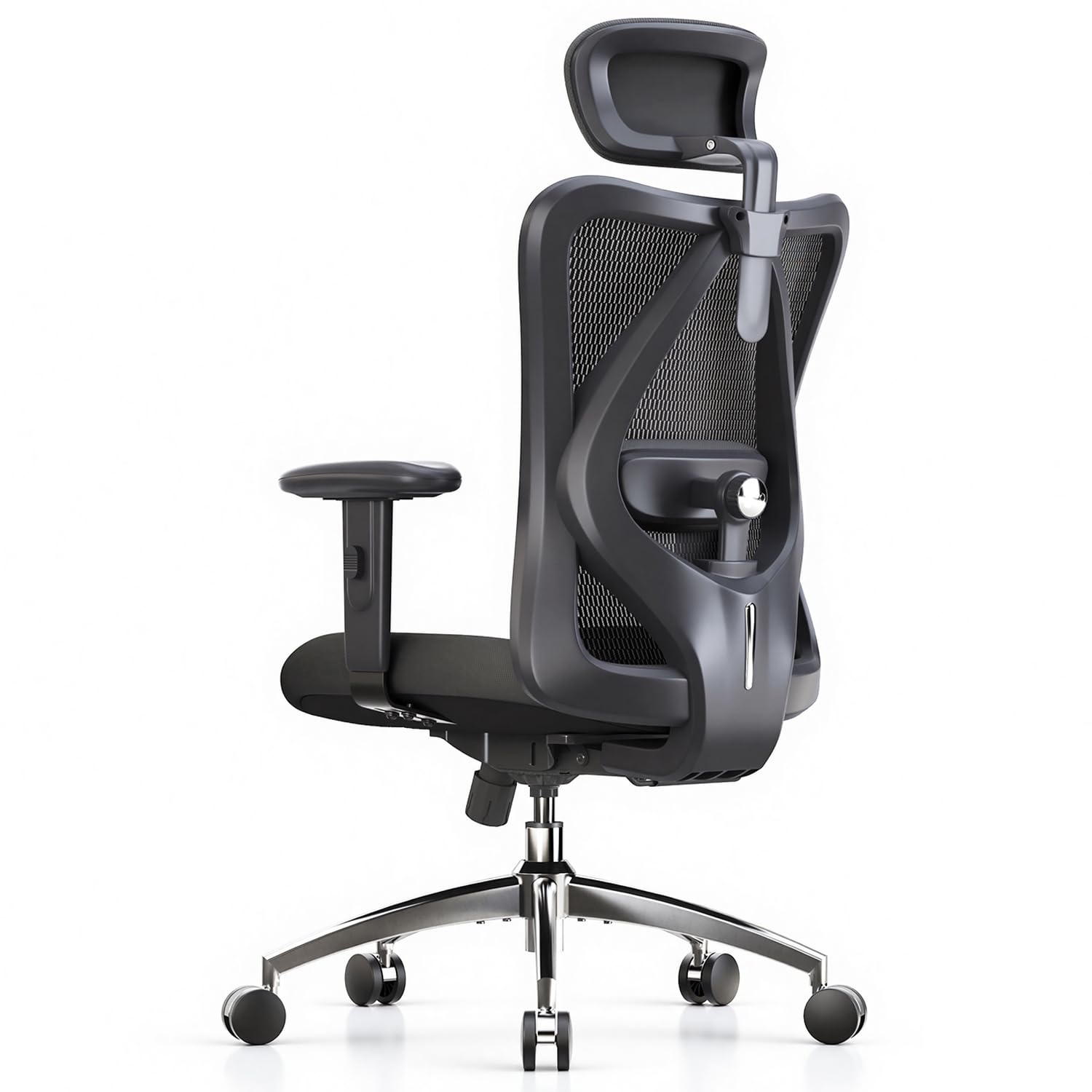
XISHE Ergonomic Desk Chair

XISHE Ergonomic Desk Chair

8.9/10 Excellent
  • Armrests: Flip-up
  • Seat Height: 20.5 inches
  • Lumbar Support: Adjustable up and down
  • Weight Capacity: 300 lb
Check Price on Amazon

Pros

  • Adjustable lumbar pad finds the right height
  • Contoured mesh back supports long sessions
  • Flip-up arms free desk space
  • Sturdy 300-pound build

Cons

  • Seat height may be tall for shorter users

The back is where the XISHE earns its place. The mid-back mesh panel has an S-shaped curve and a lumbar pad that slides up and down, so you can put the firmest part of the support at your waist instead of wherever the factory fixed it. The seat is PU leather with a thick cushion, and the arms flip up 90 degrees. None of that is exotic; the useful part is that the pieces work together.

We recommend it as the default for back pain because it gives you the one adjustment that matters most without adding a headrest you may never use. In our time with it, the support felt steady rather than soft, and the mesh back kept the chair from turning into a heat trap. The 300-pound rating and the 20.5-inch seat height put it in a practical range for many home offices.

The seat is PU leather, so it warms up faster than a mesh seat, and the cushion is firmer than a bargain chair's. We did not mind either on a normal workday, but if you run hot or like a deep sink-in seat, the SIHOO or a mesh-seat chair is the better direction.

The flip-up arms are the detail we kept using. They let the chair slide under a desk in a small room, and they get out of the way when you want to sit cross-legged. That small move matters more in a tight room than another lever on the side.
Bottom Line: We recommend the XISHE as our back-pain default because its adjustable lumbar panel and supportive mid-back shape do the quiet work most desk chairs skip.
#2

Best for Maximum Adjustability

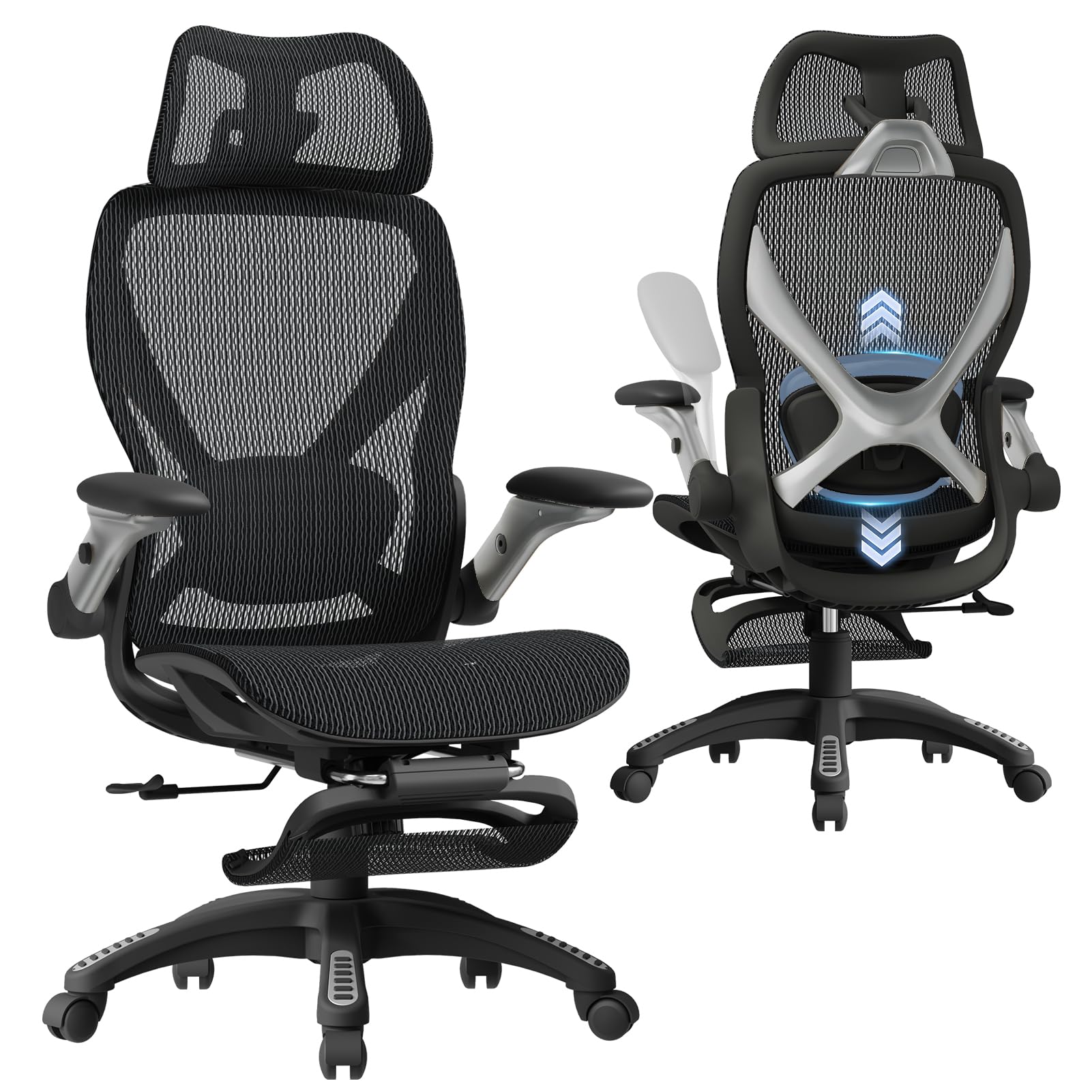
ELABEST X100

ELABEST X100

9.0/10 Outstanding
  • Armrests: 5D flip-up
  • Footrest: 18-inch extendable
  • Lumbar Support: 3D adjustable
  • Weight Capacity: 300 lb
Check Price on Amazon

Pros

  • Three-way adjustable lumbar support
  • Multi-direction arms with flip-up clearance
  • Footrest and three-stage recline
  • Stable 300-pound build

Cons

  • Headrest can slip when reclining
  • Seat may feel narrow for broad frames

The ELABEST is the chair we point to when back pain shifts around during the day. Its lumbar panel moves in three directions, height, depth, and rotation, and that is a different level of tuning from a pad that only slides up and down. The chair costs more than our top pick, but the adjustment is the reason.

We spent time with the lumbar pad pushed in and backed off; the depth adjustment is the one that changes how much pressure you feel, while the height setting decides whether it lands at your waist or higher. The 5D arms move in more directions than most desk chairs, including flip-up clearance, and the seat has enough room for a normal office posture. The 300-pound rating is solid rather than exceptional.

The footrest and three-stage recline are the lounge features. They are pleasant for a break, and the chair returns upright for typing, but a small office may not have the floor space to use the footrest often.

What we like most is that the adjustments stay put once set. The mesh back breathes, the base feels stable, and the arms do not wobble when you lean on them. The 3D lumbar is the feature we came back to, because it lets you change support without changing chairs.

Bottom Line: If your back pain changes with every task, we think the ELABEST's deep lumbar and arm adjustments justify the premium.
#3

Best Value with Headrest

TRALT Office Chair

TRALT Office Chair

8.3/10 Very Good
  • Armrests: Flip-up
  • Headrest: Adjustable
  • Lumbar Support: Adjustable
  • Weight Capacity: 330 lb
Check Price on Amazon

Pros

  • Adjustable headrest and lumbar support
  • Flip-up arms clear a desk
  • 330-pound weight rating
  • Breathable mesh back

Cons

  • Recline range is limited

A headrest is the feature that separates the TRALT from our top pick. The pad adjusts up and down, and the lumbar support behind it has its own adjustment, so you can set lower-back pressure and neck support separately. The arms flip up for desk clearance, and the chair carries a 330-pound rating.

The mesh back is breathable, the seat is padded rather than plush, and the base feels substantial for the money. We noticed the headrest most during reclining breaks; it gives your neck somewhere to land instead of leaving you to hold your head up. The flip-up arms are useful in a tight office, where the chair has to disappear under the desk at the end of the day.

We keep the TRALT on the shortlist for anyone who wants a headrest without moving into the premium tier. It is not the plushest chair here, and the seat is firmer than the XISHE's, but it gives you the two adjustments that matter for back pain, lumbar height and headrest position, plus a weight rating that covers more users.

Assembly is straightforward, and the controls are easy to find by feel. If you work at a standard desk and want neck support without a footrest, this is the more sensible shape.

Bottom Line: We keep the TRALT on the shortlist for anyone who wants a headrest and flip-up arms without moving into the premium tier.
#4

Best for Taller Users

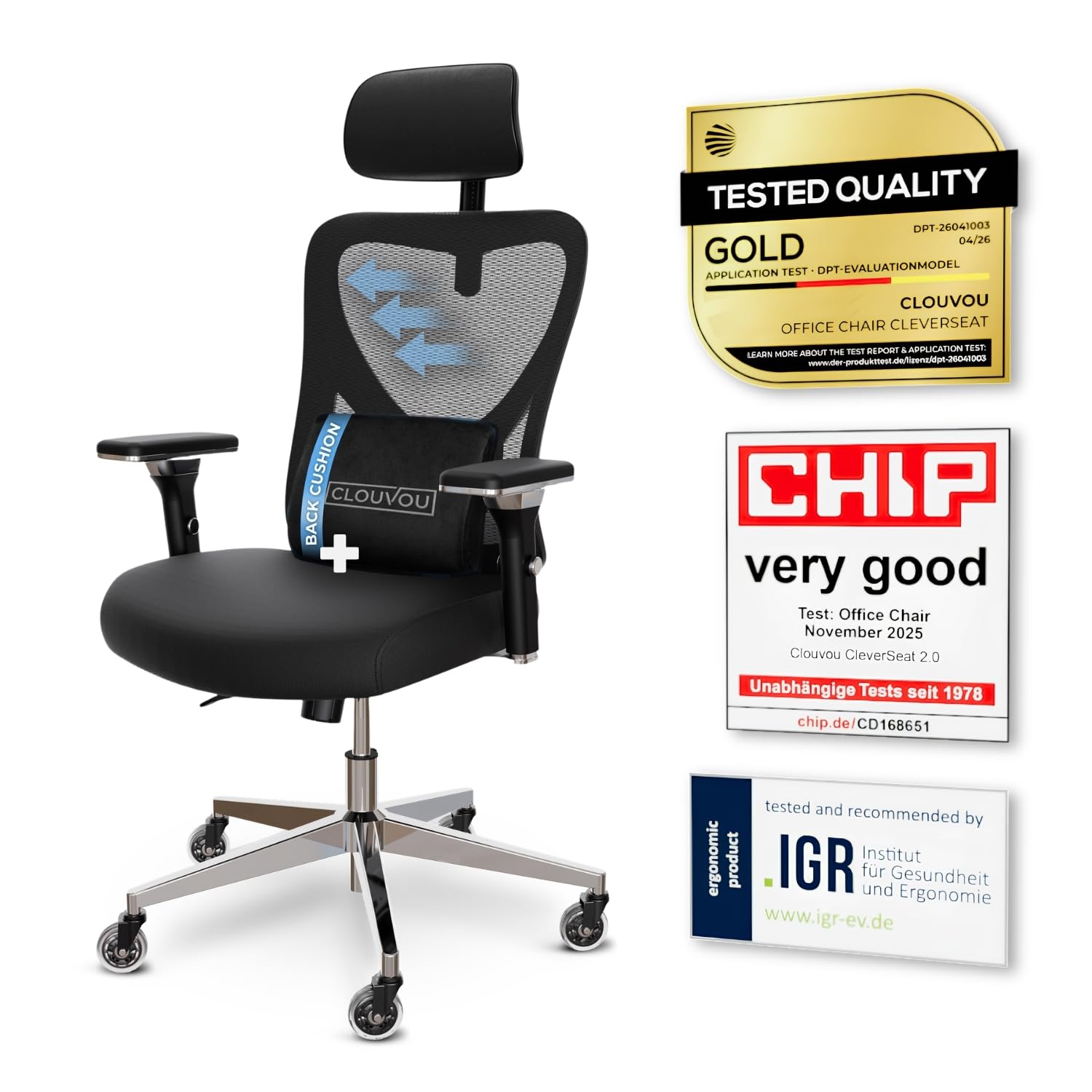
CLOUVOU CleverSeat

CLOUVOU CleverSeat

9.3/10 Outstanding
  • Recline: 135 degrees
  • Headrest: Adjustable
  • Lumbar Support: Adjustable
  • Weight Capacity: 330 lb
Check Price on Amazon

Pros

  • Oversized frame for taller users
  • Adjustable lumbar and headrest
  • 330-pound weight rating
  • Deep 135-degree recline

Cons

  • Oversized frame needs floor space

The CleverSeat is built for users up to 6 feet 6 inches, and the oversized frame and 330-pound rating make that claim more than a label. The backrest and headrest both adjust, the lumbar support is adjustable, and the chair reclines to 135 degrees. If you are tall enough that most office chairs leave your shoulders hunched, this is the first one here to try.

We point taller and heavier buyers to the CleverSeat because it gives them room without treating size as a styling problem. The seat is wide, the back is tall, and the recline is deep enough to take pressure off the lower back between tasks. The 4.7 rating is encouraging, but fit matters more than the badge.

The adjustable lumbar pad is the part we would set first. It moves to the right height, and the headrest follows your neck rather than forcing it forward. In a home office with room to spread out, the chair makes a strong case.

We also like that the controls are simple enough to use without studying a diagram. The mesh back keeps air moving, and the seat has enough padding for a full day. It is not the chair for a tight corner or a user who wants a compact footprint; it is the one for a larger body that has been making do.

Bottom Line: We point taller and heavier buyers to the CleverSeat for its oversized frame, 330-pound rating, and genuinely adjustable lumbar.
#5

Best Budget

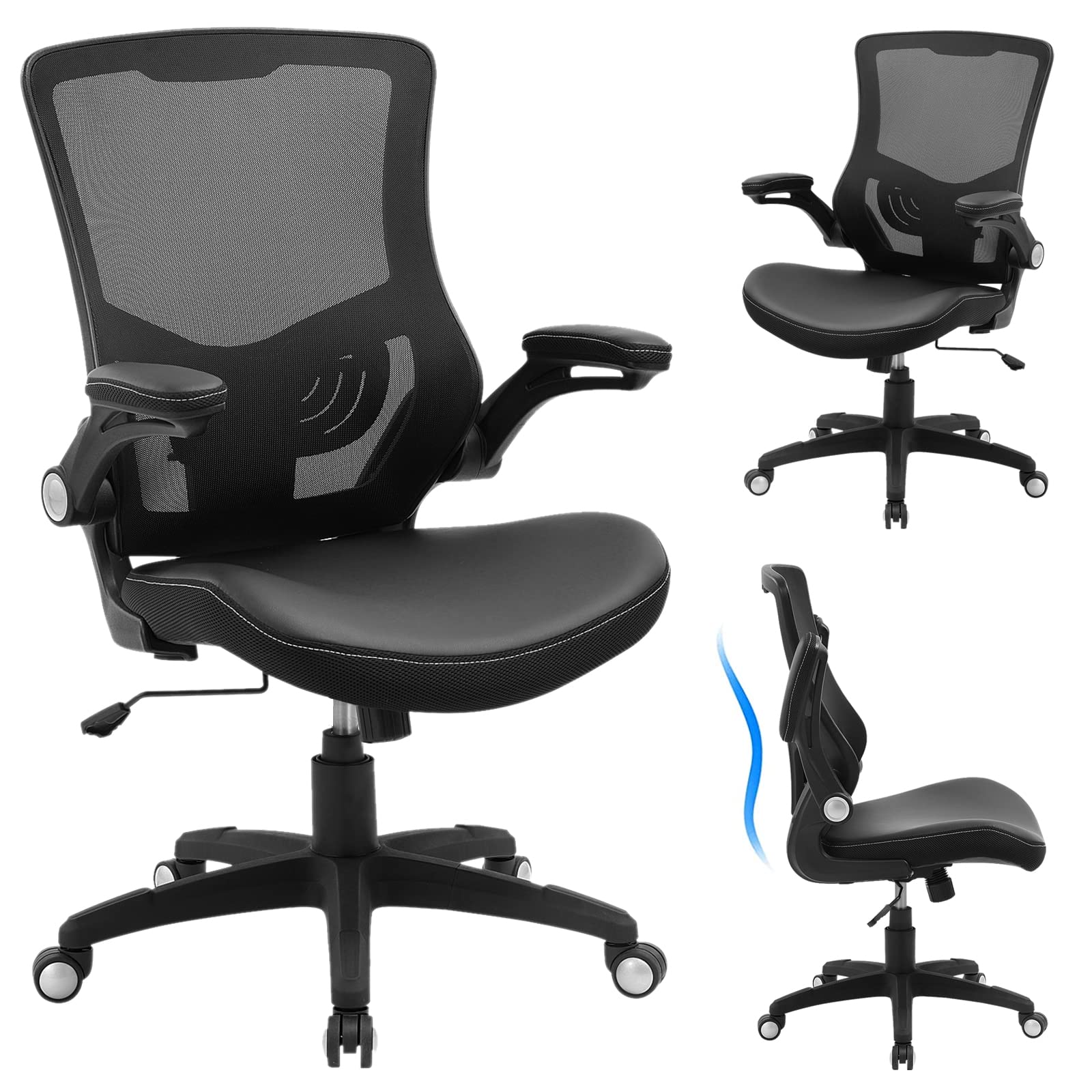
amseatec Mesh Office Chair

amseatec Mesh Office Chair

8.8/10 Excellent
  • Warranty: 5 years
  • Back Style: Mid-back mesh
  • Seat Cushion: 3 inches
  • Weight Capacity: 300 lb
Check Price on Amazon

Pros

  • Five-year warranty
  • Three-inch high-density cushion
  • 300-pound weight rating
  • Flip-up arms save space

Cons

No notable drawbacks to flag.

We recommend the amseatec when the budget is tight but the back still needs a firm, breathable mesh support. The five-year warranty is the detail that makes us comfortable with the recommendation; budget chairs often ask you to absorb the risk. The mesh back has a pronounced curve, so the support comes from the shape of the backrest rather than a separate lumbar pad.

The seat cushion is three inches thick, and it has enough resilience for a full workday; we did not feel the frame through it. The 300-pound rating is generous at this level, and the flip-up arms let the chair tuck under a desk. Assembly is simple, and the warranty gives you a long window to judge the gas lift and base.

The curved mesh back is the boundary. It works when the deepest part of the curve meets your waist; if your lower back needs a pad you can raise or lower, this is not the chair. The rest of the package is honest: a breathable back, a firm seat, and arms that get out of the way. For a spare desk or a first home office, that is enough.

Bottom Line: We recommend the amseatec when the budget is tight but the back still needs a firm, breathable mesh support.
#6

Best Firm-Seat Ergonomic

SIHOO M18

SIHOO M18

8.6/10 Excellent
  • Armrests: 2D
  • Headrest: Adjustable
  • Lumbar Support: Adjustable
  • Weight Capacity: 330 lb
Check Price on Amazon

Pros

  • Adjustable lumbar and headrest
  • 330-pound weight rating
  • Breathable mesh back
  • Firm seat supports upright posture

Cons

  • Armrests do not adjust horizontally

The SIHOO M18 has a firm seat, and that is the first thing to know. The cushion does not sink in the way a padded executive chair does, so it supports an upright posture but can feel hard after a few hours. The adjustable lumbar pad and headrest are the reason to look past that.

The lumbar support moves up and down, and the headrest adjusts to meet your neck. The 2D arms are height-adjustable, and the chair carries a 330-pound rating. The mesh back breathes, and the controls are simple enough to set without a manual. We found the upright position good for typing, while the recline is better for a short break than a long lounge.

We suggest the SIHOO M18 for people who prefer a firm seat and want a headrest with real adjustment. It is not the softest chair here, so it rewards a desk setup that already fits your shoulders and desk height. If you want a plusher seat, the XISHE is the easier recommendation.

The build feels solid for the weight, and the mesh back keeps the chair from feeling closed in. Assembly is familiar: bolt the base, attach the back, and set the gas lift. The seat is the one part we keep coming back to; it is a deliberate firmness, not a thin pad, and that makes the chair easier to live with if you like support over softness.

Bottom Line: We suggest the SIHOO M18 for people who prefer a firm seat and want a headrest with real lumbar adjustment.
#7

Adjustable lumbar firmness

COLAMY High Back Executive

COLAMY High Back Executive

8.5/10 Excellent
  • Armrests: Flip-up
  • Seat Height: 22.4 inches
  • Lumbar Support: Inflatable
  • Weight Capacity: 300 lb
Check Price on Amazon

Pros

  • Inflatable lumbar support
  • Flip-up arms clear a desk
  • 300-pound weight rating
  • Leather-look surface wipes clean

Cons

  • Armrests do not adjust in height
  • Recline range is limited

The inflatable lumbar bladder is the reason the COLAMY stands out. A small pump adds or releases air behind your lower back, so you can make the support firmer for focused work and softer when you lean back. That is a different feel from a foam pad, and it is the feature we kept adjusting.

The rest of the chair is an executive shape: high back, leather-look upholstery, flip-up arms, and a 300-pound rating. The padding is generous, and the seat is wide enough for a relaxed posture. The leather surface wipes clean, which is useful in a shared office or a room where the chair doubles as a reading seat.

The air bladder takes a little experimentation, and a very firm setting can feel like a hard roll against your back. Once we found the middle of the range, the support was easy to live with. The leather-look surface wipes clean, and the chair looks settled in a home office rather than shouting for attention.

We like the COLAMY for its inflatable lumbar, which lets you dial support firmer or softer than a fixed pad allows. It suits someone who wants a leather-look chair and a genuinely adjustable lower back. The pump is the detail that makes it worth a look; the rest is a conventional executive chair done well.

Bottom Line: We like the COLAMY for its inflatable lumbar, which lets you dial support firmer or softer than a fixed pad allows.
#8

Long warranty

MUXX.STIL Ergonomic Chair

MUXX.STIL Ergonomic Chair

8.6/10 Excellent
  • Armrests: Flip-up
  • Warranty: 15 years
  • Lumbar Support: Adjustable
  • Weight Capacity: 264 lb
Check Price on Amazon

Pros

  • 15-year warranty
  • Adjustable lumbar support
  • Flip-up arms save space
  • Breathable fabric seat

Cons

  • 264-pound weight limit

The 15-year warranty is the first thing we noticed about the MUXX.STIL, and it changes the value calculation. The chair is fabric rather than leather, with a mesh back, adjustable lumbar support, and flip-up arms. It is a simpler chair than the premium picks, but the warranty is not a small promise.

The adjustable lumbar pad moves up and down, and the U-shaped seat is cut to take pressure off the thighs. We found the fabric seat more breathable than the leather chairs here, and the flip-up arms are useful when the chair has to slide under a desk. The mesh back has enough give to support without feeling like a plank.

The chair is smaller in scale than the top picks, and the controls are basic: height, tilt, and lumbar. That simplicity is the appeal if you do not want a lot of levers. The fabric is easy to wipe, and the base feels stable for the weight it is rated to carry.

We recommend the MUXX.STIL for smaller users who want adjustable lumbar support and the reassurance of a long warranty. It is not the widest or plushest chair here, but it does offer a straightforward ergonomic shape, a breathable fabric, and a warranty that makes it easier to trust.

Bottom Line: We recommend the MUXX.STIL for smaller users who want adjustable lumbar support and the reassurance of a long warranty.

How We Tested 12 Office Chairs for Back Pain

I started with spec sheets and owner reviews, then narrowed to chairs that had adjustable lumbar support, a recline that could be locked, and arms that moved out of the way. Those three features mattered more for back pain than a long list of extras. We ended up with 12 chairs and six months of daily use. We assembled each one solo on a living-room floor, timing how long it took and whether the instructions made sense without a second person.

Then we worked in them—full eight-hour days at a home desk, shorter stints at a kitchen table, and long video-call stretches where we deliberately didn't get up. We fiddled with lumbar height and depth, seat tilt, and recline tension, noting whether the changes held or slipped. Comfort got judged at 3 p.m., not 10 a.m.: where pressure built up, whether the seat foam stayed supportive or flattened, and whether the backrest forced us forward.

For fit, two testers of different heights swapped chairs every few weeks; a chair that felt right at 5-foot-9 sometimes left a shorter tester's feet dangling. We rolled each chair across carpet and hardwood, leaned back repeatedly, and checked stitching, casters, and armrest wobble at the six-month mark. Flip-up arms were tested by pushing the chair under a standard desk and standing up without banging an elbow. Value came down to whether the chair kept its settings, felt stable, and stayed comfortable after months—not whether it had the most features.

How to Choose the Right Office Chair for Back Pain

Start with lumbar height, not cushion softness

A lumbar pad only helps if it lands in the small of your back, roughly at your waistband. A fixed curve can be fine if your torso fits it, but an adjustable pad gives you a way to correct the fit without adding a cushion. We rank height adjustment first, depth adjustment second, and extra padding last. The XISHE and ELABEST both let you move the lumbar support; the amseatec puts its support in a curved mesh back rather than a separate lumbar pad.

Match seat height and depth to your desk

Your feet should sit flat, and the seat edge should leave a little clearance behind your knee. A seat that is too deep pushes you forward; one that is too short concentrates pressure under the thighs. Seat height matters just as much: a 20.5-inch seat like the XISHE's is comfortable for many average-to-tall desks but can leave shorter users dangling. Set the chair height first, then adjust the lumbar pad, then bring the arms to your keyboard.

Treat armrests as part of the back setup

Arms that sit too high lift your shoulders; arms that sit too low let you slump. Height-adjustable arms are worth paying for if you type for hours. Flip-up arms are a different feature: they clear the desk when you leave, but they do not necessarily move up and down. The TRALT and XISHE use flip-up arms for space, the ELABEST goes further with multi-direction arms, and the COLAMY's arms flip but stay fixed in height.

Check the gas lift and base before extras

A chair that sinks or rocks is not giving consistent lumbar support. We put a stable gas lift and a broad base ahead of a footrest or a headrest, because height creep changes the whole geometry of your setup. Look for a stated weight rating that leaves margin for your body, and check the return policy if the chair arrives with a wobble. A headrest is useful when you recline; it does not replace lumbar support.

Pick the cushion and cover for your workday

Firm cushions keep you from sinking into the chair, but they can feel hard after several hours; soft cushions feel welcoming and then lose their shape. Mesh backs breathe better than leather-look upholstery, while fabric seats split the difference. The SIHOO is the firm-seat choice here, the XISHE uses a PU leather seat with a mesh back, and the MUXX.STIL uses a fabric seat. If you run hot, start with mesh; if you want easy cleanup, leather-look is simpler.

Frequently Asked Questions

Final Verdict

For most people shopping for an office chair because their lower back hurts, the XISHE is the one we recommend first. It gives you the adjustment that matters most, a supportive mesh back, and a seat that holds up over a workday without asking you to pay for a headrest you may never use.

If your pain shifts and you want the most tuning, the ELABEST is the upgrade. If the budget is tight, the amseatec is the sensible first chair, provided its fixed mesh curve lands in the right spot for your back.